-
CollectingTrek at two years old: the posts readers read the most
I launched this site in the early days of 2019 to share my love of Star Trek collectibles, give some background on the items themselves, and tell stories of how I acquired them. I am pleased with the outcome thus far; a lot of people visit this site, a good number follow me on Facebook and Twitter, and I have engaged in lively — and sometimes contentious — discussions with other fans. I am disappointed that the site contains only 49 posts, but work and life keep interfering in my collection obsession and I don’t see that changing in the near future.
Presented herein is a countdown of the five posts that generated the most reads, comments and, in one case, outrage.
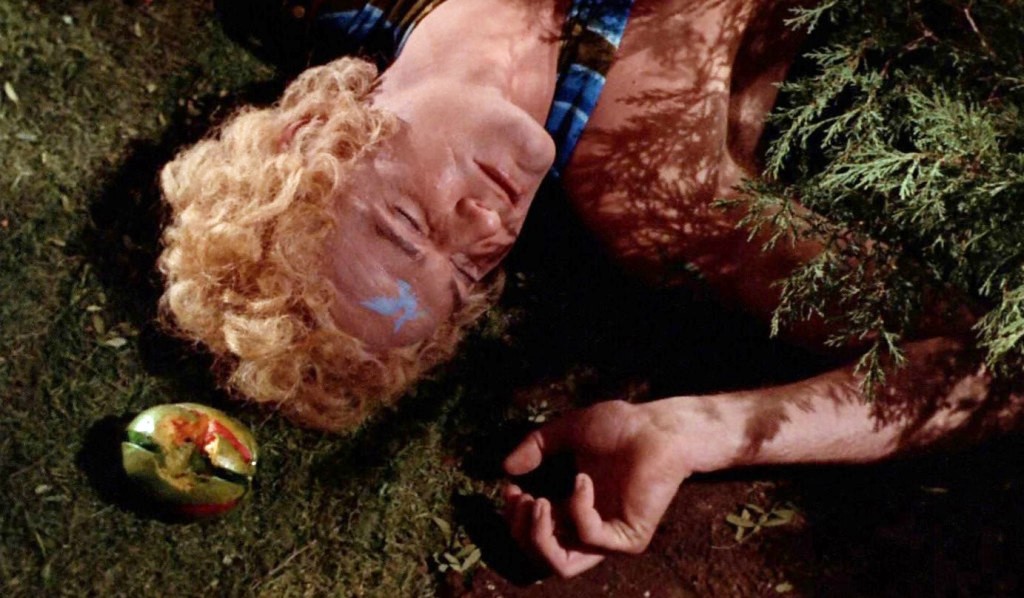
Number five: A defence of The Way to Eden
This is probably my best piece. The episode is dismissed, as I wrote, by “Viewers dazzled by the way-out costumes, the ‘we reach’ lingo and the quasi flower-power mysticism” but it is actually a warning about messianic figures and the cults they create. Far from being about hippies, “The Way to Eden is closer to Charles Manson than to the summer of love.”

Number four: Leonard Nimoy sued Paramount, and won
I did not know if Nimoy would sign my Heineken poster. The sexual innuendo offended him and it kicked off a long legal battle with Paramount that ended only because he refused to consider appearing in The Motion Picture until the matter was settled. This post has proven to have the most “legs” of any of my content; searches for this topic regularly send people to my site.
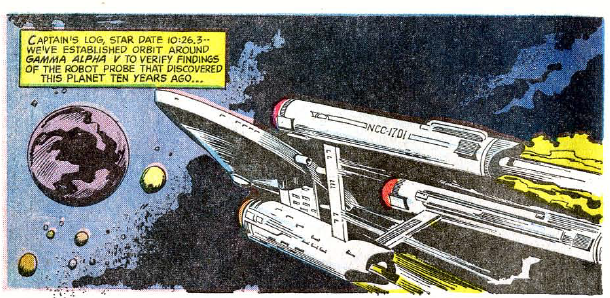
Number three: Thank you, Doug Drexler, for trying to save the Gold Key comics
Drexler is Star Trek production royalty and his connection to the show stretches back to its premiere and to the Federation Trading Post in 1970s New York City. He consulted on — and greatly improved — a few issues of Gold Key’s fantastically inaccurate comics. This post kicked off a lengthy correspondence with Doug, who is a great guy and absolutely fascinating.

Number two: Harlan Ellison put a drug dealer on the Enterprise
Ellison stands in the pantheon of science-fiction writers, but he was and is almost as well known for his outsized personality. He was never reluctant to rain scorn on the televised version of The City on the Edge of Forever, and the gorgeous graphic novel from IDW that exactly follows his script allows you to judge the merits of his vision. I found his take on Star Trek wanting, and readers were happy to agree and disagree with me.

Number one: The Enterprise is not a Constitution-class ship
Want to really annoy a bunch of TOS fans? Write that headline. This piece and its follow-on (Starship class, part two: Gene Roddenberry and Matt Jefferies) pissed off a lot of people because, well, everyone knows the Enterprise is a Constitution-class ship. It is said on screen and all those books and blueprints say it is. Yes, except it is never actually stated on screen and those reference works produced in the ’70s (like the Star Fleet Technical Manual pictured here) were just made up. That first article took the traffic top spot days after its appearance and it is still at number one. As I said repeatedly to irate TOS fans on Twitter and Facebook, if you believe Kirk’s Enterprise is a Constitution-class ship, that’s great. Be happy. But you’re incorrect.

Bonus shout-out: Bobby Clark signed a Gorn mask
This was my first post. The Gorn mask is still among my favourite collectibles.
Thanks for reading. I am always open to feedback. -
How a high-school story and a DC Fontana letter launched Howard Weinstein’s writing career
A personal note: Howard Weinstein is a really nice guy. He spent a lot of time corresponding with me and even pulled together detailed notes, shared personal anecdotes, dug through his files, and sent me scans of documents. From one Star Trek fan to another, thank you, Howard.
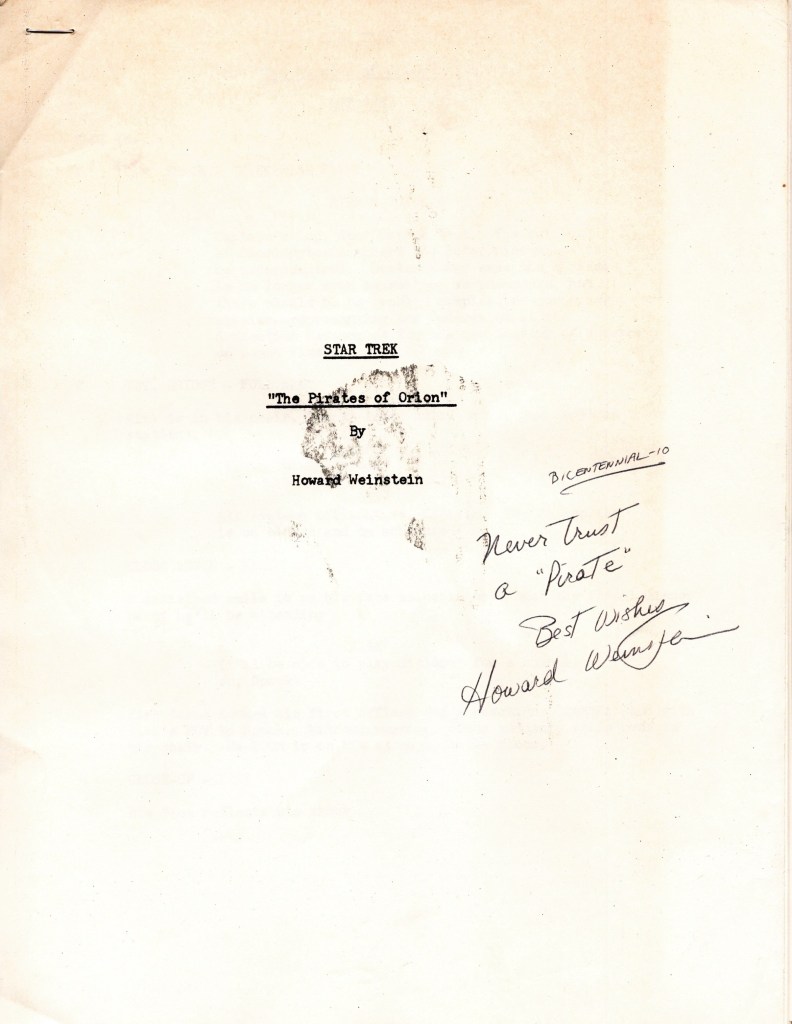
Sometimes you get really lucky on eBay. A seller in Alberta recently put a big lot of Star Trek paper up for auction, mostly old fanzines, but the description was vague and it drew no interest. But I spotted one critical photo in the auction’s jumble: the cover page of a script with Howard Weinstein’s autograph.

I knew of his work, of course. Weinstein sold The Pirates of Orion to Filmation at the age of 19, and it became the first episode of season two of The Animated Series. Weinstein then built an impressive career: he is a New York Times bestselling author and has produced 17 books, including novels (seven of them Star Trek tales), non-fiction, and graphic novels, plus 65 Star Trek comics.
This is the story of how Weinstein became a very young professional writer, of the kindness of DC Fontana, and of what Filmation co-founder Lou Scheimer taught him about writing for animation.
First, the eBay script
I have been collecting for a long time, and I have shelves, walls, and boxes full of Star Trek memorabilia. Recently, my focus has narrowed to the 15 years that stretch from the making of The Cage to the premiere of The Motion Picture.
The eBay auction promised: “Star Trek Memorabilia, 76/77 Year Books, Issues Of News Letters All In Pictures! Condition is Very Good.” The seller did not mention the Pirates script, and I won the lot for the ridiculous price of $0.99. Some of the other stuff is good but the gem is clearly the signed script.
My goal with Collecting Trek is to tell the stories behind my collectibles, so I launched into research mode. The wonderful Fanlore site informed me that “The Bi-Centenntial-10 Star Trek convention was held at the Statler Hilton on September 3-6, 1976. Approximately 5,000 fans attended.” The also wonderful Trekker Scrapbook offered up program scans that confirmed Weinstein was indeed at the convention, participating in a series of “Animation techniques” panels.

My next stop was a StarTrek.com interview with Weinstein and then on to the contact page of his web site. I sent him a brief email:
I recently acquired a script for your The Pirates of Orion episode. It is on old paper, stapled in the corner, and typed on both sides. The cover has been signed by you: Bicentennial-10. Never trust a “Pirate.” Best Wishes, Howard Weinstein.
That would be the 1976 convention in New York. I have a Star Trek collectibles site and I am working on an article on the script, and I am writing to ask if you can tell me anything about it. Were these copies that you sold at conventions? Please let me know, if you can.
Weinstein replied promptly. And thus began a lengthy correspondence.
Not a real script
I own a few outlines and scripts that came from the actual typewriters of the authors (including Ted Sturgeon’s Amok Time outline) but this is clearly not that. Although it is on old paper, it is not the original that Weinstein typed out in his college dorm room. Nor is it an actual Filmation script. For one thing, it has text on both sides of the paper; real scripts are printed on one side only. Weinstein told me:
I remember those Pirates script copies being sold, but I wasn’t the one selling them. One of the dealers got hold of a script and then photocopied and sold them for a while. I have a vague recollection that the dealer asked me to sign a bunch of them, which I did.
Which means that Weinstein agreed to sign pirated copies of his own work. As I said, he’s a nice guy.

Episode specifics
Weinstein then answered a bunch of my queries about the episode itself.
Extrapolated stardate. The Pirates of Orion is essentially a sequel to Journey to Babel. In Pirates, Spock is struck down by the illness choriocytosis, which is deadly to Vulcans. Kirk arranges to rendezvous with the freighter SS Huron to receive a shipment of the antidote but it is hijacked by pirates from the planet Orion and Kirk has to outwit the other captain to retrieve the medication.
As Weinstein said to me: “Pirates was definitely inspired by Journey — what other mischief might the Orions be up to?” He continued:
My main inspiration was the Kirk/Spock/McCoy friendship; by putting Spock in lethal jeopardy via the rare disease I cooked up (choriocytosis), I got to explore Kirk and McCoy’s shared determination to save their friend. I’m happy to say I still think it’s a pretty decent little story.
Indeed, and Weinstein drew a clear connection to Journey to Babel by having Kirk reference the episode, saying at one point: “Orion’s neutrality has been in dispute ever since the affair regarding the Coridan planets and the Babel Conference of stardate 3850.3.”
3850.3. Including that number jumped out at me, because it is not really required. So I checked. In Babel, Kirk states three stardates: 3842.3, 3842.4 and 3843.4, and the reference to 3850.3 was too close to be a coincidence. I asked Weinstein “Did you actually use the Journey to Babel dates as a starting point?” and the answer is impressive for those days before the Internet, DVDs and Netflix.
I had Kirk refer to the actual Babel conference, not the Enterprise voyage that delivered the ambassadors to the conference. So I guesstimated a stardate for the conference itself.
The SS Huron. The script has the USS Potemkin (a nice callback to The Ultimate Computer) handing the medication off to the SS Huron — not the USS Huron. I asked: Was not going with “USS” intentional, as it was a freighter instead of a starship? And indeed it was: “I’m guessing my thinking was that the Huron would’ve been a merchant ship, not a Starfleet ship.”
Filmation, however, depicted the ship on screen as the USS Huron, even though Kirk states “SS” in dialogue, but the studio did add one nice detail: its serial number is NCC-F1913, with the F indicating freighter.

The pirates of OR-ee-on. I knew this must be a perennial question but I could not ignore the odd way every character says the word “Orion.” I asked: “Orion is pronounced on screen as “OR-ee-on” and by multiple actors recording in different locations, which means someone decided on that pronunciation. Do you have any insight into why that pronunciation was used?
Yes, I got asked about that a LOT in the old days. Here’s what some of the actors told me: For the first few episodes of TAS, they got together at Filmation and recorded the dialog like a radio play. After a while, that became harder to arrange, so Filmation would send the actors their scripts and they’d tape their own lines at home, or wherever they happened to be. In order to make sure the cast all pronounced certain words the same way, they were given a phonetic guide to certain words, like planet and alien names. For some reason lost in the mists of time, someone at Filmation decided the well-known word Orion would not be pronounced the way the rest of the universe says it — Or-EYE-an — but would be spoken as OR-ee-on. And nobody ever caught or corrected that before the scripts were sent to the cast.
It’s impossible to watch the episode without the pronunciation really standing out, but this was also the show that had pink tribbles and purple uniforms on the Klingons.


More Tribbles, More Troubles (TrekCore) The story of the sale
“As a 19-year-old rookie writer, it was all pretty exciting,” Weinstein says of selling the script to Filmation. Here is that story.
The Pirates of Orion was originally a short story I’d written at age 16, for East Meadow, NY, high school’s annual one-shot science/sci-fi magazine in 1971, when I was co-editor with my friend Mark Greenstein.
I also did something I’d often do later when I wrote 65 Star Trek comic books for DC, Marvel, Malibu, and WildStorm – I dug up a tidbit from past Star Trek continuity and explored it in more depth. In the case of Pirates, it was the Orions. Other than Vina in her guise as a green Orion slave girl in The Cage and The Menagerie, what little we knew about them came from off-screen participation of Orion pirates in the excellent episode Journey to Babel (by D.C. Fontana).
After watching the first few animated episodes in the fall of 1973 (my junior year at the University of Connecticut), I was very eager to try submitting a script (as yet unwritten). So, in October ’73, I wrote a letter to Dorothy Fontana, known to Star Trek fans as D.C. Fontana, writer of some of the best TOS scripts. She was listed as script consultant on the animated series, so I asked about the proper time and procedure for sending in a script for season 2.
The fact that Dorothy replied within two weeks shows her kindness, courtesy and professionalism. Her letter told me several important facts: 1) they only accepted scripts through agents; 2) they’d bought none of their first 16 stories from outside writers; 3) they’d only be buying 6-8 additional scripts for season 2; 4) they expected word from NBC about renewal in early 1974; and 5) Dorothy herself wouldn’t be working on the show after season 1.
Dorothy’s letter made it clear that my quest to sell a script to the animated series had a very small window of opportunity, and the odds were very much against me. Thank goodness 19-year-olds are boldly clueless enough to think the rules don’t apply to them, and that merit and gumption count. We’re really idiots at that age, but idiocy can have its virtues in certain limited circumstances – such as believing I could do the near-impossible.
Luckily, Weinstein had an agent. His father’s childhood friend Bill Cooper was a Writers Guild of America agent and took Weinstein on as a favour to an old chum.
Here is Fontana’s letter. It chronicles her decision to distance herself from Star Trek, a separation that would last for many years, and it is a piece of history that I greatly covet.

Weinstein had purchased an I, Mudd script from Lincoln Enterprises to learn how to write for TV, and typed out Pirates over the Christmas holiday break.
Following the info in Dorothy’s letter to me, Cooper sent my script to Filmation in January ’74 – but addressed to “D.C. Fontana” – who by then had left the show. Filmation then forwarded the envelope (unopened) to Dorothy, who mailed it back to Cooper (still unopened, and unread).
So the script traveled coast to coast and back again – without anybody reading it. Talk about frustrating!
And here is the considerate letter Fontana sent when she returned the script.

Weinstein resubmitted the script to Filmation co-founder Norm Prescott once the renewal for season two was announced. He was in the shower at his dorm when his mother called with good news.
So I wrap myself in a towel and pad drippingly back to our room, pick up the phone, and my mother yells: “You sold your script!!” Filmation co-honcho Lou Scheimer had called my agent, my agent (not having my college phone number) called my parents, told my mother the news, and she called me.
A telegram and a cheque followed.

The network had ordered six episodes for season two of the series, and Filmation had only five months to get them ready. The studio didn’t ask for many changes to the Pirates script but one was important:
The main thing Lou Scheimer wanted me to do was get them off the ship.
Digging through my files, I see I wrote three alternate endings within a couple of weeks. As in the high school short story, the first draft script had the climactic confrontation between Captain Kirk and the Orion pirate captain taking place mostly on the Enterprise bridge and viewscreen. I’d initially been influenced by the live-action show, where getting them off the ship was expensive – requiring new sets or location shooting. Lou taught me a valuable lesson I had to relearn 20 years later when I wrote Star Trek comics: when anything a writer can imagine can simply be drawn by artists, you’re freed from live-action budget restraints. A planet surface, alien city, or interior of an exotic alien ship costs the same as drawing the bridge of the Enterprise.
Lou challenged me to be more visually creative, so I wrote a couple of new endings with Kirk and the Orion captain (voiced by Jimmy Doohan) duking it out on the colorful surface of an asteroid. We settled on the climax that was most streamlined and least talky.
Here is the original ship-bound ending, before the rewrite.


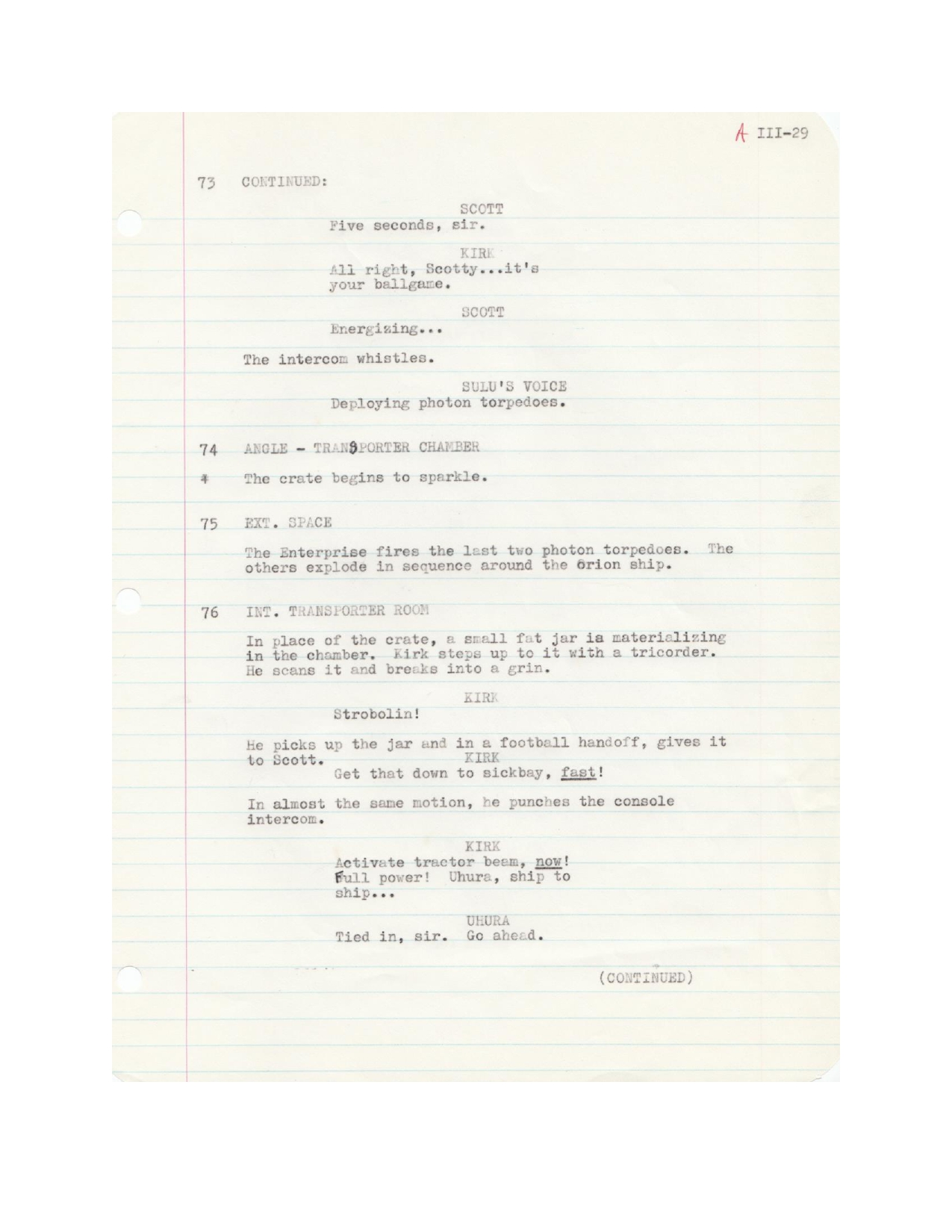

That original version then closes with the same last few seconds that we saw on screen.


The watch party
The story of that sale ends in a university dorm room, with a group of friends and a second date with a cute young woman.
I didn’t know until mid-August that Pirates would be the first show of the new season, airing September 7, 1974. That would be at the end of my first week back at school – and a week before my 20th birthday. I immediately passed the news along to as many friends as I could, and when I got back to UConn I told college buddies and invited them over to my dorm room to watch on my little 11-inch black and white TV. Somehow, we crammed 30 kids and one dog into the room – sort of a Star Trek mini-con.
A couple of friends had brought along a bottle of sparkling wine and plastic champagne glasses, so when the show started and my name appeared, everyone raised plastic glasses in a toast.
I’d also met a cute freshman that first week at the local pizza joint, and when we went out on our first date the Friday night before Pirates would be on, I shyly asked if she’d like to come over the next morning to watch my TV episode. Although she wasn’t a big Star Trek fan, and didn’t know anybody else, she did join the party. We’re still friends all these years later, and she still remembers.
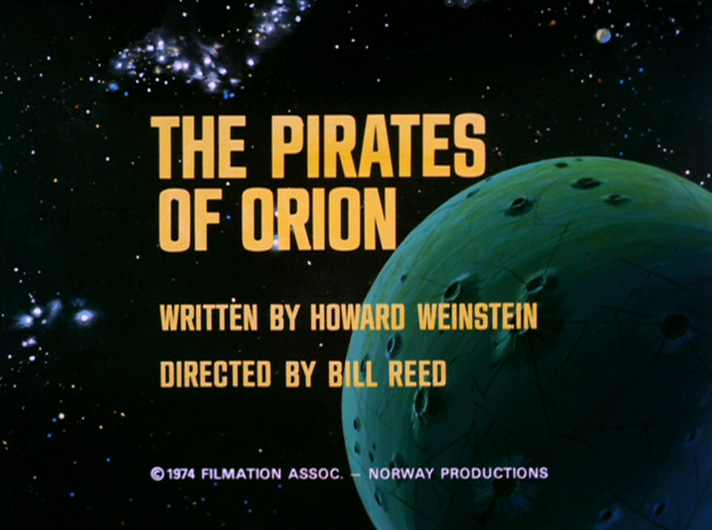
Selling that episode launched Weinstein on a lifelong career as a writer, culminating in a long string of professional sales and more than one appearance on the New York Times bestseller list. (See his web site for details.) It also helped him sell his first Star Trek novel — The Covenant of the Crown — and prompted Leonard Nimoy to consult with him on the development of Star Trek IV. But that is a story for another blog post.
To this day, he is proud that he impressed Star Trek’s creator.
While I didn’t have any interactions with Gene Roddenberry, Lou told me that Gene had read and liked the script, and said it was one of the better first-draft Star Trek scripts he’d seen. Naturally, that praise made me feel pretty good.
Thank you again, Howard, for your time and generosity.


 Amok Time, DC, DC Fontana, Fanlore, Filmation, Gene Roddenberry, Howard Weinstein, Huron, I Mudd, James Doohan, Journey to Babel, Leonard Nimoy, Lou Scheimer, Malibu, Marvel, More Tribbles More Troubles, Orion, Potemkin, Script, Star Trek, Ted Sturgeon, The Cage, The Menagerie, The Pirates of Orion, The Ultimate Computer, Trekker Scrapbook, WildStorm
 -
Inside Star Trek 10: Visiting the sound stages, meeting the music editor
Inside Star Trek was a semi-official newsletter, published under the guidance of Gene Roddenberry. This connection gave the writers access to the actors, production crew and sets.
I own the complete run:
- Issues 1 to 12: Inside Star Trek, edited by Ruth Berman
- Issues 13 to 24: renamed Star Trektennial News, edited by Susan Sackett
- Issues 25 to 31: again called Inside Star Trek, edited by Virginia Yable
Here are highlights from issue 10, published in the spring of 1969.
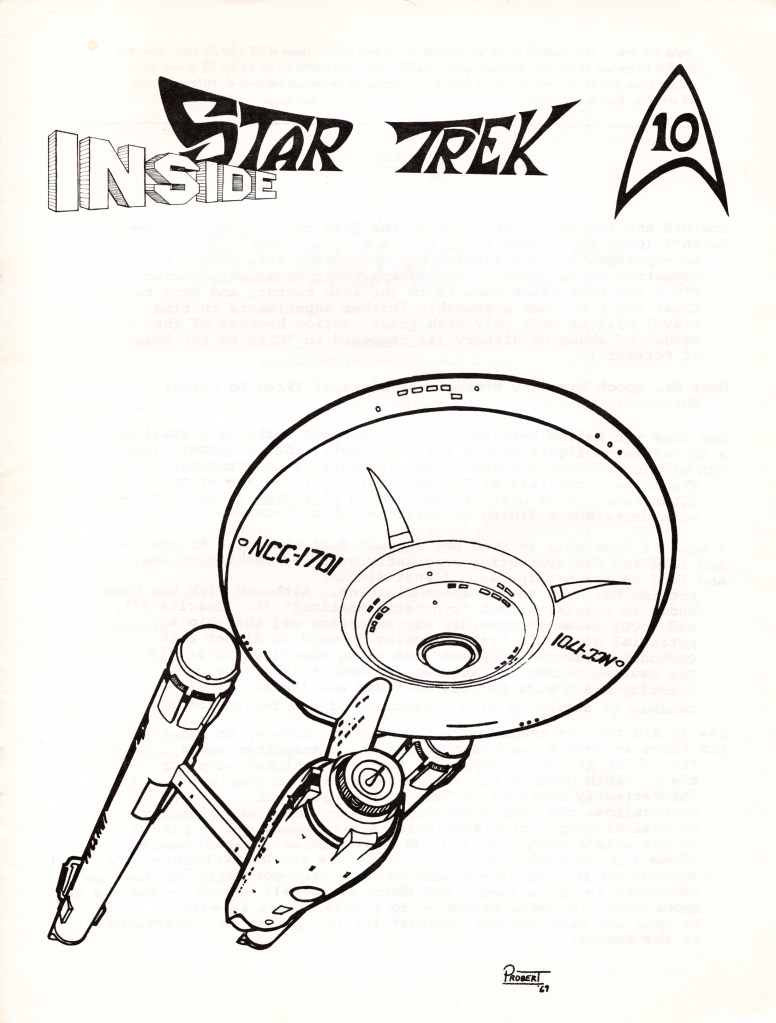
I hate to say it, but issue 10 is a letdown. It offers only two articles: a one-pager penned by the series’ music editor and a partial reprint from the fanzine ST-Philes. It’s possible that little work went into the issue because the writing was already on the bulkhead about the series’ cancellation; that certainly feels true when reading this issue.
The newsletter opens well with a pithy response from editor Ruth Berman to a fan question: “Does Mr. Spock have any brothers or sisters?” Berman’s response: “No.”
Take that, Sybok!
Season 3’s unknown music editor
Page 3 is an article written by music editor Richard Lapham — and I was intrigued. I had never heard of Lapham, and it turns out that is hardly surprising. He has no entry on StarTrek.com or Memory Alpha, is not mentioned in The Fifty-Year Mission (Edward Gross and Mark A. Altman), and the only reference to him in These are the Voyages, Season Three (Marc Cushman) is a quote taken from this newsletter.
However, he had a busy career. In addition to being the music editor for all of TOS season 3, he filled the same role on 24 episodes of The Brady Bunch, 53 episodes of The Odd Couple, 83 episodes of Knight Rider, and he was the uncredited supervising music editor on the cinema classic Airplane!
So, this looks exciting. A production person who is largely unknown today, writing about the original series. Sadly, Lapham really has nothing to say, although his piece does start off with promise:
As Music Editor on such an intellectually appealing and entertaining show as Star Trek, I was granted the opportunity to help add a stimulating and creative sensitivity to the mood already established by Gene Roddenberry and his staff.
Okay, again, I am intrigued. How do you do that?
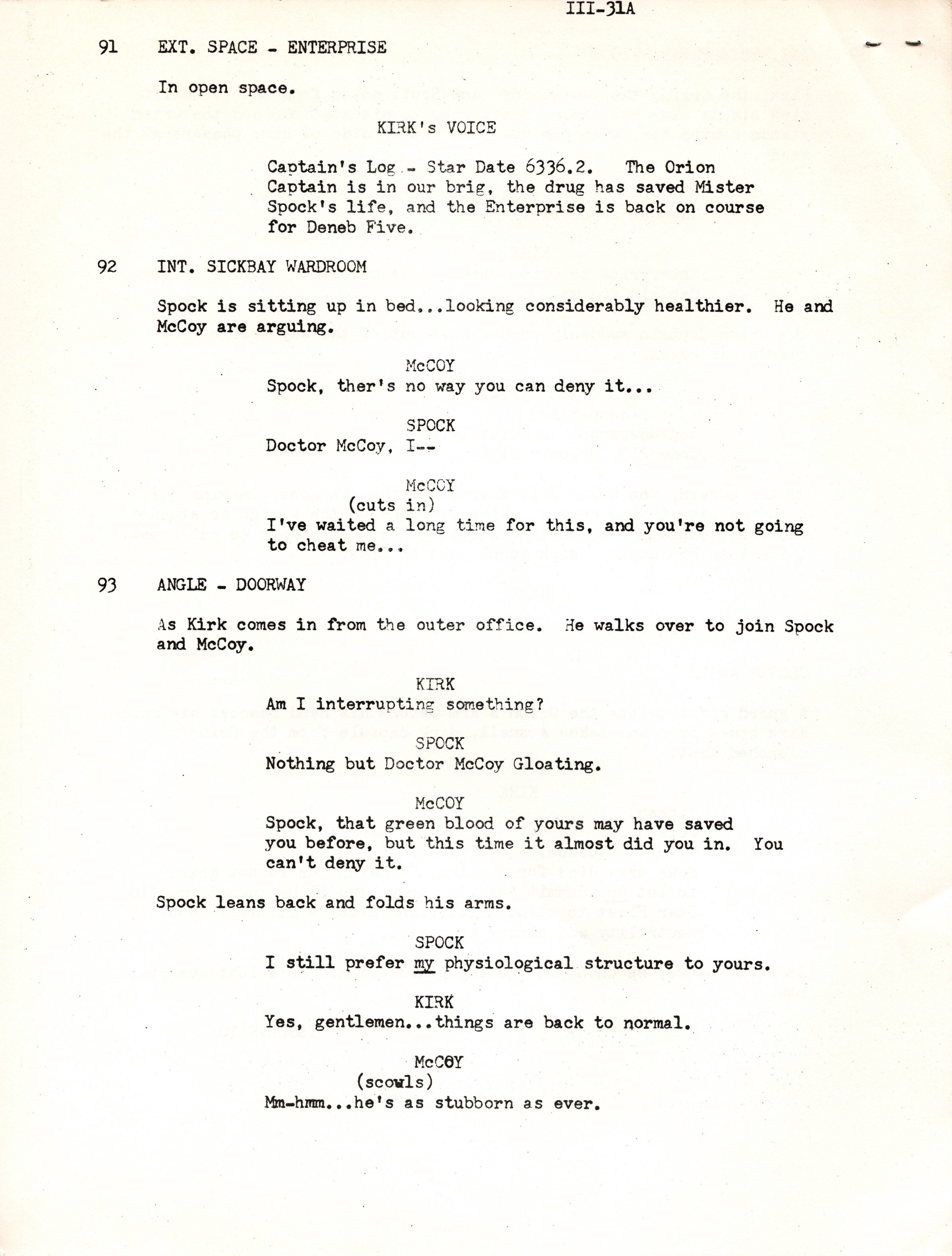
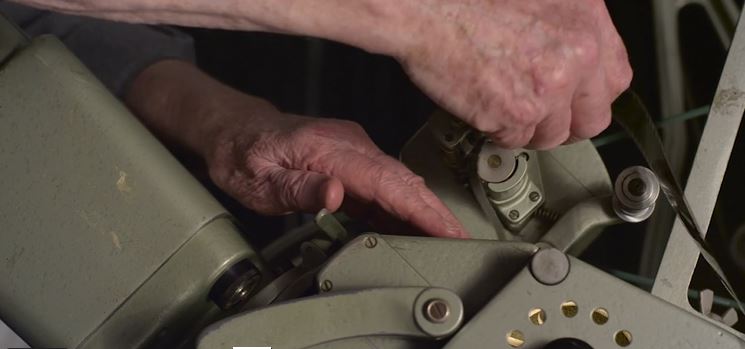
I run the picture with the producer, after it is edited to the satisfaction of Gene Roddenberry, and get an overall feel of the picture and its mood. The next step for me is to run this picture again, analytically, in a moviola (a machine that contains a small picture screen and a sound head) and decide which scenes should have music and the mood of the music to be played for the particular scene… The first six or seven episodes are composed by specially hired composers, and it is from this music that I choose the musical moods for the subsequent episodes. Once the mood is chosen, I must edit, in detail, this music with other musical pieces to create a new and original score to match the atmosphere and action of each individual story.
And that’s all Lapham shares with us. Music is critical to the drama, emotion or comedy of countless scenes, so this leaves many great questions unanswered. How challenging is it to make scenes feel fresh when working with recycled music? What was the toughest scene for you? Which piece of music is the most versatile? Are there any scores that are so specific to a moment that you really can’t use them again? Did you have any influence on the commissioned music? What music did you bring in that had not been written for Star Trek?
Editor Ruth Berman didn’t get Lapham to answer any of those questions. He remains entirely unknown to fandom, so it is unfortunate she did not do more to highlight Lapham’s work.
This great little film shows the workings of a Moviola editing machine.
Touring the TOS stages
The last entry is a rambling article detailing a set tour. The article has no headline or byline, and reading the issue you first wonder why the sound editor is suddenly wandering the studio. At the end of the piece, a small notice informs the reader “This article reprinted from ST-Phils by permission of the author.” (Yes, “ST-Phils.” Again, this issue feels like it was thrown together with little effort.)
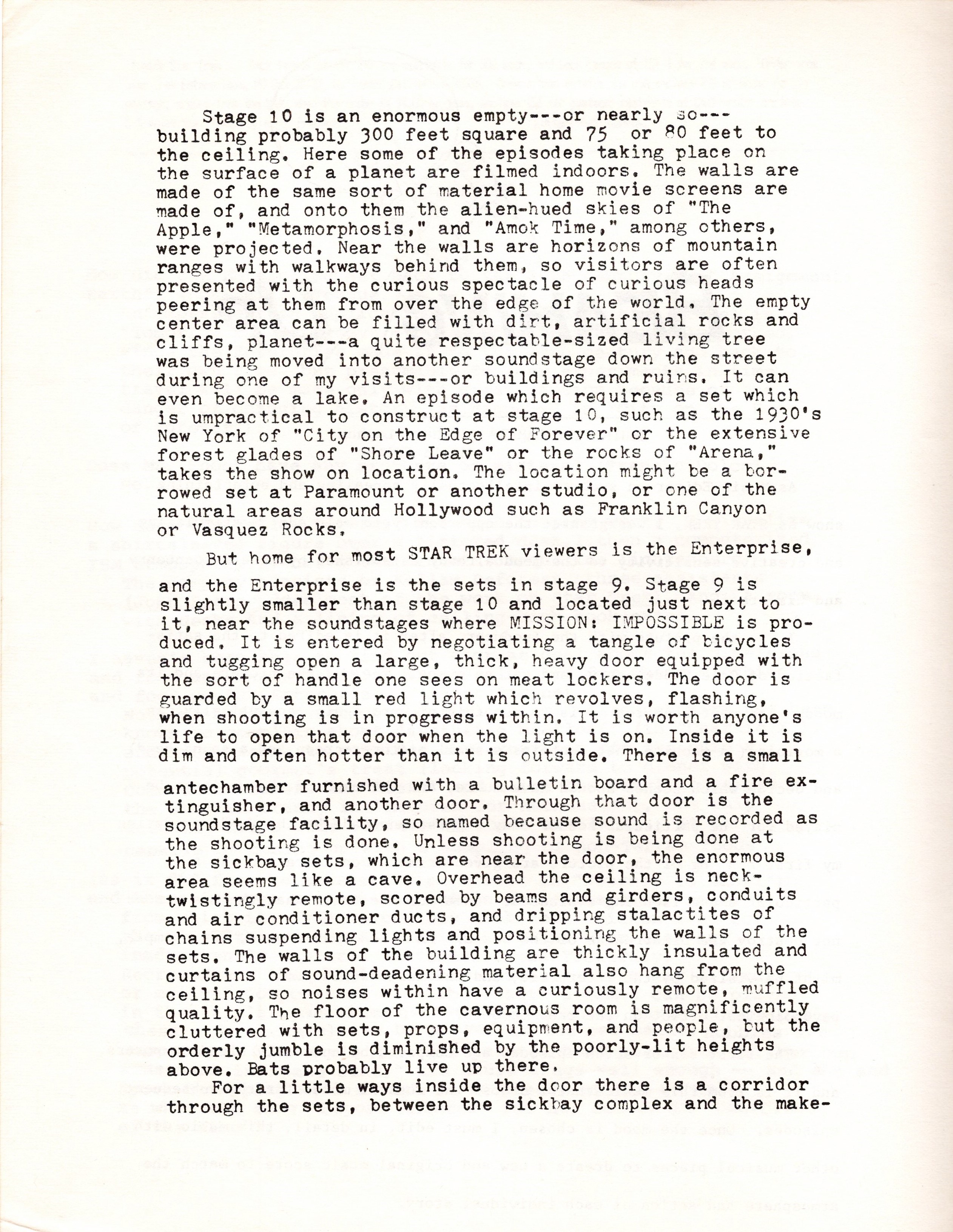
Some digging reveals the article originally appeared in ST-Philes issue 2, and was titled Where It’s At, written by K. Anderson. It was first published in November 1968 and therefore retains the Desilu numbering system, detailing a visit to Stages 10 and 9, later renamed by Paramount to Stage 32 and Stage 31 after it bought Desilu in 1968.
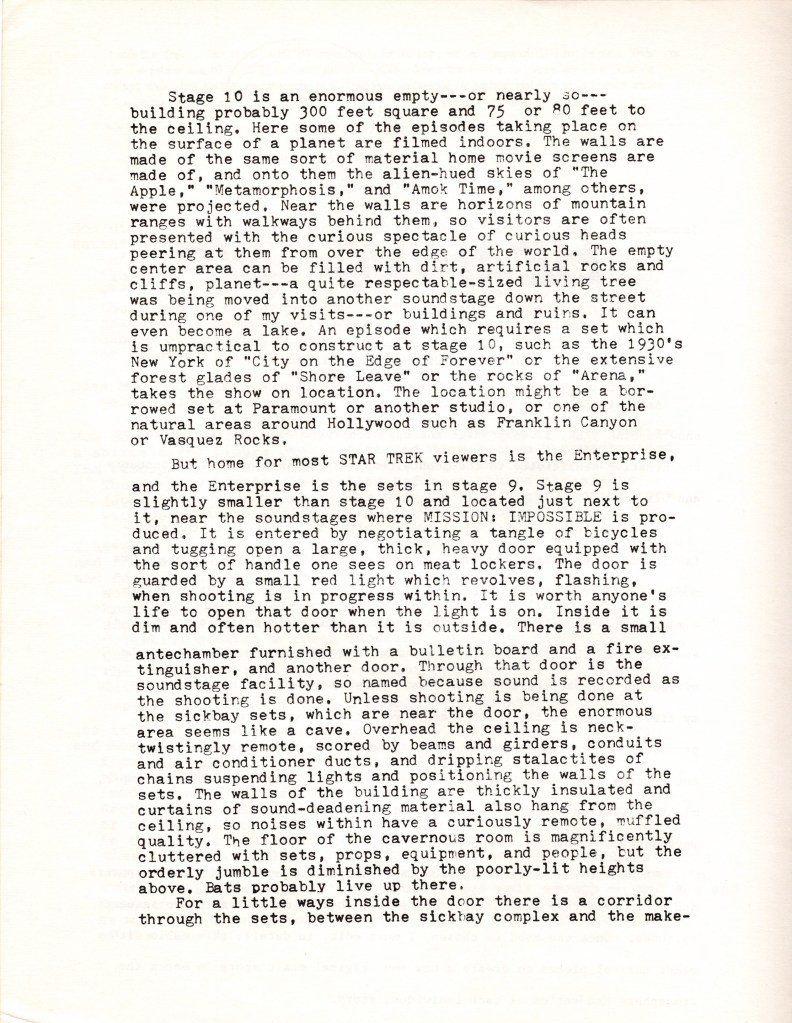
Anderson tells us Stage 10 is where “some of the episodes taking place on the surface of the planet are filmed indoors.” Memory Alpha confirms it was used for planet exteriors, non-Enterprise locations, and the shuttlecraft interior set. Reportedly, Citizen Kane and Chinatown were also shot there.
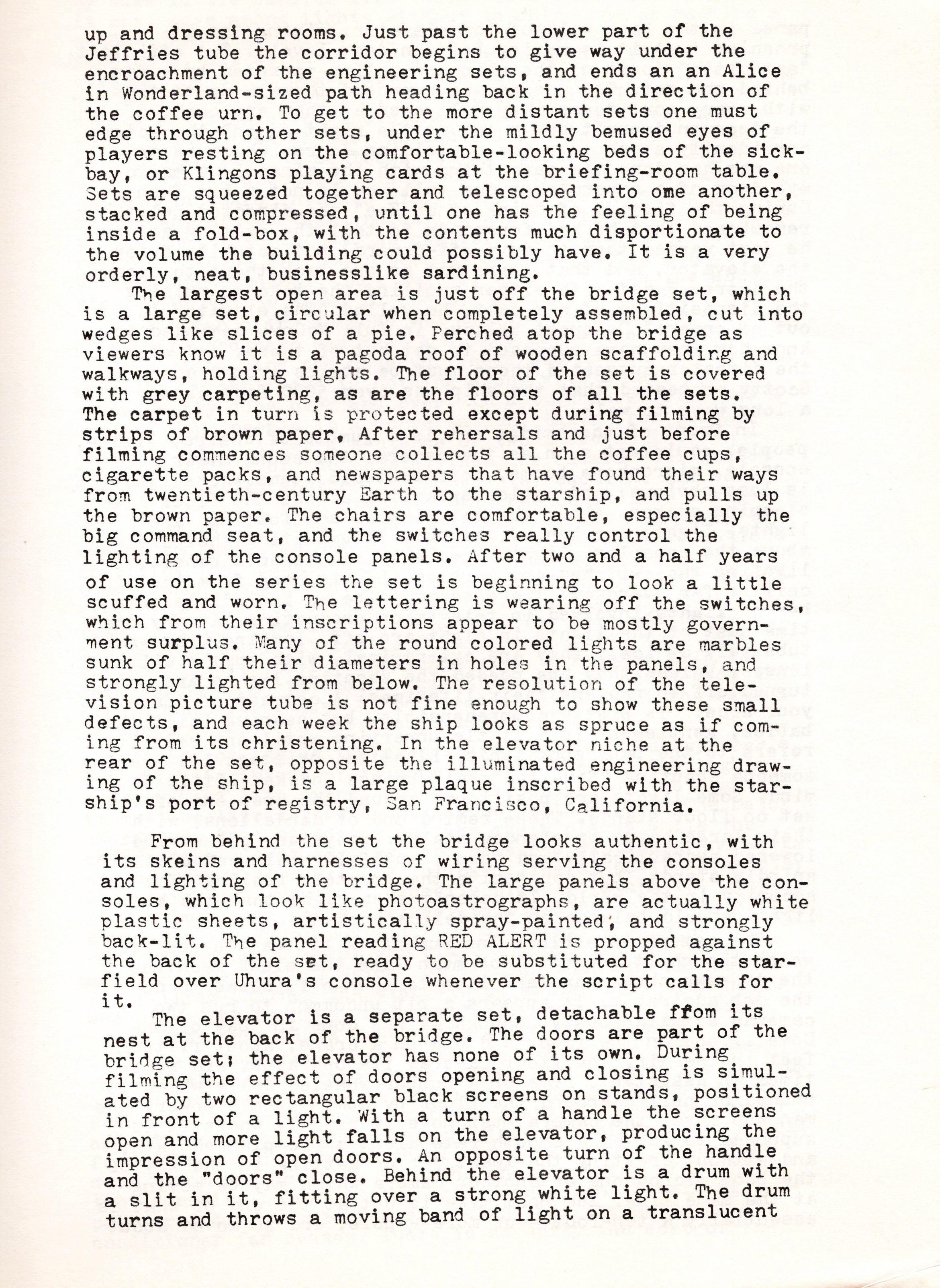
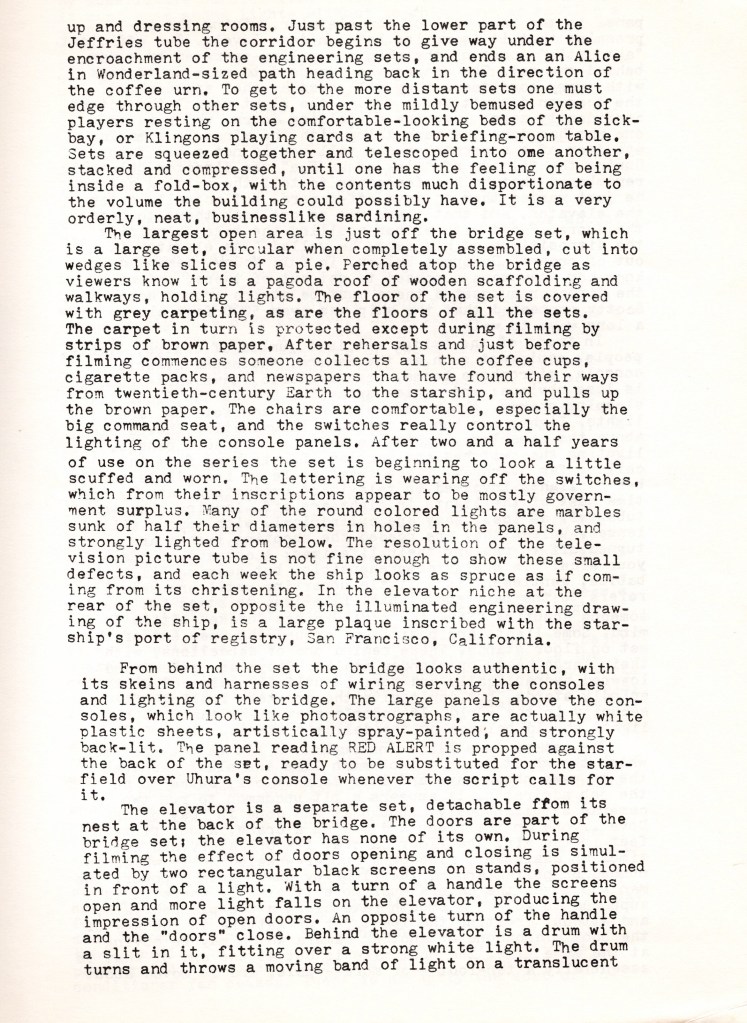
Anderson then walks over to Stage 9. It housed all the Enterprise interior sets, and is therefore a sacred site for TOS fans. Paramount’s page dedicated to Stage 31 offers a floor plan and the information that it was also the site for Forrest Gump, Wayne’s World 2 and the series Little House on the Prairie and Becker (which starred Terry Farrell.)
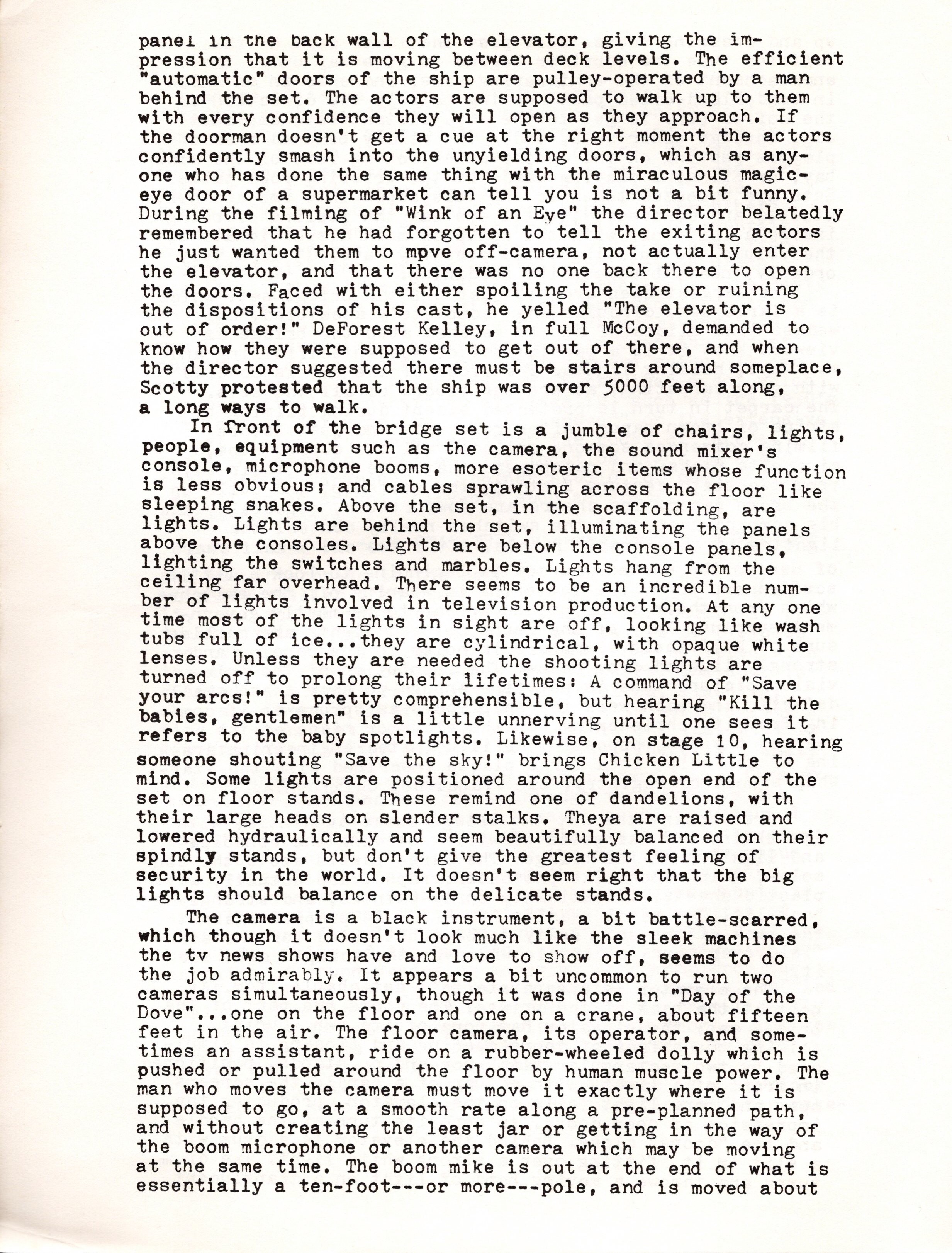
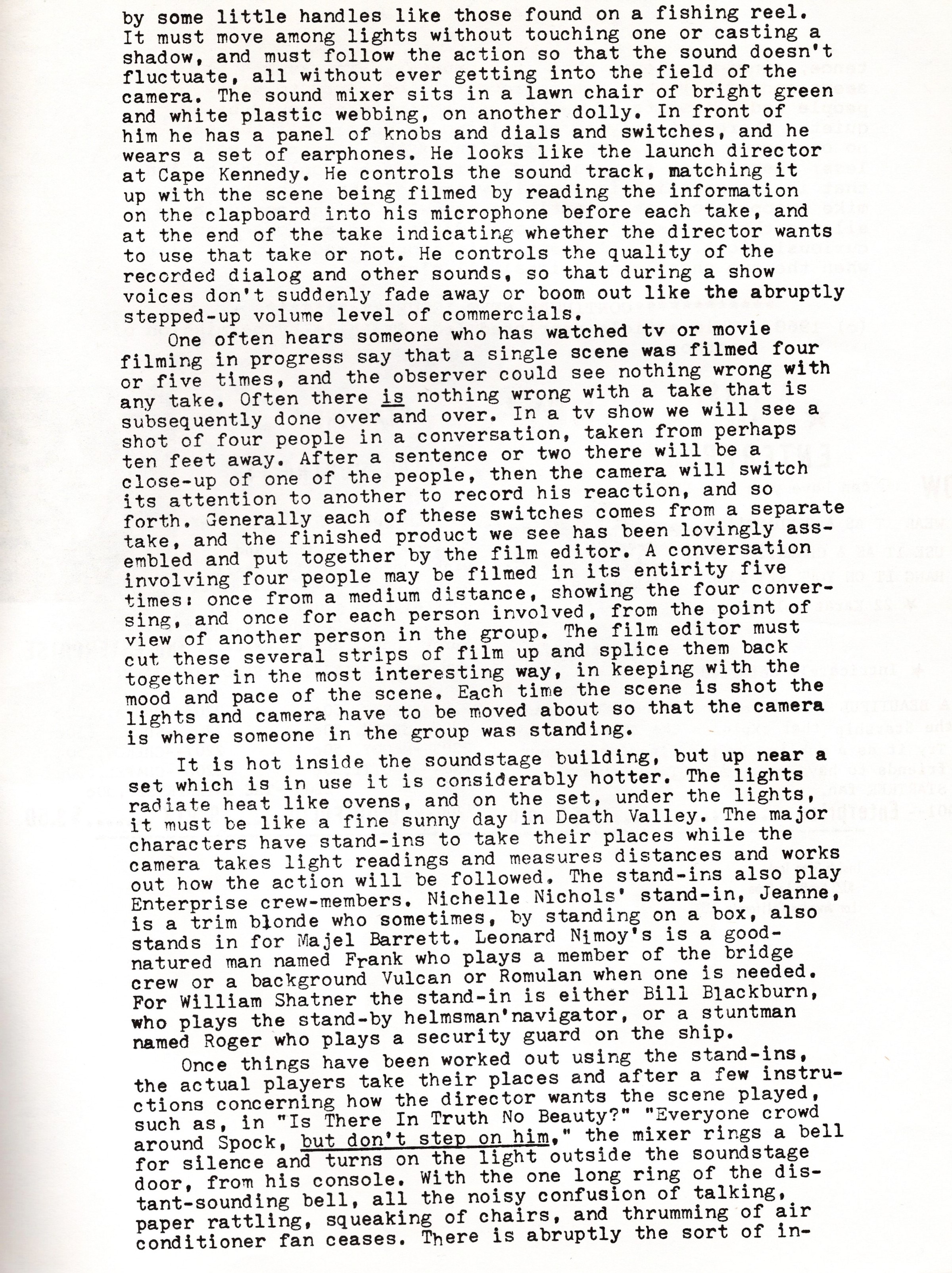
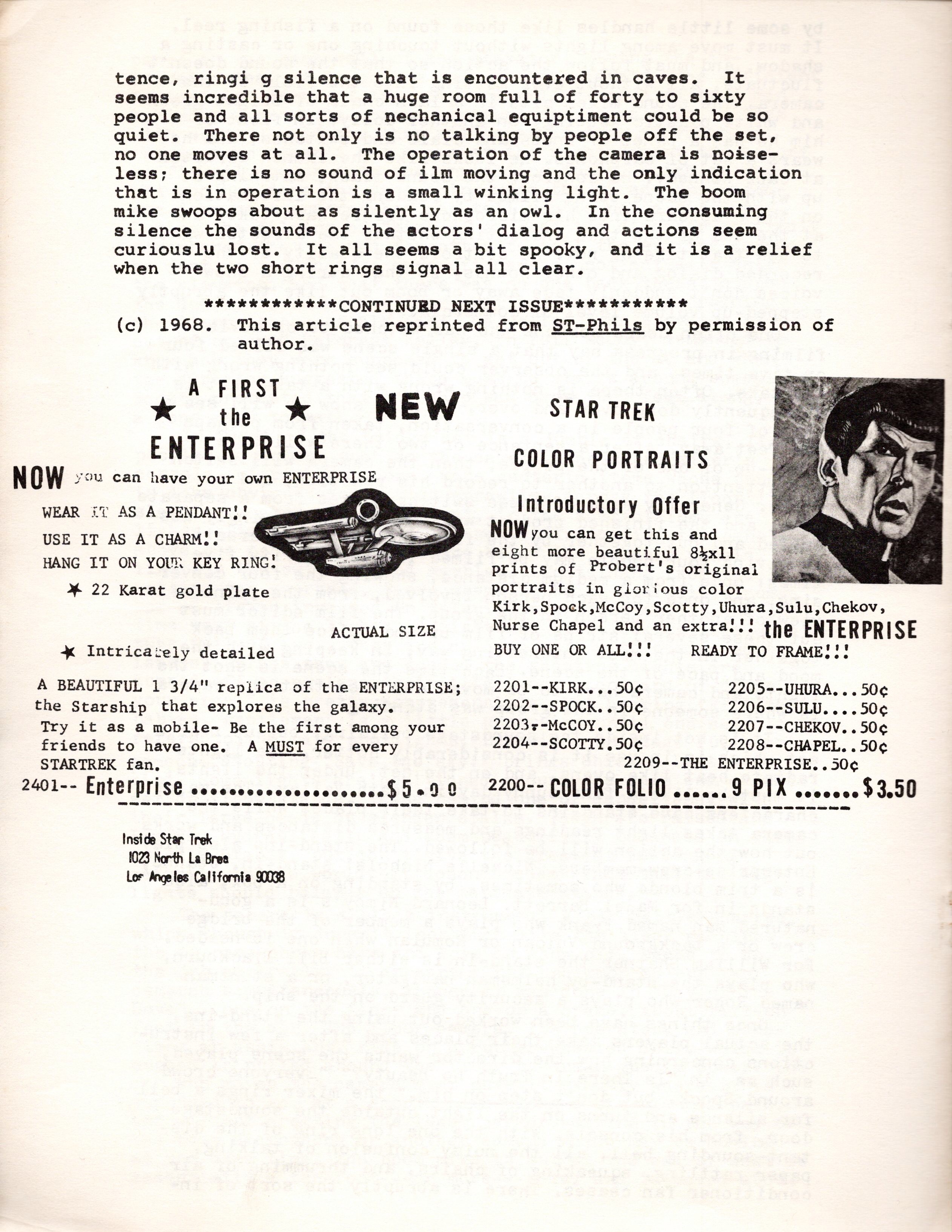
The article ends with a depiction of the silence that drops over the huge space when filming begins. Here are the sentences that close out the piece, plus scans of the entire article. (Clicking the images below will open a new tab with a large file.) The reprinted article will continue in issue 11 of Inside Star Trek.
With the one long ring of the distant-sounding bell [to signal filming is starting], all the noisy confusion of talking, paper rattling, squeaking of chairs, and thrumming of air conditioner fans ceases. There is abruptly the sort of intense, ringing silence that is encountered in caves. It seems incredible that a huge room full of forty to sixty people and all sorts of mechanical equipment could be so quiet. They’re not only is no talking by people off the set, no one moves at all. The operation of the camera is noiseless; there is no sound of film moving and the only indication that it is in operation is a small blinking light. The boom mike swoops about as silently as an owl. In the consuming silence the sound of the actors’ dialogue and actions seem curiously lost. It all seems a bit spooky, and it is a relief when the two short rings signal all-clear.
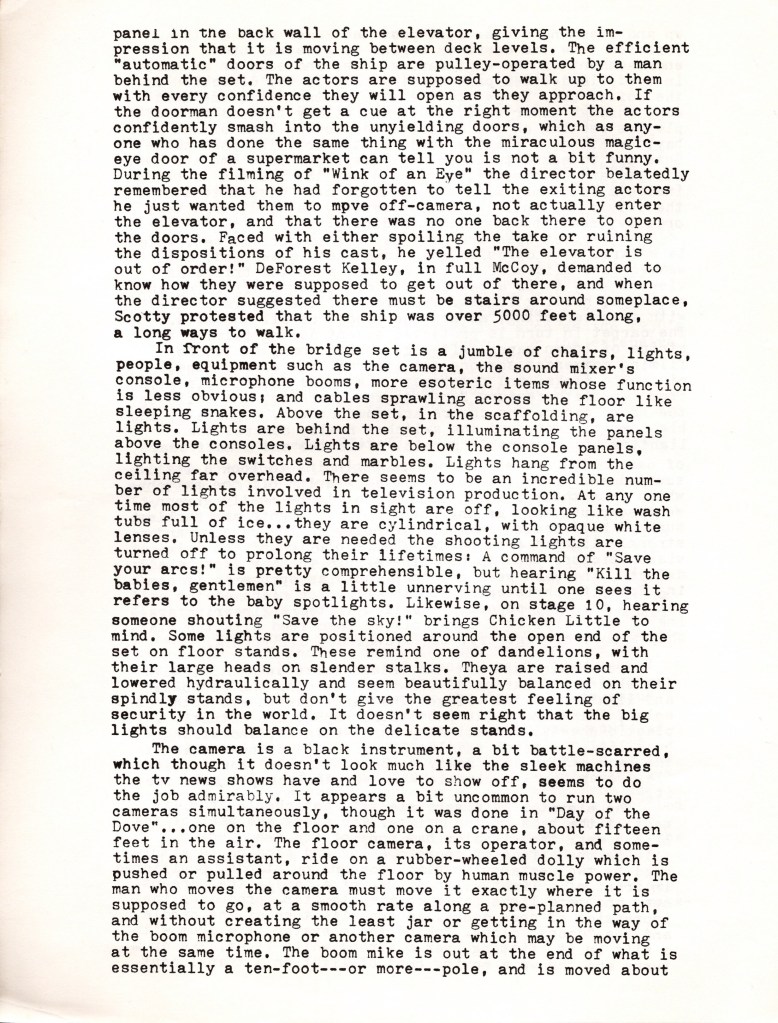
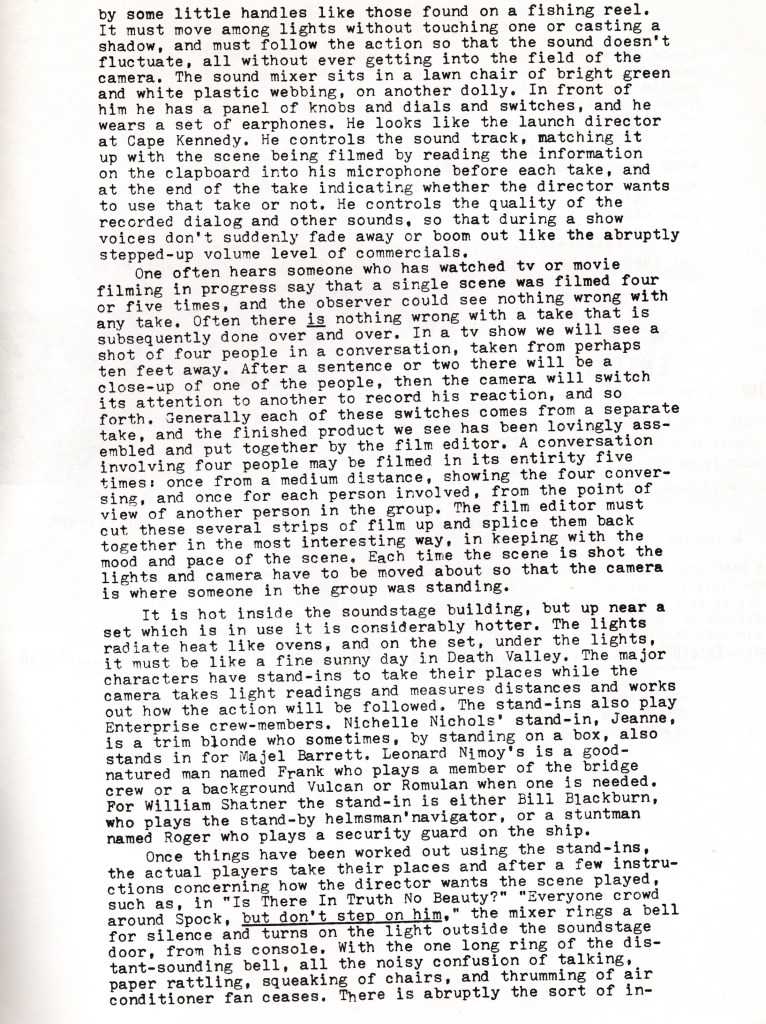
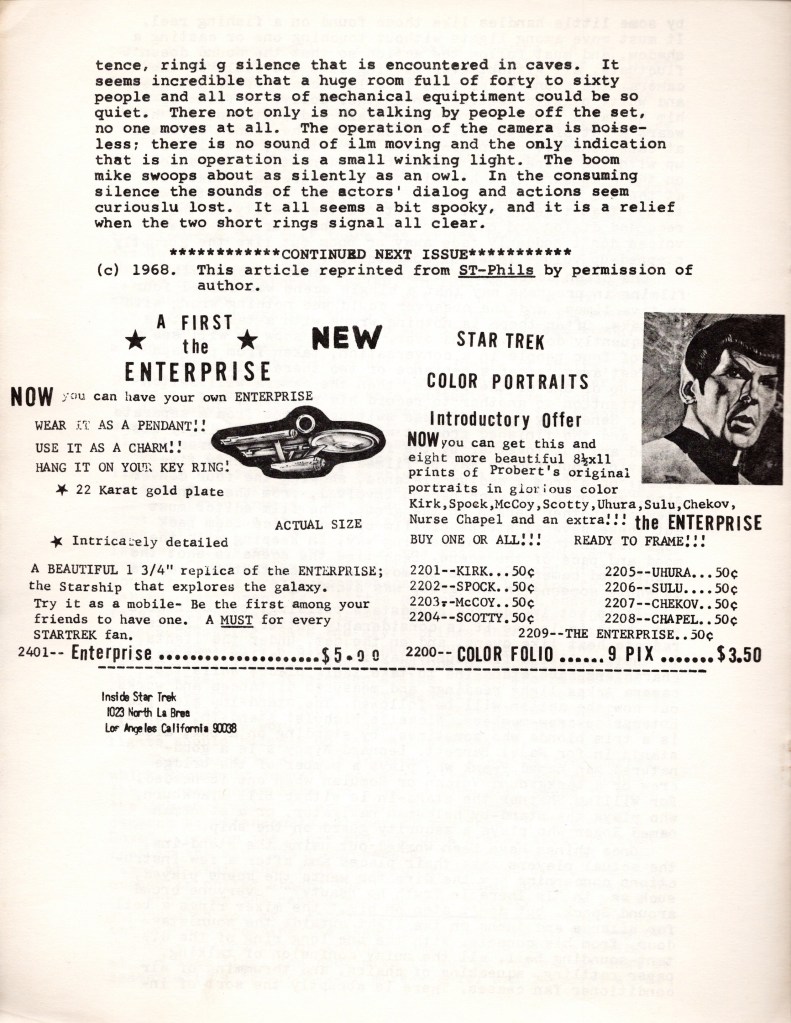
Inside Star Trek is an invaluable source of early Star Trek voices. I’ll cover each issue. Click here to read other articles in this series.
-
There were no resurrections in Obsession
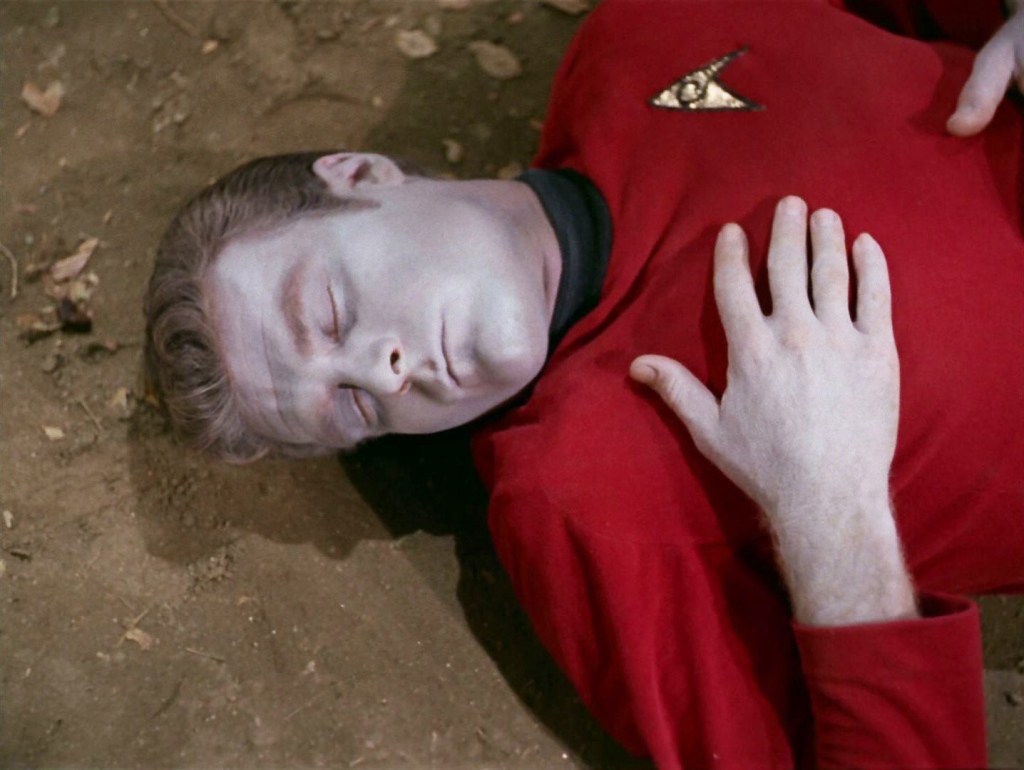
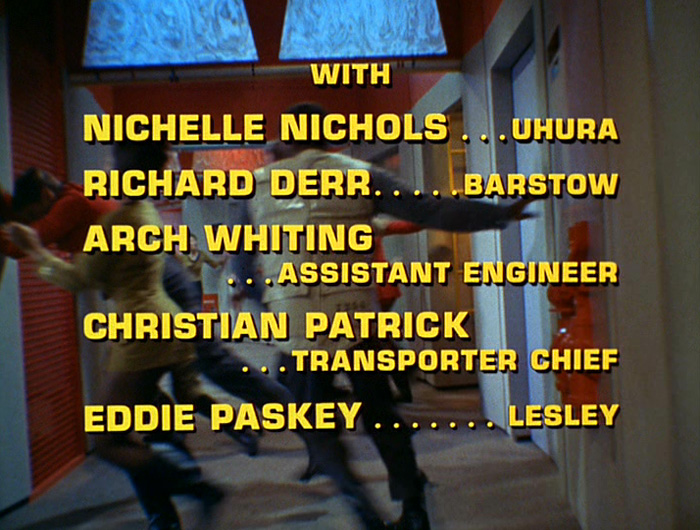
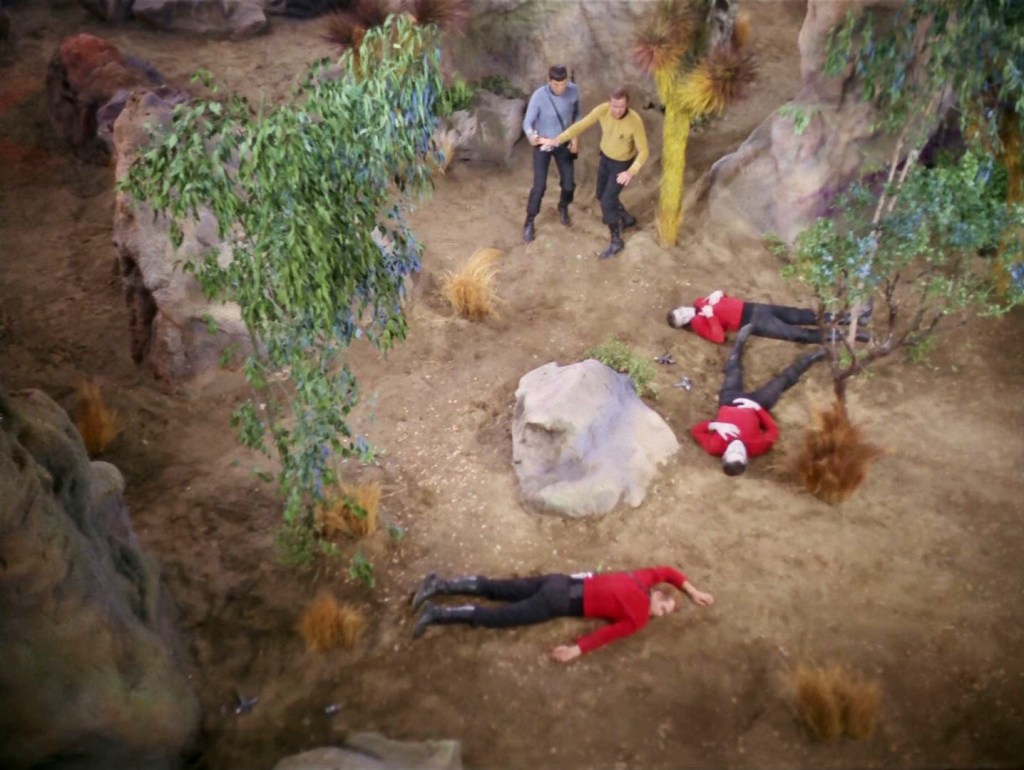
Lieutenant Leslie died in the opening moments of Obsession, attacked by a cloud creature which sucked all the red blood cells from his body. And then the character is seen on screen in a bunch of episodes that follow. Eddie Paskey, who played Leslie, told an interesting story about that on his now-defunct web site:
[Leslie] can be seen in nearly every episode from the first two seasons as well as a few from the third. He played many scenes as a “red shirt,” usually the first to die when exploring a planet. He is the only one though, to have died in one episode (“Obsession”) and returned in the next! This was due to the fact that a scene from the script that was never shot indicated that the victims were brought back to life!
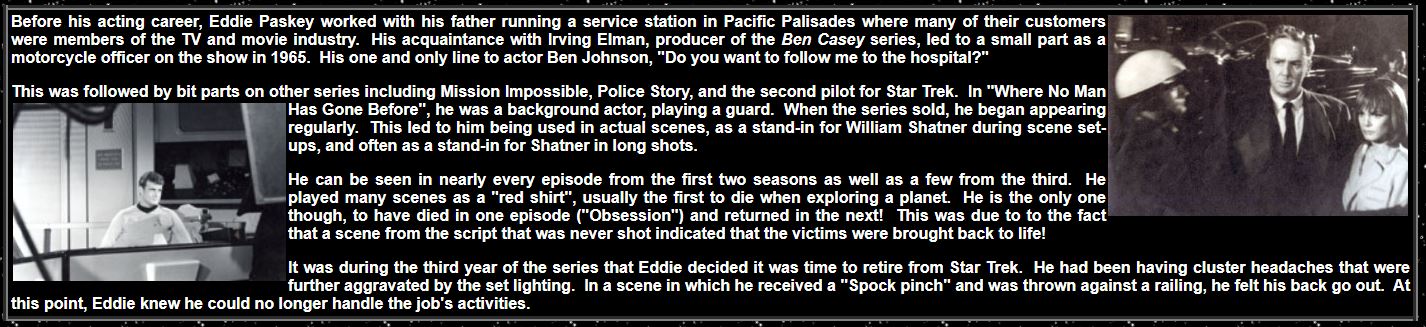

(Paskey’s site, eddiepaskey.com, has since fallen out of his control and is now registered in Pakistan. At time of writing, it contained 17 seemingly random posts. However, Paskey’s original site can be accessed through web.archive.org. He told the return-of-Leslie story here and here.)
The resurrection bit is a great story and it appears in many other places, including StarTrek.com, Memory Alpha and Wikipedia, but, as far as I can tell, it is not true.
Paskey was a regular on the Star Trek sets until health problems pushed him to quit the business, following Is There In Truth No Beauty? He was in 57 episodes, mostly as a background actor, and had a line or two in four episodes. His best bit was probably in This Side of Paradise: waiting outside the transporter room to beam down, Leslie refuses Kirk’s order to return to his station and replies to the captain’s “This is mutiny, mister” with “Yes sir, it is.” Paskey also served as Shatner’s lighting stand-in and body double and as the hand double for James Doohan when Scotty testified in Wolf in the Fold.
Back to Obsession. I own the Revised Final Draft script from Oct. 4, 1967. It contains pages dated between Oct. 4 and Oct. 12. Shooting on the episode began Oct. 9.
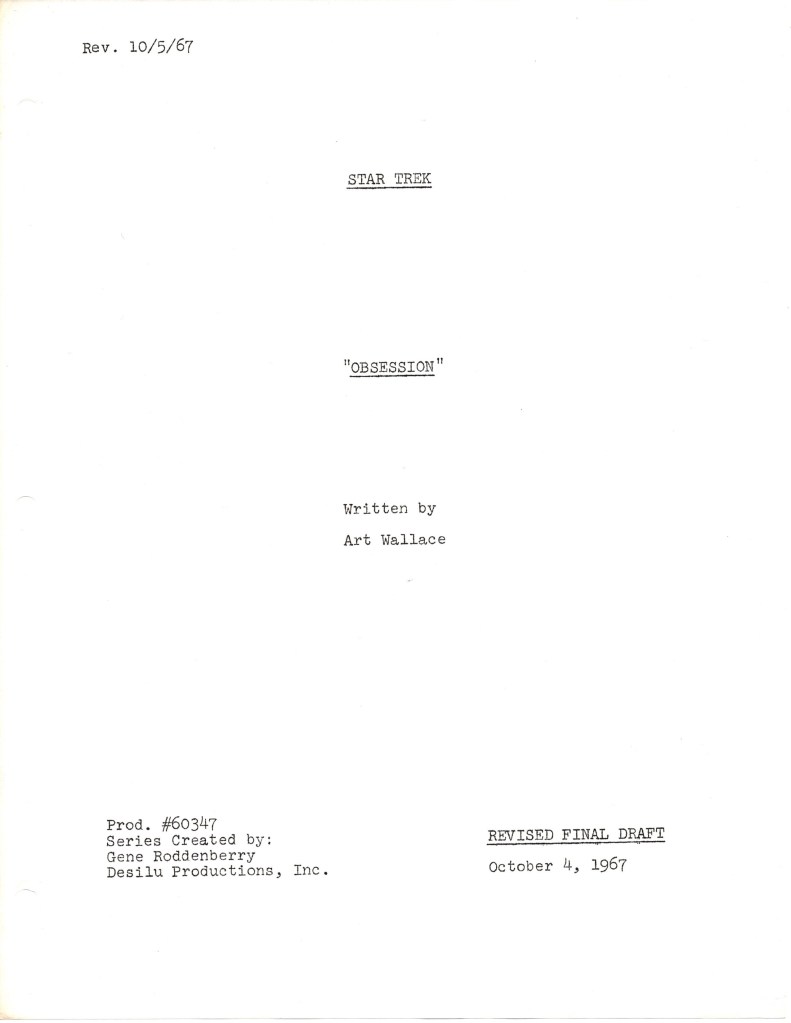
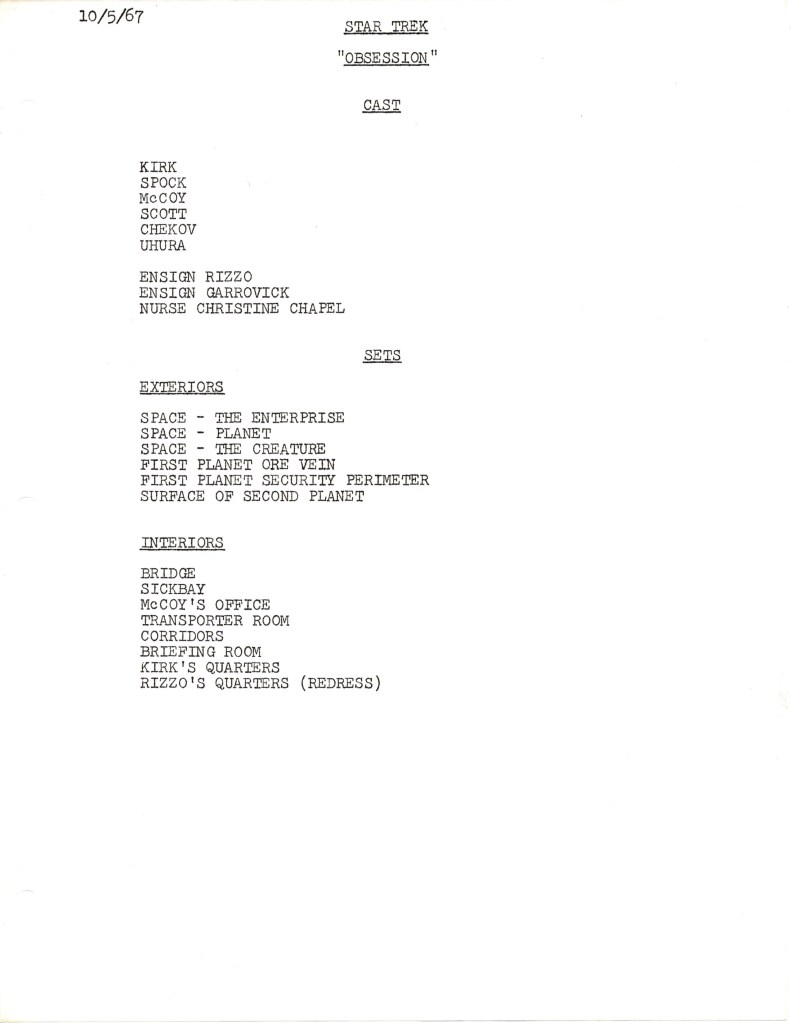
In that script, there is no resurrection scene for any of the poor redshirts lost during the teaser. Two are killed outright and Rizzo lives for a while before succumbing. None is brought back.
The director of the episode, Ralph Senensky, confirmed to StarTrek.com that no scene was shot in which a character came back. Senensky also addressed this phantom segment on his own web site. Instead of Leslie, he tells a story about Rizzo, who was played by Jerry Ayres. Ayres had earlier played O’Herlihy in Arena, another redshirt who died early on. About the reappearance of the actor in Obsession, Senensky wrote:
I have read an interview Jerry gave in which he said there was a scene filmed that explained that, but that scene ended up on the cutting room floor. I don’t think so; at least I didn’t direct that deleted scene, and…that scene was not in the script.
Serensky seems to be mixing up Ayres and Paskey here but, for the purposes of this article, the important point is that he says there was no resurrection scene in the script.
Also, These Are The Voyages, Season Two, goes into detail on the evolution of the script and there is no mention of Leslie returning from the dead.
Furthermore, the nature of the creature’s attack makes a miracle cure improbable. When Kirk asks for the autopsy report on the first two dead crewmembers, McCoy replies: “You saw their color. There wasn’t a red corpuscle left in their bodies.” McCoy is good but even he can’t save someone in that condition and already dead.
It is just possible, of course, that someone on the production staff ran into Paskey on set and said “Hey, you die in the next episode, but don’t worry because they bring you back to life.” Paskey was in A Private Little War, produced just before Obsession, so maybe that happened.
But it is more likely that the resurrection tale is a good story that did not actually happen.
Postscript
The character’s name should, arguably, be spelled “Lesley.” The only time the name appeared in the credits was in The Alternative Factor, and that spelling was used.
However, Leslie was supposedly named for William Shatner’s eldest daughter, Leslie Carol Shatner, and for that reason and because fandom has settled on the “Leslie” spelling, I went with that here.
-
Hauling garbage: the best trash can in half a quadrant

In a corner of my Star Trek room sits a small metal trash can. It often goes unnoticed by visitors, and that’s too bad. It’s more than 40 years old, it’s in really good condition, and it’s a great example of Star Trek in the ’70s, when fans would buy almost anything that sported those magic words. It is also cool that a small US novelty company lavished such quality artwork and attention to detail on a tin receptacle destined for apple cores and used tissues.
The can was manufactured by J. Chein & Co. and, sadly, by the time it rolled off the production line in Burlington, New Jersey, that company’s best days were already years behind it. Its doors opened in 1903 and it stayed in business for more than 75 years. The first products made by founder Julius Chein were tin toys dropped into boxes of Cracker Jacks and the company soon became known as a source of wind-up Ferris wheels and spinning tops, mostly sold in five and dimes. Chein died in a horse-riding accident in 1926 and his widow asked her brother, Samuel Hoffman, to take over. The company switched to manufacturing parts for airplanes and weapons during World War II and then got back to tin toys, but the slow decline of F.W. Woolworth Company, its main retail client, and the rising popularity of plastic eventually forced it out of that business.
The company moved into lithographed housewares such as wastebaskets and canisters, produced under the Cheinco brand. And that’s where my trash can comes in. It’s dated 1977, stands 33 cm/13 inches tall, sports colourful and reasonably accurate artwork, and even offers up interesting facts about the ship and its crew.
The Enterprise stats are seemingly drawn from the Star Fleet Technical Manual by Franz Joseph, published in 1975. The measurements — length of 288.6 meters and breadth of 127.1 meters — are essentially identical, albeit expressed in feet by Chein. However, the can’s “190,000 tons” is not quite the same as the manual’s measurement of “Deadweight tonnage-metric 190,000.”

One odd bit: Cheinco stated Christine Chapel’s rank as Lieutenant. There was no rank braid on Chapel’s uniform and I believe — and correct me if I am wrong — that her rank is never stated on screen during TOS, although she is promoted to Lieutenant in the animated episode Mudd’s Passion.

From What Are Little Girls Made Of? Those details, plus the mostly accurate artwork, means either someone at Cheinco knew Star Trek or Paramount was consulted to get the details right.
The company made many licensed trash cans for properties including Peanuts, GI Joe, The Wizard of Oz, and Disney, and also produced a Star Trek: The Motion Picture can, which I do not own.
I got my Cheinco at a Toronto Trek convention many years ago, and I have never seen another in person. I don’t remember how much I paid, but I do recall debating the purchase, as I had very little money with me. I am glad I bought it. It is quirky and rare and in far better shape than ones I have seen in online auctions. A TMP can sold at VintageToys.com in 2013 for US$30; I wish I had bought it.
-
Playing with dolls: the Mego Enterprise Action Playset

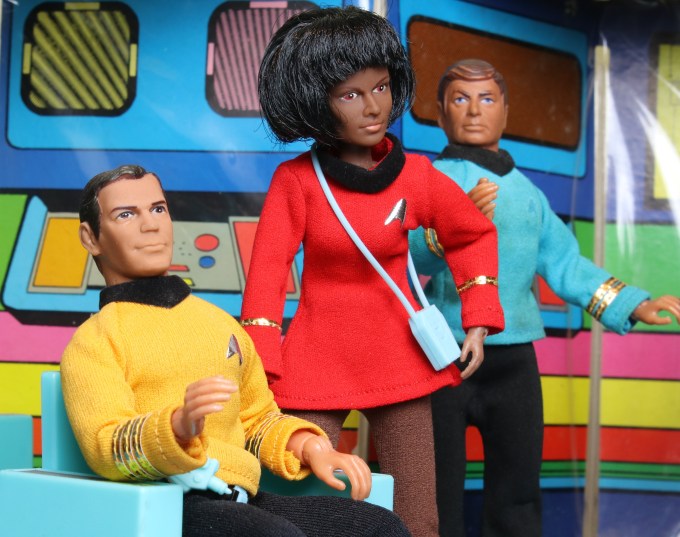
Mego was about fun, not accuracy. That’s clear from its U.S.S Enterprise Action Playset. Had I owned one way back when, it would have been big on play value for young me.
But I never got the chance. Mego started producing Star Trek toys in 1975 and I was too young to buy them new. I had to wait a few decades for my playset. The figures and bridge pictured here are the original ’70s versions; not for me the 2008 reissues from Diamond Select.
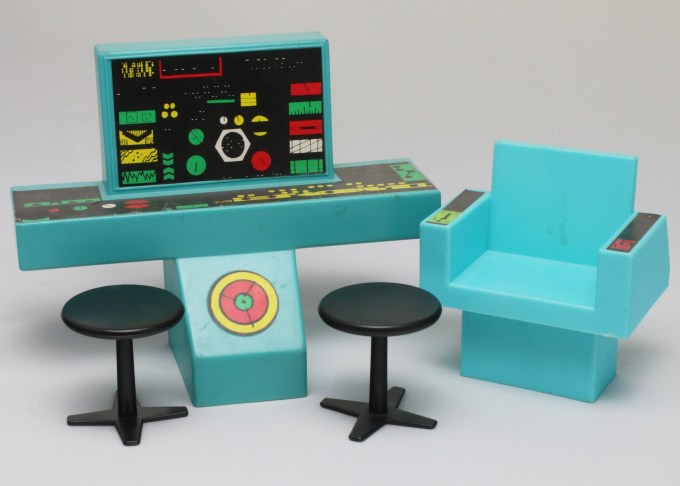
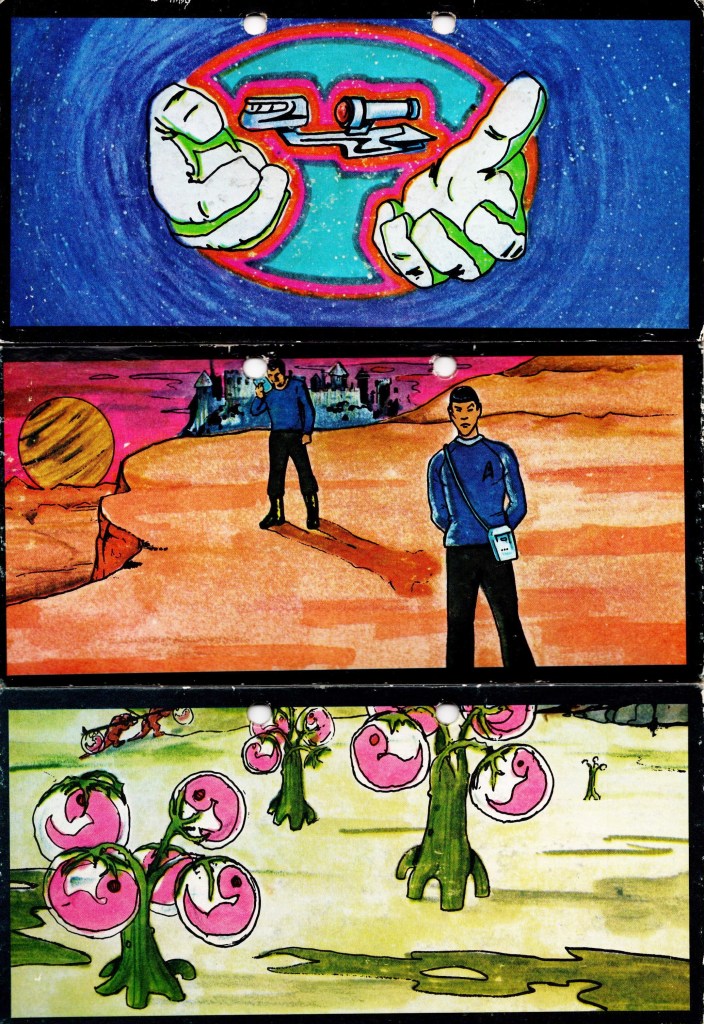
Mego, founded in 1954, made cheap and unremarkable toys for almost two decades before landing on the idea of producing licensed dolls in the early 1970s. Its first two lines were Planet of the Apes and Star Trek. It made a number of TOS figures, even entirely inventing some characters, and a few playsets. The Mego Museum’s Star Trek page has a good summary. My playset has all the accessories: the nav and helm console, the two stools, the captain’s chair and all three double-sided viewscreen images, and my set came with all the stickers applied. I also have all six of the Wave One figures. I don’t have any of the others.
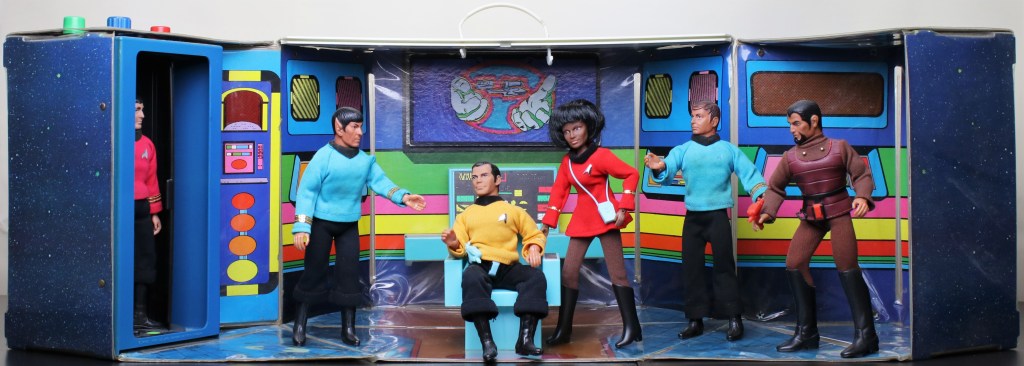
My original-issue playset 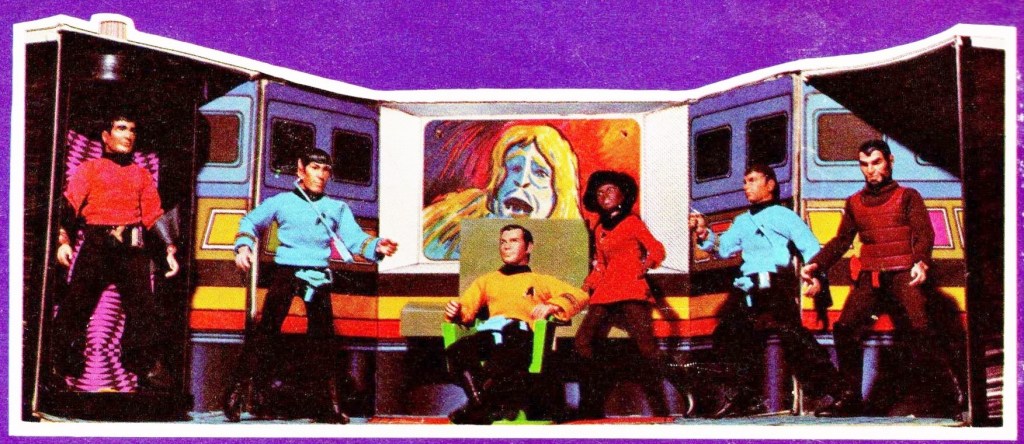
I also own Kirk and Spock still mint-fresh in their boxes, and for the photo of my playset above I took for inspiration the promo photo from the back of those boxes. I don’t, however, have enough phasers, tricorders and belts to quite do justice to the scene.
The bridge, of course, looks nothing like the real one. It’s not curved, the stations are all wrong, and if you have the characters face the viewscreen then you’re left looking at the back of their heads. And the real bridge did not have a one-person transporter over on the side. Which raises an interesting point: this is called an Enterprise — and not a bridge — playset. This is because Mego crammed different departments into this thing.

Such as the mini transporter room, which is shockingly innovative. Here is the beaming process:
- place a figure in the transporter
- give the spinning knob a quick twirl
- watch as the revolving decals create a nifty illusion of the transporter cascade
- press the green button on the top; the transporter will stop spinning with the figure facing the back
- open the secret flap on the back of the set to remove the figure.
The crewmember has now been beamed down. Reverse the process, pressing the red button, to retrieve him or her from the planet.
Over on the other side is engineering, denoted by a circuit diagram on the wall. That’s it; that’s all of engineering.
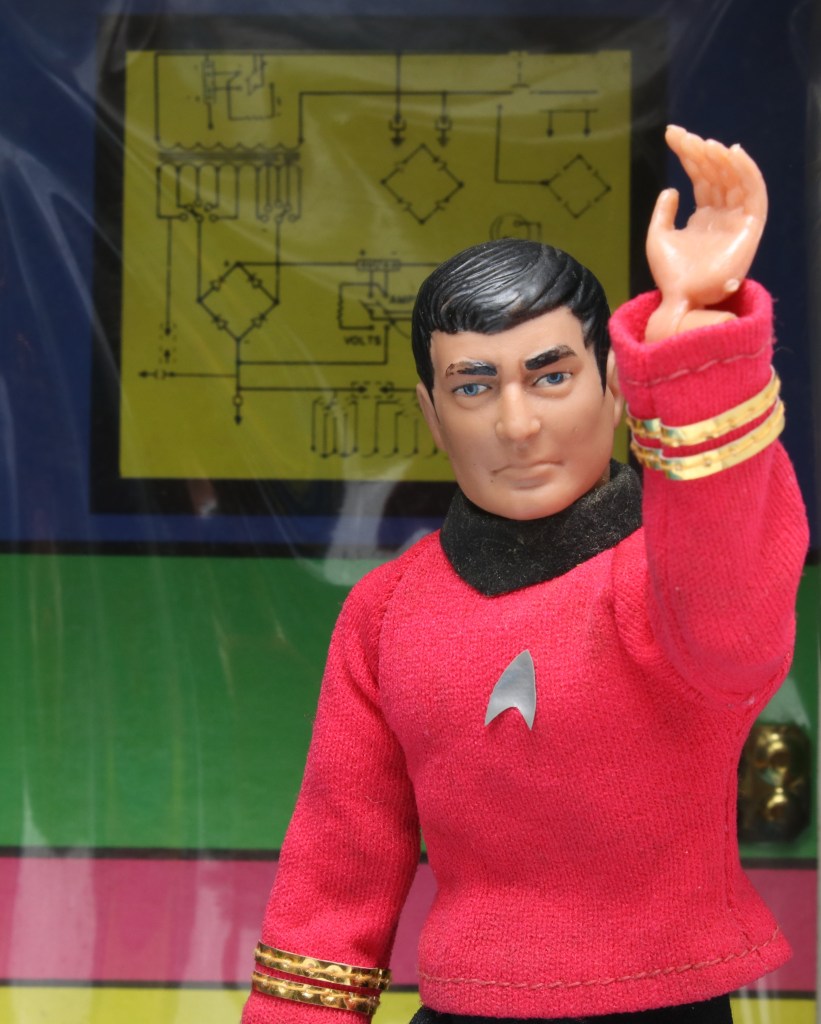
Again, accuracy was clearly not Mego’s goal, but kids could have adventures on the bridge, have Kirk call down (over) to Scotty in engineering, beam crew around and, if they wanted, maybe even squeeze a sickbay into the back for McCoy.
Collector challenge
The playsets are also great fun for collectors. They were made of thin plastic laid over a cardboard framework and almost all were actually played with, so most units are in poor shape today. The plastic dries up and cracks, the corners get bashed in, and the white carry handle at the top is almost always broken.
All of which makes the pursuit of one in good condition a lot of fun. I bought mine a few years ago from a TOS collector I met on Facebook. It has no tears in the plastic, the handle is intact, the colours are bright and the decals in good shape, and it came with all the accessories. I paid less than $100 and I think I got a deal.
Collectors, especially completists, should know that Mego produced a few batches of these and there are many variations. The furniture came in either blue or yellow and in one or two pieces, there are a number of different boxes, the decals were either on a sheet or already affixed and, the biggest difference, the sets produced for the Canadian and French markets were about 10 percent smaller overall. I own the standard US version.
I spent years searching for a playset in good condition that I could afford, and I worried not at all about which colour the console was or whether the decals had been applied by the factory or a 10-year-old.

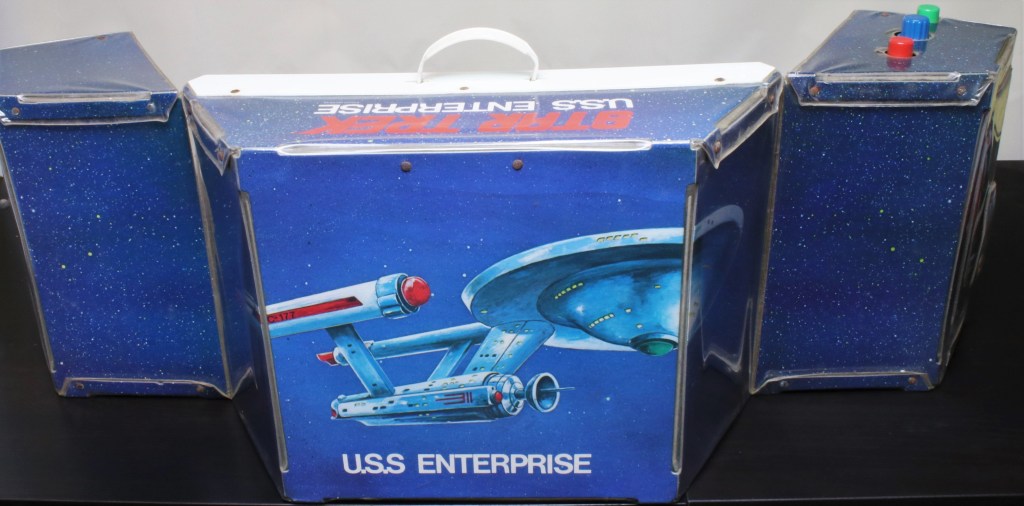
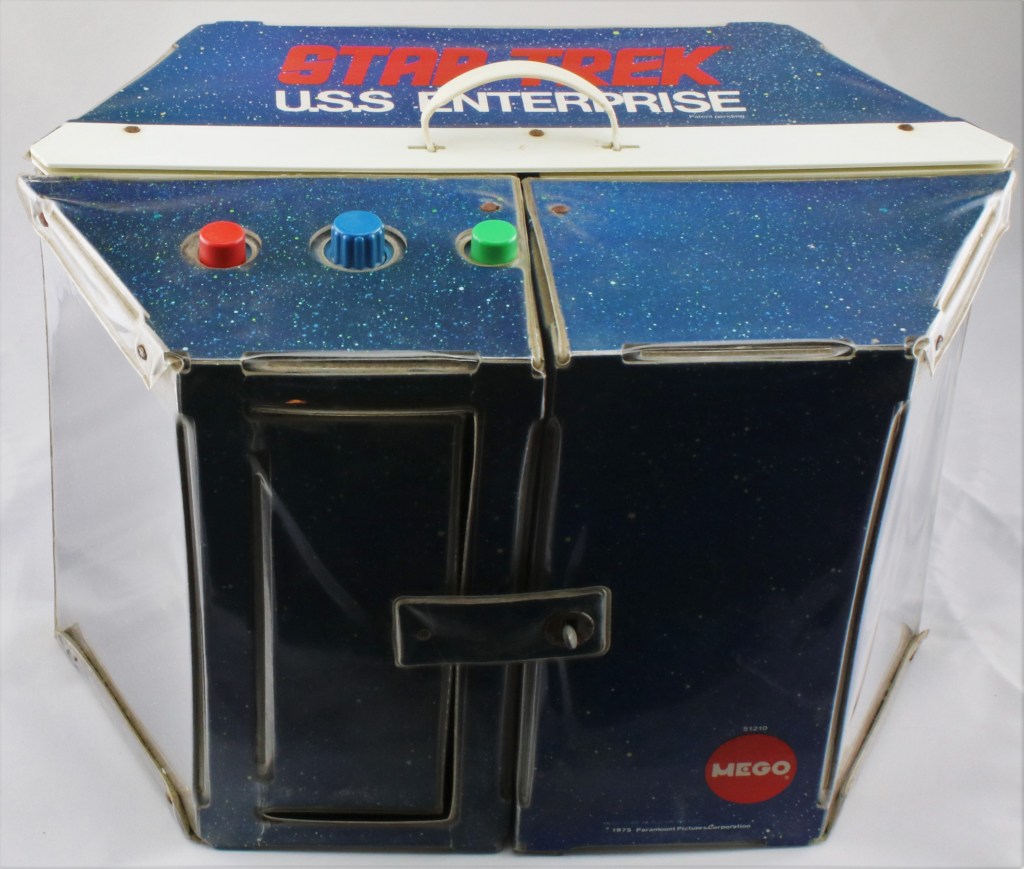
The playset folds into a carry box. My playset sits on a shelf in my Star Trek room, with the figures arrayed as pictured above.
Update: I recently created a dedicated Mego display area.
I don’t play with the figures but it’s nice to know that I can, anytime I wish.

Postscript
Mego created a prototype updated bridge playset that was a little more accurate. It also sported a separate sickbay, although it was positioned as a sort of treehouse over the bridge. Check out this Mego Museum page for photos.
-
Inside Star Trek 9: Polka-dot marshmallows and herding extras with Charlie Washburn
Inside Star Trek was a semi-official newsletter, published under the guidance of Gene Roddenberry. This connection gave the writers access to the actors, production crew and sets.
I own the complete run:
- Issues 1 to 12: Inside Star Trek, edited by Ruth Berman
- Issues 13 to 24: renamed Star Trektennial News, edited by Susan Sackett
- Issues 25 to 31: again called Inside Star Trek, edited by Virginia Yable
Here are highlights from issue 9, published early 1969.
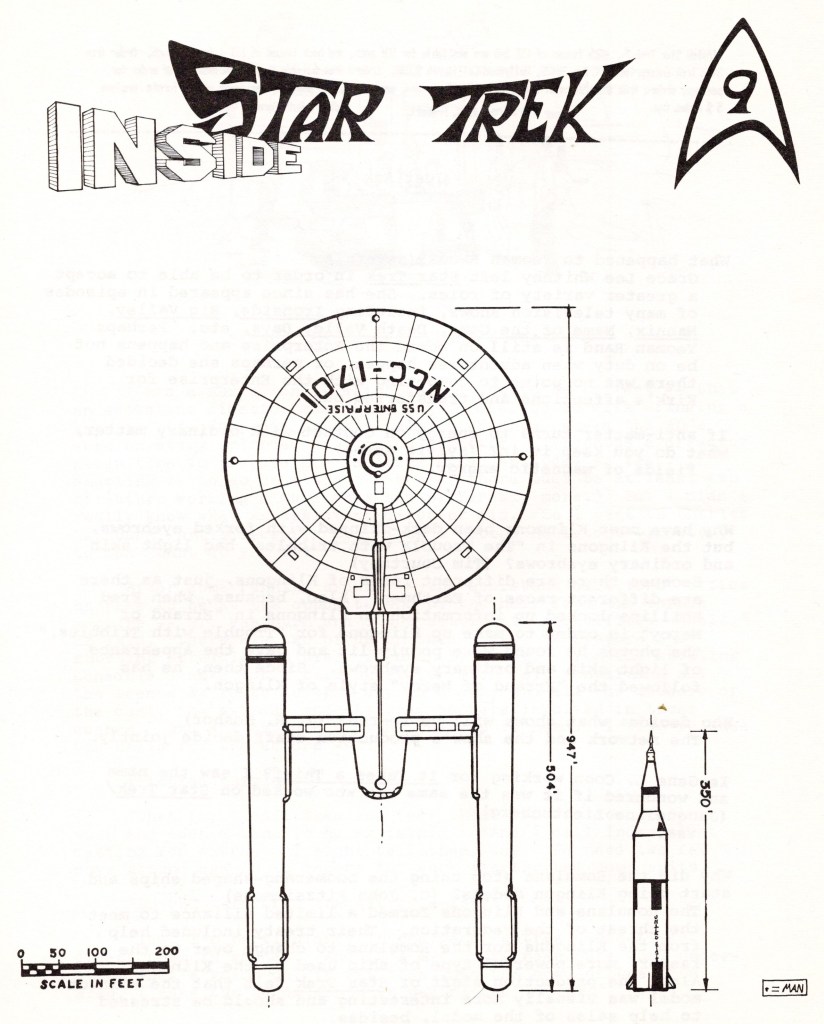
This issue highlighted two important production staffers and is one of the best so far.
Working around the periphery of the set
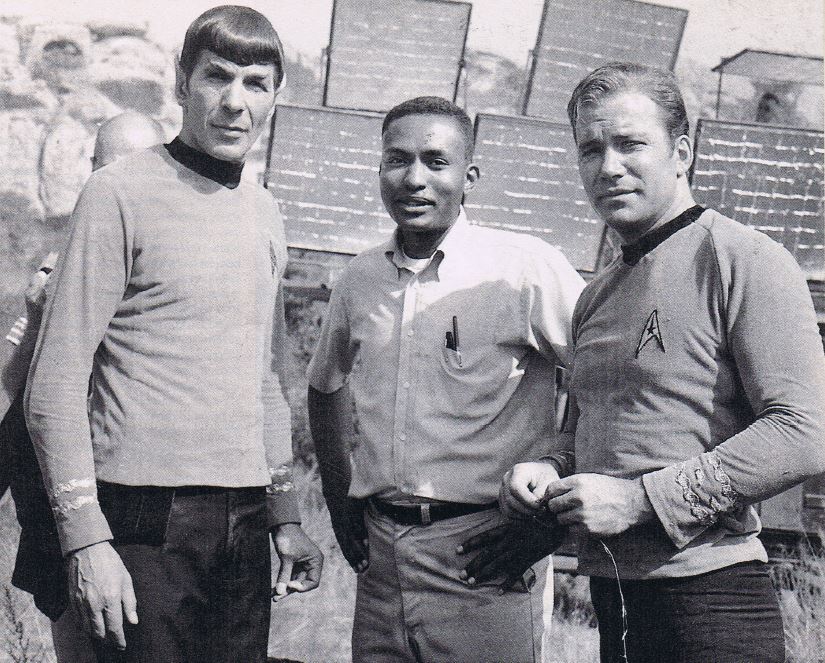
Charles Washburn was a second assistant director on seasons two and three of the original series. He landed at Desilu after completing an apprenticeship at the Directors Guild of America’s trainee program.
The article, which is uncredited but almost certainly written by editor Ruth Berman or frequent contributor DC Fontana, opens with Washburn explaining the role of second AD.
We prepare the shooting schedule and break it down by scene. From the shooting schedule I make out a call sheet for each day, containing all the scenes we’re to do that day in order, and all the members of the cast, the extras, and the crew-members involved in those scenes. And any extra equipment that we’ll need. I also call [the actors] and tell them ‘You are to come in at such and such a time.’
As second, I’m usually at work around the periphery of the set, in touch with all the departments and their needs. There might be a sequence coming up that requires food, so I check with the property department that they have the polka-dot marshmallows or whatever and that they will be ready.
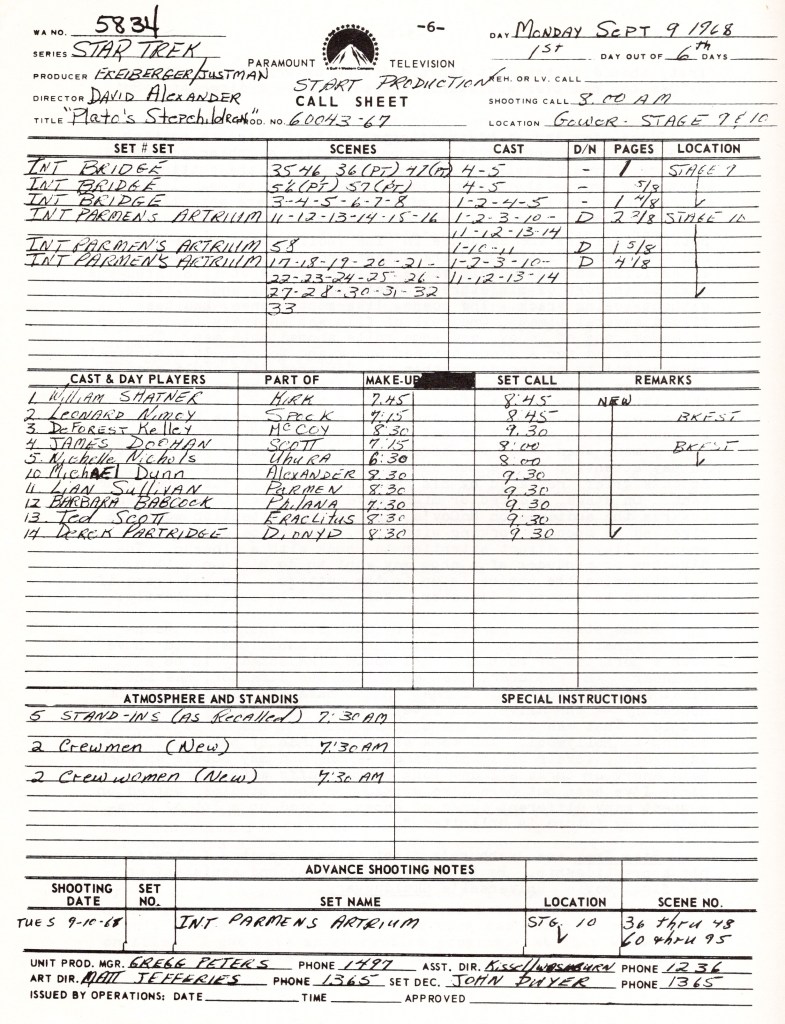
One of Washburn’s call sheets, reproduced in the newsletter Washburn was also in charge of the extras on the set. He explained that they usually got a fixed-scale payment but he would bump up their fees if “we’re going to shake the ship and they’ll have to fall down or hang onto the rail.”
The article noted that “Washburn is Negro” and, despite the dated language, I appreciate that he was asked about barriers in the industry: “Did you have trouble getting into the guild because of prejudice?” Surprisingly, for the time, Washburn said no, pointing instead to the familial nature of unions as the biggest challenge:
I’m sure there has been prejudice, but, as I understand it, it’s not exactly prejudice against minorities — many of the unions have been closed to anyone who wasn’t related to a member. I cannot personally point to incidents in which I have been discriminated against because of my color.
Washburn concludes the article by stating that he was not really looking to become a director:
The work (of an AD) isn’t necessarily designed to turn out a director, but a lot of it would be helpful to someone who wanted to become one… But being an Assistant Director can be a career in itself. It’s a more stable job than straight directing — well, usually anyway.
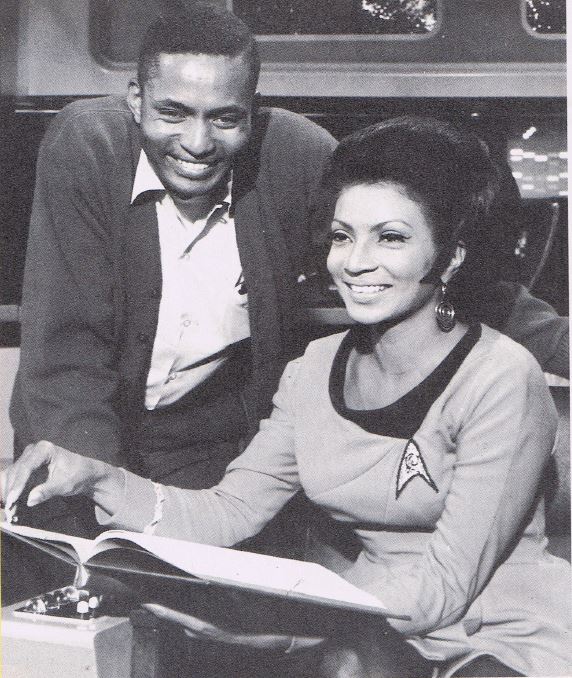
Photo from Starlog Cutter, director and writer
The author of the article then walked “down to the opposite end of the lot” to chat with “cutter” Bill Brame. The film editor was “whirling rolls of film through a moviola (a sort of miniature projector).” Brame was at work on The Tholian Web.
The scene, like most scenes, had been filmed several times. One roll of film was entirely in close-up of Spock, one of McCoy, and some rolls showed both men. The script called for a scene between Spock and McCoy. It was Brame’s responsibility to decide whether the finished film would show a close view of the speaker, or a close view of the reactions of the listener, or a more distant shot of both (or a closeup of the object of discussion). The impact of the scene can be heightened by good editing or lost by bad… The director or producer of a show may want to do his own cutting, but otherwise the choice is up to the cutters.
Brame hoped editing would be his path to directing, and by the end of this career he had directed four movies, two of which he also wrote.
Washburn on Washburn
Washburn was a fixture on the lot, even becoming known as “Charlie Star Trek” because of his habit of answering the set phone with “Star Trek…Charlie!” but not much was written about him. The other significant source on Washburn is an article he himself wrote in issue 112 of Starlog in 1986. In it, he expands on the duties listed in Inside Star Trek, adding delivering breakfast to the actors, directing extras in the background, distributing script changes, rereading the next day’s scenes each night to ensure all bases were covered, and “cueing the special effects man when to open the Enterprise’s sliding doors as the actors approached.”
Washburn began working on Star Trek as a trainee second AD under Leonard “Tiger” Shapiro. Washburn said Shapiro gave nicknames to those he liked, and called George Takei “Take Home Pay.” He also called Nichelle Nichols “Madam Fufu” but, unlike most nicknames, he did not use it openly and she never heard it — until he wrote about it in Starlog.
To me, there is a condescending undertone to this supposedly fun practice, especially as Tiger called the “lot’s shoeshine man” Jake “Honest Jake the Gonif.” That last word is Yiddish and means a thief, dishonest person, or scoundrel. Washburn himself was called Washrag, Washtub, or Washbottom but says “I was never offended, even though the name was often shouted across the stage. I would always smile, yell out “Yes, sir,” and run to him. I loved the man.”
Washburn then provided some interesting day-in-the-life information and dropped a funny story about Shatner’s breakfast:
The reporting times for our main cast almost never changed. Nichelle Nichols’ and Leonard Nimoy’s reporting time was 6:30 a.m. to be ready for an 8:00 shoot. Bill Shatner’s was 7:00. And DeForest Kelley, George Takei, Jimmy Doohan and Walter Koenig were all expected at 7:30, since their makeup requirements were minimal. Leading ladies would usually have a 6:00 a.m. call. Now, for all the cast members in before 7:30, we would tender a breakfast to avoid a meal penalty (an actor could only work 5 1/2 hours without a company breaking for a meal, and we usually had lunch at 1:00 p.m.).
Nichelle, Bill and Leonard’s breakfast order was almost always the same. Nichelle would order yogurt. Leonard would order two soft-boiled eggs with bacon. Bill’s would be a rather grand order: two soft-boiled eggs, bacon, two scrambled eggs, a half grapefruit, wheat toast, and a large orange juice.
What Gregg (Peters, the unit manager) didn’t know — and I somehow never got around to telling him — was how Bill’s breakfast was disposed of each day. Bill would eat a piece of toast and drink the orange juice. His wardrobe man, Ken Harvey, would eat the half grapefruit. And his Doberman (Morgan), who Bill brought to work each day and kept in his dressing room, ate the rest.
Over the course of the third season, Washburn apparently changed his mind about directing, telling Gene Roddenberry “that my number one ambition was to be a motion picture director.” Roddenbery replied: “I don’t know what you tell you as to how to go about being a director. But, the most important thing for you is to want to do it. And, if you want to do it bad enough, you’ll find a way.”
Washburn worked as an assistant director after TOS, mostly in television, including contributing to the first season of The Next Generation.
Inside Star Trek is an invaluable source of early Star Trek voices. I’ll cover each issue. Click here to read other articles in this series. -
Relive John Belushi’s final captain’s log

Saturday Night Live is known for bittersweet Star Trek skits. William Shatner’s “Get a life!” bit is infamous, and the other standout is “The Last Voyage of the Starship Enterprise” from season one in 1976.
John Belushi was an early star of the show and Michael O’Donoghue was SNL’s first head writer. They were also Star Trek fans. The 12-minute Last Voyage sketch they wrote tells the story of a network executive (Elliot Gould) chasing down the Enterprise in a Chrysler Imperial. He boards the ship, announces that Star Trek has been cancelled and orders the set dismantled. Spock, played by Chevy Chase, and Dan Akroyd’s McCoy slowly acknowledge the reality and break character, walking off the bridge with the rest of the crew. Only Belushi’s Kirk sticks it out, closing out the scene by recording his last captain’s log.
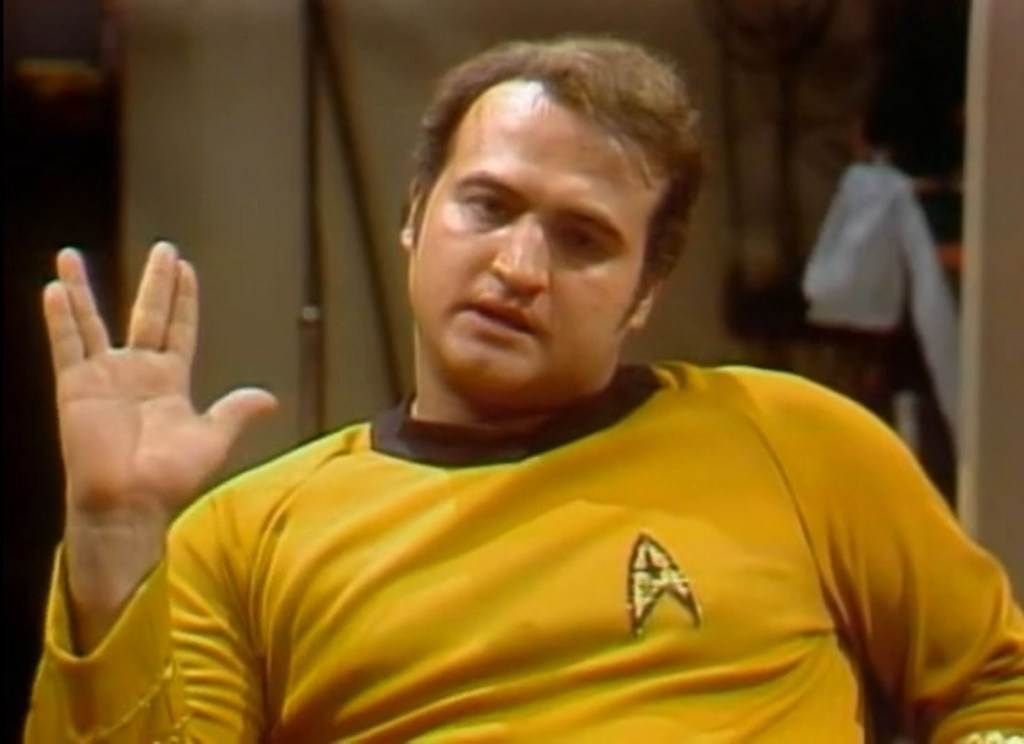
The only way to watch that skit now is on an old VHS or DVD copy of The Best of John Belushi or this bootleg version. (Online at time of writing.)
The 1977 book Saturday Night Live collects scripts and notes from many of the best early SNL skits. It has a $7.95 price tag printed on the cover. I bought my copy secondhand for $4. You can get one today for about $6 at Thriftbooks and elsewhere.
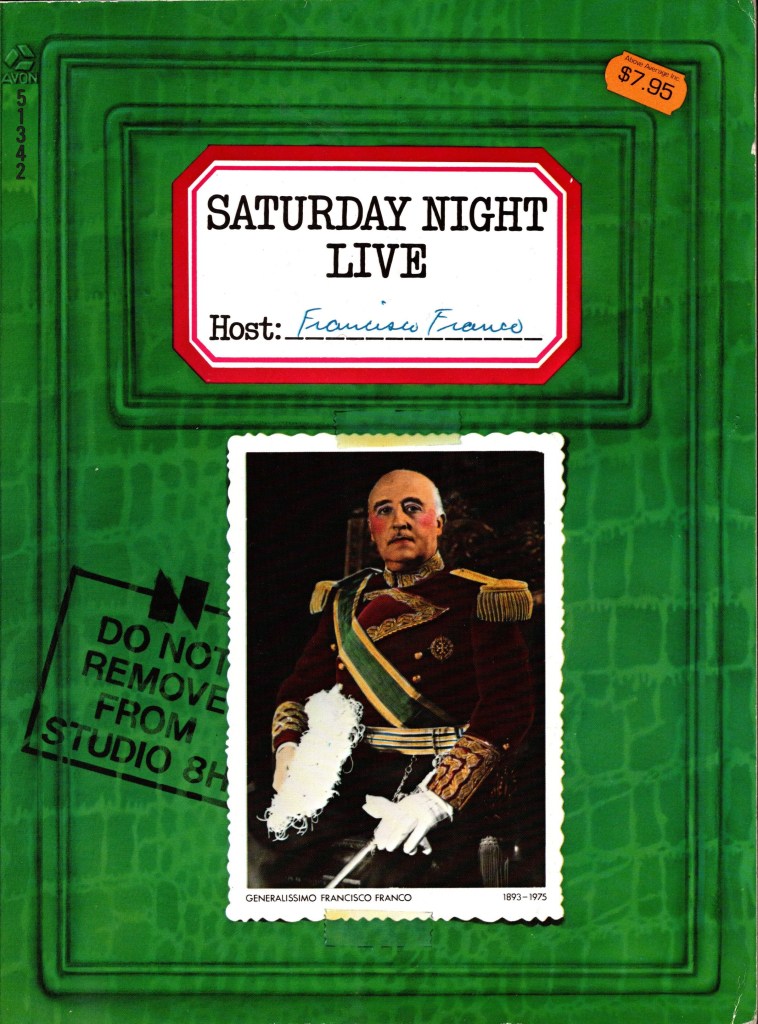
I scanned the Star Trek section, which contains the script plus some photos and a set sketch, and created a PDF.
The book also includes a letter Gene Roddenberry wrote to express his appreciation of the bit. Strangely, he addressed the letter to Gould, that episode’s host, rather than to Lorne Michaels or another member of the production staff. Perhaps this was because, as Roddenberry wrote, he had been “something of an Elliot Gould fan for years.” Still, sending the praise to O’Donoghue or Belushi would have been better choices.
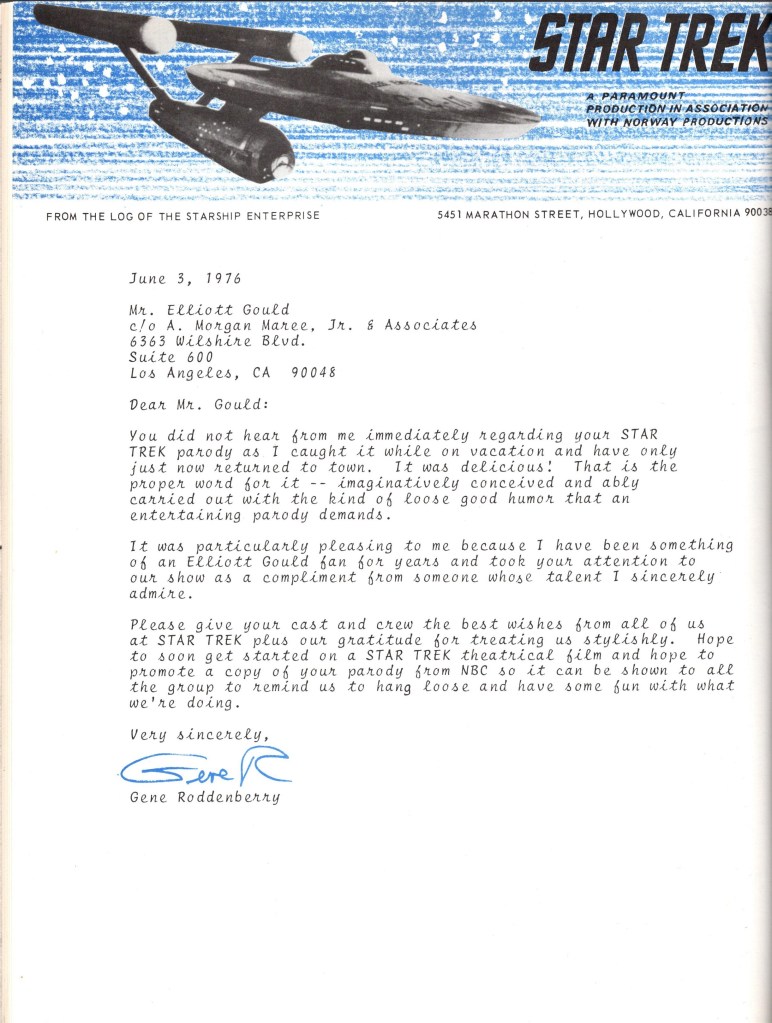
The approval he expressed makes sense, however, as Belushi and O’Donoghue clearly knew their Trek and respected the source material, even as they parodied it. Belushi’s Kirk says twice that there are 430 crewmembers aboard the Enterprise and accurately cites the captain’s serial number — SC937-0176CEC — as heard in Court Martial. There are also two references to the Promise Margarine commercial Shatner made in 1974.
Postscript
The tunics worn in the sketch were purchased from the Federation Trading Post in NYC.
-
Starship class, part two: Gene Roddenberry and Matt Jefferies
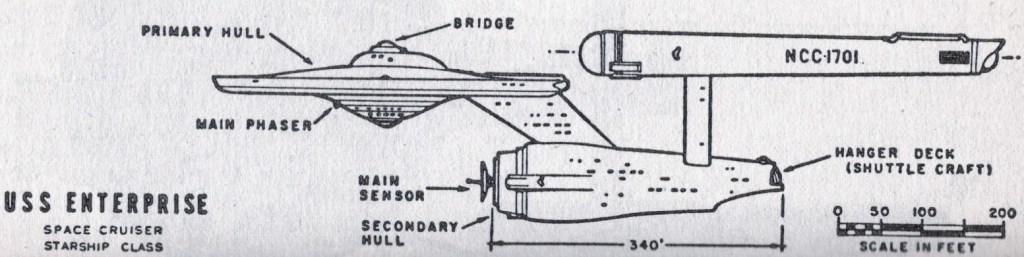
I grew up believing the Enterprise is a Constitution-class ship. I later learned differently and recently wrote The Enterprise is not a Constitution-class ship.
Many people really did not like that. Within 24 hours, the article generated lots of comments on social media, not all of them kind, and a bunch of hits on this site. (The traffic and the comments surpassed the previous champ, my piece on Harlan Ellison’s drug-dealing crewmember, in less than a week.)
Here’s the thing: we discuss this stuff because we love Star Trek, and I respect that, and anyone can disagree with me. I’m just this guy.
But if you hold fast to the idea the Enterprise is a Constitution-class ship, you are also disagreeing with Gene Roddenberry and Matt Jefferies.
The creator
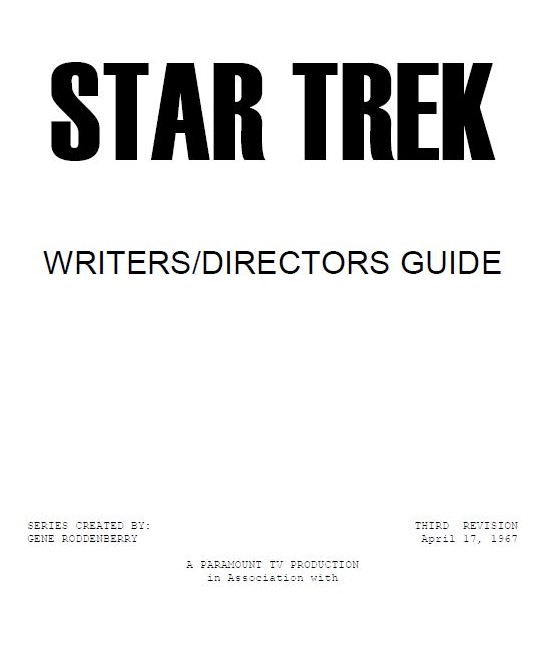
Gene Roddenberry created what’s typically called a “bible” for his show. The Writers/Directors Guide was a briefing document for people who were not part of the ongoing production and therefore needed basic information on the show. On page 7, Roddenberry and his staff wrote: The U.S.S. Enterprise is a spaceship, official designation “starship class.”

My copy is of the third revision, dated April 17, 1967. The date is important. This is almost two years after filming Where No Man Has Gone Before. It has been suggested that the dedication plaque, which states the Enterprise is a Starship-class vessel and which forms the basis of my argument, was a leftover from the pilot days that no one could be bothered to replace. This document makes it clear that is not the case.
The Making of Star Trek, first published in 1968 and written by Stephen E. Whitfield and Gene Roddenberry, also could not be clearer on this point.
The Enterprise is a member of the Starship Class (there are twelve of them) Registry Number NCC-1701. Starship Class vessels are the largest and most powerful man-made ships in space.
You can disagree with me. I don’t think you can disagree with Gene Roddenberry.
The designer
Walter Matthew Jefferies designed the Enterprise. The Making of Star Trek includes Jefferies’ renderings of the Enterprise, the bridge, the hangar deck, the shuttlecraft and the Klingon battle cruiser.
The Enterprise, depicted on page 178, is labelled “Space cruiser. Starship class.”
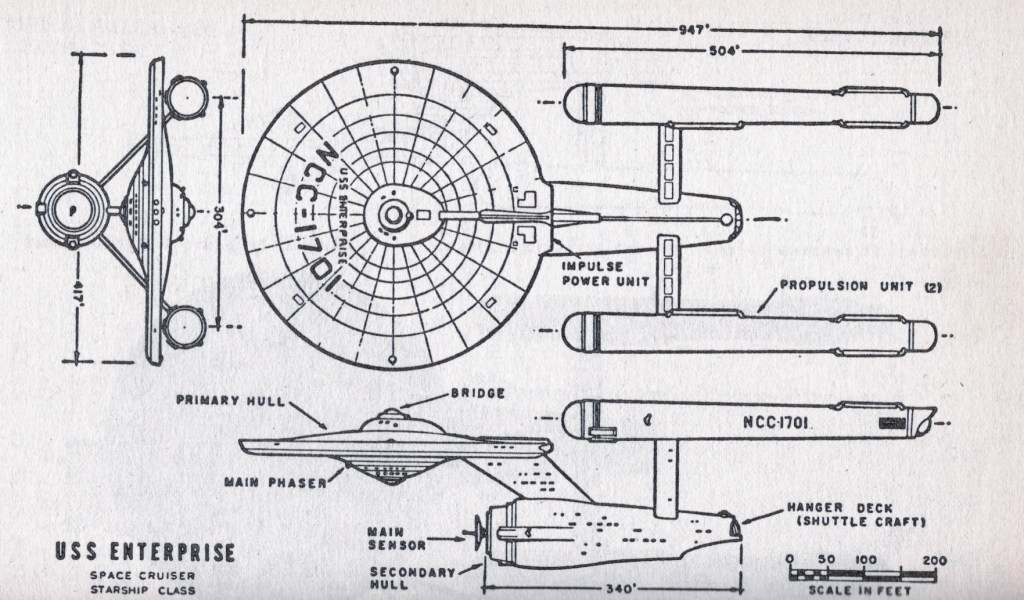
You can disagree with me. I don’t think you can disagree with Matt Jefferies.
If you haven’t done so, please read my first piece on this. I know a lot of people don’t like to hear it, but the reality is the Enterprise is a Starship-class ship.
I appreciate everyone who took the time to engage with me on this. Special thanks to Robert J. Sawyer and Pierre Charles Dubreuil who pointed me to the Jefferies drawing and the show bible, respectively.
Postscript
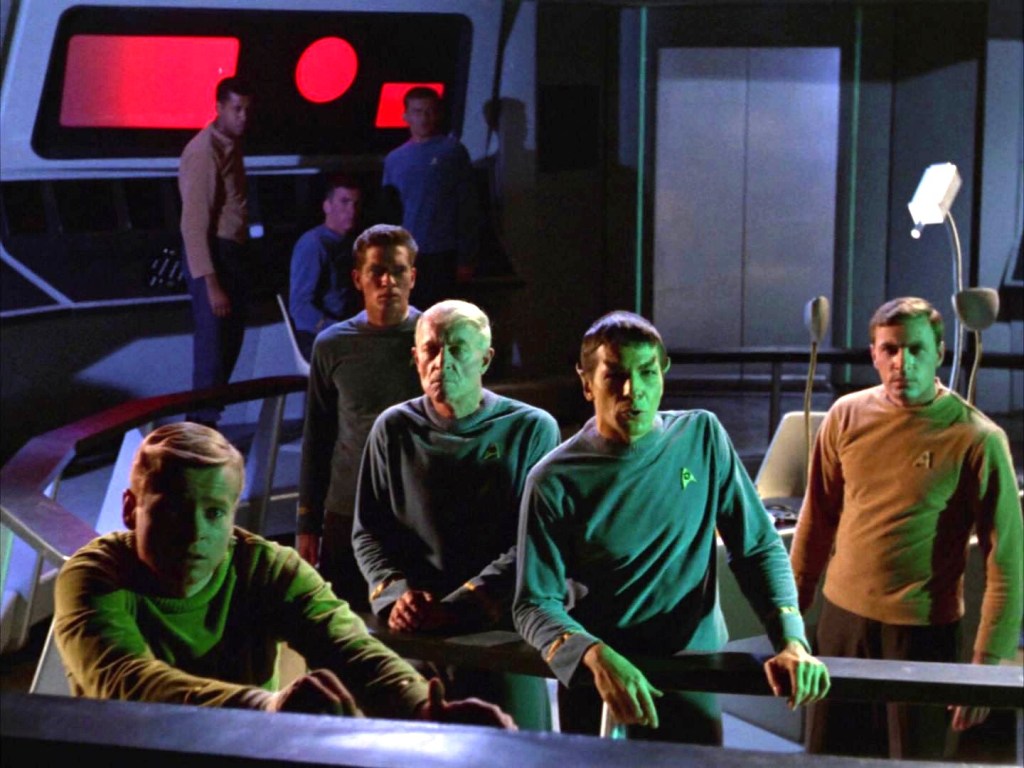
Captain Pike assigned one crew member to do nothing but stand beside the turbolift. He is there in every bridge scene in The Cage, so I have no idea if the plaque was on the set in 1964.
Images from TrekCore Update: Trek fan Karl Tate pointed out that guy moves off the wall in one scene and you can see the space beside the turbolift — and there was no dedication plaque on Pike’s Enterprise.
-
The Enterprise is not a Constitution-class ship

I grew up knowing that Kirk’s Enterprise was a Constitution-class ship. The designation was never stated on screen, but I was one of the chosen few with access to a trove of Star Trek facts: the Star Fleet Technical Manual.
Created by Franz Joseph and published in 1975, this book filled out imaginary worlds for me with details we never saw on screen. I knew the names of the buttons on the Vulcan lyrette, I knew Scotty had an office in Engineering, I knew McCoy’s pointy red scanner thingy was an anabolic protoplaser, I knew that the staterooms had jacuzzis, I knew that the bridge was offset 36 degrees counterclockwise from “front,” and I knew the Enterprise was a Constitution-class ship.
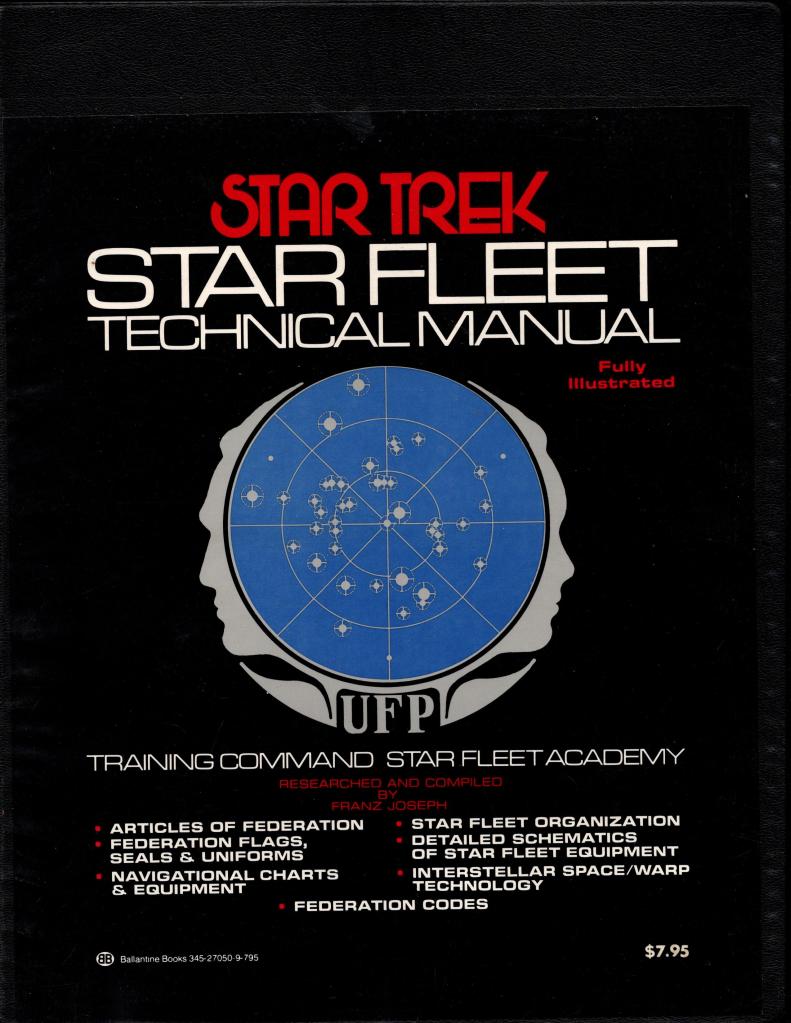
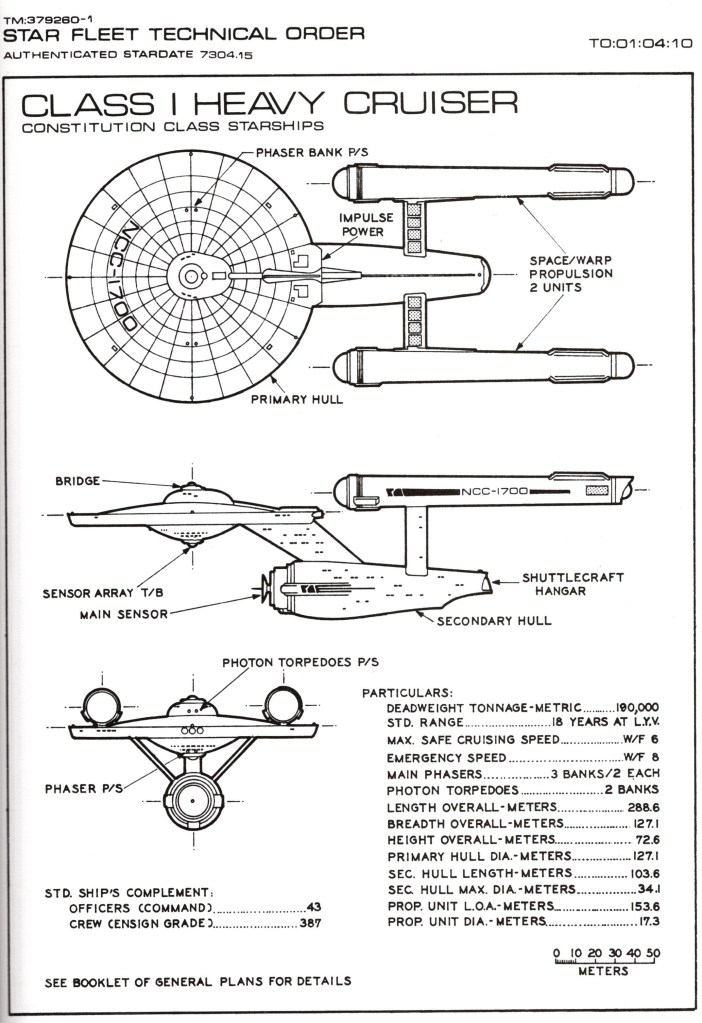
I knew all these things because the Technical Manual said so.
Later, I learned Joseph had based his work on a thorough study of Star Trek but that he also made up a lot of stuff. Indeed, “Constitution-class” is never said on-screen during the original series and we never see a USS Constitution or hear it referenced.
Instead, the Enterprise is actually a Starship-class ship. It said so right on the dedication plaque, just to the right of the turbolift as you exit the bridge. The plaque read:U.S.S. ENTERPRISE
STARSHIP CLASS
SAN FRANCISCO, CALIF.
It is just barely legible on screen, even on Blu-ray, but in this screen cap from Elaan of Troyius it is clear by the number and shape of the letters that it does not say Constitution Class. I also zoomed in on an image from The Naked Time, but it doesn’t really help. The resolution is just not there. (All episode images are from TrekCore.)
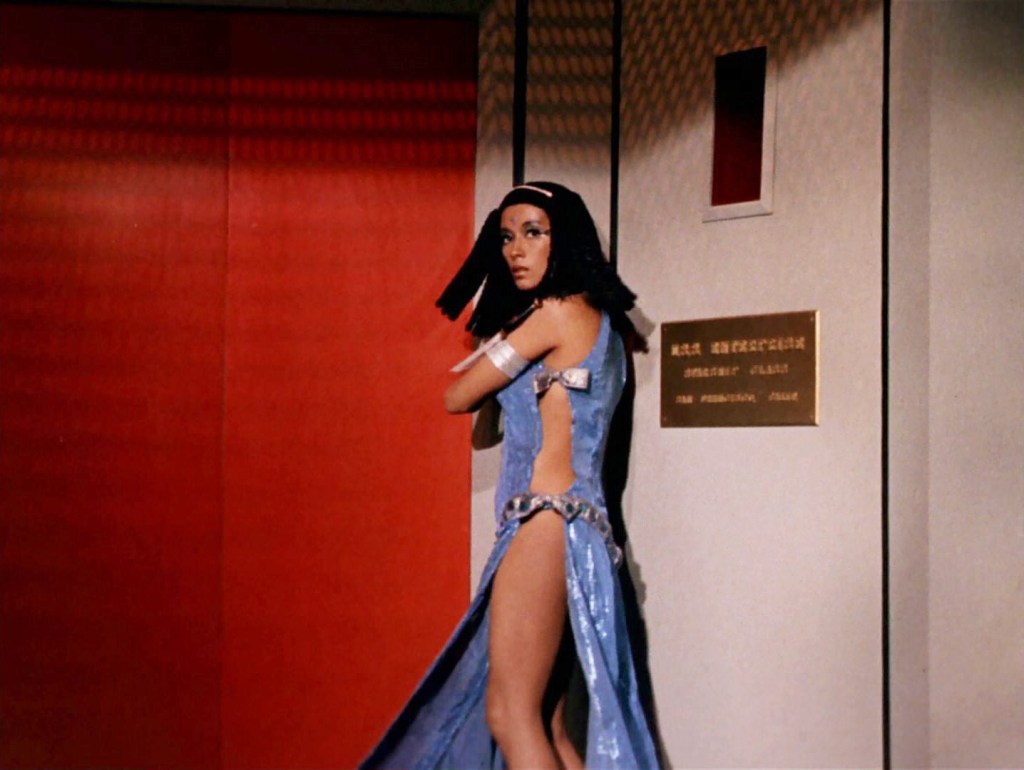
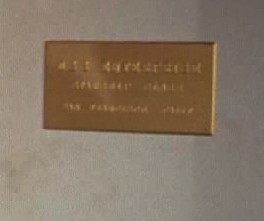
So, where did Franz Joseph get Constitution class? From the script for Space Seed, it seems. In the episode, Khan asks to study “the technical manuals on your vessel” and the script specifies that one page of a manual has the words “Constitution class.” While this is an interesting production tidbit, “Constitution” is neither stated nor visible on screen.
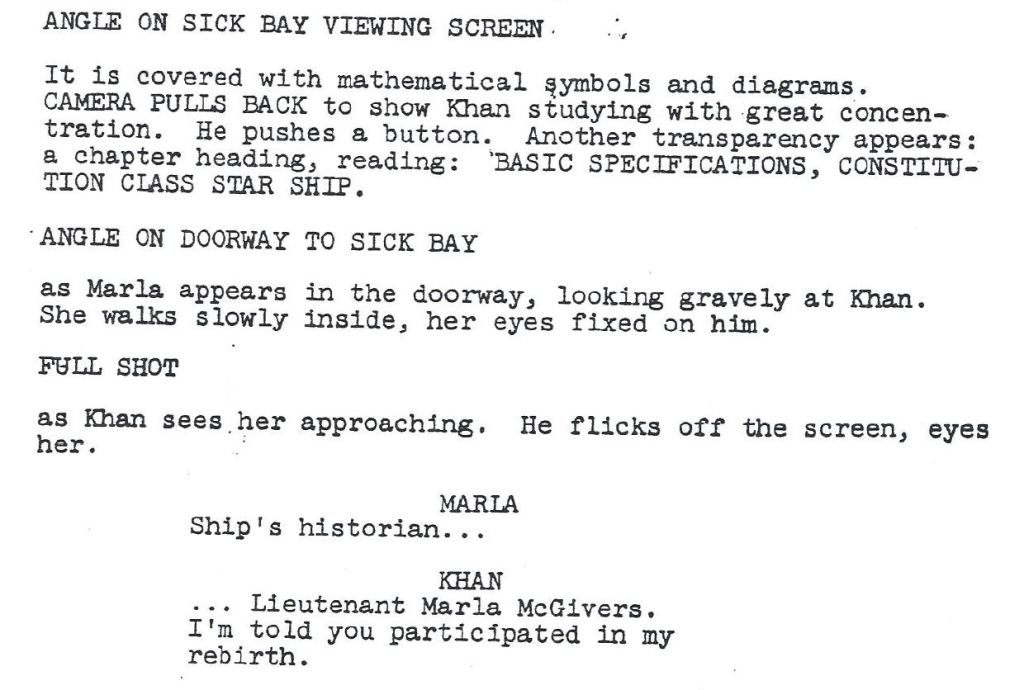
But that script was enough for TOS uber-fan and professional Star Trek prop and model maker Greg Jein. His seminal 1975 article The Case of Jonathan Doe Starship, published in the zine T-Negative, reproduces the graphic that was meant for the episode. (Click through to his article to see this image.) But here’s the thing: the image is not seen on screen and, even if it was, it is not a schematic of the ship but rather a component of the “primary phaser.” It is as logical to conclude that this is a Constitution-class component, not a part from a Constitution-class ship. (The graphic would be used later in The Trouble with Tribbles, but it is far too small to see any details.)
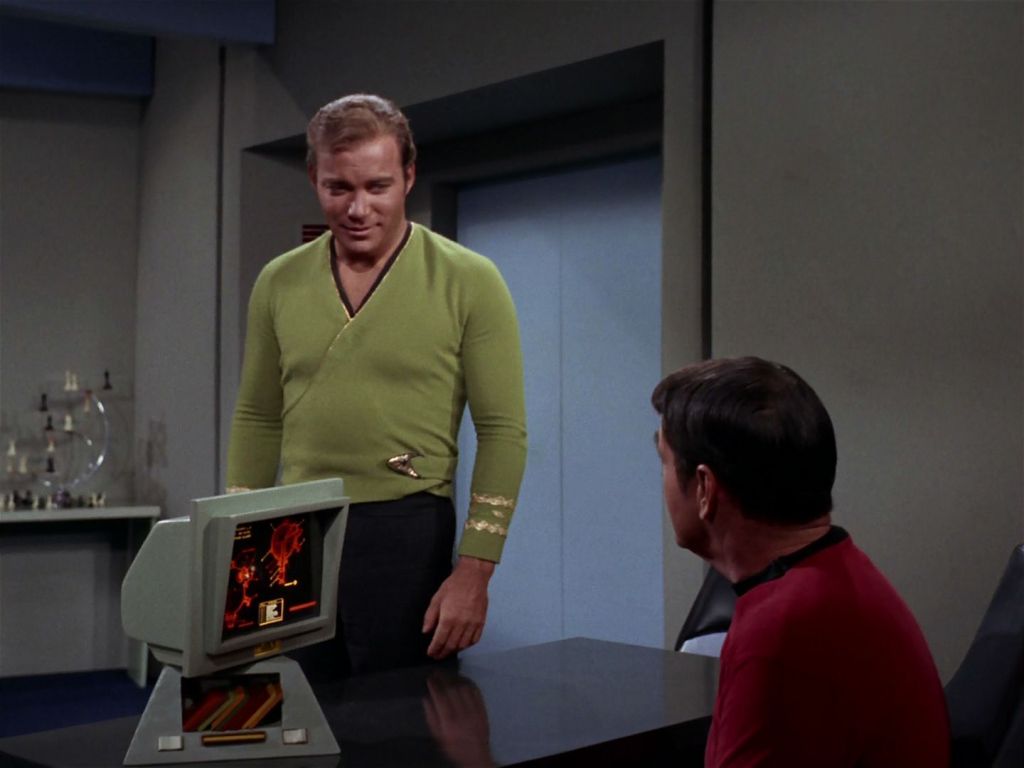
The Trouble with Tribbles Star Trek production luminary Michael Okuda is on the Starship-class side. When Eaglemoss decided to reproduce the dedication plaque in 2016, it turned to Okuda to confirm the appearance and content of the original. And, just as with the plaque on the bridge set, it identifies the Enterprise as Starship class.
(I, of course, had to buy one. It’s a nice piece but Eaglemoss decided to make it smaller than the original, probably to keep the cost reasonable. I wish it had not done that.)
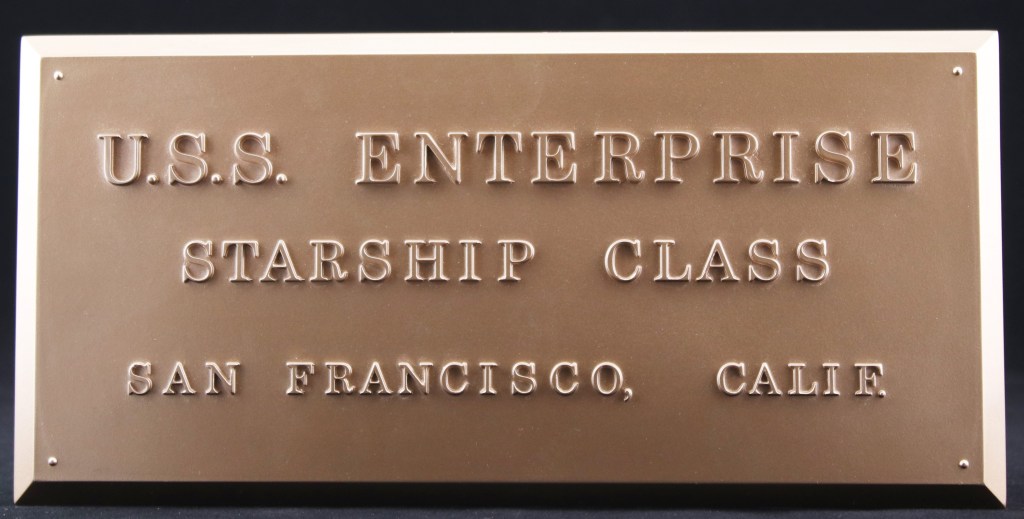
With apologies to the young fan I was, I have to go with the actual dedication plaque on the wall of the bridge. The Enterprise NCC-1701 was a Starship-class ship.
What did Gene Roddenberry and Matt Jefferies have to say about this? Read my followup article.
Postscript: The TNG retcon
“But,” say Next Gen fans, “Picard said it was a Constitution class.” He did — twice. Reading out loud from the database in The Naked Now, he says: “The Constitution-class Enterprise, Captain James T. Kirk commanding.”
Later, Picard confirms the class in a touching scene in Relics as he looks around the holodeck scene Scotty created, and the engineer himself uses “starship” to define a type, not a class.
Picard: Constitution class.
Scott: Aye. You’re familiar with them?
Picard: There’s one in the Fleet museum but then, of course, this is your Enterprise?
Scott: I actually served on two. This was the first. She was also the first ship I ever served on as Chief Engineer. You know, I served aboard eleven ships. Freighters, cruisers, starships, but this is the only one I think of, the only one I miss.
So, absolutely, TNG retconned the class. I don’t care. Dedication plaque beats TNG dialogue.
Update: Mike Okuda explained to me why the TNG staff opted for Kirk’s ship being a Constitution class.
We went with “Constitution” on TNG because it satisfied fan expectations, and because it implied that there were many different types of starships, which in turn implied that Starfleet was a bigger, more interesting, more capable organization.
That makes sense, as most fans would have thought using the correct designation was an error. But it is a retcon; it was a Starship-class ship in the 1960s.
Postscript the second: JJ got this right at least
I really dislike the design decisions in JJ Abrams’ reboot: the Apple-store bridge, using a brewery for Engineering and, worst of all, mucking up Matt Jefferies’ sleek and beautiful ship design with bulbous nacelles. But one thing Abrams got right: that ship is Starship class.
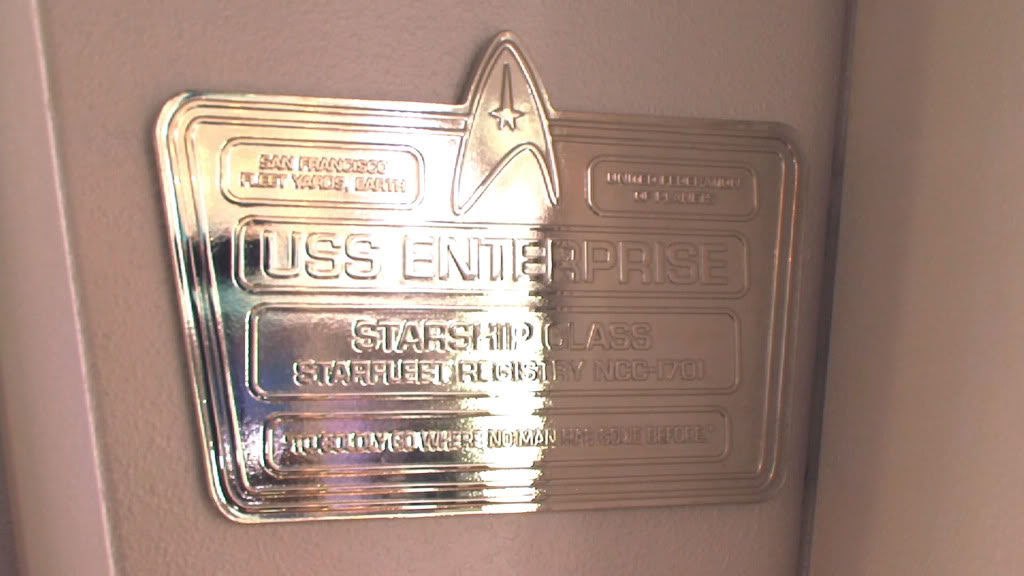
Image from Memory Alpha
Please also read the follow-up article I wrote, with additional primary sources.
Collecting Trek
A TOS collection 40 years in the making