-
Inside Star Trek 8: George Takei on almost everything except Star Trek
Inside Star Trek was a semi-official newsletter, published under the guidance of Gene Roddenberry. This connection gave the writers access to the actors, production crew and sets.
I own the complete run:
- Issues 1 to 12: Inside Star Trek, edited by Ruth Berman
- Issues 13 to 24: renamed Star Trektennial News, edited by Susan Sackett
- Issues 25 to 31: again called Inside Star Trek, edited by Virginia Yable
Here are highlights from issue 8, published early 1969.

Those invisible stagehands
This is the weakest Inside Star Trek so far. It opens with a silly reader question:
In “Plato’s Stepchildren,” did the actors control the forced movements the characters made when they were being telepathically pushed around, or were they pushed around by “invisible” stagehands? Dorothy Waibel
Invisible stagehands? Well, kudos to Dorothy for having the courage to sign that question. Editor Ruth Berman responded, “The actors did it themselves.”
Reader Carol Stoddard asked:
Is Dr. McCoy’s daughter going to come on the Enterprise in any episode?
The idea of meeting McCoy’s daughter had first been pitched by Dorothy Fontana in early 1967, and the third issue of Inside Star Trek touched on this briefly. (Here is my article on that.) Berman replied:
No, at least not this season. Plans for a show about Joanna McCoy were begun, but did not work out.
No, those plans did not work out. Fontana’s pitch had Kirk and Joanna begin a relationship, and that caused problems between the captain and Leonard McCoy. It would also have caused problems for viewers, because it would have been icky.
George Takei on everything else
The rest of the issue is a wide-ranging interview with George Takei, and that’s why this is a weak outing. Not because of Takei himself — who I quite like and often find interesting — but because he wasn’t asked about Star Trek. We hear about a course at the Inner City Cultural Center, a small play he was in, the origins of Japanese Kabuki theatre, and a character study of Shakespeare’s Brutus. There was so little content available to fans in the 1960s that anything related to the show was consumed eagerly, but this really would have been a better article had they actually discussed Star Trek.
Still, there are two interesting bits. The first is about the advantage of being an Asian actor.
Many people complain about being of minority groups and so forth. But I think the very fact that I have this face opened a lot of doors for me… Other kids I was going to school with were kind of envious of my thing. But they were tall, blond, blue-eyed, and good looking, and they were a dime a dozen. My type was a rarity, so I worked, and they stayed in school.
Takei also discussed his family’s internment in Japanese-American World War II camps. Berman asked him:
In the official biography of you, it says that during World War II your folks moved from California to Arkansas. Is that a euphemism for saying that you were in one of our concentration camps?
It’s amazing to me that Desilu or perhaps Paramount, depending on when this biography was created, would characterize forced imprisonment as a family move, and good for Berman for asking this question. Takei’s response, in part:
My real memories of those camp days are fond memories… When we went, I was two years old or something like that, not really old enough to comprehend, and my parents told us we were going for a long vacation in the country. To a child, you know, that’s exactly what it was.

In his autobiography To the Stars, published in 1994, Takei puts his age at four, and states again that he thought of it as an adventure: “I just assumed this was the way people went to the country for a long vacation.”
For those old enough to understand what was being done to them, however, it was a grave injustice. Years later, that experience inspired the musical Allegiance, featuring Takei as the grandfather of an uprooted family. It premiered in 2012 and hit Broadway in 2015. It garnered mixed reviews, as in this piece from Variety:
There’s a tremendously affecting scene at the end of Allegiance in which George Takei’s character, his eyes glistening with tears, reconciles with his conflicted past and finds a promise of comfort that has eluded him for more than 50 years. The knowledge that the story was inspired by Takei’s childhood hardships in the Japanese-American “relocation centers” of World War II adds significantly to the emotional impact. But the powerful sentiments involved are too often flattened by the pedestrian lyrics and unmemorable melodies of Jay Kuo’s score, making an unconvincing case for this material’s suitability to be a musical.
…the most moving work comes from beloved Star Trek veteran Takei, who brings gentle, albeit sometimes corny, humor to Ojii-chan. His deep personal association to the material and evidence of a generous spirit of forgiveness dictate the tone, and are among the show’s strengths.

Photo: NY Times The newsletter’s overlong and unfocused interview comprises almost all of this issue, and it feels like Berman just wanted to fill the pages. Readers would have been better served by more Star Trek in their Star Trek newsletter. This issue does end on a great note, however. Berman says that just after her interview with Takei, the cast and crew learned the series had been “picked up for the rest of the third season.”
Inside Star Trek is an invaluable source of early Star Trek voices. I’ll cover each issue. Click here to read other articles in this series.
-
One of everything, please: 1969’s Catalog #3 from Star Trek Enterprises

Gene Roddenberry realized in the late 1960s that people who love a TV show want to buy stuff related to it.
That had eluded most people back then, which is funny because the sports folks got it a lot earlier. The first set of baseball cards was issued by Goodwin Tobacco in 1886. Gypsy Queen or Old Judge smokers could collect cards featuring 12 New York Giants. And you’d be in the money today if you held on to the 1939 World Series program with the famous photo of Lou Gehrig’s big swing.

Photo from allvintagecards.com But Desilu and then Paramount did not market Trek collectibles in the 1960s. Luckily, Roddenberry was not known for missing business opportunities, and Star Trek Enterprises was born. Soon renamed Lincoln Enterprises, it began in 1967 as a mail-order business run by Bjo and John Trimble. It sold pendants, memo pads, insignia and postcards, plus subscriptions to the Inside Star Trek newsletter (which I am covering). It also sold film clips cut from production footage, which technically belonged to the studio, and scripts, while ignoring the percentage of those sales that should have gone to the writers.
But, for early Star Trek fans, these catalogs were a grand source of memorabilia when there was almost nothing else for sale. Here is my take on this 1969 catalog.
Research note: Catalog #3 is not dated but three observations lead me to believe it was published in 1969:
- It was produced by Star Trek Enterprises, which was renamed Lincoln Enterprises just before Roddenberry and his first wife Eileen divorced in 1969.
- It advertised issues one to 12 of the Inside Star Trek newsletter; issue 12 was produced in 1969.
- That issue would be the last until 1976, when it would relaunch under a new name, and as Catalog #3 references “subscribers” the company obviously did not yet know that the newsletter was about to suspend publication.
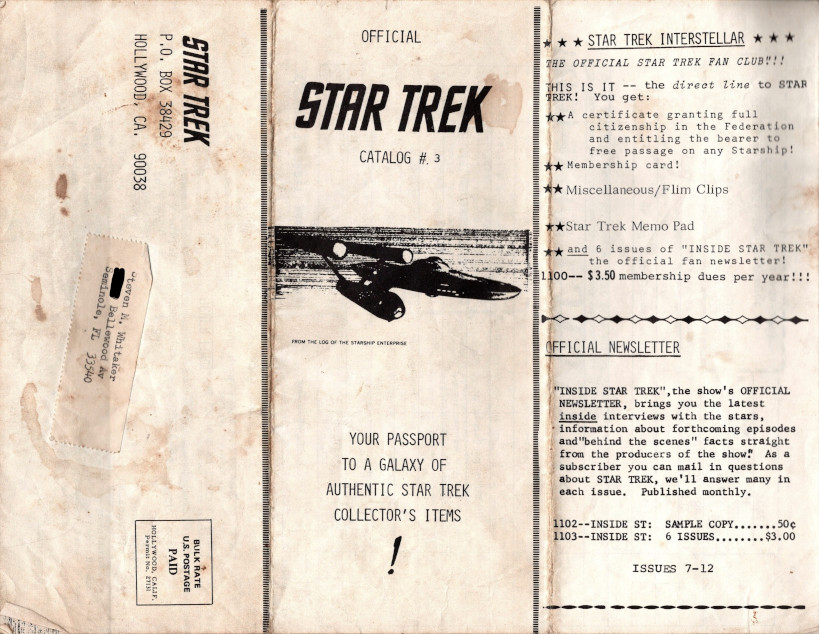
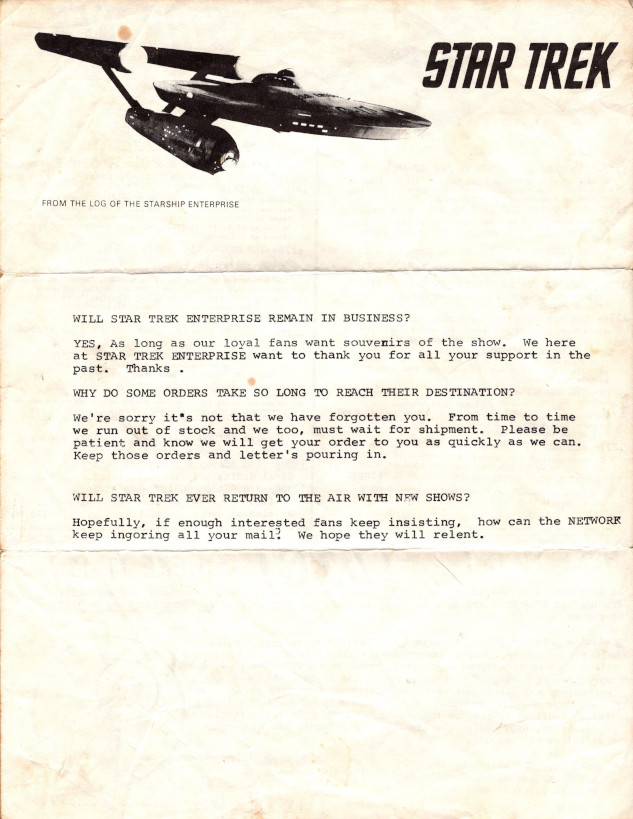


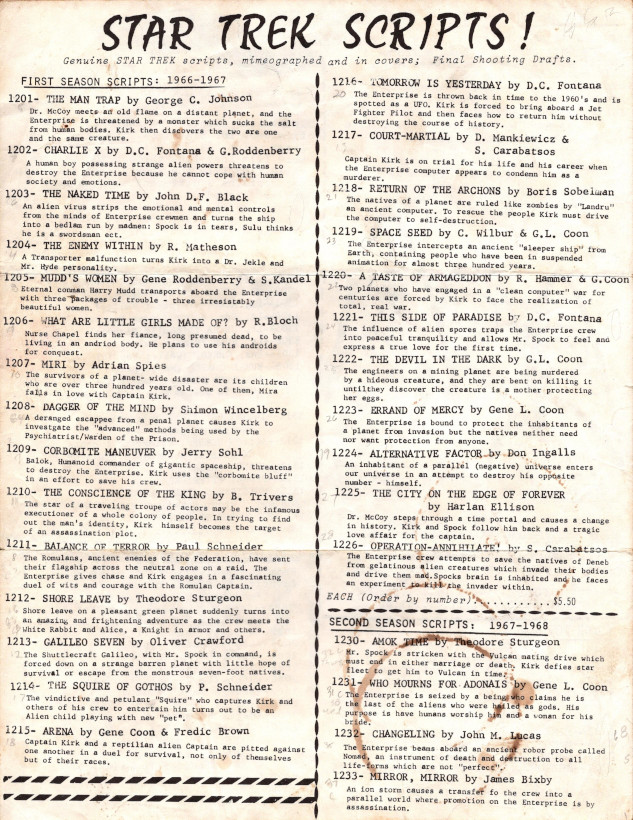

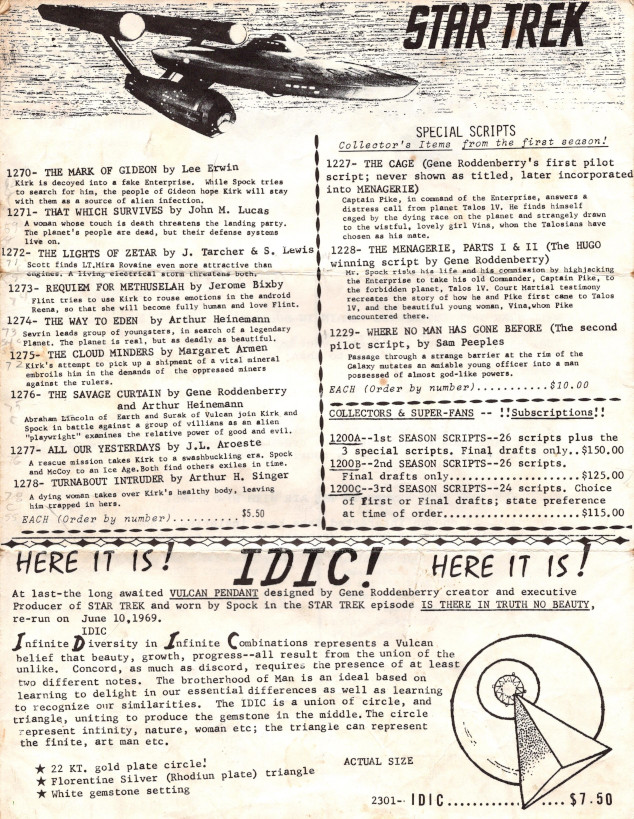
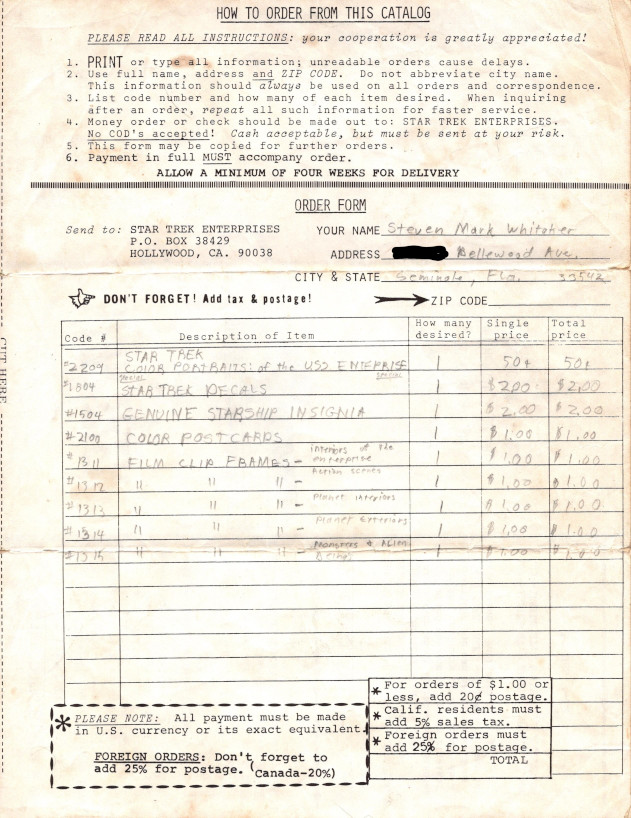
Click for larger versions.
What I would have bought
I was too young to place an order with Star Trek Enterprises, but here’s what would have been at the top of my shopping list. All prices are in US dollars.
Star Trek Interstellar membership. $3.50. Film clips, a memo pad, issues of the newsletter and a membership card for a few bucks? Deal.
Star Trek Writer’s Guide. $2. I now have a copy of the third revision of this document, dated April 1967. It’s a wonderful resource for fans as well as writers. I will cover it someday.
Flight Deck Certificate. $1 for the deluxe version. I would have grabbed one of these based on the promise it was “signed by Captain Kirk and Gene Roddenberry!” Sadly, it was not. I got mine from a short-lived sci-fi store in Toronto. I tell its story here.

IDIC medallion. $7.50. Back then, I would have purchased one. Today, even knowing what I know, I probably would anyway.
Film clip frames. All 14 sets for $12. “These are the first print ‘daily’ originals from the very film that runs through the cameras as they film the show…Scotty tells us that these frames will fit into half-mount holders…for viewing in a home 35mm projector.” So, this is actual Star Trek film, from the set, that I can project on a big screen at home in glorious colour? For fans in the 1960s — accustomed to watching the show on tiny TV screens, often in black and white — this would have been amazing.
Star Trek is… pitch. $1. This is perhaps the most important document in Star Trek history — and you don’t have to pay a buck for it. Read about it and download a PDF here.
Star Trek scripts. $505 for every episode and variant. In the days before Chrissie’s Transcripts Site put all the Star Trek dialogue online, this would have been a Holy Grail of collecting. Before streaming and Blu-ray, we had reruns that were always chopped up to make room for more commercials, the James Blish adaptations that often differed from the screened version, and the Fotonovels that were great but often changed the dialogue. To have the actual scripts would have been wonderful.
How much for one of everything?
I added it up. A well-heeled Star Trek fan back in the day could buy one of everything for $554.50. That’s the best version of each item: six issues of the newsletter, all three sets of the two-color decals, all three seasons of the scripts, including the first and final drafts from season three, etc.
That’s the cost at the time. In today’s dollars? I can’t say how accurate inflation-calculation sites are, but two seemingly reputable ones (Morgan Friedman and the US Inflation Calculator) say we’re looking at about $4,800 in 2024 dollars.
That’s a fair bit of money but, if I could use the light-speed breakaway factor to slingshot back to 1969, would I spend that much on Mr. Roddenberry’s mail-order store? You bet I would.
Also, my thanks to Florida’s Steven Whitaker for holding on to his copy of the catalog — numerous coffee-mug rings and all — so that I could buy it on eBay years later. He completed the order form but apparently never actually purchased his portraits, decals, insignia, postcards and film clips, so I hope he attended one of the early conventions and grabbed some great stuff.
-
The last-minute Roddenberry rewrite that elevated Balance of Terror
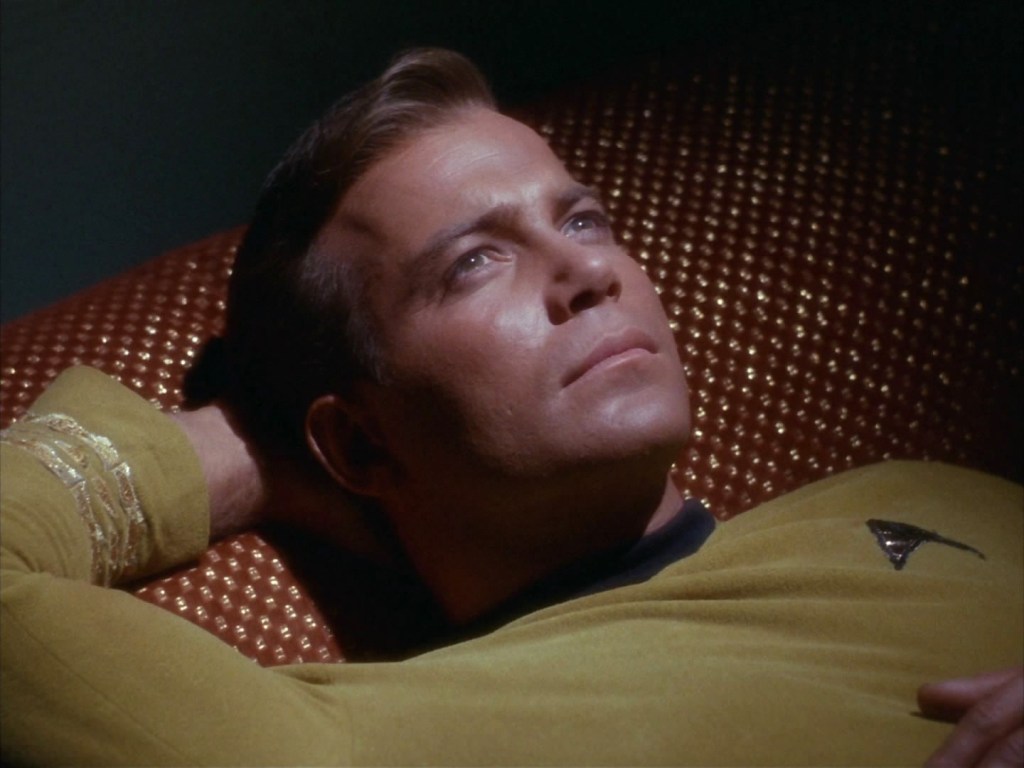
Captain Kirk is fond of a good speech. All the adventure in Return to Tomorrow hinges on his inspirational words in the briefing room: “Risk…risk is our business. That’s what this starship is all about. That’s why we’re aboard her.”
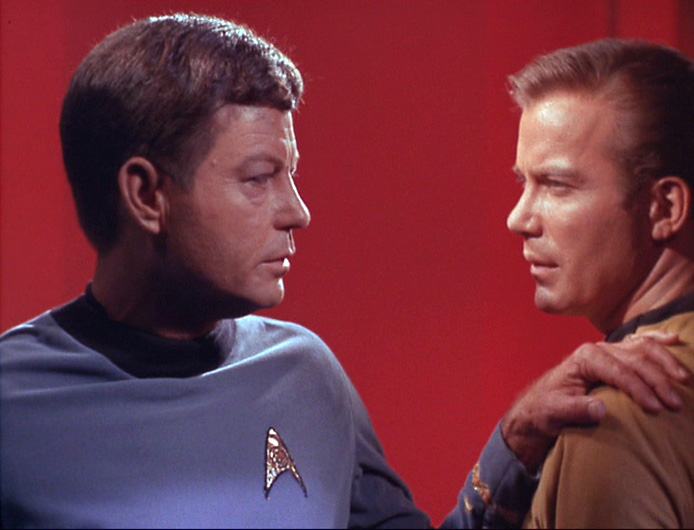
A similarly critical moment is brought to life in Balance of Terror when Kirk confides in McCoy during the standoff with the Romulan Commander. It’s a smaller and more private moment than the other speeches, and a rare glimpse into the inner life of the usually self-confident captain.
I wish I were on a long sea voyage somewhere. Not too much deck tennis, no frantic dancing. And no responsibilities.
Why me? I look around that bridge, and I see the men waiting for me to make the next move — and Bones, what if I’m wrong?
It is one of the best scenes in all of Star Trek. The captain, at a critical moment when a poor decision could lead to the loss of his ship and a catastrophic rise in tensions with an old enemy, confides his fear and insecurity to one of his closest friends. McCoy’s reassurance hits just the right note, and Kirk returns to a hushed and darkened bridge to once again make the next move.
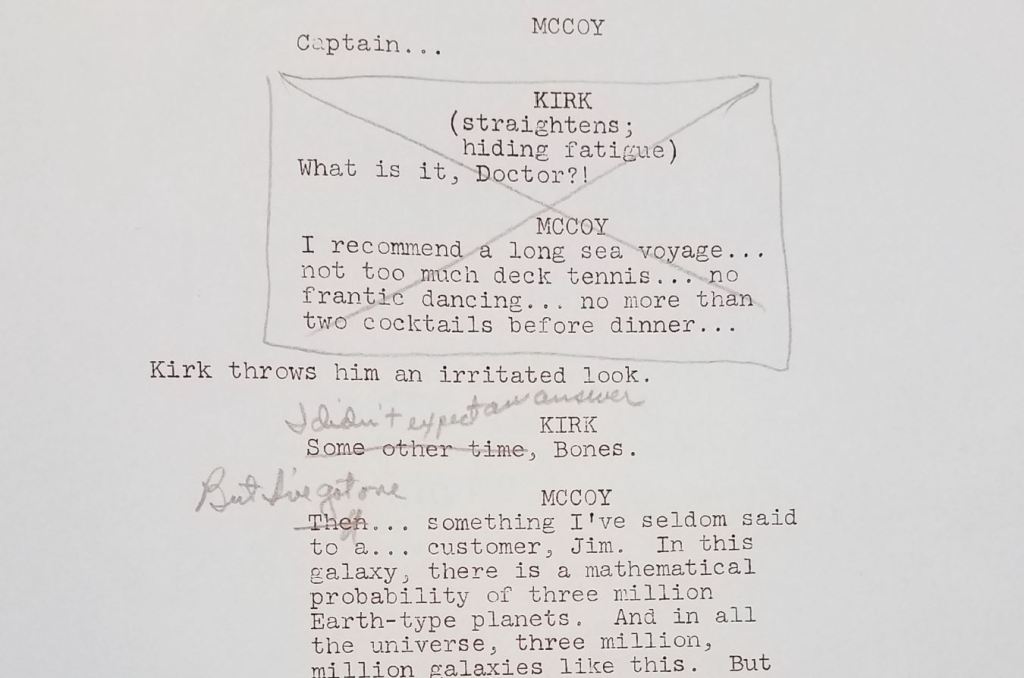
That scene was filmed on Tuesday, July 26, 1966, according to both Memory Alpha and These are the Voyages, and it was penned by Gene Roddenberry only the day before. The handwritten change was dated July 25. Writer Paul Schneider’s last script, dated July 22, 1966, had Kirk say:
Why, Bones?… I’m a Starship captain… This is a decision for diplomats, not one man! How can I decide if we risk starting a war… risk millions of lives.

Here’s the thing: had that speech been left unchanged, the story would have played out the same and the episode would still be considered a classic. But Roddenberry’s version showed a much greater understanding of the character and of the burden laid on him. The commitment to detail showcased by this small, non-plot scene is one reason Star Trek holds its audience when just about every other ’60s show has faded into the ether.
Reuse the best material
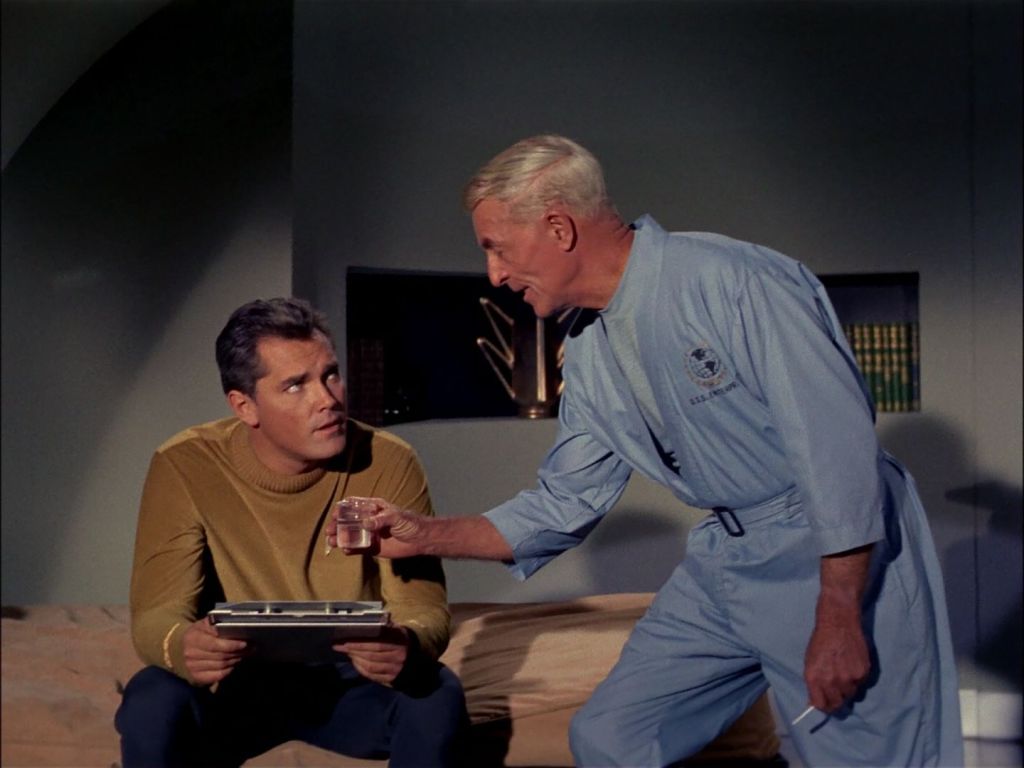
This scene is a direct call back to Captain Pike in The Cage. Following the death of three crew members on Rigel VII, he too is doubting himself and he, like Kirk, confides in the ship’s doctor in the privacy of his cabin. The scene Roddenberry wrote in 1964 worked beautifully then and worked just as well when he borrowed the idea two years later.
JJ Abrams’ Star Trek Beyond made the same play. Kirk is again with McCoy, questioning the choices he has made, but he has much less cause to feel insecure and the scene is a pale imitation.

It was not unusual for Roddenberry to rewrite scripts, as in Balance of Terror. He did it so often and to such an extent that writers routinely complained and many had pseudonyms ready to go. The story credit on A Private Little War is “Jud Crucis,” for example, a take on “Jesus Crucified” that Don Ingalls adopted to protest Roddenberry’s changes.

But those rewrites were often magic. That scene in Balance of Terror lasts less than 90 seconds and yet it gives a world of insight into the captain. The episode would still be great without it, but less so.
Postscript
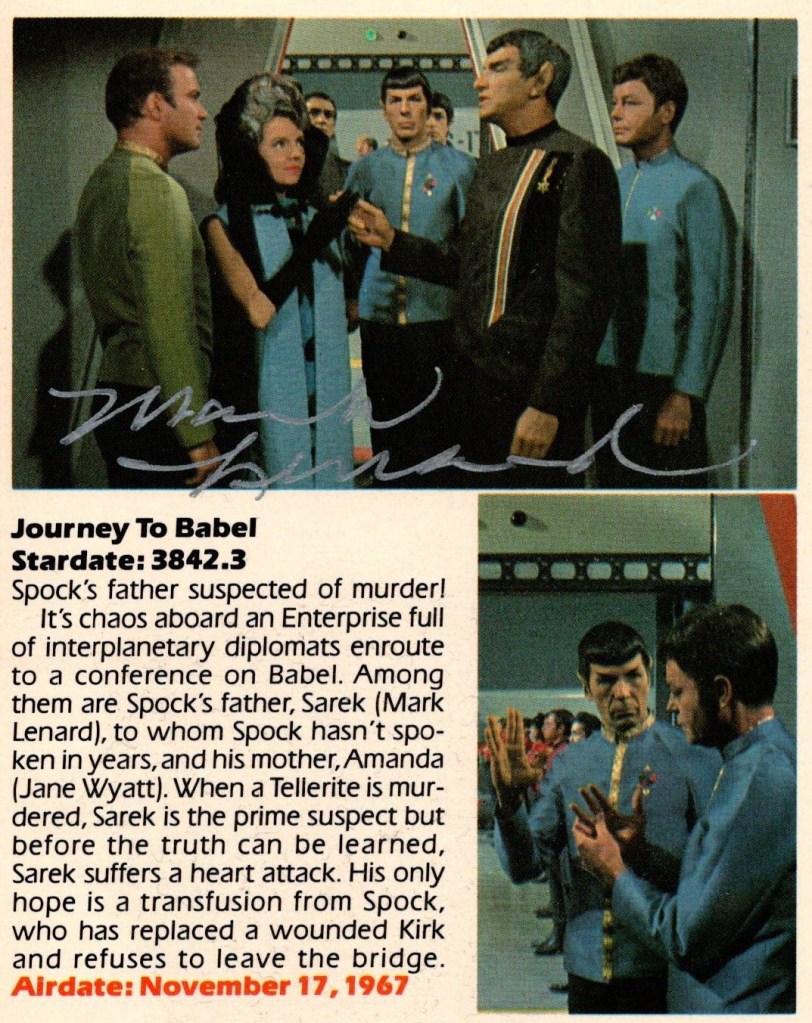
Mark Lenard was a guest at the 1989 Toronto Trek convention, and I guess he didn’t charge much for autographs because I could afford to get three items signed: a Star Trek III 8×10, the convention program book and, my favourite, a VHS copy of Journey to Babel.
At his talk, the only question I could think to ask was: “Did the Romulan Commander ever have a name in the script?” He looked at me blankly for a second and then replied: “No, he was just called ‘Commander.’”
Different versions of the script and the memos on the episode confirm Lenard’s answer. It is strange the Romulan was denied a name, but perhaps it was done to emphasize that being a commander was what he was, and not just what he did.
Postscript the second
An interesting side note: Roddenberry borrowed the deck-tennis idea. Paul Schneider had McCoy speaking some of those lines in a script dated July 20. Roddenberry deleted the sentence and then a few days later gave those words to the captain, and added his moment of self doubt.
-
What did AMT get for building the Galileo? And how much does a shuttlecraft cost?
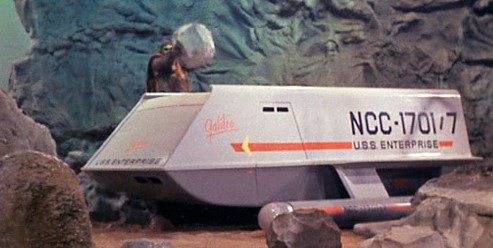
You may have heard that model company AMT built the shuttlecraft Galileo exterior, the interior set and the miniature used for filming in exchange for the right to produce one or more consumer kits, but many sources are vague or incorrect about which models came out of that deal. As I wrote in an early post on this site: “Some sources say the deal was to produce the Klingon D7 model, others say the Enterprise; Matt Jefferies’ brother Richard claimed in his book Beyond the Clouds that the deal covered both the Enterprise and the Galileo models.”
Even Richard, however, was fuzzy on the specifics. The truth, according to Desilu documents from 1966, is that AMT’s Galileo construction work netted it the right to produce only the Enterprise model kit.
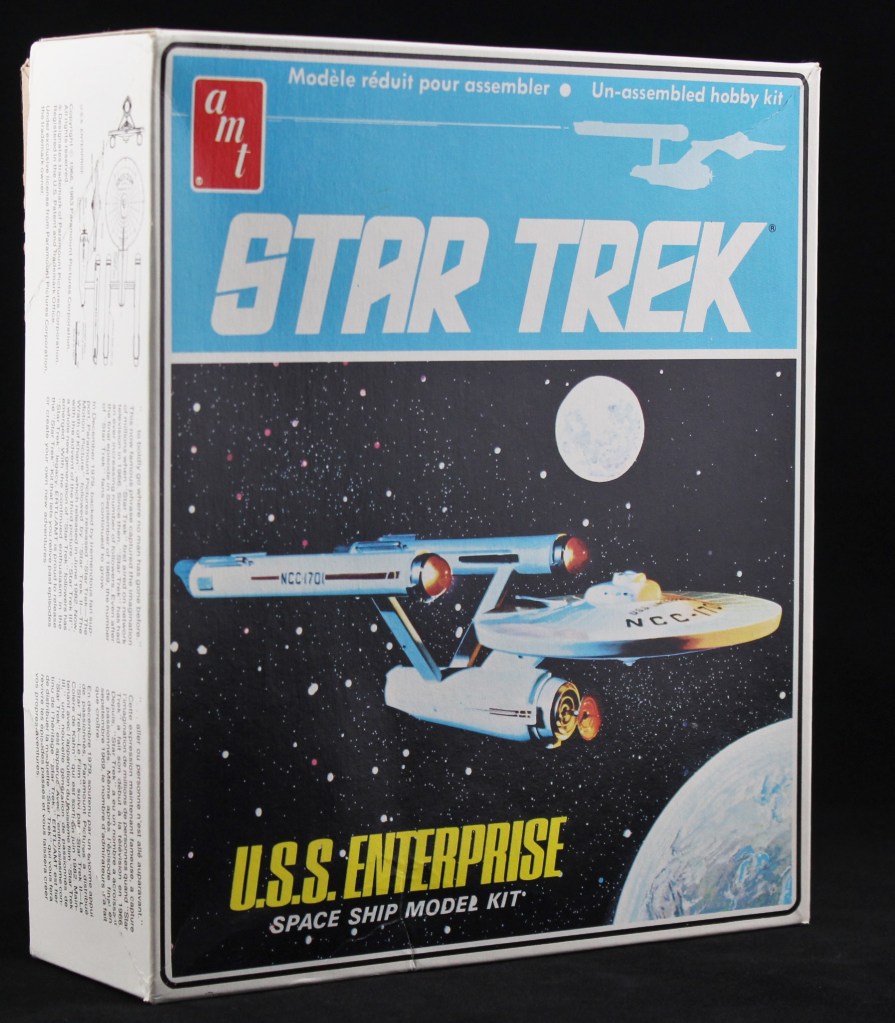
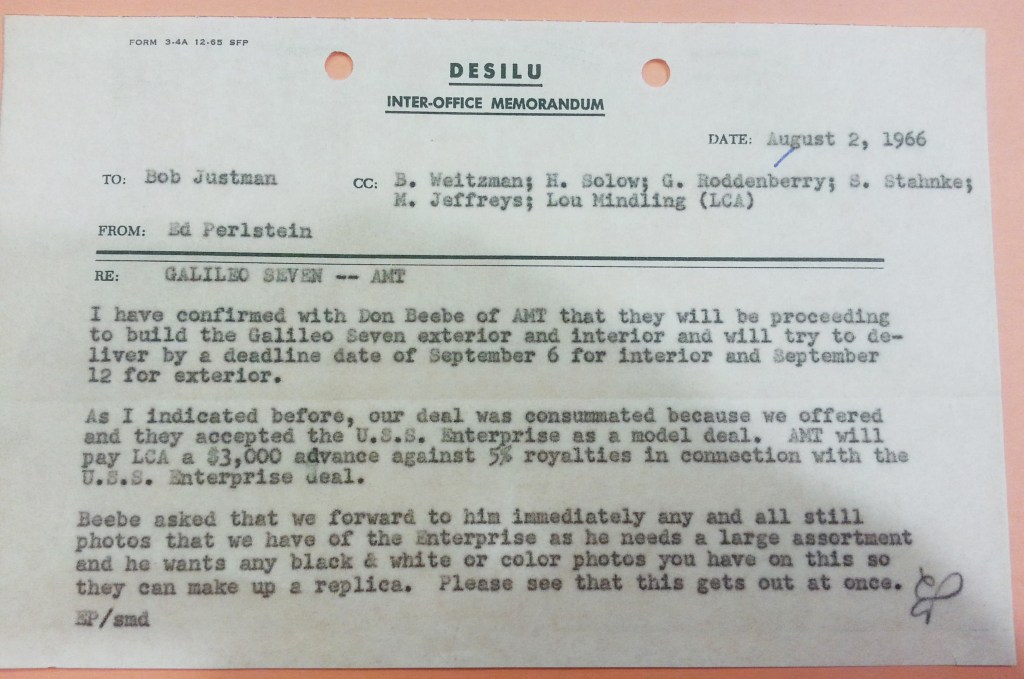
The 1983 reissue AMT Enterprise A memo from Edwin Perlstein, Desilu’s Director of Business Affairs, dated August 2, 1966, informed producer Bob Justman that the licensing deal had been finalized.
I have confirmed with Don Beebe of AMT that they will be proceeding to build the Galileo Seven exterior and interior and will try to deliver by a deadline date of September 6 for the interior and September 12 for the exterior.
As I indicated before, our deal was consummated because we offered and they accepted the U.S.S. Enterprise as a model deal.
A September 1967 article in Popular Mechanics identifies Beebe as the manager of AMT’s Speed and Custom Division in Phoenix, where the Galileo interior and exterior were constructed. The shooting miniature was probably built there as well.
$24,000 for a shuttlecraft
A separate letter from Perlstein, also sent on August 2, 1966, communicated the details of the agreement to Lou Mindling of Licensing Corporation of America, which handled official Star Trek licensing.
Perlstein said AMT had set the construction cost of the Galileo exterior and the interior set at $24,000. AMT would build those and the shooting model and pay LCA royalties of 5% plus a $3,000 advance.
In a separate deal, AMT would also be permitted to sell Galileo model kits. That deal was worth a royalty of 5% of sales, with 60% going to Desilu and the rest to LCA.
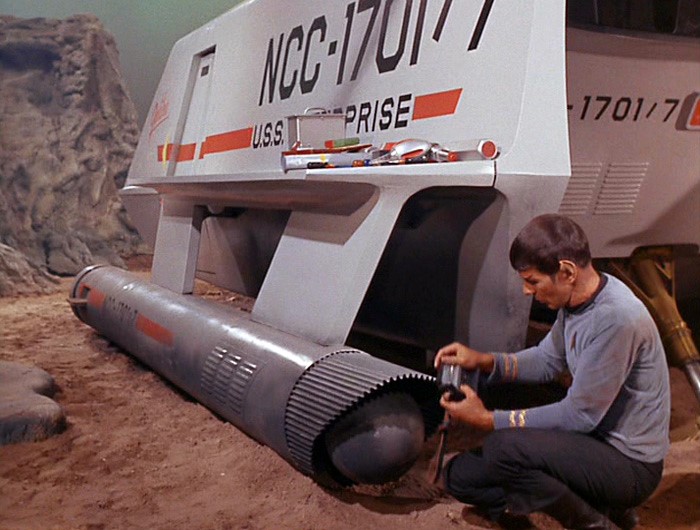
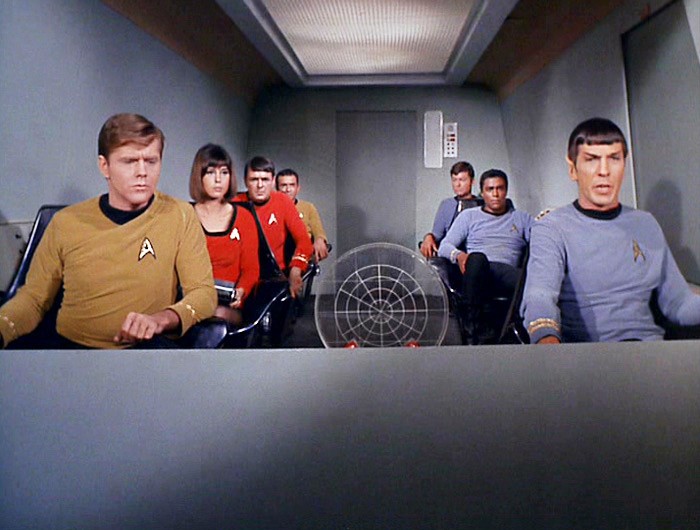
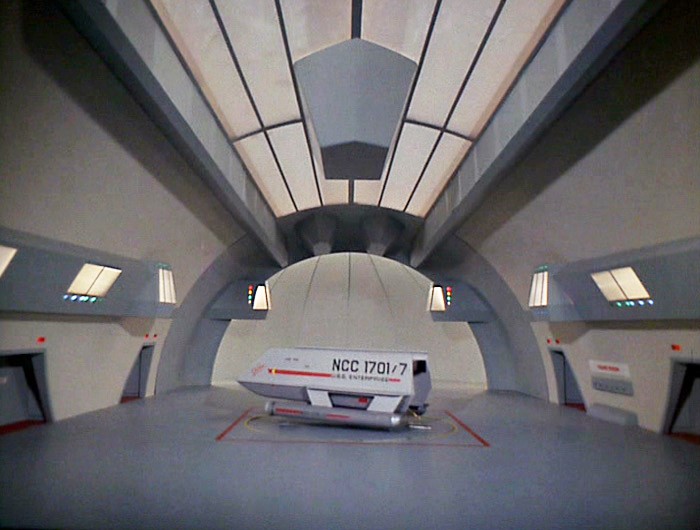
AMT’s Galileo exterior, interior set and the miniature (from TrekCore) Union considerations
The letter then gets specific about the final assembly of the Galileo, as that work needed to be done by union members.
Because of the Local #44 problem, the hardware such as seats, instrument panel, etc. will be unassembled and will be assembled at Desilu by Local #44 personnel. This cost of installation by Local #44 employees will be absorbed by Desilu.
$650 for the shooting model
A follow-up letter from Perlstein to AMT’s Beebe on September 14, 1966, adds the interesting fact that AMT estimated the cost to build the shooting miniature at $650. It also stated that LAC had dropped its request for a $3,000 advance on the Enterprise sales.
One million model kits
More than a year later, we get a sales update in a memo from Bob Justman to Gene Roddenberry. Writing on October 19, 1967, Justman said of the Enterprise kit:
I have it on reliable information that the “STAR TREK” Model Kit will sell more than a million copies within its first year of production… All I know is that the machine which turns out the plastic parts for the kit goes continually 24 hours a day, 7 days a week and AMT is rushing another machine into production, so that they can keep up with the demand.
Despite having the rights to the Galileo, the shuttlecraft kit was not released until 1974. I do not know the reason for the delay, but Justman was probably correct when he said in that same 1967 memo that “My personal feeling is that pretty soon AMT will be sorry they did not undertake the Galileo Model Kit.”
The misconceptions around the licensing specifics are, admittedly, minor details, but these documents are an interesting glimpse into the very early days of TV and movie marketing. In so many ways, Star Trek and its fans forged a path that other franchises would follow.
Justman ends his memo with a lament that would be validated a decade later by the success of the Star Wars toys:
Just imagine what aggressive merchandising could have done for the show and for the studio!
Postscript
Doing some reading for this piece, I discovered Memory’s Alpha’s AMT page had misspelled Perlstein’s name as “Pearlstein.” I have corrected that.
-
Before VCRs, we had the Fotonovels. And they were glorious

The serial number of the USS Reliant is NCC-1864. I’ve known that since 1984, when my family got a VCR and I could pause a rented copy of The Wrath of Khan. Pausing let me study details, and that was a game changer. Soon I was recording TOS repeats and taking 90 minutes to play and pause my way through the episodes.
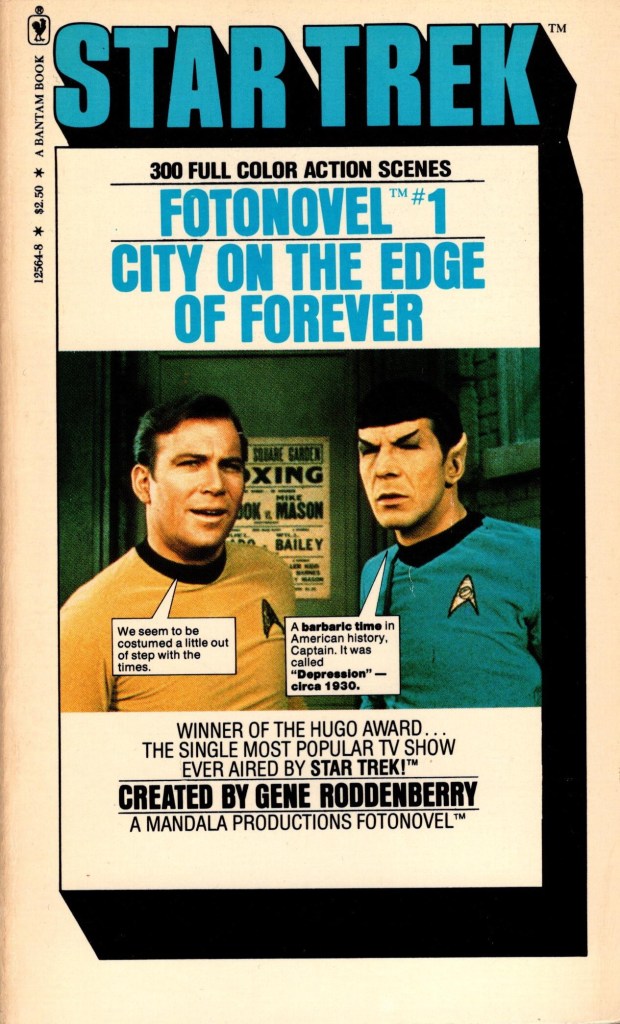
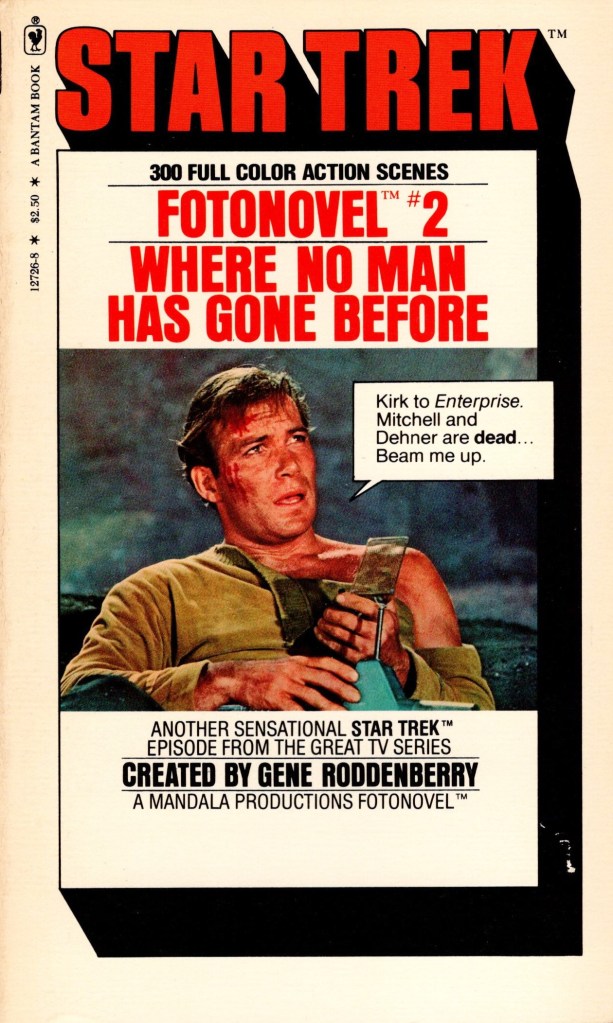
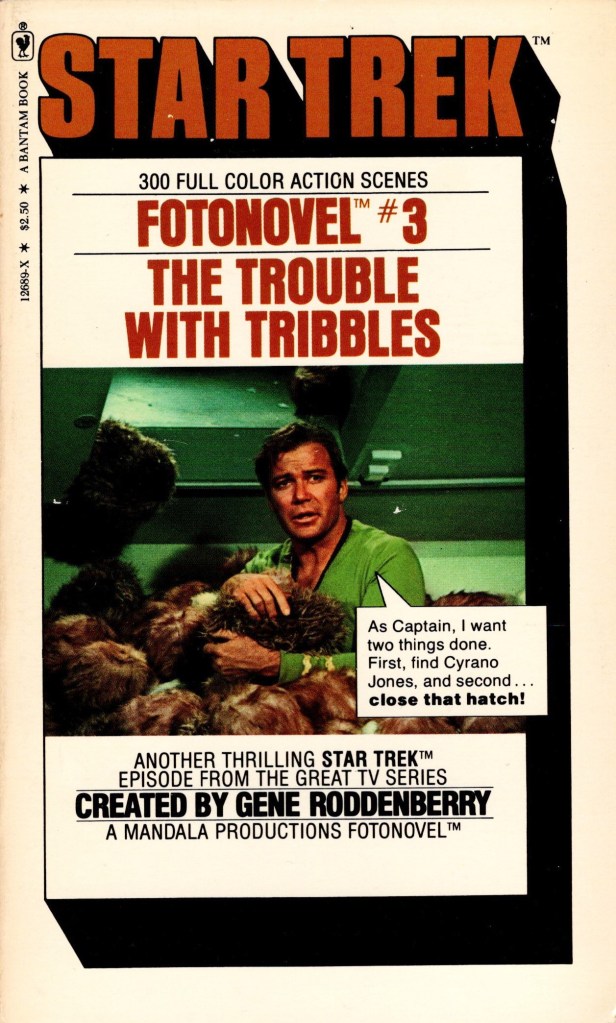
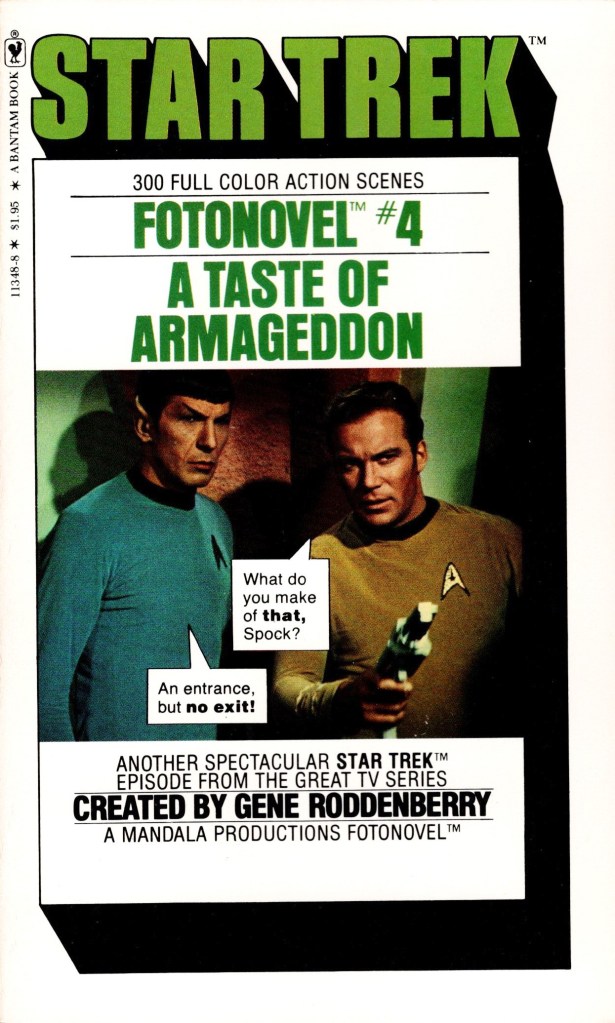
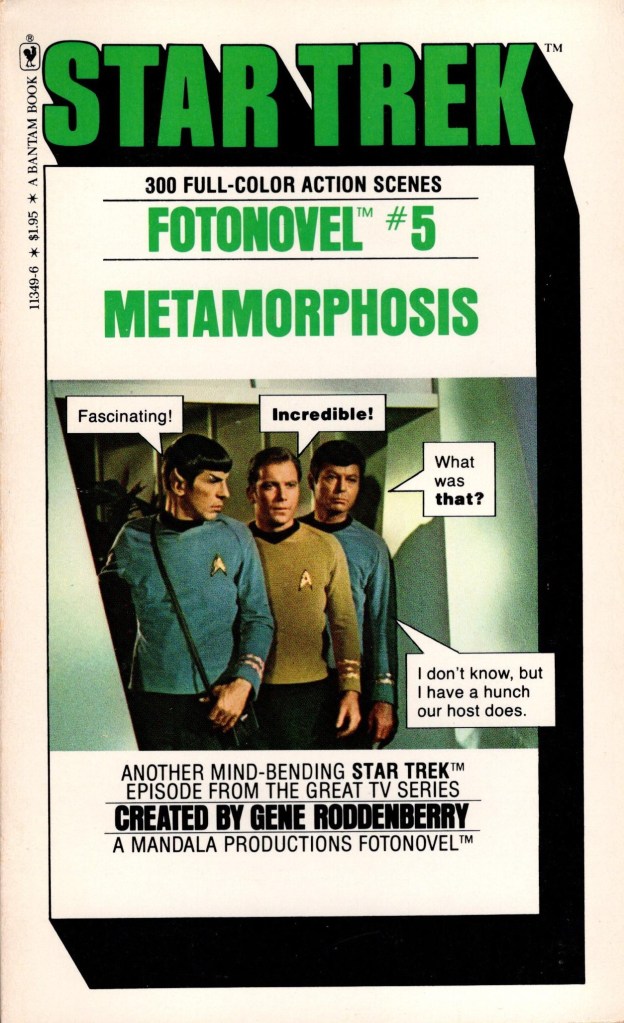
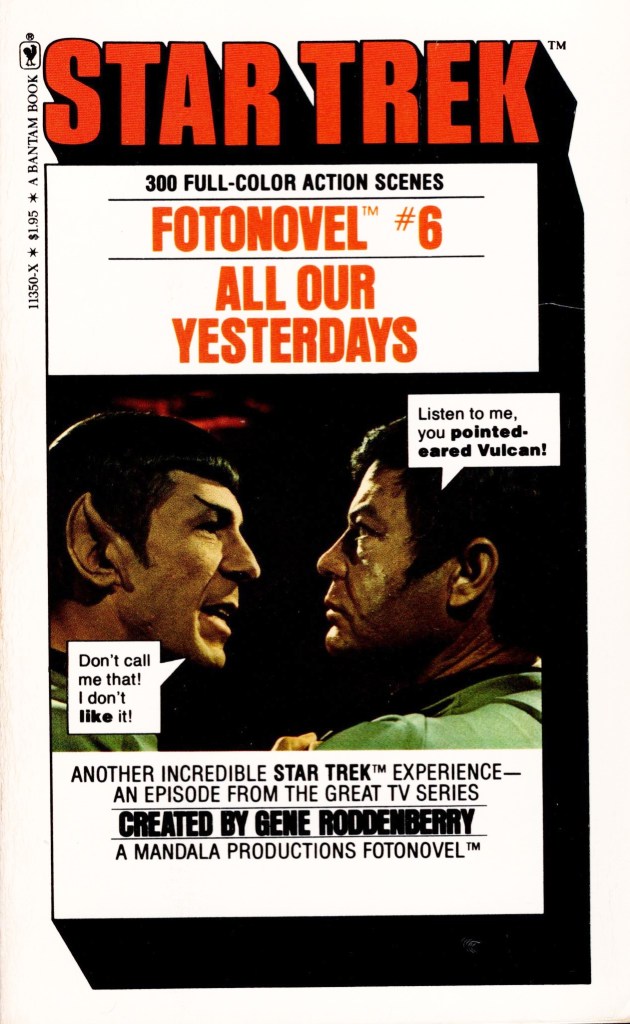
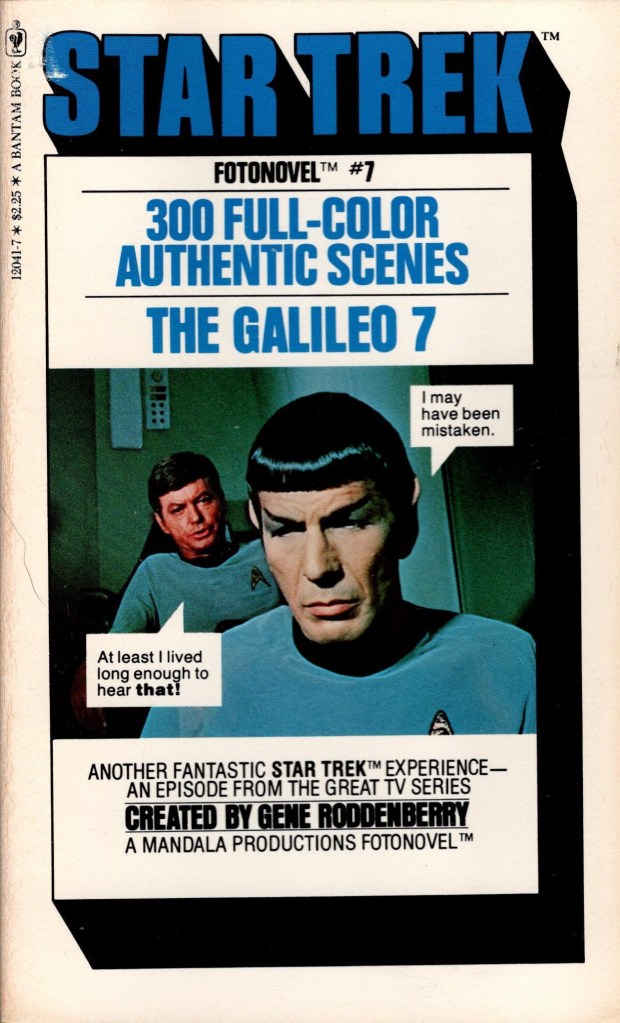
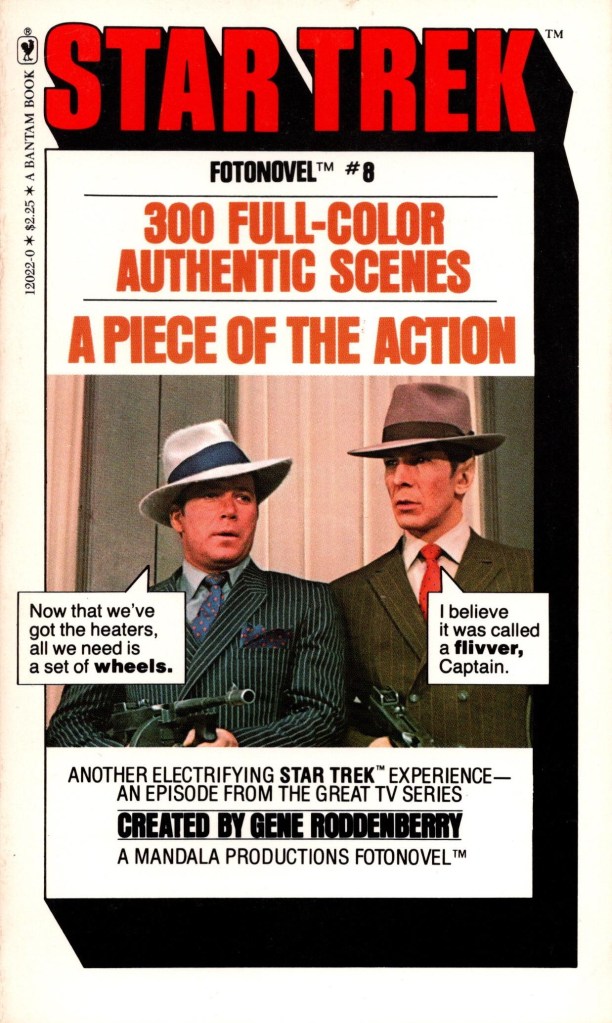
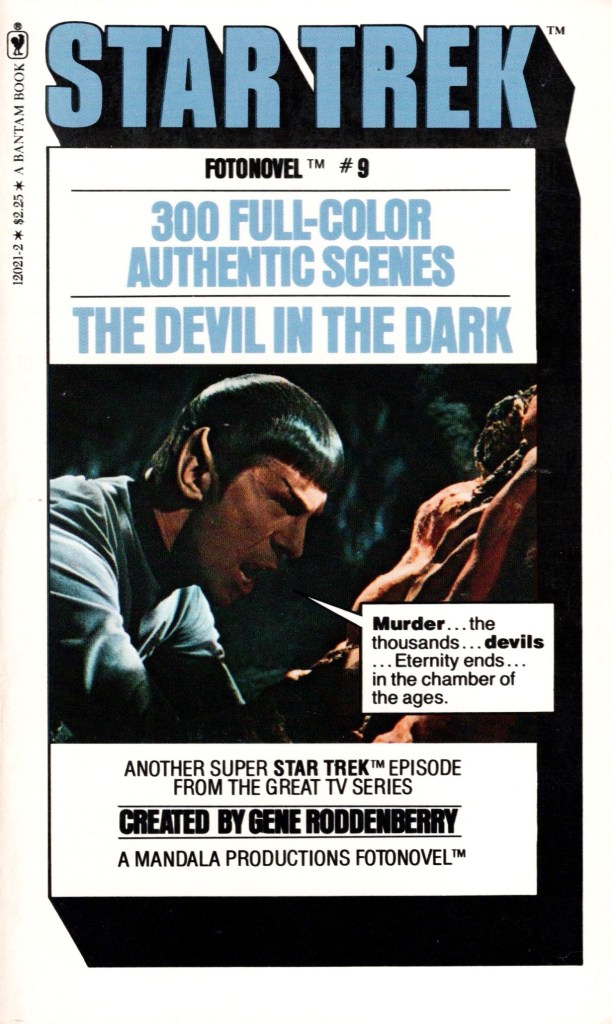
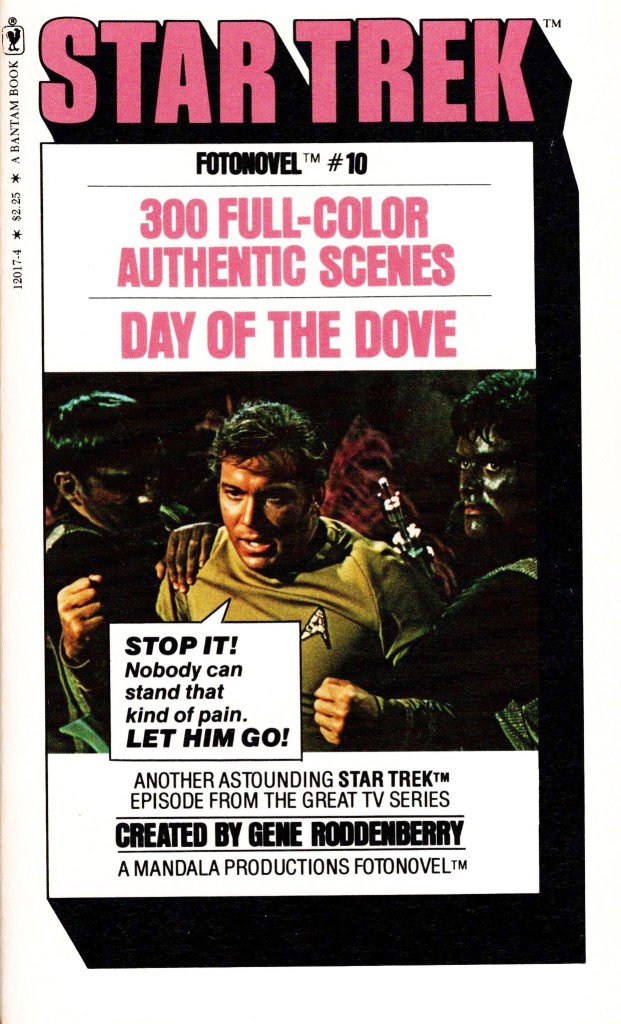
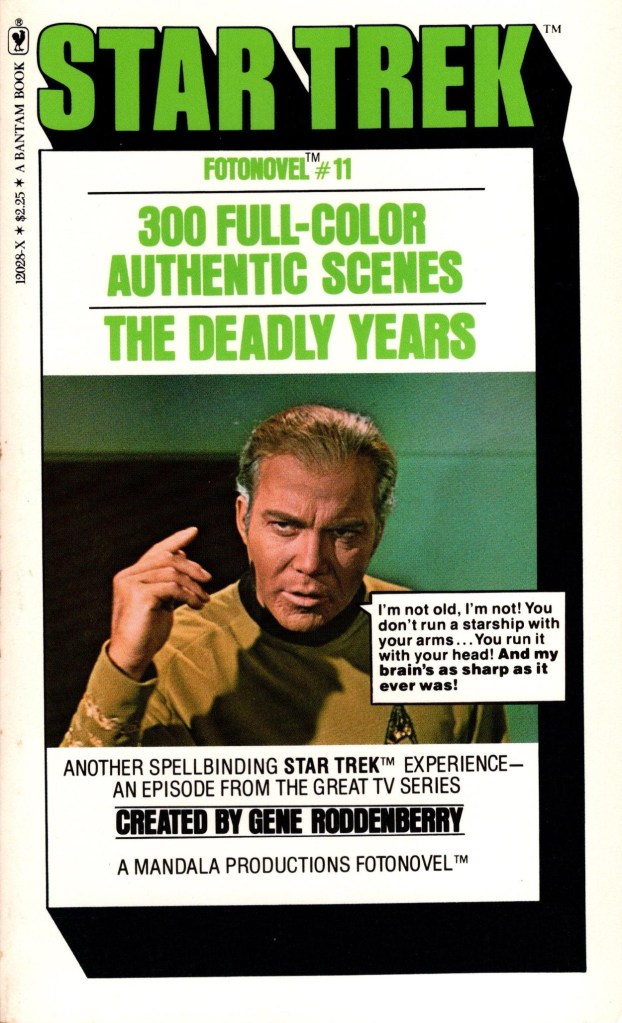
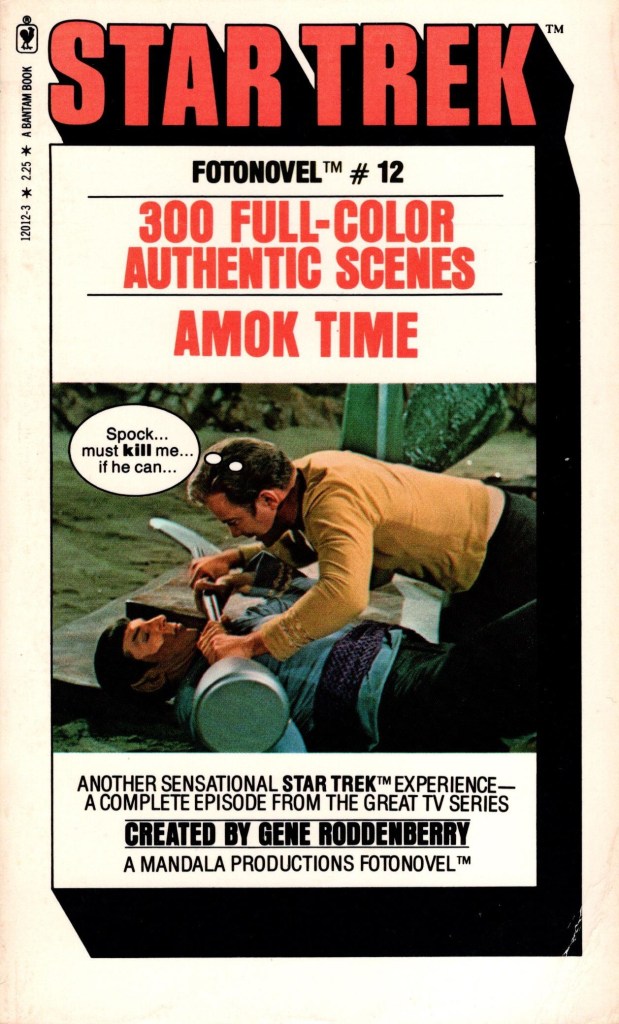
I had a similar experience years earlier in 1979, when I discovered the Star Trek Fotonovels. These were essentially graphic novels that used episode images instead of drawings. Created by Mandala Productions and published by Bantam Books, 12 were released between 1977 and 1979, with one episode per book. I bought my first one at Bakka in Toronto, and grabbing one whenever I had a few dollars is one of my favourite collecting experiences.
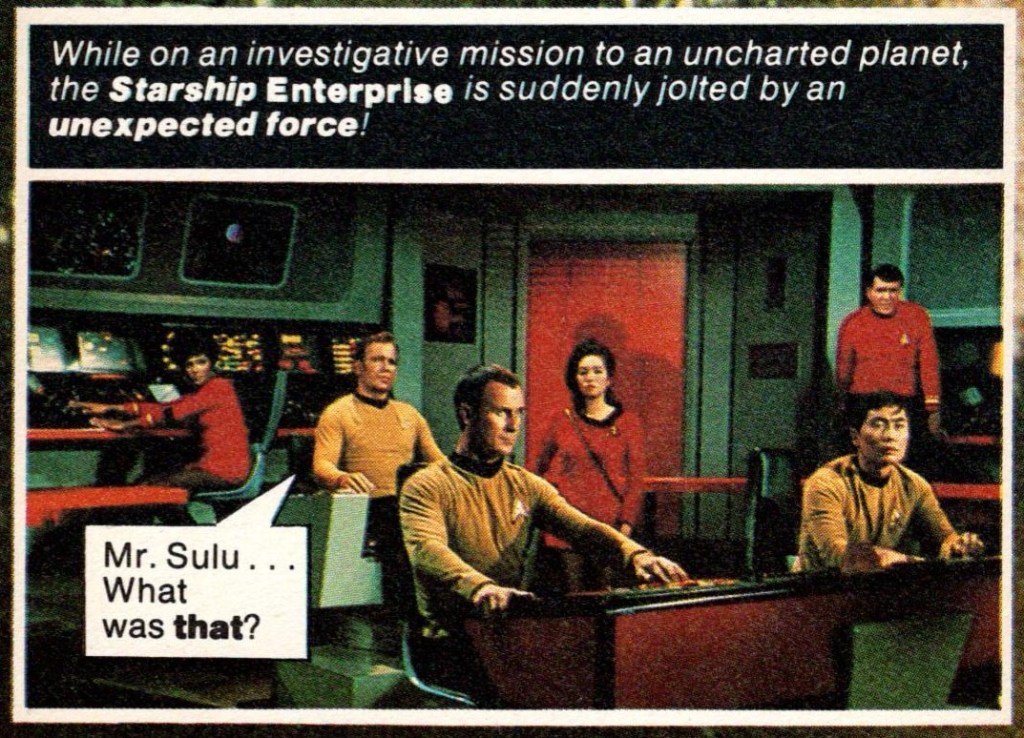
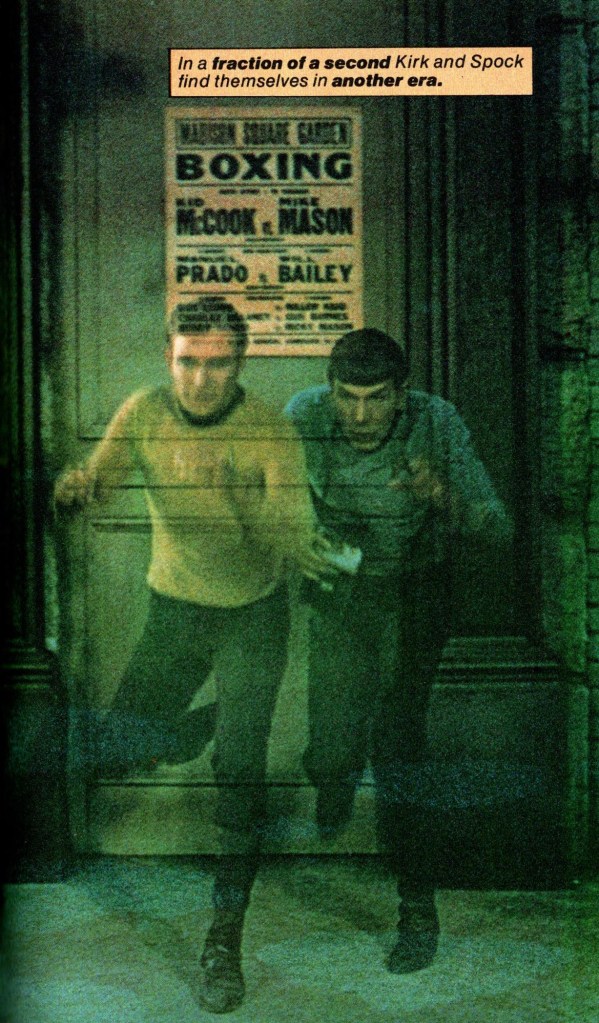
You could linger on an image, examine the bridge and see the relative positions of the crew, look at the buttons on the consoles, note that a crewmember had a tricorder slung on one shoulder. The books were better for images than dialogue, however. The first issue in the series was, inevitably, The City on the Edge of Forever, and this pic from the opening puts words in our captain’s mouth that he never said on screen.
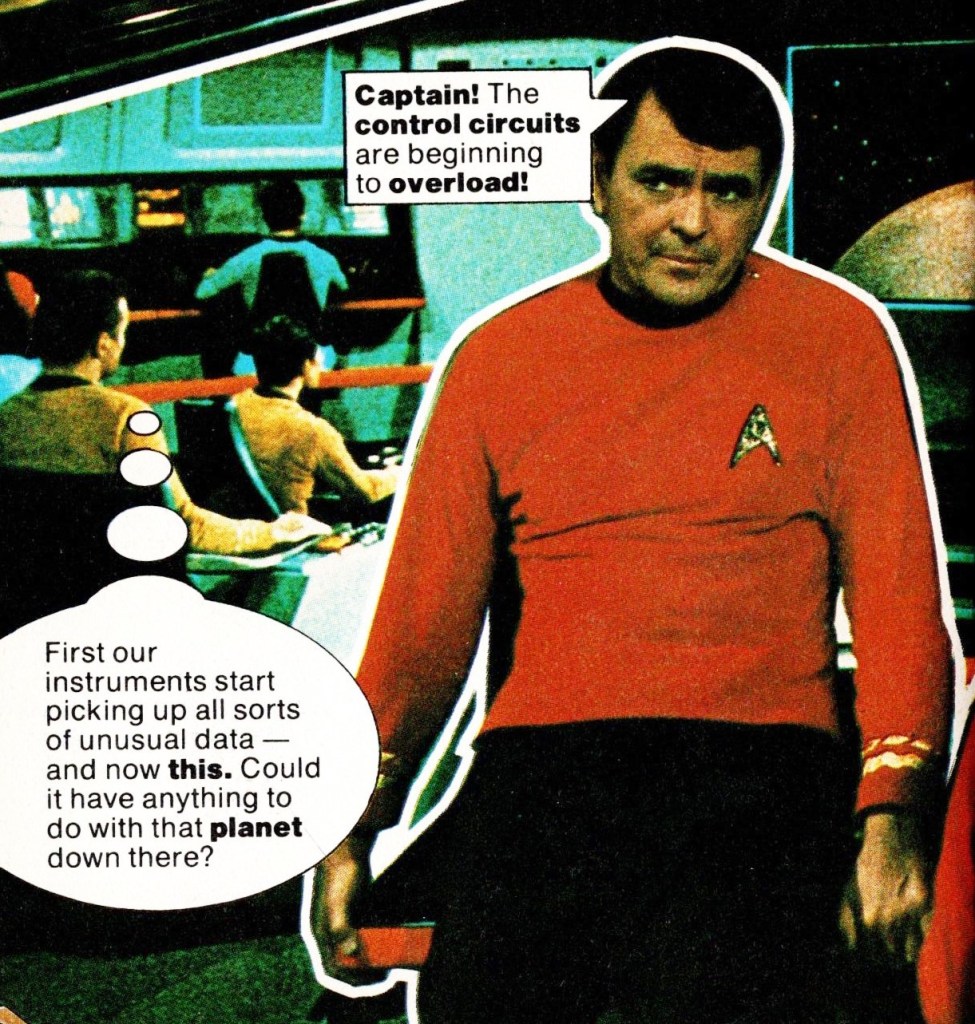
And it’s true that the images weren’t always stellar. This one, for example, is not kind to Scotty.
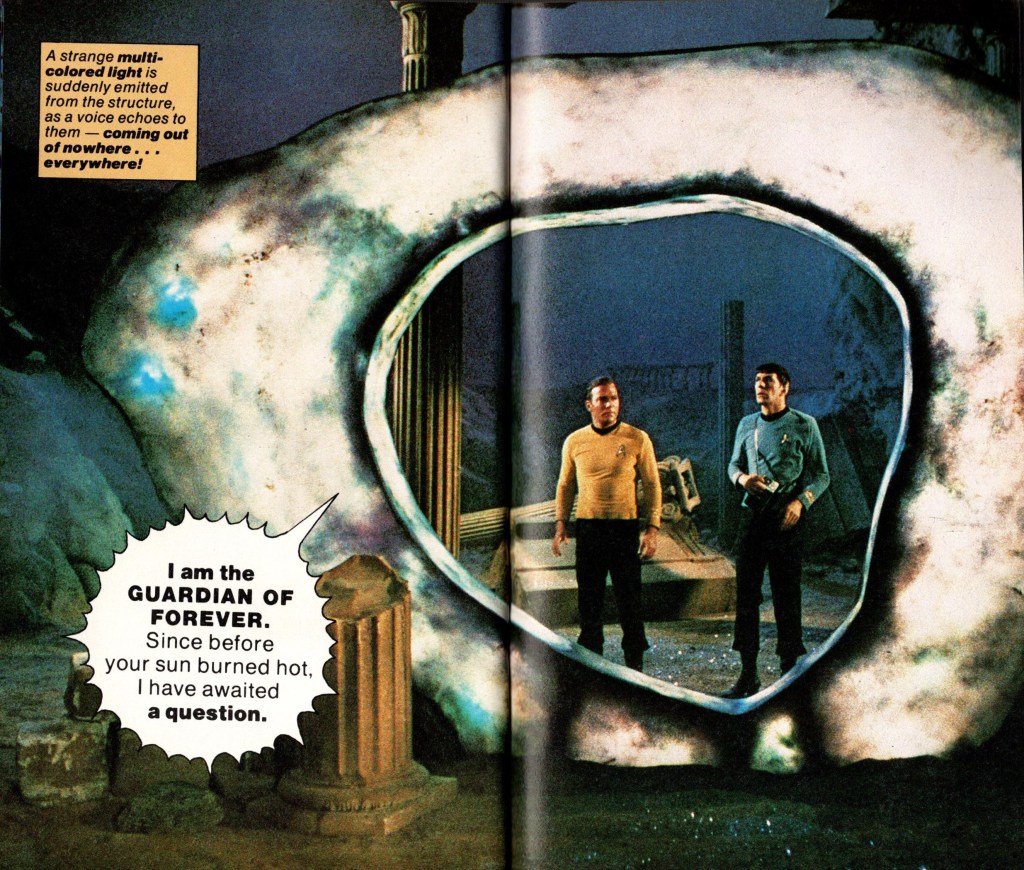
Most others, though, are great, and fans like me would often have these books fall apart from hours of use.
“Encounter with an Ellison“
A nice feature of these books was the supplemental material. Issue #1 has a good, albeit sadly brief, interview with Harlan Ellison, who wrote the screenplay on which the episode is based. The interview, conducted by Sandra Cawson (about whom I could find no information), opens with a description of Ellison’s home:
Harlan Ellison’s home is a calculated fall down a rabbit hole. Every wall scintillating with original paintings by the Italian Campanile, the German Wunderlich, the Japanese Kanemitsu, Leo and Diane Dillon — who do the covers of his books. Every corner is jammed with sculptures and toys and books, my God! the books: 17,000 in a sprawling, many-winged hillside retreat from which pour, every year, books, short stories, essays, reviews, motion-picture scripts and, of course, award-winning teleplays.
In a remark designed to tell you she had heard of Ellison’s gruff manner, Cawson writes: “To my surprise and delight, I found Ellison to be outgoing, charming, hospitable and prepared to answer my most prying questions.” As Ellison probably had approval rights on the resulting interview, this may have been more of his own world building.
The screen version of City was very different from Ellison’s script (my piece on the beautiful IDW graphic novel goes into those changes) and he was never shy about promoting his version as the superior story. In the interview, he said:
You must understand that working in television can be a singularly crippling and brutalizing thing for the creative spirit, particularly if a writer perceives himself as something more than merely a hack or a creative typist who is helping to fill network airtime in order to sell new cars and deodorants. So a writer who cares about his work puts in small touches, special scenes, lines of enriching dialogue, that give him his reason for writing it. Almost all of those touches were excised in the name of straight action sequences. Their loss diminished the value of the script enormously.
This is the writer of the episode slamming the story you just paid money to own. It was my first exposure to Ellison’s take on the episode, and at the time I had no idea what he meant. True to form, the interview ended with:
Sandra: Thank you. It’s been peculiar.
Harlan: And thank you. Yes, hasn’t it?
The Star Trek Quiz
Ten of the 12 Fotonovels also included a quiz. (The exceptions are numbers six and seven.) Even as a kid, these questions were too easy.
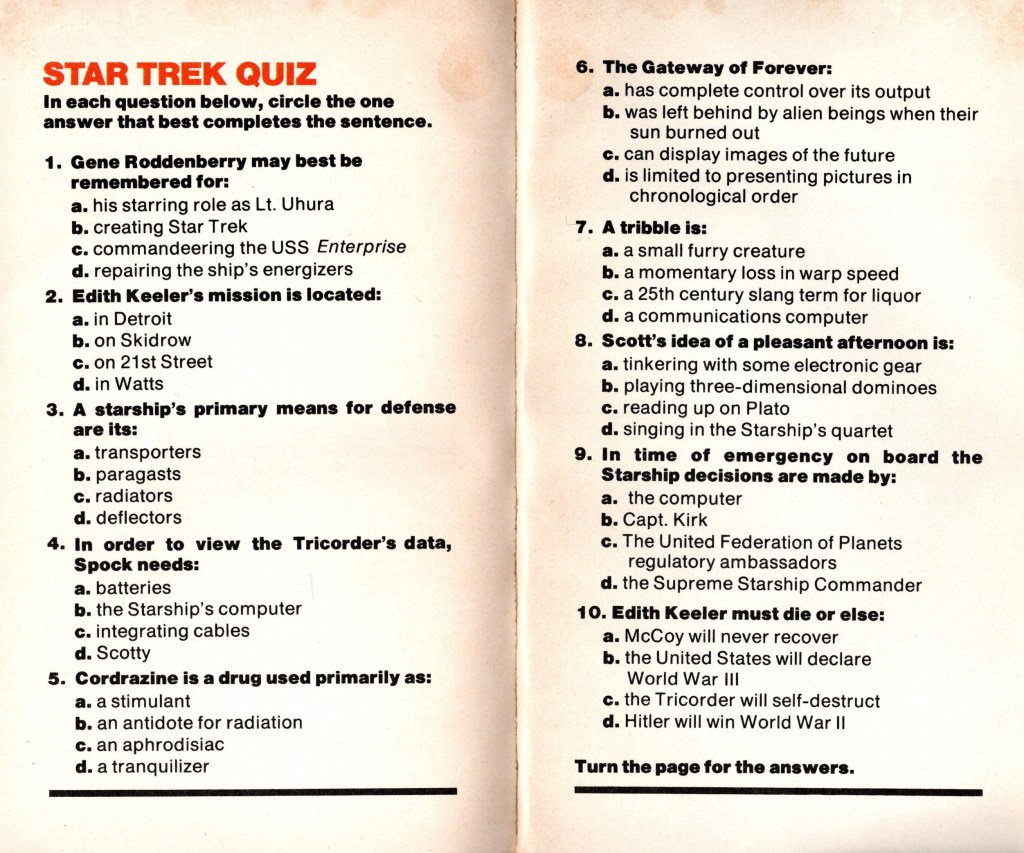
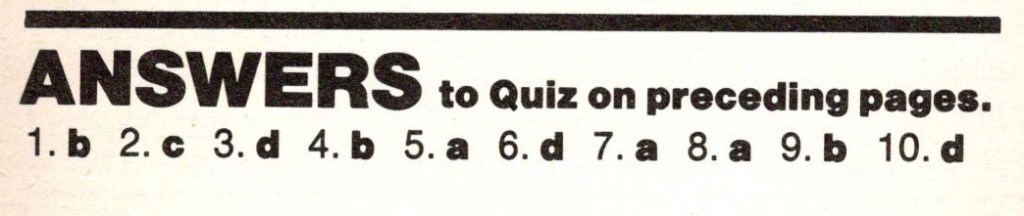
Here are the answers. I will cover the other Fotonovels in future posts.
-
Pain on screen and in real life: Diamond Select’s Devil in the Dark diorama

I usually write about unique or rare collectibles on this site, and there are many I have yet to cover, but looking around my Star Trek room for post inspiration I was struck by the accuracy and attention to detail in Diamond Select’s The Devil in the Dark diorama.
Also, as it always does, looking at the scene on my shelf reminded me of a terrible time in William Shatner’s life, and of a behind-the-scenes story that illustrates both his professionalism and annoying sense of humour.
Behind-the-scenes TOS history
Like the company’s Space Seed diorama, this piece can be assembled to present one of two scenes: Spock standing and pointing his phaser at the Horta or a kneeling figure, grimacing in pain during the mindmeld.
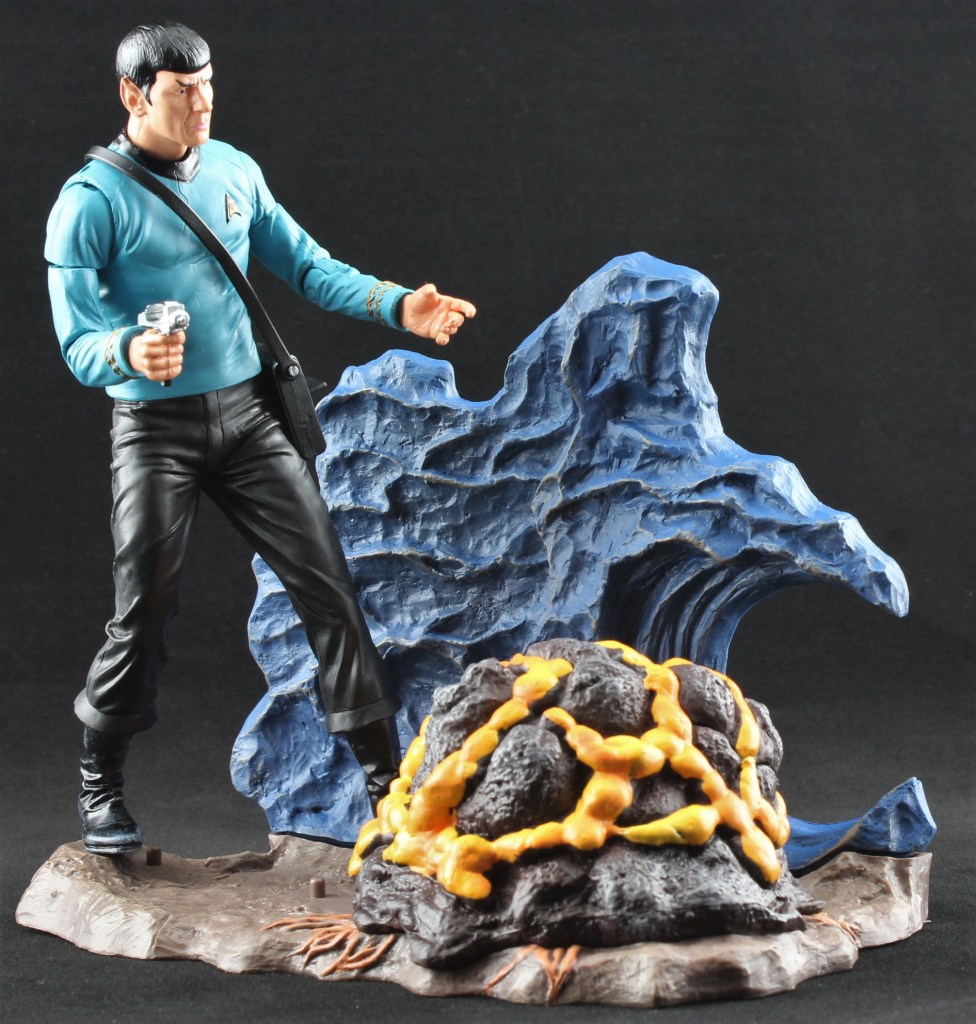


I chose the latter because it’s a pivotal moment in the episode and because Shatner tells an interesting story about filming it in his book Star Trek Memories. He first names this episode as his favourite — “Exciting, thought-provoking and intelligent, it contained all of the ingredients that made up our very best Star Treks” — and then adds: “None of that stuff qualifies it as my favourite.” He explained:
Early in the second day of shooting this episode, I got a phone call that told me my father had died… The grief is long since gone, and just the joy of having known him and loved him and of knowing that he loved me remains. But at that moment in time, the pain was awful. My father had died.
He died in Miami, and…no matter how we juggled flights, there was just no way for me to avoid having to wait about five hours before I could get to Miami out of Los Angeles airport. It was almost lunchtime by the time my travel arrangements were finally firming up, and… I can remember hearing Gregg Peters, an A.D., saying ‘We’re going to break for lunch then shut down for the rest of the day. Everybody go home, we’ll not shoot today. Bill is leaving.’ And I said to Gregg, ‘Please don’t do that, my plane doesn’t leave until six, and I don’t know what I’ll do with myself for these remaining hours if I’m not here. Please, let’s continue to shoot.
An hour later, after we broke for lunch and after the tears and the anguish, we started shooting what we’d been rehearsing all morning… And even though I really can’t remember most of the day’s details anymore, the one thing that I recall perfectly and that I’ll never forget is the closeness that my friend Leonard had toward me. Not just emotionally, but physically as well. I mean, I’ve seen film with elephants that support the sick and the dying with their bodies, and Leonard somehow always seemed physically close to me.
Our cinematographer, Jerry Finnerman, whose father had also recently passed away, stayed close, too. And together, they kind of herded around me, assuring me that there were people close by in case I wanted to talk or just needed a friend. Between Leonard and Jerry, we were able to make it through that awful afternoon, and I was able to fly out that evening to my father, warmed by their love and affection.
That’s what makes this episode my favorite.
Shatner’s professionalism is impressive. In the episode, Kirk briefs the security detail before sending them into the tunnels to seek the monster and, according to Marc Cushman’s These are the Voyages, season 1, that is one of the scenes Shatner insisted on shooting before his flight. Cushman quotes actor Eddie Paskey: “I didn’t know at the time that his father had just passed away, and, as far as I knew, no one else on the set knew it.” No one there and no one watching the episode could see that Shatner had been weeping just before the cameras rolled.
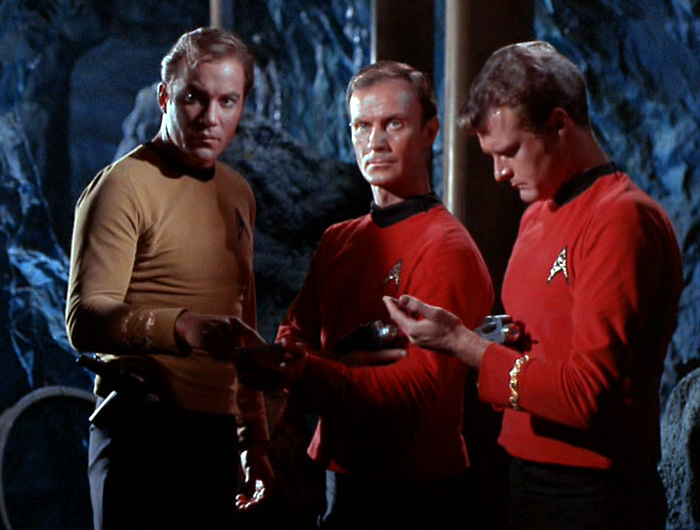
Eddie Paskey (right) after Shatner got the bad news (TrekCore) Shatner continues the story:
As I flew off to my dad’s service, the crew went ahead and shot the scene where Spock mind-melds with the Horta. Now, as you know…it’s in great pain. So, of course, as Spock taps into its mind, he too experiences the creature’s anguish. With that in mind, he gets very emotional and yells out something like ‘Pain! PAIN!!’ Still, by the time I got back to the set, this was all in the can and I had no chance to see it.
When Shatner returned, the first task was to film Kirk’s reaction shots. He asked that Nimoy replay the scene, so his responses would be appropriate.
I kept pleading with Leonard until he finally gave in to my request, went over to the Horta costume and got ready to run the scene for me, at which point I said to him ‘Now Leonard, do this thing full out for me, will ya? Don’t just say pain, pain, let me really hear it. Do it for me!’ So now Leonard sighed, took a moment to prepare, and then launched into a full bore mind-meld.
“PA-A-A-A-A-A-A-IN!’ he howled. “Oh, PAIN, PAAAAAAAAIN!!!’
At which point I yelled, ‘Jesus Christ! Get that Vulcan an Aspirin!”
The crew broke up laughing, Leonard shook his head at me in disgust, and all at once I felt a whole lot better.
Shatner was dealing with a lot and probably needed humour to get through his day, but he admitted in a 2016 article in the Daily Mail that Nimoy was hurt by the prank, and he details a very different crowd reaction:
When the time came for the camera to shoot my reactions, I asked him to replay the scene, which he obligingly did. He didn’t rush it — he felt the emotion and cried out from the depths of his soul: ‘Pain! Pain! Pain!’
I went for the cheap joke and yelled, ‘Hey, someone get this guy an Aspirin!’ Then I waited for a laugh that never came.
Leonard was absolutely furious. He thought I’d set him up for ridicule. He stalked off the set but confronted me later, telling me that he thought I was ‘a real son-of-a-bitch.’
My apology must have sounded hollow because he didn’t say a word to me that wasn’t in the script for at least a week.
Great value
Diamond Select’s depiction of this scene is really good, with excellent attention to detail. The package contains two heads for Spock, two sets of hands, and two tricorders, one with the top flipped open and the other closed, because Spock’s tricorder is open when they first encounter the creature but closed as he approaches for the meld. The Horta’s wound can also be hidden or visible.


The packaging, however, is not quite as accurate. There is a notable error in the photo on the back of the box.
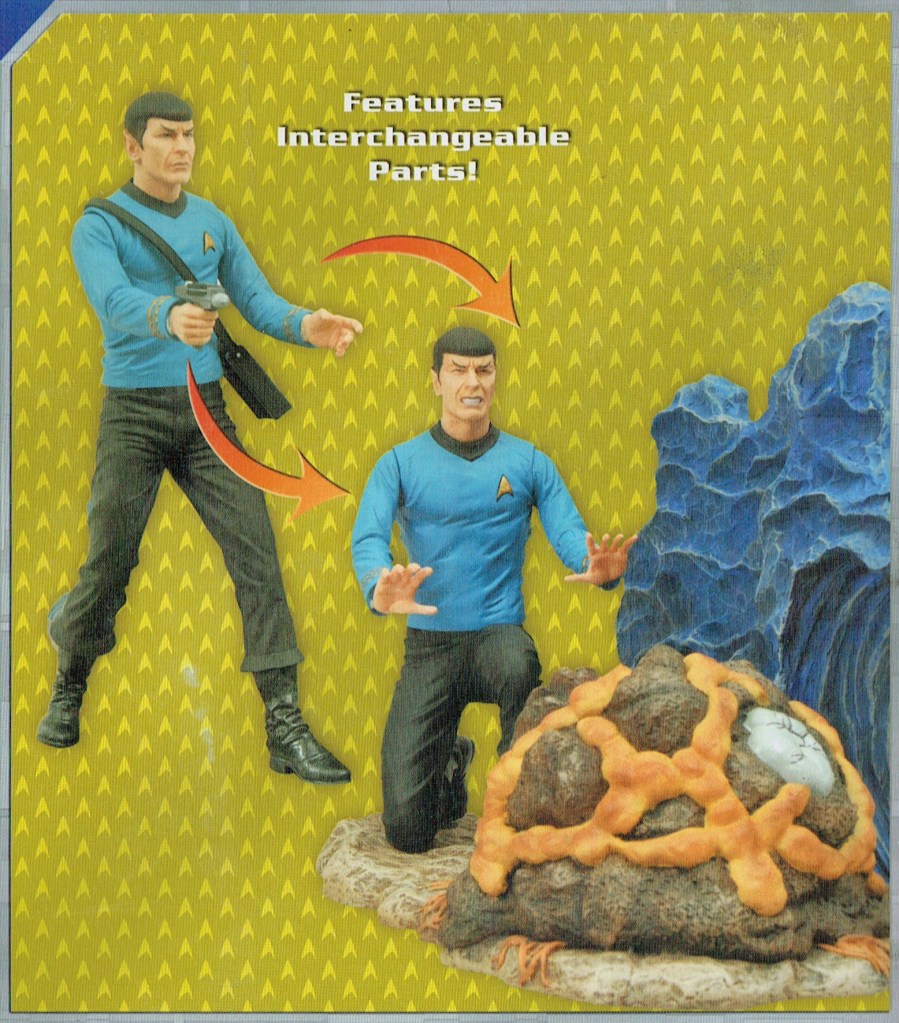
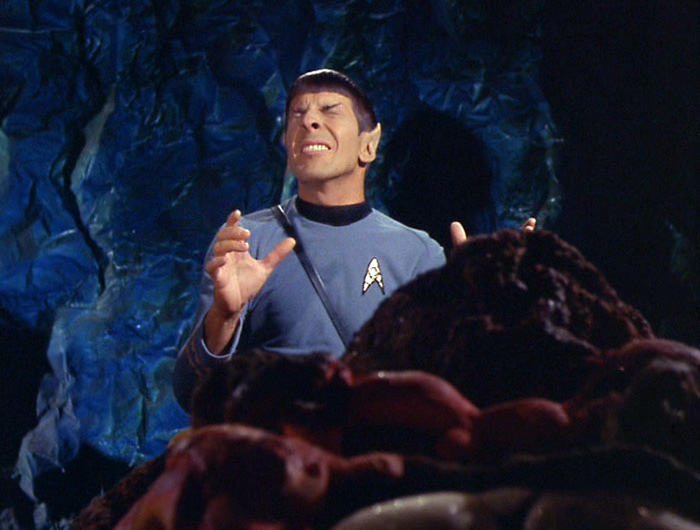
These dioramas are often available quite inexpensively. I paid C$15 for it at Hamilton Comic Con 2019 because the box was a little damaged. It’s an excellent piece that tells two great stories — one on screen, one behind it.
-
Star Trek as Canadian content
Make a list of the people most responsible for Star Trek’s conception and early development. Roughly, that list would be Gene Roddenberry, Gene Coon, DC Fontana, Samuel Peeples, Matt Jefferies, Herb Solow and Robert Justman. They are all American.
But what they created is Canadian on a fundamental level. That idea was new to me and — once pointed out — obvious.

Sawyer I love Star Trek for many reasons, paramount of which is its optimistic view of the future, but there was always an element I couldn’t quite identify. I recently sat down with one of the world’s foremost science-fiction novelists, Robert J. Sawyer, to discuss Boarding the Enterprise, the Star Trek book he edited with David Gerrold. It’s a fascinating and unique book and you should read my article on it and then go buy it.
During that interview, Rob, who is Canadian, identified the aspect of my fandom that had eluded me.
I looked at…Star Trek first from a Canadian perspective. That peace is better than war, that multiculturalism is better than uniformity, and to me Star Trek was so Canadian in most of its vision. The rhetoric that you would hear was what Canada was supposed to be.
Rob is right. The ideals of Star Trek, the heart, the aspiration, are absolutely consistent with the best elements of Canadian society. Neither I nor Rob would suggest Canada is a utopia. We have gun violence and racial problems and poverty, but it is fair to say that we suffer those ills to a far lesser degree than do most countries.
Cultural mosaic
Although we don’t use the term as much anymore, Canada views itself as a cultural mosaic, a whole composed of pieces that are themselves distinct and unique. This contrasts to the melting-pot concept, in which being American means being the same.
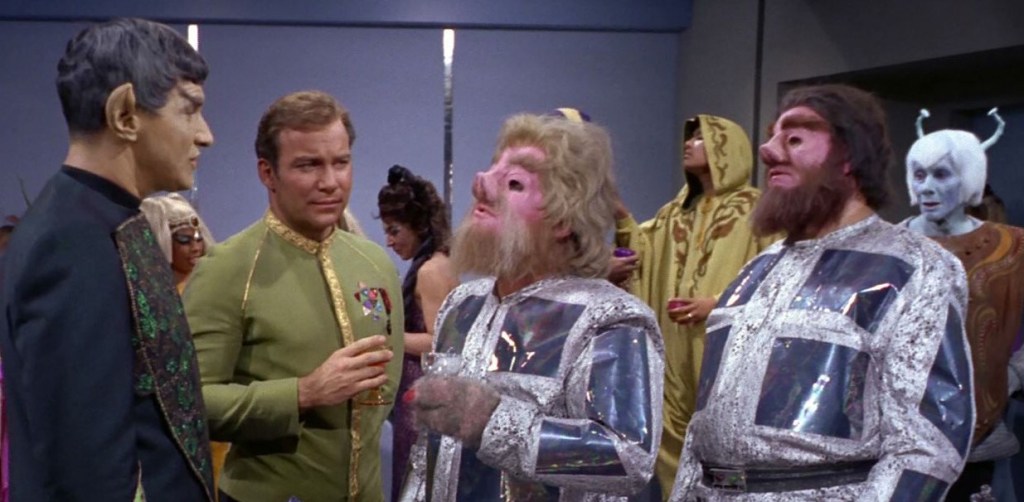
Plato’s Stepchildren is about power imbalances and what the mighty do to those outside of the norm. Not the best episode, it nonetheless contains among the most Star Trek of lines. Kirk tells Alexander: “…where I come from, size, shape, or color makes no difference…” Alexander doesn’t have to be like everyone else. He can be both different and valid.

All episode photos from TrekCore Infinite diversity
The Vulcan concept of infinite diversity in infinite combinations was introduced in Is There In Truth No Beauty? and while the IDIC symbol was created for a real-world commercial reason, its sentiment is very much in keeping with the philosophy of Star Trek.
Miranda Jones’ parting words to Spock make the same value statement as Kirk’s to Alexander: “The glory of creation is in its infinite diversity.”
We’re not going to kill…today
Kirk is often presented with the opportunity to take ostensibly justified revenge on an enemy. The Horta in The Devil in the Dark, Balok in The Corbomite Maneuver and the Gorn of Arena are all at his mercy — yet he stays his hand. Even the vanquishing of Apollo in Who Mourns For Adonais? is an occasion for regret rather than a fist-pump of victory. As Rob said, time and again Star Trek tells us that preserving life is better than taking it.

The group that fashioned Star Trek in its early days were all American, and yet what they created uses ideals drawn from the Canadian example. Think of the Federation itself: a collaborative organization founded by very different people which promotes exploration, peace, and the common good, and which sends its ships out into the void to meet more people and invite them to contribute to the group. It is a cultural mosaic writ large.

-
Boarding the Enterprise, a review: challenging and fascinating insights into the original series
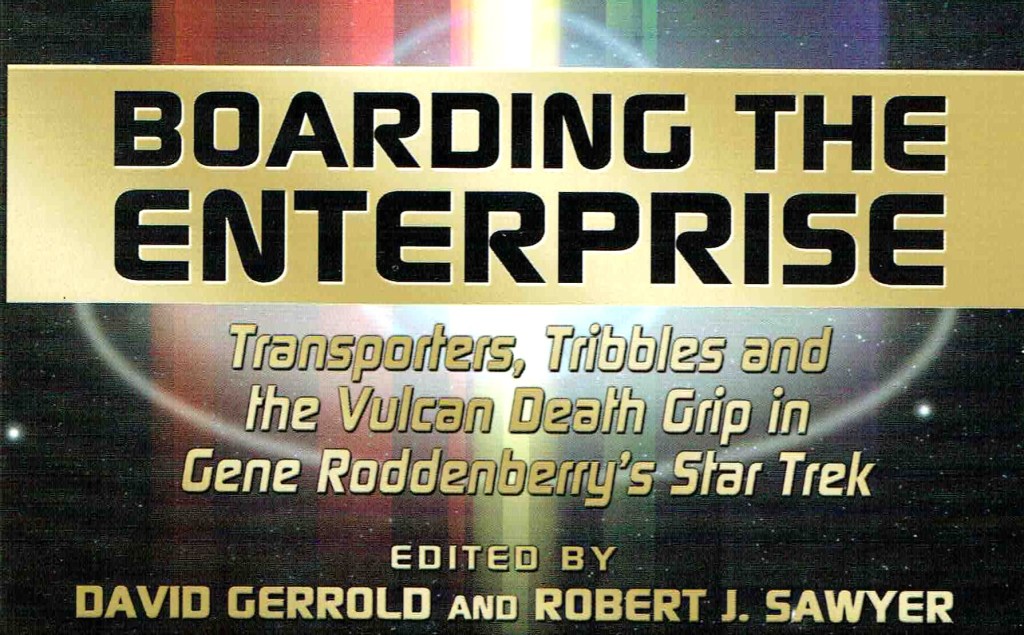
Boarding the Enterprise is an atypical Star Trek book. It is a philosophical, scientific and cultural examination of the original series’ goals, messages and influence. The brainchild of notable and noted Canadian science-fiction novelist Robert J. Sawyer, the collection of essays is a serious and analytic examination that will gift even longtime Star Trek fans with new insights.
Despite that, Sawyer told me it was not a publishing success.
I am very proud of that book. And it tanked. It came out for the 40th anniversary of Star Trek and had a nice cover reminiscent of the Star Trek: The Motion Picture rainbow and it just did not sell for some reason. I was stunned when it didn’t leap off the shelves. With that cover and David’s name…I don’t know what went wrong. Maybe around the 40th anniversary there was too much product available.
The David is David Gerrold, another science-fiction powerhouse. He came on board as co-editor.
I asked David, ‘If I pitch a book to Glenn [Yeffeth, editor at BenBella Books], will you do an essay for it?’ I said that to him one morning at a convention and he came back to me later in the day and said, ‘Oh good news, I’m going to edit that book with you.’ So suddenly it went from being my book to being David’s and my book. But I thought, ‘Well, I can’t go wrong.’ I also figured it would do better, because David has the cachet in Star Trek.
David said we have to have something from Norman Spinrad and we have to have something from DC Fontana and from some other people. So [the essayists were] two worlds coming together: the people who had actually created the show and the people who had been influenced by the show as science-fiction professionals.


Sawyer and Gerrold
And yet, it didn’t sell. That is not, I think, because there was a glut of 40th anniversary material, but rather because it didn’t fall neatly into the two categories of Trek non-fiction that do well: gossipy personal accounts written by the actors or detailed production diaries that please behind-the-scenes nerds like me. It was doomed by its uniqueness, which is really unfortunate because it is full of insights that will resonate with thoughtful TOS fans. (Interestingly, Sawyer convinced BenBella to release a slightly updated version for Star Trek’s 50 anniversary.)
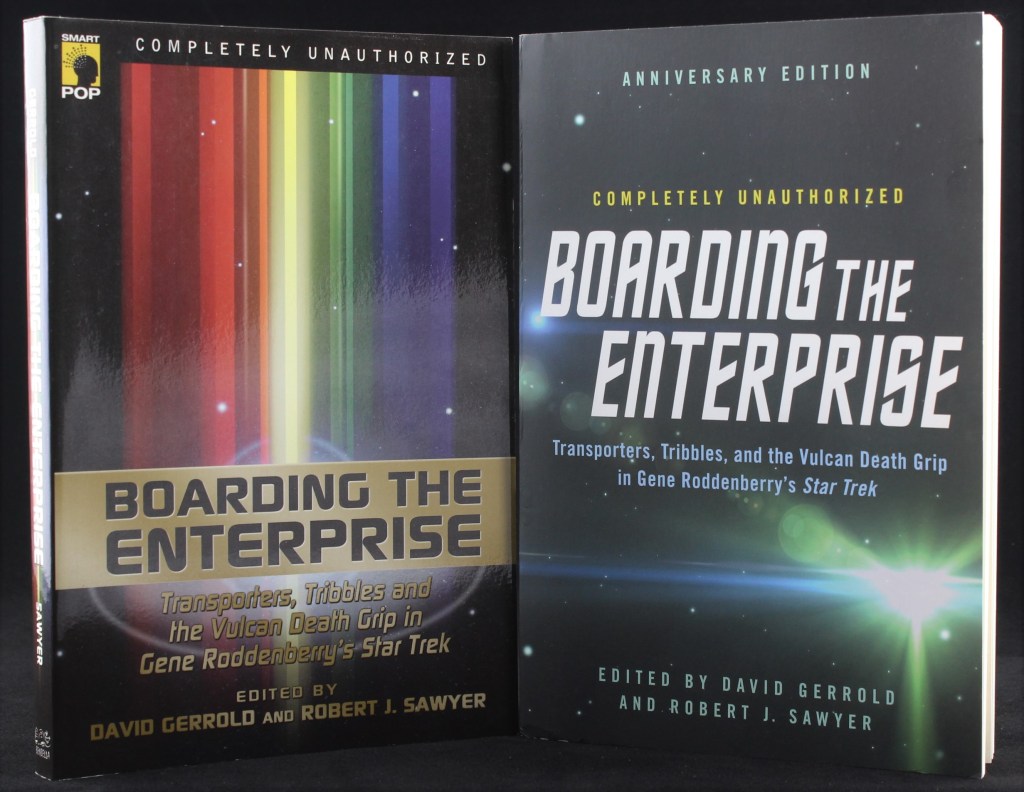
Here are thoughts on just two of its essays.
No identification of self or mission
Actor, writer and civil-rights activist Eric Greene used the Prime Directive to tackle Star Trek’s relationship to the real-world events of the 1960s, primarily the Vietnam War. He wrote:
In the course of the series, the Prime Directive was often debated, occasionally derided, but rarely obeyed. The Prime Directive was not a directive as much as it was the Prime Question: how much power should a superpower use when dealing with other peoples? That very question, the central tension driving the stories of Star Trek, was at the heart of American politics and popular culture at the time.
TOS hid its Vietnam commentary in the clothing of science fiction. DC Fontana, quoted in Boarding the Enterprise, said “no one was allowed to talk about [it] on television…but under science fiction we were able to get in commentary on Vietnam.”
Among the most biting of these is Errand of Mercy. Kirk risks his life and his ship to prevent innocent and seemingly powerless people from being taken over by an aggressive, technologically superior force. That’s laudable. But it is also the same role America cast for itself in Vietnam. As Greene writes:
Seeking to “deny” Organia to the Klingons and to win Organia’s allegiance to the Federation, Kirk offered Organia medical, educational, technical and military assistance — the trademark nation-building and counter-insurgency tools the U.S. used to “deny” developing nations to the Communists.
The Organians, however, refused the proffered benefits. “…we really do not need your protection,” Claymare tells Kirk. When Ayelborne adds that they have nothing anyone would want, Kirk replies “You have this planet and its strategic location.”
The irony is that, in this at least, the Federation is the same as the Klingons. As Sawyer said:
The Federation could have shown up at any time to offer all [that help] to the Organians, but it didn’t, until Organia turned out to be strategically useful. So, it was not like this was UNESCO going out to offer aid, it was ‘We will do all these nice things for you — because we need you.’
The difference, of course, is that the Federation would not take over the planet. Kirk tells the council “With the Federation, you have a choice. You have none with the Klingons.” That crucial difference allows us viewers to maintain our esteem for the Federation good guys, but the parallels to Vietnam are clear.
Also fascinating in the Vietnam context are The Apple and A Private Little War. Spock, Greene writes, argues in The Apple that the feeders of Vaal have “the right to choose a system that works for them…Whatever you choose to call it, the system works.” This exact argument was made by those who opposed the Vietnam War. Kirk, however, sees a people yoked unwillingly to a communal ideal of service: “They should have the opportunity of choice. We owe it to them to interfere.”

Kirk opts for force, using the ship’s phasers to destroy the foundational basis of this society, an ending that always bothered me. Is that choice consistent with his oath to uphold the non-interference directive? No, which is why The Apple does not work as an episode. But it does work as allegory. Watch The Apple as a debate about the very real problems of the Vietnam War, and it is effective.
A Private Little War premiered about five months later. It presents one interpretation of the Vietnam conflict in stark and obvious terms: two superpowers fight a proxy war by arming both sides with enough weapons to fight, but not with what Kirk calls “an overpowering weapon.” Greene wrote:
The episode thus represented the roots of the Vietnam conflict as noble and necessary, [but] it also dramatized the dilemma of that policy: Kirk acknowledged no limiting principle, no stopping point and, significantly, no strategy for success, only a strategy for stalemate.
The sheer hopelessness of the tactic Kirk must adopt is grimly powerful. Robert Sawyer:
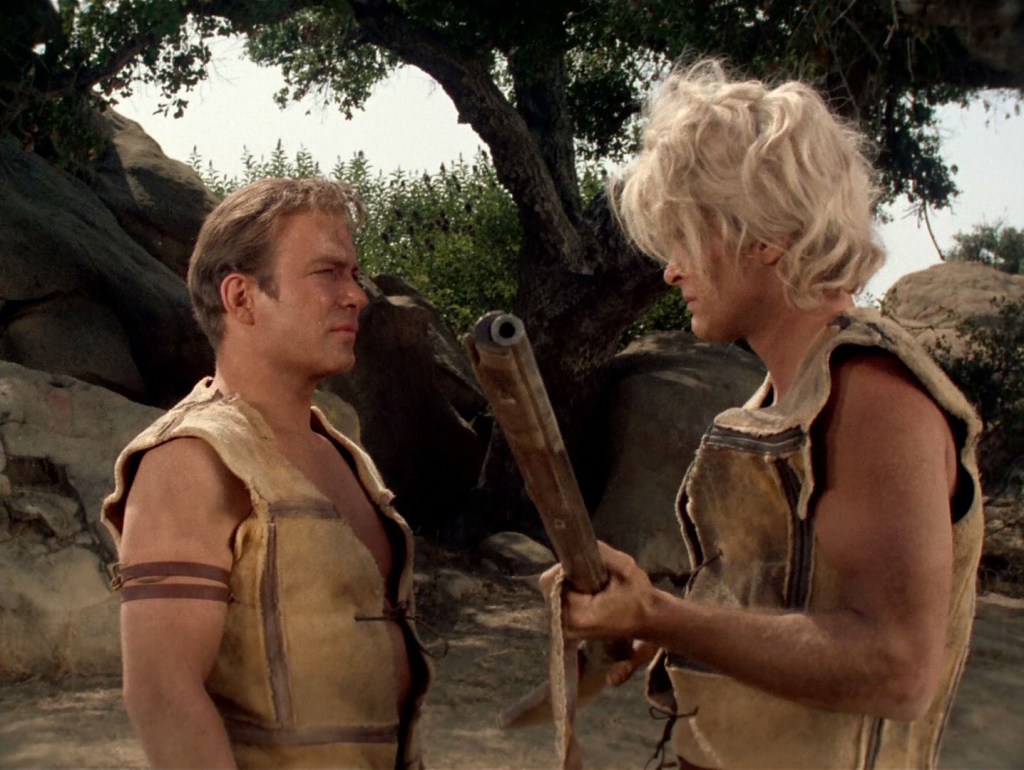
A Private Little War is a very tricky episode for me, because McCoy is right: ‘It went on bloody year after bloody year.’ And Kirk has to argue the position that we have to take an interventionist role. Now, the United States arguably started the Vietnam War to prevent lawful elections from happening in Vietnam that would have elected a Communist government. I think the most important line in the episode is when Kirk asks Scotty for a hundred flintlocks and Scotty replies ‘A hundred what?’ Kirk says ‘A hundred…serpents…serpents for the garden of Eden. We’re very tired, Mister Spock. Beam us up home.’
He gets to say they’re coming home at a time when all those soldiers in Vietnam didn’t get to say that. It’s a very powerful moment: he realizes that he is following through because he’s in it this deep and he is going to continue, but that is the moment he realizes that it is evil. A hundred serpents for the garden of Eden.
In these episodes, the two Genes — Coon in The Apple and Roddenberry in A Private Little War — presented to TV viewers the rationales and conflicts of Vietnam in a way no one else was able or willing to do. As Sawyer told me:
No one was dealing with any of these issues on TV, so the fact that they were even touching on this is so praiseworthy. This is a time when every other prime-time show tried to ignore the fact that the United States was at war and the teenagers were dying overseas, even putting aside the many, many Vietnamese who were dying. The American-as-apple-pie teenagers that we would see on other shows were being sent overseas to kill and be killed, and America just had blinders on about it.
In both episodes, there’s a lot of arguing about whether what they were doing was right. And that’s good, because there were no clear-cut answers. If I had to choose, I’d rather watch A Private Little War, although both have terrible wigs in them, because it at least shows the cost of war when Tyree, after Nona is killed, decides he wants many more guns. You see a good person just destroyed.
Kirk slash Spock: fan fic love stories
Slash fiction is fan fiction that focuses on romantic, usually sexual, relationships between characters of the same sex. The name comes from the / when people write “Kirk/Spock” or other combinations of characters.

Slash fic The Price and the Prize
If you are new to slash fic and curious about it, check out the 61,437 Star Trek stories at Archive of Our Own.
I have never been interested in slash fic. This is not because I have LGBTQ hangups; whatever consenting adults want or don’t want to do is fine with me. Rather, I have dismissed slash fic because it is not canon; there was never any hint during the series of a sexual relationship between the main characters.
Because of that, I never gave slash fic much thought, but luckily Sawyer decided to examine it. “We had to track down an expert on slash fic,” he said, “because this had never been explored.”
The expert he found was fan fiction writer Melissa Dickinson, who explained why slash fic matters to many fans.
If we look at the canon text of the show, and the weekly romantic interests…it provided for our complex, heroic, flawed characters, it becomes very quickly apparent that they lack two essential things: intimacy and equality. Those same bright, imaginative, educated female fans who identified with Spock, who admired Kirk for his ideals and courage (or vice versa), found it impossible to reconcile their admiration for the characters with the idea that Kirk could seriously fall in love with a pretty, emotionally vacant android in about fifteen minutes, or that Spock would get high on spores, leave his work and abandon his loyalty to Kirk for the vacuous Leila Kalomi, who so clearly didn’t get him at all.
These passionate fans weighed the popular 1960s images of romantic love and found them wanting. Instead, they wanted for Kirk and Spock what they wanted for themselves: an emotional unity based on shared ideals, equality, intimacy, and trust. They were busy throwing off the roles that society had tried to impress upon them — why would Kirk and Spock not do the same?
This is such a profound idea: that the deep friendship between Kirk and Spock would find expression in romantic love not because the characters are homosexual or bisexual but because specifics of sexuality are irrelevant, and that what actually matters is an intellectual and emotional bond that, perhaps, results in physical intimacy.
Buy the book
Boarding the Enterprise is a deep well of insight, and I’ve only dipped into the surface here. It offers 14 essays, including pieces on religion in Star Trek, what happened to the space race, and a hilarious take on safety equipment in the 23rd century. Each could easily be an article in itself. Sawyer posted his introduction to the book on his site. Read that and then go buy the book. It’s available for a handful of dollars on your local Amazon site and as a Kobo or Kindle e-book.
The book is a challenging, serious, even scholarly tome that requires intellectual participation from its reader, but that effort is worthwhile. It is among the most thoughtful of books on the original series.
-
Inside Star Trek 7: favourite designs and fashion advice with Bill Theiss

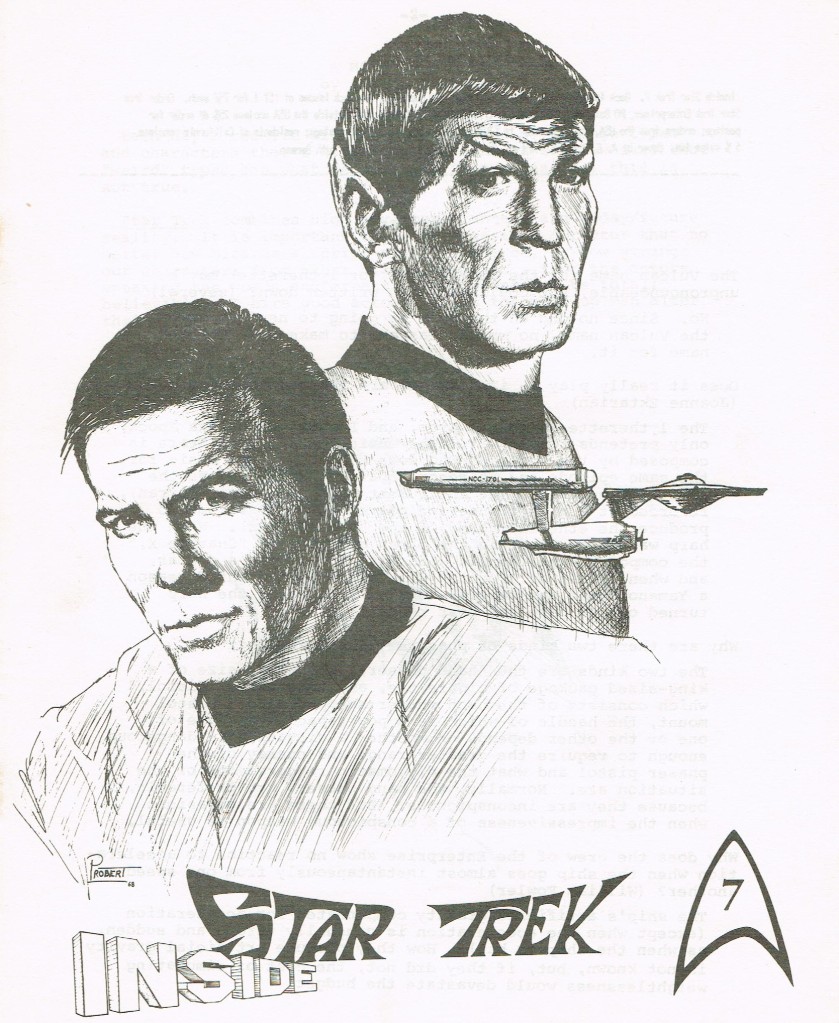
Inside Star Trek was a semi-official newsletter, published under the guidance of Gene Roddenberry. This connection gave the writers access to the actors, production crew and sets.
I own the complete run:
- Issues 1 to 12: Inside Star Trek, edited by Ruth Berman
- Issues 13 to 24: renamed Star Trektennial News, edited by Susan Sackett
- Issues 25 to 31: again called Inside Star Trek, edited by Virginia Yable
Here are highlights from issue 7, published early 1969.
That “real now” sound of the Vulcan harp
Reader Joanne Ektarian wrote in to ask if the Vulcan harp or lytherette (a word that also appeared in some fanfiction) actually works and, if not, how its sounds are made.
Editor Ruth Berman replied that the prop does not actually work and Leonard Nimoy does not play the instrument. That’s obvious, but the question generated interesting information on its unusual sound:
The instrument used is a harp (Terran) recorded at a high volume and played at a low volume to produce the ethereal tones of the harp (Vulcan). When the harp was first used, in the first-season show Charlie X, the composer experimented with both harp and guitar, and when Elaan of Troyius was filmed in the third season, a Yamano organ was tried — but in both cases the harp turned out to give the best results.
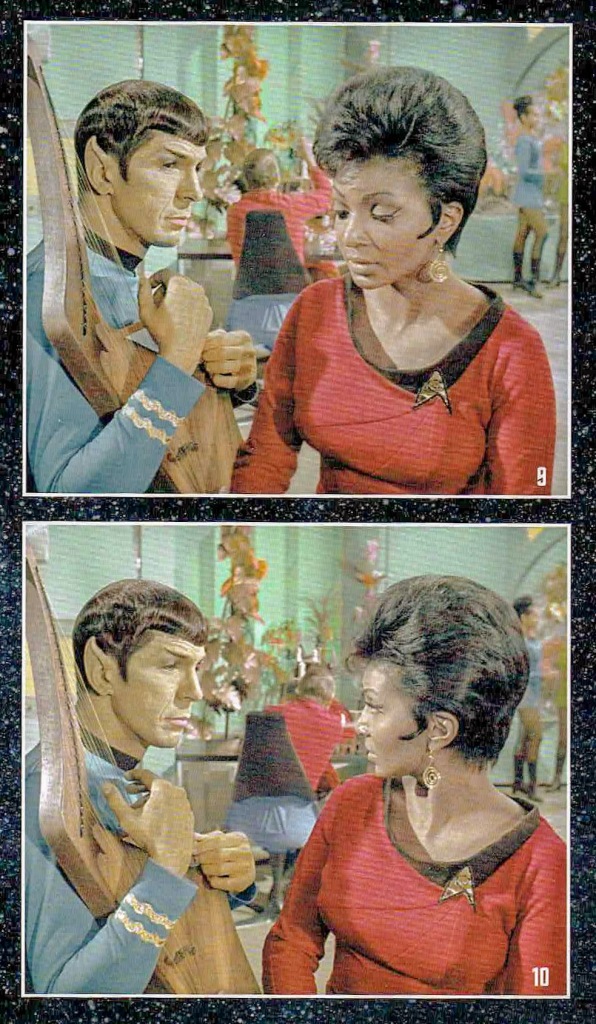
From Star Trek: Lost Scenes I am not clear how recording at a high volume and playing at a lower volume would change the sound itself; it would only change the resulting volume. Perhaps Berman meant speed, although again one would think the two opposite approaches would simply balance out. In any case, the sound is indeed otherworldly as early as its first appearance in Charlie X.
Berman refers to the harp in Elaan of Troyius. Don’t remember that? A sequence on the recreation deck was filmed but cut before broadcast, according to the excellent book Star Trek: Lost Scenes.
The costume designer’s favourite costumes
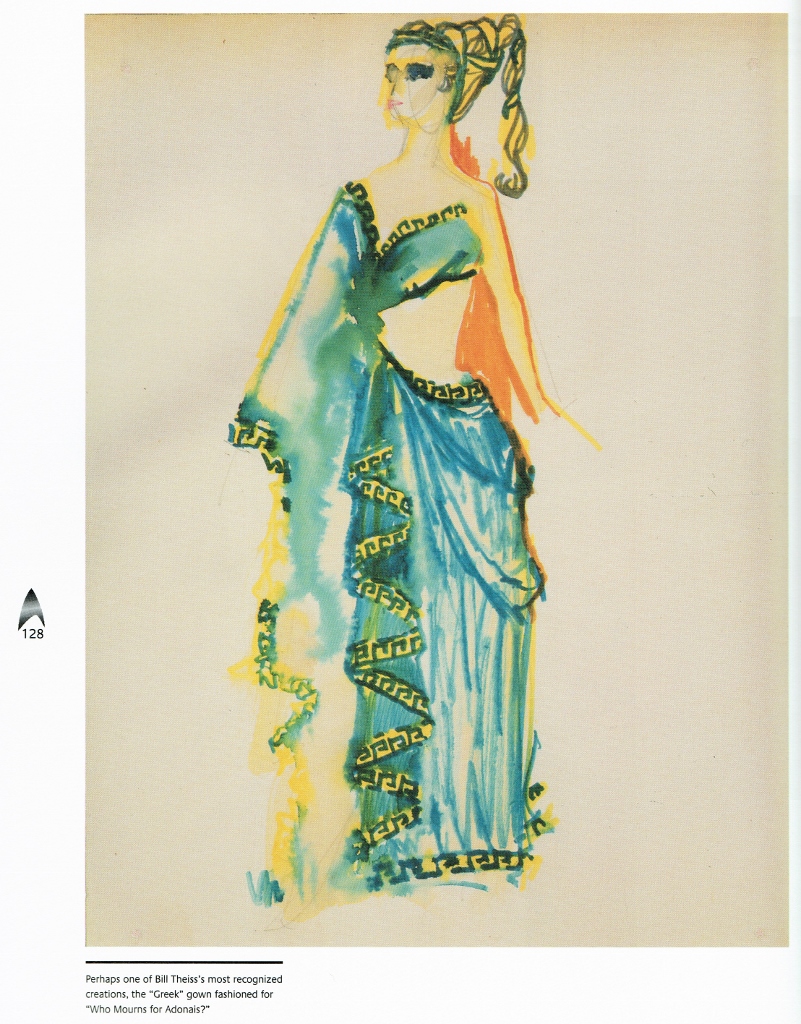

From Star Trek Sketchbook D.C. Fontana interviewed Star Trek costume designer William Ware Theiss. She asked which of his creations were hits with the fans.
The three most popular costumes I remember off-hand were Sherry Jackson’s costume from What Are Little Girls Made Of?…Leslie Parrish’s costume from Who Mourns for Adonais? and Jill Ireland’s costume from This Side of Paradise. I was prepared for and eagerly anticipated the storm over Sherry Jackson’s costume and pleased that Leslie Parrish’s was as well liked by the audience as it was by me. The popularity of Jill Ireland’s costume was a surprise to me inasmuch as it was a rehash of a style my mother wore when I was a little boy, which just goes to show classic designs are always good.


L-R: Sherry Jackson, Leslie Parrish, Jill Ireland (TrekCore) And what were Theiss’ own favourite designs?
I would have to mention Leslie Parrish’s costume first of all…a breathtakingly beautiful girl in one of my favorite scripts. (Because I am hung up on Greek mythology, I always preferred the script in the version the studio killed, wherein the ending becomes bittersweet rather than tragic. Dr. McCoy discovers the young female officer is due to bear the child of Apollo.) I feel this design, while Greek in feeling, was a completely fresh idea, i.e. the front of the dress was held up by the weight of the train which fell over the shoulder to the floor.
Another favorite of mine is the floor-length chiffon poncho over a black lace body stocking worn by Antoinette Bower in Catspaw. The design itself is not that unusual, but through a stroke of luck the finding of just the right black and white cabalistic print chiffon enabled me to portray a sinister, sexy futuristic witch.

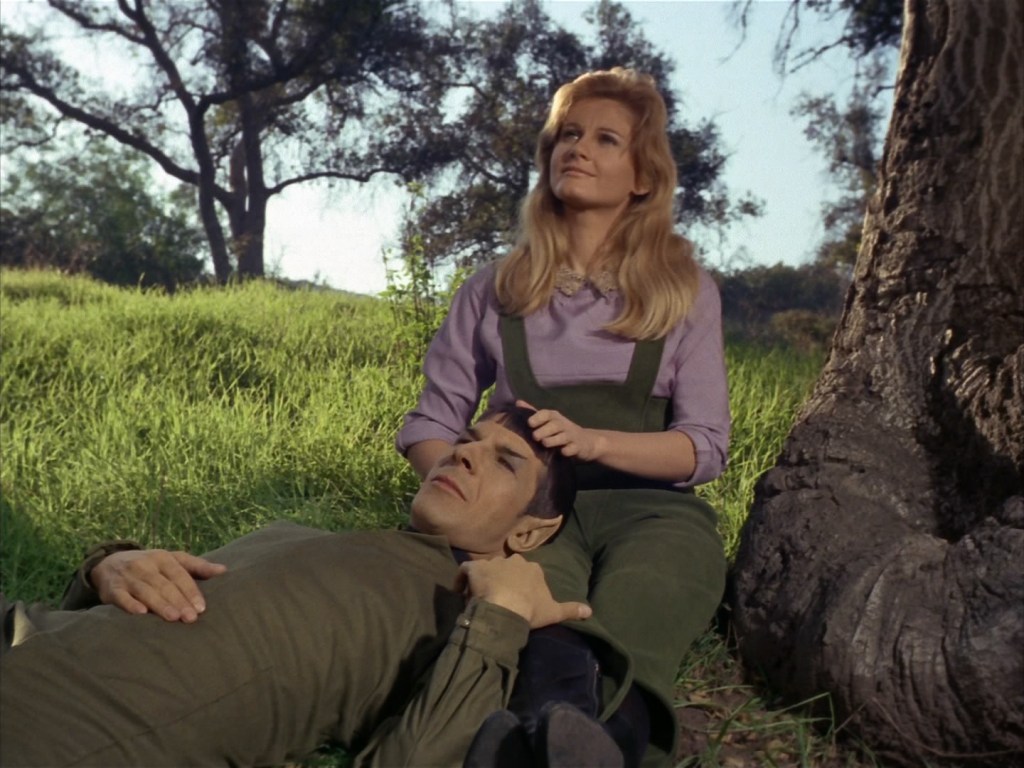
Antoinette Bower, Catspaw I too prefer the original ending of Who Mourns for Adonais? The screened episode ends with Kirk’s sad question, “Would it have hurt us, I wonder, to gather a few laurel leaves?” The script, however, added a closing scene in which McCoy informs the captain and first officer that Parrish is pregnant, and wonders “What will the child be? Man? Or God?” That scene is also in the James Blish novelization of the episode, as Blish was working from the script and had not seen the episode.
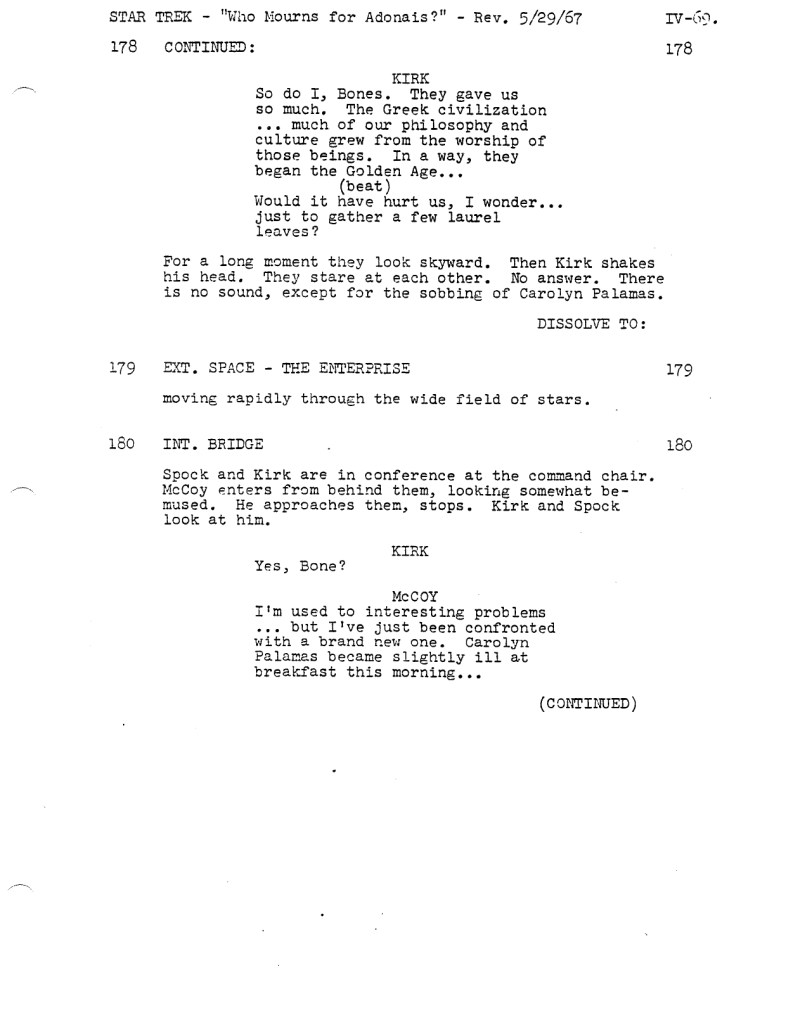
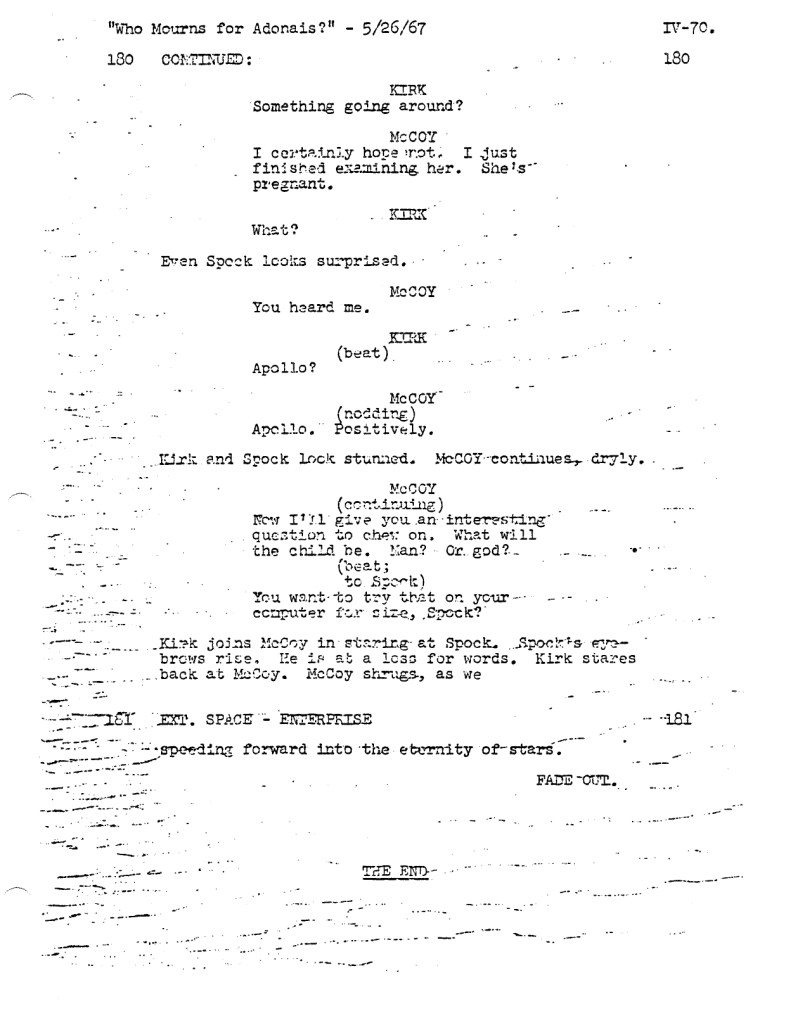
From the second revised final draft script The interview also includes this fashion advice for readers:
There are lots of things you can say, like “Listen to your mother.” But, of course, your mother might have rotten taste. Or “Believe in yourself.” But you might have rotten taste. Or, “Read the best teenage fashion magazines.” But they do have rotten taste — too often. I guess the only general advice is only buy things you feel very strongly about.”
Inside Star Trek is an invaluable source of early Star Trek voices. I’ll cover each issue. Click here to read other articles in this series. -
A defence of The Way to Eden: it’s better, and much darker, than you remember
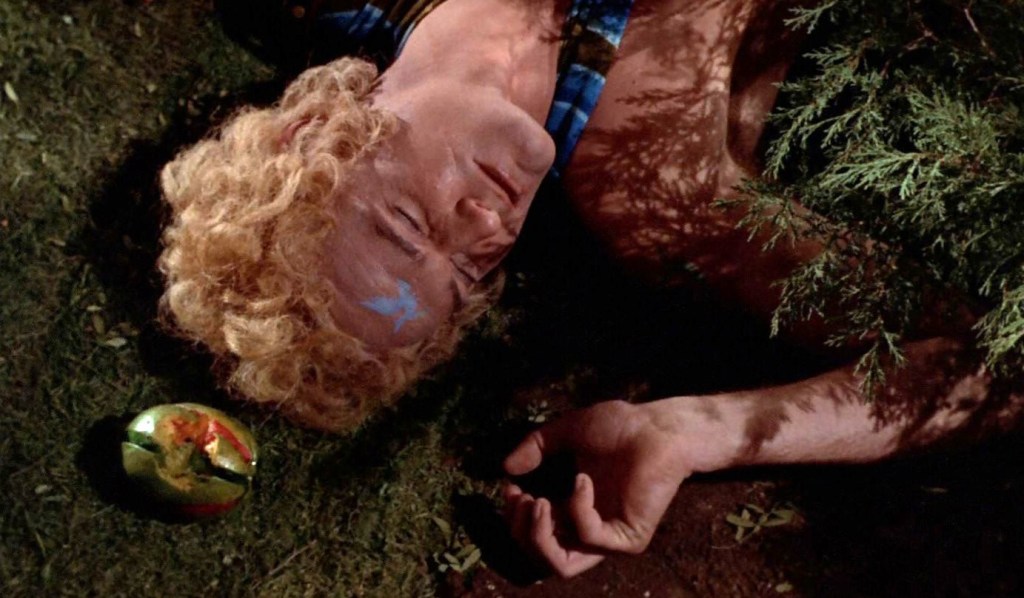
Star Trek IV is called “the one with the whales” but, where that is said with affection, The Way to Eden is often dismissed as “the one with the hippies.” Viewers dazzled by the way-out costumes, the “we reach” lingo and the quasi flower-power mysticism often don’t see the warning about messianic figures and the cults they build around themselves. The Way to Eden is closer to Charles Manson than to the summer of love.
It’s not a popular episode, so you probably haven’t watched it in a while. Here are some reasons you should fire up Netflix or pull disc 4 of the Blu-ray set off your shelf.
Solid production values
The costumes are way out and also fantastic. Tongo Rad asks Chekov “Say, tell me, why do you wear all those clothes? How do you breathe?” and their outfits fit perfectly with that world view.
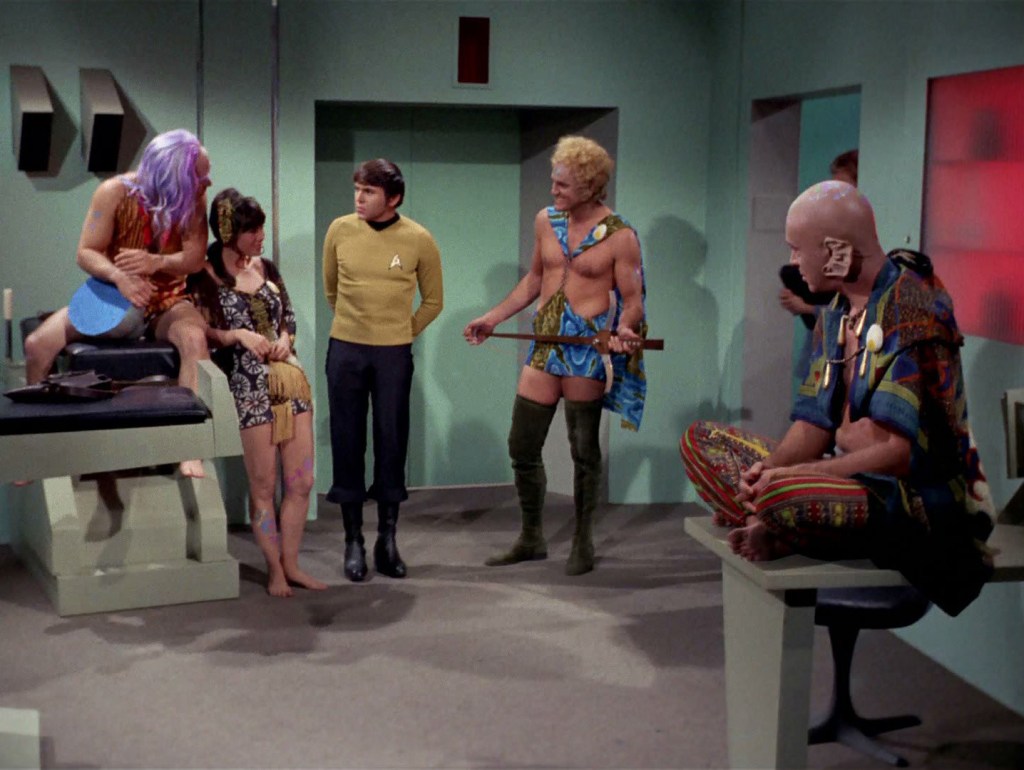
All episode images are from TrekCore The dialogue is often outlandish — “Oh ho, that’s now. That’s real now. I reach that, brother. I really do. Give.” — but it is always delivered realistically, as if it makes perfect sense to the speaker.
It’s also well directed. David Alexander’s only other episode, Plato’s Stepchildren, is also considered to be over the top but he gets strong performances from the actors here. And there are nice little touches throughout. As Kirk exits sickbay just after McCoy explains Sevrin’s diagnosis, for example, a security guard hears the door open behind him and hurriedly tosses one of the egg-shaped One pins back to the blond female passenger. He does not want his captain to know he had been chatting with the group. That small piece of stage direction is not detailed in the second revised final draft of the script, and so perhaps came from Alexander.
But the direction is not perfect. In the same scene, during Adam’s “Stiff man putting my mind in jail” song, the actor stops playing his “guitar” halfway through but the strumming is heard throughout.
Good character moments
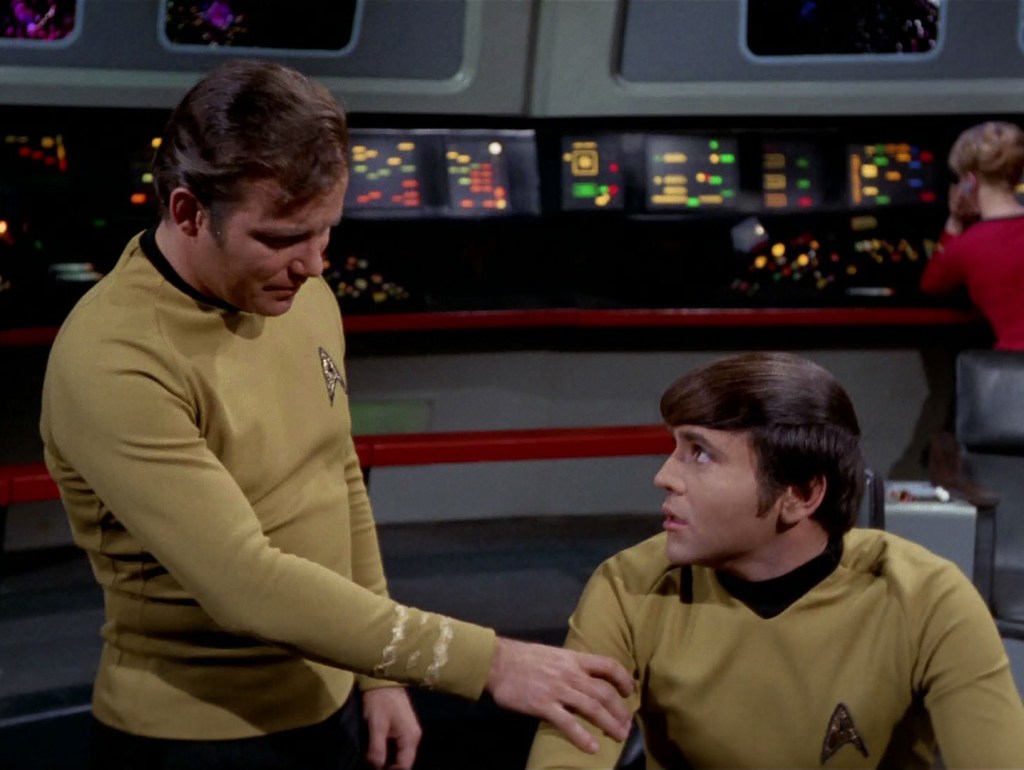
One three-minute sequence gives us wonderful insights. Kirk returns to the bridge after his initial confrontation with the group. Chekov has heard Irina’s voice from the transporter room and it is clear on his face that he once loved her. Kirk tells Chekov he may leave his post, without the ensign actually asking to do so. The moment says much about the respect these officers hold for each other, and it’s a nice performance from Walter Koenig.
Spock then explains his interest in the One movement by telling Kirk “They regard themselves as aliens in their own worlds, a condition with which I am somewhat familiar.” It’s a small yet powerful statement.
Directly after that, Kirk asks Spock to explain the group’s “Herbert” jabs. Spock reluctantly defines Herbert as “a minor official notorious for his rigid and limited patterns of thought” and William Shatner’s reaction is a wonderfully understated bit of acting.
The script was written by Arthur Heinemann and Michael Richards. The latter is the pseudonym Dorothy Fontana employed after her script Joanna somehow morphed into this episode. (I wrote about that a little here.) She was clearly displeased with the screened version, but this brief scene on the bridge is reason enough to watch this episode.
The Federation doesn’t suit everyone
The Way to Eden is a rare look at people who are uncomfortable living in the Federation. This otherwise utopian society, Sevrin tells Spock, “is poison to me. This stuff you breathe, this stuff you live in, the shields of artificial atmosphere that we have layered about every planet. The programs in those computers that run your ship and your lives for you…” Spock describes the One movement to Kirk as “almost a biological rebellion. A profound revulsion against the planned communities, the programming, the sterilised, artfully balanced atmospheres.”
That no one social model serves everyone’s needs is an important message, especially for those Star Trek fans who, like Roy Neary in Close Encounters of the Third Kind, would jump at the chance to board a starship.
The social warnings
The limits of authority. The episode is an interesting examination of the limits of Kirk’s authority. Accustomed to command hierarchies, what does he do when people simply refuse to obey? He faces the same dilemma when his crew, stoned on spores, mutinies in This Side of Paradise. In Eden, when Sevrin and his followers do not accept the captain’s authority, Kirk gives up and turns to someone who will obey: “Mister Spock, you seem to understand these people. You will deal with them.”

Religious fanaticism. It’s striking that Sevrin never really explains his belief system, and his followers seem fine with that. Asked by Spock to state the group’s purpose, Sevrin says only “If you understand One, you know our purpose.” Pushed a little, he adds “We turn our backs on confusion and seek the beginning.” But that beginning is identified as the planet Eden, so at best his religious system is built on an adaptation that replaces a garden with a remote planet in Romulan space. That certainly stretches the source material, but his followers buy into it.
Cults. Sevrin is a cult leader. Like many before him, his followers are willing to die and kill for him. They barely question that requirement. When Sevrin announces he will kill all the crew on board the Enterprise, their quick acquiescence is chilling.
Sevrin: I’m using sound against them, beyond the ultrasonic. It will stun them and allow us time to leave. We’ll go in one of their shuttlecraft.
Irina: Sound pitched that high doesn’t stun, it destroys. I remember when we read in the text that it…
Sevrin: I’ve gone beyond those texts, Irina. It’s correct for you to be concerned, but be assured also.
Rad: We are in orbit over Eden, Brother Sevrin. (pause) It does destroy.
Sevrin: We cannot allow them to come after us.
The cult leader has spoken, his followers nod, and then Adam sings an upbeat song as the entire crew is dying.
Sevrin is a deep and dark character

The fun songs and crazy outfits tend to obscure the truly dark nature of the main antagonist. While Sevrin is not one of Trek’s best bad guys, he is one of the darkest. Khan tries to kill Kirk in a decompression chamber, sends Spock to die and threatens “Each of you in turn will go in there” until he gets cooperation — and all of that is bad, but Sevrin decides to flat-out slaughter every person on board the Enterprise. He does that just so he can get a ride to a planet.
His character gives us an interesting look at madness and the power of a charismatic figure to lead others to their doom.
Of course, there are problems here too
People dislike The Way to Eden for its crazy costumes, far-out dialogue and the music. Those elements do not bother me; my criticism is far more substantive.
Sevrin and his followers tried to murder all 430 people on the ship and, at the end of the episode, everyone is fine with that.
After barely escaping certain death, the landing party beams down to Eden. Sevrin and Adam are dead, all the others are horribly burned by acid, and Chekov’s response is to put his arm around Irina and comfort her. Later, the two share an emotional goodbye and a tender kiss on the bridge.
This is the woman who agreed to his death and that of everyone around him. Worse, Kirk makes this ridiculous statement to Chekov: “You did what you had to do. As did we all. Even your friends.”
What? This band of psychopaths had to kill them all? Oh well. Shrug.
If you want to hate on The Way to Eden, do it because the ending is absurd and offensive. I believe it was an attempt to say that the methods were wrong but that the basic beliefs of the group had merit. Spock outright says that to Kirk: “There is no insanity in what they seek.” This fit with the progressive thinking of the 60s that dismissed conformity, but there is no way around the fact that the episode ends on a terrible message.
Even with its faults — or, more likely, because of them — this is a deeply misunderstood episode. It is not a hippie-dippy story about a bunch of quirky malcontents who just want to sing songs and eat fruit. It is a warning about the power of cults, the discontent that even utopian conformity can create, and a cautionary tale about a society that most viewers (myself included) would embrace.
Postscript
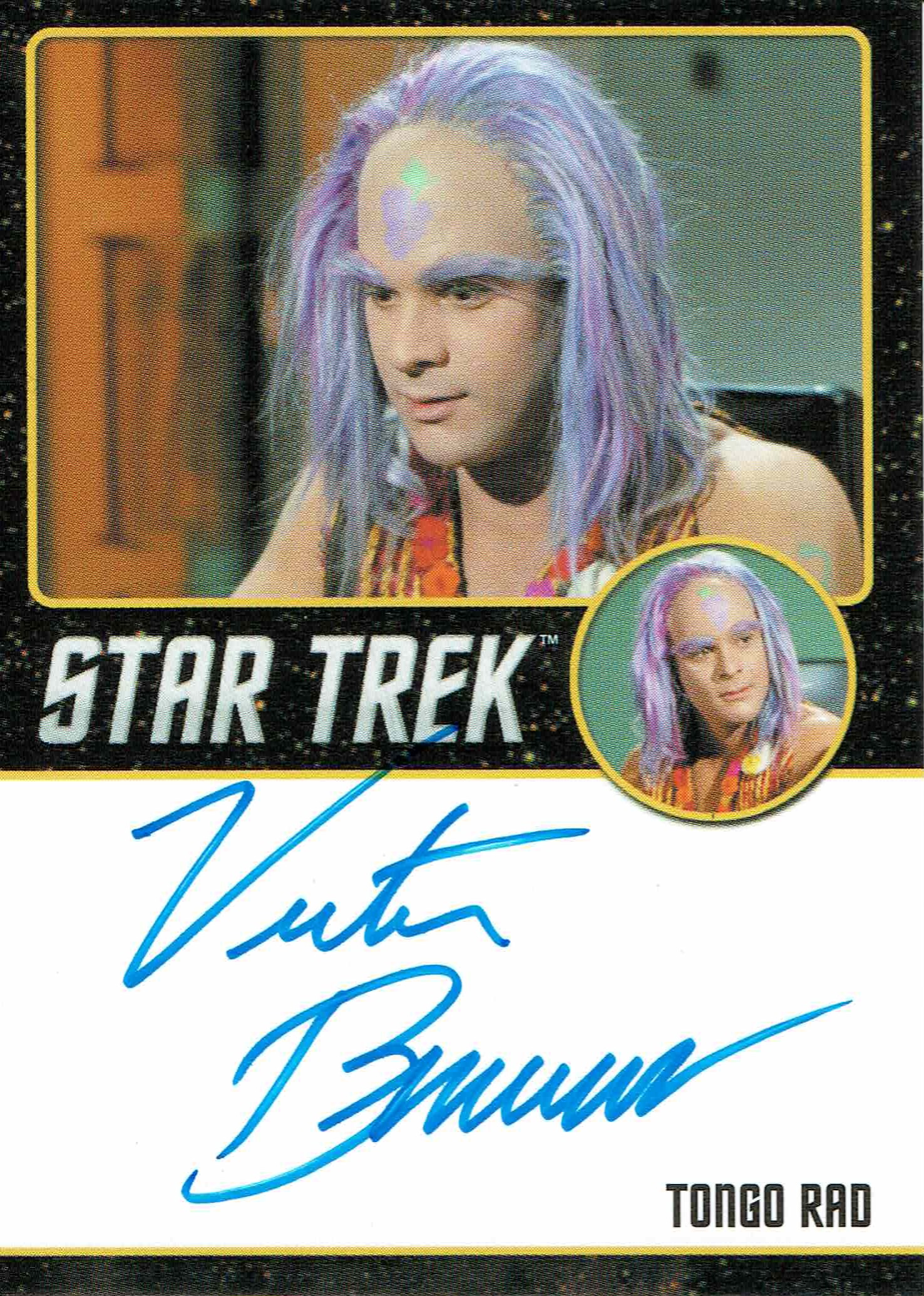
Victor Brandt played Tongo Rad and had a small role in Elaan of Troyius, and there are two interesting bits in this interview with StarTrek.com. The first is about his legacy as an actor: “I had no idea at the time Star Trek would be on my gravestone. It will say, “Here lies Victor Brandt, who played Tongo Rad.”


He also tells a great story about his guest shot on Shatner’s T.J Hooker:
I went in and auditioned, and I got the part. It was an interesting part, a cabbie who was being coerced into ratting out a fare. I went on the set in the morning – and this is true – and I introduced myself to Bill. I said, “By the way, Bill, do you remember me?” He said, “From what?” I said, “Well, I did two episodes of Star Trek.” He looked at me and he said, “Victor, I’ve got to tell you the truth.” I said, “What’s that?” He said, “I only remember the women.” I wasn’t insulted. We both laughed. He wasn’t kidding.
Postscript the second
Overall, I far prefer to watch my TOS with its original effects, but the remastered episode features a nicely reimagined space cruiser Aurora. The ship was originally the Tholian vessel from The Tholian Web with nacelles glued on the model. By contrast, the remastered version actually looks like a ship that would exist alongside the Enterprise. Kudos to the remastering team.

The original Aurora 
The remastered version
Collecting Trek
A TOS collection 40 years in the making