-
Spend time with the two sides of Leonard Nimoy
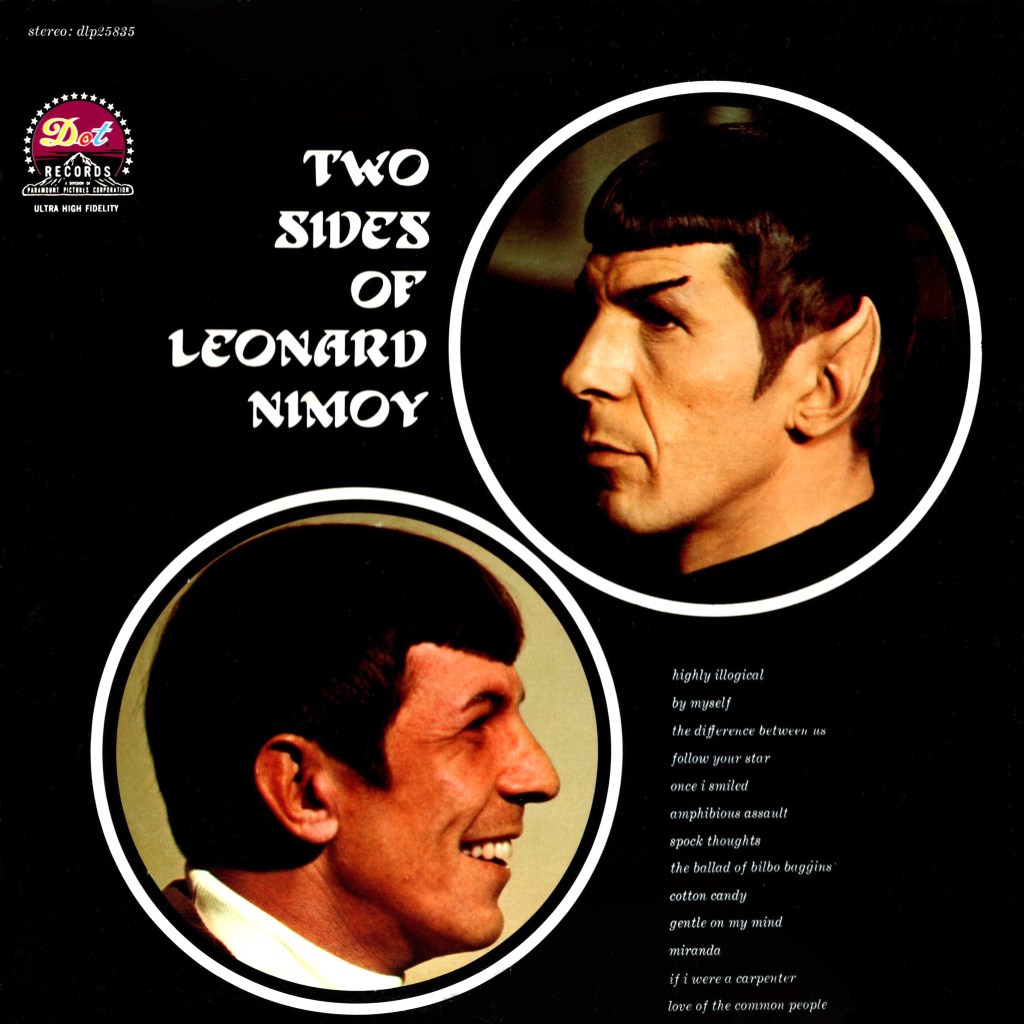
Leonard Nimoy was born on March 26, 1931, and I am commemorating his birthday by listening to Two Sides of Leonard Nimoy — and you can too. All the tracks are playable below.
Nimoy reflected on Spock and on his own view of the world in this 1968 album. The theme of the LP is described on the back of the record sleeve:
Ever since Gene Roddenberry and his Norway Corp. created the series “Star Trek” for Desilu, Leonard Nimoy has developed a distinctive second personality. He now spends half of his life as “Mr. Spock,” the highly logical, unemotional, intelligent and super-efficient first officer aboard the Starship Enterprise. The original Nimoy is the talented, experienced actor who has played many TV and movie roles, and who is called by his friends an “Actors’ actor.” Nimoy is also proving himself a most capable singer and entertainer in his personal appearances throughout the country. In this album, Leonard Nimoy offers musical versions of his “two sides.”
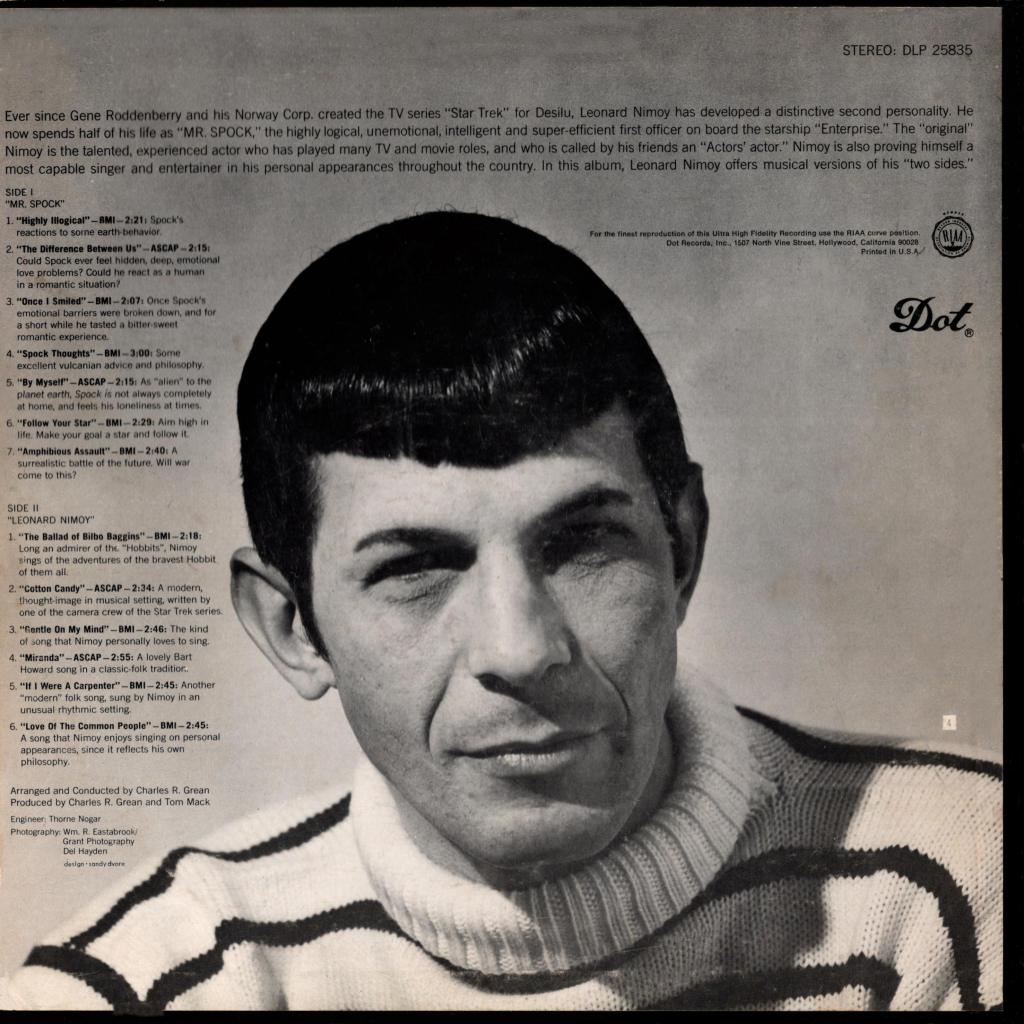
The description “a most capable singer” may ring a little thin to modern ears, as much of the music is not terribly impressive, but the insights into Nimoy and his thoughts on Spock are worth exploring. The album is a precursor to his self-reflective musings in the books I Am Not Spock and I Am Spock.
The idea here is that side one is Spock speaking and side two comes from Nimoy.
Here is side one:
Highly Illogical
The Difference Between Us
Once I Smiled
Spock Thoughts
By Myself
Follow Your Star
Amphibious Assault
The album opens with a lighthearted (and somewhat sexist) take on humanity called Highly Illogical. Next is The Difference Between Us, which really sounds like it’s about Droxine in The Cloud Minders, except that the album was released six months before even that episode’s story outline was penned. The lyrics include:
If you could live for just a moment in my world,
and recognize what makes me what I am,
perhaps that would the catalyst be,
to harmonize the differences between you and me.
Similarly, listen to Once I Smiled and just try not to think of Leila Kalomi as Nimoy sings “Once I smiled a smile so rare, Loved a girl with golden hair” and even references that the singer “swung from trees.”

Another highlight of side one is Spock Thoughts, but I was disappointed to learn it is not original to the album. The track is a slightly modified version of the poem Desiderata by Max Ehrmann. Some of it applies well to the Spock character, some not as well. Here are three sections.
Go placidly amid the noise and haste, and remember what peace there may be in silence.
Speak your truth quietly and clearly, and listen to others, even the dull and ignorant, they too have their story.
Be at peace with god, whatever you conceive him to be.
Here is side two:
The Ballad of Bilbo Baggins
Cotton Candy
Gentle on my Mind
Miranda
If I Were a Carpenter
Love of the Common People
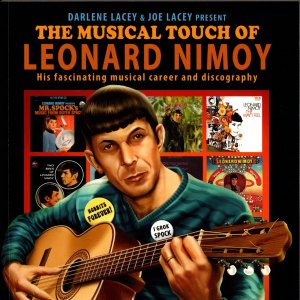
And, it must be said, some songs are quite awful. Cotton Candy, on side two, is painful. It is, however, notable as it was apparently written by Star Trek camera operator Cliff Ralke. That is a cool bit of obscure trivia. He is not credited by name on the album, which states only that the song was “written by one of the camera crew on the Star Trek series,” but a few sources, including a great little book called The Musical Touch of Leonard Nimoy, lists him as the writer. And he had a track record with Trek music, as the liner notes for William Shatner’s 1968 album The Transformed Man state Ralke encouraged Shatner to record the album.
One highlight on side two is Love of the Common People. The song has been performed by many artists, including Paul Young, Waylon Jennings, John Denver, The Everly Brothers, and Bruce Springsteen, and Nimoy’s version is quite good. The lyrics are about poverty and hunger but most versions present it with an upbeat tempo, as did Nimoy.
And then there is the famous — or infamous — The Ballad of Bilbo Baggins. The album explains: “Long an admirer of the ‘Hobbits,’ Nimoy sings of the adventures of the bravest Hobbit of them all.”
Honestly, this track alone is worth the price of admission, especially if you also watch the music video Nimoy made. I have never seen a high-res version; here is the best I can find.
And, once you have enjoyed the musical stylings of Two Sides, watch the actor briefly discuss his recording career at Fan Expo in Toronto in 2009.
You have to respect that Nimoy, like Shatner, was an accomplished actor who decided, what the hell, I’ll make some albums too. And we all benefit from that willingness to trade the safe confines of a TV soundstage for the unknown frontiers of a recording studio.
Happy birthday, Leonard.
-
Shatner wanted to get closer to his fans in 1977

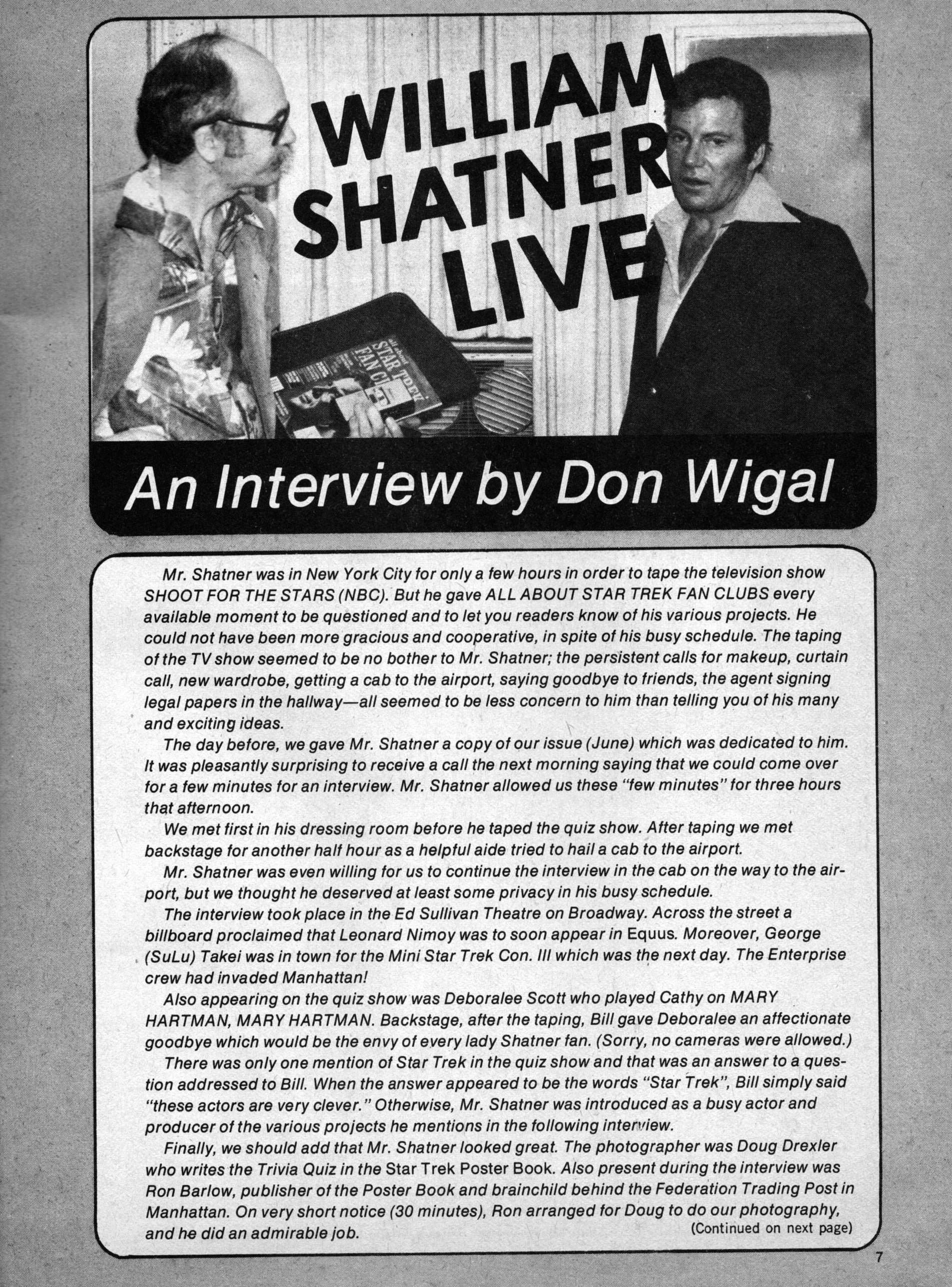
I recently shared Doug Drexler’s story of photographing William Shatner in 1977 for the magazine All About Star Trek Fan Clubs, and then I realized that issue is probably among the more than 150 Star Trek magazines I own. And I did find it in one of my storage boxes.
Here are the highlights from that interview.

Shatner opens by telling magazine associate editor Don Wigal that he has a newfound interest in connecting with Trek fans, but adds that his interest is essentially commercial: “I’m actively, now, looking for those people I’ve ignored all the years. I have now my own record called William Shatner Live. I’m mail ordering it myself. So I too have a vested interest in reaching the fans.”
It’s good that he’s honest. I guess.
The interview itself is a prime example of the semi-professional nature of most genre magazines in the ’70s. The piece is disjointed and meandering, because it seems the writer used everything that was said, rather than editing for clarity and interest. For example, when Shatner promotes an upcoming play, the magazine includes this exchange:
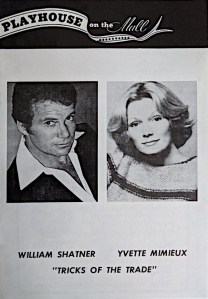
Image credit: Kevin G. Shinnick WS: Then, there is a play which I’ll be doing—Sidney Michaels’ “Tricks of the Trade,” here in the summer. And— (to his agent) do we know where?
Agent: Westport, Conn.
A more experienced editor would have left out the aside.
But the Shatner we know today does come through in the piece, especially when he talks about the many topics that interest him. He touches on “the conservation of whales and porpoises” and the “slaughter and genocide” humans inflict on them, Neanderthal anthropology, child welfare, and the meaning of life: “It’s such a mysterious thing. What people call God, or what the various religions attach a name to might just very well be the mysticism of what life is.”
Here is the interview in its entirety, along with a link to download a PDF.
And here is the magazine’s spread of the Drexler photos mentioned above.

The magazines of that era are a wonderful look into 1970s fandom, when both the publications and the celebrities were a little less polished and practiced.

-
Check out these photos of Bill Shatner from 1977

I have had the privilege recently of interviewing Doug Drexler for some articles (including this one) and he told me an interesting story about photographing William Shatner back in 1977, while Drexler worked at The Federation Trading Post in New York City.
I took photos of William Shatner backstage at the Ed Sullivan Theater in 1977. He was doing a game show, and a magazine, All About Star Trek Fan Clubs, arranged to interview him backstage. We knew the editor through The Federation Trading Post and he knew I liked to take pictures, so he asked me if I wanted to come along and be his photographer. I was snapping shots while he was being interviewed, and I caught some really good moments, because I knew all of Shatner’s moves, I knew where he was going. He could tell that and he started playing to me.
We sat and chatted after that. It was awesome.
The photo is owned by Doug Drexler. He has posted more from this series on his Facebook page.
I also wrote about the article in that issue of All About Star Trek Fan Clubs.
-
Join me for two Trek tales from Peter Pan Records
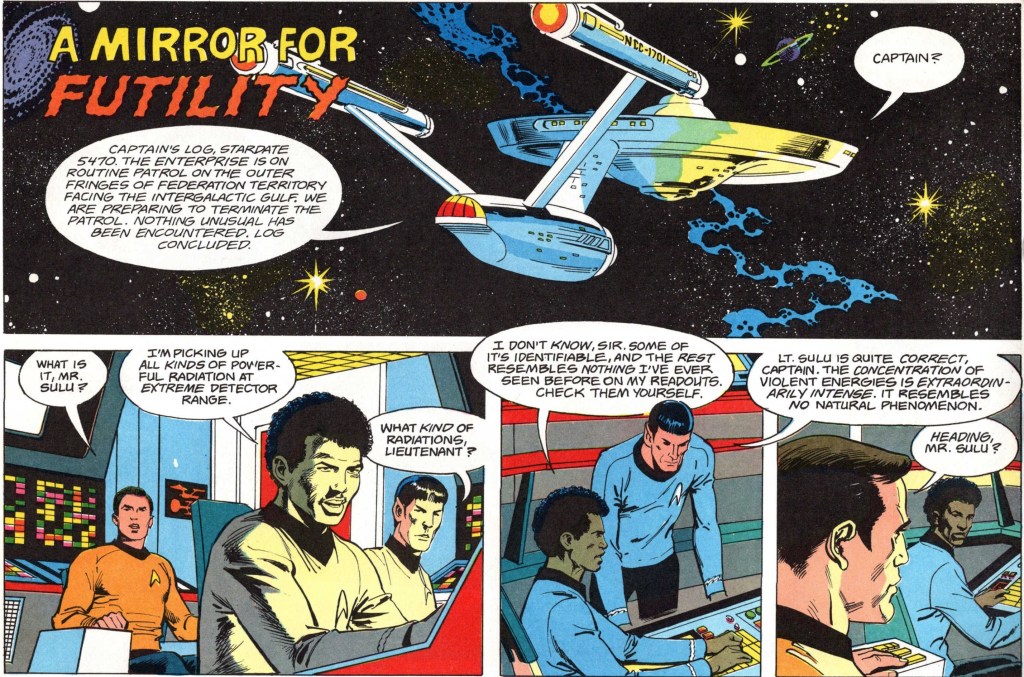
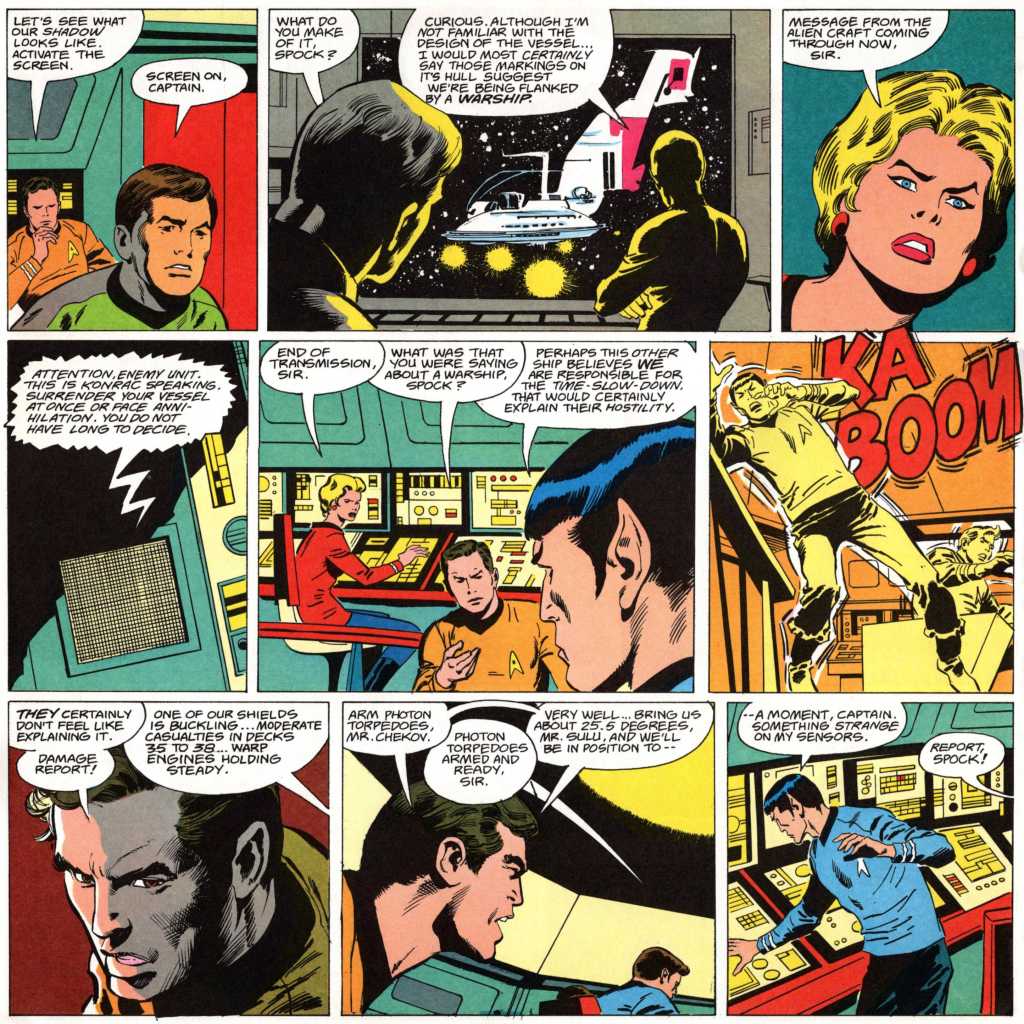
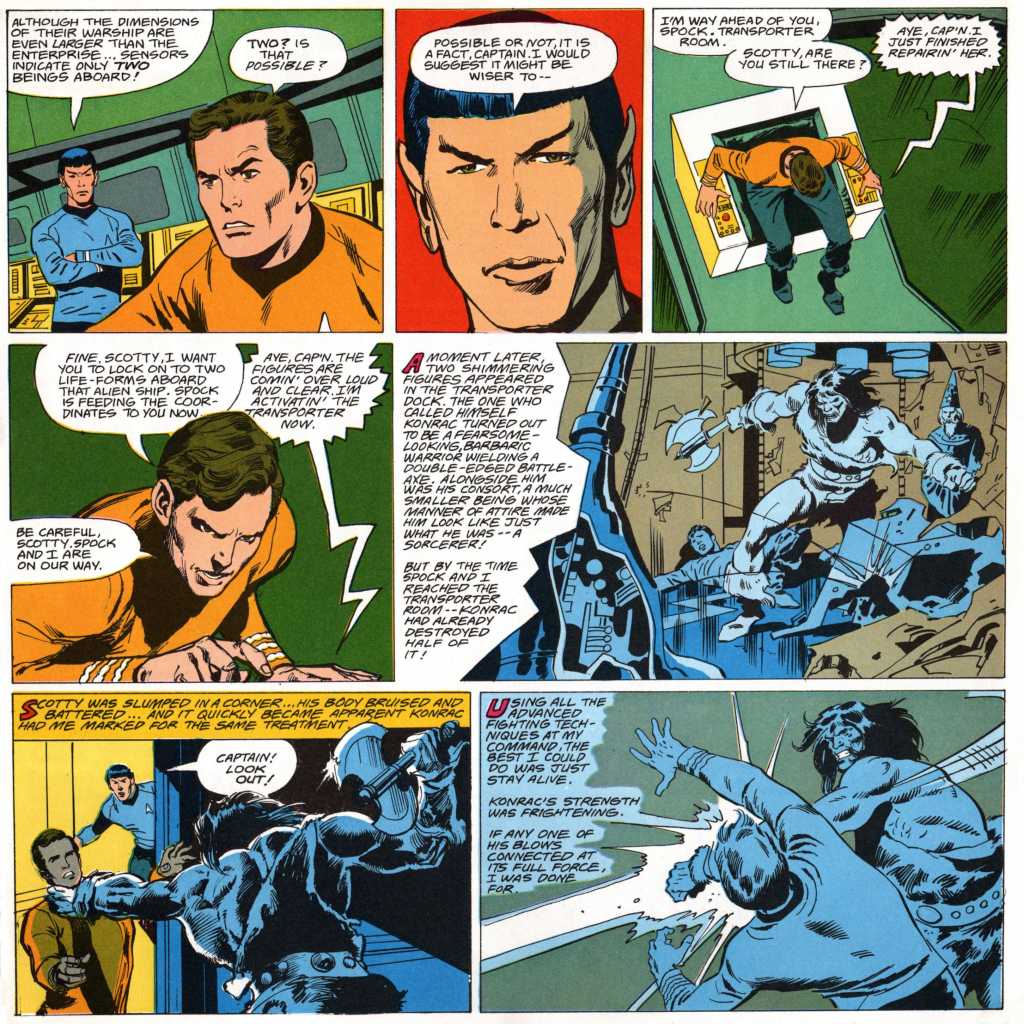
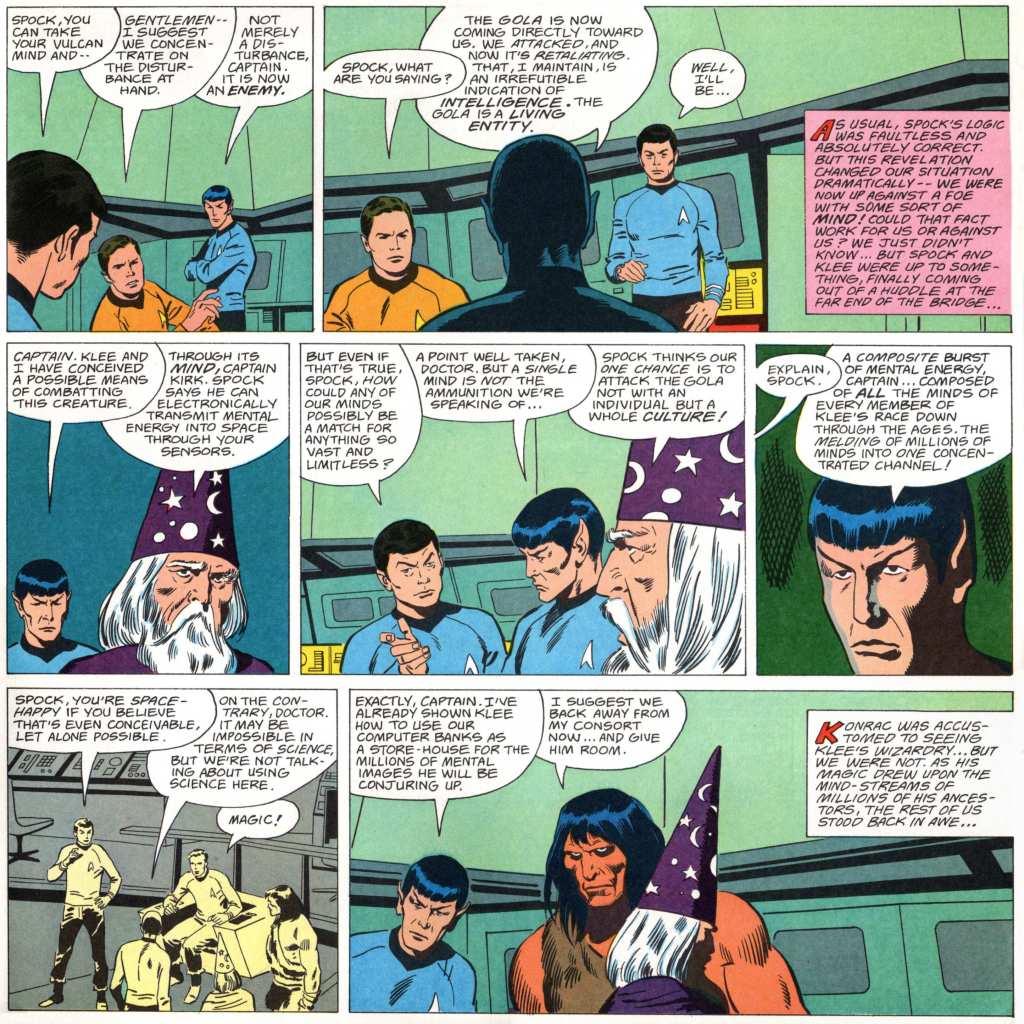
I own all the mainstream Star Trek original-series comics but some of the lesser-known books are not on my shelves. Then I was reminded recently that many Peter Pan records came with comic books, and it suddenly bothered me that I had none of those.
To eBay! I picked up two book-and-record sets for C$18 each, still sealed in plastic. I am writing about one of those here.
(A small aside: there are a ton of Star Trek comics and comic strips and as far as I know only two people own all the US and UK English-language instances: Rich Handley and Mark Martinez.)
A quick history: Peter Pan and Power Records
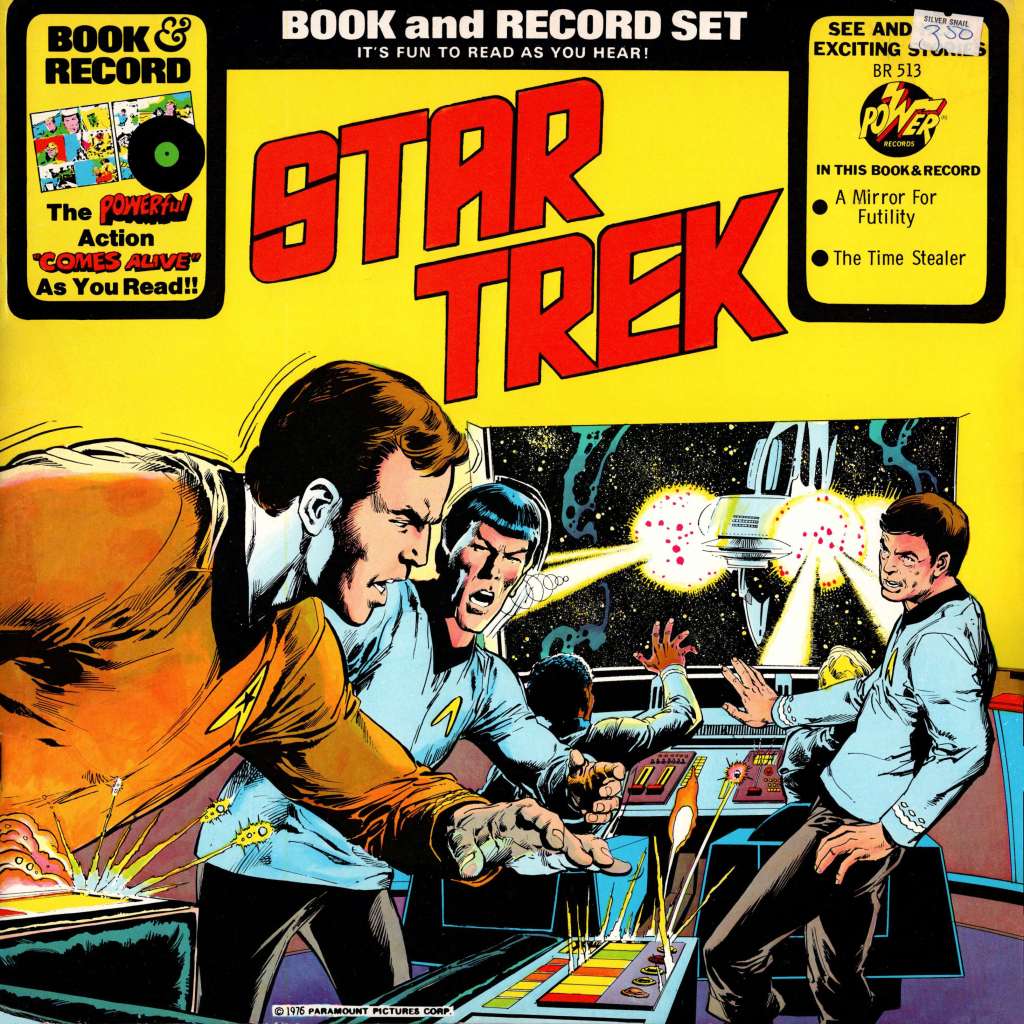
Peter Pan Industries produced records for kids under the brand names Peter Pan and Power Records. The recordings were dramatic performances of original stories, with music and sound effects. The company’s tales featured many TV shows, including The Six Million Dollar Man and Kojak, and a bunch of superheroes and cartoon characters. It also produced 11 original Star Trek stories between 1975 and 1979 and packaged and repackaged them across more than 20 33-1/3 and 45 RPM discs. Ten of those sets included colourful read-along comic books.
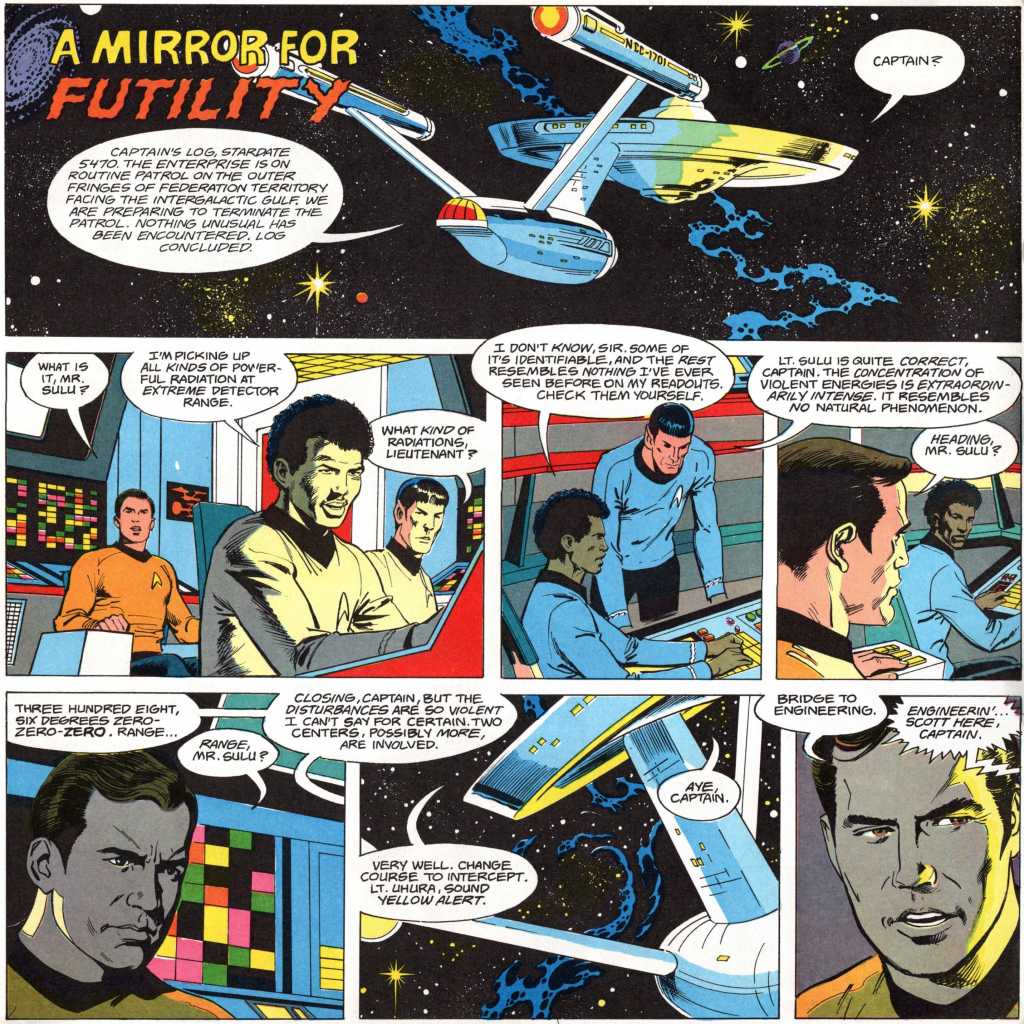
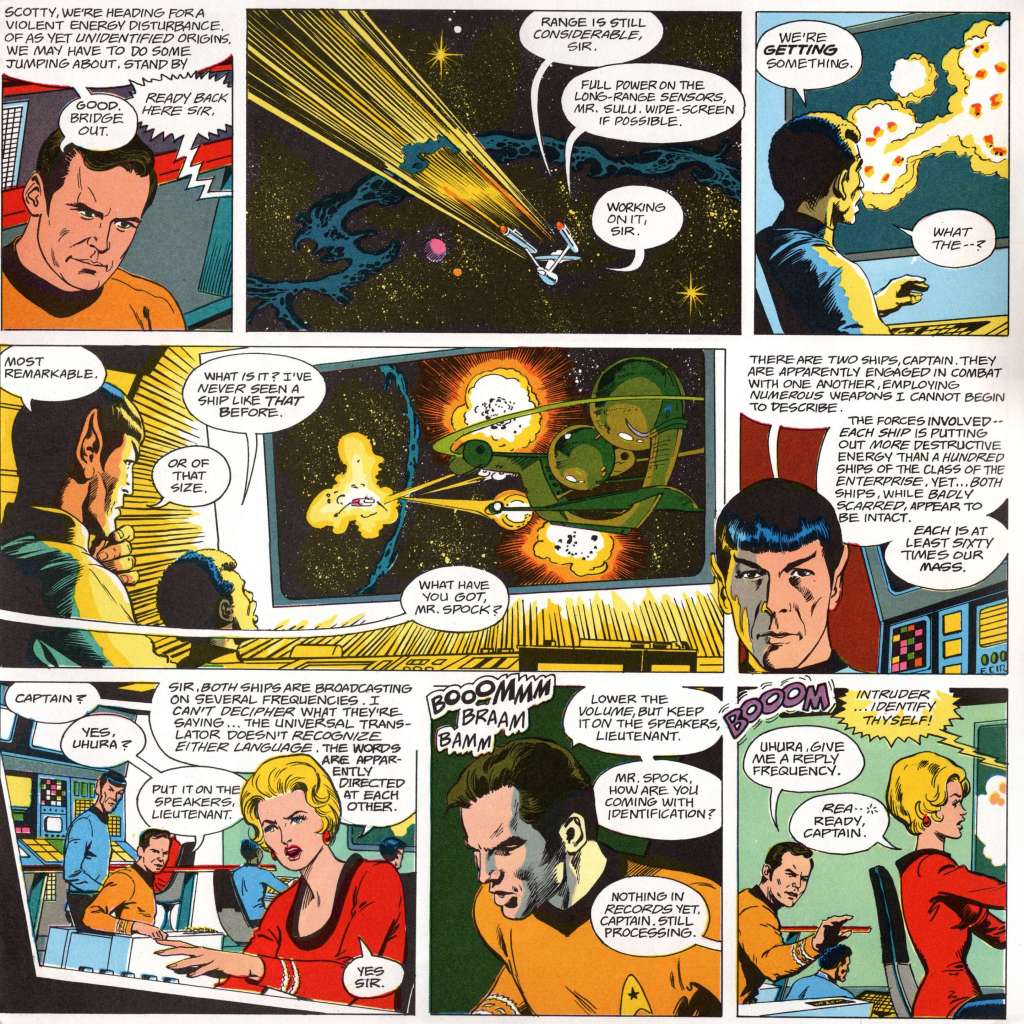
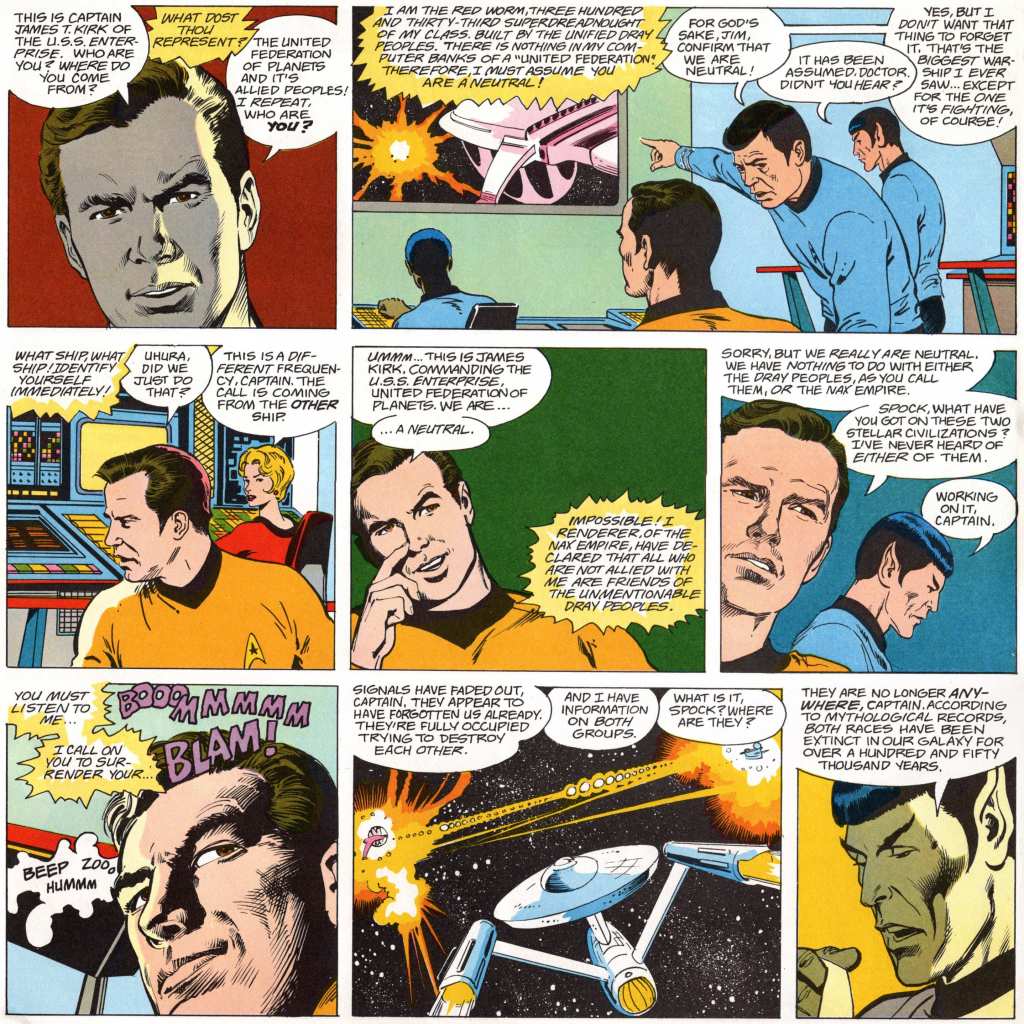
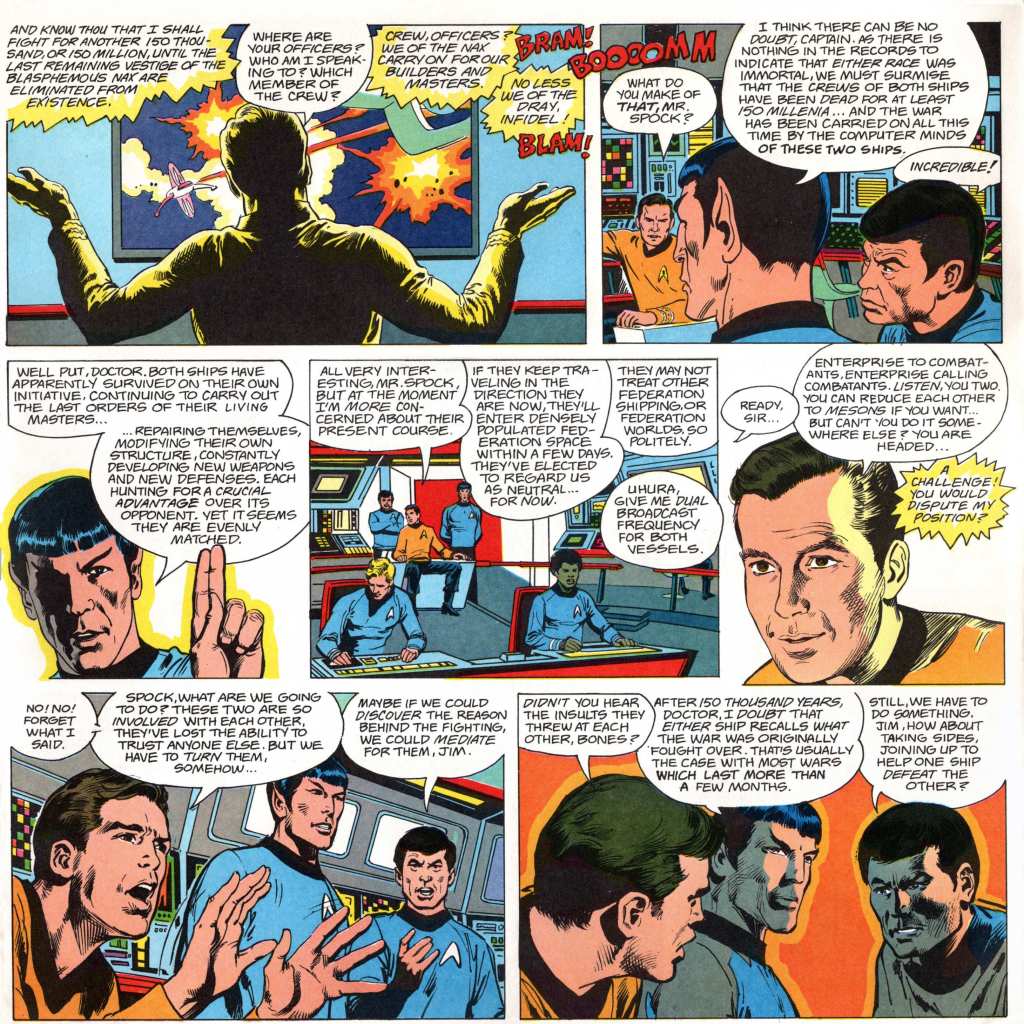
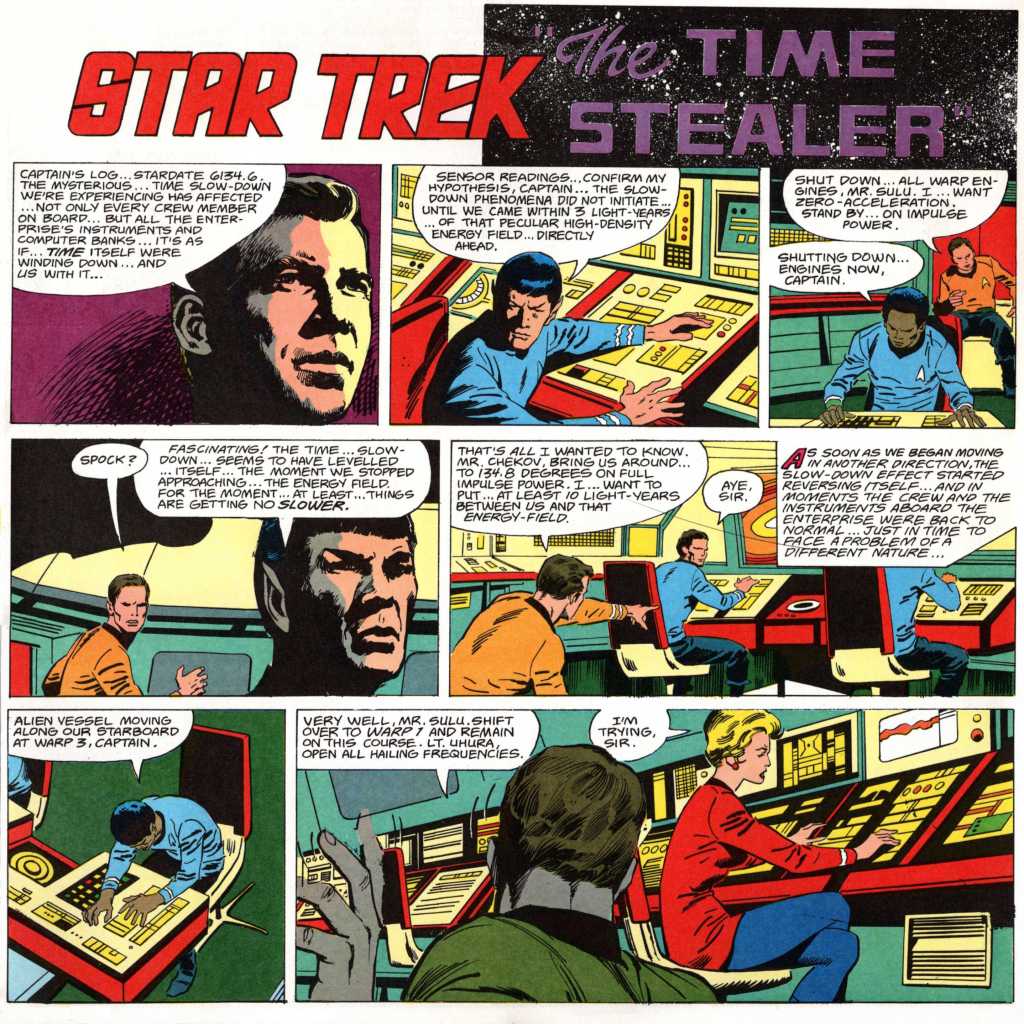
My recent acquisitions include the 1976 LP that published The Time Stealer and republished A Mirror for Futility, originally released in 1975 although apparently without the comic that accompanied the later release. (Honestly, the permutations of story and comic releases are headache inducing.)
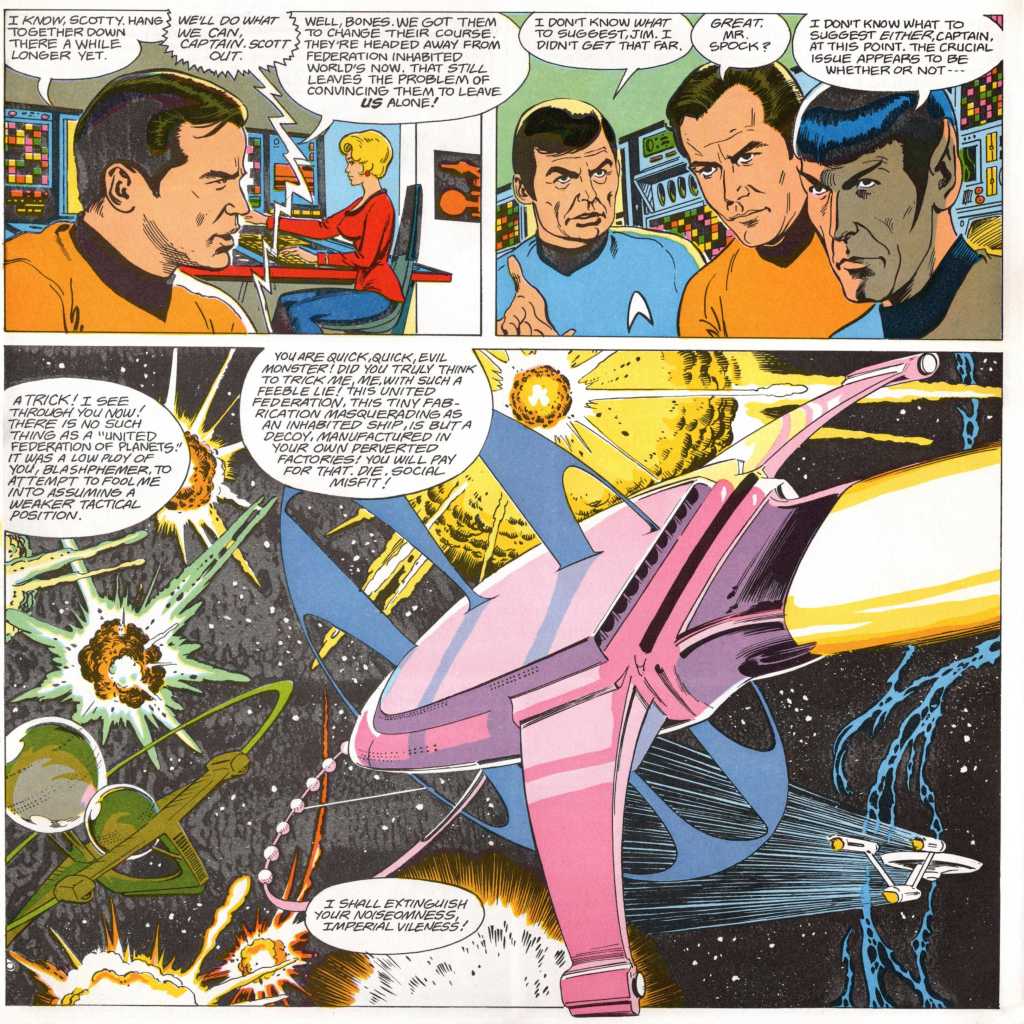
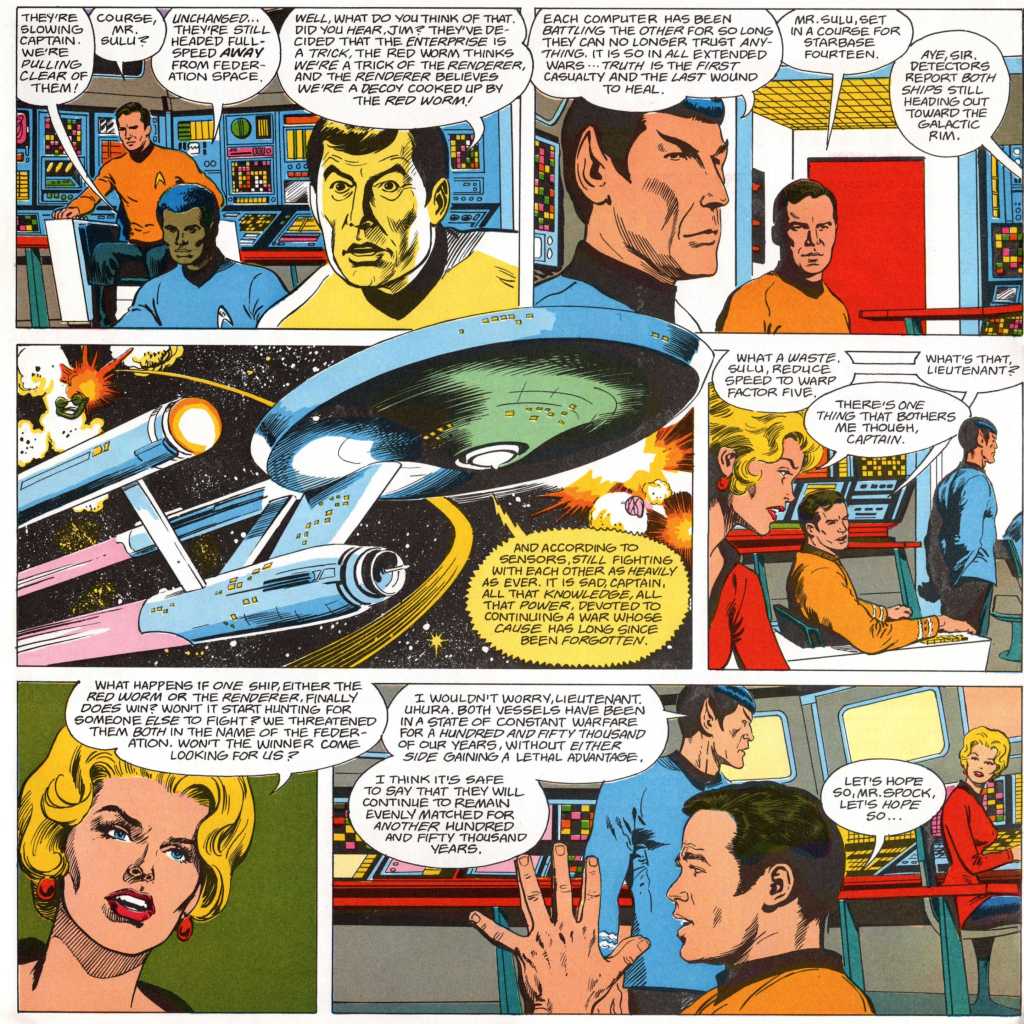
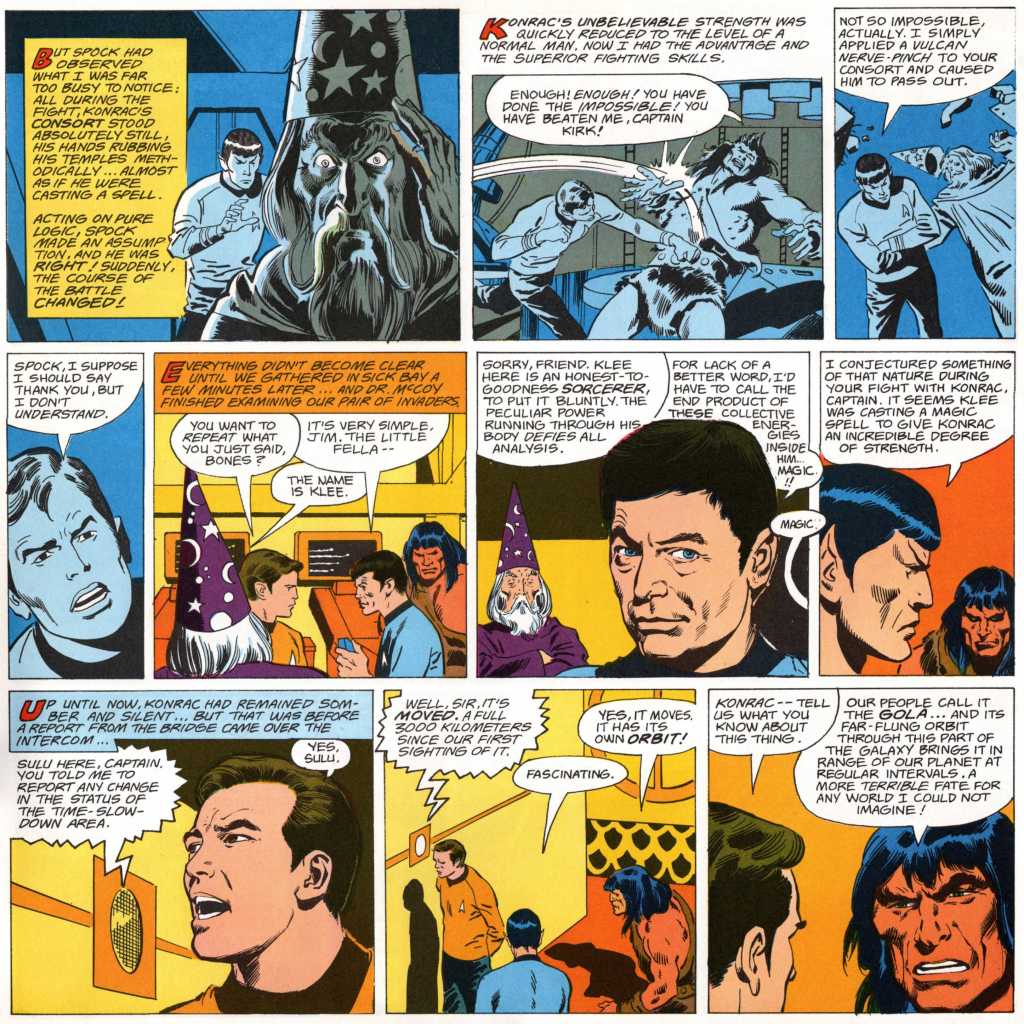
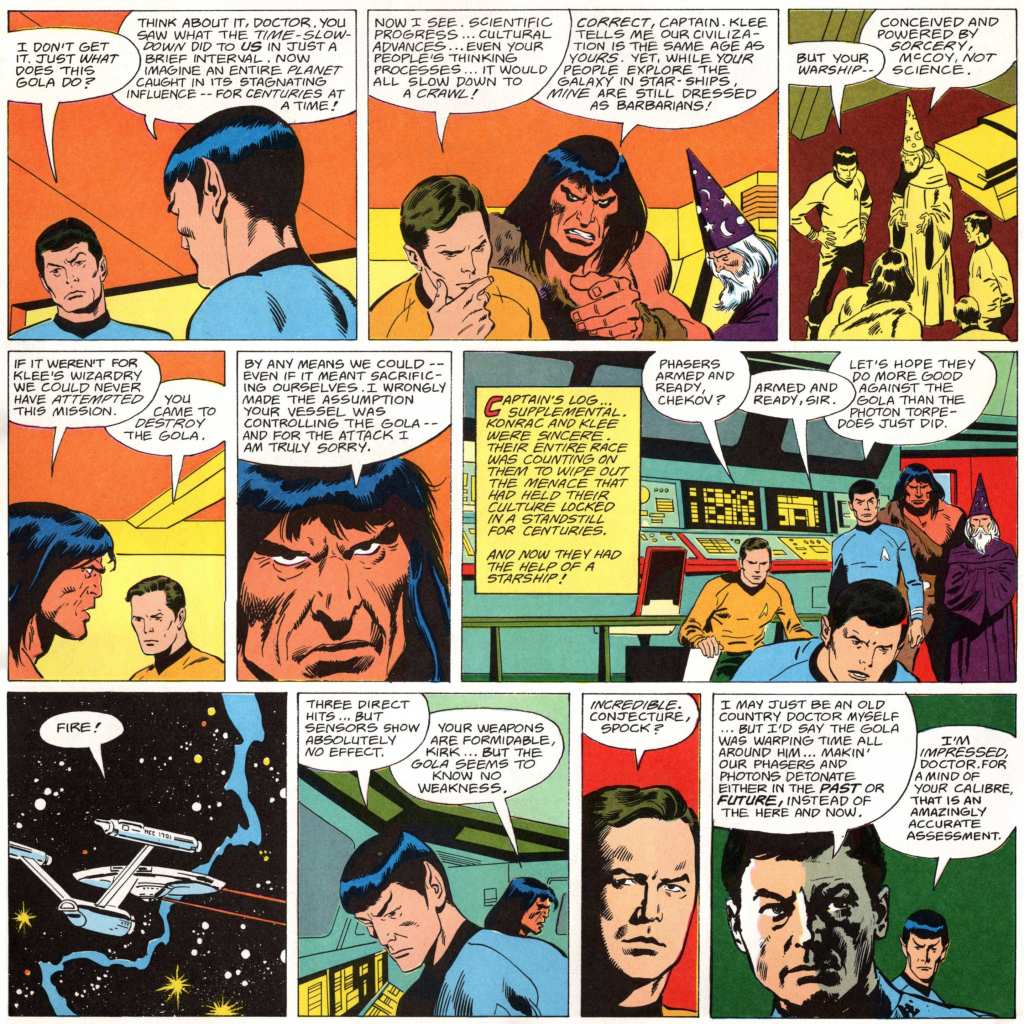
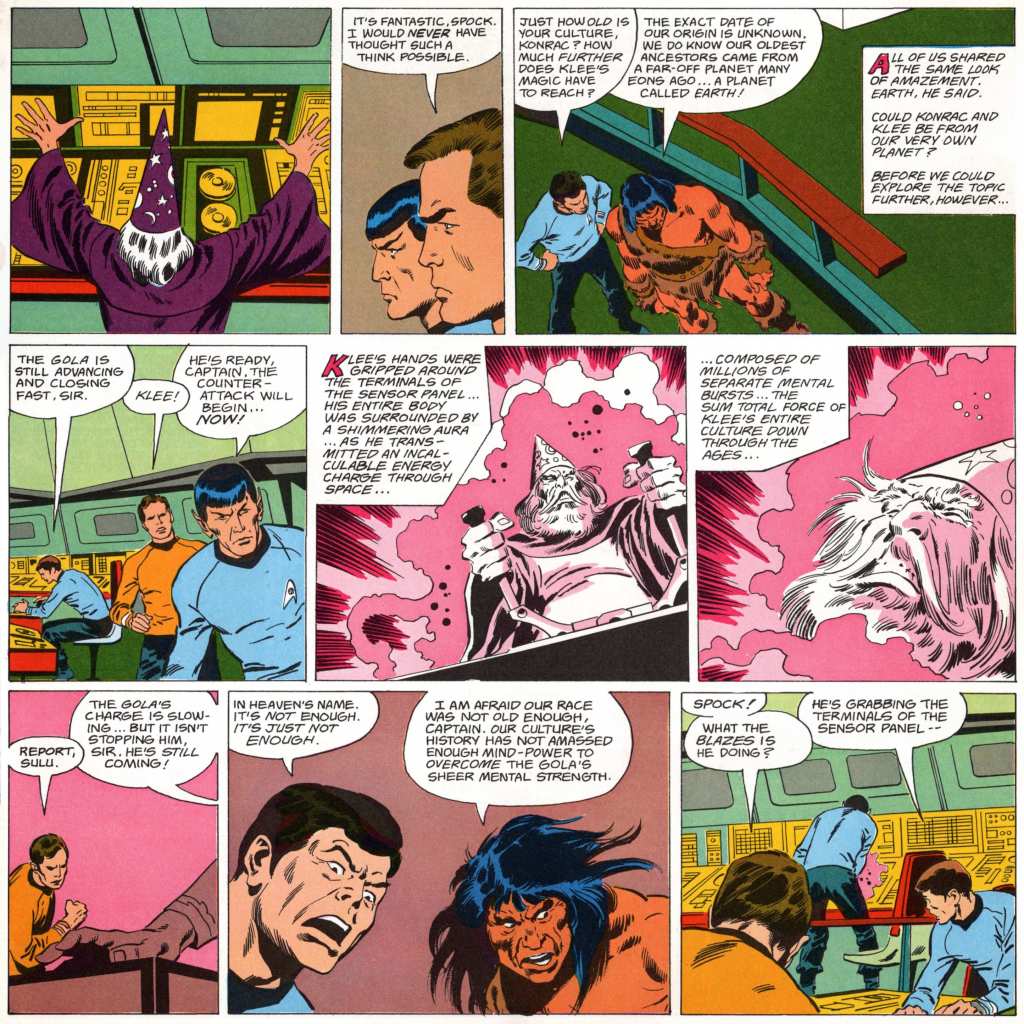
The artwork is dynamic and quite true to the show — except when it isn’t at all. For example, Sulu is depicted as a black man wearing science blue and Uhura is a white woman with very blond hair. A Star Trek fan named Clay Arden told me that he asked Neal Adams, a frequent Peter Pan artist, about this. Adams said the depictions were intentional, as the company had only licensed the likenesses of William Shatner, Leonard Nimoy and DeForest Kelley.
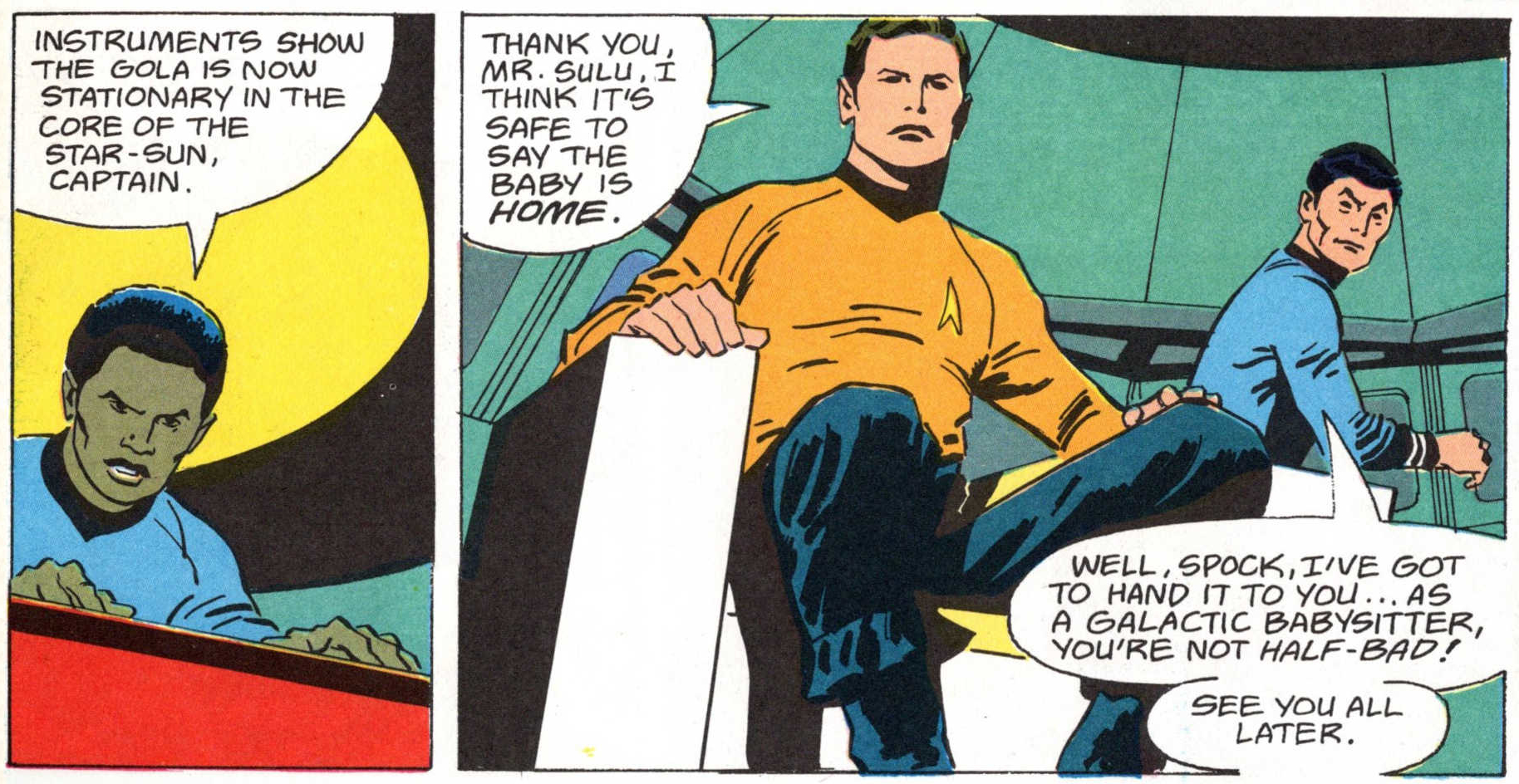
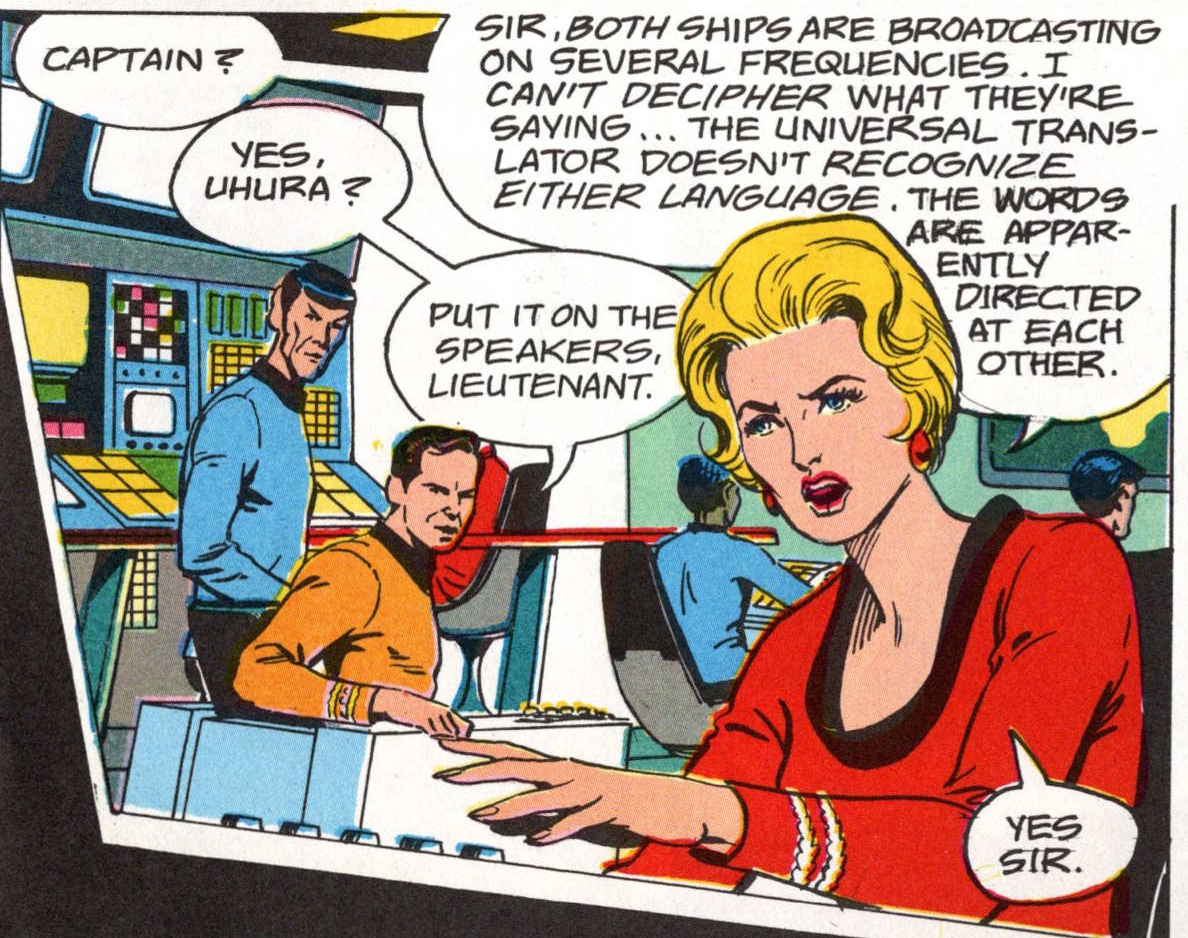
Here are the two stories, both the audio and the comics. You can start the audio playing and click through the scans along with the story — just as you were meant to do in 1976 with the record and the comic.
A Mirror for Futility
This is the better of the two stories. It was written by Alan Dean Foster, a prolific author who also penned the Star Trek Log animated-series adaptations, and drawn by Adams, who also created my favourite Star Trek poster.
The Time Stealer
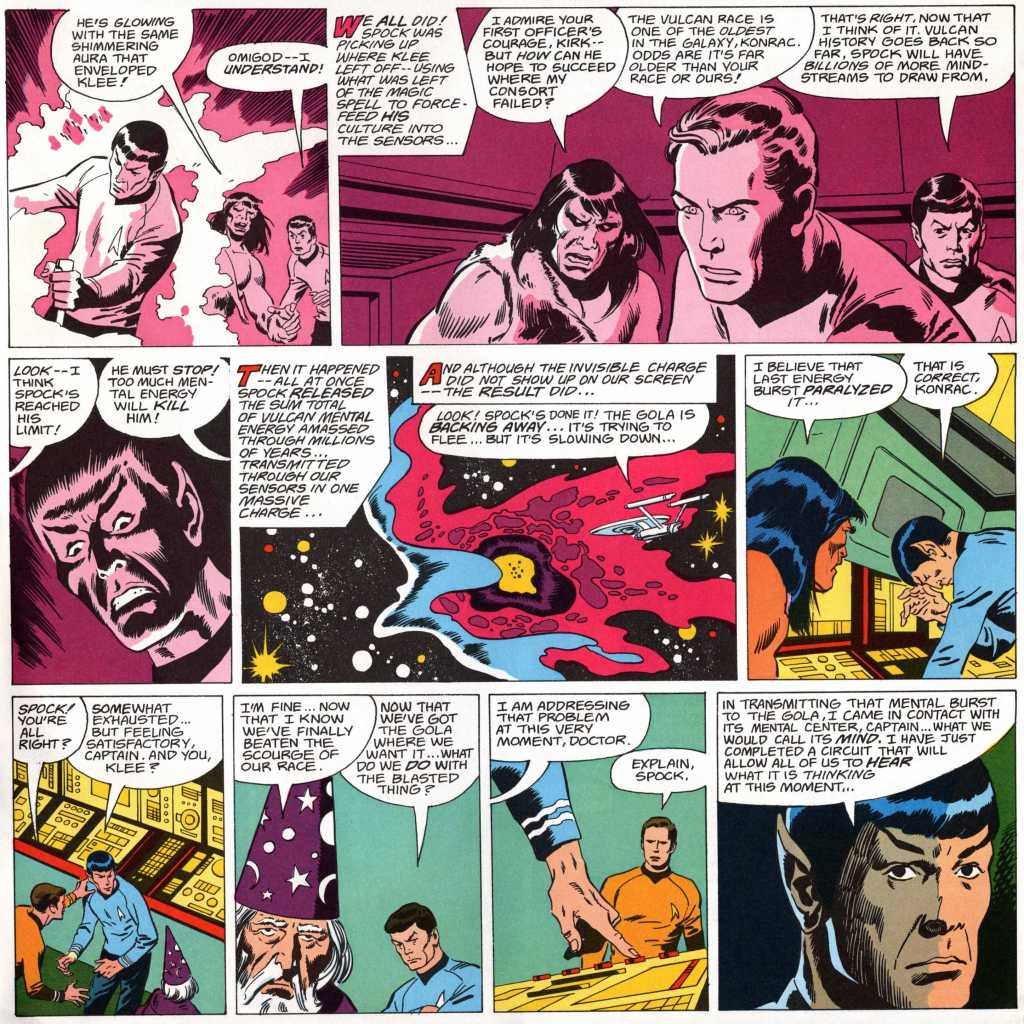
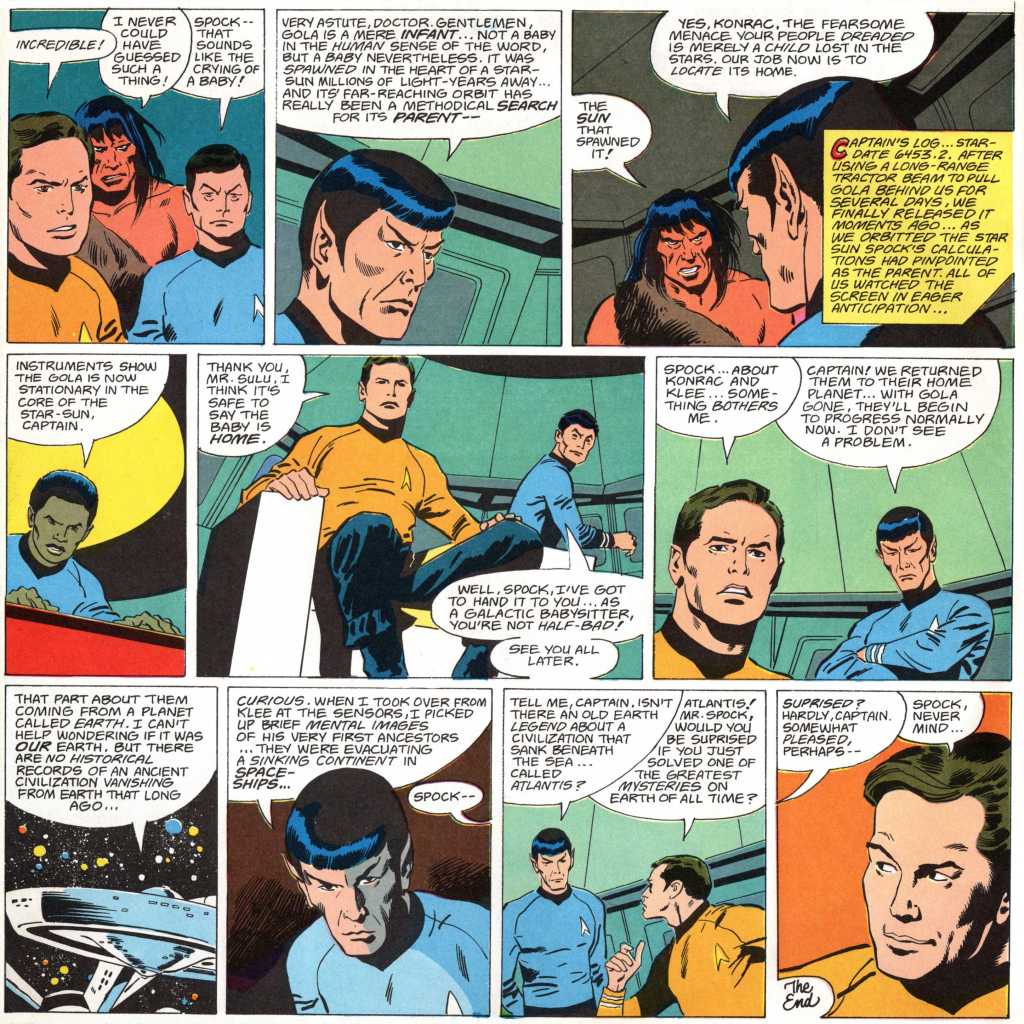
The Peter Pan stories were written and drawn for kids, so you have to expect some silliness. Even so, the two antagonists here look exactly like Conan the Barbarian and Merlin, and the plot relies on Spock using magic and the Enterprise computers to project the “mental images” of millions of dead people — or something. Oh, and Kirk tries to shoot a possibly sentient being with the ship’s phasers. This one was written by Cary Bates and Neal Adams.
I also own the 1979 LP that features the stories The Crier in Emptiness and Passage to Moauv but uses photos from The Motion Picture on the front and back covers even though the comics are set in the TOS era. I wrote about that one here.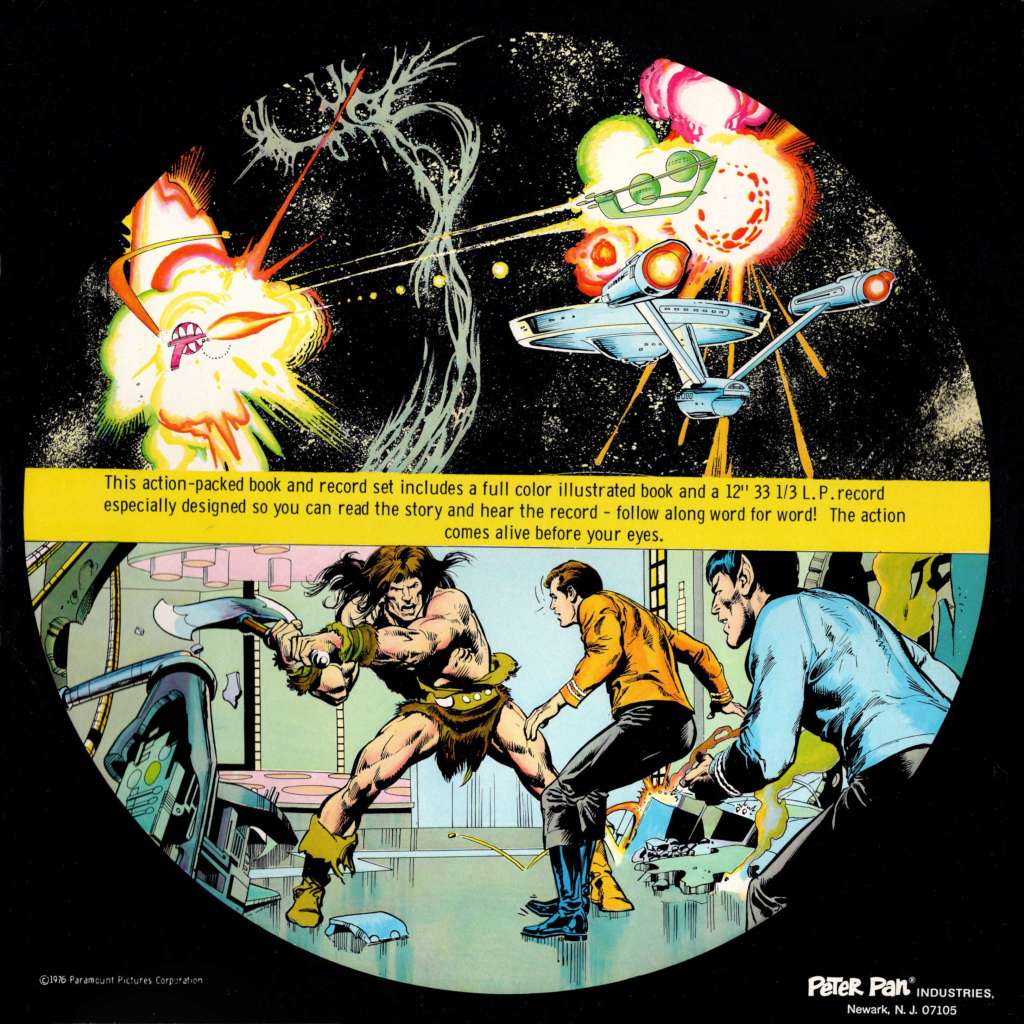
-
Revisiting the quirkiest Star Trek book, with Doug Drexler
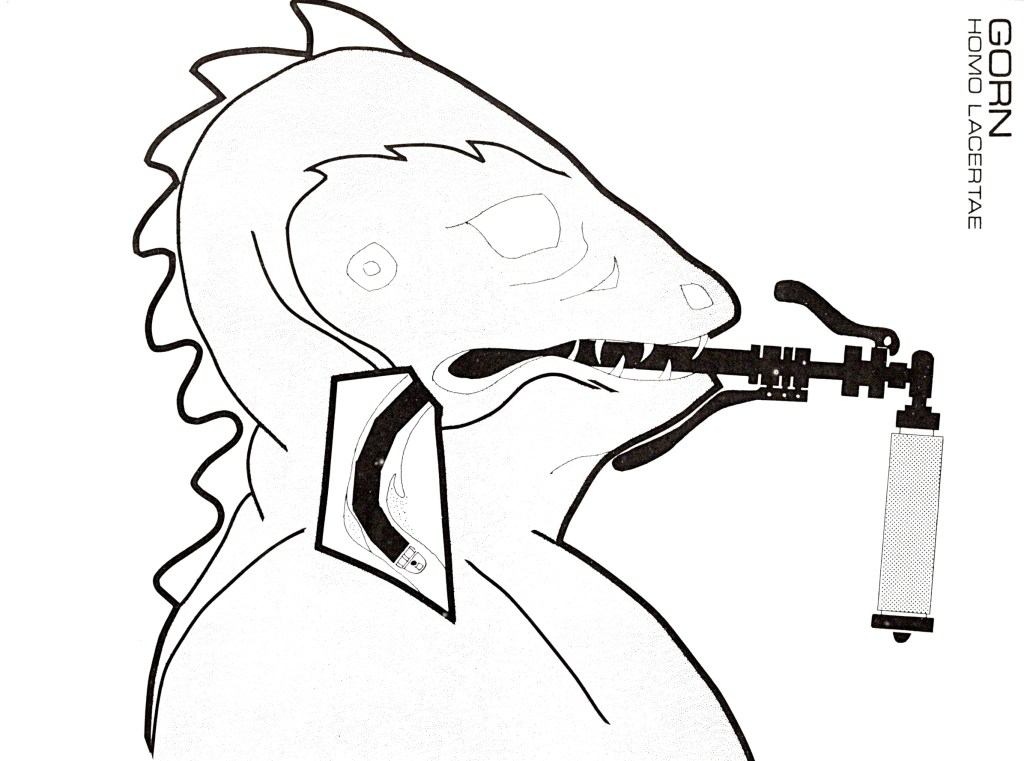
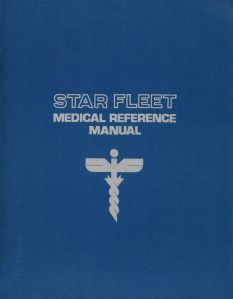
There are about 140 original-series reference and non-fiction books worth owning. One stands out for sheer oddness: the Star Fleet Medical Reference Manual.
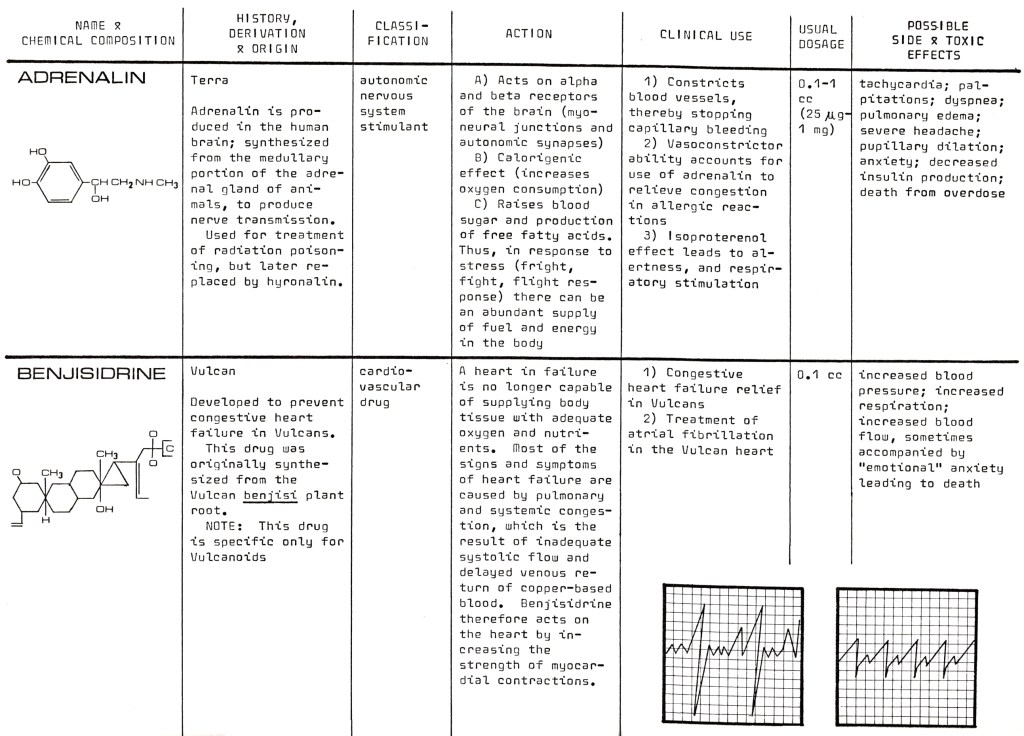
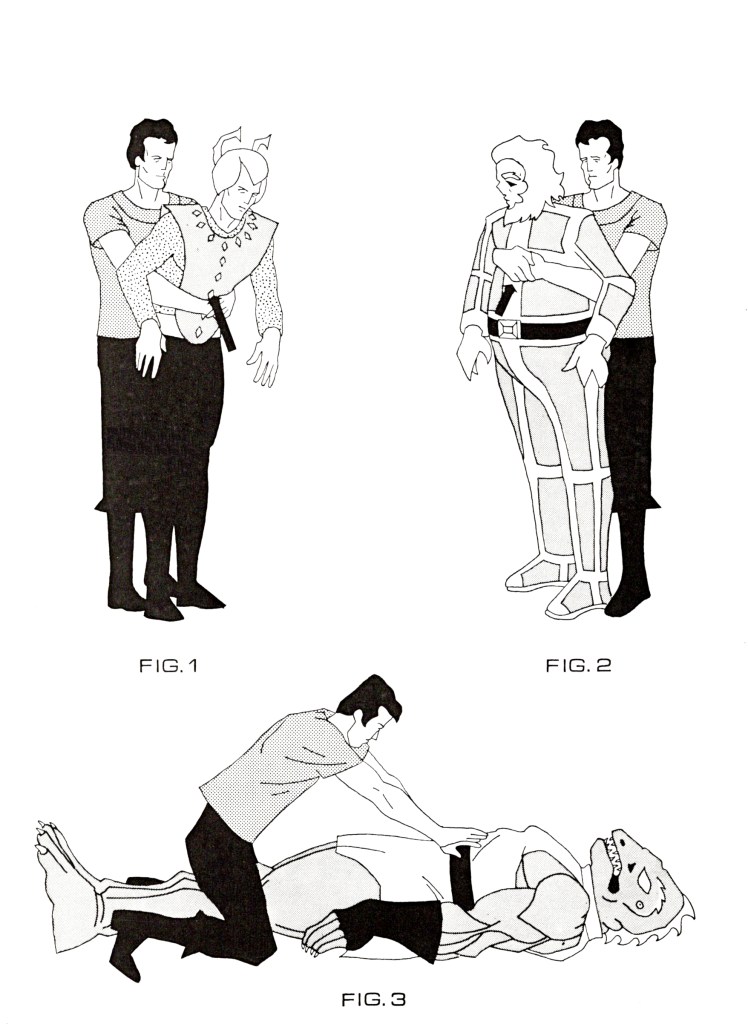
About half of this delightful 1970s fandom jetsam is like a real-world textbook, with lists of diseases and drugs, instructions on lifting injured persons, and information on the Heimlich Maneuver, CPR, and resuscitation. The other half is fanciful speculation on the species — humanoids, non-humanoids, parasites, and plants — that filled Star Trek, plus information on otherworldly elements, psionic studies, and the requirement that “each Starship shall have in its health crew complement at least one person so designated as a Doctor of Chiropractic.” A chart will inform you, quite correctly, that palladium is represented by the symbol Pd, has the atomic number 46, and was first identified in England in 1803, and then the next entry is about pergium, Pe and atomic number 111, which was discovered on Mercury in 2023.


The book is a decidedly odd mix of fact and fancy and one of its creators, Star Trek luminary Doug Drexler, told me that most of the people who worked on it didn’t really want to.
“It’s a strange anomaly of a book that we would not have done except that Ron had this girlfriend,” he said, referring to Ron Barlow, with whom Drexler worked at the storied Federation Trading Post, a Star Trek store in New York City in the 1970s. “Ron had a girlfriend, Eileen Palestine, who was a registered nurse and she had the idea of doing the Medical Reference Manual. I thought we could have spent the time doing something more interesting.”

Barlow and Palestine convinced Drexler, store employees Geoffrey Mandel, Mitch Green, and Anthony Frederickson, and others to work on the book. The team was tasked, for example, with describing the Tribble digestive system and then Frederickson had to draw it. “We had to say to ourselves ‘How are we going to figure this out?’ but we did it for Ron’s girlfriend. We would rather have been doing ships.”
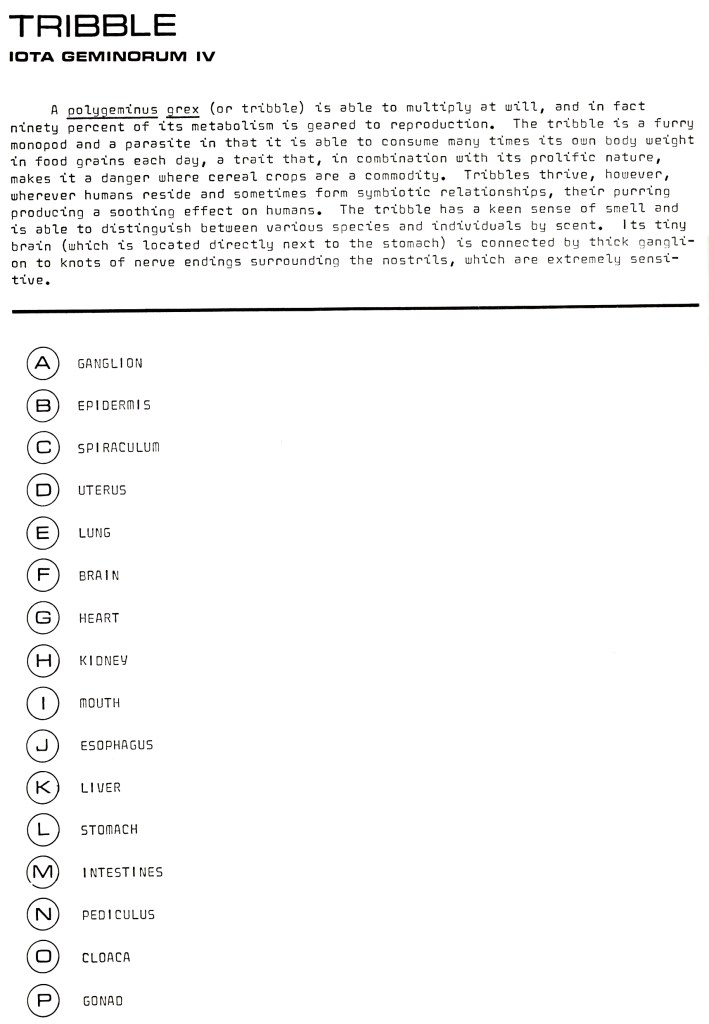
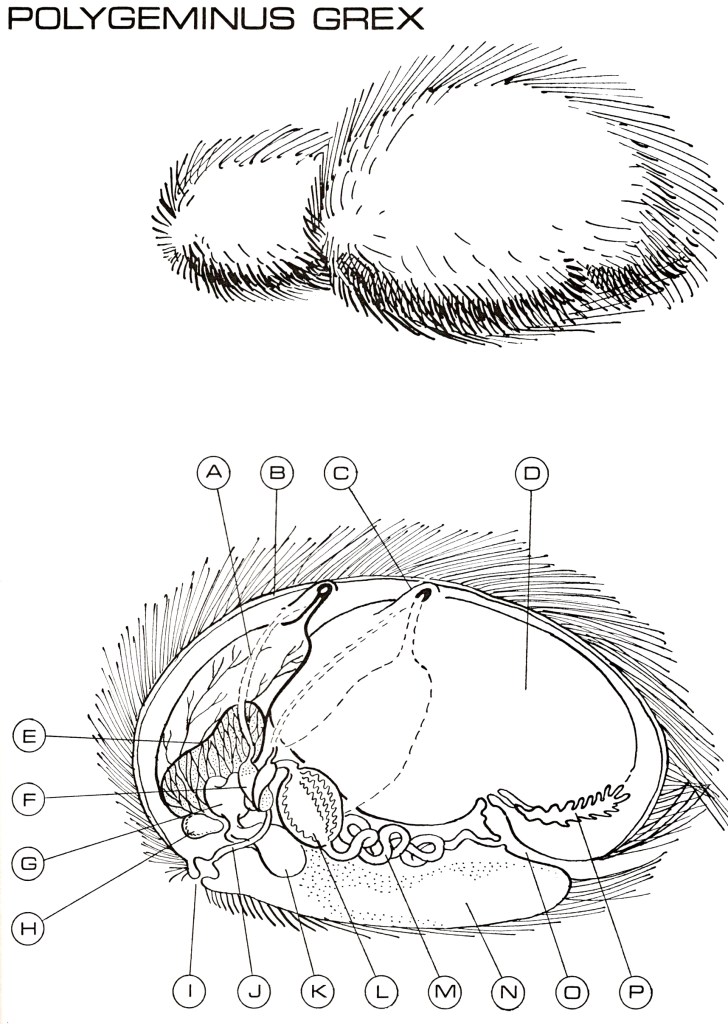
Palestine handled the medical information and she and Barlow wrote the text, while the rest worked up the illustrations. Drexler cannot recall which of them drew each one. The first version of the book, a fan edition with a shiny white cover, was sold in the store.
Then one day “a guy came into the Federation Trading Post and he had a contract with Ballantine Books to do a Star Trek book, and he knew nothing about Star Trek. He came in to pick our brains.”
The publisher sent the man’s manuscript to the store for a review — and it was terrible. “We told Ballantine that, and they cancelled the book with this guy,” Drexler said. “We had the fan edition of the Medical Reference and they saw that and said ‘Well, we could make a book out of this, if you want.’ And that’s how it happened.”
The book must have been at least fairly successful, as its first printing in October 1977 was followed one month later by a second.
The happenstance nature of its publication is typical of 1970s Star Trek merchandise, much of which was created by semi-professional fans who started out making unlicensed items for themselves or for sale at conventions.
Then DS9 made a bunch of it canon
Drexler worked as a scenic artist on Deep Space Nine, and when the producers needed some graphics for the wall of Keiko O’Brien’s classroom in season one, they grabbed illustrations those store employees had created more than a decade earlier.
Seven drawings were colourized and used on a display labelled Comparative Xenobiology, seen here in the episodes A Man Alone and The Nagus.


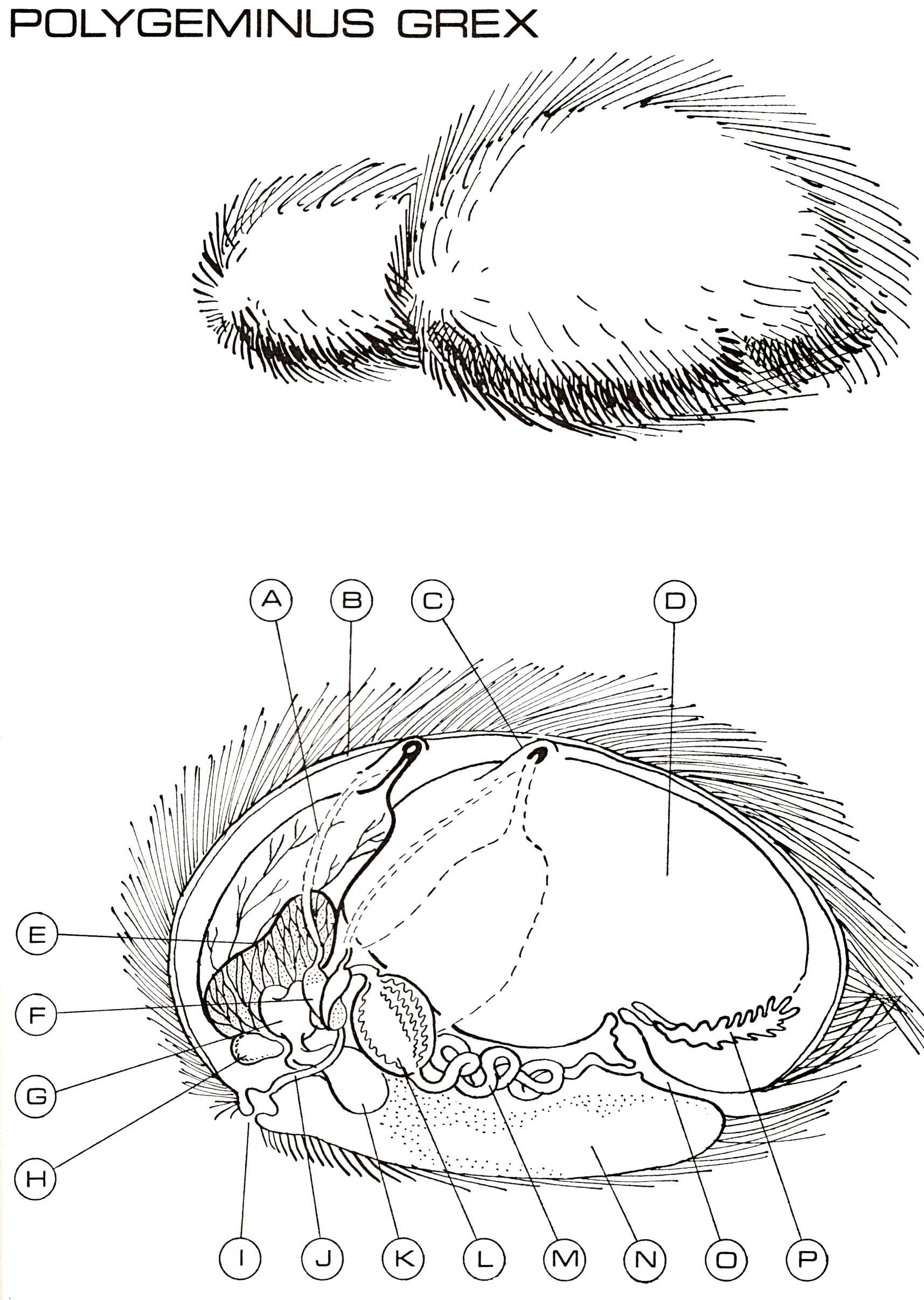
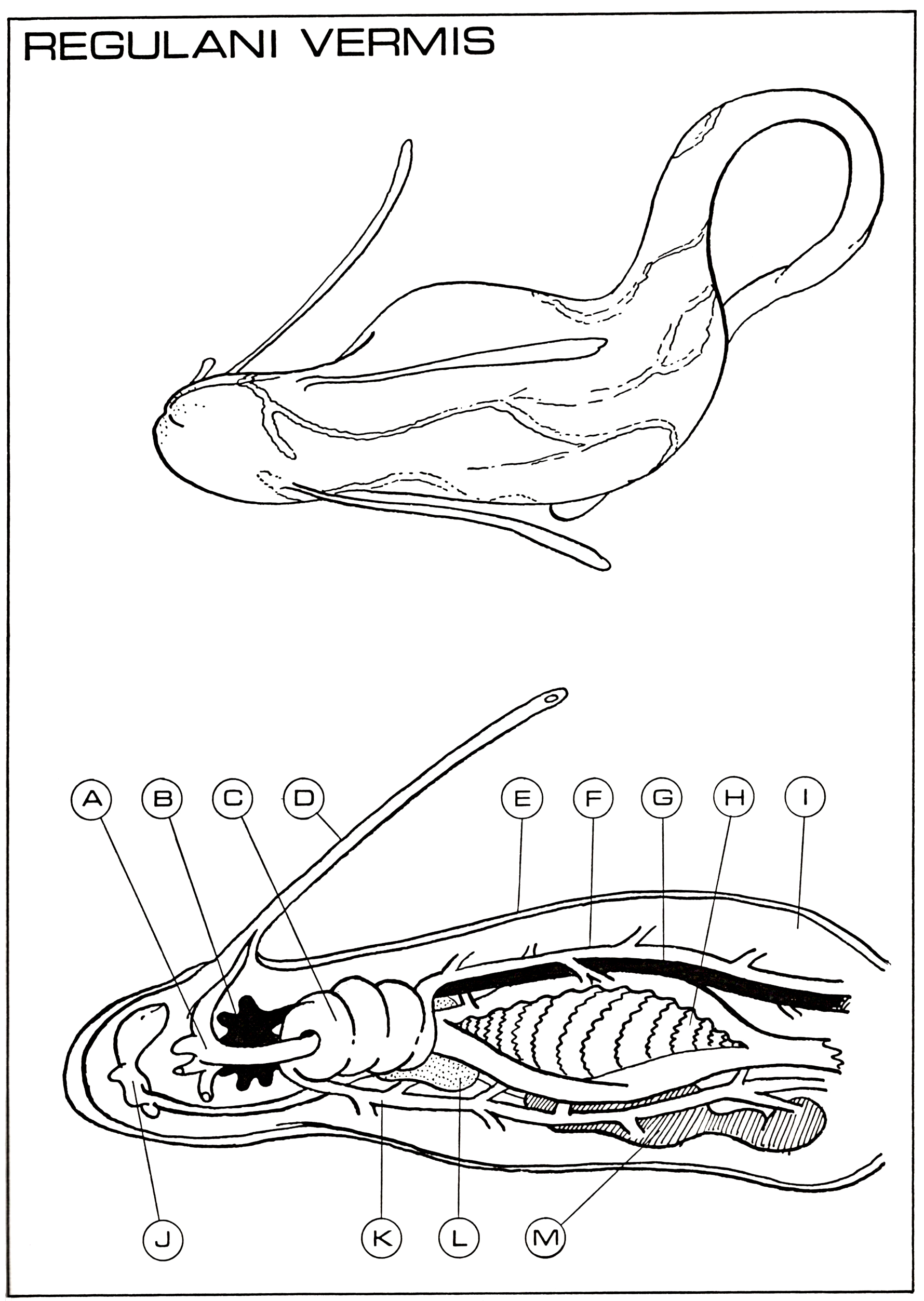
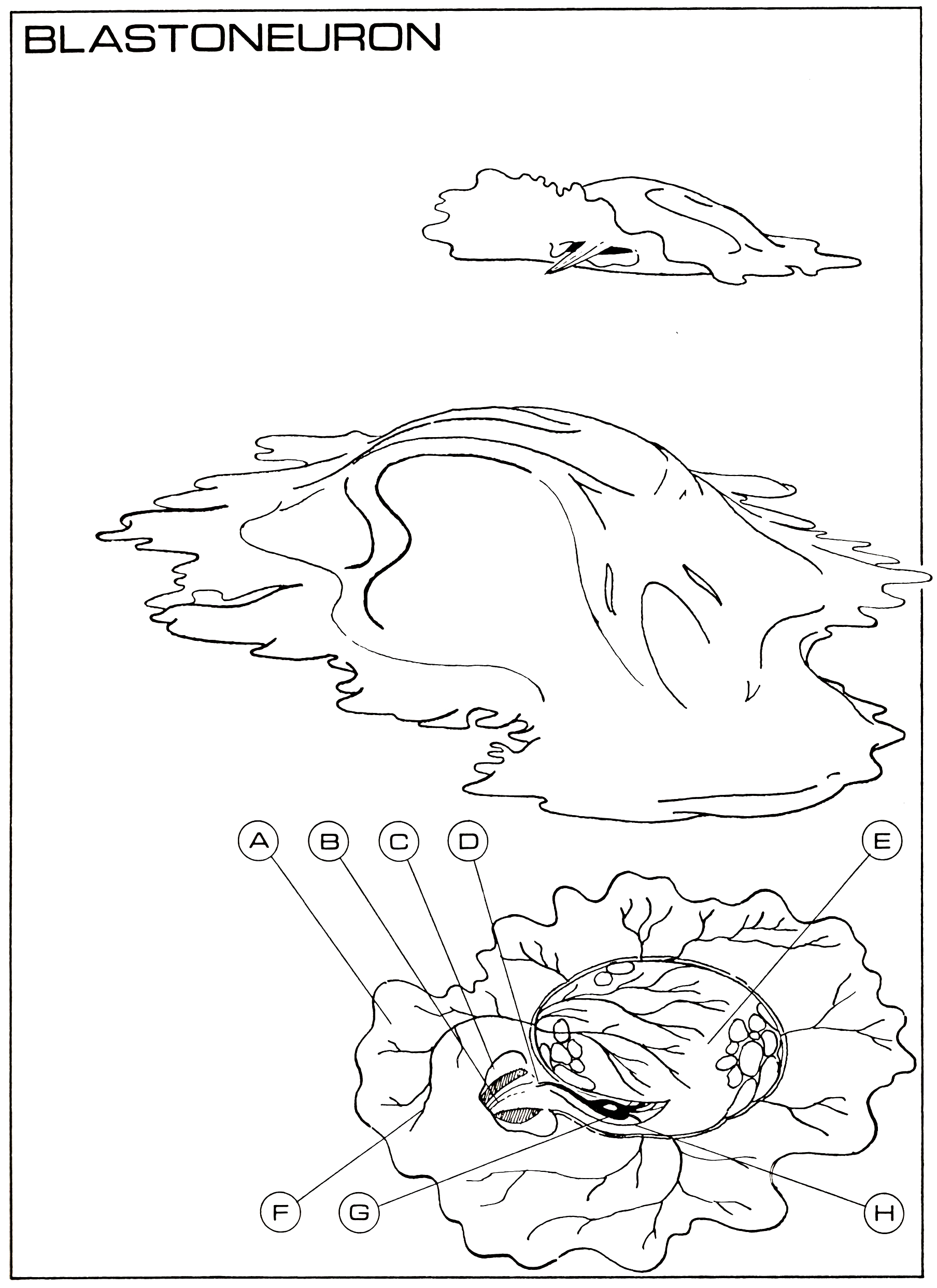

Which makes the location of Horta ovaries canon.
-
Quick-hit TOS novel reviews

I have been revisiting the Star Trek novels I loved as a young fan — and I did love them. All of them. One of my favourite fandom memories is flipping through the sci-fi novels at my local library and finding a Trek I had not read. It was as exciting as if I had discovered an unknown episode.
But if young me loved every novel that had Star Trek on the cover, I cannot say the same for the adult me. It turns out that a lot of Trek novels are really crummy. They were pumped out to satisfy hungry fans, and the quality was all over the place.
I have been buying ebook versions of all the classic novels I already own in paper, whenever they come up in the publisher’s monthly $0.99 sales.
I won’t comment too much on some of the titles I didn’t like, such as Memory Prime and Vulcan’s Glory (which I didn’t finish), The Entropy Effect (which was okay) and The Joy Machine (truly awful; I wrote about it here).
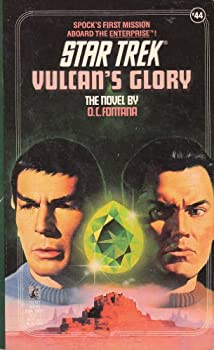
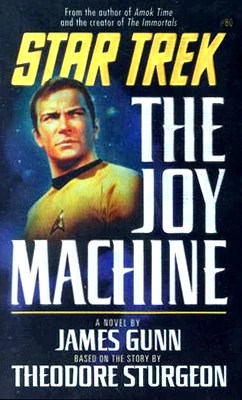
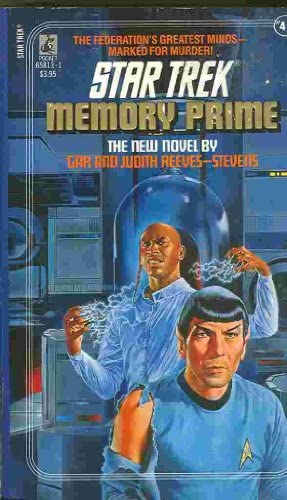
But I’ve read a few that were quite good.
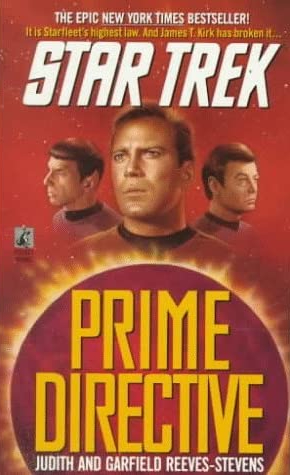
Prime Directive
Judith and Garfield Reeves-Stevens
This novel is a little dystopian for my Trek tastes but it posits an intriguing and very well-considered question, and is worth reading. It makes you reconsider Federation ideals, and that is rare in a Star Trek novel.
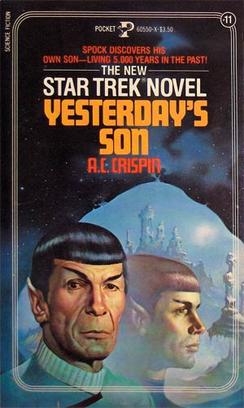
Yesterday’s Son
A.C. Crispin
This novel presents a compelling what-if: what would Spock do if he discovered he had impregnated Zarabeth during the events of All Our Yesterdays?
But Crispin had to add a lot of fluff to stretch the premise to novel length. This would have worked better as a TOS or TNG episode.
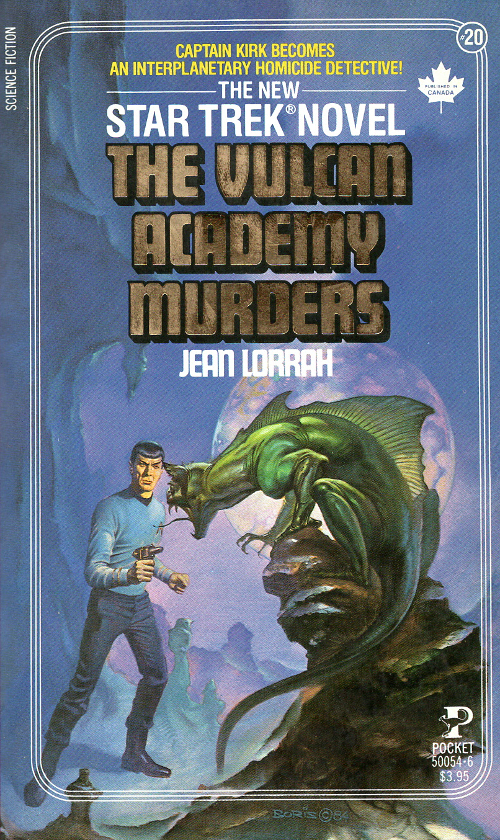
The Vulcan Academy Murders
Jean Lorrah
Lorrah offers an intriguing and mostly plausible look at Vulcan society and does a lot to address Sarek’s terrible parenting in Journey to Babel.
The murders themselves are far too complicated and improbable but the Vulcan stuff is solid.

The Motion Picture
Gene Roddenberry
I recently reread Roddenberry’s movie novelization, which is of course delightful. Love instructors, new humans, and a preface by Admiral Kirk himself: it is peak late-70s Roddenberry.

Spock Must Die!
James Blish
This was the first non-juvenile Trek novel, and I really wanted to like it. Did I? No. Should you read it anyway? Probably. It is interesting for its place in fandom and it offers some interesting ideas. The same cannot be said for the actual first Trek novel, the terrible Mission to Horatius. Don’t read that.

Agents of Influence
I don’t love the organization that forms the premise of this novel but the writing and the pacing are very good, and this is an intriguing story. I plan to read more of Ward’s books.
Postscript: I have to call shenanigans on the cover of The Vulcan Academy Murders. Spock is pictured confronting a le-matya (first seen in the animated episode Yesteryear) but in the novel Spock never even travels out into the desert and never encounters the predator.
A.C. Crispin, Agents of Influence, D.C. Fontana, Dayton Ward, Eugenics War, Gene Roddenberry, Greg Cox, James Blish, James Gunn, Jean Lorrah, Memory Prime, Mission to Horatius, Novels, Reeves-Stevens, Spock Must Die, Star Trek, The Entropy Effect, The Joy Machine, The Motion Picture, The Vulcan Academy Murders, Vonda N. McIntyre, Vulcan's Glory, Yesterday's Son -
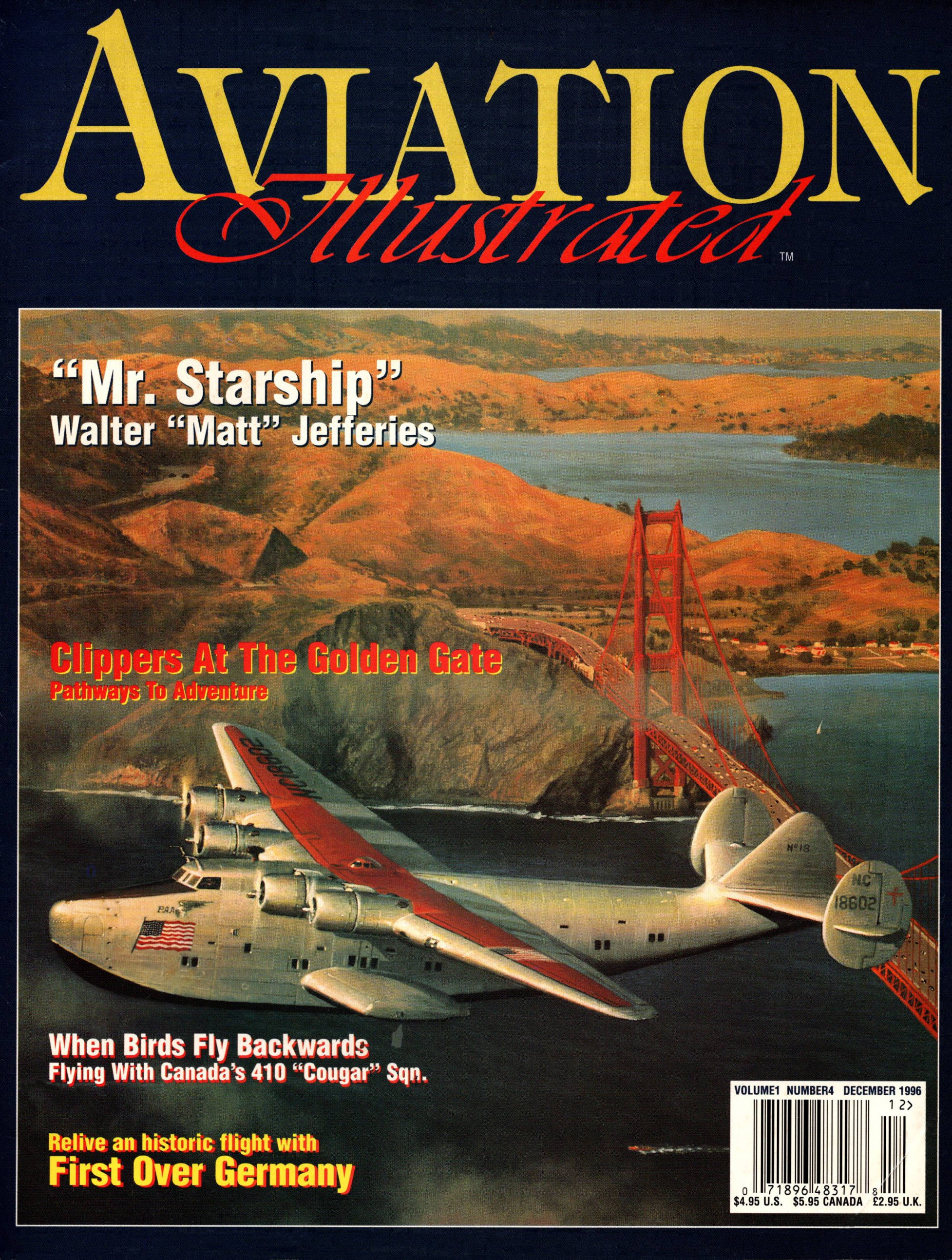
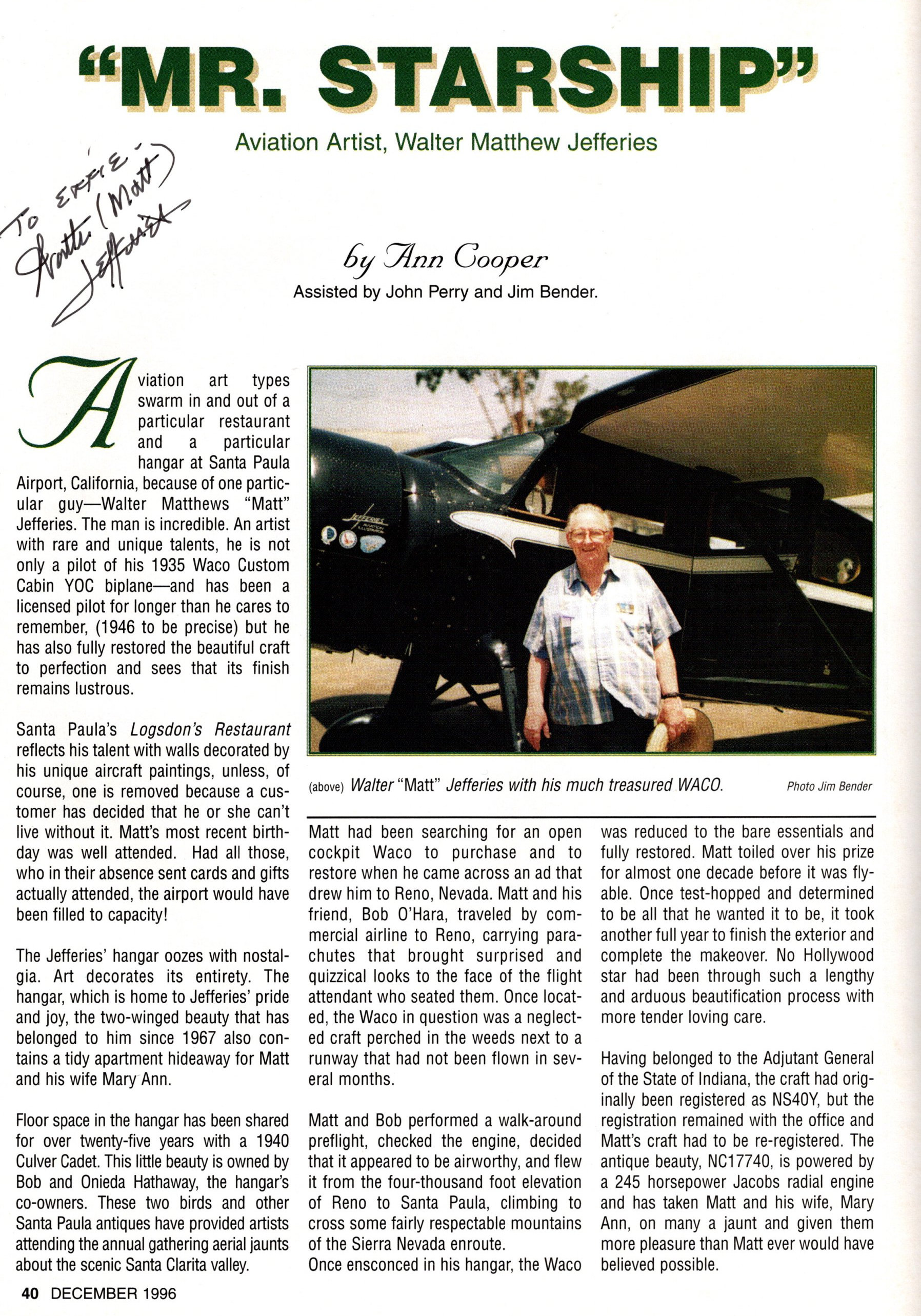
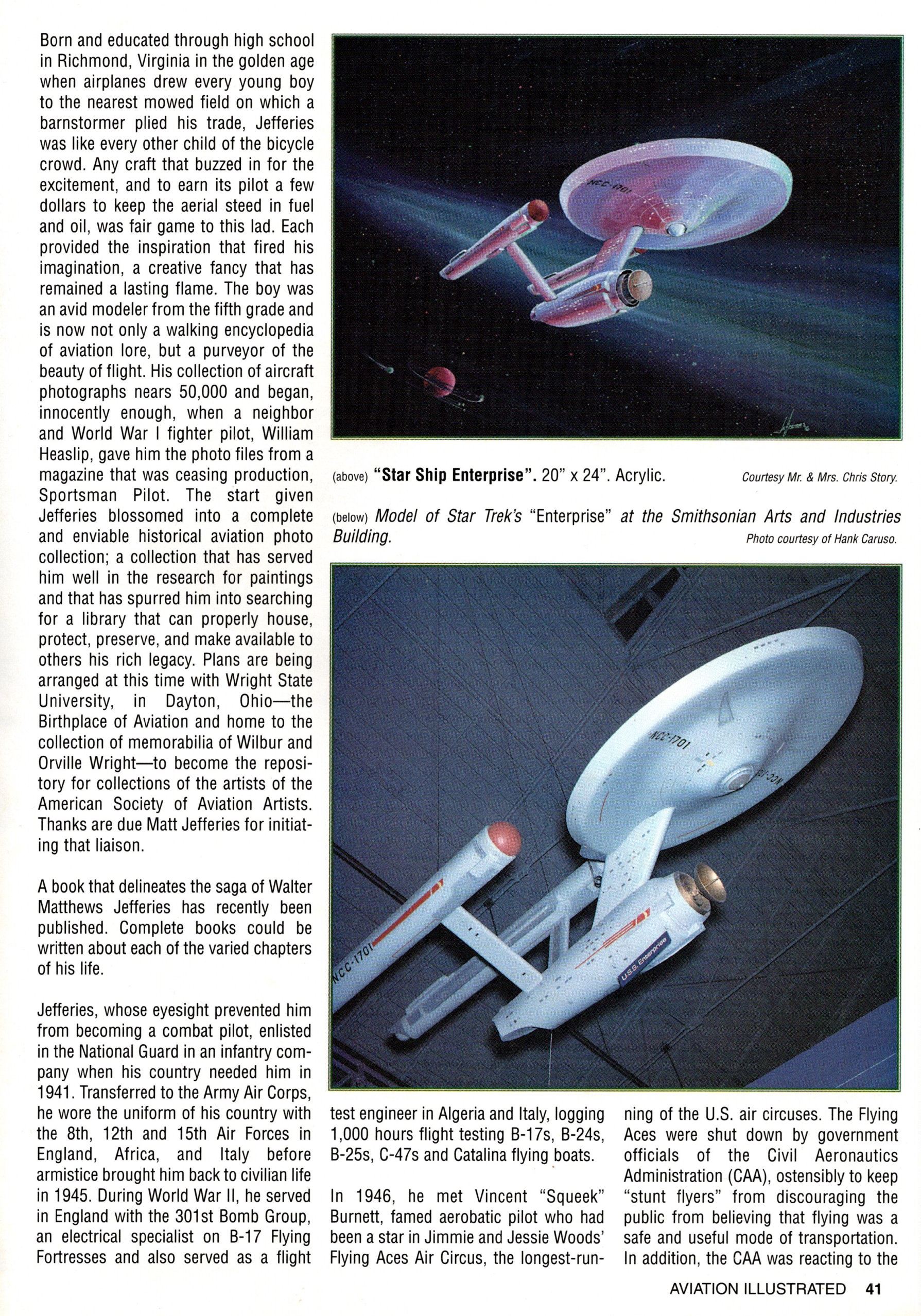
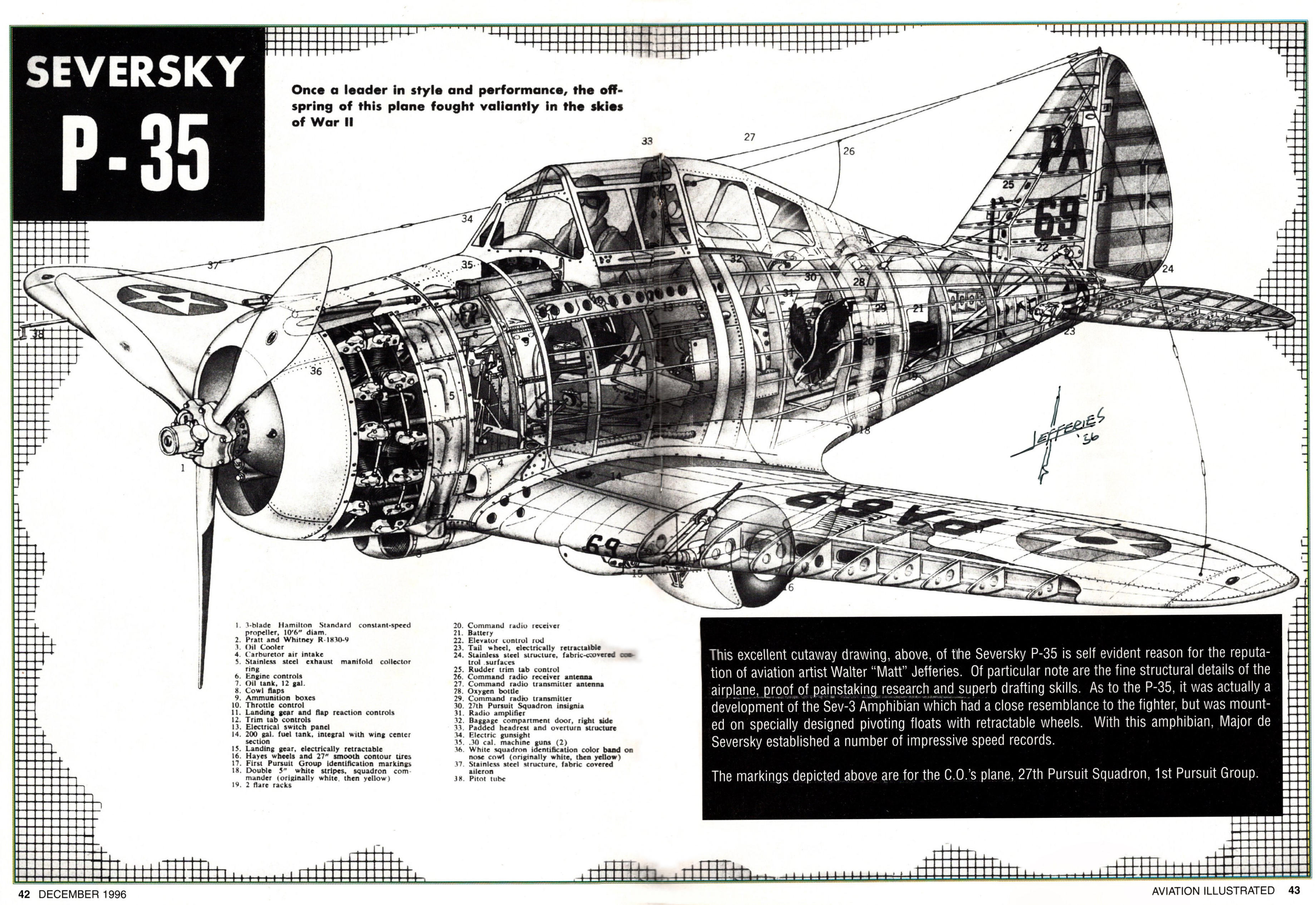
How I got three Matt Jefferies signatures
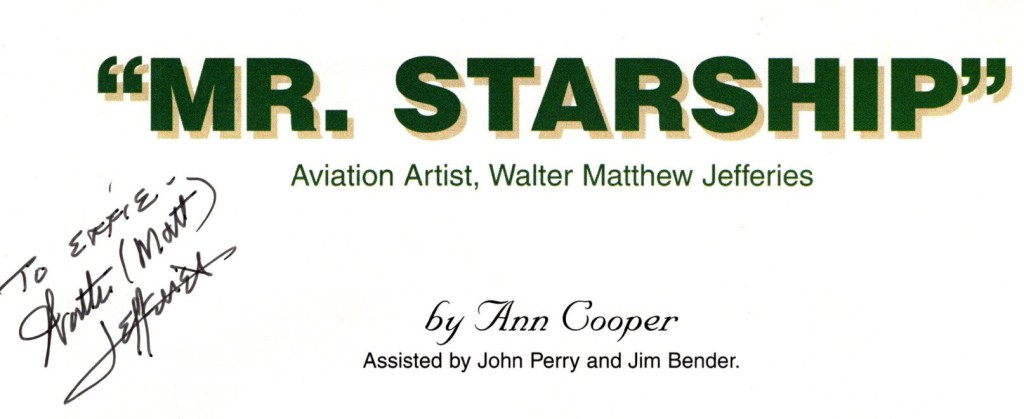
Running a Star Trek collectibles site means you get contacted by people looking to sell stuff. Sometimes that ends in disappointment but sometimes you land a big envelope of Matt Jefferies autographs from Australia.
This is a story of the latter.
I received an email in early October: “I have hand written letters, card, magazine…. All signed by Walter Matt Jeffries… Found in a box of books I bought in an auction… Maybe you’re interested… cheers Tracy”
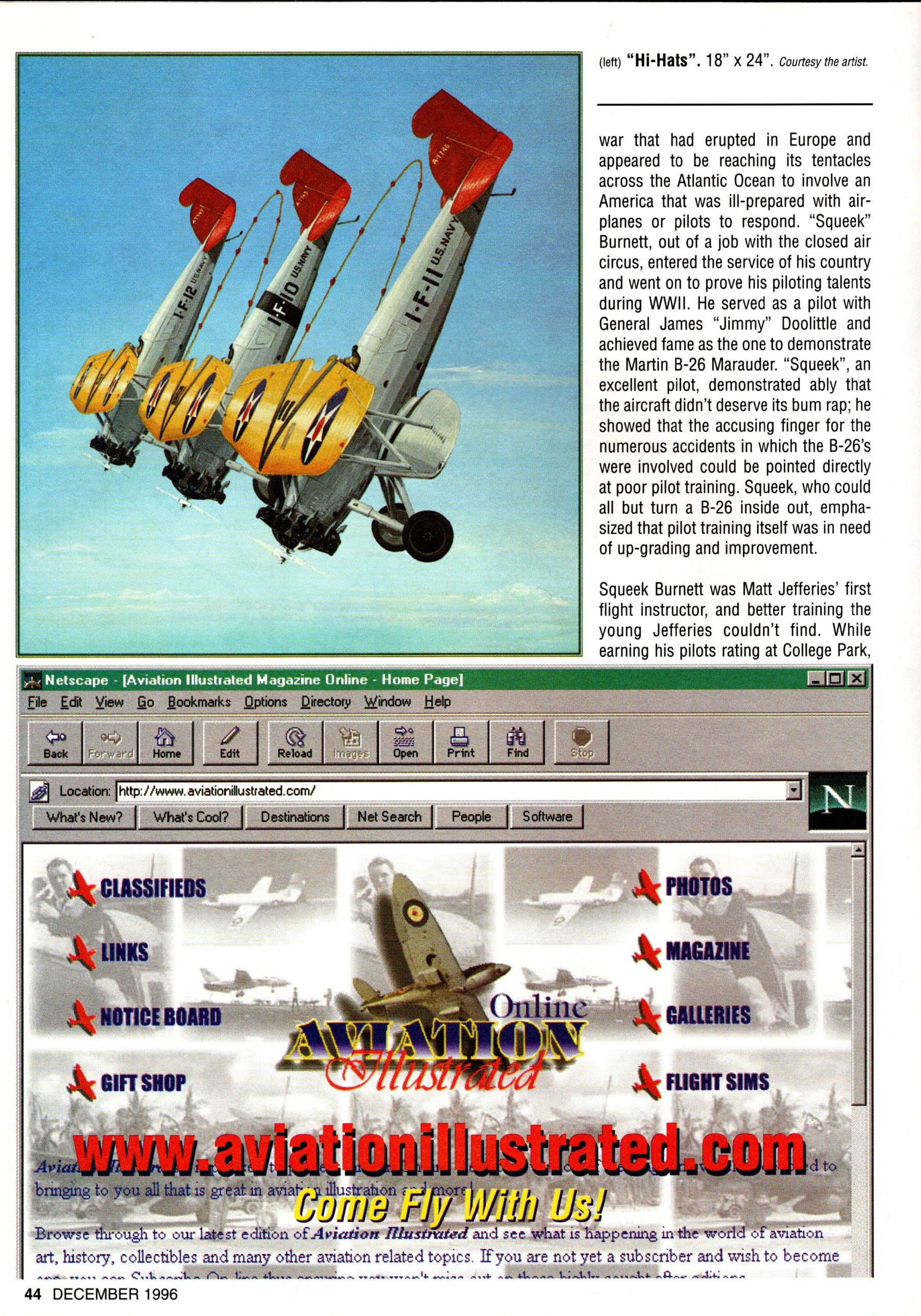
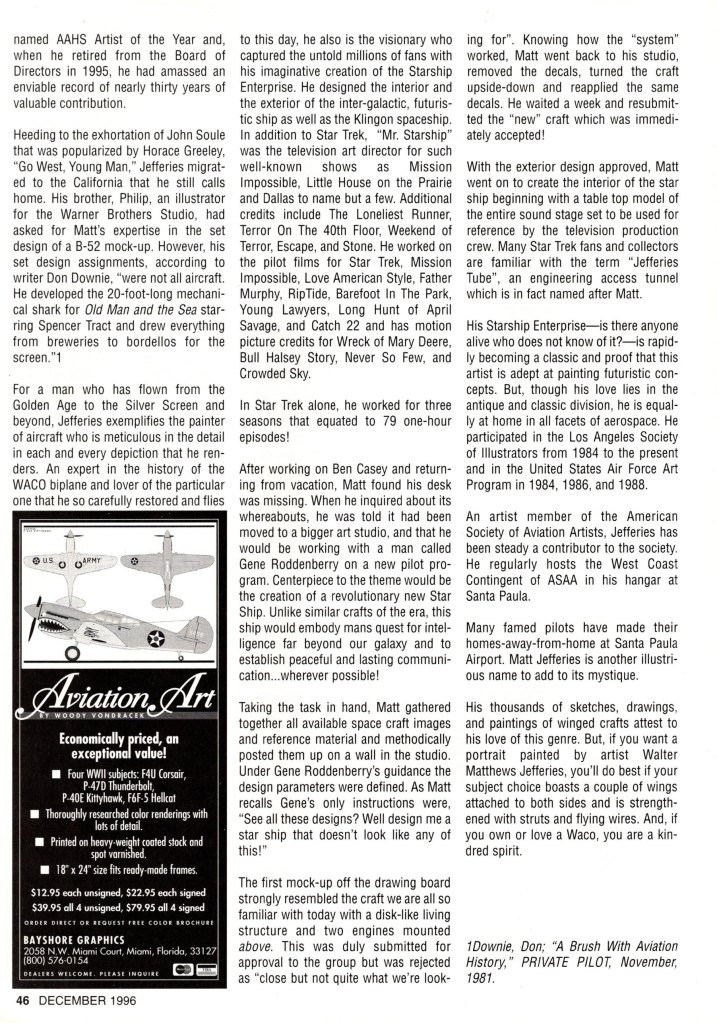
I was, and I asked for photos. Unfortunately, Tracy did not have set sketches or production notes, but rather personal correspondence from later in Jefferies’ life. The best item is a signature on an article about Jefferies in the December 1996 issue of Aviation Illustrated magazine. But yes, I was interested. Jefferies, the art director for TOS’ entire run, is a Star Trek hero and I had only the official signed card and the book his brother wrote, Beyond the Clouds.
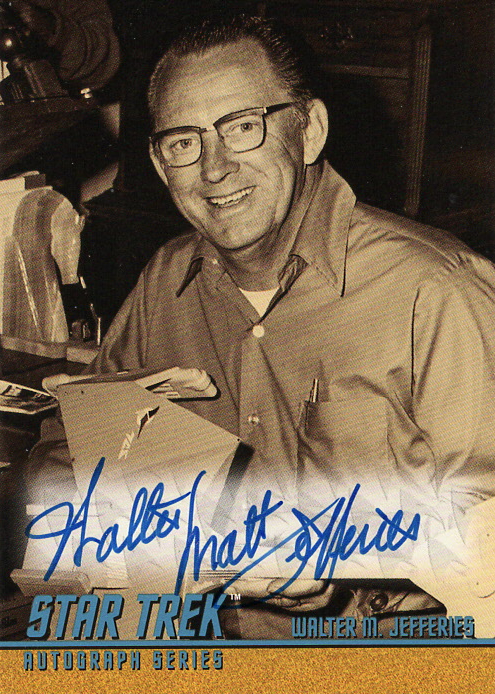
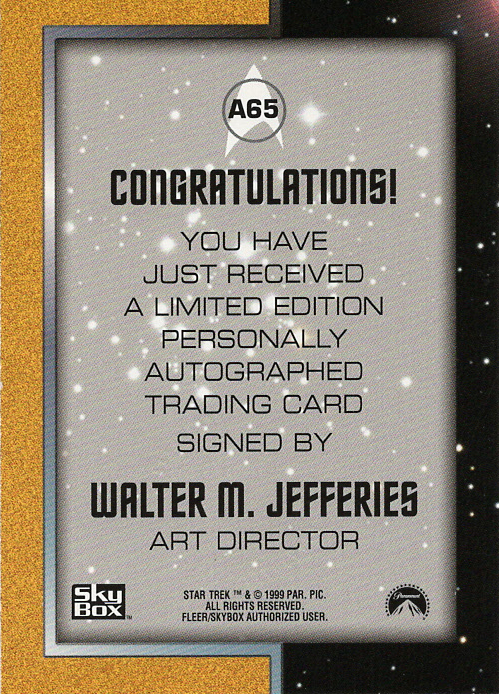
Tracy suggested $100 plus shipping, and I countered at $100 including shipping. She agreed, and that’s when I learned she’s in Australia, so even better. $100 Australian was about $88 Canadian.
While I waited for the package, I asked Tracy for more details on the acquisition.
I bought a box of books at my local auction (deceased estate) and found some personal stuff belonging to Effie Young amongst the books. On the front of the envelope says … Do not throw out… friend since I was 15… Effie was an American girl (who ultimately married an Aussie) and she knew Matt Jeffries when she was a teenager (possible romance?) Effie lived in California growing up… Effie married and moved to Australia but she must have had a strong friendship over the years with Matt and his family, as he posted the signed magazine to her from California.
The package arrived and I am certainly pleased with my purchases. I got the magazine, a business card, a large envelope, a note signed “Love Walter” and a Christmas card he signed “Love Mary Ann ’n Walter.” For the scans of the last two items, I cropped out the personal details he shared with Effie. Jefferies was unwell and undergoing treatment, and the details are a little too personal to share.
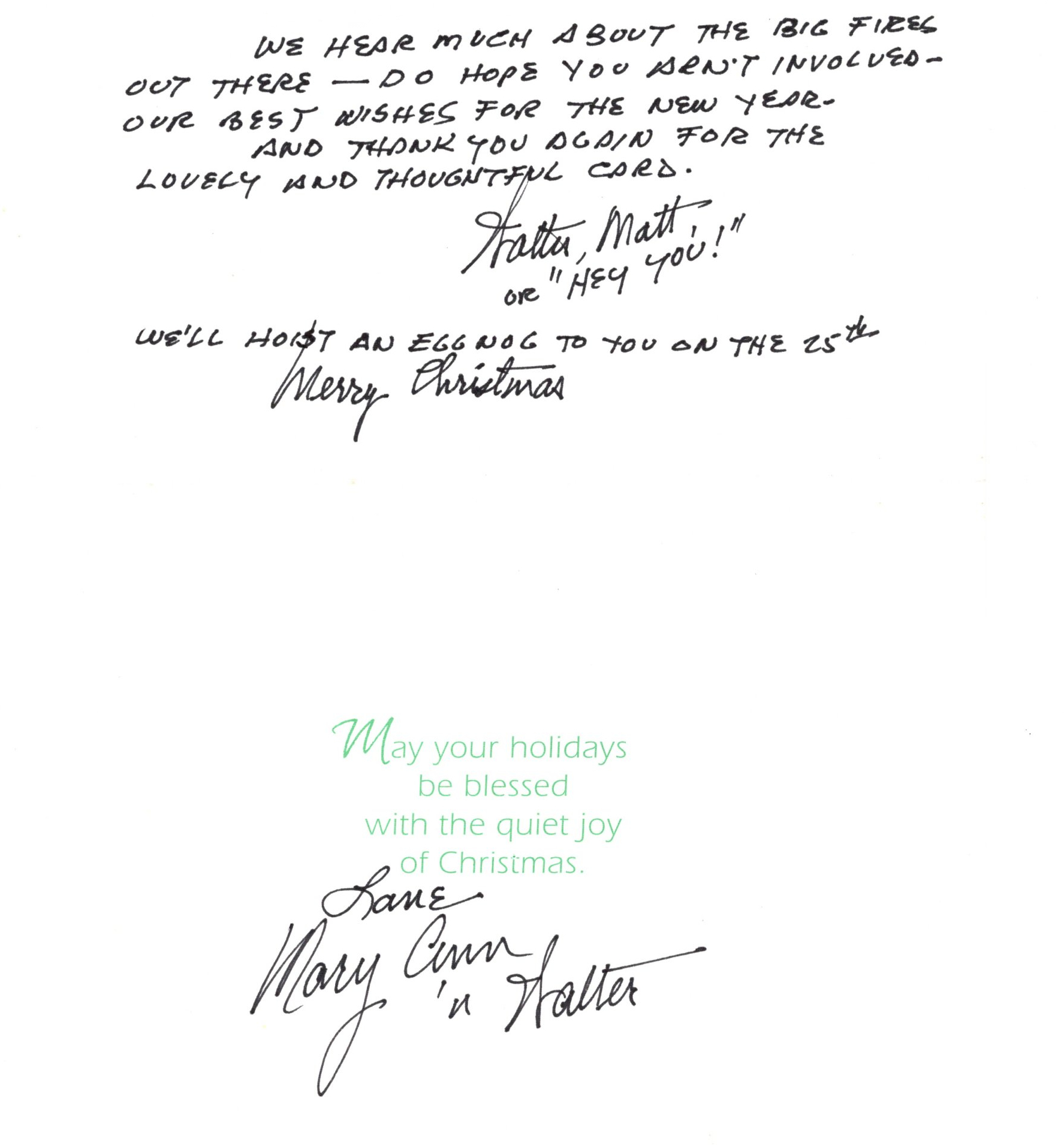

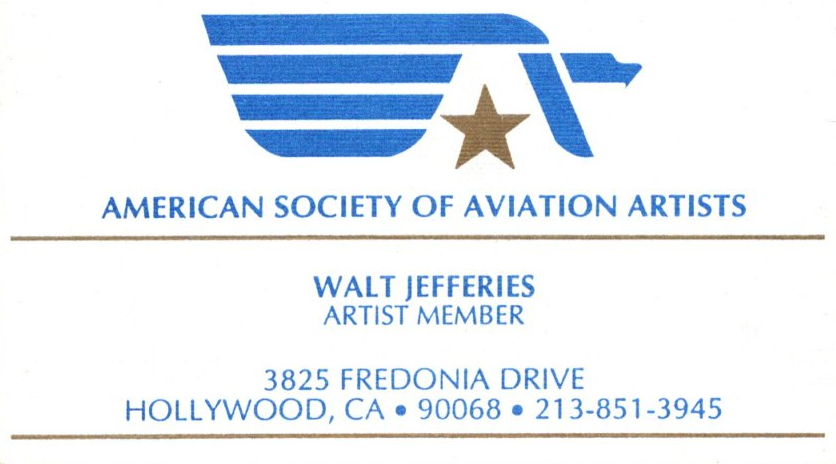
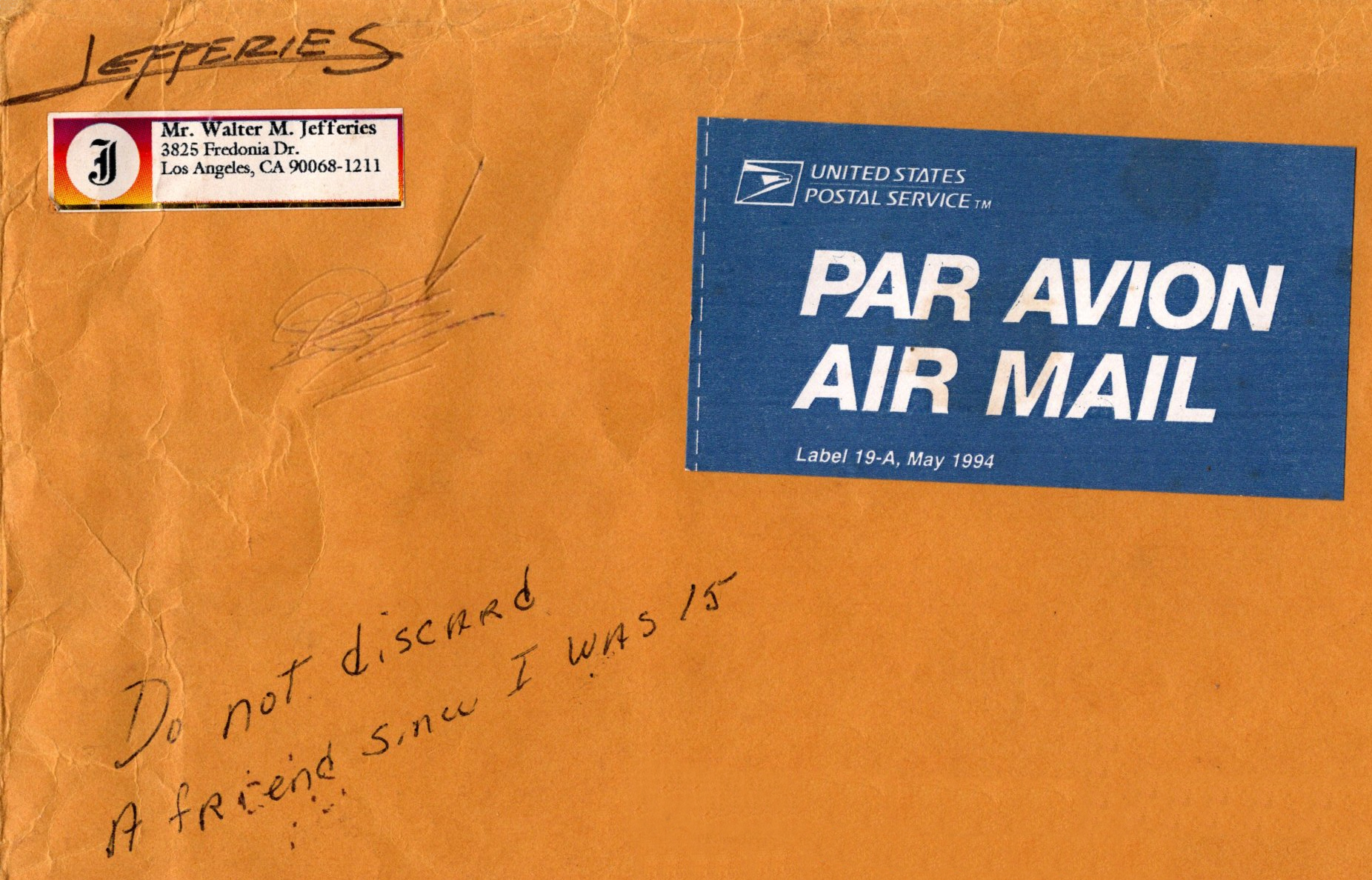
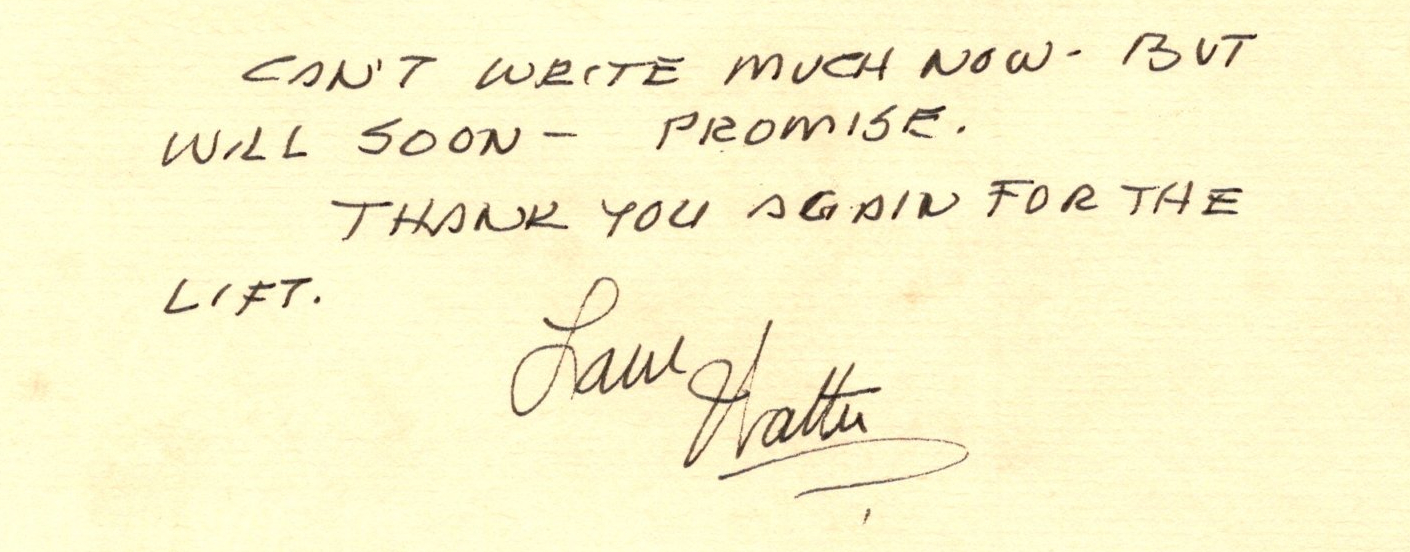
Thank you, Tracy. I got a small glimpse into this long-term friendship and a few items connected to Matt Jefferies, and you made a little money. Good deal.
-
Display your collectibles, the Mego edition
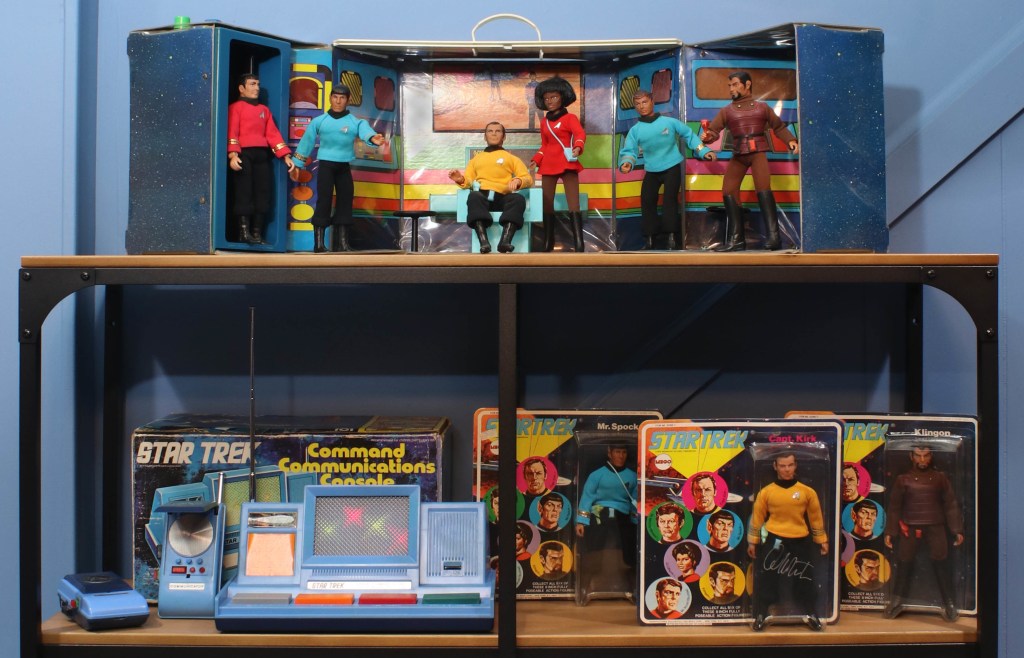
A good friend of mine is a longtime Star Trek fan and an active collector, but he has none of his collectibles on display — and he has a room available for this purpose. This bugs me to no end, because the best way to enjoy your collection is to put it out where you can see it.
A case in point: I recently created this Mego display area in my Star Trek room.


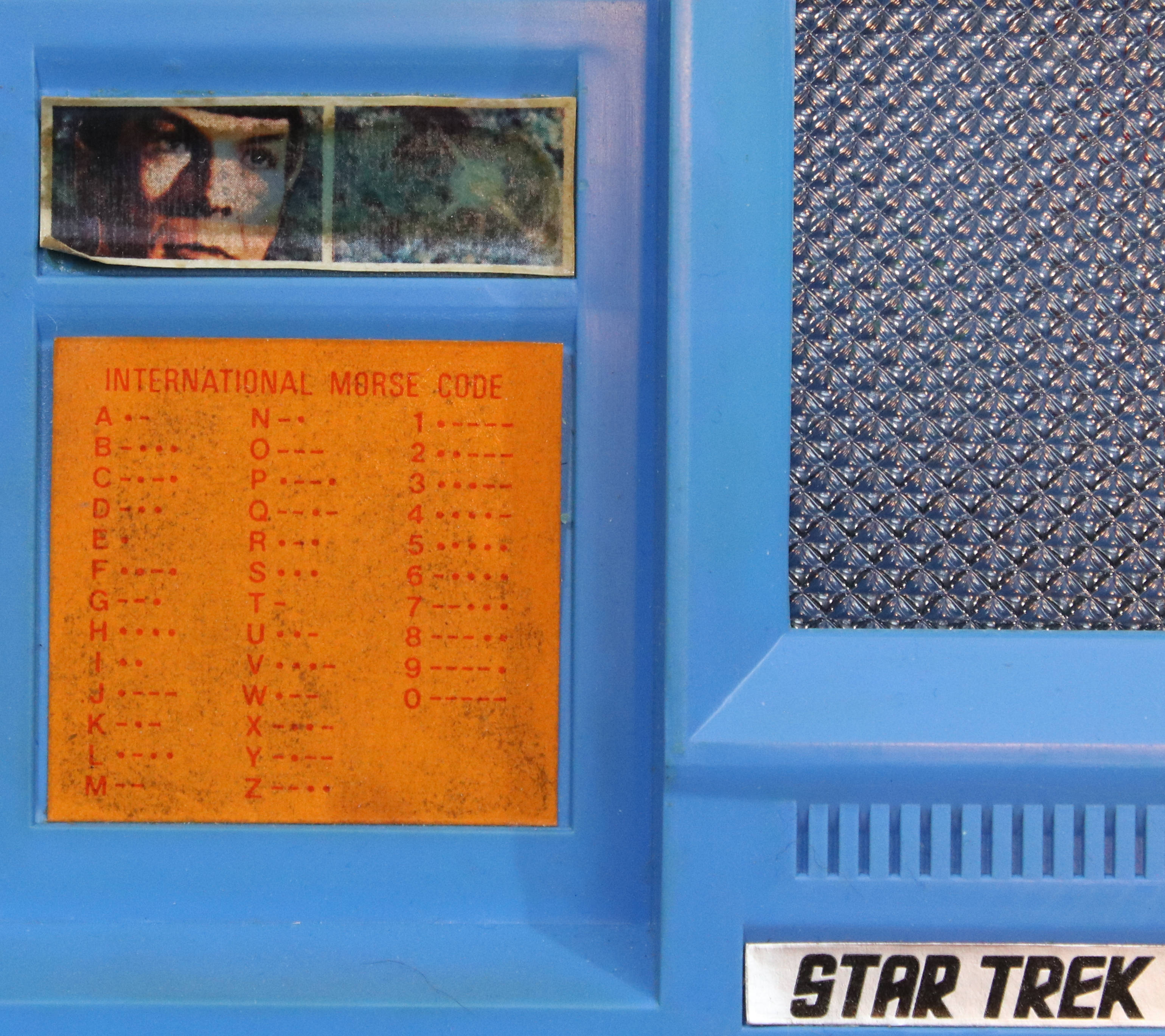


This was prompted by two recent acquisitions: a pair of Star Trek Communicators walkie-talkies and the matched Command Communications Console. All three toys work perfectly and are in surprisingly good shape. The Console seems like it has barely been used; the stickers are peeling a little with age but otherwise it looks great. I also got the original box, although it is a little beat up. The toy came from England, and the seller said: “I had an elderly relative who owned a small independent gift/toy shop and whilst clearing out the warehouse we discovered a wide range of action figures, including quite a few rare and collectible items.” We haggled over the price a little and settled on 180 pounds, about $280 Canadian, plus shipping. I got it in September 2022. I picked up the pair of Communicators for US$85, about $115 Canadian, two months earlier.
The Console has moving red and green lights on the front, reminiscent of some of the computer displays on the show. Here is a video of those lights and another with the Console’s alert sounds.
I purchased the Mego U.S.S Enterprise Action Playset in 2018 for the amazing price of US$100 and it had been living on a bookcase shelf since then, but I always felt it deserved a better space. The figures were acquired over time. I bought Uhura, Scotty and Spock (all loose) for $200 from Steven Panet at Fastball Collectibles in Toronto (who has a number of Star Trek items for sale, including a nice playset with box), the Kirk was a steal for $25 at Hamilton Comic Con, and the Klingon and McCoy figures were both purchased loose years ago for about $20 each.
The three mint-on-card figures were about $100 each, acquired at different times, and the signature on the Kirk figure was free.
Buying the Console and the Communicators convinced me I needed one home for all my Mego stuff, so I bought a nice shelf unit at Ikea for $150.
Add that up and the items in my new Mego display area set me back about $1,200, plus some shipping costs. Say $1,400 total.
There is even room for expansion: if I ever manage to afford the Mission to Gamma VI Playset and the Telescreen Console Playset, I can simply remove the doors on the lower part of the cabinet.
$1,400 is a lot of money, even spread over a few years, but the new display makes me happy every time I walk into my Star Trek room. Which is why people should display their collectibles. They don’t make you as happy sitting in boxes.
And now for some commercials
The commercial Mego made for the Command Communications Console also shows off the Communicators, although oddly the Console is different from mine: the colour seems much darker and the antenna is attached at the right side, rather than the left as on my toy. Perhaps that’s because mine is from England. The photo on this UK collector’s site looks just like my toy.
And here’s the commercial for the Communicators.
-
How much would you pay for the 1967 Leaf card set?
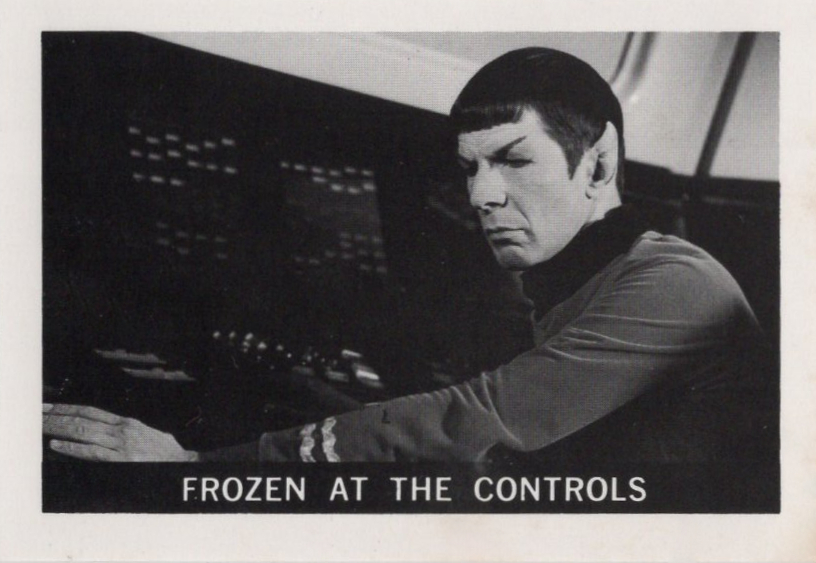
I was recently offered a first shot at a complete set of authentic Star Trek Leaf cards. These are a holy grail of TOS collectibles. The story often told is that the distribution was shut down because the manufacturer had not bothered to secure a licence, and I can’t say if that tale is correct but authentic cards are certainly rare and a complete set is worth a lot.
So I had to decide: how much was I willing to pay? I settled on a limit of US$500, but there is a story in how I got there. Read on for a tale of high hopes and poor manners, and for advice on how to spot the real cards in an ocean of worthless forgeries.
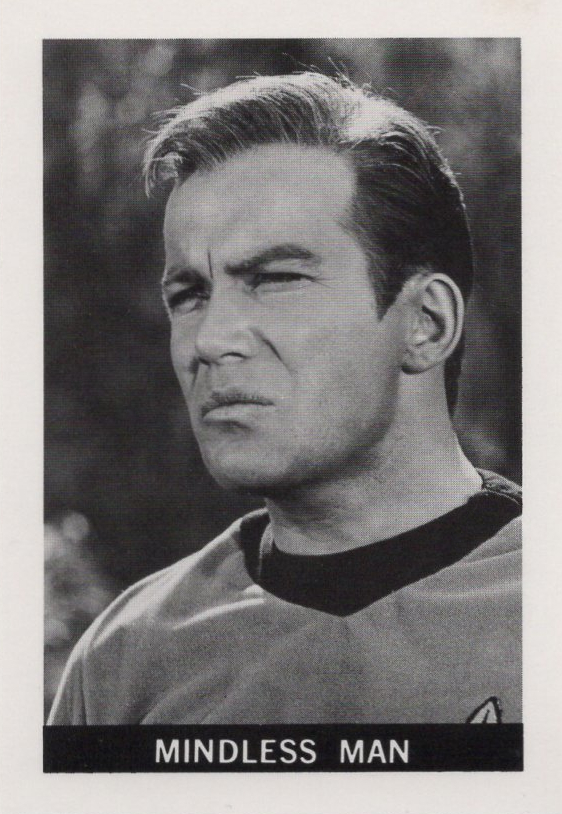
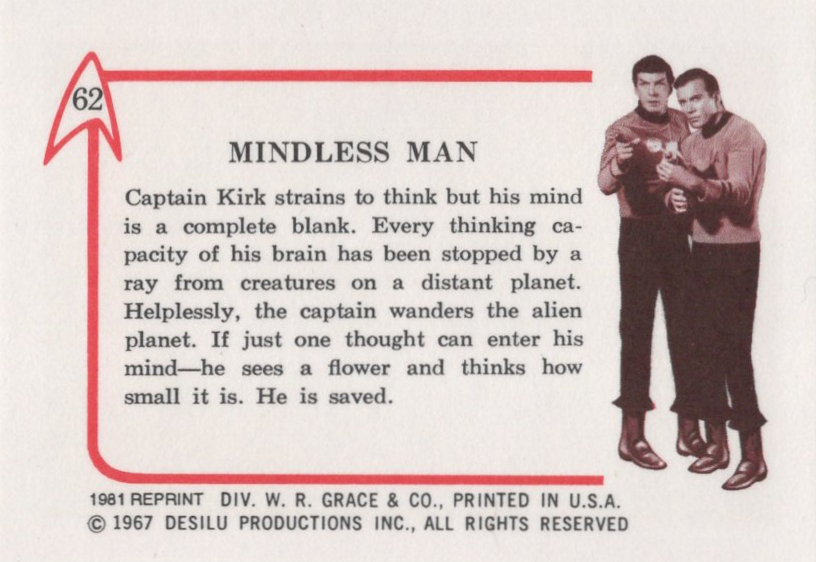
The 1967 cards were made by Leaf Brands. The 72 cards were a little smaller than standard and featured black-and-white images backed by text. To call them oddball is faint praise; the text is often unrelated to both the image on the front and any actual episode of Star Trek, but they are wildly entertaining.
I started collecting TOS more than 40 years ago, which means I have been chasing a Leaf set for all those decades. At the end of July, 2022, I was contacted through this site by a guy I will call Trey. (I’ll call him that because that’s his real name.)
Running a Star Trek collectibles site means I get email fairly regularly from people looking for information and advice on items bought in a curio shop, acquired from a deceased relative or found in an attic. Most of these people are not actually Star Trek fans.
I like to be helpful, so I spend time on research and reply with estimated values, selling advice and even contacts. And then — more often than not — the person disappears, without even saying thank you. Which is what Trey did.
How to tell if a Leaf card is real
Those who really know their Trek collectibles can spot authentic 1967 cards, but it’s not knowledge most people have.
The real 1967s. If you’re looking at cards that meet these three criteria, you probably have the real things.
- The size, measured end-to-end of the cardboard, is 61 x 88 mm.
- The authentic items were made from layers of cardboard in slightly different colours, so there should be visible layers in the construction of each card.
- The images should be sharp. Check particularly card 3, but if any are fuzzy or soft that is a bad sign.
The excellent 1981 reprints. This reprint set is helpfully and clearly labelled “1981 reprint.” These words replace the “Leaf Brands” on the back and the reprints were not printed using shaded layers of cardboard, but otherwise they are identical to the originals, as they are the same size and the images are clear.
The worthless 1989 Dan Kremer Imports set. A bunch of cards were released to the market in the late 1980s, sold with a fake Certificate of Authenticity which told the following story. (The text here is drawn from the excellent Wixiban Star Trek site.)
1967 Leaf (European) Star Trek Set
This Star Trek Leaf card set was discovered in Europe in 1989 at a former card producer’s warehouse that has been in business since well before the 60’s. From the information provided to us, we understand that these were manufactured in cooperation with Leaf for European distribution only. Shortly thereafter, Desilu withdrew the contract with Leaf, due to contractual difficulty. Upon notification of the aforementioned problem, the European card manufacturer decided not to issue them and stored them in the warehouse where they have been until their re-discovery in 1989 by Dan Kremer, a European collectibles importer.
And on the reverse:
Upon examination, The European set exhibits the following differences to their American counterpart. The European sets were never gloss coated (very few European cards were ever gloss coated). The cutting was poorer than the American edition (the cutting machines in Europe were early outdated cutters from the U.S.) The camera work is slightly poorer (again, inferior cameras).
We hope you enjoy the very special previously unavailable set.
Dan Kremer Imports
That tale is untrue; these were simply pirated copies, produced later and poorly done. They are slightly smaller than the originals, the images are often fuzzy, and the card stock is single layer, so there is no variation when a stack of cards are viewed on end.
Trey and his cards
Back to Trey. In July 2022, I received a few polite but insistent emails from him. He wanted to talk as soon as possible, so we set a time. Over email and a long phone call down to Texas, I learned that he and his partners buy abandoned storage units, and one of those gambles paid off: they found a bunch of valuable construction material and a small pile of Star Trek cards. Internet research led him to Leaf and then to a mention on my About my Collection page.
Trey had also seen an article that referenced an auction price of $1,000 for a complete 1967 set, so he had visions of dollar signs dancing in his head. He wanted advice on selling and asked me if I wanted to buy them.
I asked if the cards said “Reprint” on them and was told no. I then said he most likely had the pirated 1989 set, as there are a lot of them around. His business partner actually had the cards in front of her and, once she was added to the call, I told them what to look for and suggested she grab a ruler to measure a card. Then she suddenly dropped off the call.
And I never heard back from Trey. Not even to say thank you. Follow-up emails were ignored.
So, what would it be worth to me?
Had the cards been authentic 1967s and in good shape, how much would I have offered? My 1960s and 1970s collection does not have many holes, and this is certainly a big one. But I have the 1981 reprints, and that feels very much like owning the real things.
As I said above, I decided on a limit of US$500. I was a little reluctant to spend that much but how could I not try? How often does an authentic 1967 set just drop out of the air?
So now I feel let down, by Trey and because I would like to own the 1967s. To make myself feel better, I spent some time with my reprint set and then decided to share, so here’s my piece on them, full of reprinted 1967 goodness.

Postscript
Being repeatedly asked for advice and then not even thanked has a draining effect on one’s willingness to help the next person. But a guy named Maxwell on the US west coast recently renewed my faith. He was looking for information on a dinner plate produced by Pfaltzgraff for Star Trek VI: The Undiscovered Country. The text on the back is not the standard and I hoped he had a prototype or an artist’s proof, but some research revealed his version is rare but not a one-off. I gave him some advice on selling it.
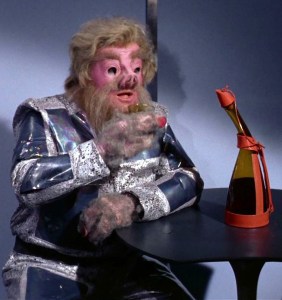
And Maxwell thanked me for my time, even adding “Too bad I’m on the other side of the continent (NW WA state in the U.S.) or I’d offer you a Saurian Brandy at some point.” He owns a Dickel bottle, similar to the ones used on the series, so he’s an actual Trek fan.
That probably explains why he was kind enough to thank me for my time.
-
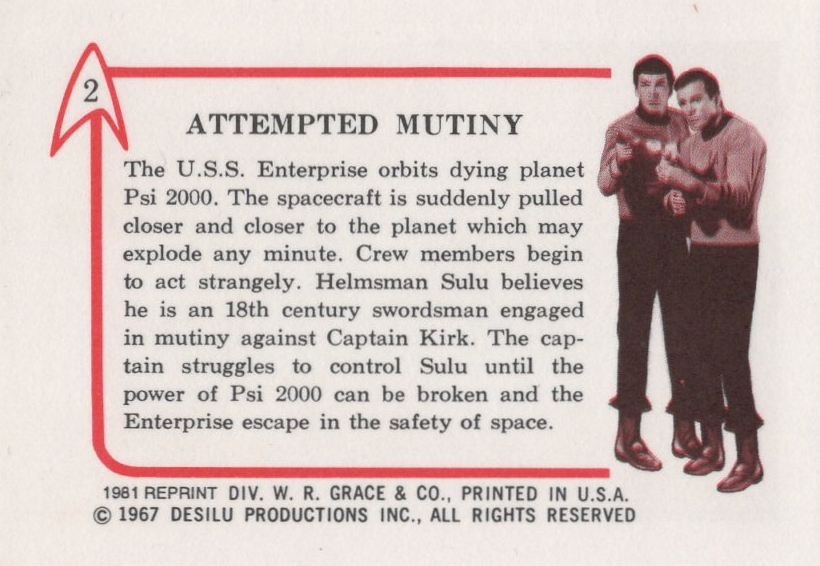
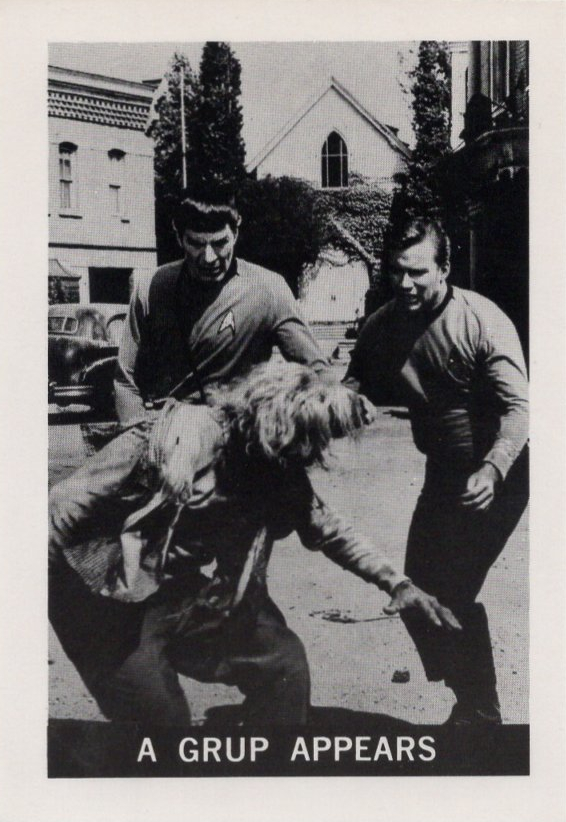
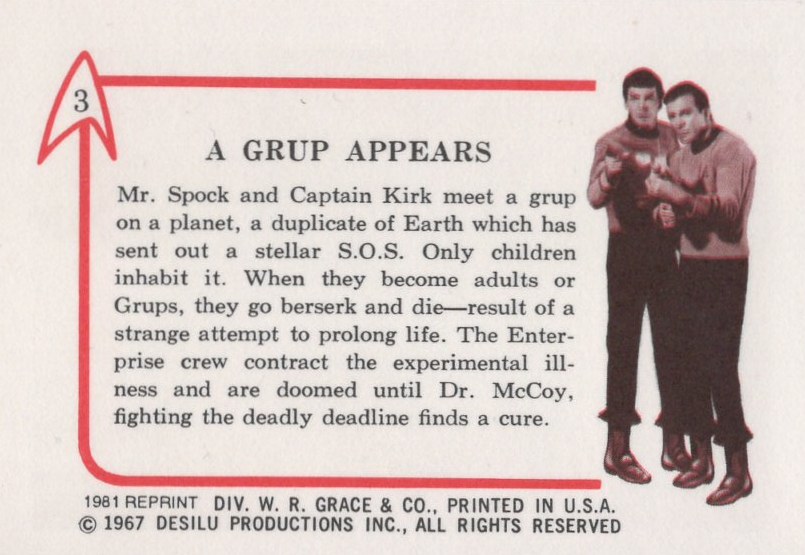
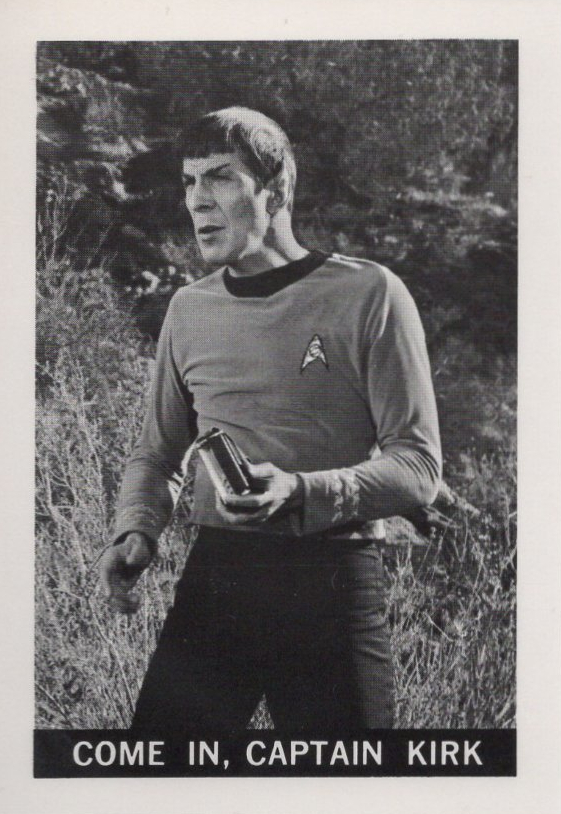
Share in the glory that is the (reprinted) Leaf cards
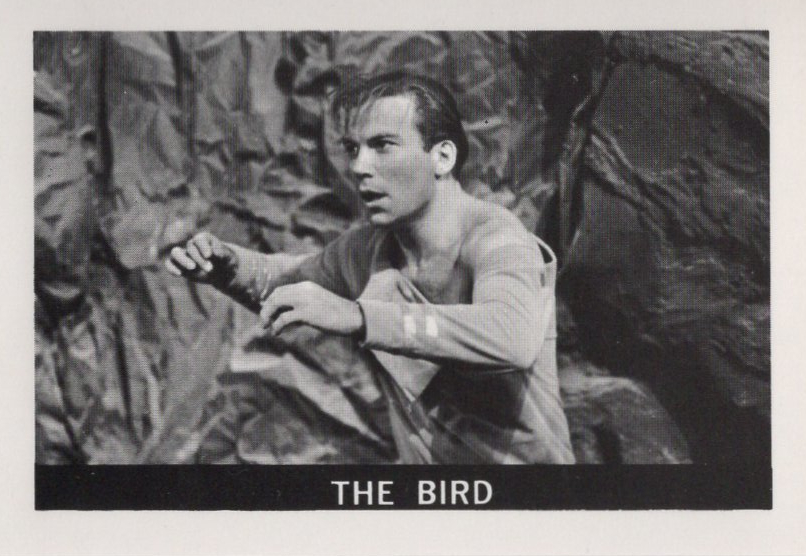
I recently thought I had the inside track on an authentic set of the 1967 Leaf cards. It was a brief and shining moment and I wrote about it here. It all went nowhere, as the guy who contacted me actually had a set of the worthless Dan Kremer pirated cards.
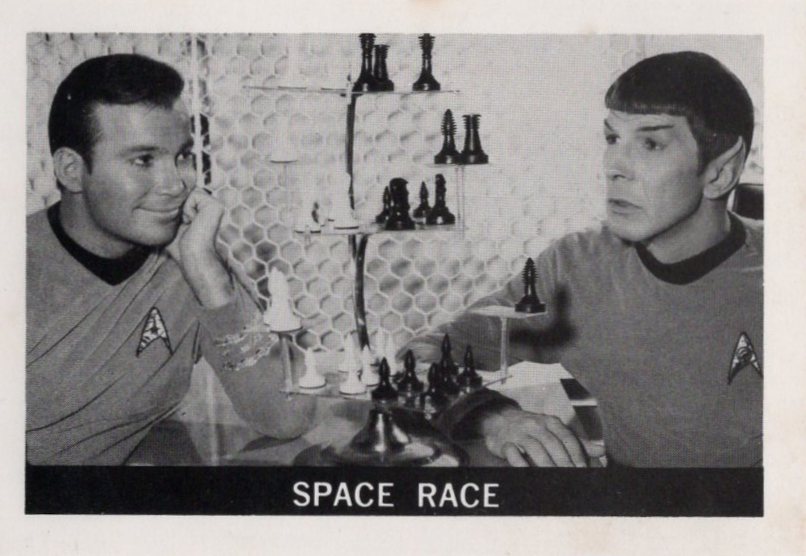
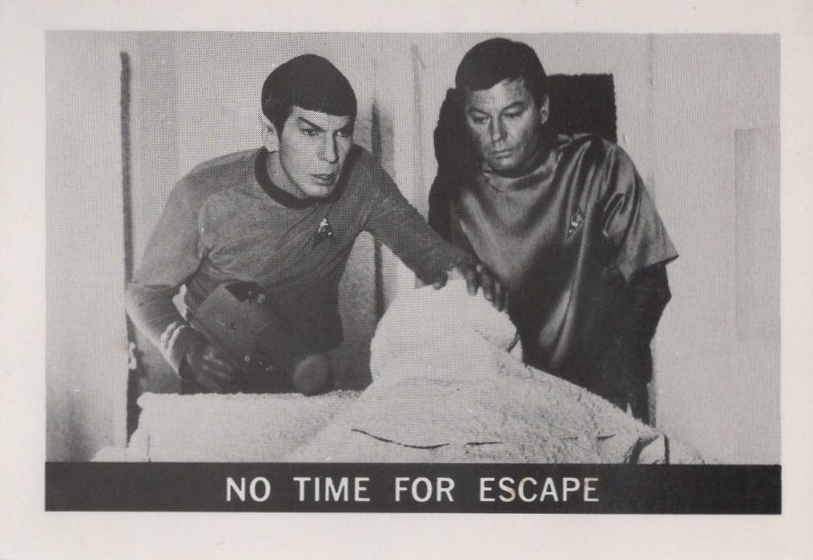
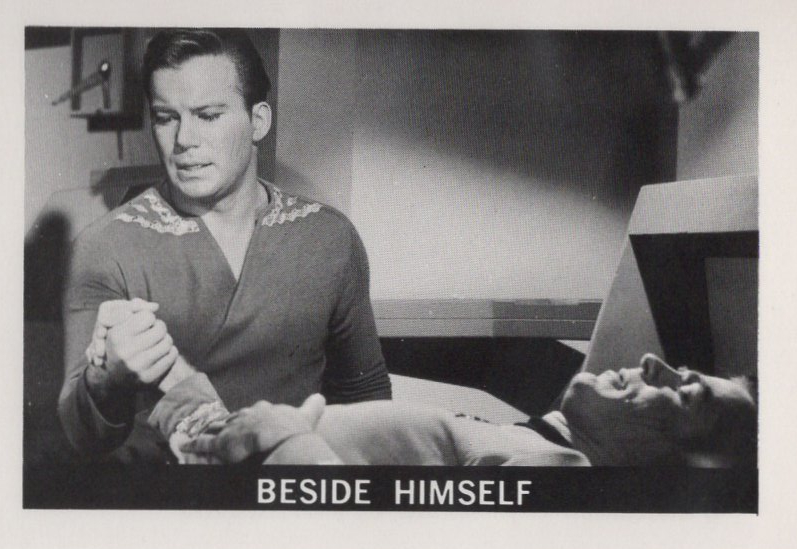
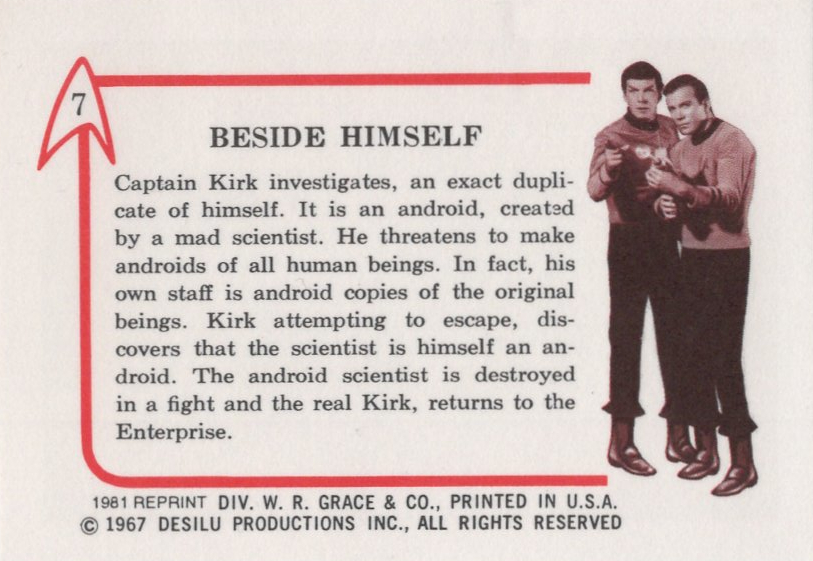
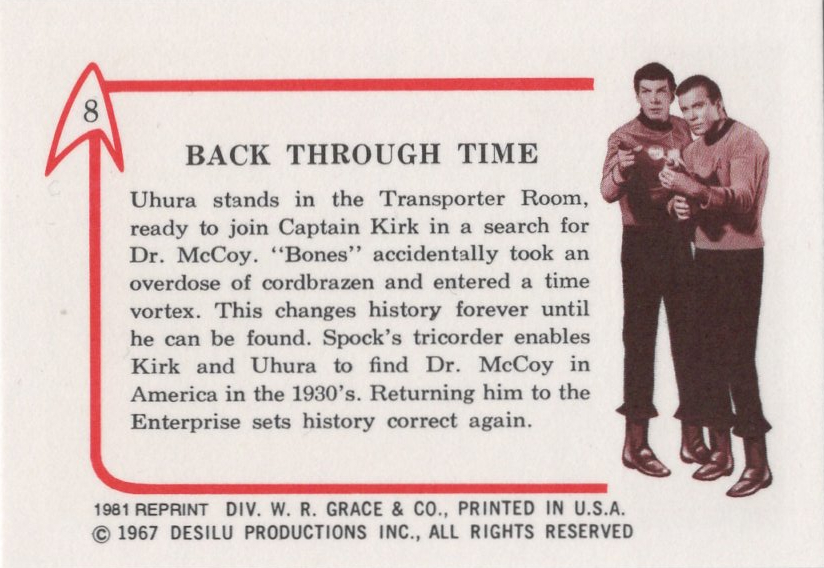
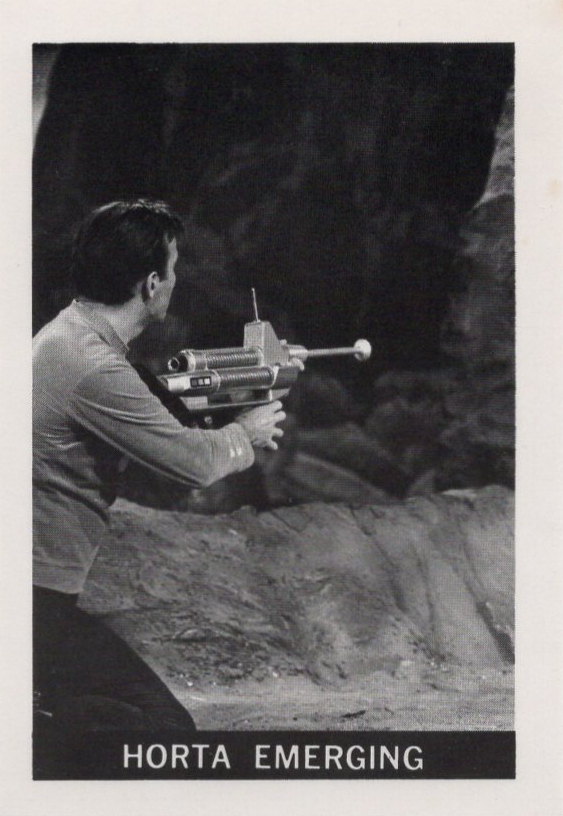
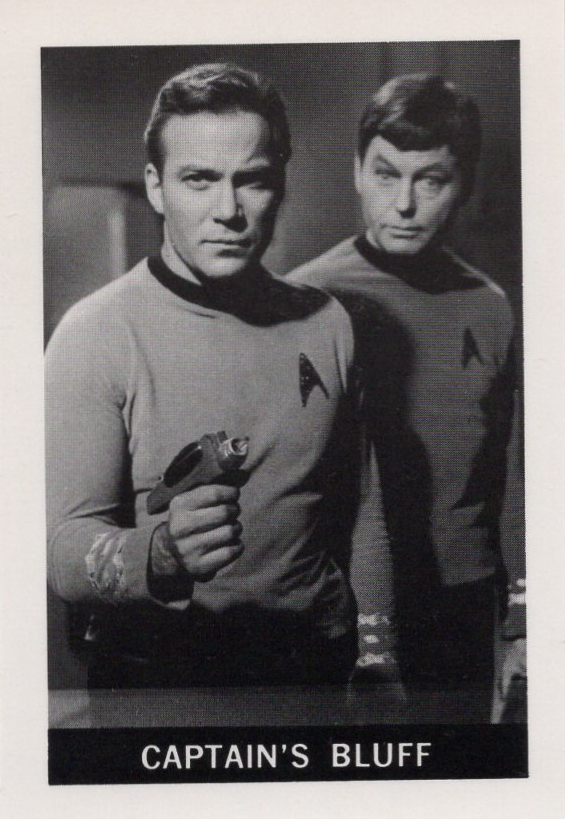
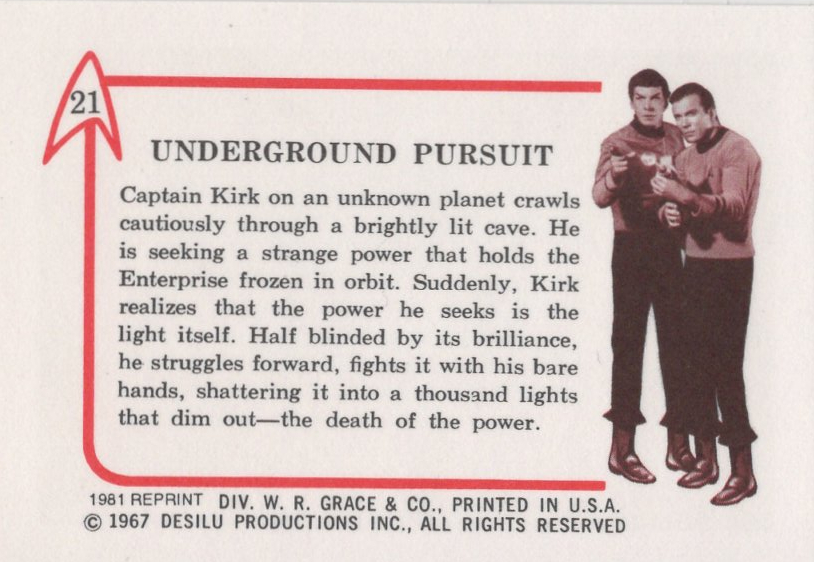
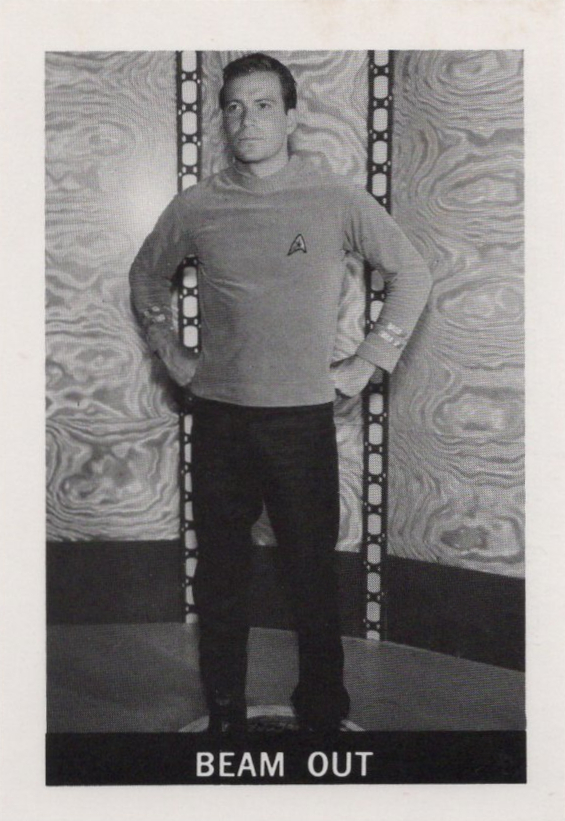
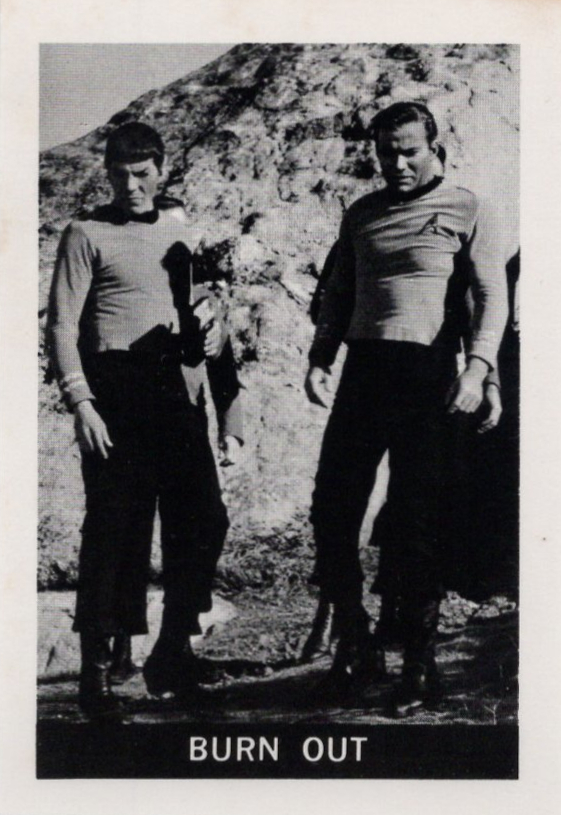
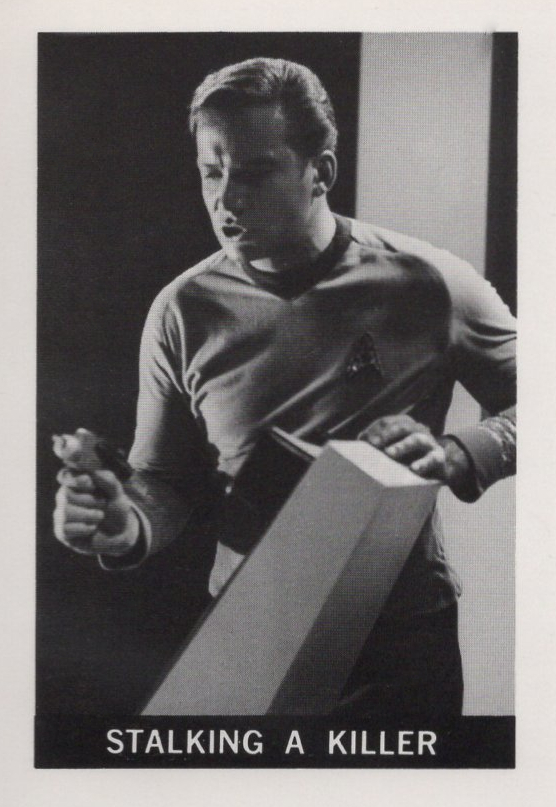
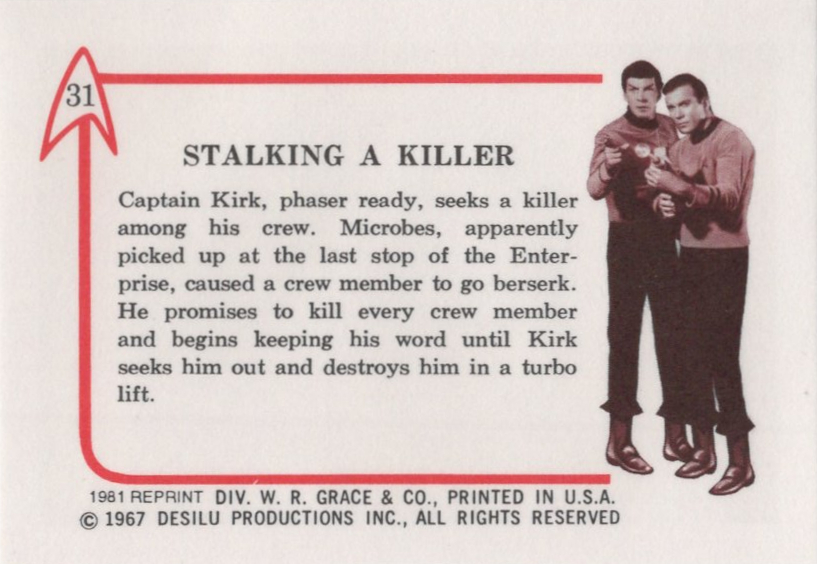
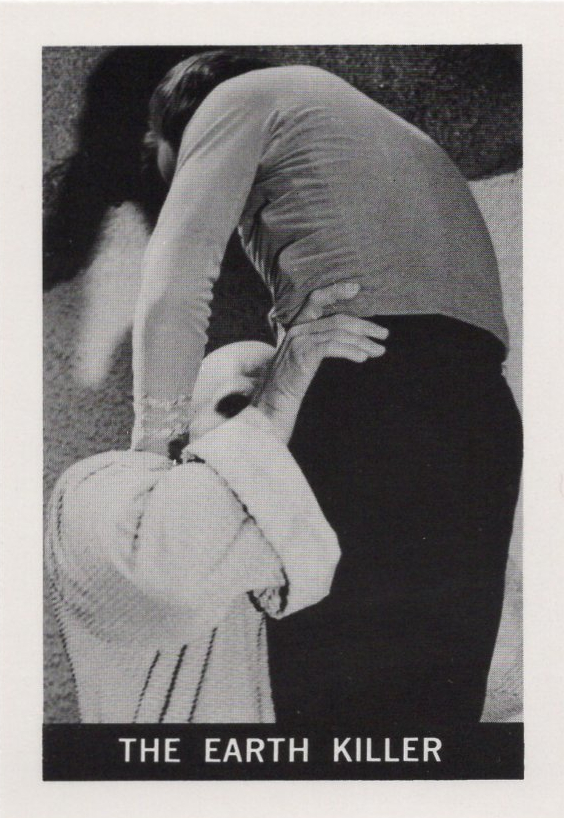
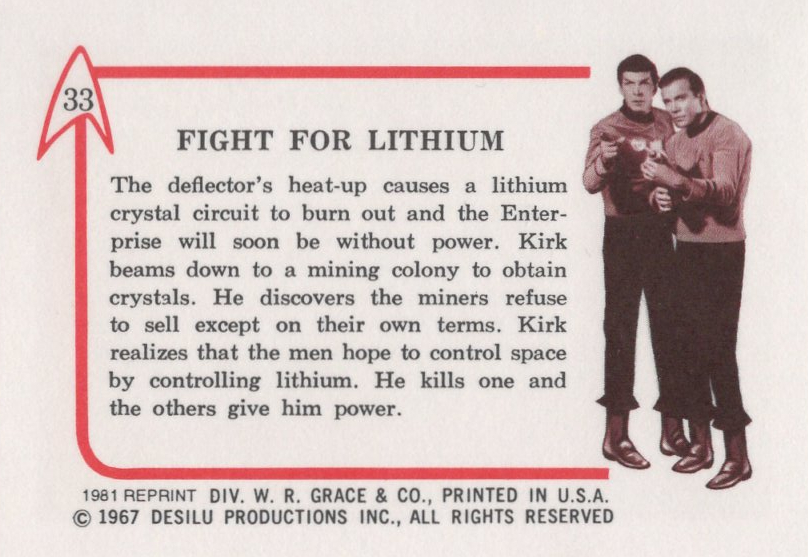
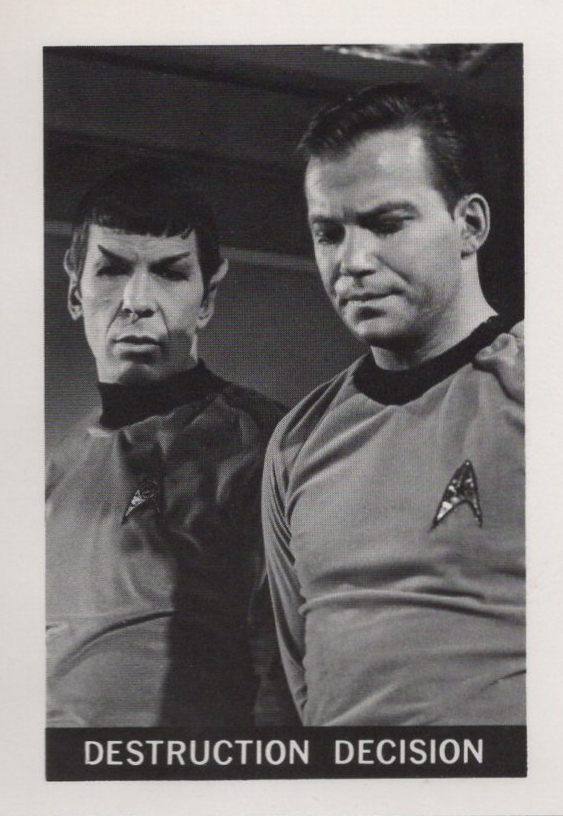
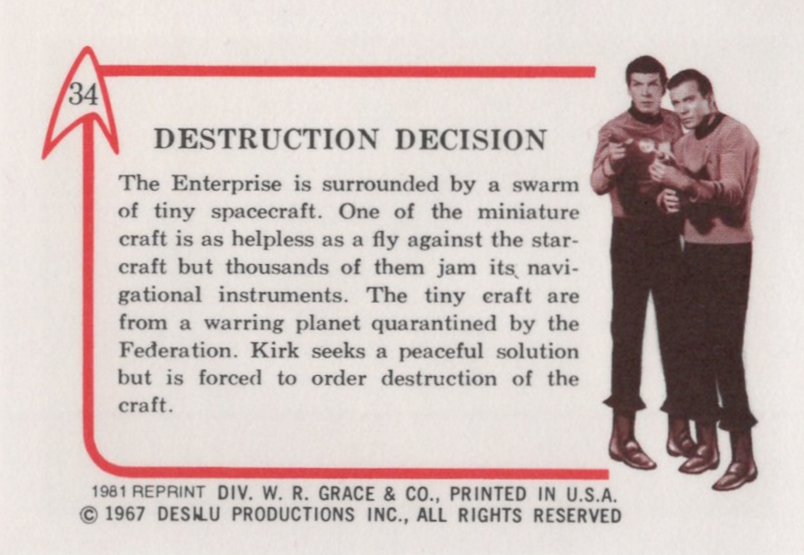
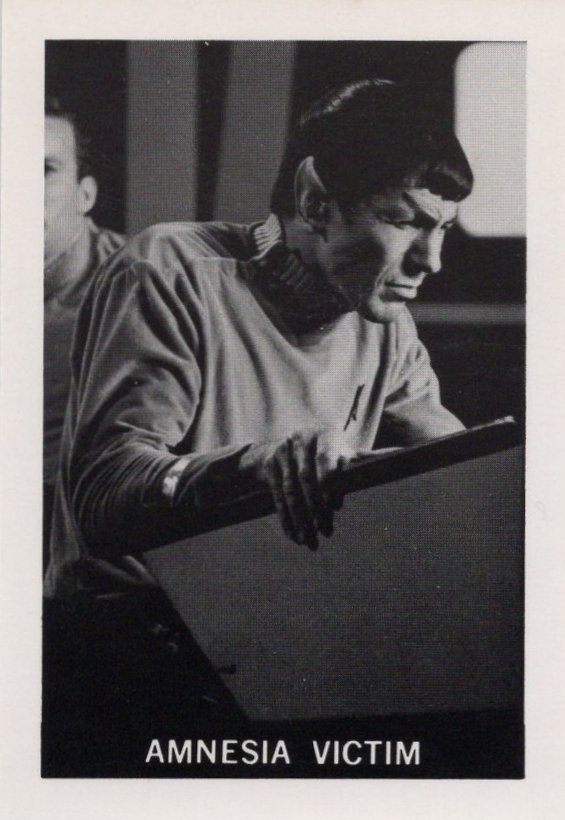
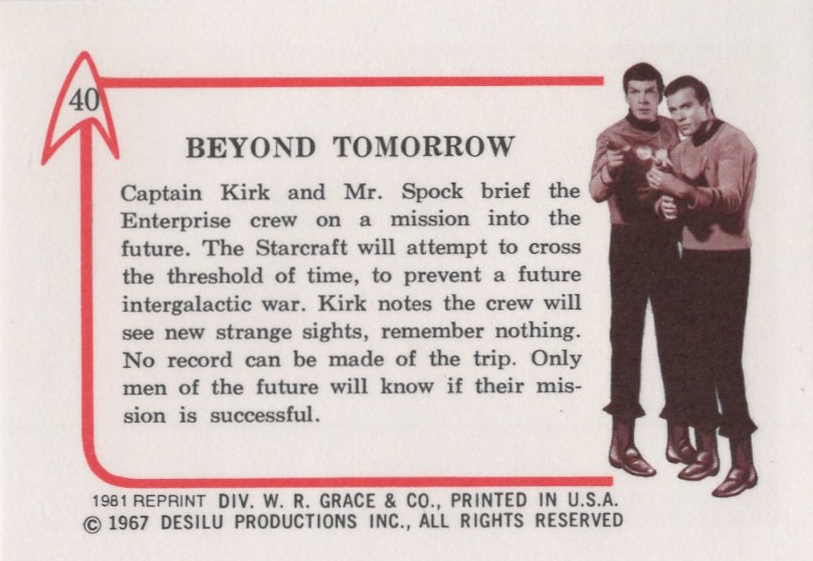
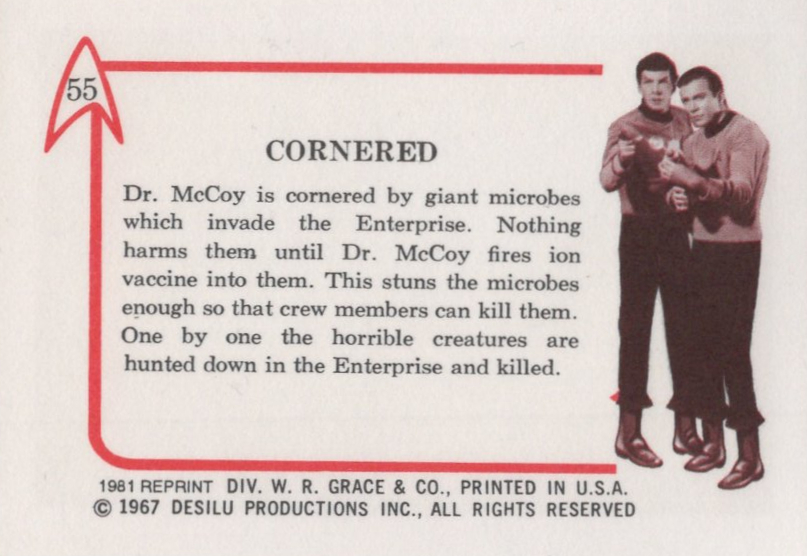
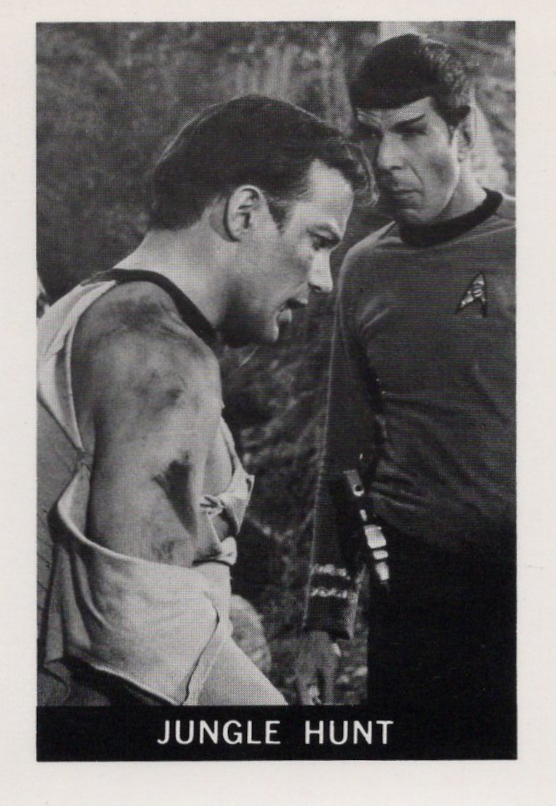
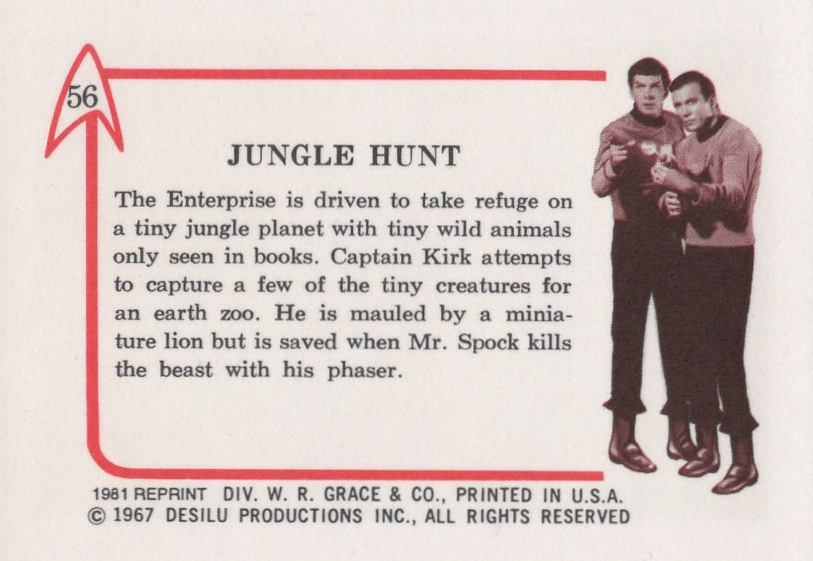
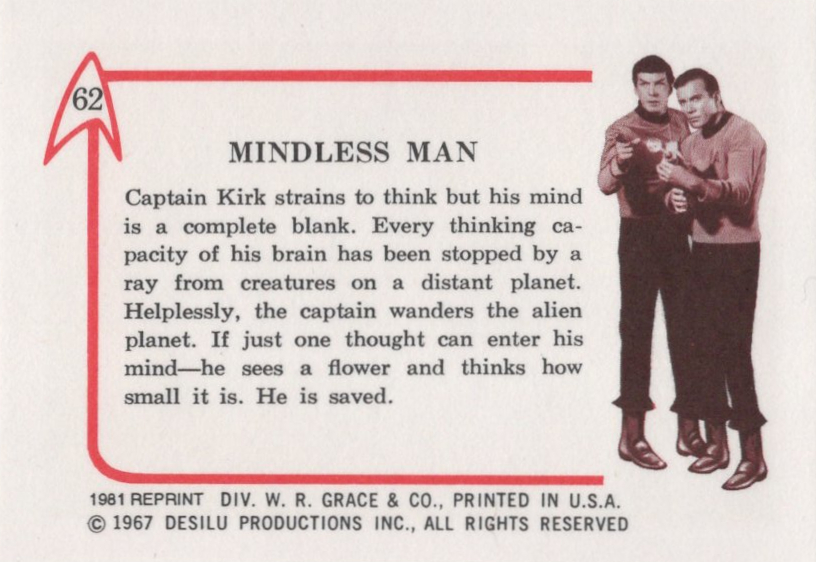
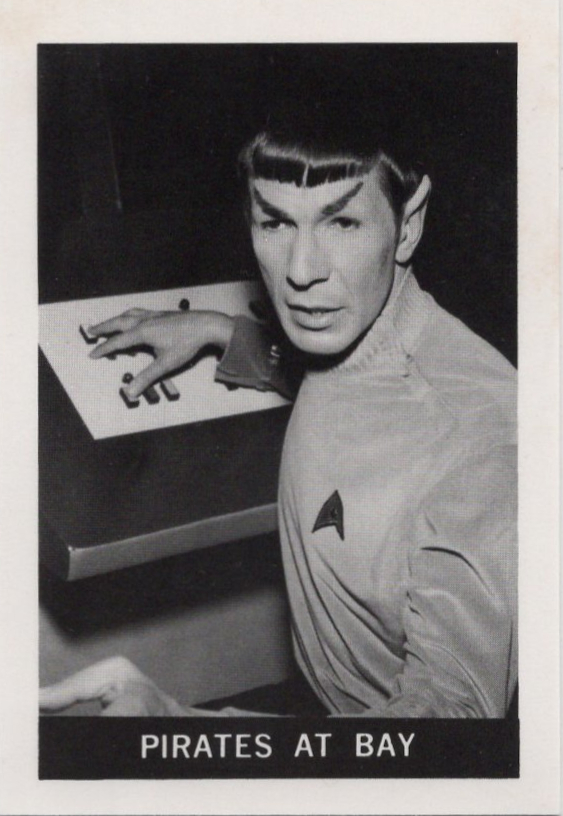
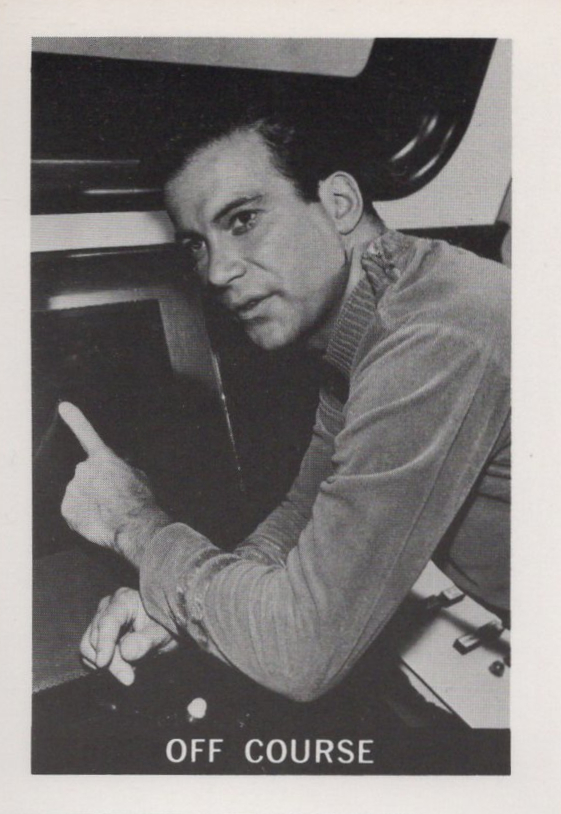
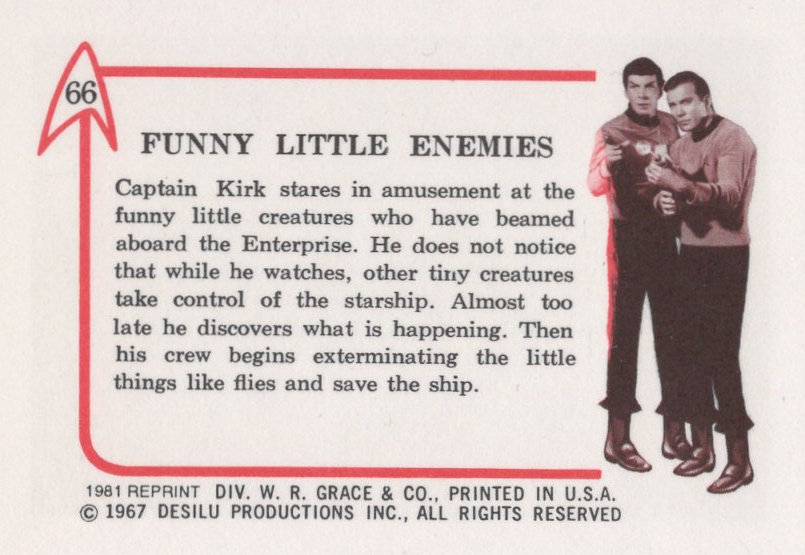
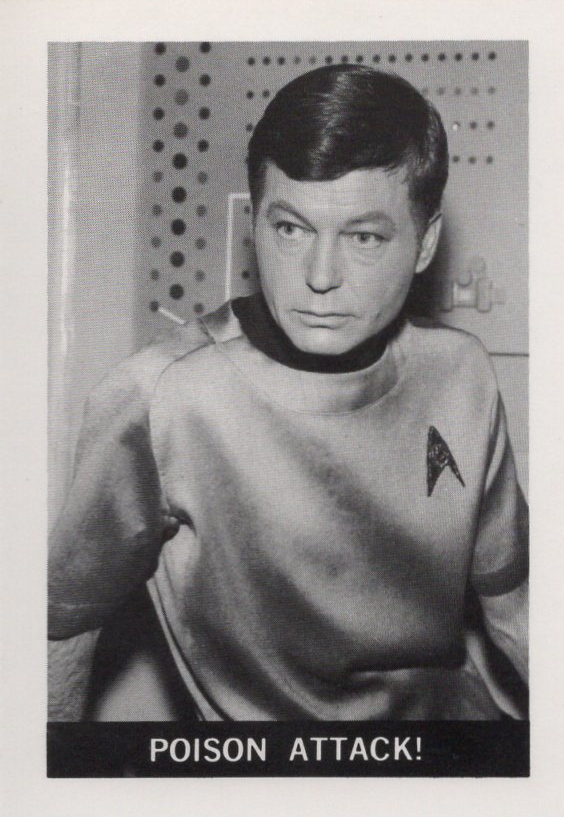
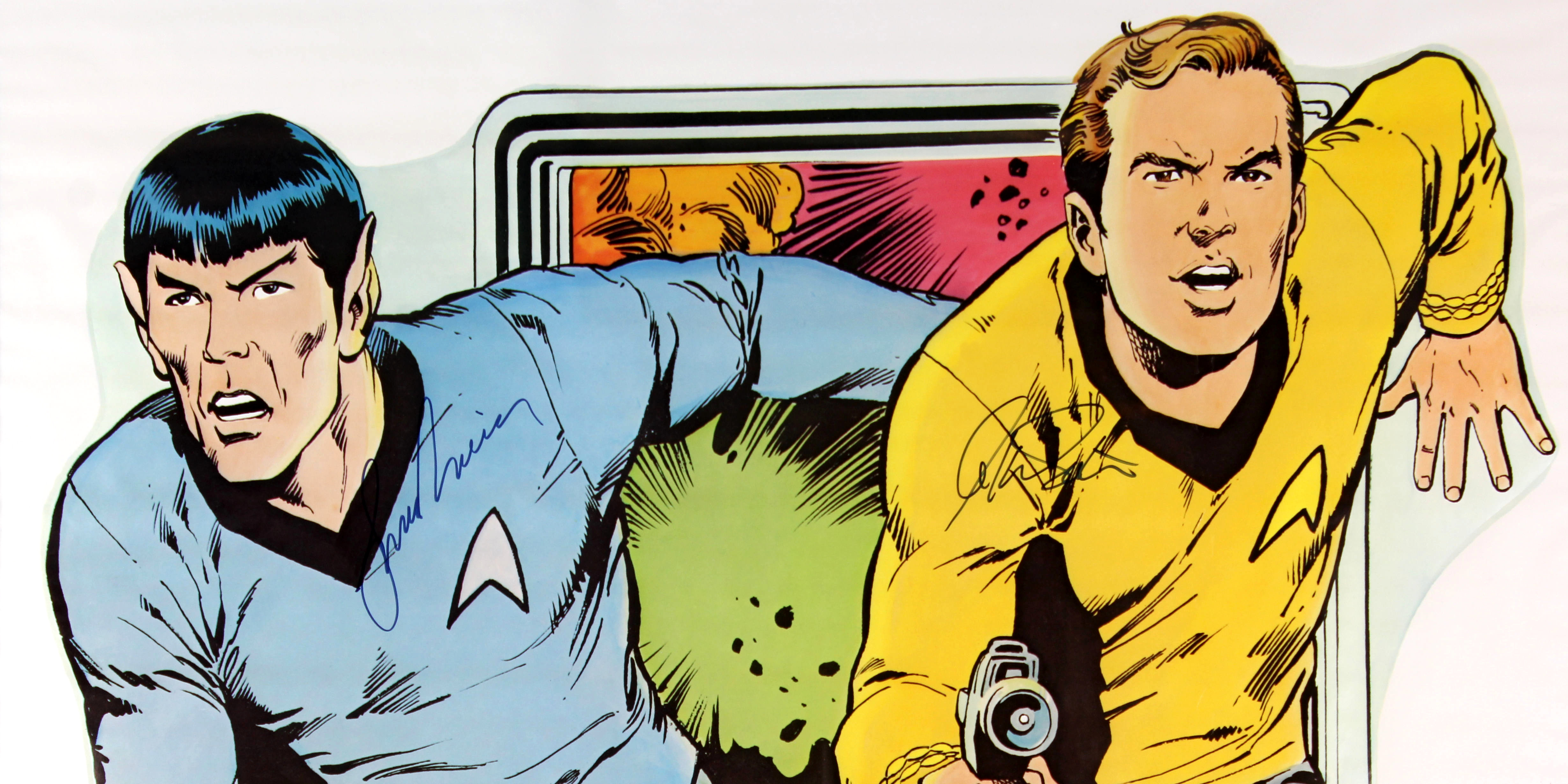
But that experience made me want to share the excellent (if reportedly unauthorized) reprint set from 1981. Unlike the 1989 Kremer cards, these were stamped “1981 Reprint” — so no one was trying to fool buyers.
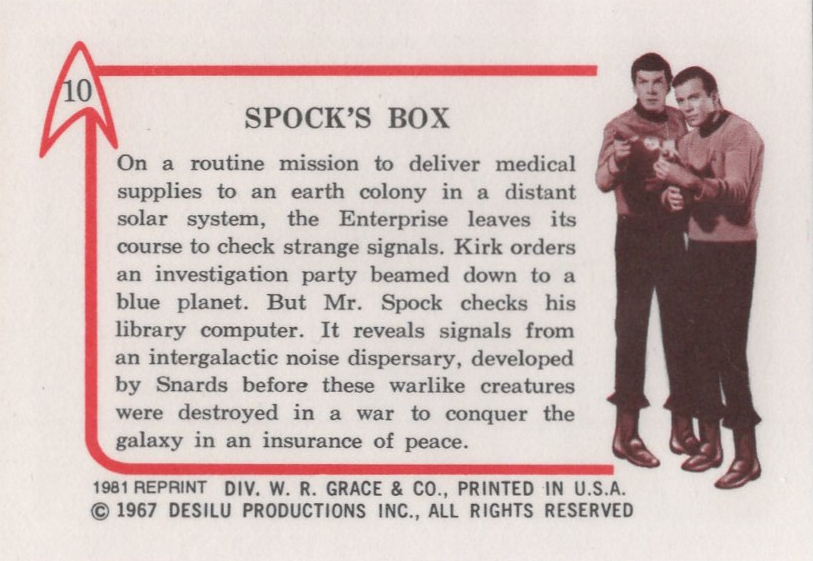
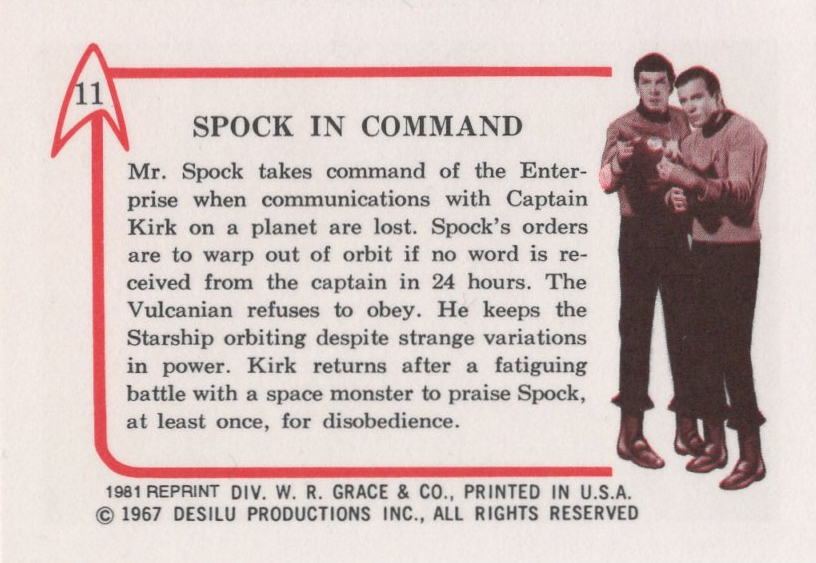
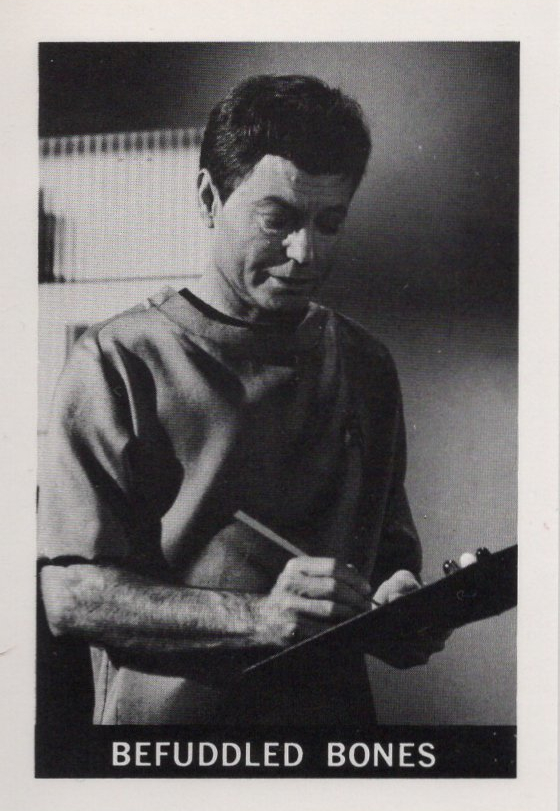
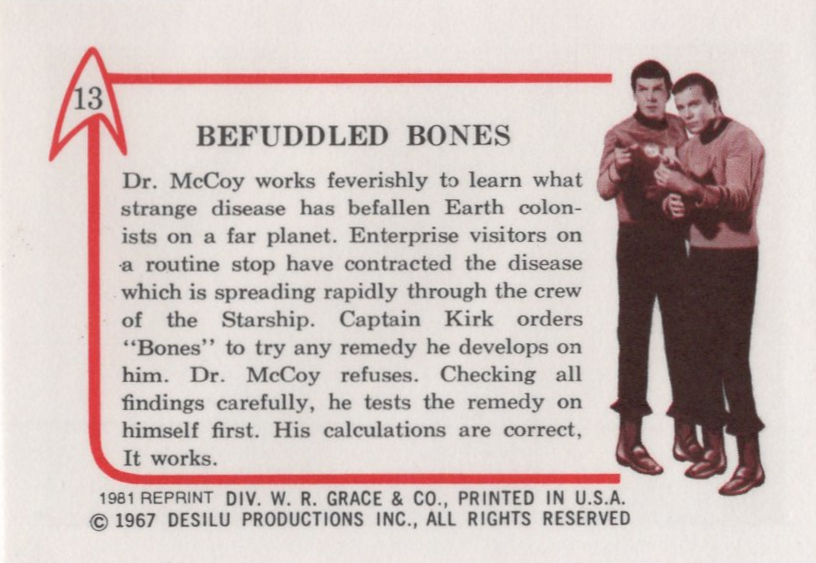
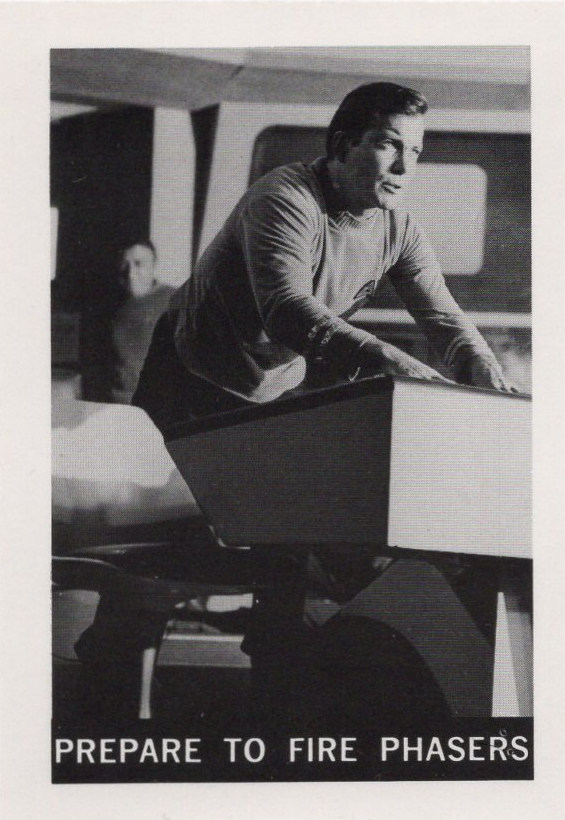
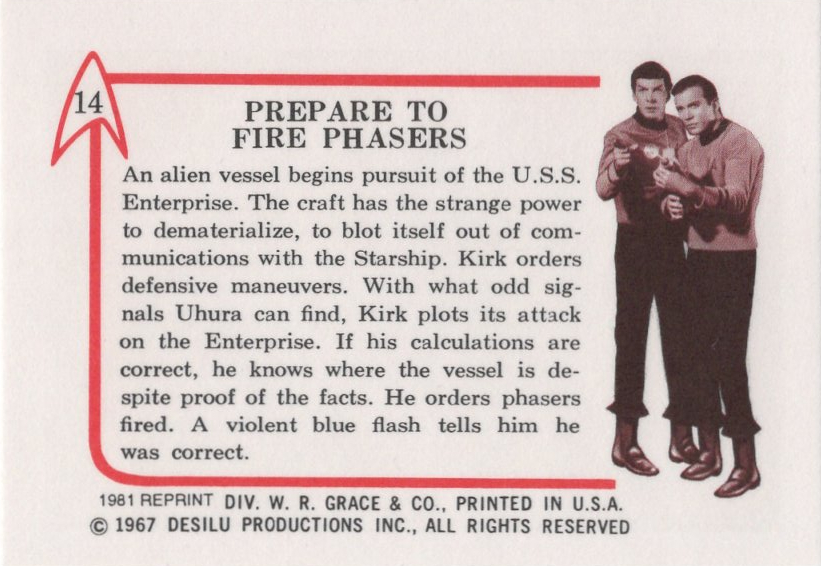
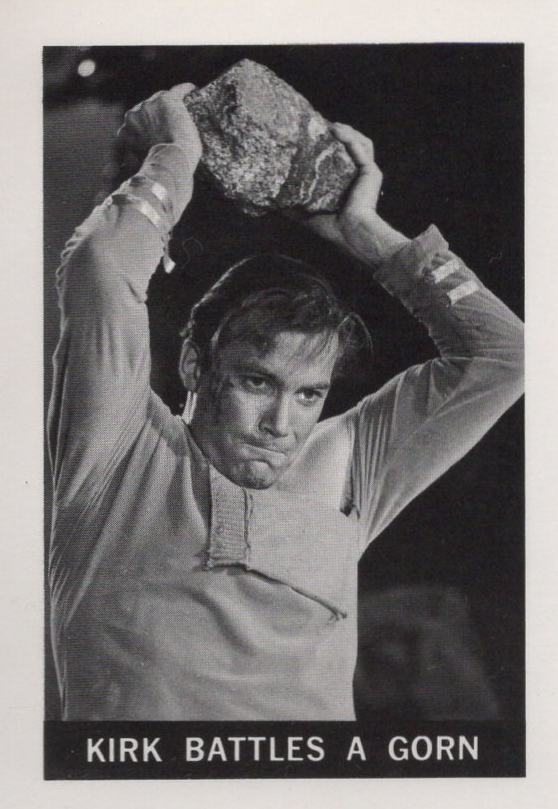
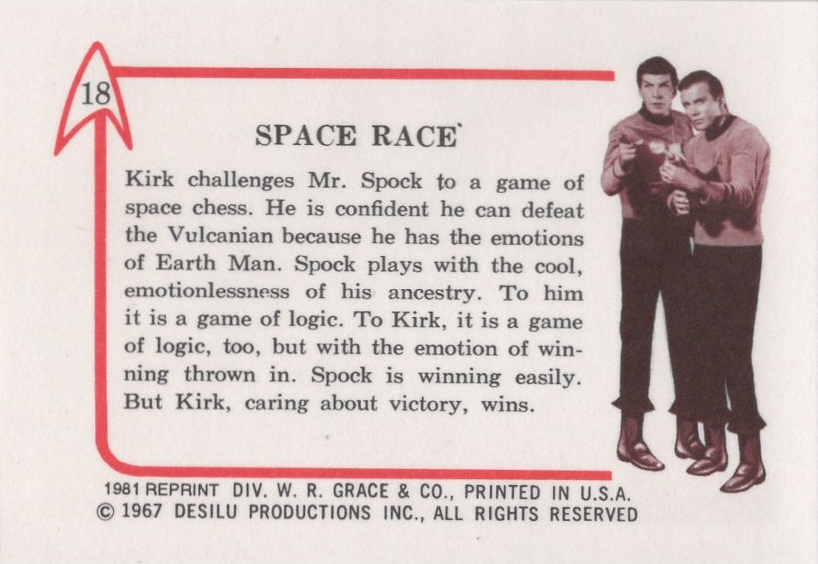
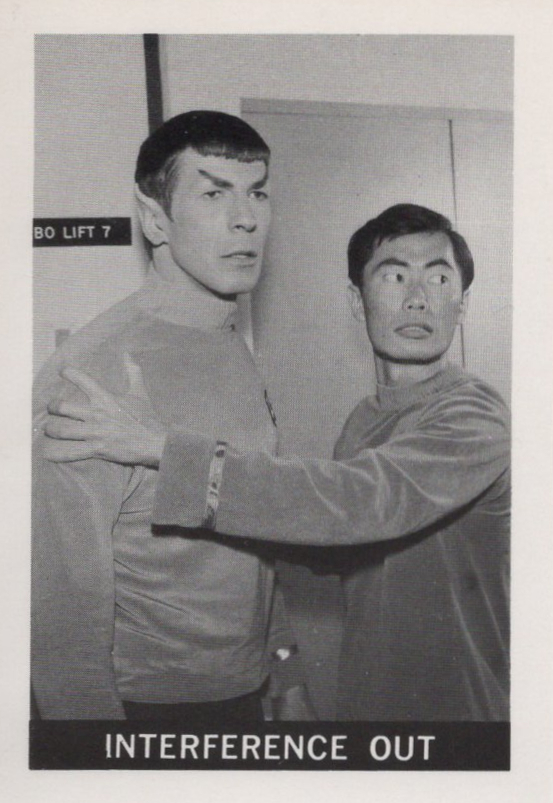
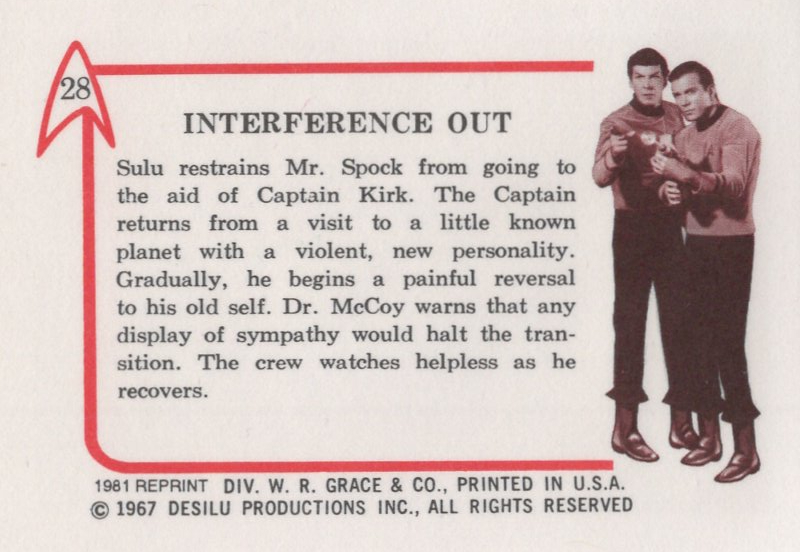
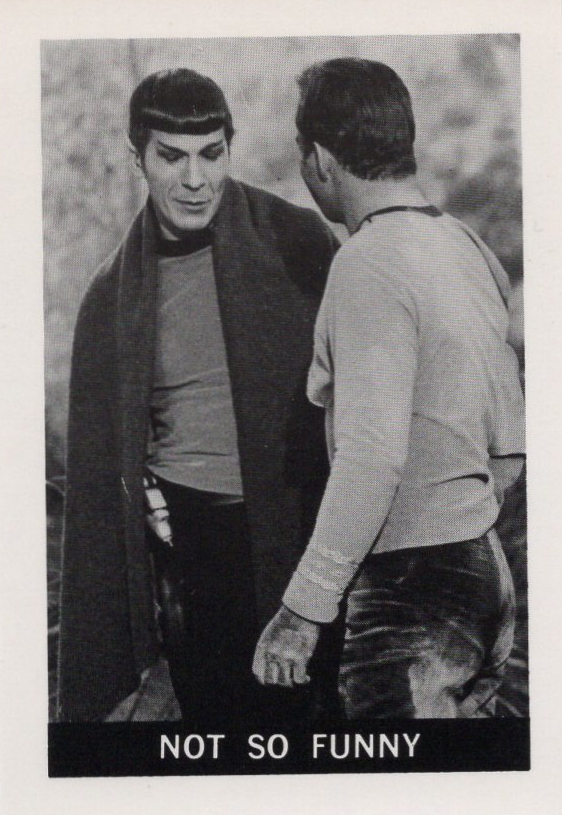
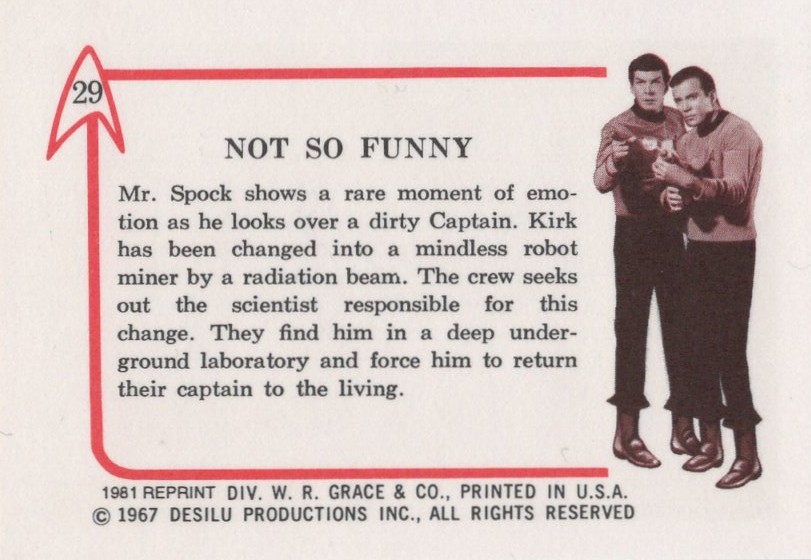
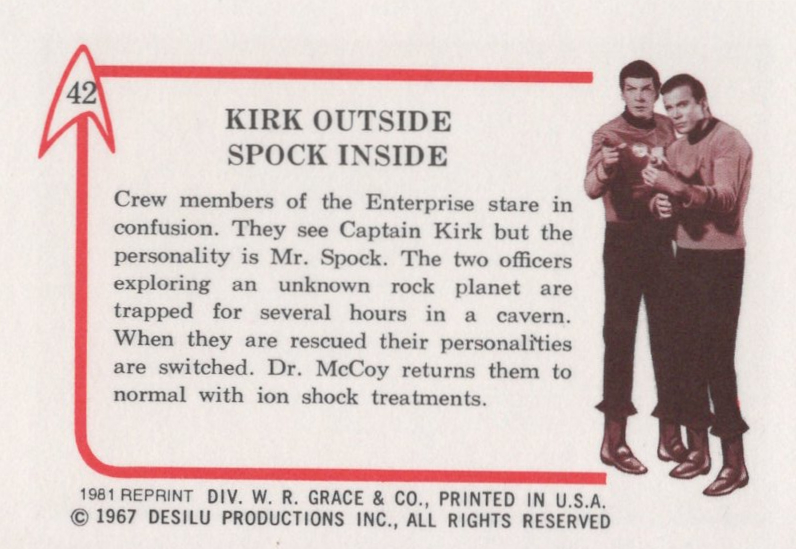
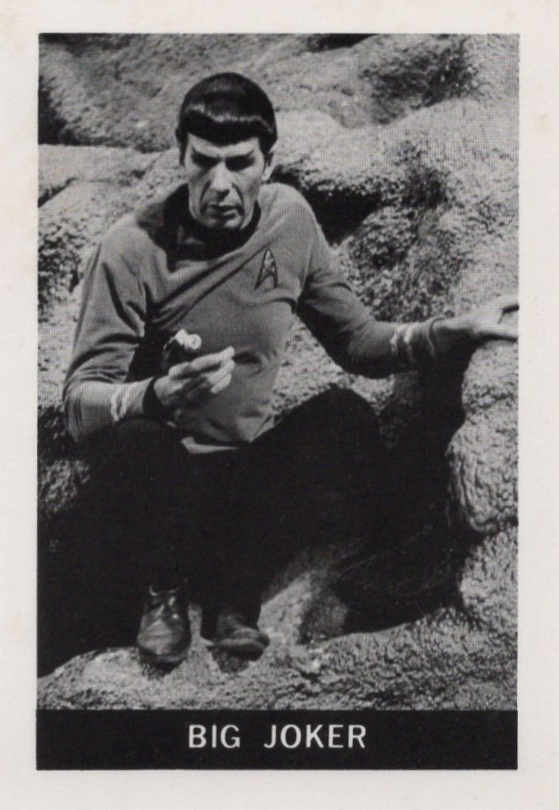
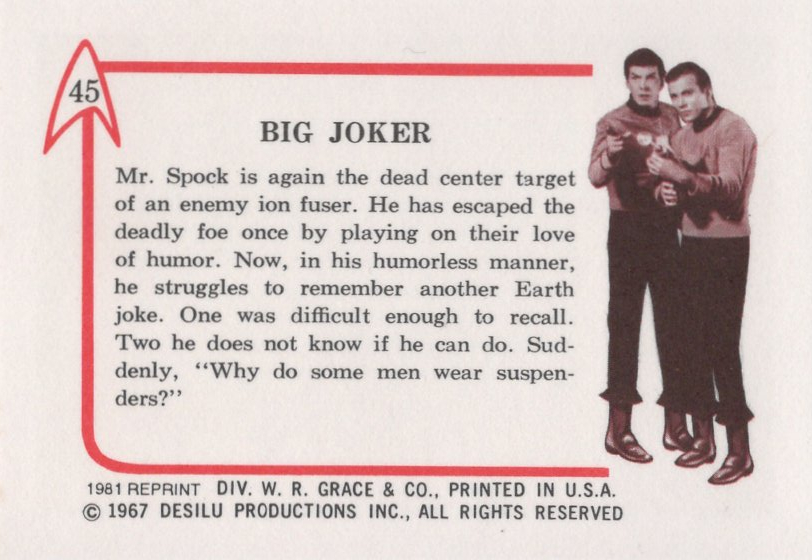
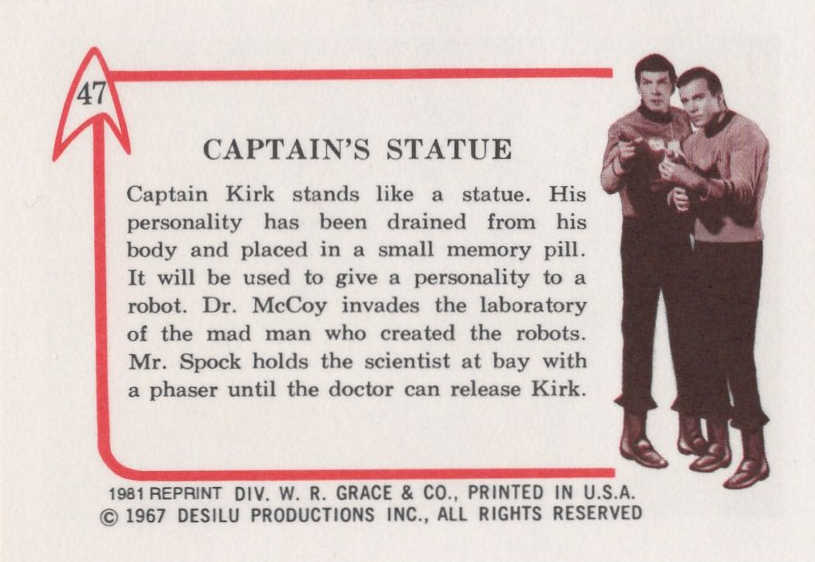
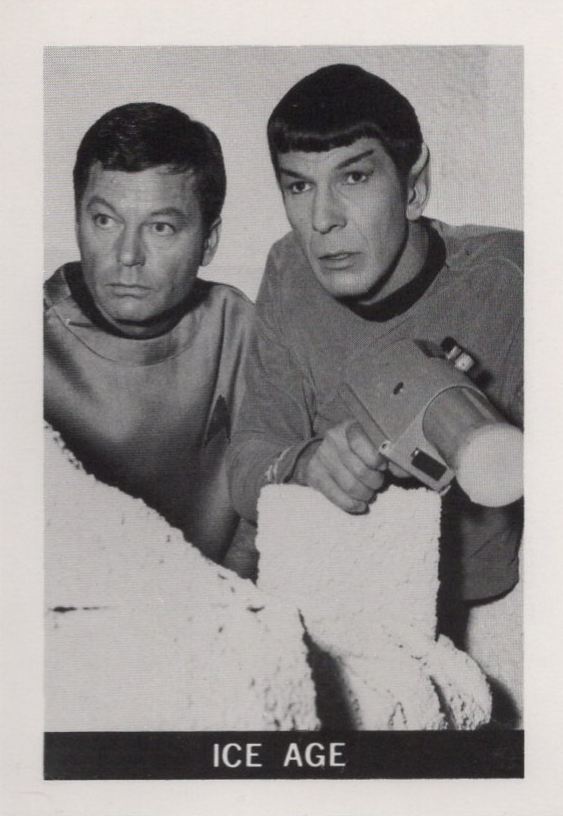
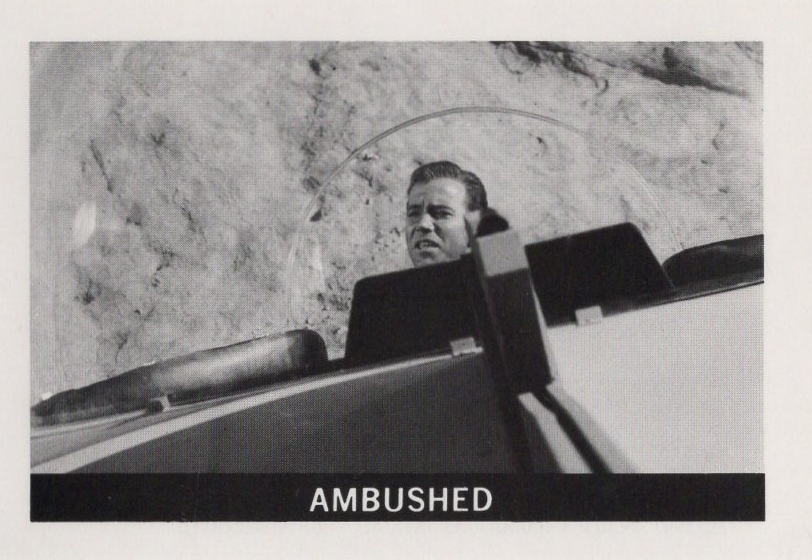
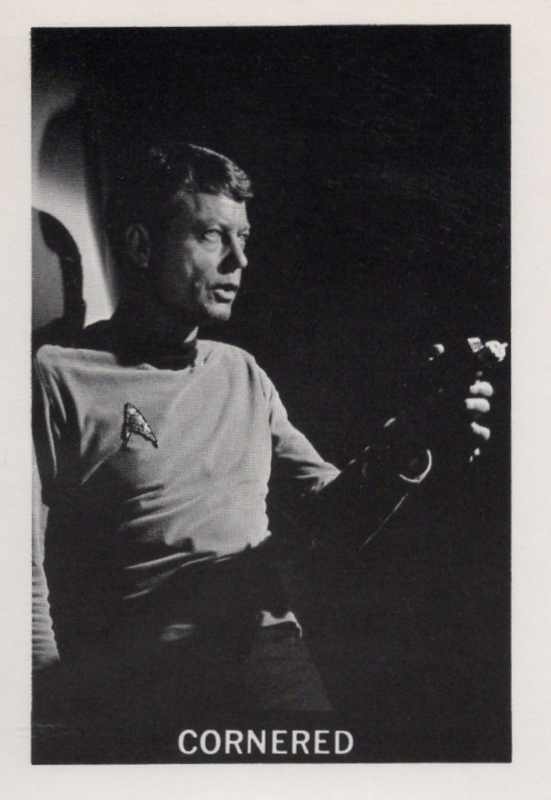
The cards feature many publicity and behind-the-scenes images, and some of the text is actually pretty close to actual Star Trek episodes. But mostly, these cards are wonderfully wacky. You would not feel cheated if you bought the entire set just for this plotline:
Mr. Spock checks his library computer. It reveals signals from an intergalactic noise dispensary, developed by Snards before these warlike creatures were destroyed in a war to conquer the galaxy in an insurance of peace.
Click on any image to see a bigger version.


















































Collecting Trek
A TOS collection 40 years in the making