-
Revisiting the weird planet fan stories
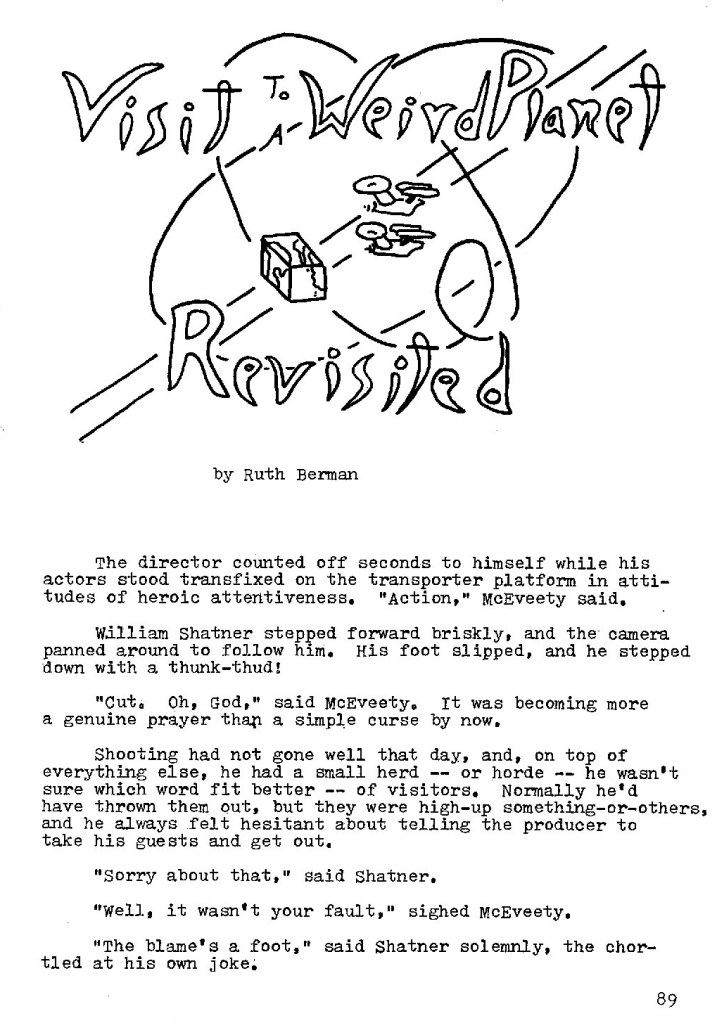
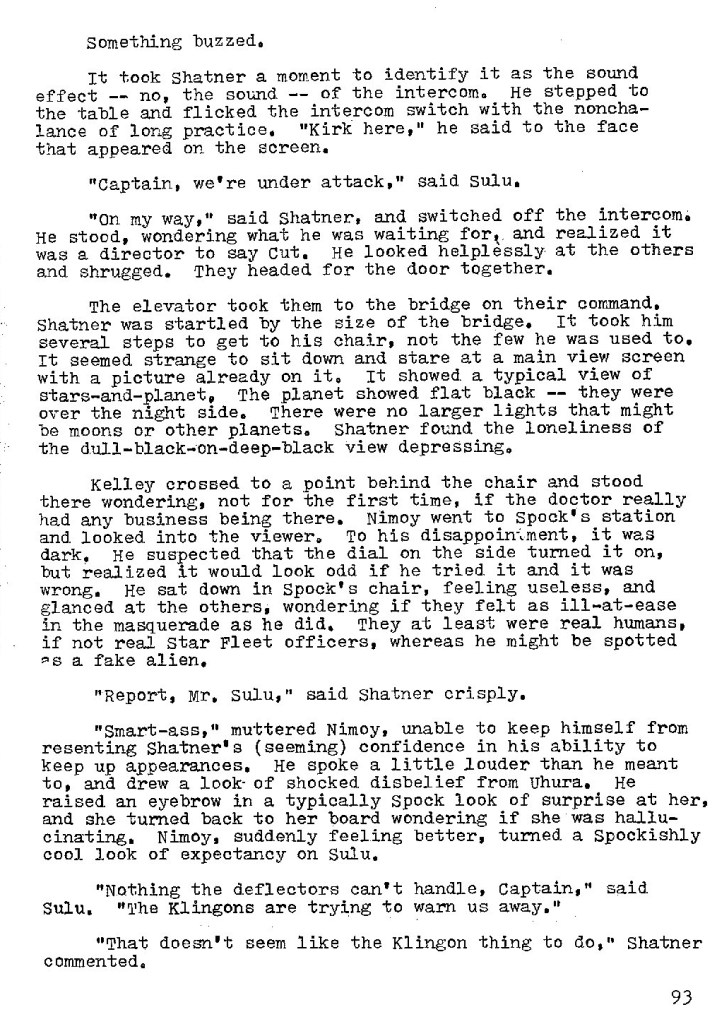
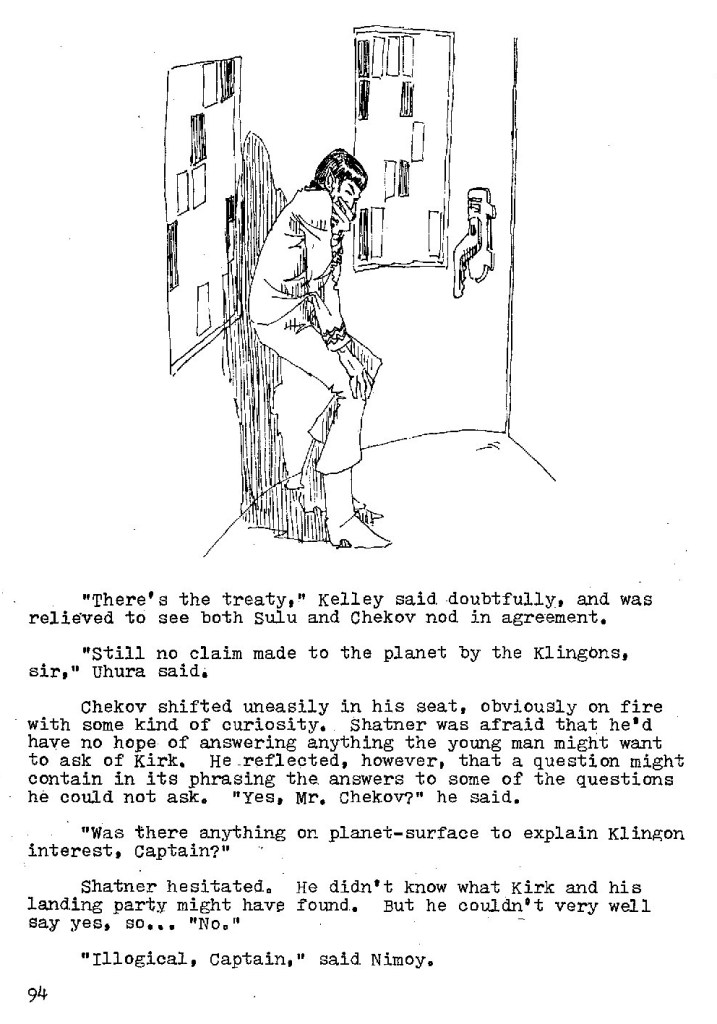
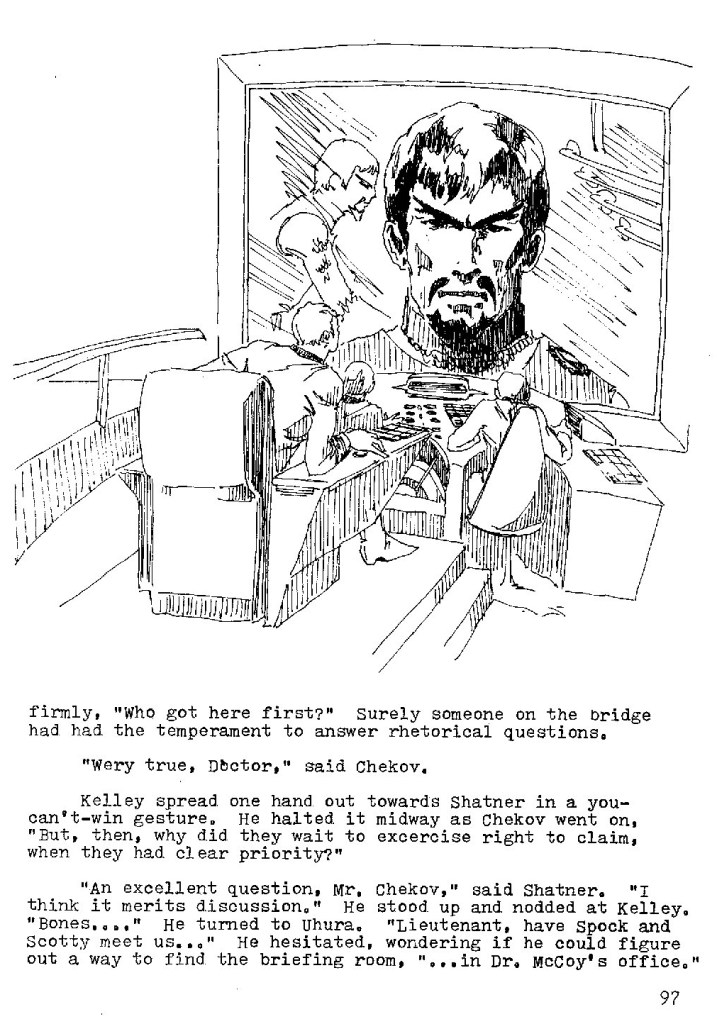
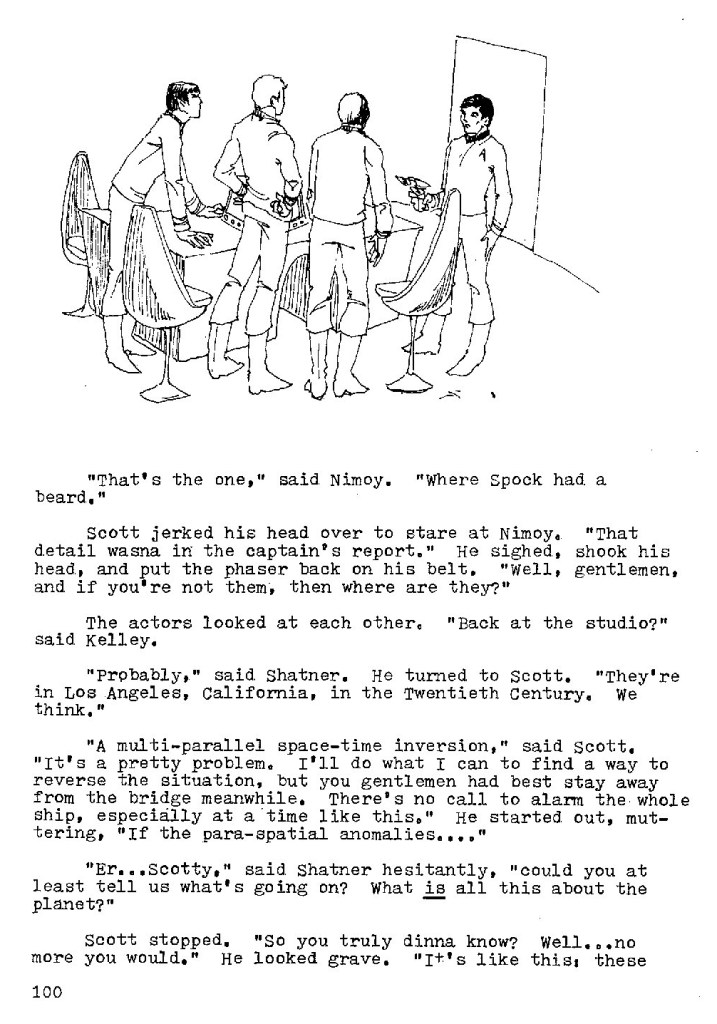
This week on The Inglorious Treksperts podcast, the guys discussed the fan story Visit to a Weird Planet Revisited. That piece, published in the short story compilation Star Trek: The New Voyages in 1976, is a take on an earlier work of fan fiction called Visit to a Weird Planet.
The hosts said they had not read the original work, and I could not let that stand. So here are both of those stories.
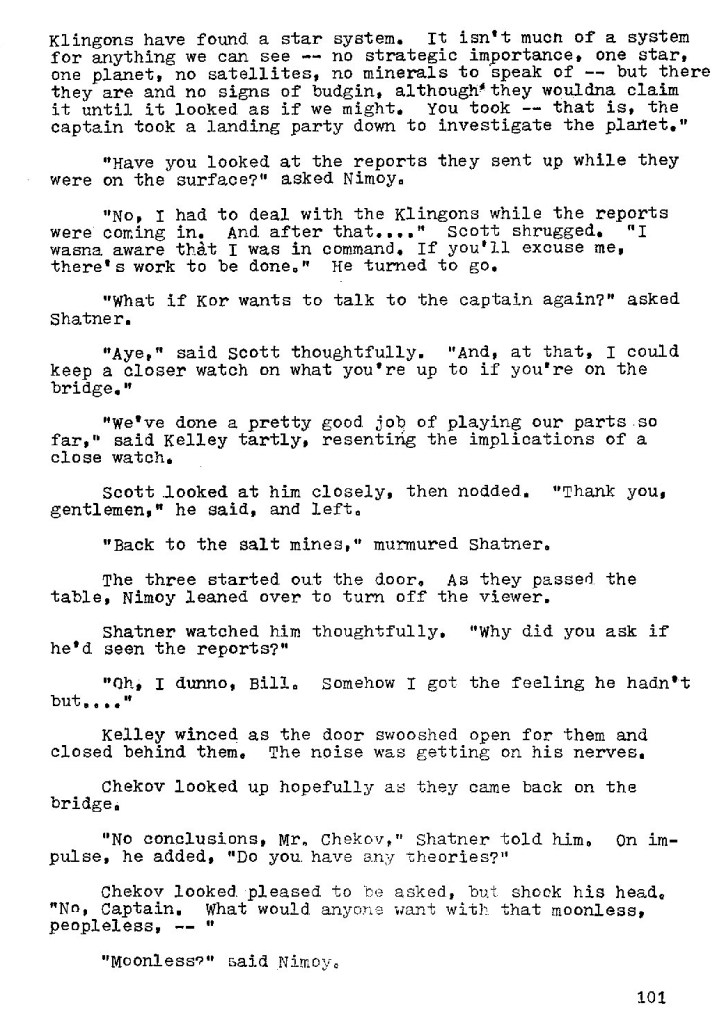
Visit to a Weird Planet
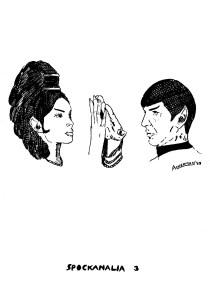
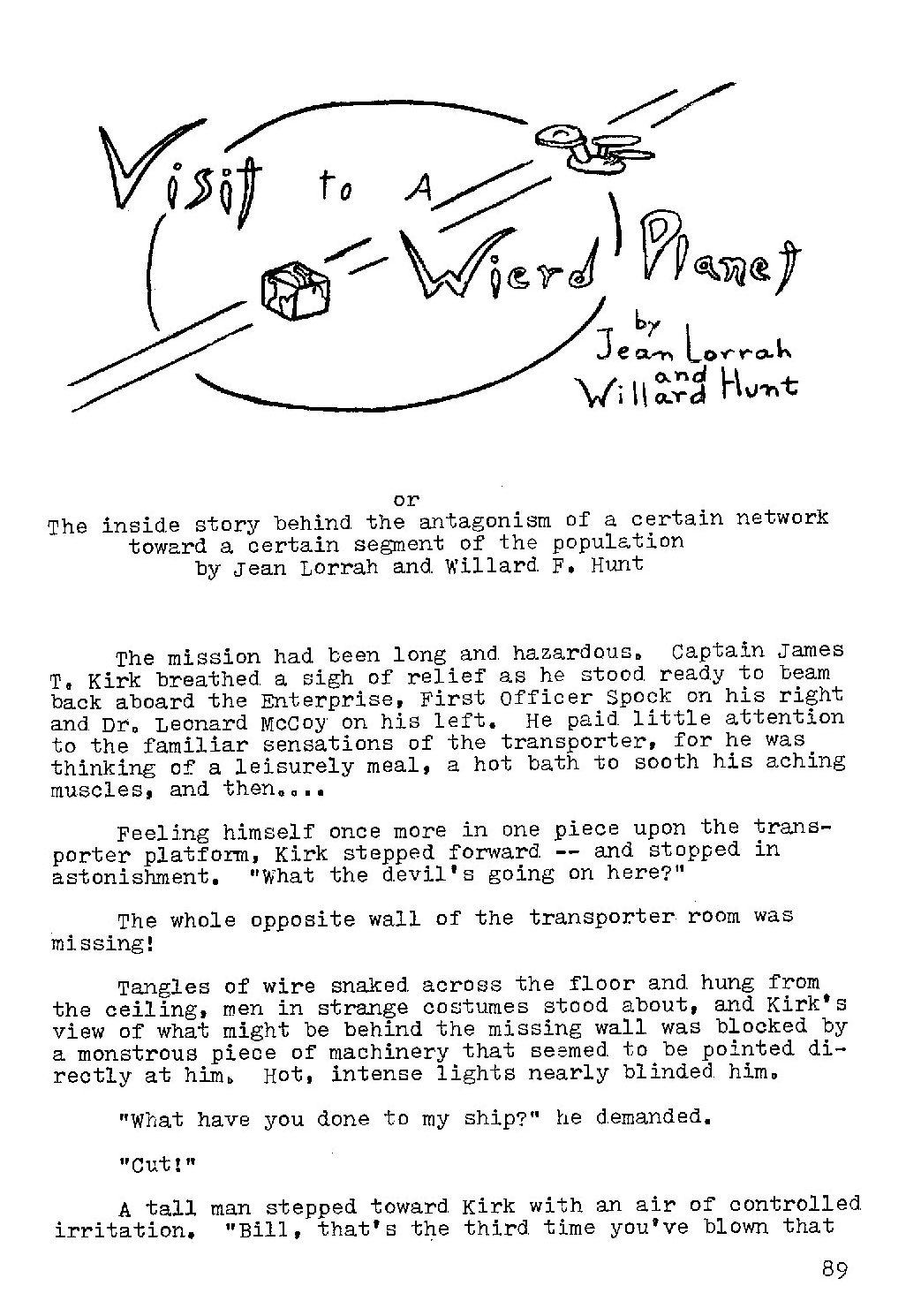
Spockanalia was one of the best of the early fanzines. (I own the complete run and I need to write about them one day.) Issue number three was dated September 1, 1968, and included Visit to a Weird Planet, penned by Jean Lorrah (who would go on to write the TOS novels The Vulcan Academy Murders and The IDIC Epidemic and TNG novels Survivors and Metamorphosis) and Willard F. Hunt (a fanfic writer).
The story is subtitled “the inside story behind the antagonism of a certain network toward a certain segment of the population” — so you immediately get an idea of where this is going.
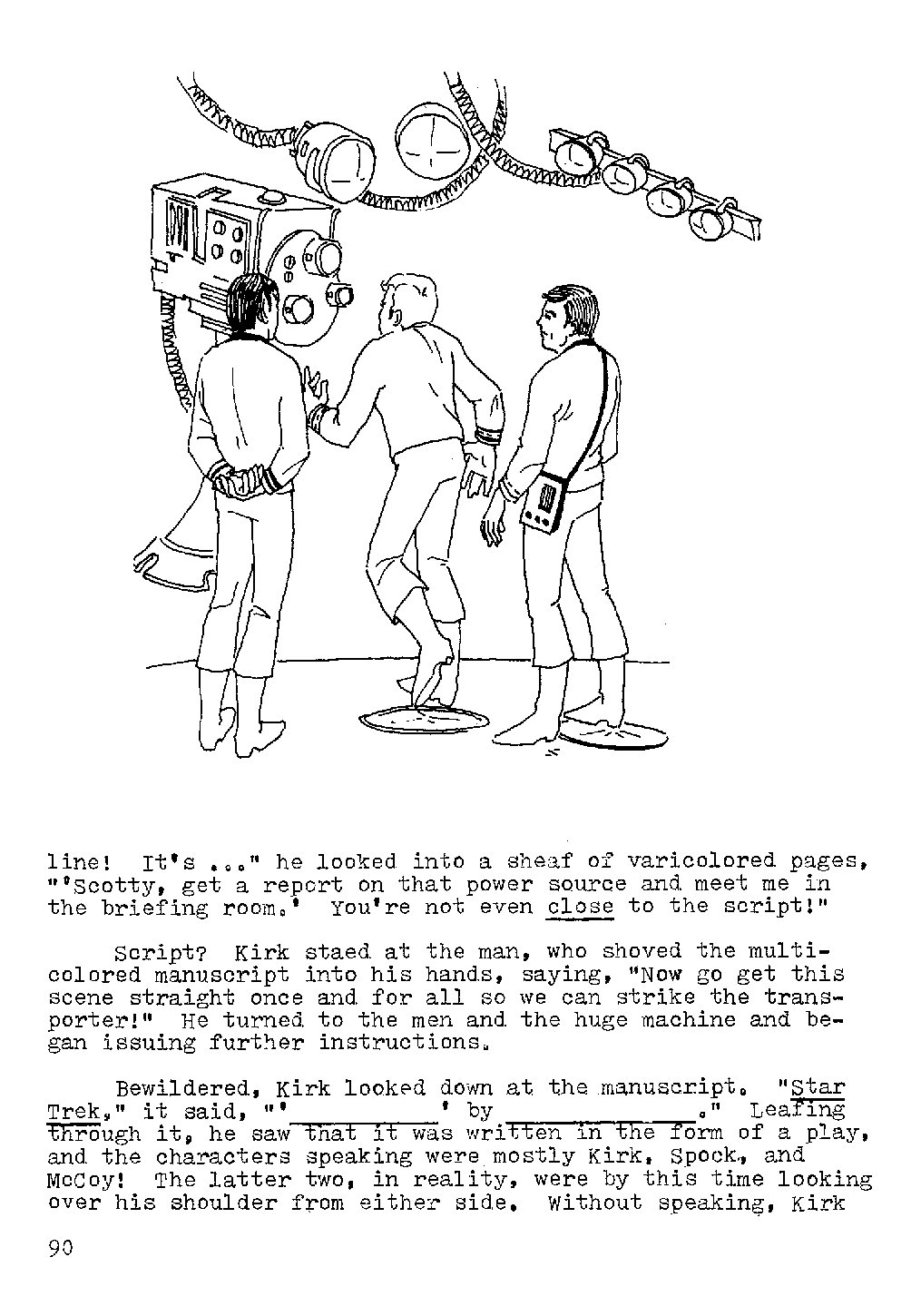
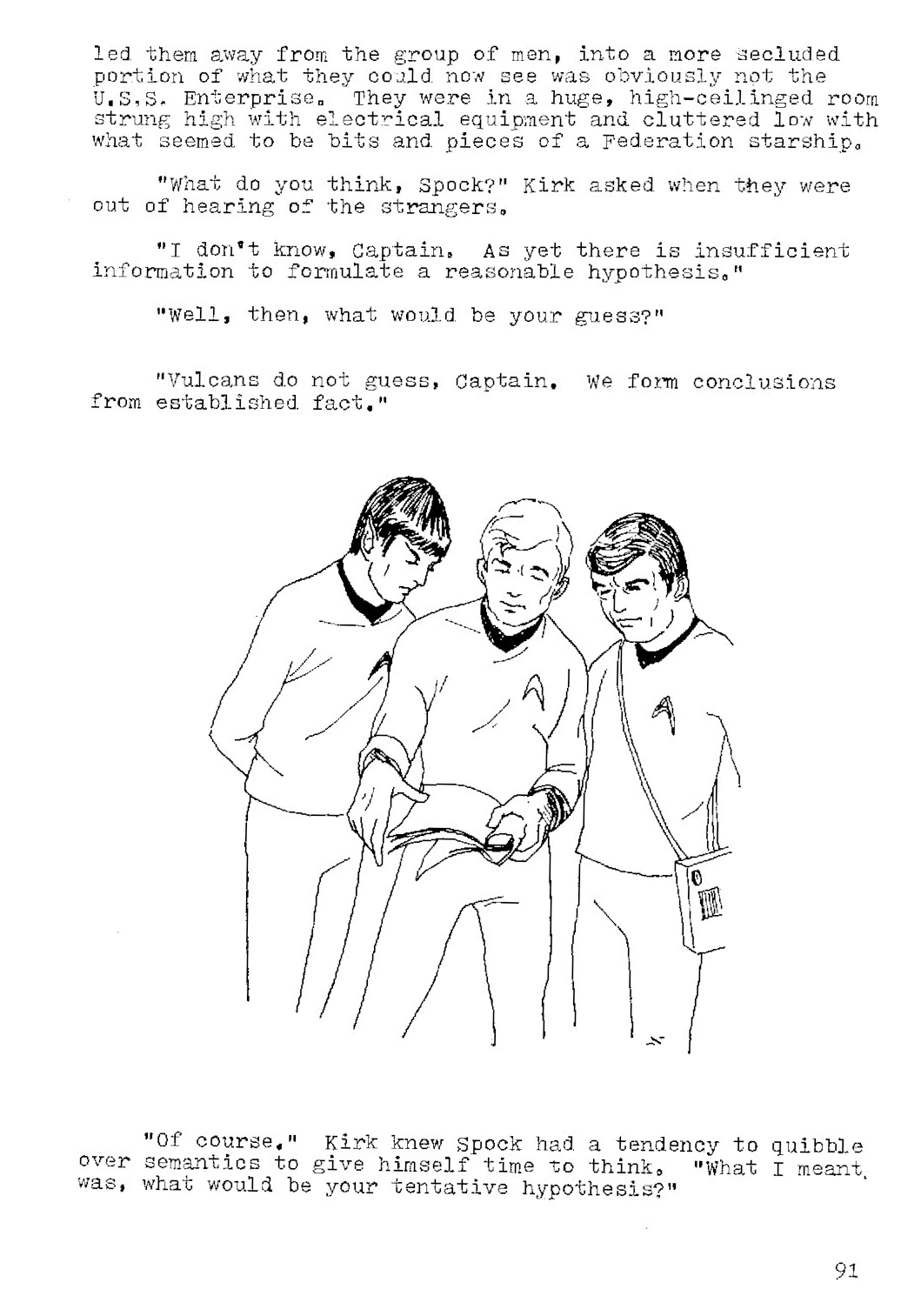
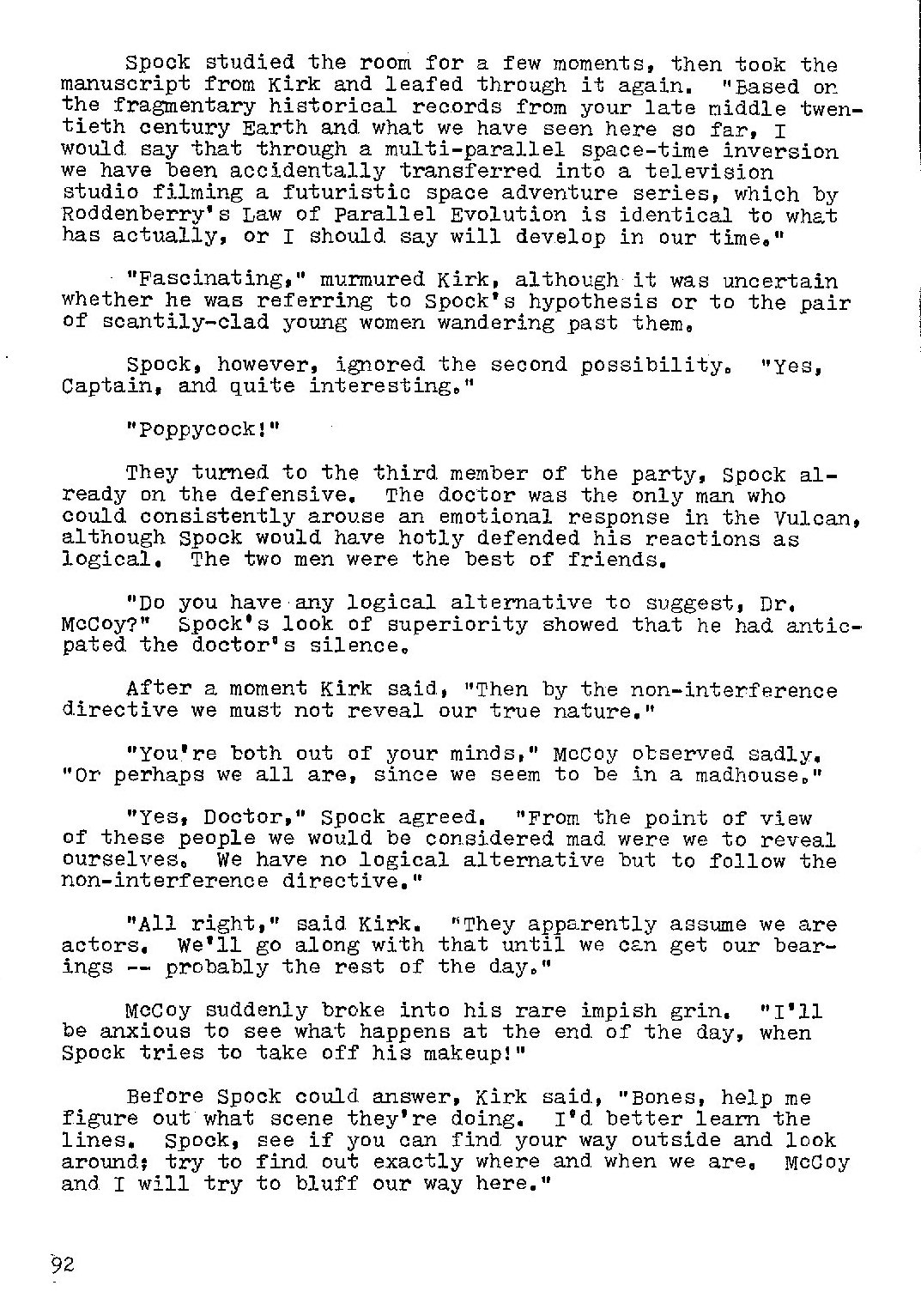
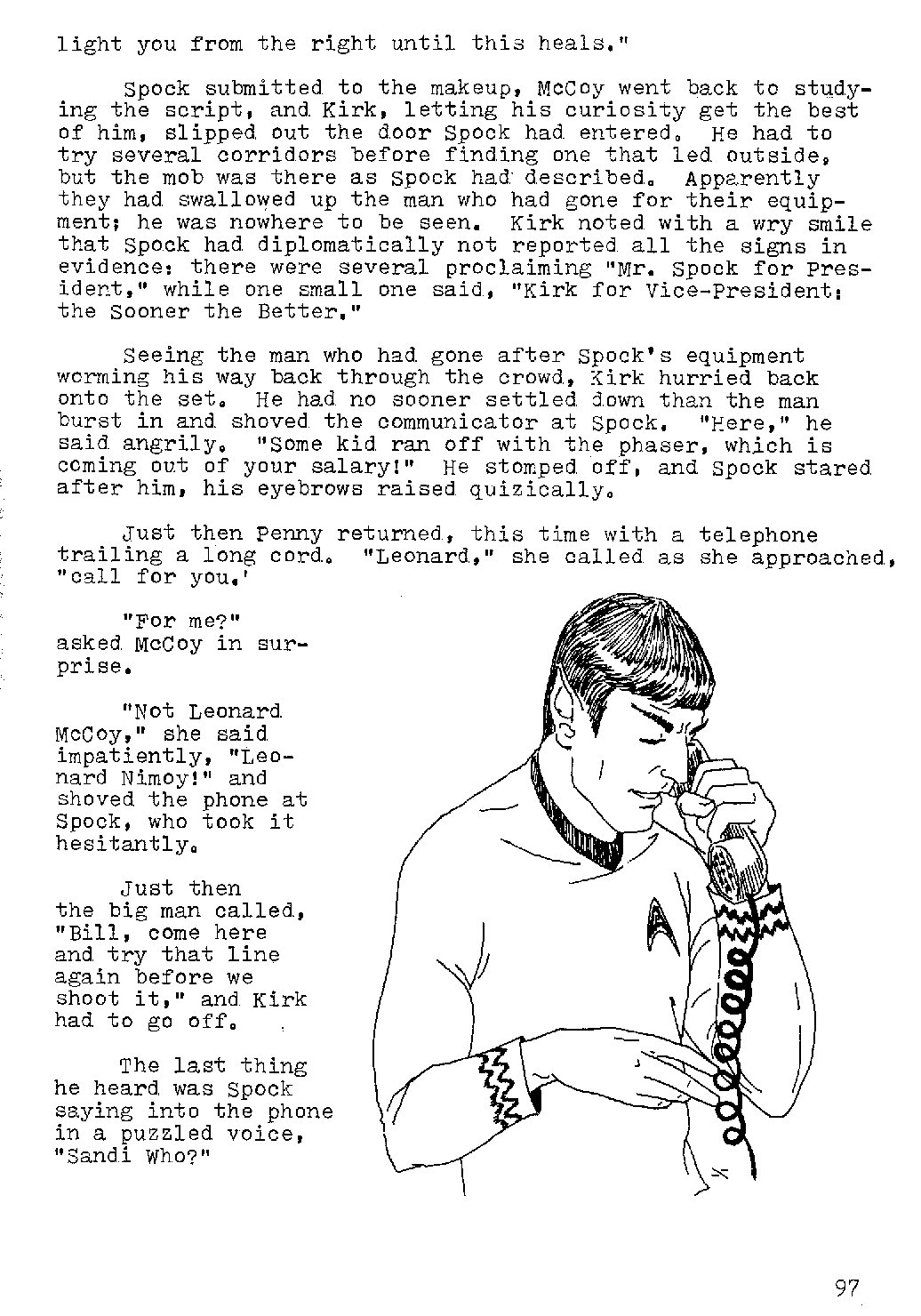
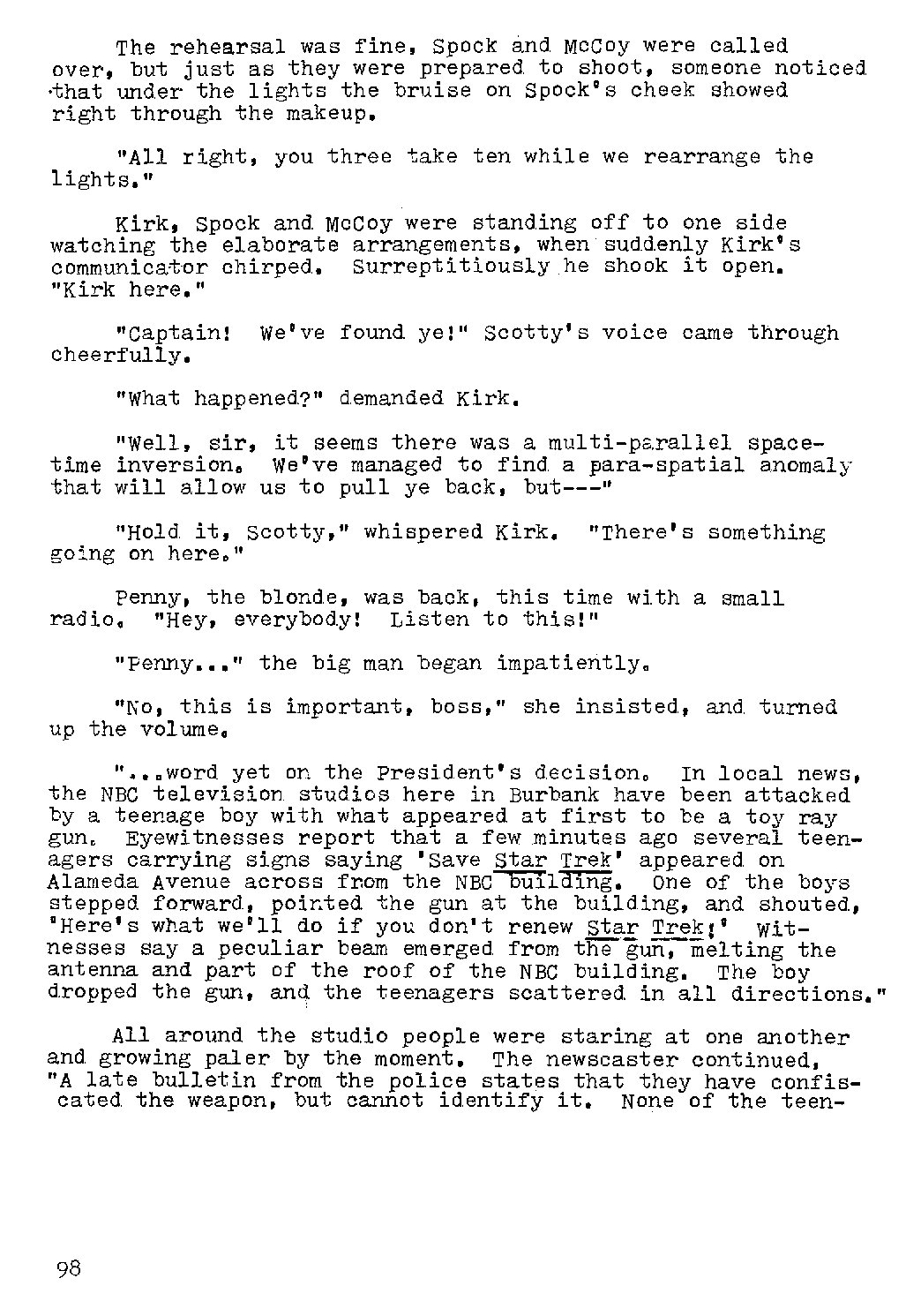
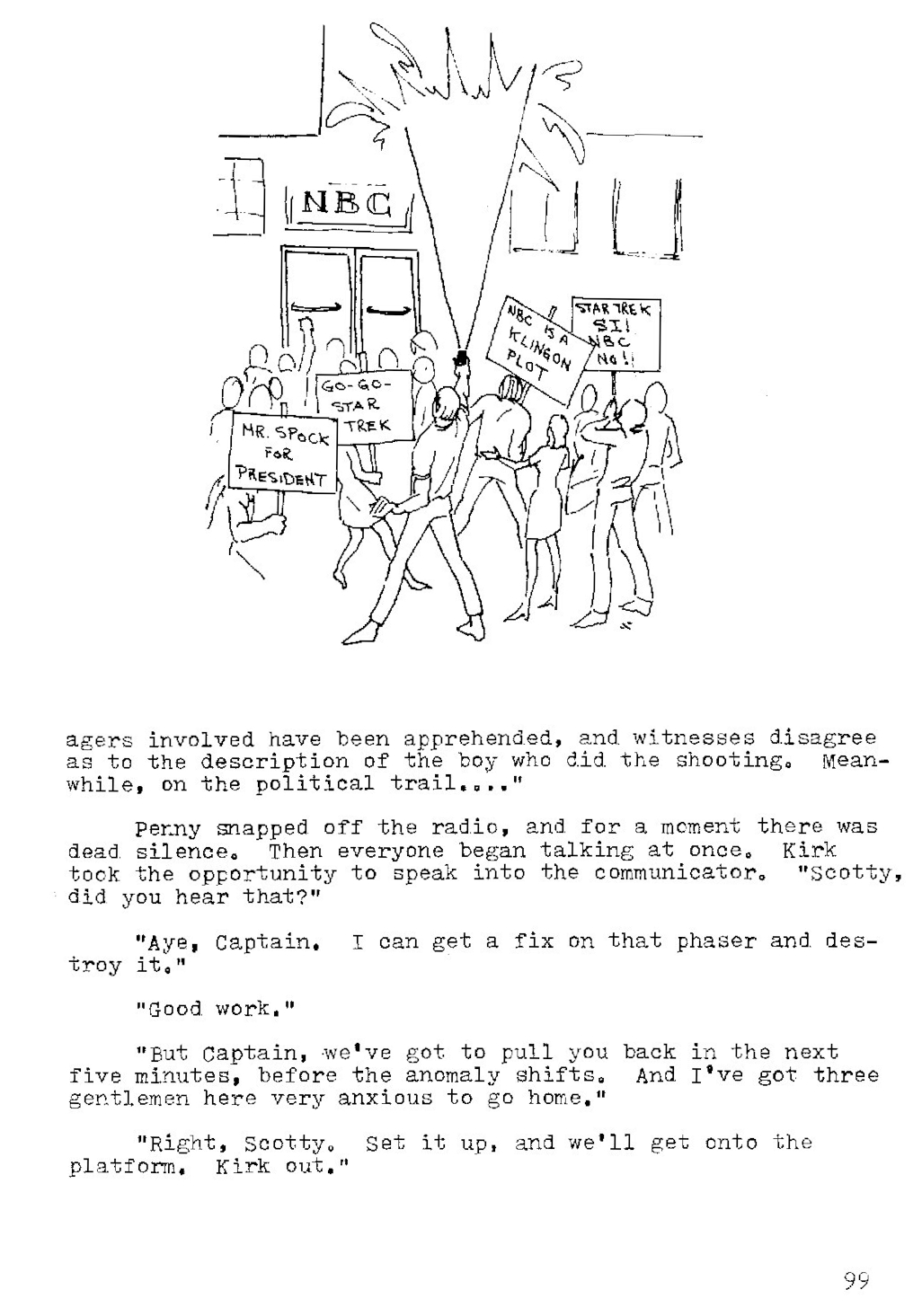
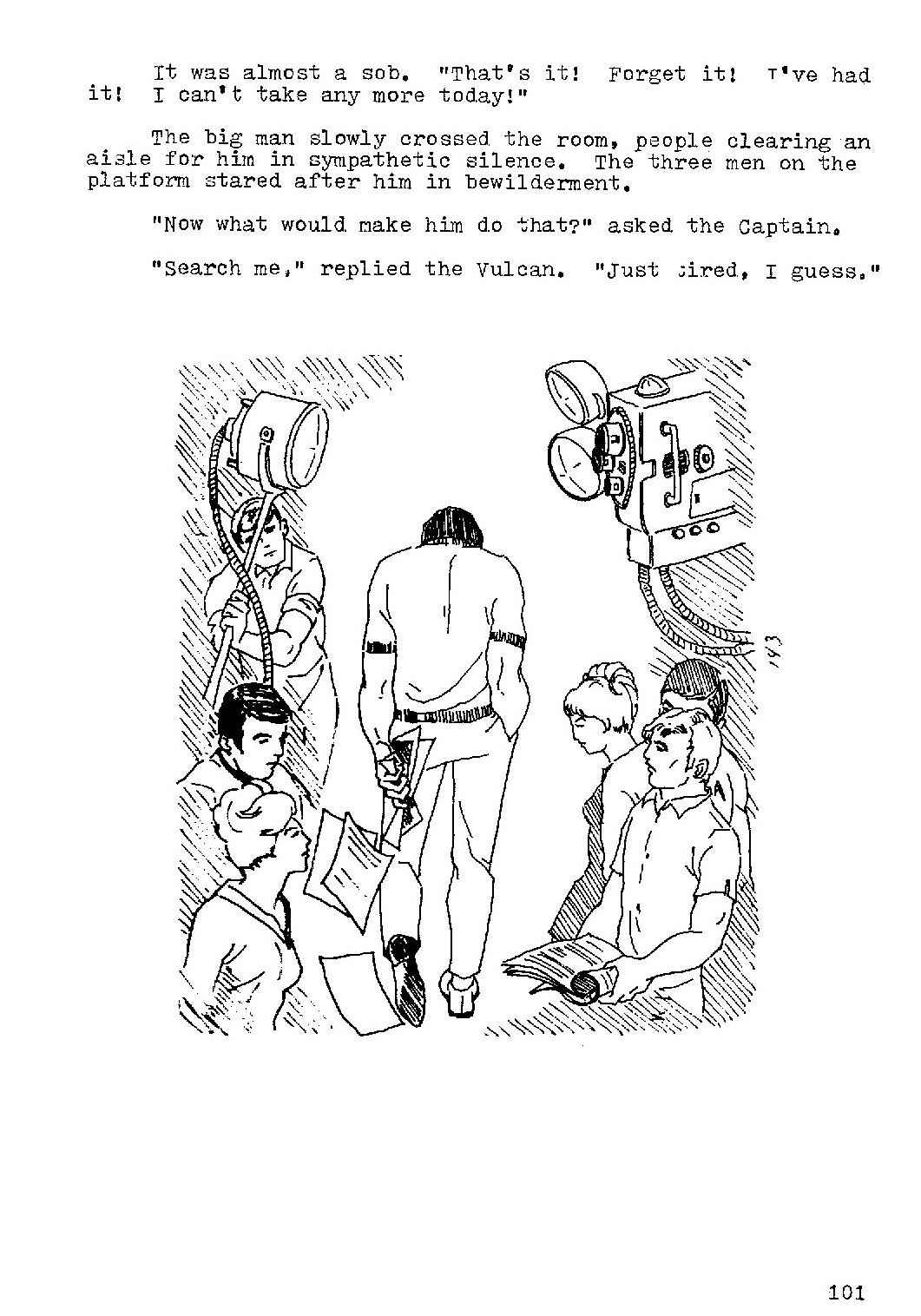
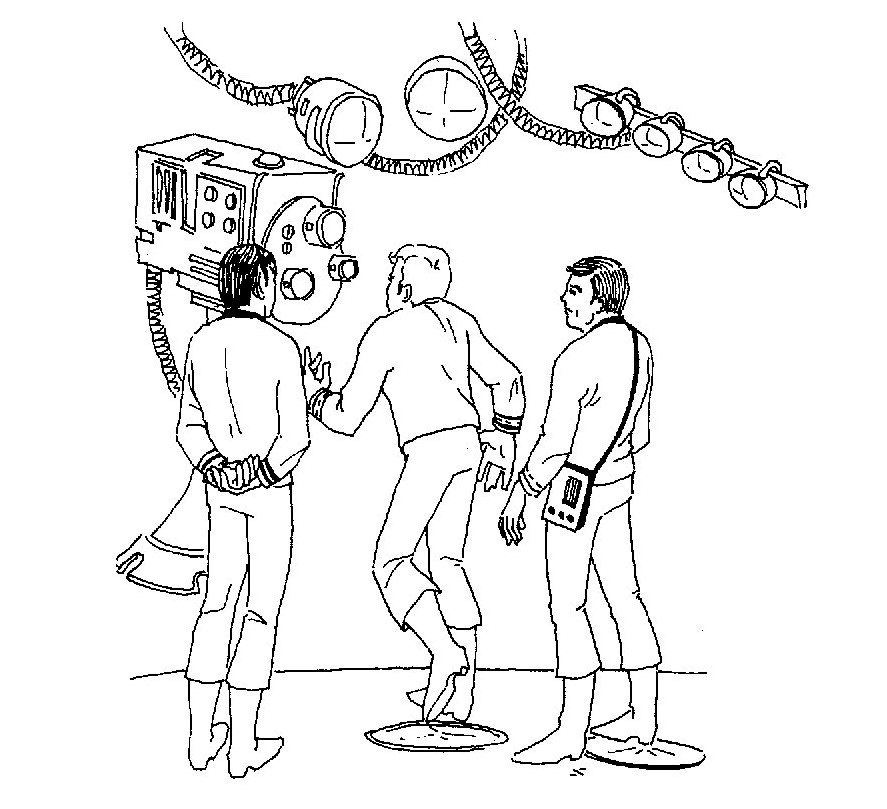
Kirk, Spock and McCoy are transporting up to the Enterprise but they materialize in the transporter set at Desilu, not their starship in space. The trio have a quick discussion and Spock suggests a “multi-parallel space-time inversion” has landed them in “a television studio filming a futuristic space adventure series.” The scene is reminiscent of the sickbay meeting early in Mirror, Mirror.
Kirk invokes the Prime Directive, he and McCoy proceed to learn their lines for the scene being filmed, and the three do their best to blend into the 1960s. I won’t give away more of the plot. You can read it yourself.
The story is very well written and does a good job of portraying a sound stage of the era. The script Kirk is handed is even described as a “sheaf of varicolored pages,” which is a deep-cut reference to the practice of printing revised pages on different coloured paper. The scripts the actors used were, indeed, “varicolored.”
Here is the story. Click through the page images or read or download a PDF of just the text.
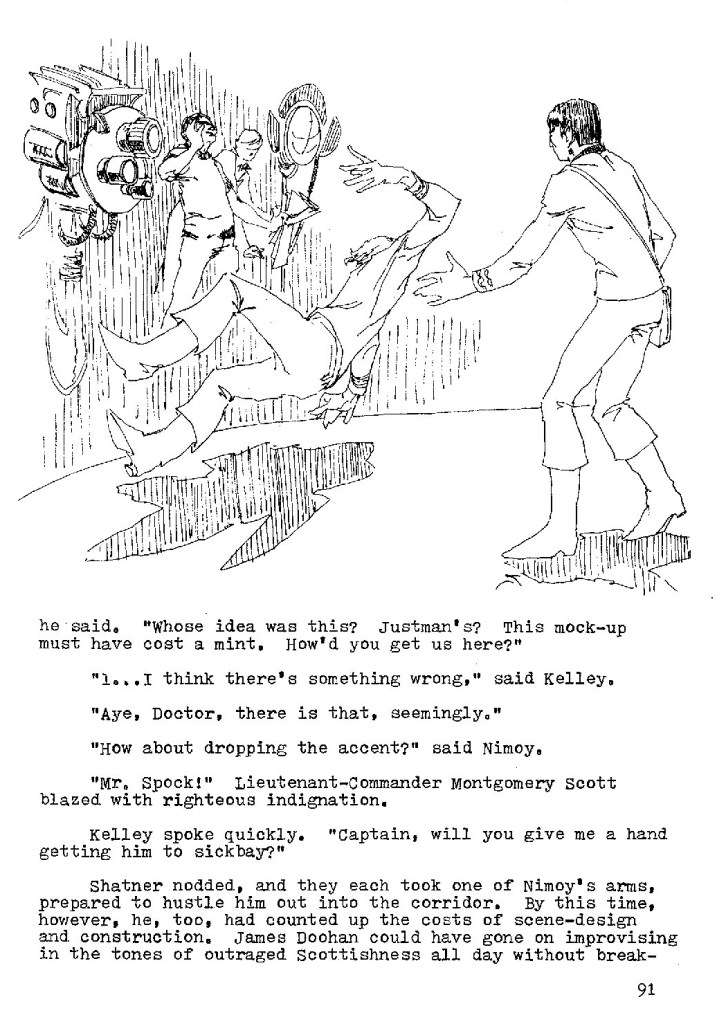
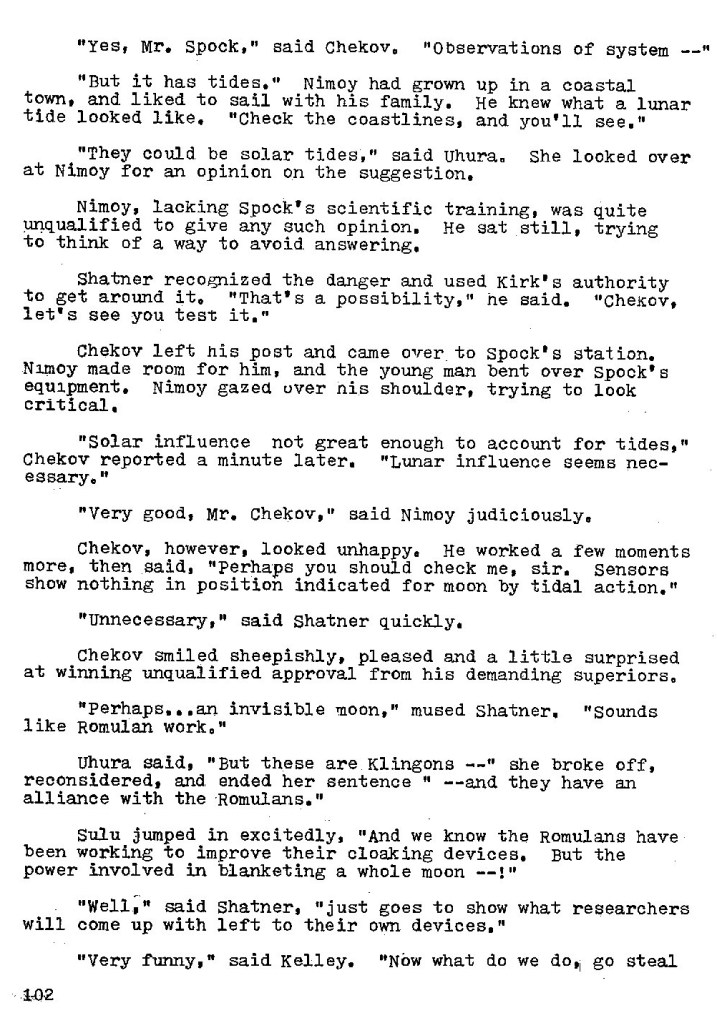
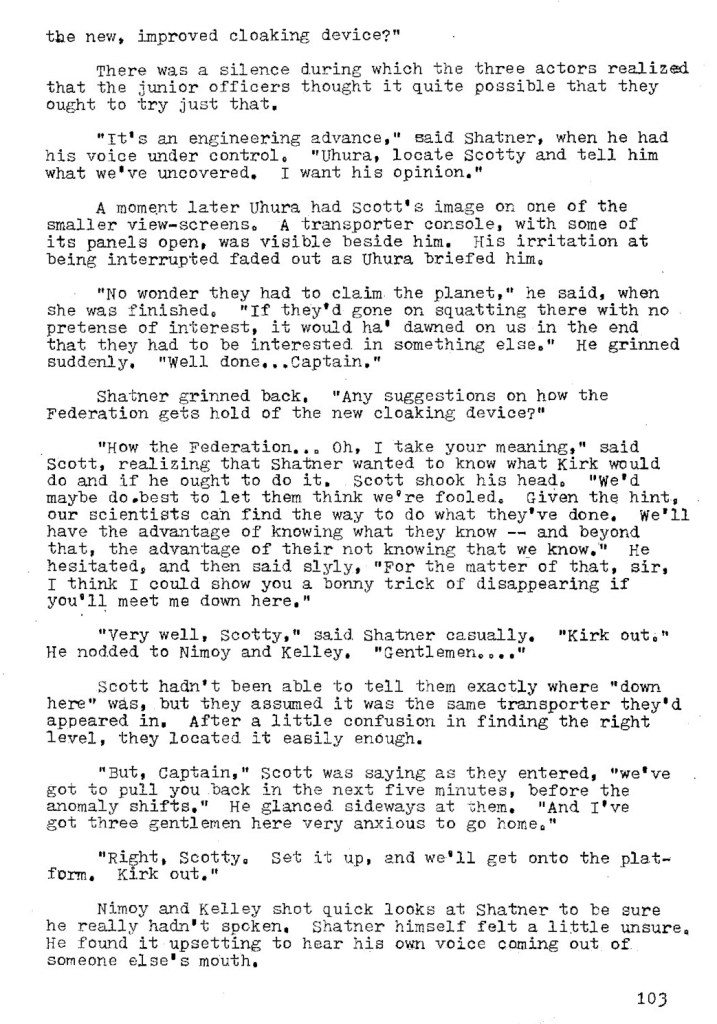
Visit to a Weird Planet Revisited
Fan writer and editor Ruth Berman was the editor for the first run of the Inside Star Trek newsletters and, after reading Visit in Spockanalia, she started to wonder about the other end of the premise: what the actors did on the Enterprise. So she wrote that story and it was published in Spockanalia issue 5. However, like the Inglorious Treksperts, I first read the piece in Star Trek: The New Voyages. It too is well written and entertaining.

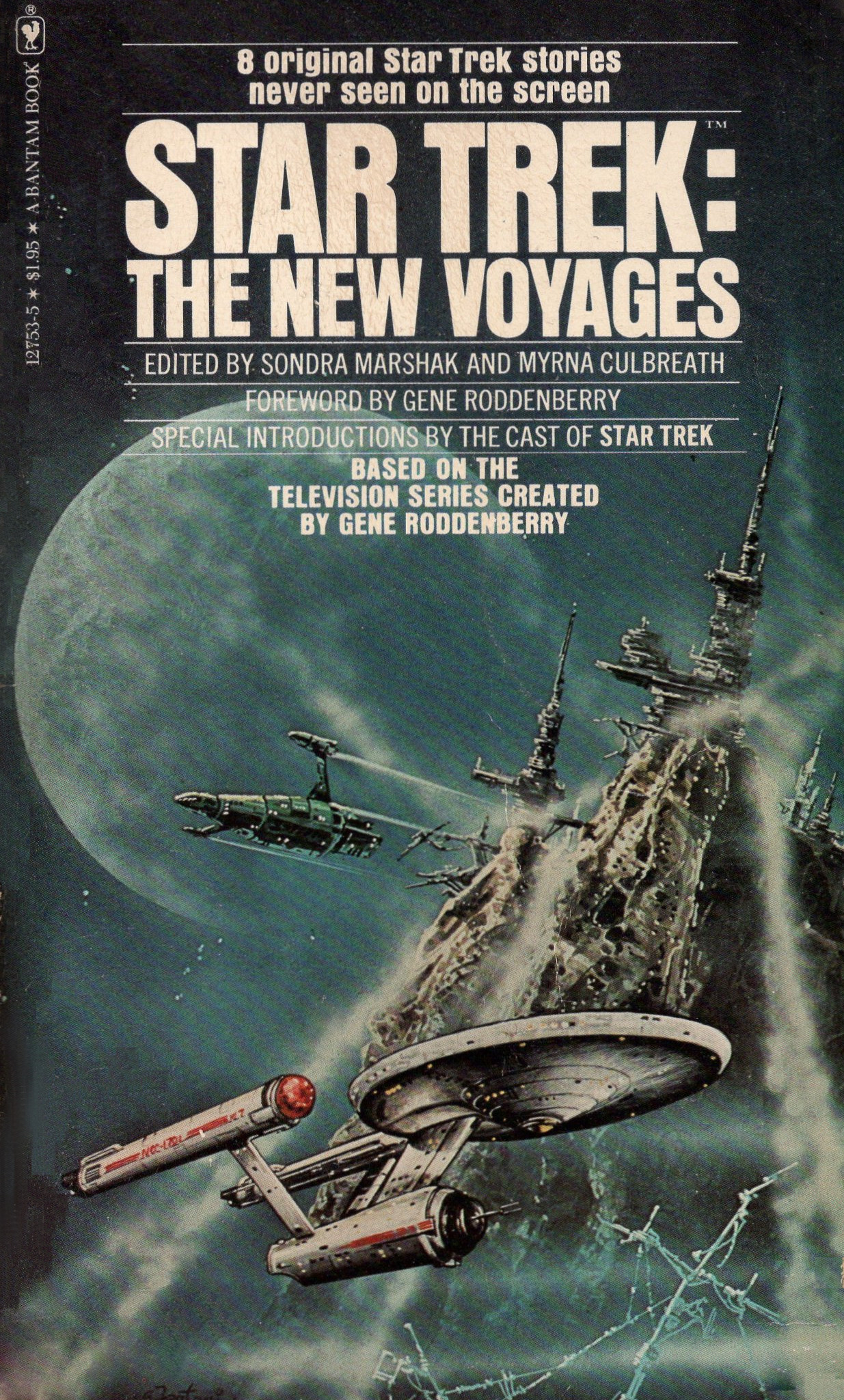
Click here to listen to the guys talk about it on the podcast, flip through the page images, or read the text or download the PDF.
Both these stories are, of course, Galaxy Quest before there was Galaxy Quest, and they kicked off a whole series of related tales. We also got Visiting a Visit to a Weird Planet Revisited (TNG), Visit to the Weirdest Planet—Earth (Voyager), Visit to a Weird Island (Gilligan’s Island), Visit to a Weird ‘Verse, Re-revisited (Firefly), and others. I’ve read most of those. The original two are the best, although the Gilligan one is also clever.
-
William Shatner Live! — with tripod
Writer Mike Poteet interviewed me recently for a profile of Collecting Trek on the site Redshirts Always Die and wrote a really good article. Give that piece a read.
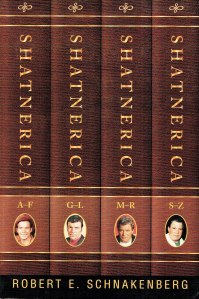
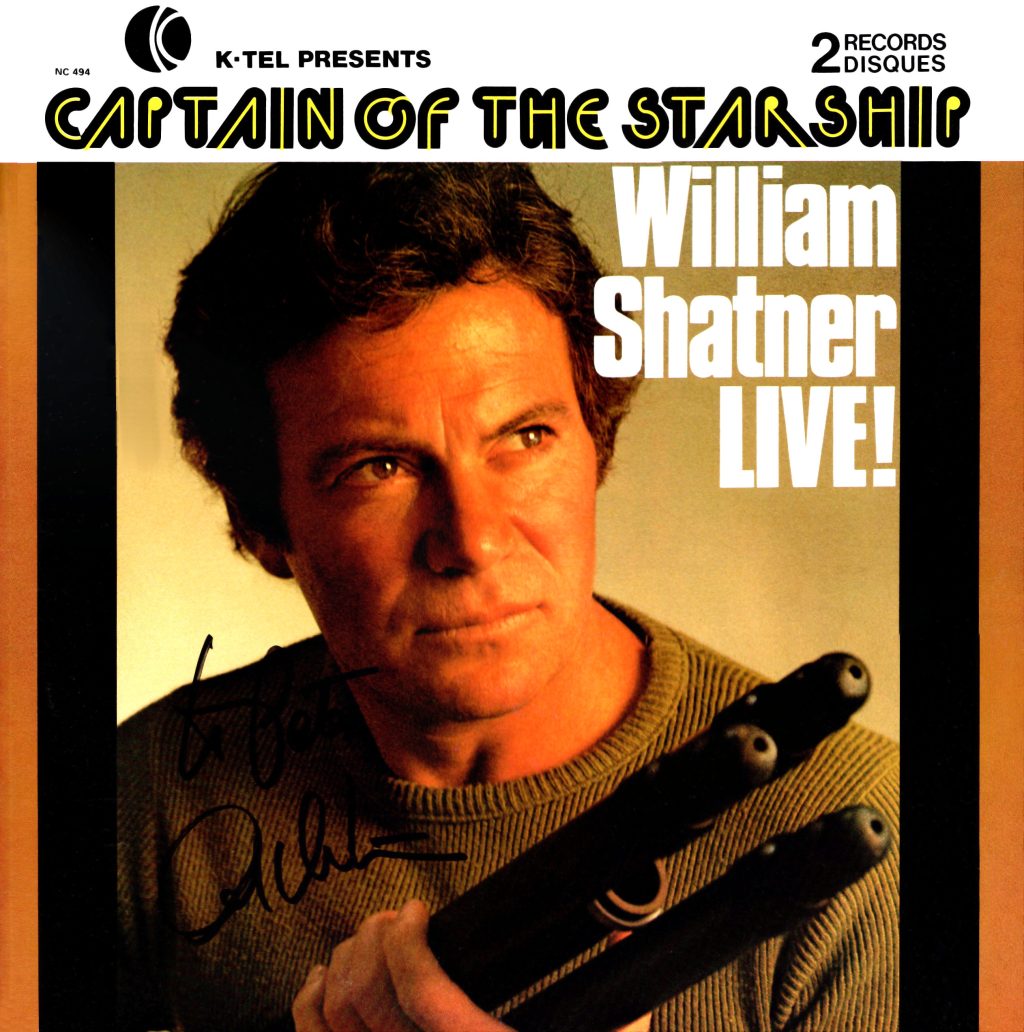
We did a quick video tour of my Star Trek room and I ended up relating the story of William Shatner’s photo shoot for the album Captain of the Starship. William Shatner Live! The autographed and framed album on my wall is the Canadian version of the US LP. The Encyclopedia Shatnerica has this to say about that album:
This 1977 live album captures Shatner’s performance of his one-man show in the mid-1970s. Recorded at Hofstra University (in Hempstead, New York), the two-disc set was produced by Shatner and released through his company, Lemli music (named after his daughters Leslie, Melanie and Lisabeth). A remarkable performance before a mostly stoned college audience.
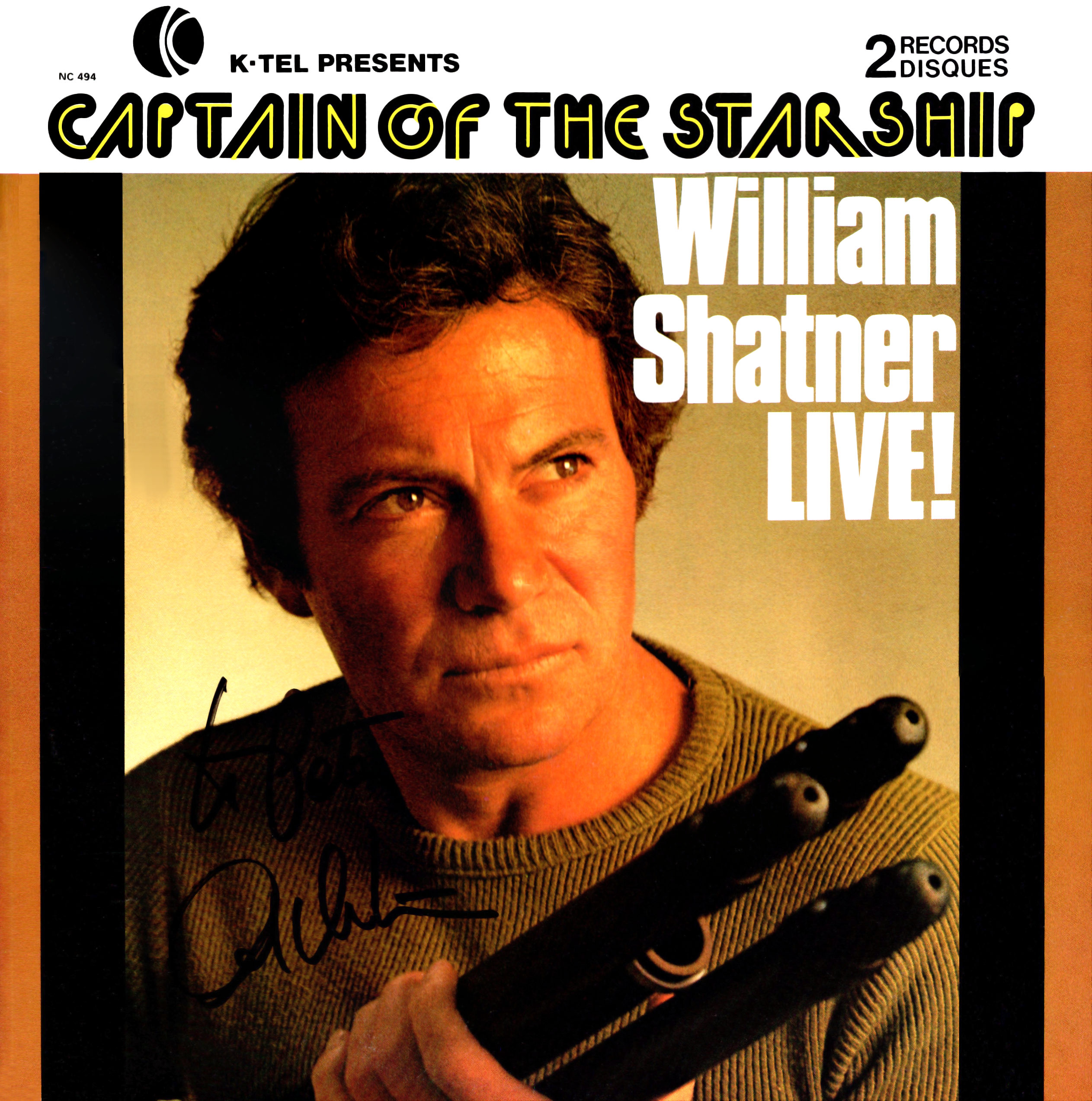

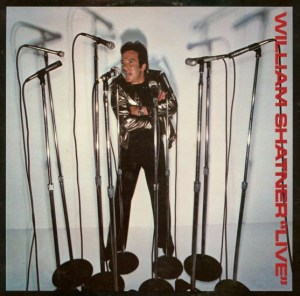
The US product has a fairly cool photo of Shatner on stage surrounded by 10 microphones, but Canadian compilation powerhouse K-Tel International could not use that image for some reason, so it needed a new cover photo. Therein lies a tale I have heard Shatner tell on at least one occasion.
Shatner arrived for the photo shoot and glanced around the fairly empty room. He asked what the plan was and received only blank looks from the photo crew. They had the same question.
An action pose was needed for the picture, so Shatner grabbed a tripod, flipped it around, and held it like a ray gun. Luckily he had chosen a sort-of yellow sweater when he headed out that morning. The photo works well enough on the album cover but it’s even better if you know that back story.
Shatner signed the LP for me in 2014 at Fan Expo in Toronto but, sadly, he used a black marker, so the autograph does not stand out well against the dark photo.
I cannot play these two discs, as I do not own a record player. Until recently, all four sides of the recording were on YouTube but the uploader has removed those videos.
The first disc is Shatner doing a number of readings from classic plays and novels. The best of those is “Ways to the Moon” from the Edmond Rostand play Cyrano de Bergerac. I say that because the performance is quite good and because Cyrano is my favourite play.
The second disc is mostly our captain answering questions from the audience. Notably, he relates the story of why Leonard Nimoy was reluctant to sign on for the first Star Trek movie. I tell the story of the Heineken poster incident here.
Speaking of Leonard Nimoy
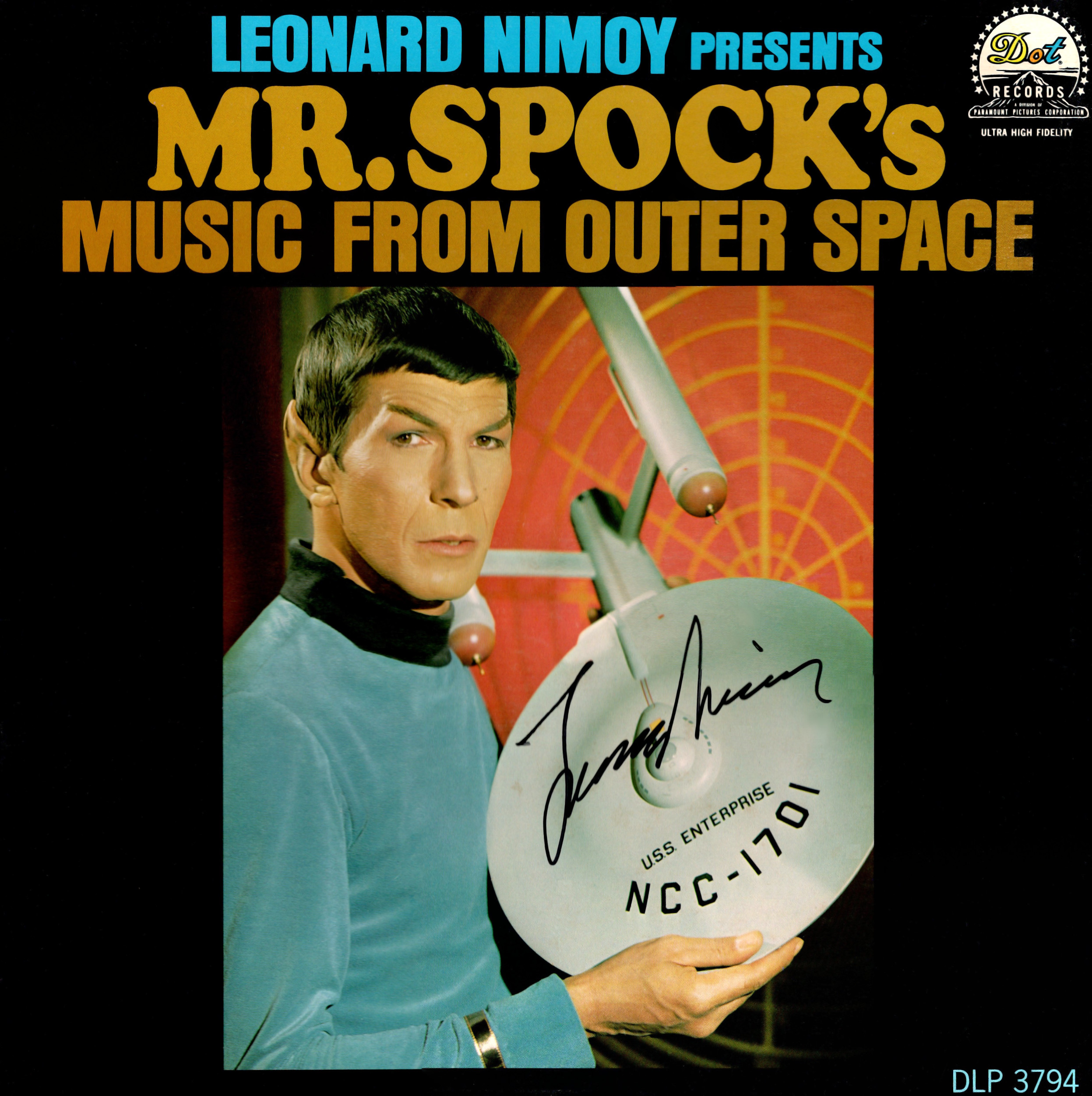
Joining the Shatner album on my wall is Mr. Spock’s Music From Outer Space, signed for me at Fan Expo in 2009. I don’t have an interesting story about that one, but at least its tracks are on YouTube.

Postscript
The text on the back of Shatner’s album was written by Sondra Marshak and Myrna Culbreath. They were fans and semi-professional writers and I was often baffled by their Star Trek novels as a kid. I have not read those books in years but the prose they penned for the album reminds me why their writing style bothered me.
“What is becoming increasingly clear is that the legendary Kirk is finding a place in the history of heroes which is unique, one-of-a-kind, unprecedented.” Those three terms are synonyms. Someone apparently paid good money for a thesaurus and wasn’t about to not use it.
Here is another bit: “The dramatic performance speaks of the flying, and is the flying.” What? -
Avoid the Blurg: playing 1975’s Star Trek Game from Palitoy
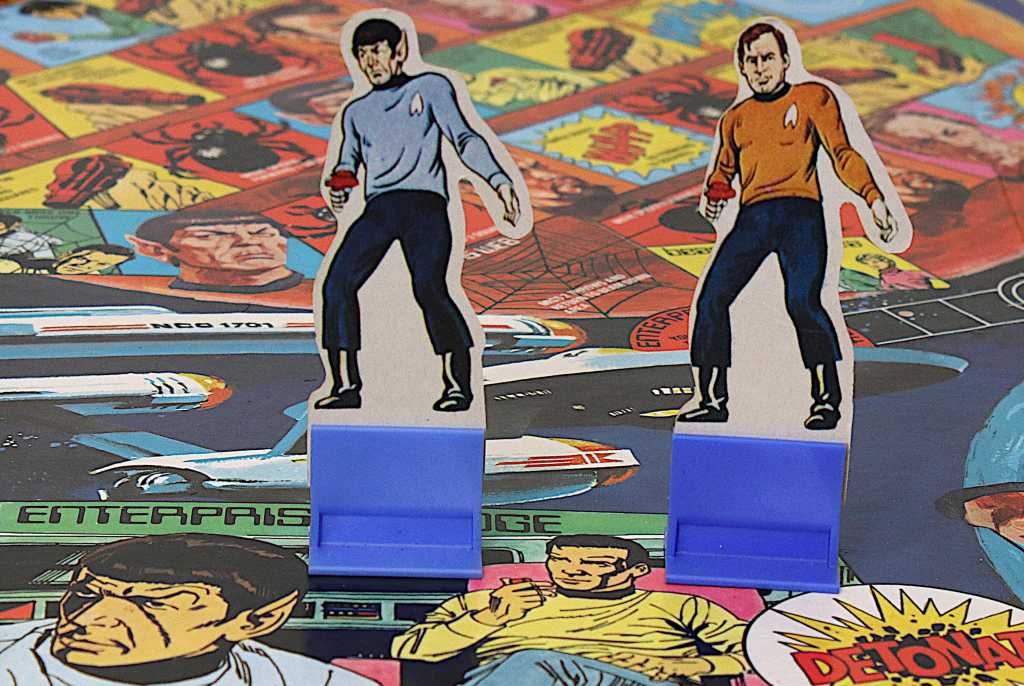
Star Trek premiered on the BBC in 1969 and was quite popular but there was scant homegrown merchandise and most of the Trek products on British shelves were US imports.
That changed a little when Palitoy landed a Star Trek licence in 1975. The company, originally called Cascelloid, produced its first toy in 1920. It was renamed Palitoy in 1935 and its business was mostly built on UK versions of American toys. Its popular Action Man figures, for example, were copies of Hasbro’s GI Joe line.
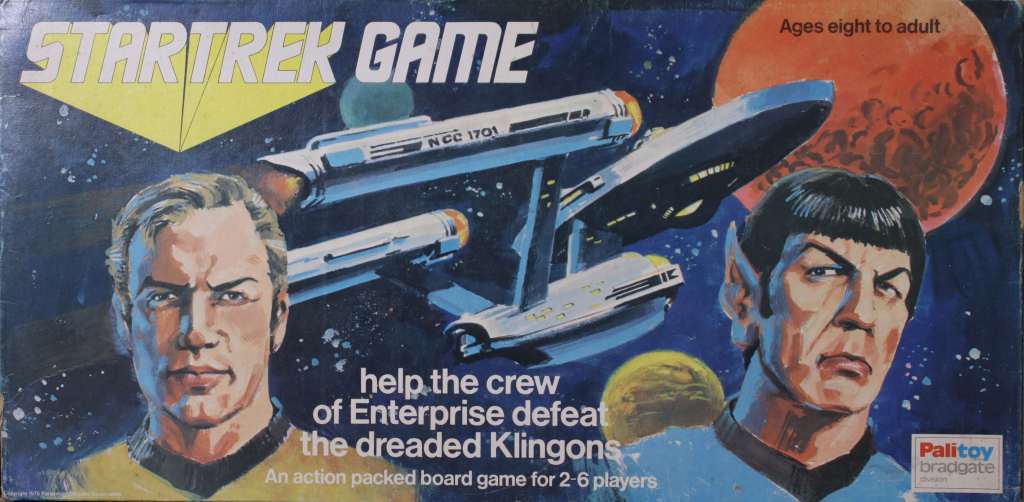
One of the company’s few original products was its Star Trek Game. (Quick aside: coming up with game names was not anyone’s strong suit, as four different companies each produced a board game between 1967 and 1979 and all were called Star Trek Game.)
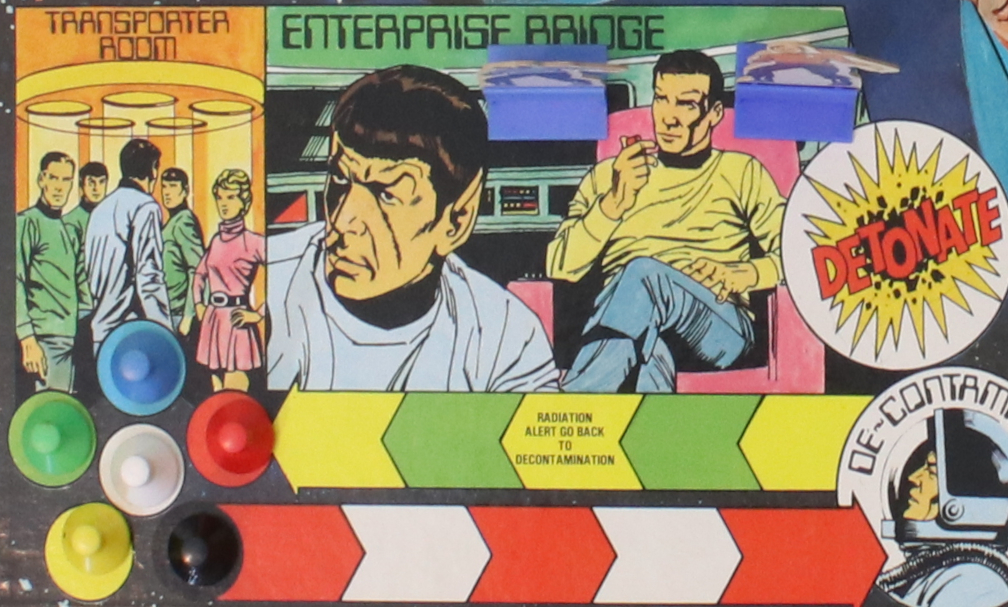
The instructions for Palitoy’s game tell players that “the Enterprise is menaced by a deadly Klingon War Ship. Only Zithium and Beton crystals from the Planet of Fire and the Ice Planet can destroy it.”
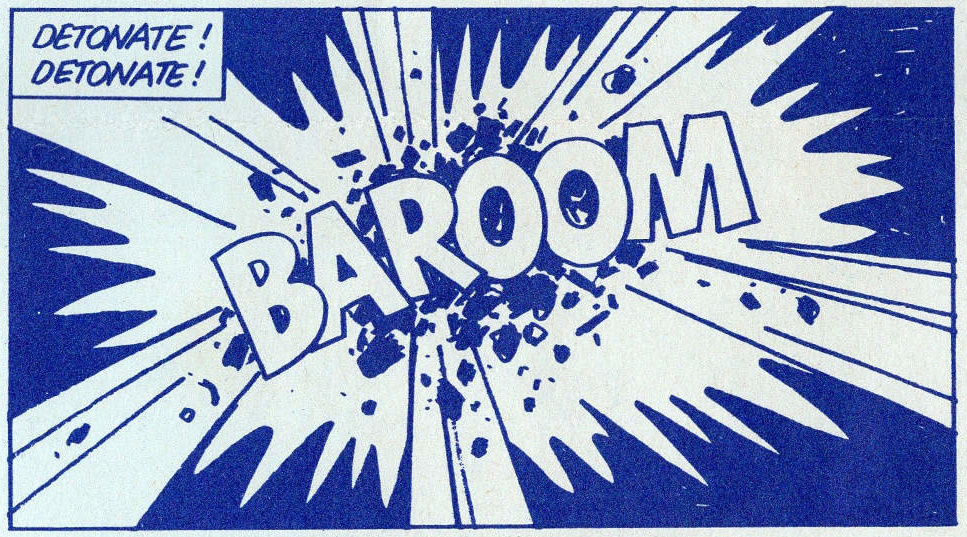
The mission is to “Bring back both crystals and plant them in the War Ship.” The player then uses the Baroom card, which blows up the Klingon ship.
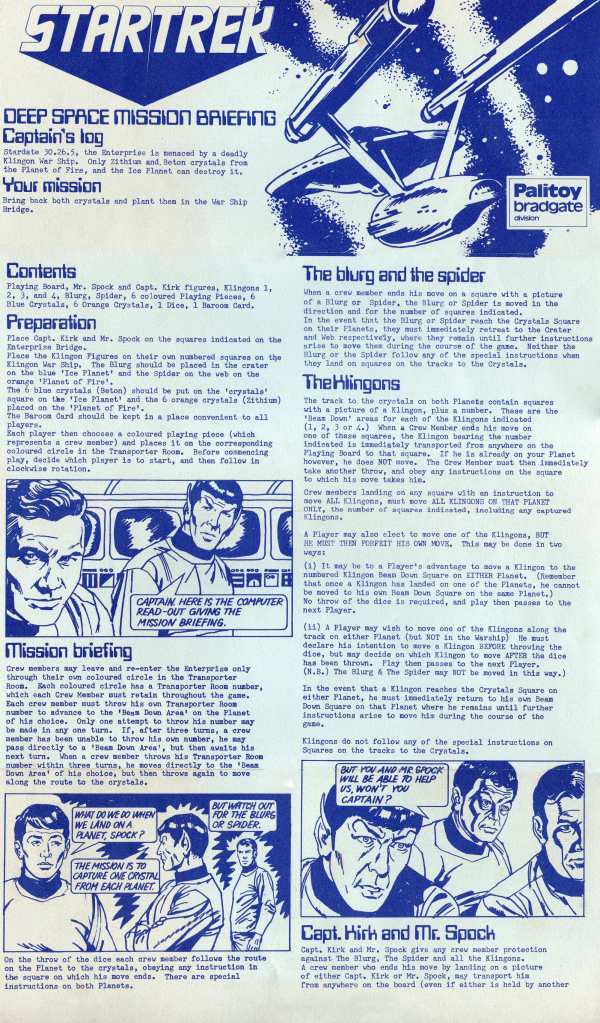
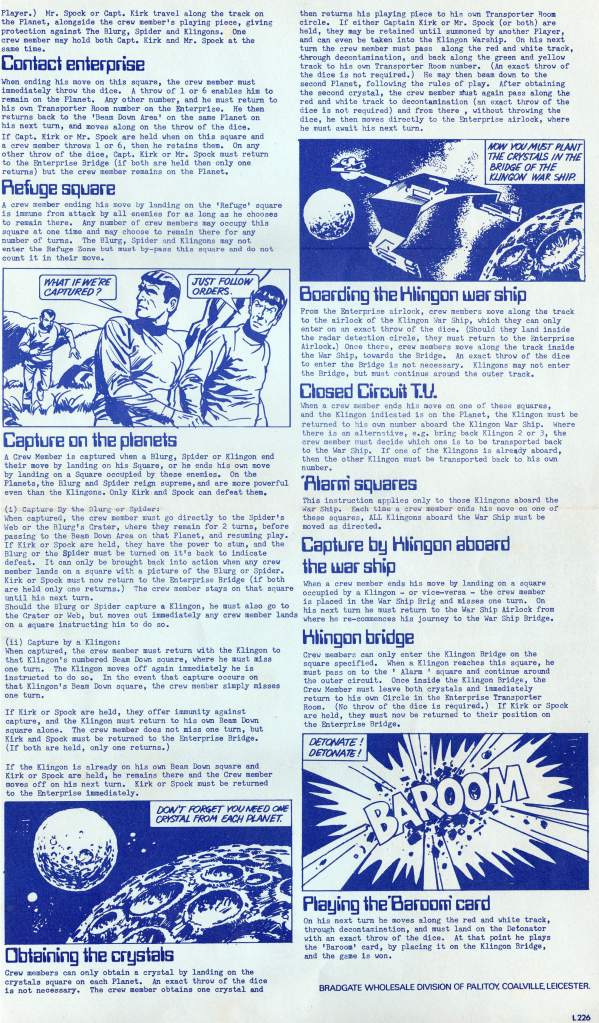
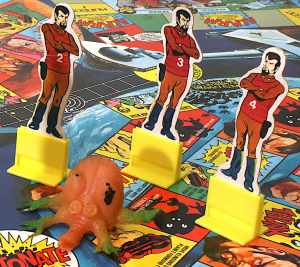
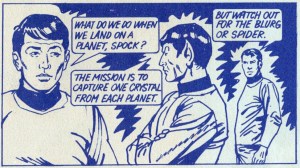
The Blurg and some Klingons But getting those crystals is not easy, because four Klingons chase you around the board, and each planet has its own protector: the Spider on the Planet of Fire and the Blurg on the Ice Planet. An encounter with these adversaries delays, but does not kill, players. Luckily, Kirk and Spock are hanging around and are available to stun opponents.

And that’s a strange element of the game design: you can’t play as Kirk, Spock, or any crewmember. Instead, you get to be one of six generic game pieces. This seems like a big miss. Kids (and adults) would rather play as a character.
Big collectible value
I am not a gamer so, although I have owned this for years, I only played it recently to write this article. But if I don’t love it as a game, I do love it as a collectible. The artwork – which was based on both the Mego and Gold Key takes on Star Trek – is fantastic. It’s colourful and silly and fun. And it is from the 1970s, a decade of fandom that continues to fascinate me.
My game includes all the original pieces, except for a few of the small plastic tubes that represent the crystals. I have five of the orange and three of the blue pieces, instead of six of each. And some of them are fused to the plastic tray in the carton. This is apparently common with this game, as the chemicals in the pieces can react with the plastic carton, making it appear partially melted. This can also happen with the Blurg and Spider figures, although my bad guys are in good shape. The box on my game is also in good condition, considering it’s almost five decades old.
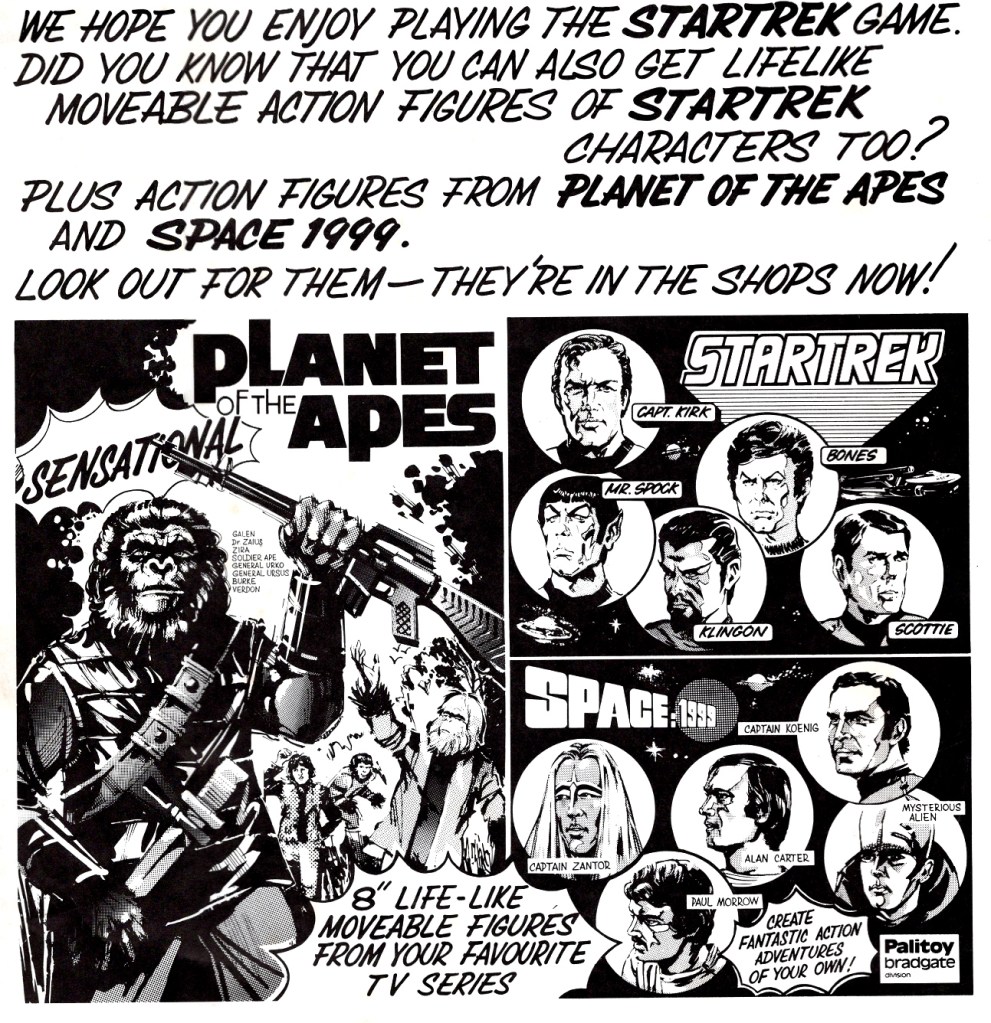
Palitoy also included an ad for its Star Trek, Planet of the Apes, and Space: 1999 figures, all UK versions of the Mego products. The company also manufactured a stand-alone Transporter Room toy but did not sell versions of the full Enterprise Action Playset.
I also own the 1976 Hasbro Star Trek Game, which I will cover.
-
Listen to Leonard Nimoy defend I Am Not Spock in this long-lost radio interview from 1976
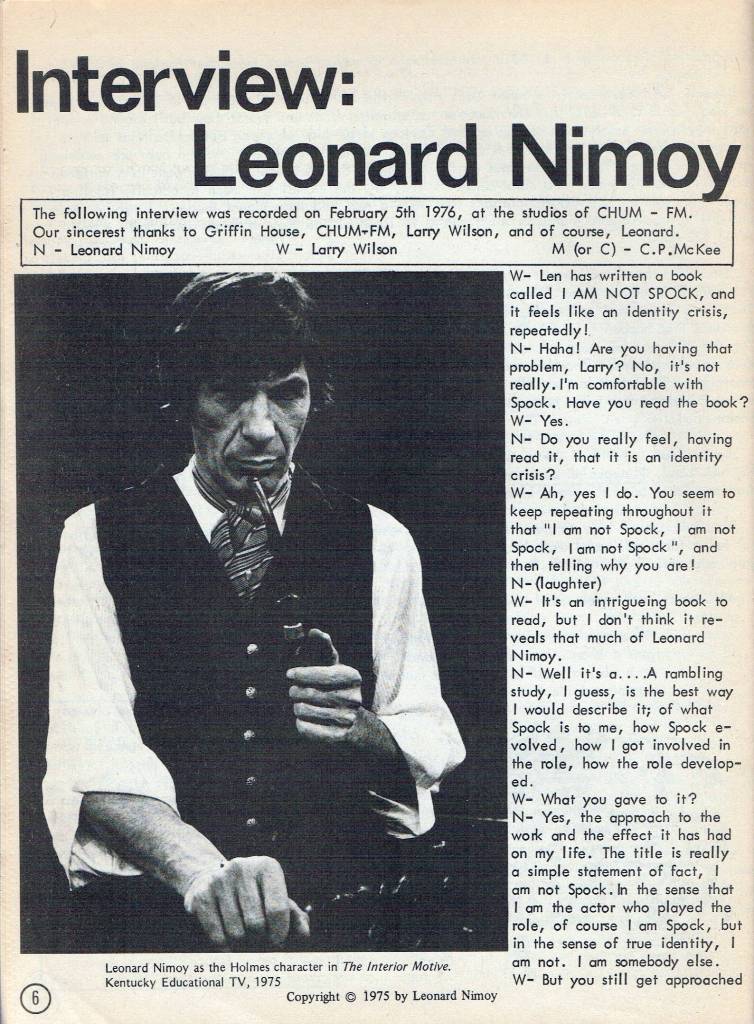
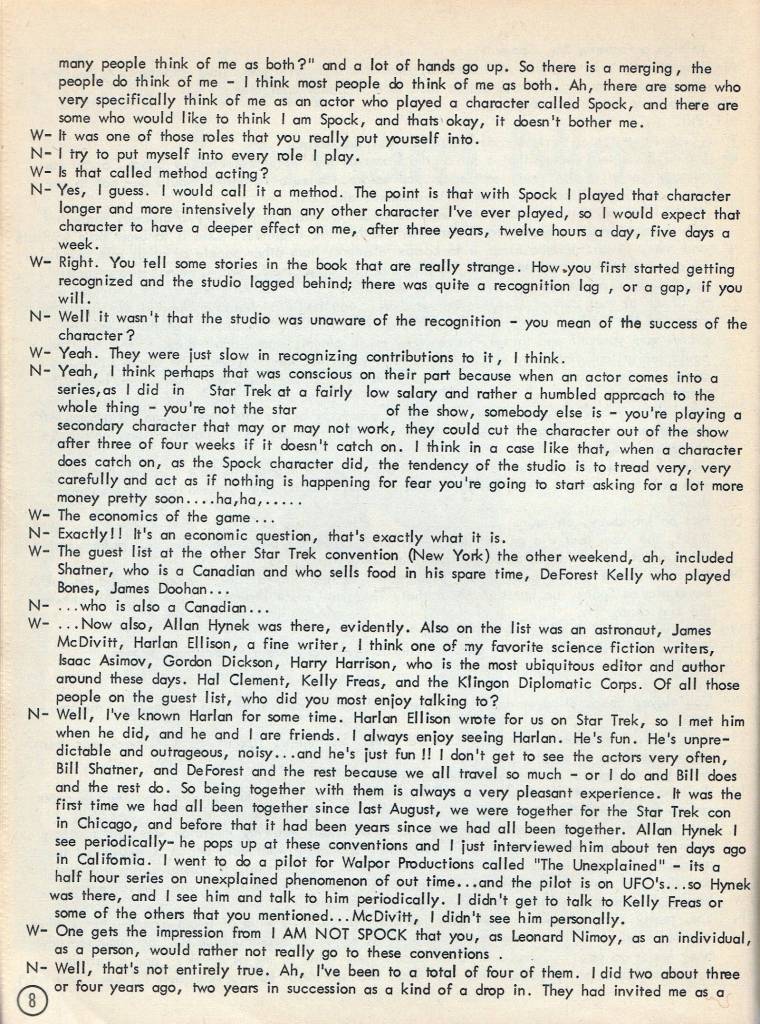
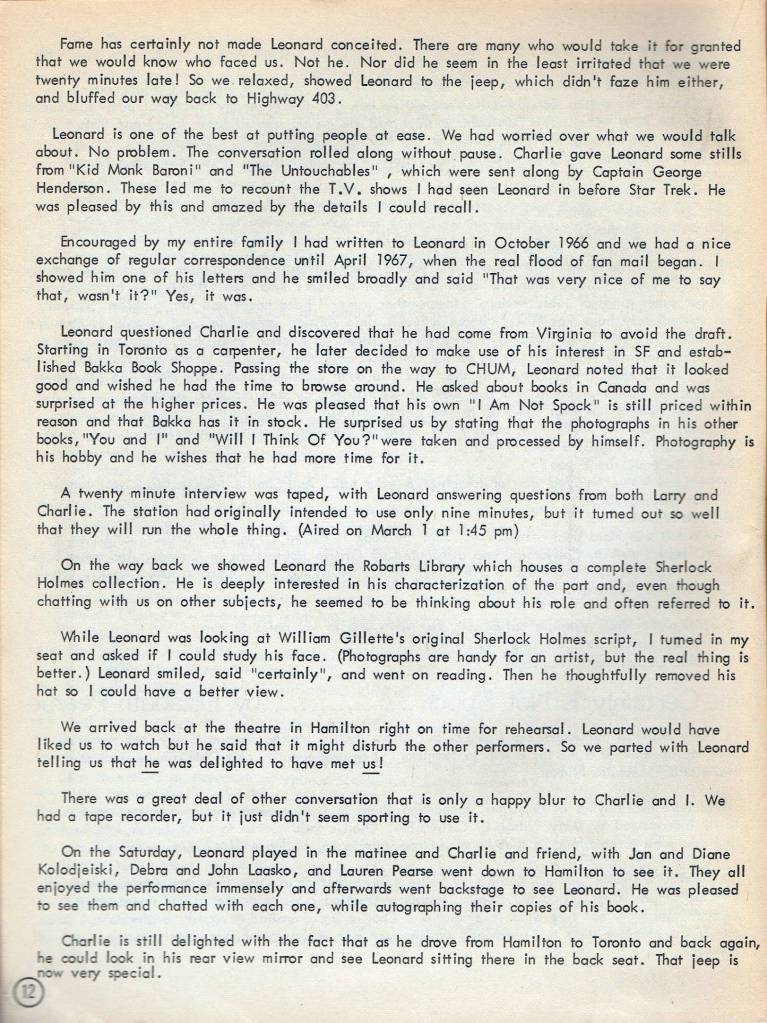
Neither Charlie McKee nor Elizabeth Pearse were early risers. But on the frigid morning of February 5, 1976, the two friends climbed into McKee’s Jeep Commando for the 30-minute drive west from Toronto to Hamilton, Ontario. They were heading out to pick up Pearse’s friend Leonard Nimoy.
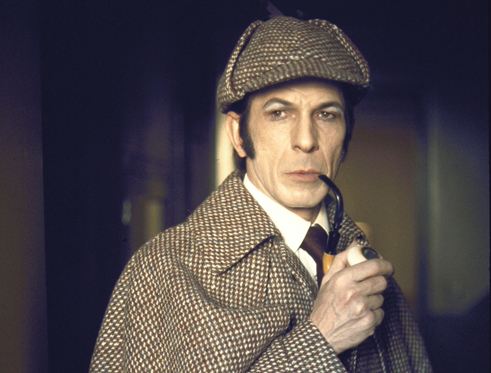
Nimoy was starring in the touring production of Sherlock Holmes, a popular play by actor-playwright William Hooker Gillette. Nimoy was in rehearsal at the Hamilton Place theatre prior to the play’s debut and he had booked an interview at Toronto radio station CHUM-FM.
This was five months before the doors opened on Toronto Star Trek ’76, Canada’s first Star Trek convention, created by Pearse. McKee was a co-owner of storied Toronto sci-fi bookstore Bakka and a major source for my recent definitive history of that convention. During one of our talks, McKee offered to send me his recording of that radio interview.
To the best of my knowledge, this interview had been lost to fandom – until now. Click below to listen to the entire 20-minute conversation.

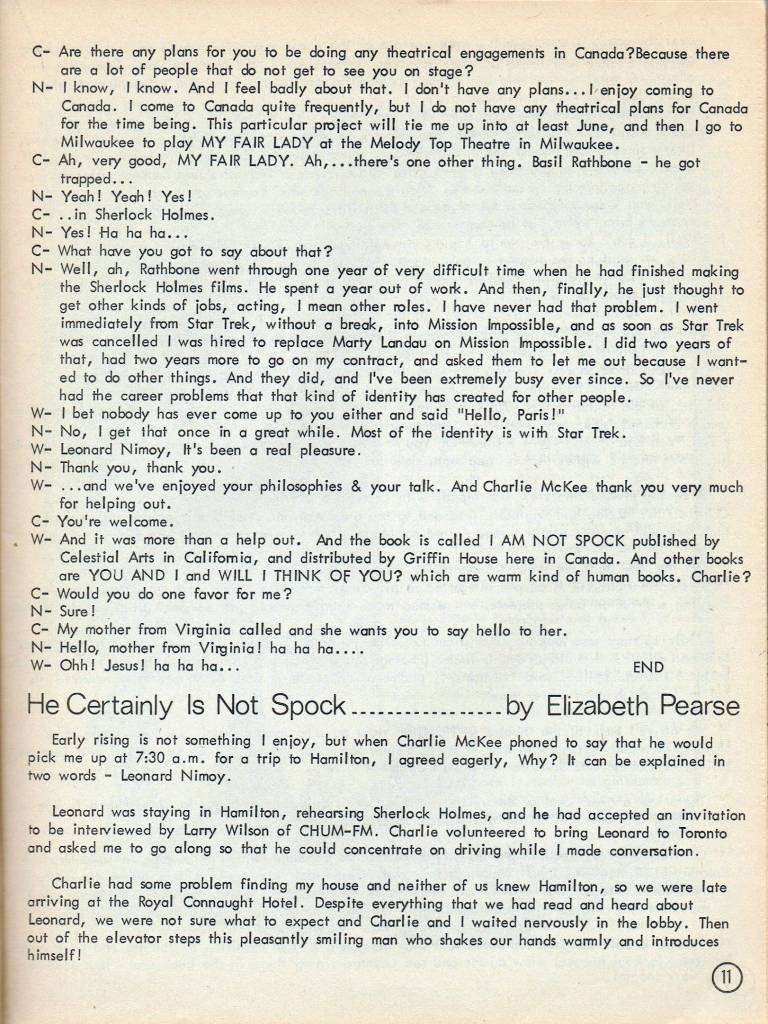
A transcript of the interview was published in the 1976 Spring/Summer issue of Bakka Magazine, along with Pearse’s account of the car drive. Here are those pages.
He was not Spock

Nimoy’s somewhat controversial first book about his relationship with Spock was published in 1975 and, as the actor said in the radio interview, he thought the point he was making was straightforward:
The title is really a simple statement of fact, I am not Spock. In the sense that I am the actor who played the role, of course I am Spock, but in the sense of true identity, I am not. I am someone else.
But many fans felt Nimoy was disrespecting the character they loved, and this interview was one of the many times he was pressed to explain his thinking. He added:
…people are concerned about what my intention was with the book. “Was it my intention to disassociate myself from Spock?” whatever, which is really not the intention. The intention is to study the differences and to examine, if possible, the feelings that an actor goes through playing a character, and then being identified with the character.
But he also said playing Spock never limited his career, as Basil Rathbone experienced with Holmes.
Rathbone went through one year of [a] very difficult time when he had finished making the Sherlock Holmes films. He spent a year out of work… I have never had that problem. I went immediately from Star Trek, without a break, into Mission: Impossible… I did two years of that…and asked them to let me out because I wanted to do other things. And they did, and I’ve been extremely busy ever since. So I’ve never had the career problems that that kind of identity has created for other people.
Nimoy on stage
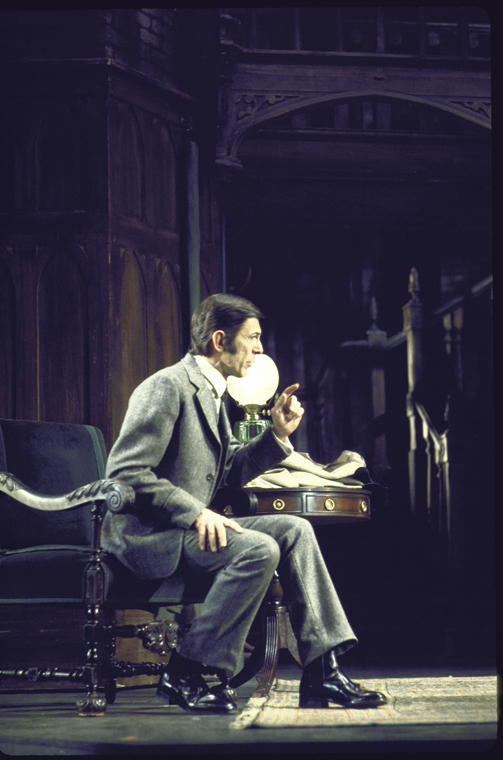
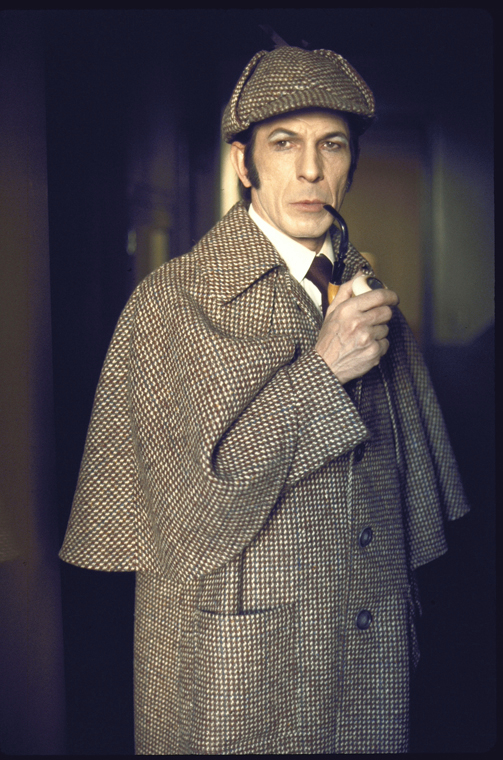
Nimoy performing at the Fisher Theatre in Detroit. Photos: New York Public Library. The radio interview was recorded on a Thursday and, on the following Saturday, Charlie McKee, Elizabeth Pearse, her daughters Lauren and Debra, and a few others attended a matinee performance of the play, then still in rehearsals. Pearse wrote in Bakka Magazine that the group “all enjoyed the performance immensely and afterwards went backstage to see Leonard. He was pleased to see them and chatted with each one, while autographing copies of his book.”
Nimoy autographed McKee’s copy of I Am Not Spock and later sent him a signed playbill from the Fisher Theatre in Detroit.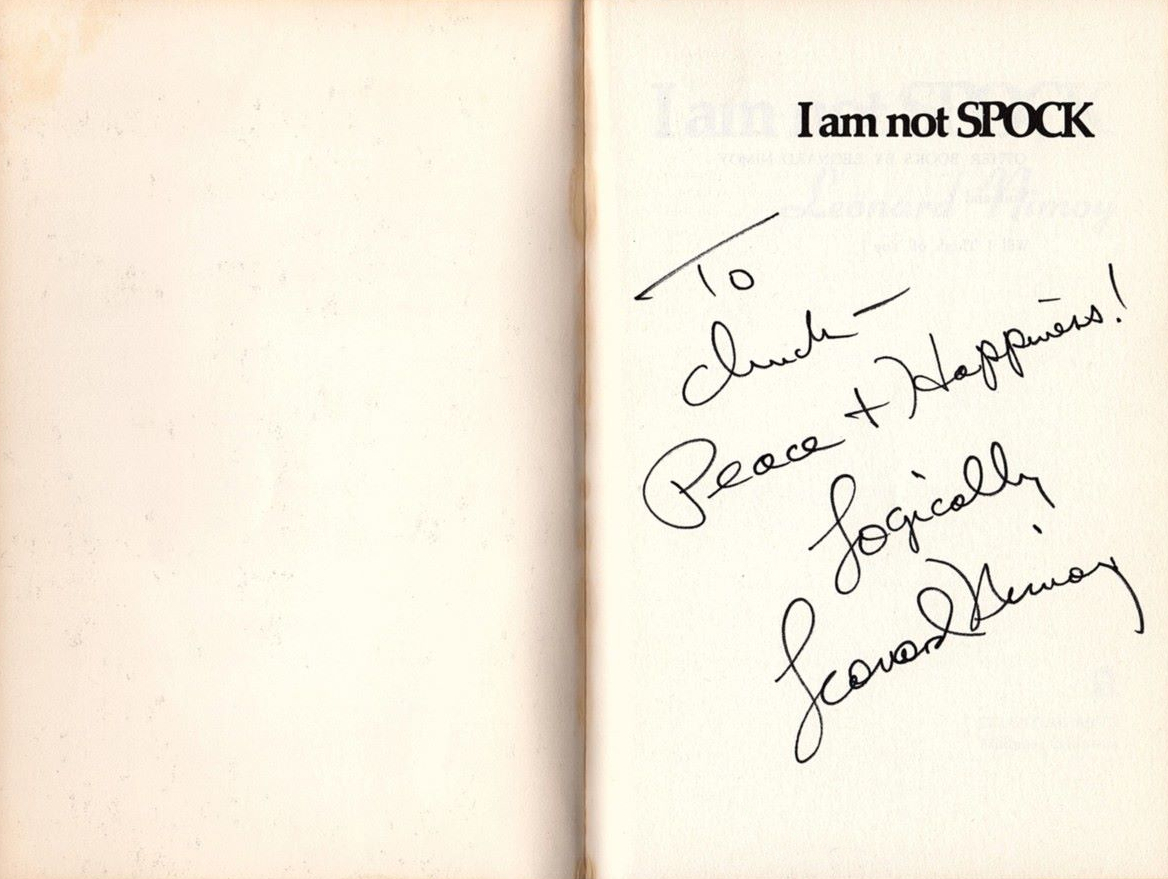

Debra Pearse Hartery related a slightly different review to me in 2020.
I thought he was average. He was not my favourite Sherlock Holmes but certainly not the worst. I found it to be fine and I enjoyed the show, but I was not taken by his performance. He was a really nice guy, but not the best actor and not the worst actor.
Nimoy’s first turn as Holmes
That day in Hamilton was Nimoy’s second appearance as Holmes. As he mentioned in the interview, he first played Doyle’s detective in the short film The Interior Motive, produced for the Kentucky State Educational System, filmed in 1975. In it, Holmes and Watson use inference to understand the internal construction of the Earth. The Arthur Conan Doyle Encyclopedia has more information on the production.
And fortunately for us, the film is on YouTube.
-
Review: The Joy Machine story outline and novel

Warning: there are plot spoilers below for the novel The Joy Machine.
I have been trying to rediscover the Star Trek novels I loved as a teen. Why only trying? Because, so far, they have not been very good. I have started more than I have finished.
I recently read the novelization of The Joy Machine. It was written by James Gunn, based on a story outline Ted Sturgeon submitted during the second season of Star Trek. I have a copy of that outline and I was curious what Gunn had done with it. (I also own Sturgeon’s outline for Amok Time, from his own typewriter.)
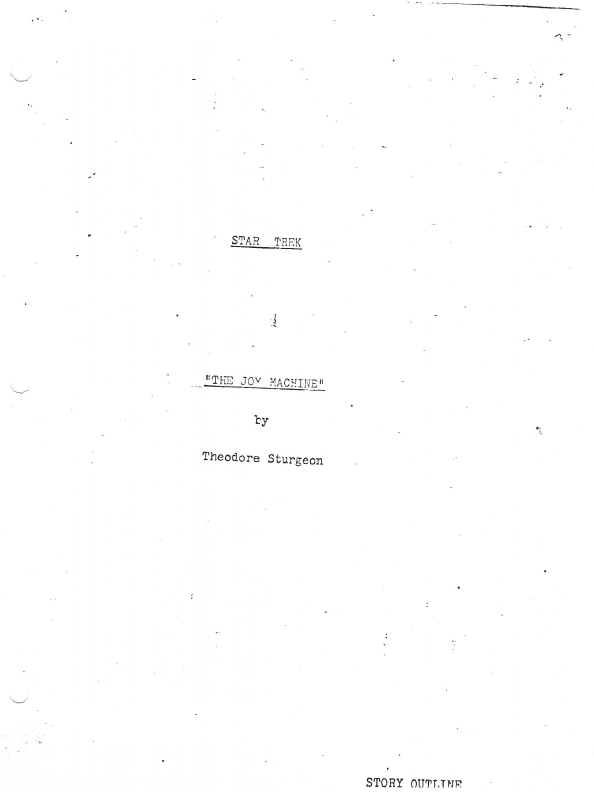
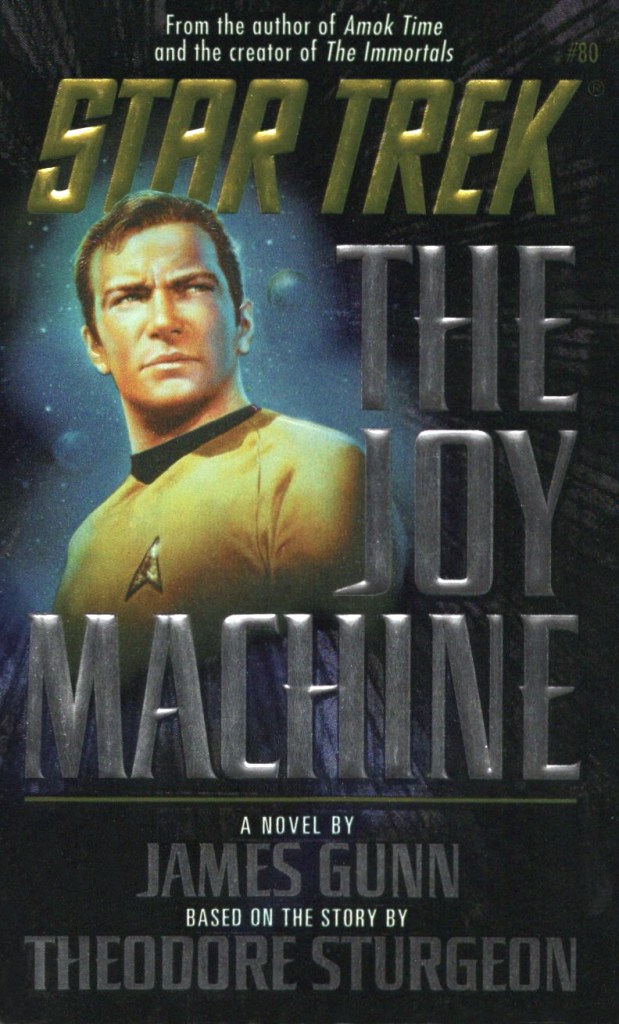
Sadly, the novelization is just not good. To be fair, Sturgeon’s outline was a little weak, too. We’ll start with that.
The Root of Evil
The story was called The Root of Evil in Sturgeon’s first outline. I have not seen it. He delivered a second take on May 16, 1967, retitled The Joy Machine. I have a scan of that document.
The story takes place on Timshel. The planet was considered almost a paradise but cut off all communication with the Federation two years earlier. Kirk is sent to investigate, as he has personal connections to the place: his former fiancée resigned from Starfleet after moving to Timshel and his friend Marouk is an administrator on the planet.
Kirk beams down alone and quickly discovers that the inhabitants are in thrall to the Joy Machine, a computer that rewards menial labour with an electronically induced state of absolute euphoria called a “payday,” delivered through a wristband all adults wear. Planetwide, the citizens have given up ambition, learning and development, and instead sweep streets and build pottery bowls to accumulate enough credits to earn their next fix.
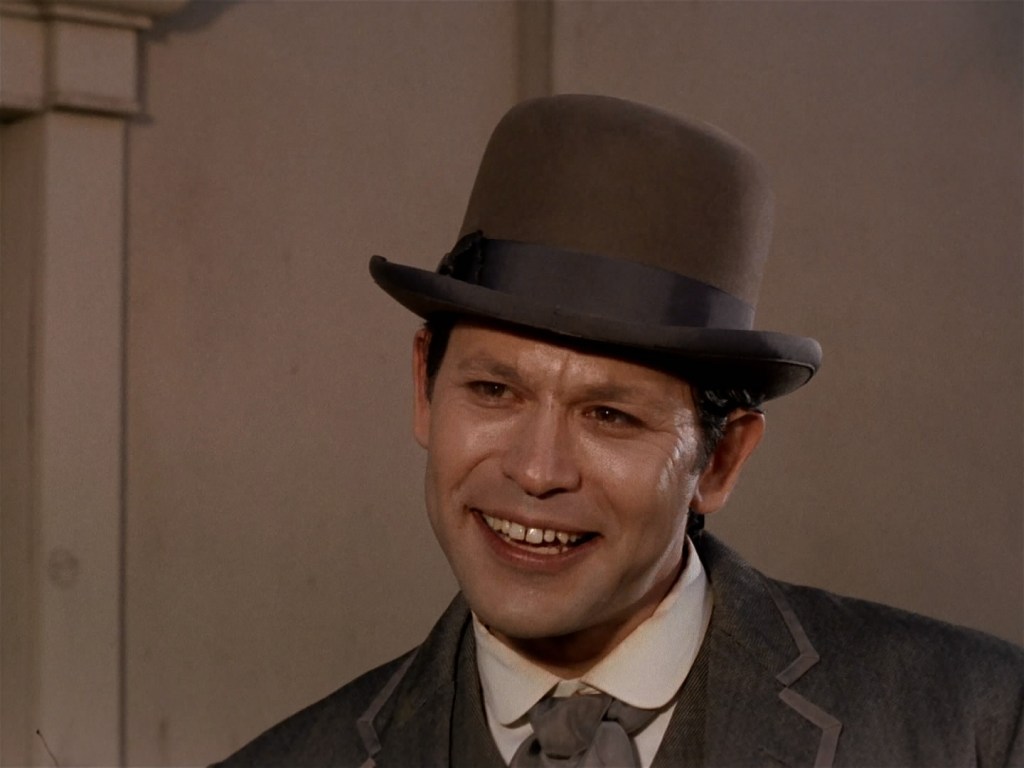
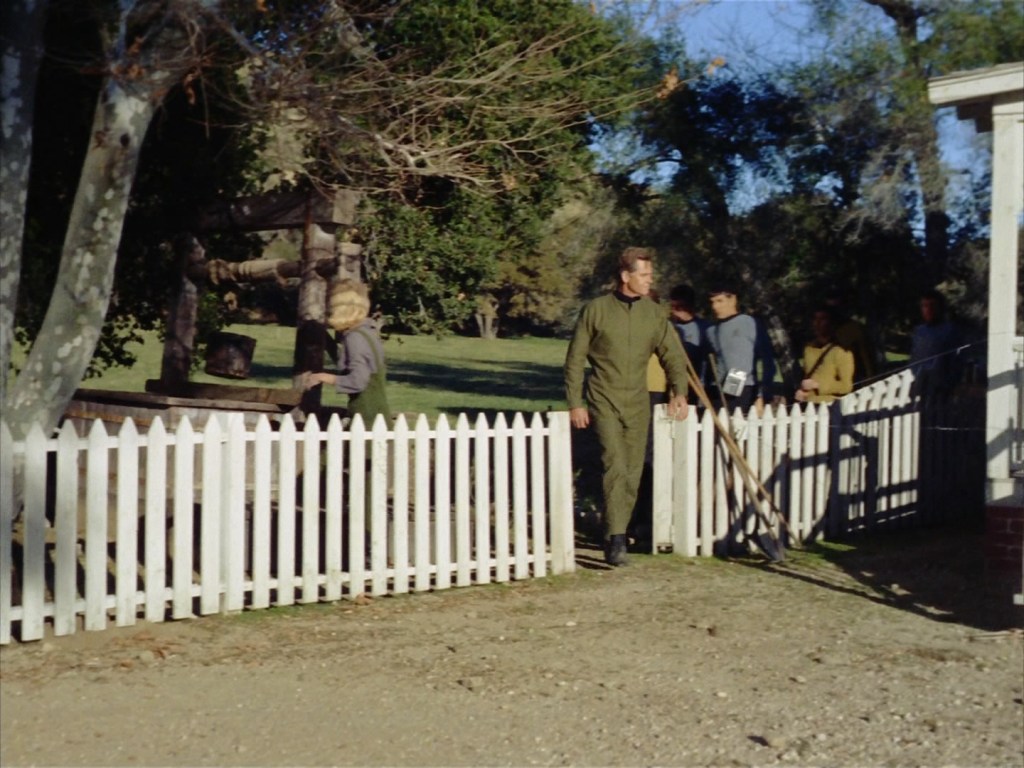
The Return of the Archons. This Side of Paradise. TrekCore The premise is equal parts The Return of the Archons, with the Joy Machine and payday subbing in for Landru and red hour, and This Side of Paradise, in which the spores create a simple world of subsistence farming in the same way the inhabitants of Timshel pursue mundane tasks. “We’ve done nothing here. No accomplishments, no progress,” Elias Sandoval says when released from the spores, and that describes the residents of Timshel since the advent of payday.
Both of those episodes aired in the first season, long before Sturgeon typed out his story outline. And it is a well Star Trek drew from often; see also The Apple. Sturgeon is clearly commenting on drug addiction more than those other stories did but the basics — a docile and obedient population rewarded with joy or wellbeing — are the same.
Sturgeon’s resolution is interesting, if really implausible. Spock, McCoy and Uhura figure out how to remotely reprogram the un-addicted so that the Joy Machine will not deliver actual joy to them.
…the wave-length, or channel, of the Timshel brain can be shifted, by means of the ‘payday’ machine, to a new frequency that will continue to operate with them, but which will not affect anyone else. This way, the quarter-million ‘incurables’ on the planet can live out their lives just as they are — but to anyone else the device will accomplish nothing but instant sleep. The children would never know: they’d grow up wondering vaguely why their folks enjoyed it so much.
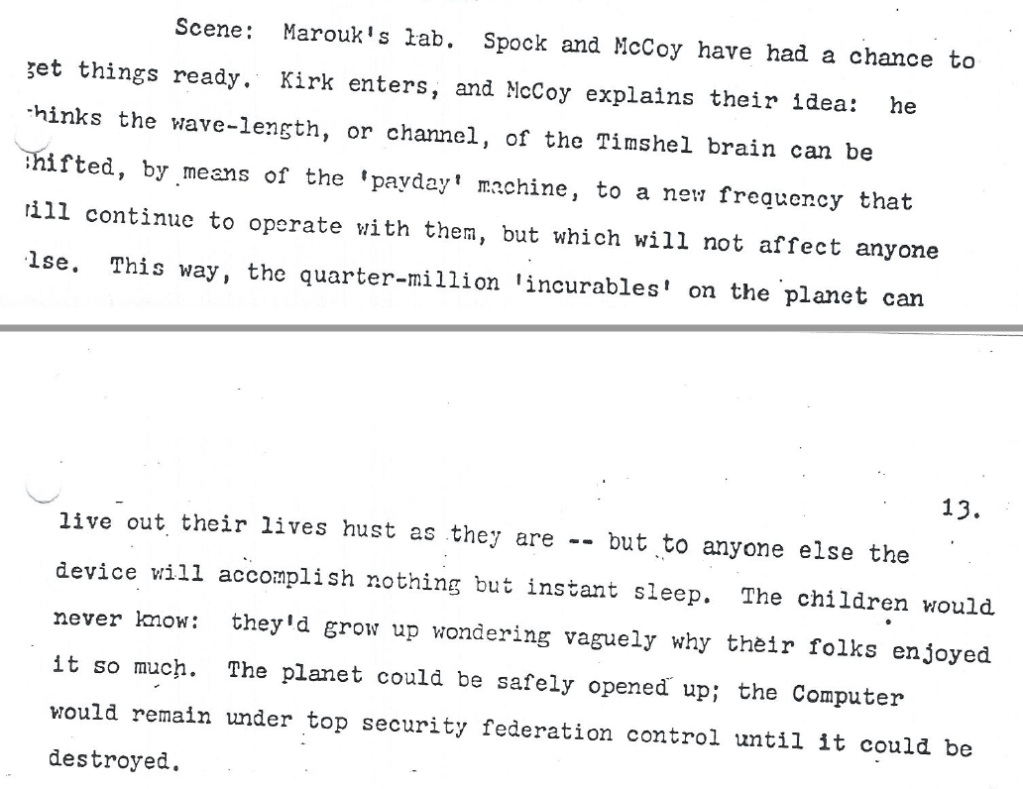
So…250,000 people are to be left to their addiction, and the teens will now have no reason to resign themselves to mindless labour and will therefore rebel at the idea, creating huge — and irreconcilable — conflict with all the adults.
It’s not a great denouement but at least Kirk does not talk the computer to death. In Sturgeon’s outline. Now, on to the novelization.
Gunn’s take
Gunn writes in his novel’s afterword that he considered Sturgeon a mentor and a friend. After Sturgeon’s death in May of 1985, an editor at Pocket Books handed Gunn a copy of the outline and asked him to turn it into a novel.
(Marc Cushman wrote in These Are The Voyages, Season Three, that Sturgeon was paid to turn his outline into a screenplay, and that he delivered the first draft on October 21, 1967, followed by two revisions on November 8 and 13. Gunn, however, specified that he worked from an outline, not a script, and I have never seen Sturgeon’s full script.)
Gunn took on the challenge.
Page one of the novel sets the scene: “Timshel turned slowly in its orbit, a blue-and-white oasis in a dark desert of desolation, an exquisite anomaly in the lifeless void.” We are also told that “The citizens of Timshel were in love with each other, in love with the universe, in love with life. Being there, if only for a few weeks or a few days, or even a few hours, was like being reborn.”
And that is the first problem here: that overblown tone continues throughout. The second problem is basic sentence structure. We have bits like “The right side of the room was walled off into small rooms” and “The next morning he felt a small shiver run through the ship as he sat at the ship’s second sitting for breakfast.” This is careless writing or lack of editing, or both. One more: “He found a screwdriver, a pair of wire cutters, and an infinitely adjustable wrench…” Even putting aside the impossibility that its adjustments are infinite, just say “an adjustable wrench.”
These examples illustrate why the adult me has trouble enjoying Star Trek novels: they often come across as products produced quickly, with little regard for quality.
About half of Gunn’s pages are devoted to a band of rebels who live in the arctic. They do not appear in Sturgeon’s outline. I understand the need to stretch the story to novel length, but ideally new content would contribute to character development, tension, or the outcome. Instead, the insurgents are entirely inconsequential; their chapters could be yanked out with no change to the outcome.
Landru. Nomad. Norman. The M-5
While Sturgeon’s brain reprogramming was a stretch, it was at least inventive. Gunn’s story ends with Kirk talking a computer to death, as he had done already in three episodes at the time the outline was written and was about to do again in The Ultimate Computer.
Kirk encountered the Joy Machine early on as a smallish box sitting alone in a room. Towards the end of the story, he and a few others walk into a multi-denominational chapel in the capital city and find “alcoves containing figures or symbolic representations.” These religious statues come to life to debate with the crew. How does this happen, and why? That’s never addressed. It comes across as essentially magic.
The first is a Buddha which “opened its eyes and spoke to them.” They discuss the nature of pleasure, and McCoy makes the first speech. “People are meant to pursue happiness, not to perpetually achieve it.”
The next niche holds an elaborate three-part statue representing Brahma, Vishnu and Siva, and “an exotic incense drifted around the figures and into the air.” One of the figures comes to life, changing into “a naked black woman with four arms wearing a garland composed of the heads of giants. Around her neck was a string of skulls.” (How does a human-sized statue wear a number of giants’ heads? Good question.)
Uhura decides to play the woman card, for some reason. “I am a woman, and I speak to you as a woman… As a woman, I know that the proper way to raise children is with kindness. But it is not kind to give children everything they want. Then they never grow up.”
They next approach the figure of Apollo, who “stretched his hand toward Spock as if trying to pass along the spark of truth.”
Lastly, they encounter the Joy Machine back in its basic form of a small box. It also speaks to them, and it is now Kirk’s turn to hold forth. “Happiness is not the only good,” the captain says. “Humans value other things even more: love, friendship, accomplishments, discovery, and, most of all, knowledge. Given a free choice between happiness and knowledge, humanity will choose knowledge every time.”
Sound familiar? It’s the story of Adam and Eve through a lens of This Side of Paradise. In case you missed that, Kirk mentions a Bible story about paradise and the Joy Machine replies “The Garden of Eden.” And that seemingly does the trick.
“Happiness is seductive, but it is ephemeral. Knowledge is eternal. Give your people free will. Provide only the guidelines that an omnipotent being can offer without making its people mere puppets.”
The Joy Machine sat silent for what seemed like minutes to Kirk and the others, but may have been only moments.
The bracelets on the wrists of four of them sprang open and fell to the floor.
And that’s it. Wristbands litter the ground and all the citizens of Timshel may now continue as they were meant to, embracing unhappiness in the quest for knowledge.
These two tropes — Kirk kills a computer and suffering and striving are essential to the human condition — were used in the series more often than was ideal but that is understandable when a small group of people are pumping out 24 to 29 episodes per season on a tight budget. In a novel, however, the use of these fallbacks is just disappointing.
There is also the disturbing reality that the crew encounters and moves past representations of many religions but the challenge of the Joy Machine is only solved when Christian mythology is referenced. I cannot say if that Christian-centric view was intentional but surely someone at Pocket Books should have called out this seeming endorsement of one belief system over others.
Both the novel and the outline sidestep the criticism leveled at episodes such as The Apple, in which Kirk arguably breaks his oath through a quick decision to entirely change a planet’s culture. Timshel is a member of the Federation and at least some of its citizens want help. But this does share the same somewhat unsatisfactory feeling that Kirk lands, dislikes what he sees, changes everything, and then just warps away.
Sturgeon first pitched The Joy Machine for season two and, after revisions, it was added to the list for season three. Marc Cushman writes that it was planned as the 25th episode of that season, and that William Shatner was slated to direct. The third season of TOS contained only 24 episodes.
I don’t love Sturgeon’s outline but it was better than Gunn’s take, and it would have been interesting to see Shatner direct a Star Trek story. Instead, we had to wait 20 years for Star Trek V.
Postscript
James Gunn wrote 16 novels and that is 16 more than I have penned, but I really have no respect for the mechanics of his writing. Here is another bit: “The bridge was once more solidly under Kirk’s feet. He felt the characteristic resilience of its floor beneath him.”
Resilience means “the capacity to recover” or “an ability to spring back into shape.” And even if we accept that the intention was to be evocative rather than literal, surely describing a deck first as solid and then as resilient is redundant.
I am currently reading Child of Two Worlds by Greg Cox. It is set aboard Captain Pike’s Enterprise and, so far, it is quite good.
-
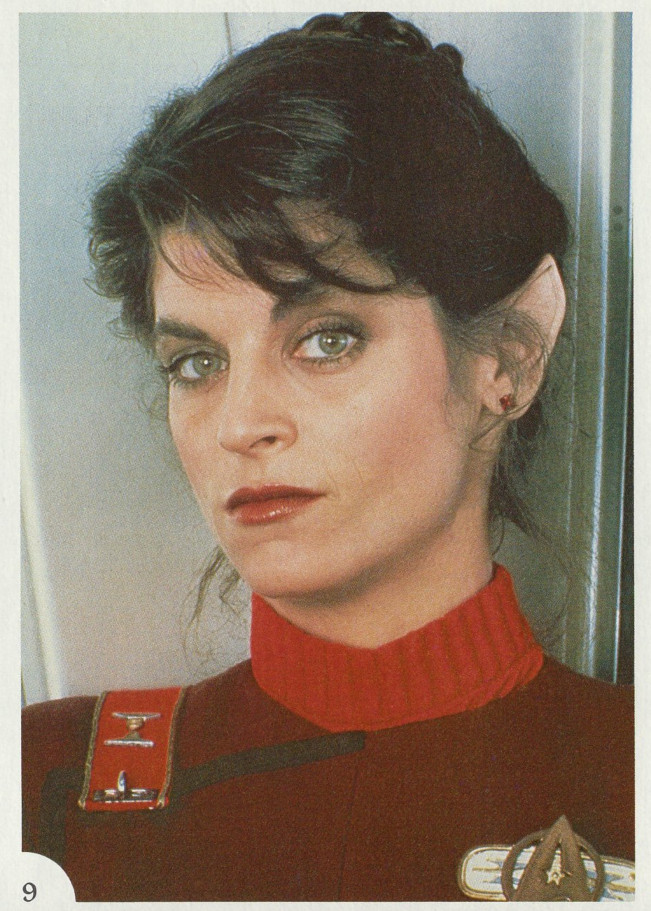
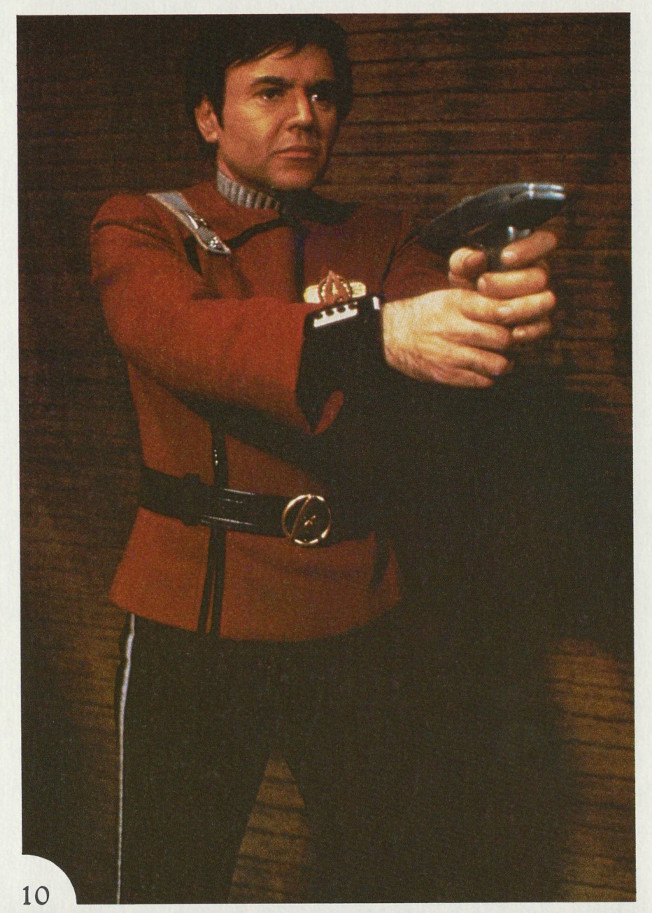
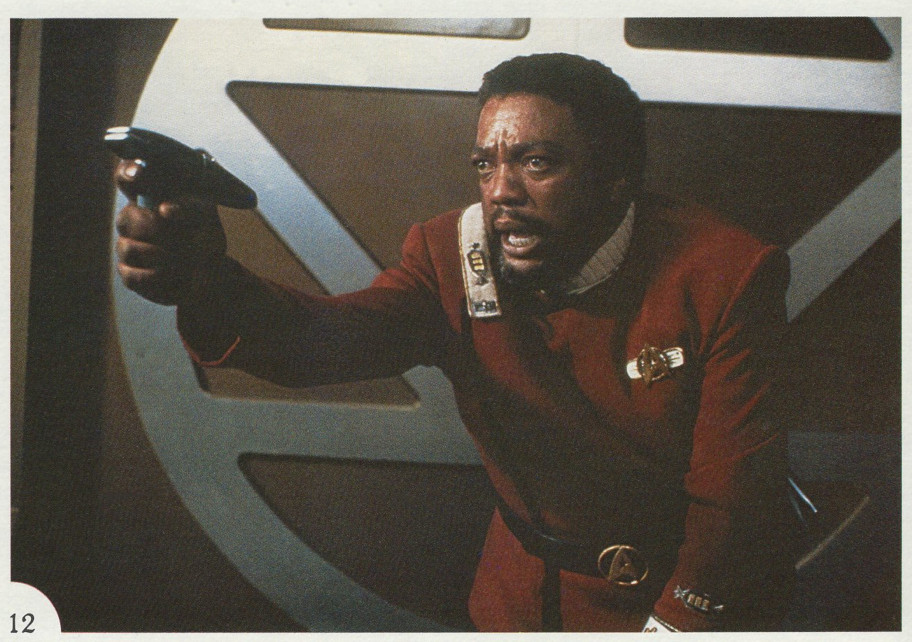
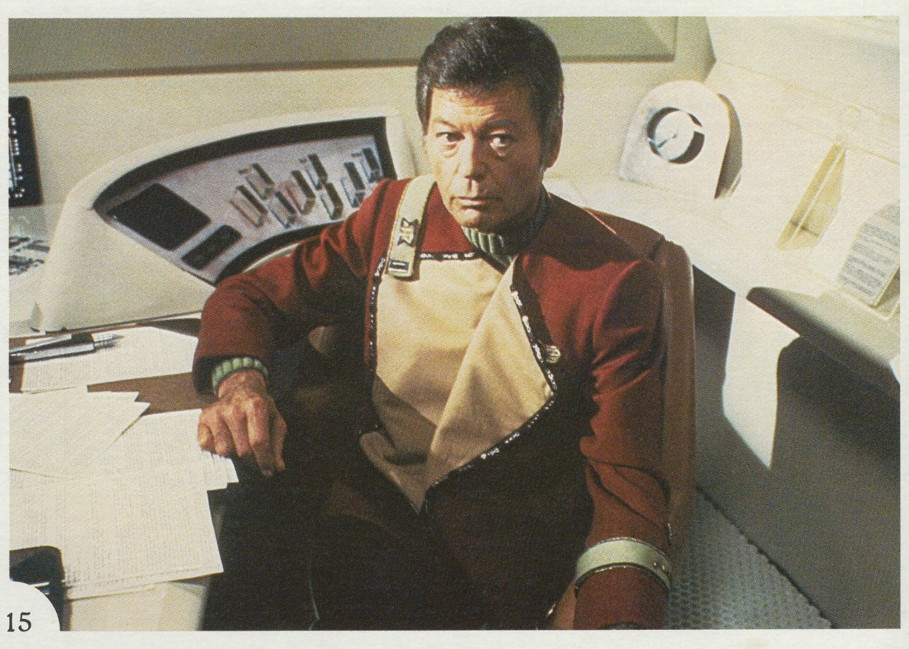
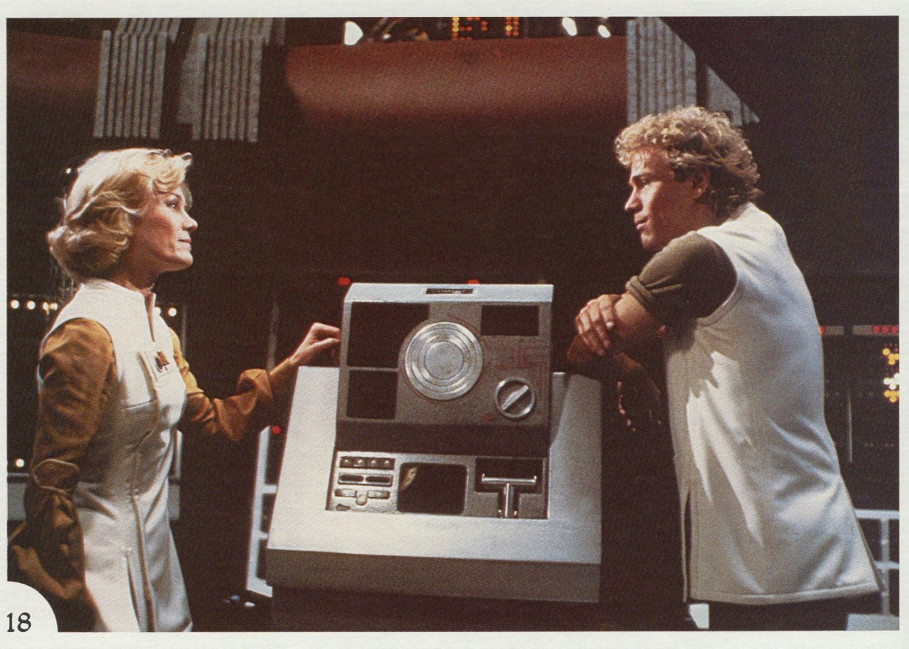
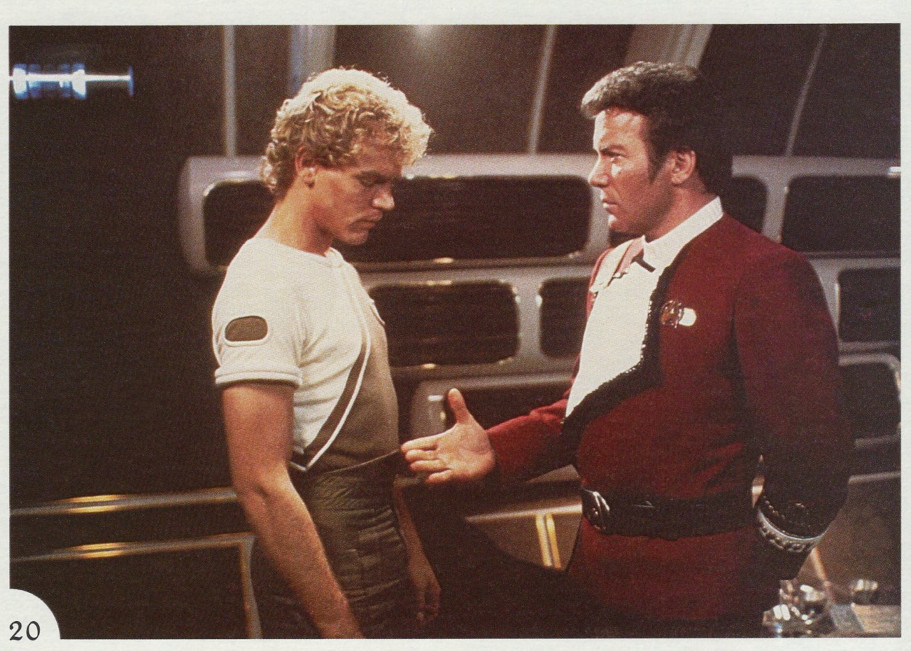
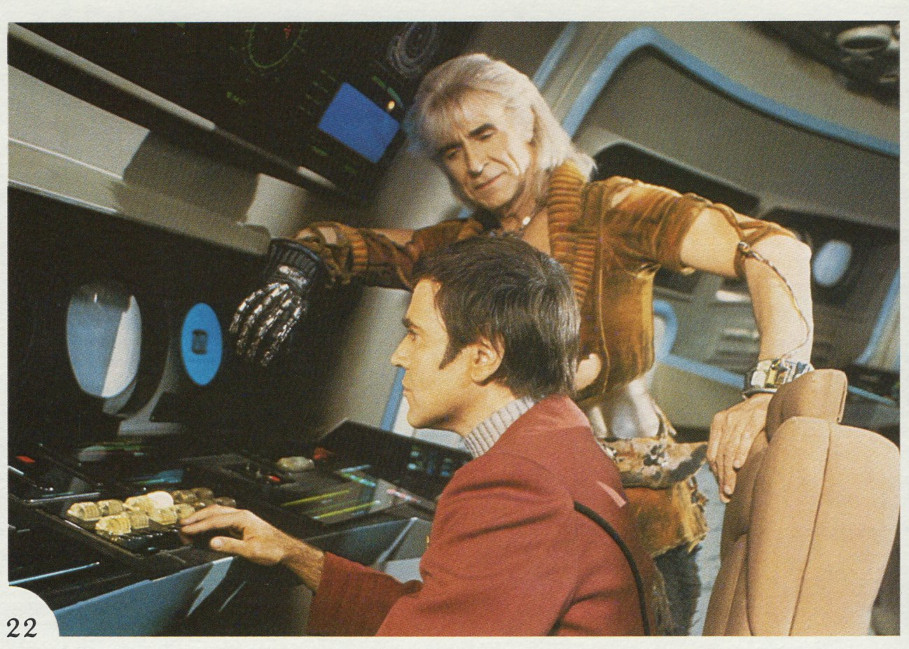
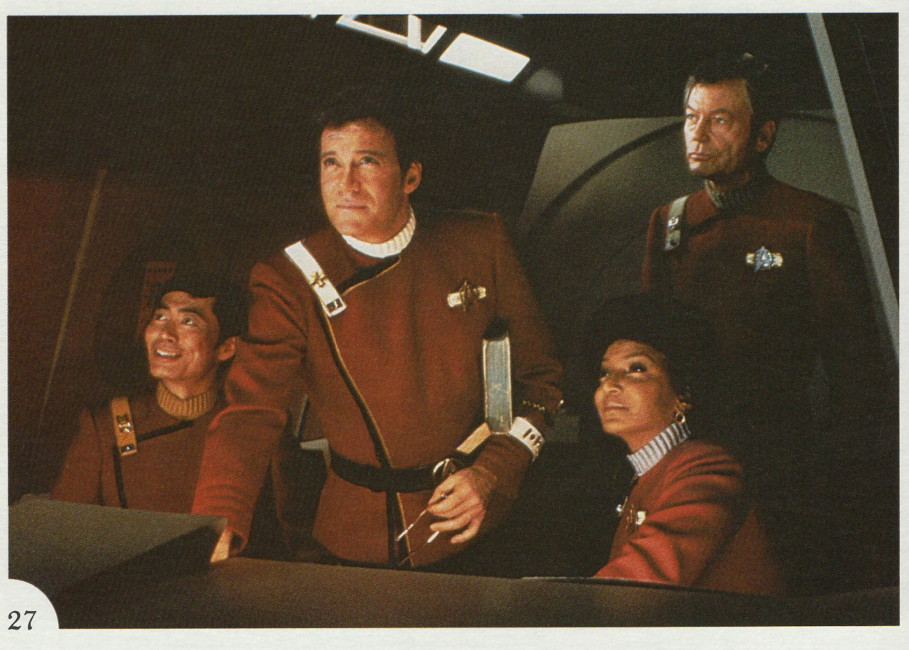
Revisiting the FTCC cards for Khan’s 40th anniversary
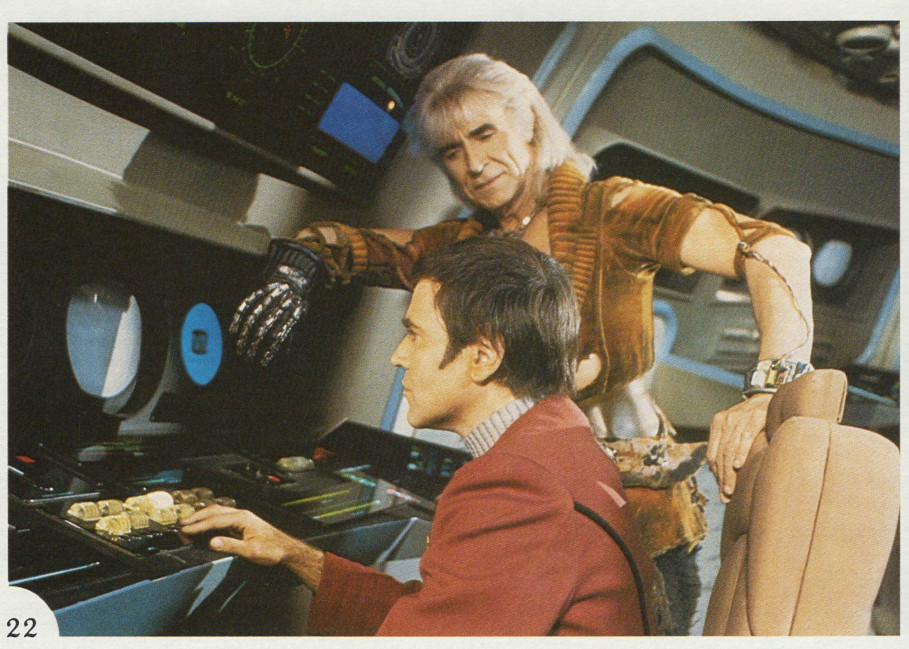
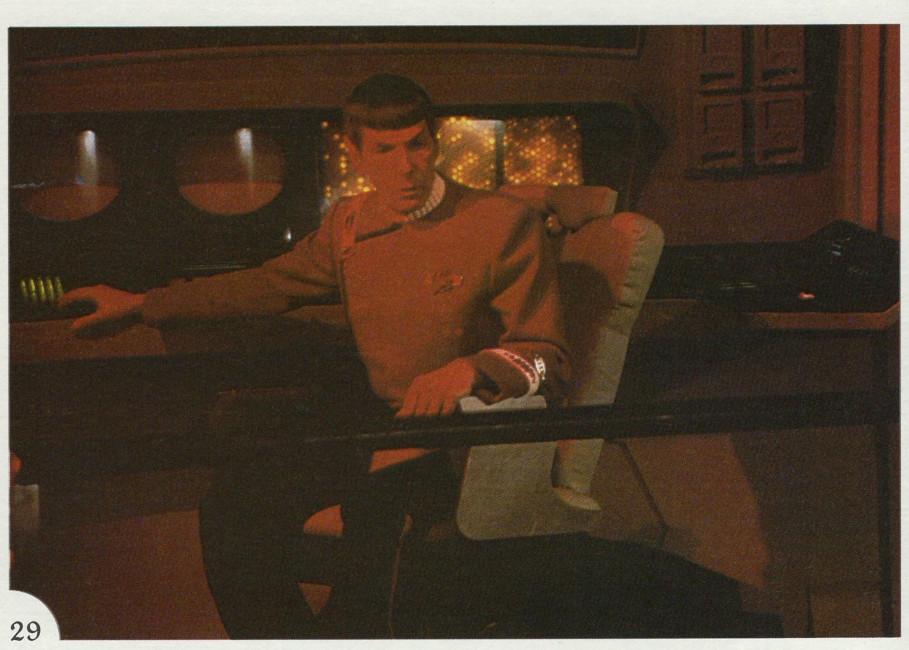
The 40th anniversary of The Wrath of Khan got me thinking about my Khan collectibles. Probably my favourite are the big 5×7 cards made by FTCC in 1982. Cards that size are a rarity; SciFi Hobby made an In Motion TOS set and there were some box toppers but I don’t think there are many other 5×7 cards.
(Quick aside: I own the full set of the In Motion cards but I don’t love them. They are gimmicky and the motion thing doesn’t work that well.)
The Khan cards are impressive simply because they are big. Also, the production run was limited, so not too many collectors own these. Having said that, the quality is middling. Registration errors in the printing means the colour layers on a number of the cards did not line up accurately, and the backs feature only a monochrome version of the movie logo. No trivia, interesting stories or even movie quotations.

It’s odd to me, then, that StarTrek.com says “Fantasy Trading Card Company’s owner Mark Macaluso was a respected, pioneering figure in modern trading card collecting. FTCC had built a reputation for making quality cards…” That is not proven out by my set. Still, I really do like these, especially because there were not a lot of photos from the film available in 1982. That was the year Pocket Books gave us the high-contrast, washed-out, black-and-white The Wrath of Khan Photostory.
Here is the full set of the 30 FTCC cards. Click any image to scroll through larger versions.
Gallery 1
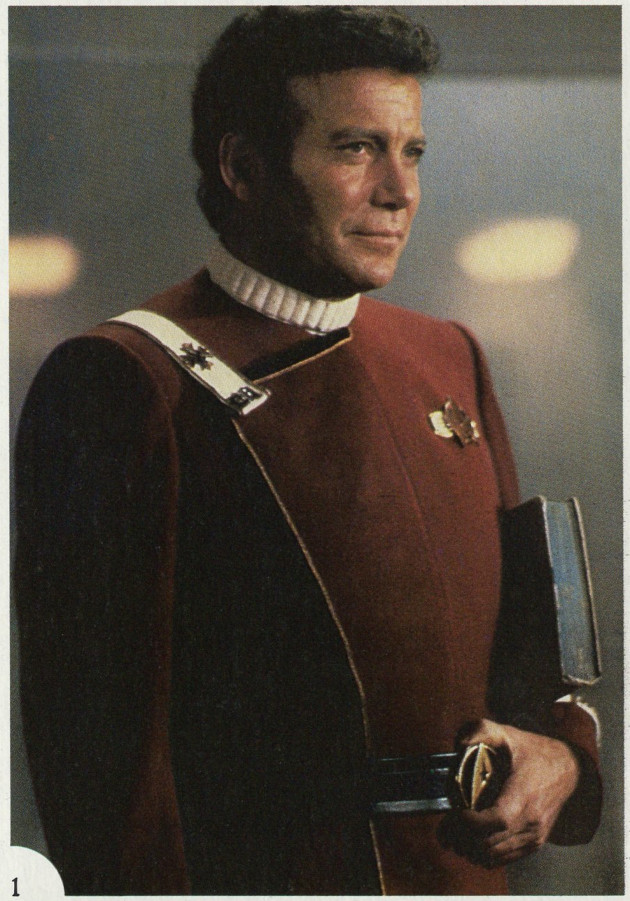
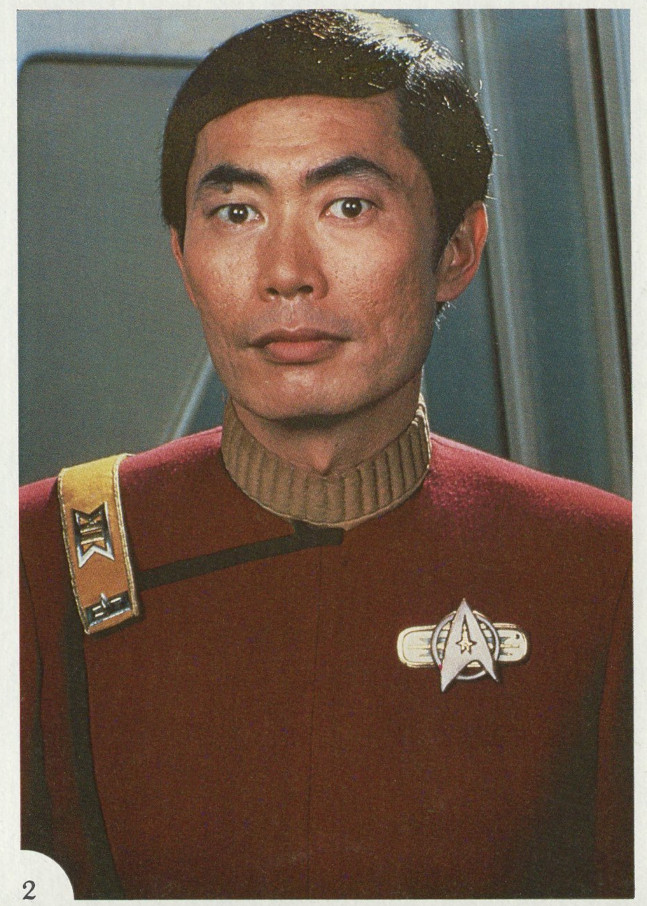
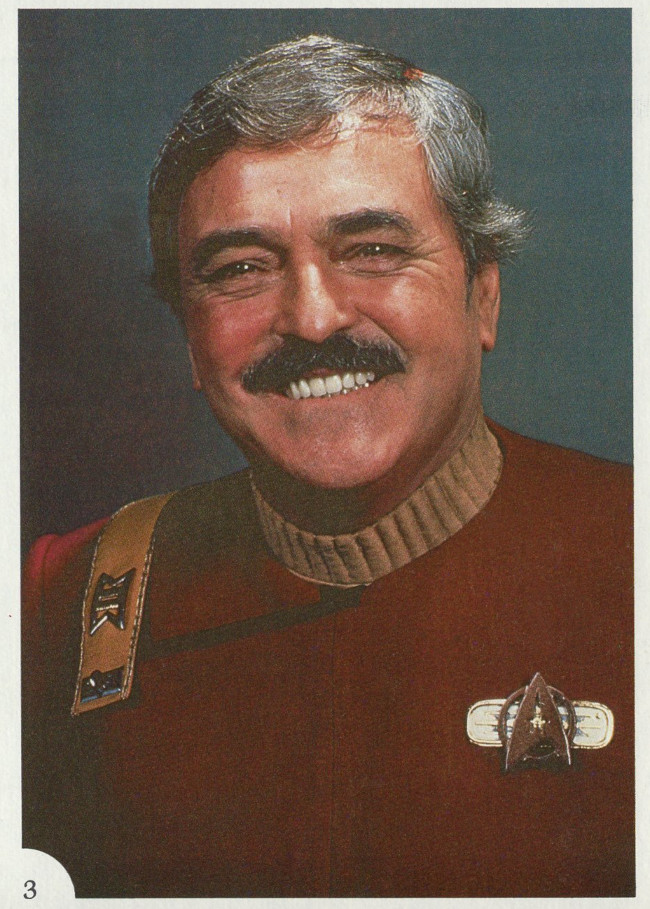
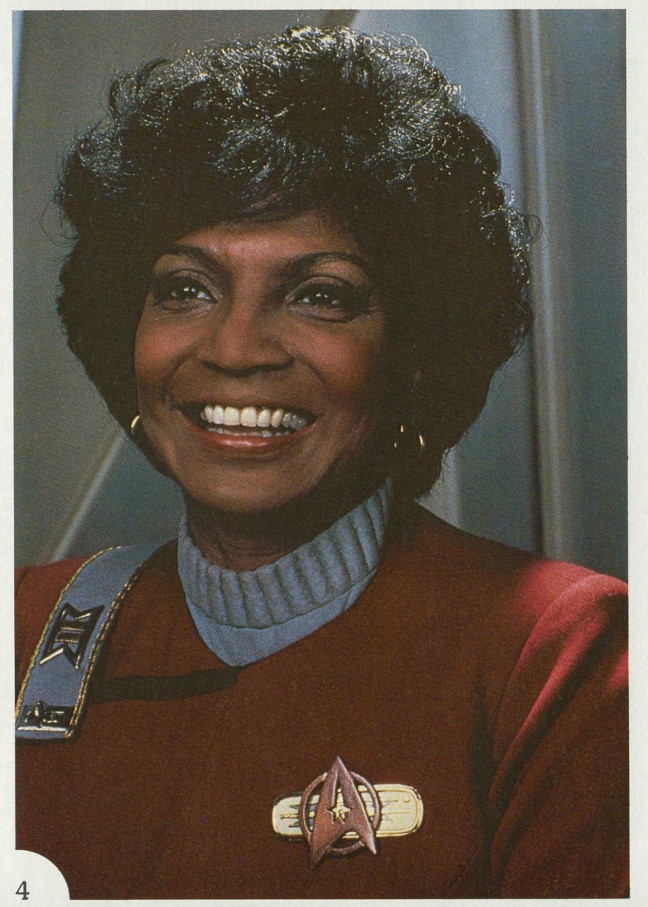



Gallery 2











Postcript
The registration error is most evident on cards 21, 26 and 28.
-
Trektennial News 14: NCC is not Naval Construction Contract, plus a Q&A with Kelley
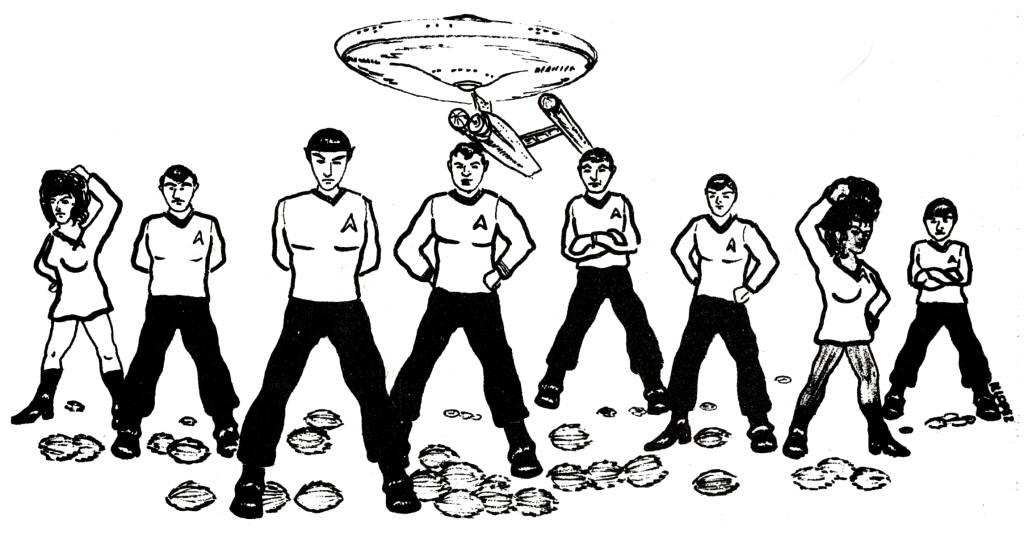
Star Trektennial News was the second semi-official newsletter published under the guidance of Gene Roddenberry. The complete run of these publications includes:
Issues 1 to 12: Inside Star Trek, edited by Ruth Berman
Issues 13 to 24: renamed Star Trektennial News, edited by Susan Sackett
Issues 25 to 31: again called Inside Star Trek, edited by Virginia Yable.
Here are highlights from issue 14, published in 1976.

The second issue of the revamped newsletter offered a movie update and a solid interview with DeForest Kelley. Sadly, subscribers did not also receive the required magnifying glass.
The cameras will roll on July 15
This edition opens with the exciting news that the first movie, called Star Trek II in the newsletter, will begin filming on July 15, 1976. “The studio has set this date and they are getting anxious to get rolling on the film! Now, all we need is a script!”
That must have been a significant barrier, as principal photography on The Motion Picture actually started more than two years later, in August of 1978.
The contest over NCC
Readers were promised a regular contest in the last issue but, sadly, it was the trivia question “What do the letters N.C.C. on the hull stand for?” The thing is, there is no one answer to this, and the explanation provided by the newsletter is inconsistent with what Matt Jefferies said later.
The newsletter answer:
…the letters grew from Gene Roddenberry’s and Matt Jefferies’ brains — “N” was adopted by the United States around 1928 as the letter identifying that country; “C” came into use at that time also and stands for “Commercial” and the third “C” was purely for aesthetic reasons — Matt and Gene thought two “C”s looked good. Navy Curtis Craft was not allowed, because, after all, the Enterprise is not a Navy Curtis Craft. We also didn’t allow Navy Construction Contract.
Jefferies later told the BBC a slightly different version of the origin story, and I take this answer to be definitive:
NC, by international agreement, stood for all United States commercial vehicles. Russia had wound up with four Cs, CC CC. It’d been pretty much a common opinion that any major effort in space would be too expensive for any one country, so I mixed the US and the Russian and came up with NCC.
It’s interesting that editor Susan Sackett specifically says NCC does not stand for Navy Curtis Craft. If you Google NCC you will see that explanation posted widely, and the idea was obviously around even in the mid 1970s. Here is a modern example of this story from the Memory Alpha discussion boards:
According to both “The Making of Star Trek”, and the second season writers’ guide update, NCC officially stands for “Navy-Curtis Craft”, referring to the fact that the design and construction of the cruisers was a combination of the Navy’s and Curtis Industries inputs. Curtis Industries is (will be) an industrial ship-builder located in San Francisco that has fulfilled many Starfleet-bid projects. The Navy was responsible for transporting the components into low Earth orbit, and assembling the ship in space.
This is not stated in the TOS show bible and if it is in The Making of Star Trek, I cannot find it.
Wikipedia gives yet a third version and includes the Naval Construction Contract idea that Sackett specifically ruled out.
The ship’s NCC-1701 registry stems from NC being one of the international aircraft registration codes assigned to the United States. The second C was added because Soviet aircraft used Cs, and Jefferies believed a venture into space would be a joint operation by the United States and Russia. NCC is the Starfleet abbreviation for “Naval Construction Contract”, comparable to what the U.S. Navy would call a hull number.
All of which means this was not the best trivia question to select.
This issue asks for the best artwork, with prize packs in four age categories. Those efforts are promised in the next issue.

Good luck reading the DeForest Kelley interview
Sackett offered a lengthy Q&A with DeForest Kelley that is almost unreadable. Not due to the writing or the content but because, inexplicably, she ran it on one page in a miniscule font. It was a bizarre decision. Skip the fan poem above and run the Dr. McCoy interview over two pages.
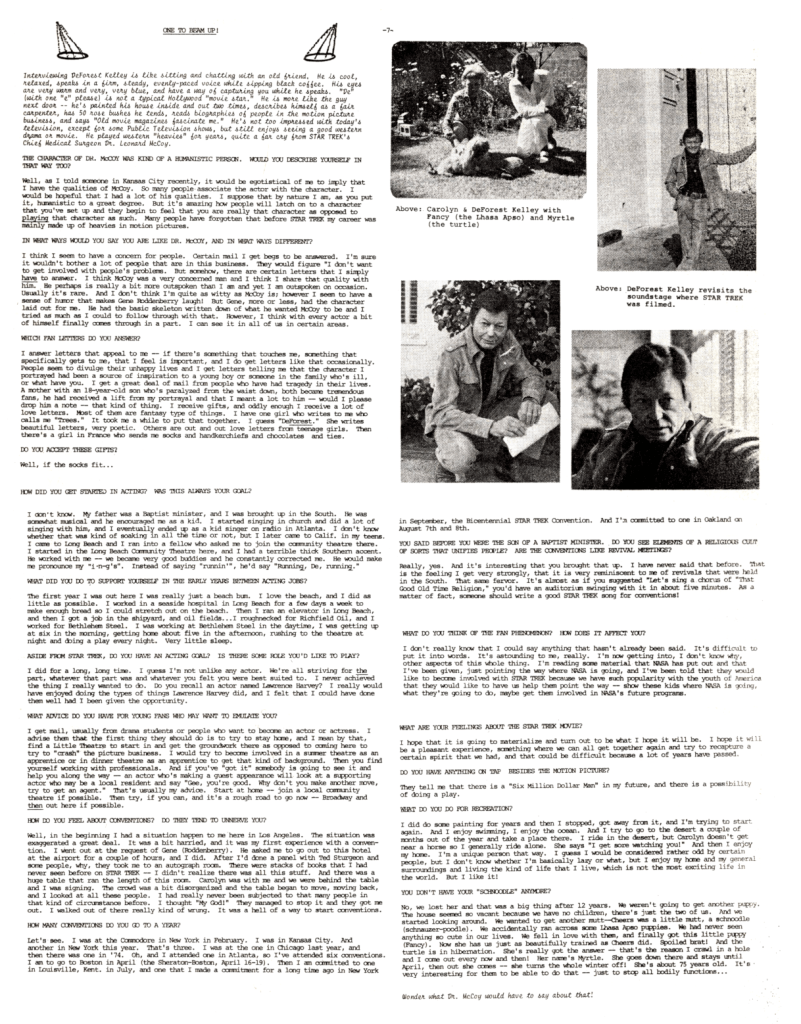
I had to scan the interview and then zoom the image on my screen just to make the words legible. Here are the best bits.
Which fan letters do you answer?
I answer letters that appeal to me — if there’s something that touches me, something that specifically gets to me, that I feel is important, and I do get letters like that occasionally. People seem to divulge their unhappy lives and I get letters telling me that the character I portrayed had been a source of inspiration to a young boy with someone in the family who’s ill, or what have you. I get a great deal of mail from people who have had tragedy in their lives. A mother with an 18-year-old son who’s paralyzed from the waist down, both became tremendous fans, he had received a lift from my portrayal and that I meant a lot to him — would I please drop him a note — that kind of thing. I receive gifts, and oddly enough I receive a lot of love letters. Most of them are fantasy types of things. I have one girl who writes to me who calls me “Trees.” It took me a while to put that together. I guess “DeForest.” She writes beautiful letters, very poetic. Others are out and out love letters from teenage girls. Then there’s a girl in France who sends me socks and handkerchiefs and chocolates and ties.
Do you accept these gifts?
Well, if the sock fits…
What did you do to support yourself in the early years between acting jobs?
The first year I was out here I was really just a beach bum. I love the beach, and I did as little as possible. I worked in a seaside hospital in Long Beach for a few days a week to make enough bread so I could stretch out on the beach. Then I ran an elevator in Long Beach, and then I got a job in the shipyard, and oil fields. I roughnecked for Richfield Oil, and I worked for Bethlehem Steel. I was working at Bethlehem Steel in the daytime, I was getting up at 6 in the morning, getting home about 5 in the afternoon, rushing to the theatre at night and doing a play every night. Very little sleep.
How do you feel about conventions? Do they tend to unnerve you?
Well, in the beginning I had a situation happen to me here in Los Angeles. The situation was exaggerated a great deal. It was a bit harried, and it was my first experience with a convention. I went out at the request of Gene Roddenberry. He asked me to go to this hotel at the airport for a couple of hours, and I did. After I’d done a panel with Ted Sturgeon and some people…they took me to an autograph room. There were stacks of books that I had never seen before on Star Trek — I didn’t realize there was all this stuff. And there was a huge table that ran the length of the room. Carolyn was with me and we were behind the table and I was signing. The crowd was a bit disorganized and the table began to move, moving back, and I looked at all these people. I had never really been subjected to that many people in that kind of circumstance before. I thought “My God!” They managed to stop it and they got me out. I walked out of there really kind of wrung. It was a hell of a way to start conventions.
R-rated Majel

The newsletter concludes with a list of conventions and appearances for the main cast, along with a note that Gene Roddenderry Jr. (Rod) had fled a TV commercial audition. “He took one look at the waiting room of children and ran out crying ‘No doctor! No doctor!’”
Sackett also told readers that:
Majel Barrett will appear in the forthcoming film “Drum” — but don’t plan on seeing her if you’re under 17. Majel says it will definitely be rated R!”
IMDb, however, does not list Barrett in the 1976 film Drum, which is not a big loss: it’s pretty much a sex and violence exploitation film. Here’s the trailer.
Click here to read other articles in this series.
-
Cigarettes for kids – and 12 wild Star Trek cards
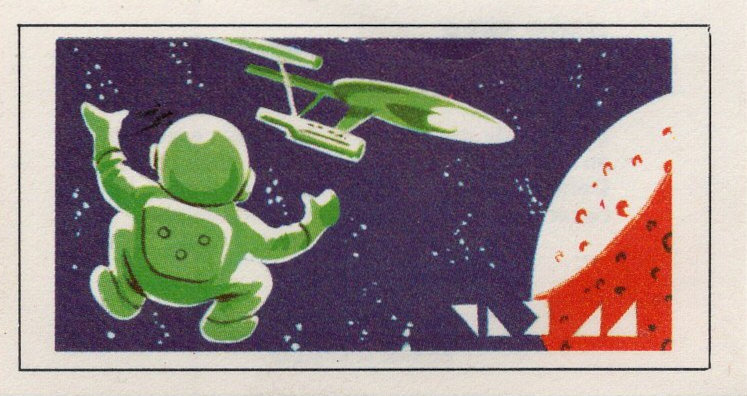
The Primrose Confectionary Co. of Slough, Bucks (Buckinghamshire), England used to sell candy cigarettes to kids, back when that was not considered wildly inappropriate. The company packaged cards with those sweet treats, including a 1971 set of 12 based on Star Trek. I love these because the text on the back of these “stamps” has only the loosest connection to the actual show.
The company also produced cards based on Superman, Dad’s Army, Joe 90, The Beatles, Bugs Bunny, Laurel and Hardy, Popeye (its most famous line), and a bunch of others.
Here are all 12 of the Primrose Star Trek cards. (Click the photos for a larger view.)
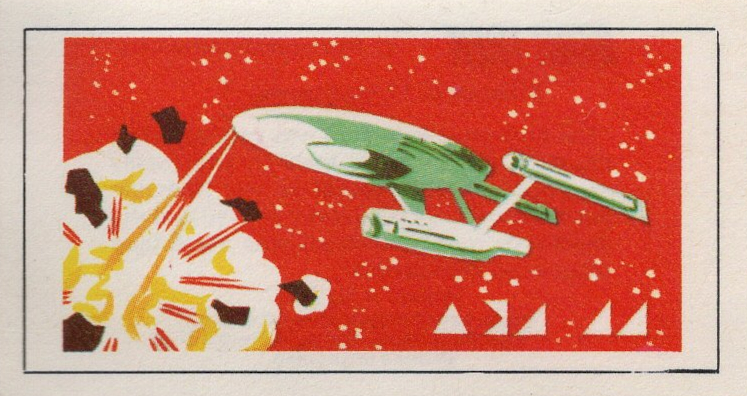

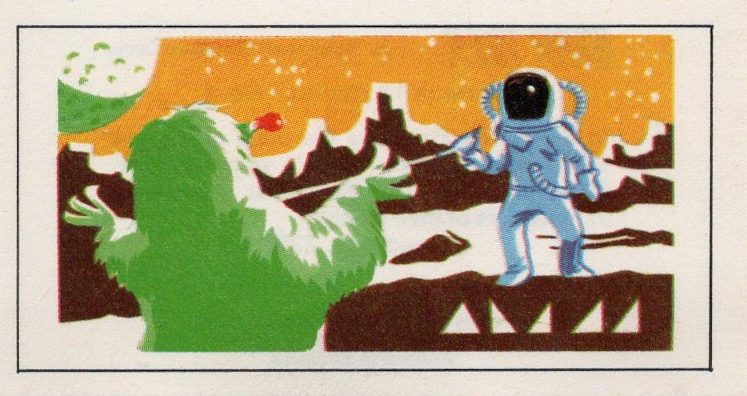
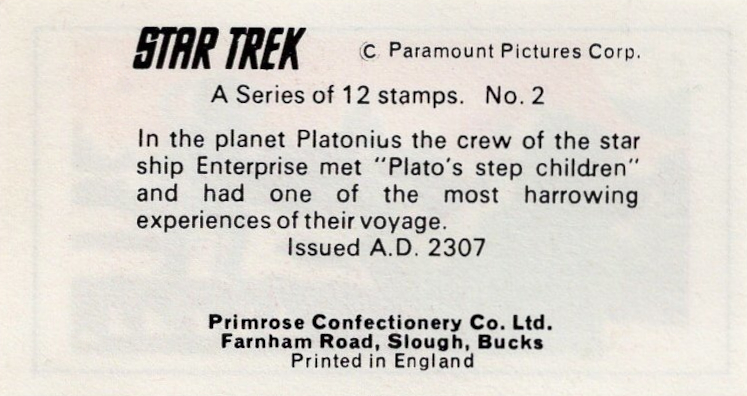
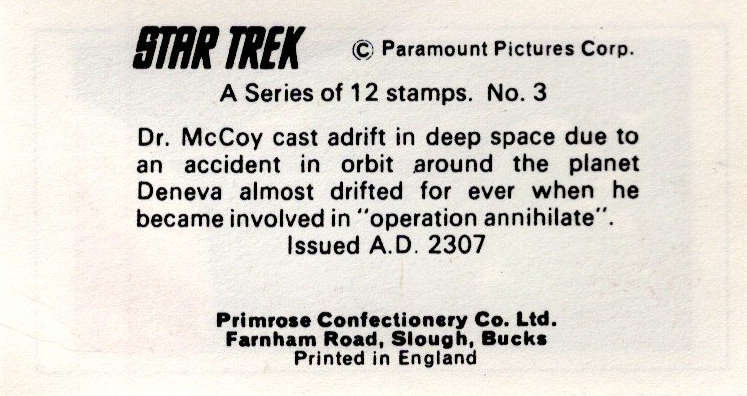
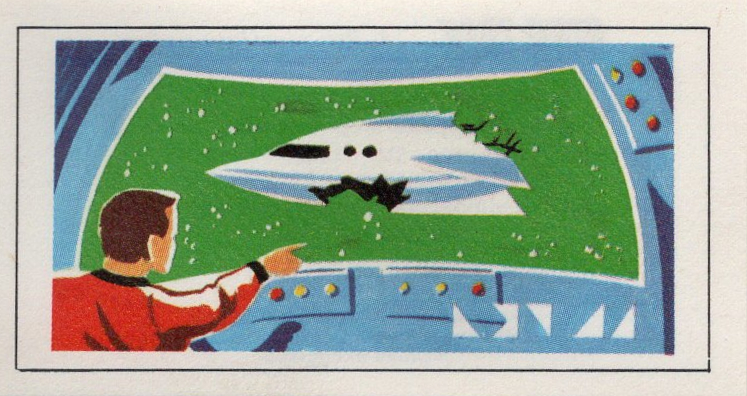
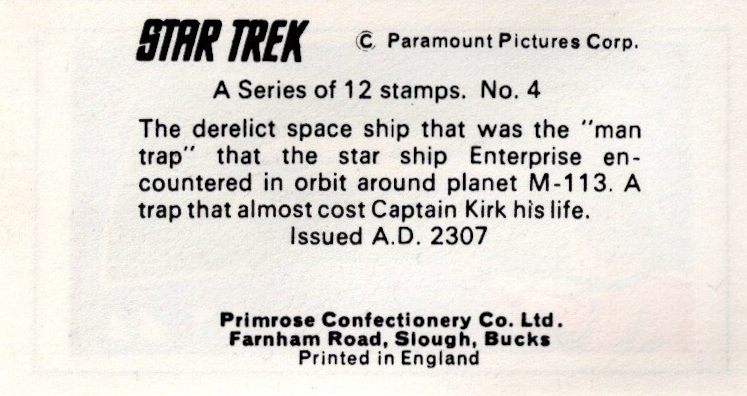


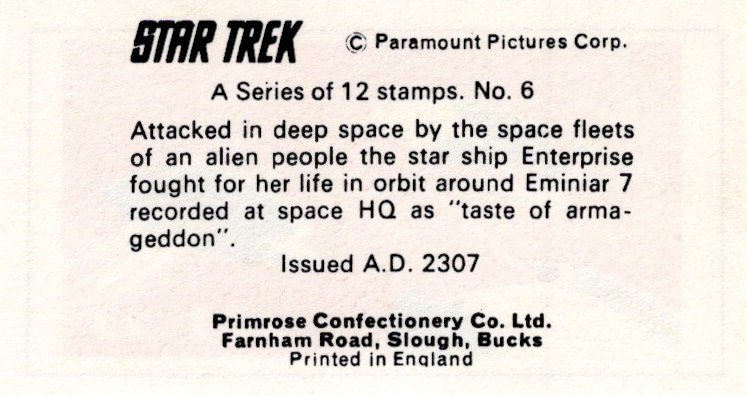
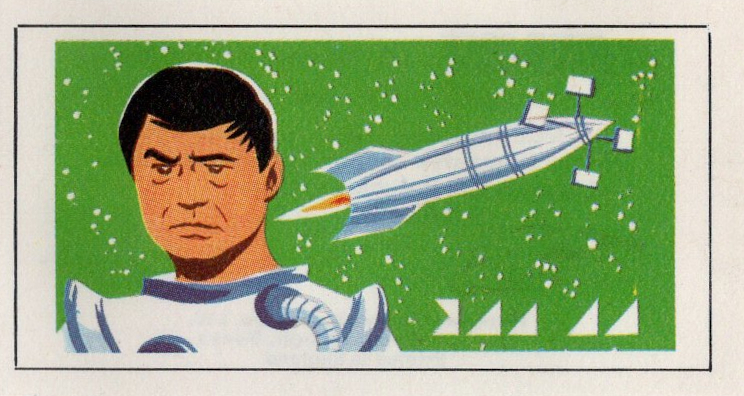

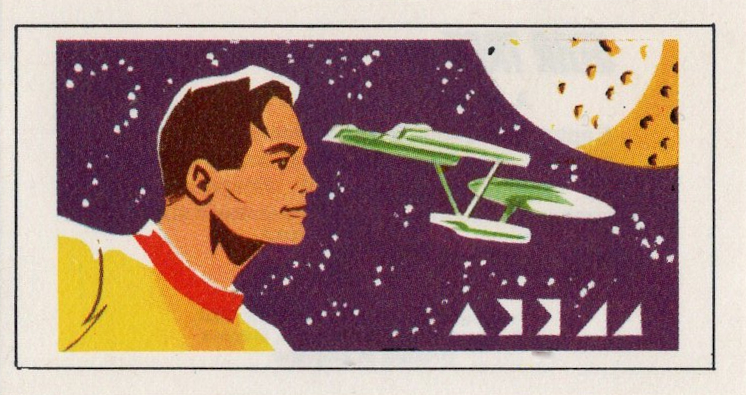
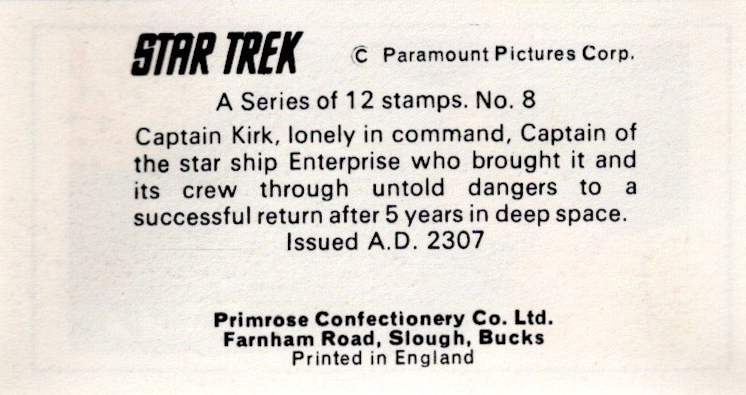
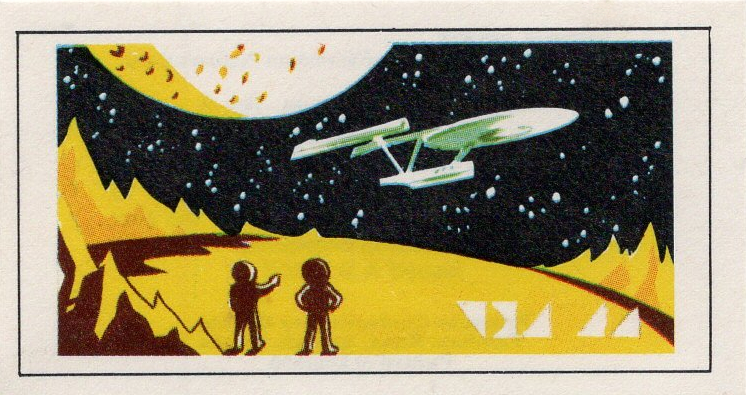


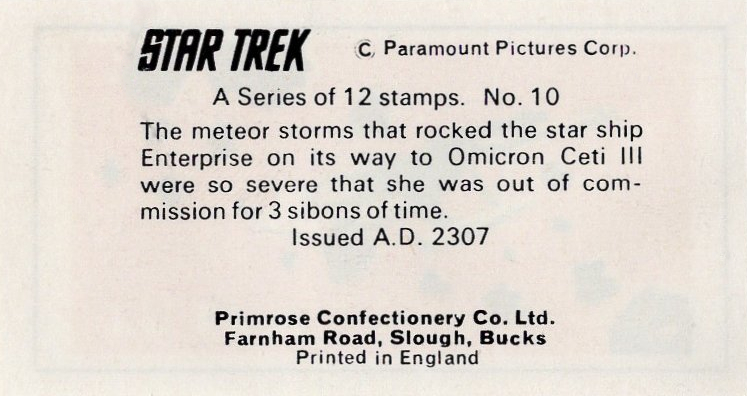


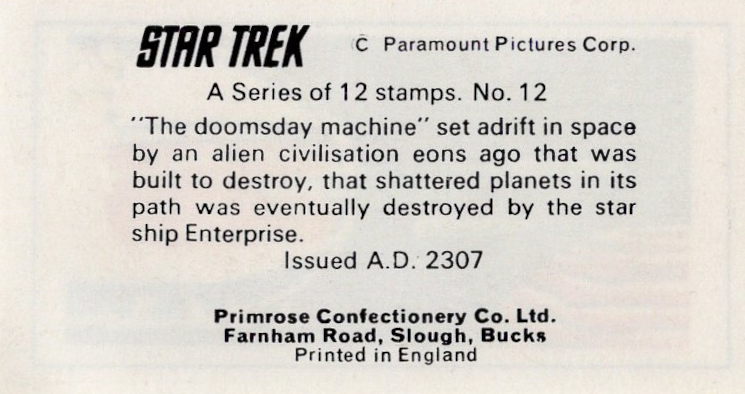
The funniest bit about the text on the back is that you would expect it to either be accurate or completely made up, yet all are a hybrid, with most pairing an actual episode name and maybe a planet with some nonsense about the plot. Also, none of the episode names are capitalized. My favourite stories are:
- operation annihilate, in which Dr. McCoy is for some reason drifting in space around the planet Deneva
- man trap, when a derelict ship in orbit around M-113 almost killed Captain Kirk
- the meteor storm near Omicron Ceti III (plucked from This Side of Paradise) that knocked out the Enterprise for “3 sibons of time.”
It’s also amusing that the rewording of Kirk’s opening narration on card 11 corrected the famous split infinitive.
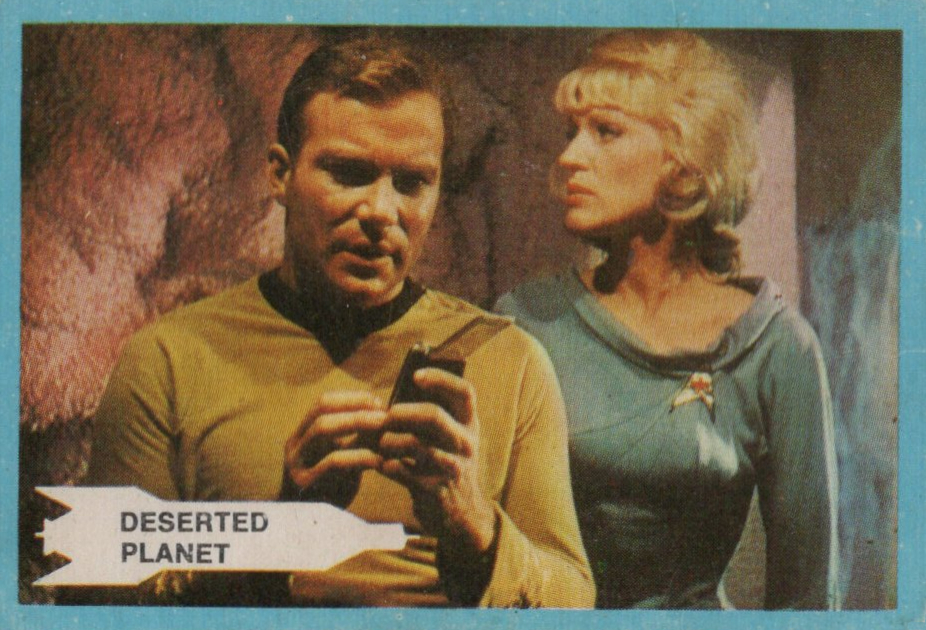
An A&BC card The cards were printed on thin paper and measure 6.4 x 3.4 cm. Sets are fairly rare but, at time of writing, the London Cigarette Card Company has all 12 for a very reasonable £12. That same seller wants £720 for the A&BC set from 1969, which is good news for me and one other collector I know, as we both own that set.
-
The best part of The Enemy Within came from Roddenberry
Richard Matheson’s The Enemy Within was a good story. Gene Roddenberry made it great.
The episode we see on screen is a thoughtful examination of human duality, of the balance between the positive and negative impulses and qualities that make up humans. We learn that we cannot function without this balance.
That central meaning was missing in Richard Matheson’s story outlines and in his first draft script. In those versions of the story, the “double,” as the second iteration of Kirk is called, is evil but there is no explanation of why, while the “good” Kirk is essentially unchanged except that both are physically weak, as if their strength has been halved. There is even the suggestion that the two have lost mass in the split, an idea that Roddenberry and others dismissed as the Kirks would then have to appear physically smaller on screen.
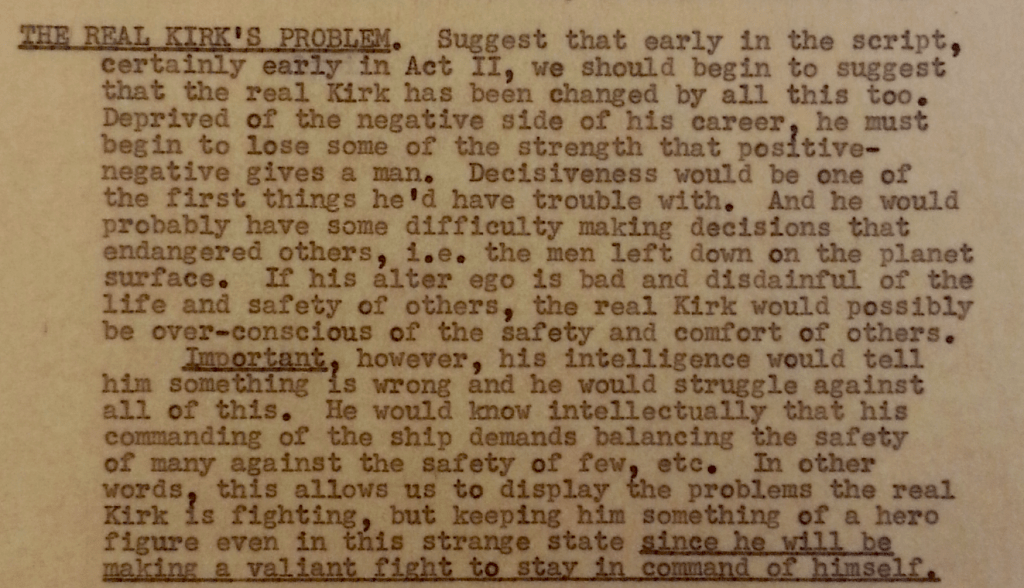
Matheson submitted his first story outline in early April 1966, with a revised version delivered about two weeks later. His first script was dated April 25. On April 26, Roddenberry sent a memo to Matheson with a number of suggested improvements. The most interesting one, and the idea that absolutely elevates the story, is that both Kirks have suffered a loss. He wrote:
…we should begin to suggest that the real Kirk has been changed by all this too. Deprived of the negative side of his career, he must begin to lose some of the strength that positive-negative gives a man. Decisiveness would be one of the first things he’d have trouble with.
Important, however, his intelligence would tell him something is wrong and he would struggle against all of this. He would know intellectually that his commanding of the ship demands balancing the safety of many against the safety of few, etc.
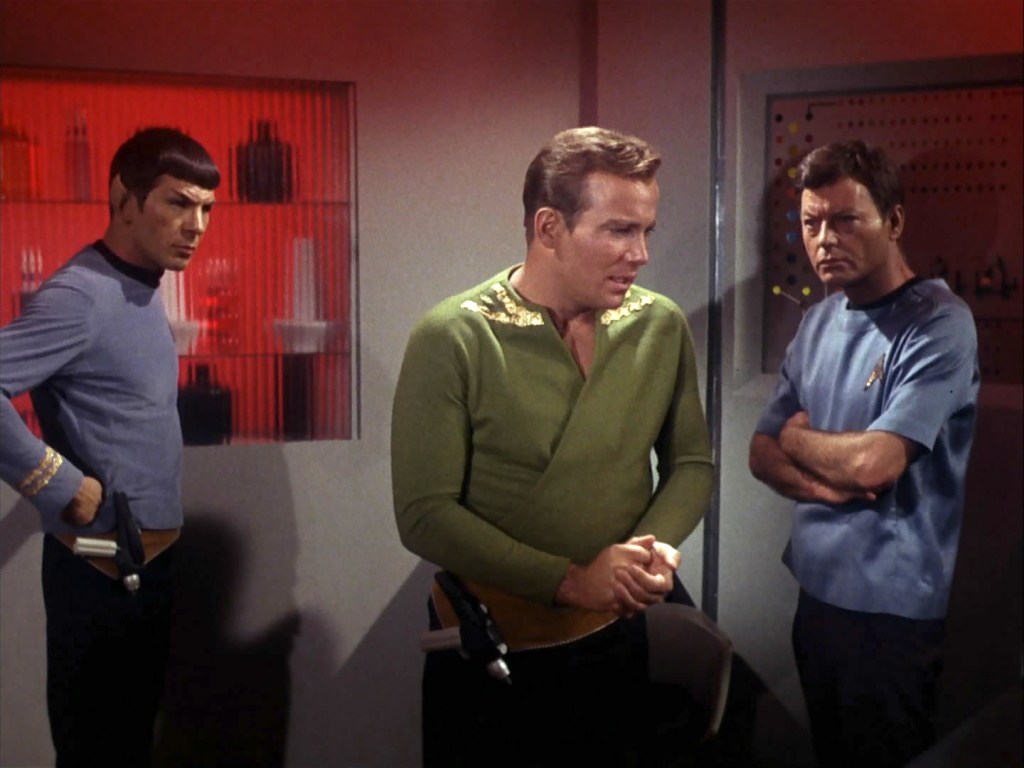
We see this idea play out exactly as Roddenberry suggested halfway through the screened episode, with the “good” Kirk talking to McCoy and Spock while the other is strapped to a bed in sickbay:
Spock: We have here an unusual opportunity to appraise the human mind, or to examine, in Earth terms, the roles of good and evil in a man. His negative side, which you call hostility, lust, violence, and his positive side, which Earth people express as compassion, love, tenderness.
McCoy: It’s the Captain’s guts you’re analysing. Are you aware of that, Spock?
Spock: Yes, and what is it that makes one man an exceptional leader? We see indications that it’s his negative side which makes him strong, that his evil side, if you will, properly controlled and disciplined, is vital to his strength. Your negative side removed from you, the power of command begins to elude you.
Kirk: What is your point, Mister Spock?
Spock: If your power of command continues to weaken, you’ll soon be unable to function as Captain. You must be prepared for that.
McCoy: You have your intellect, Jim. You can fight with that!
Roddenberry’s examination of what it means to be human is far more interesting than Matheson’s take, which towards the end of his story was closer to a monster hunt.
Input from NBC
Stan Robertson was an NBC executive and the Program Manager for Star Trek. While typically an annoyance to the producers, he often had good ideas. That was not the case with this episode, however.
His June 10, 1966 memo, written four days before the cameras rolled on Enemy, offered feedback that would have ruined the episode. He wrote to Roddenberry:
We would further suggest at this time:
1. That there be frequent intervals during the telling of our story in which we make it clearly understood that the “Alter Ego” is not the “real” Kirk, but only a manifestation of some technical failure in the Transporter device which caused “unexplained” changes to occur in anything passing through.
2. That we minimize or eliminate completely the weakness in the “real” Kirk, such as the failure of his ability to make command decisions in the face of the appearance of his “Alter Ego”. We would think that, confronted with this great challenge, he would rise to greater heroic heights, be more definite, the complete antithesis of the “Alter Ego”.
3. That there be a definite resolution in the story of the “Alter Ego”, clearly indicating that he is dead and gone for all times. Further, that what has occurred could have happened to anyone and does not necessarily indicate that the negative qualities, as materialized in the “Alter Ego”, are the secret inner cravings of our hero.


This is the opposite of everything Roddenberry was trying to do with the episode and would have drained all meaning from it.
But the worst bit made it through
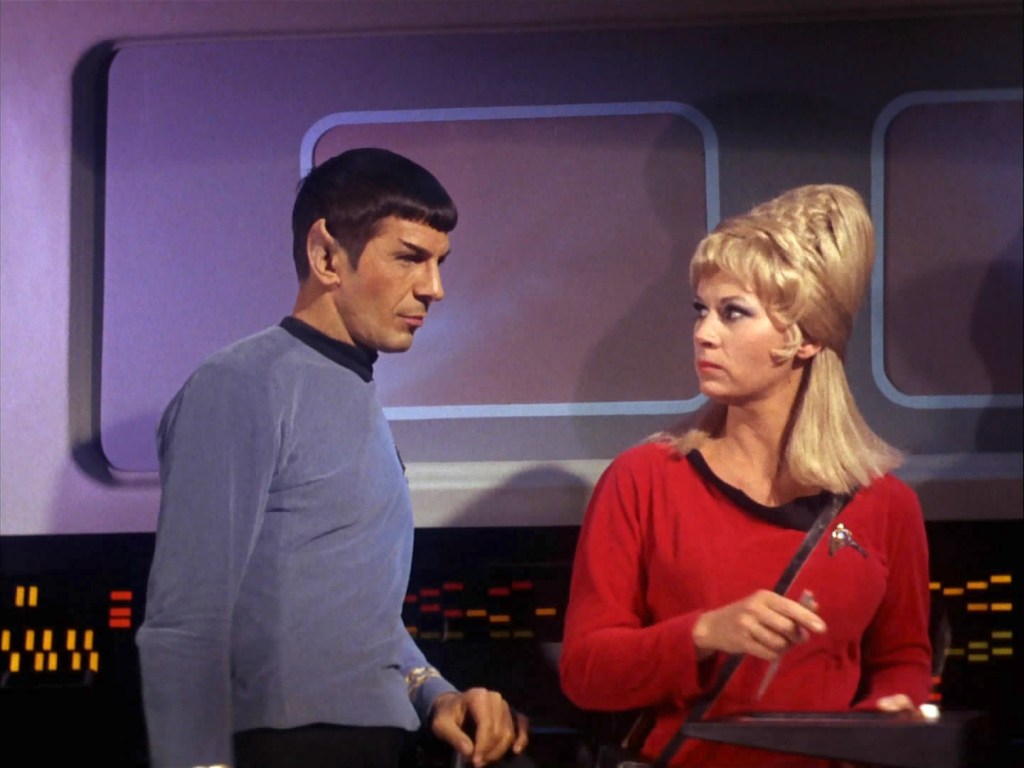
The Enemy Within is a great episode of Star Trek — except for the bit at the end. In the final scene on the bridge, a smirking Mr. Spock makes a grievously inappropriate comment to Yeoman Rand. Shortly after she is almost raped by her captain, the first officer suggests to her that “The imposter had some interesting qualities, wouldn’t you say, Yeoman?”
That same message was included in Matheson’s story outline, except this time he put the offensive words in Rand’s mouth. Kirk has just said that he needs his “darker side” and that “The challenge is to master that side, wishing neither to destroy it nor to flee from it.” He then asks Rand “Isn’t that right?” to which she replies:
“Yes,” she answers. “It would be a shame to destroy it.” Is that a twinkle in her eye? “It has some very interesting qualities.”
Both versions of this scene are just gross. Roddenberry’ understanding of character and the conviction he showed in ignoring NBC’s notes elevated this episode. If only he could have also ditched this misogyny.
-
So, where is Engineering?

Sci-fi novelist and Star Trek uber fan Robert J. Sawyer got me thinking recently about the Engineering section on the original NCC-1701 and its sister ships. On his Facebook page, Rob made an excellent point:
Ever wonder what that forced-perspective thing behind the grill in Engineering is supposed to represent?
There’s really no doubt; it’s canonically answered in THE DOOMSDAY MACHINE. Scanning the one in the identical Engineering Room aboard the ENTERPRISE’s sister ship, the U.S.S. CONSTELLATION, Scotty refers to it as one of the impulse engines.
The relevant dialog:
KIRK [in the Constellation’s Auxiliary Control room]: “Scotty, where’s that power?”
SCOTT [crouching in front of the forced-perspective set component and scanning it with his trident scanner]: “Coming, sir. If I push these impulse engines too hard in the condition they’re in, they’ll blow apart.”
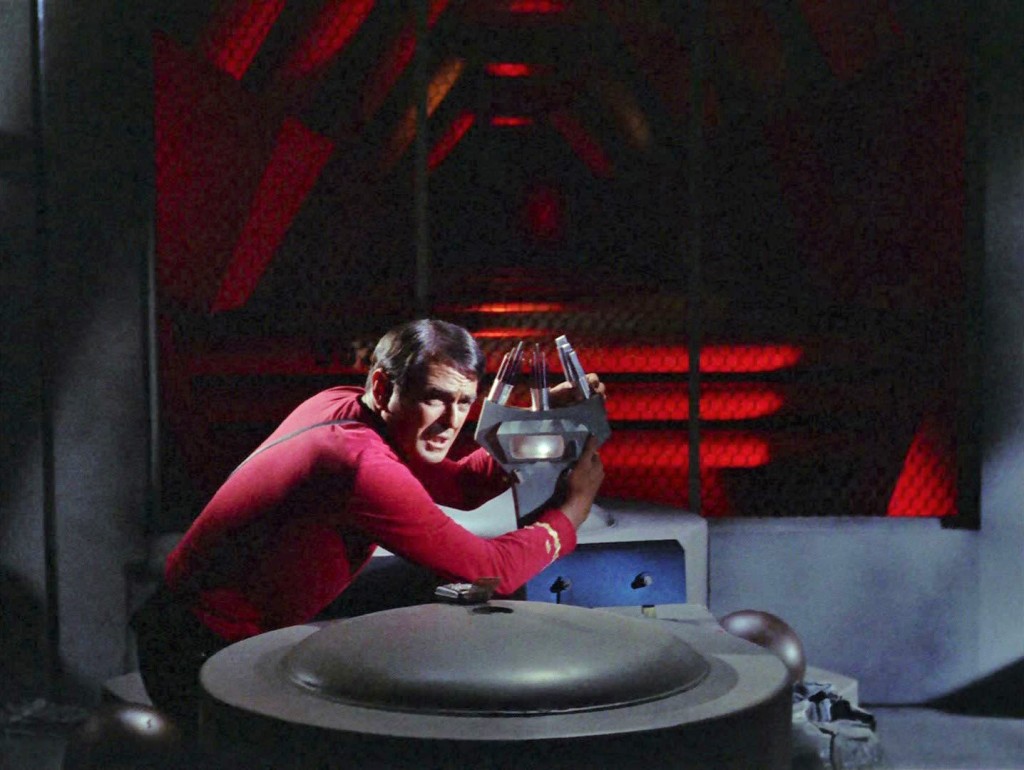
The Doomsday Machine I can’t argue with Scotty. The dialogue is right there. But I always figured that section of Engineering was the warp core, a horizontal version of the vertical design we see on the Enterprise D and the Voyager. The core in Star Trek: The Motion Picture seems to be a hybrid or transitional design.

The 1701-D 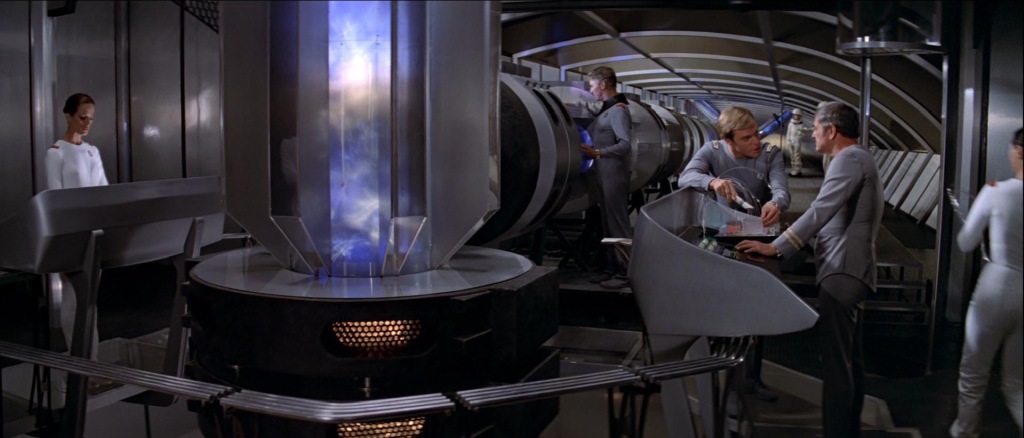
The Motion Picture And that belief was supported by Enterprise, which suggested horizontal warp cores were an early design, later replaced with vertical alignments.
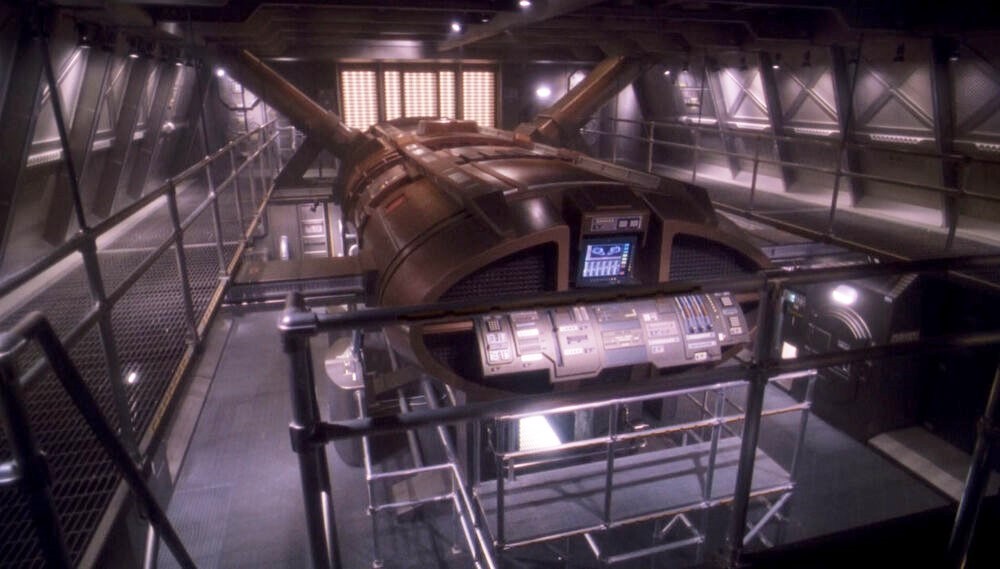
The Enterprise NX-01 Also, the lit conduits visible in this later scene from The Doomsday Machine look like the ring-shaped pipes on the D’s warp core.

The Doomsday Machine It is possible, of course, to explain away the dialogue in The Doomsday Machine. Perhaps Scotty was scanning the warp core when Kirk called down and his comment about the impulse engines was unrelated to his specific location at that time. Or (likely the real reason) director Marc Daniels thought the shot would look good against that section of the set, and didn’t wonder if the placement made sense.
But the thing about adhering to what is seen on screen is you have to adhere to it.
And the location fits
The proposition that the equipment seen in The Doomsday Machine is not the warp core is supported by the relative locations of Engineering and the impulse engines. While the placement of neither is specified on screen, The Making of Star Trek (which I consider to be just slightly less authoritative than the screened episodes) has this to say on page 171:
The primary hull is 417 feet in diameter and is 11 decks thick through the middle. Designed to operate separately from the rest of the ship, the saucer therefore contains all elements necessary for independent operation.
Propulsion for the primary hull is provided by impulse power. The impulse engine section is located at the bottom rear end of the saucer. Headquarters for the engineering division is also located in the same area, as are main engineering control facilities plus sufficient repair, storage, and other facilities to service the primary section when detached from the stardrive sections of the vessel.
That seems definitive: main Engineering is adjacent to the impulse engines. Also, fans who grew up in the 1970s saw this proximity in the Star Trek Blueprints by Franz Joseph and on the diagram printed on the AMT Enterprise box.
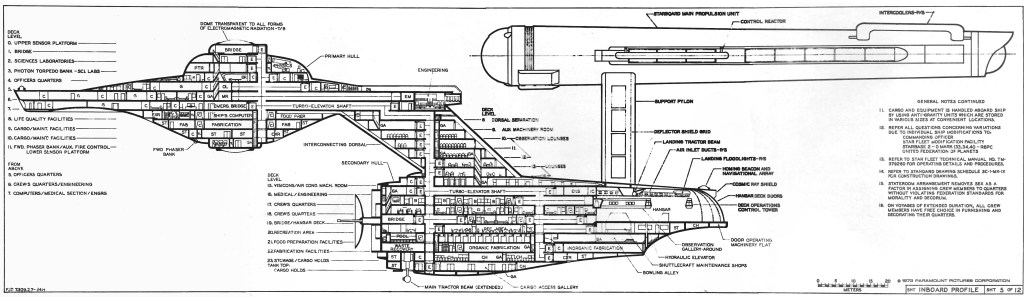


Those sources are not canon but they agree with The Making of Star Trek.
Which means Scotty worked in the saucer section
When I first started watching TOS, I figured engineering was in the secondary hull because the warp engines attach to it. But a few years later I studied the Making of and the blueprints as if I had to sit an exam on them, so I learned better.
But I never connected that scene in The Doomsday Machine to the impulse engines. Thanks, Rob.
But wait a minute
A friend in Trek, Subcommander Tal on Twitter, also made a good point, in response to this piece: at the end of Day of the Dove, the entity flees Engineering and exits into space at the forward end of the secondary hull. That shows Engineering is in the secondary hull.
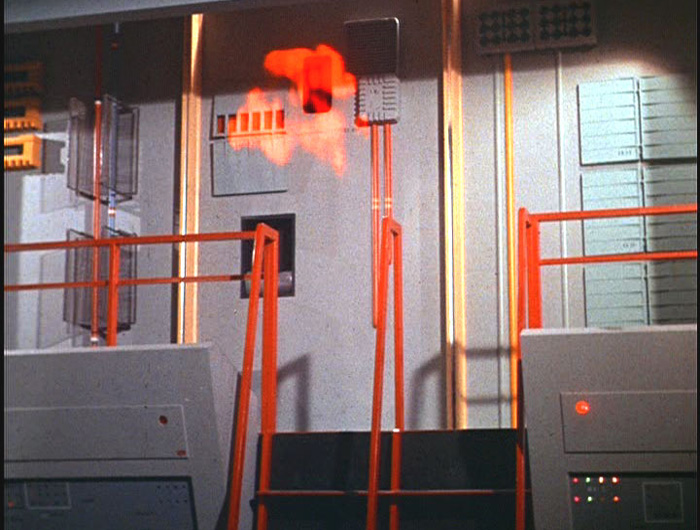
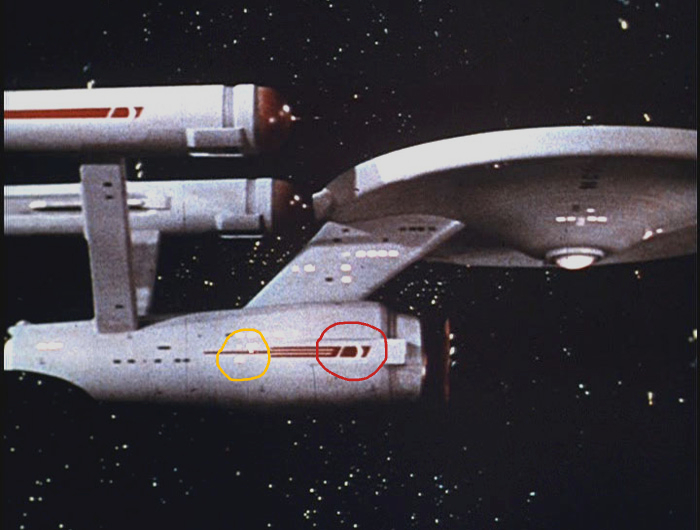
The red circle is where the entity exits the ship. The yellow circle is the entity itself.
But, again, there is evidence on the other side. In the same episode, just after Mara leaves Engineering to sabotage the main life-support couplings, we see her walking down a curved corridor — which means Engineering is in the saucer section.

And I recently watched The Paradise Syndrome for the first time in a while (and I was surprised how little I liked the episode). Scotty looks towards the maybe warp core and reports to the bridge: “I can’t give you warp nine much longer, Mister Spock. These engines are beginning to show signs of stress.”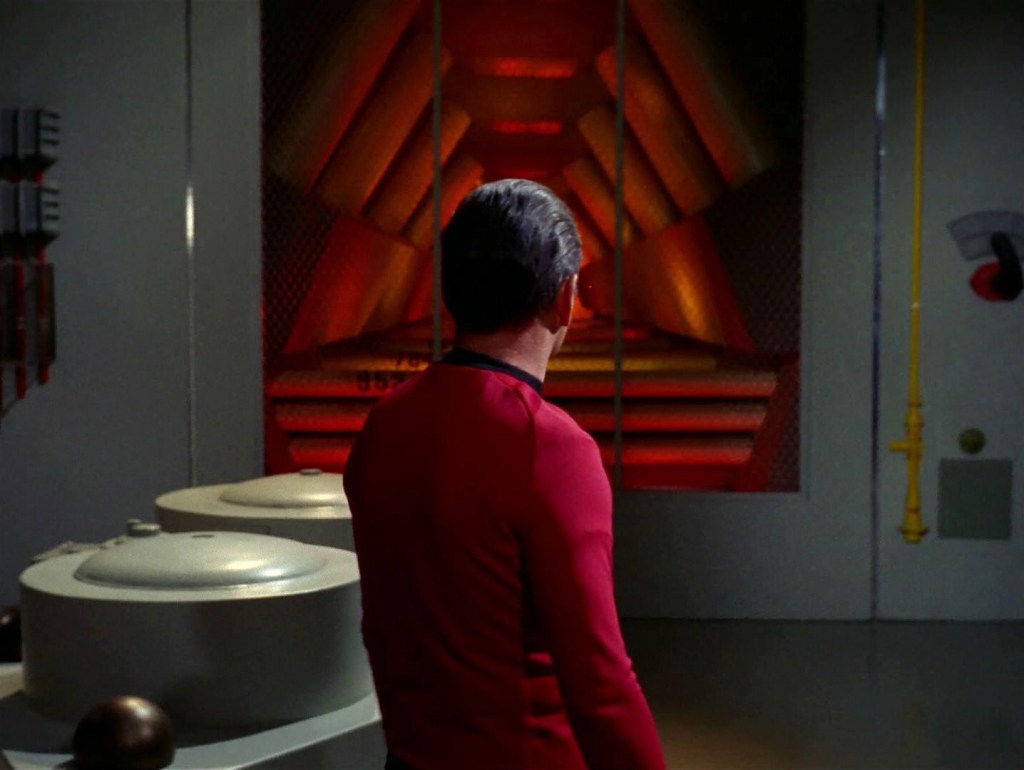
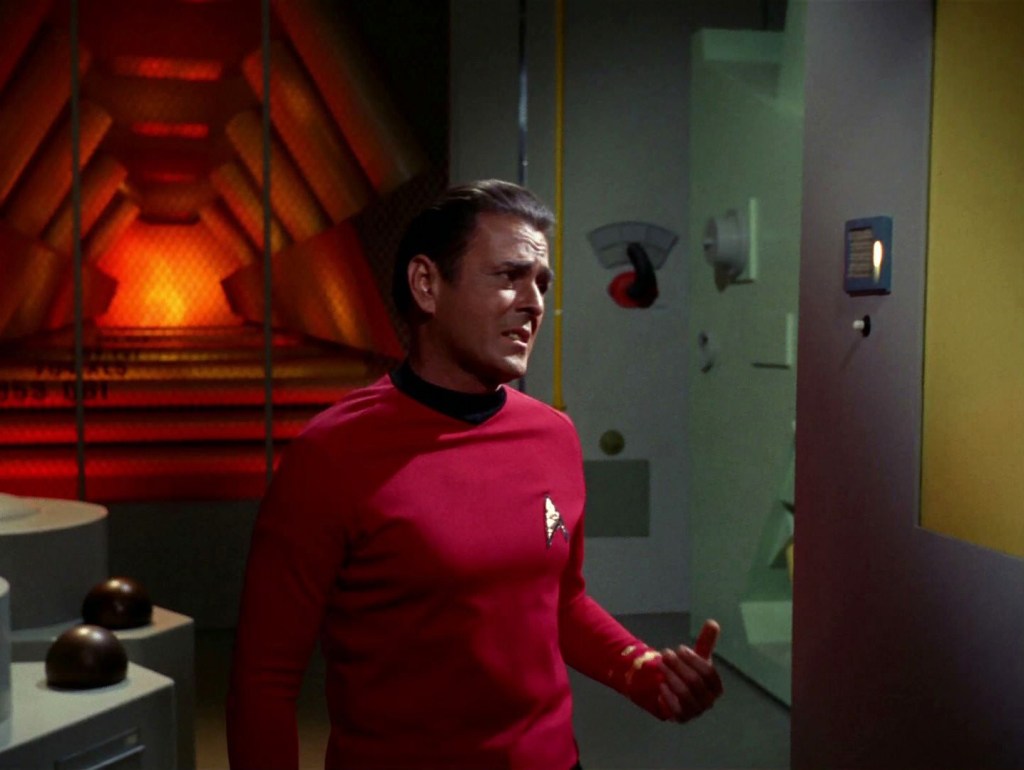
So the canon sources do not agree, and I think that means TOS fans can justifiably hold to either location for Engineering and can also choose whether that pulsating bank of equipment is the warp core or the impulse engines. My rule has always been that what we see on screen is the final word and that collectibles like the Star Trek Blueprints, the novels, and the model kits — beloved though they may be — are not reliable sources. However, I have always made an exception for The Making of Star Trek; as I said above, I consider it only a half step down from on-screen proof.
So now I don’t know where Engineering is. Locating it in the secondary hull still makes sense to me, but I also know that almost all the people who made TOS great were gone by the third season and that, in contrast, The Making of Star Trek was written at a time when the creative people were not only present but still had the energy to really care about the show. That book clearly states Engineering is in the primary hull and gives a good reason why those control systems are there: “Designed to operate separately from the rest of the ship, the saucer therefore contains all elements necessary for independent operation.”
That is logical and perhaps takes precedence over what we see in the haphazard third season. Perhaps.
Collecting Trek
A TOS collection 40 years in the making