-
Matt Jefferies made Star Trek look believable
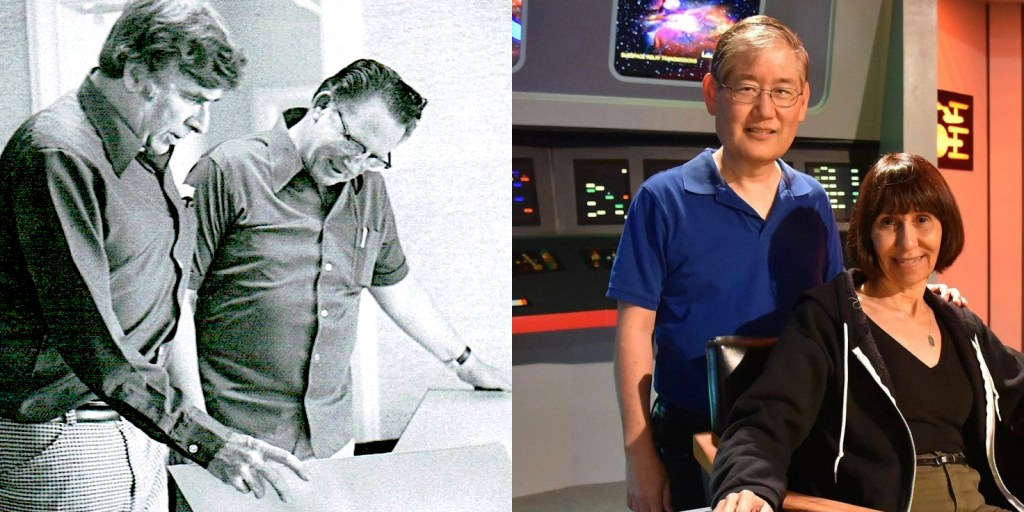
Matt Jefferies is a hero. He created the world Star Trek inhabits, starting with the Enterprise. Gene Roddenberry made it clear he did not want a rocket ship, and Matt executed on that vision. And, while he is rightly lauded for creating the best ship in all of science fiction, his greatest contribution was actually the sets he designed for the story of the week.
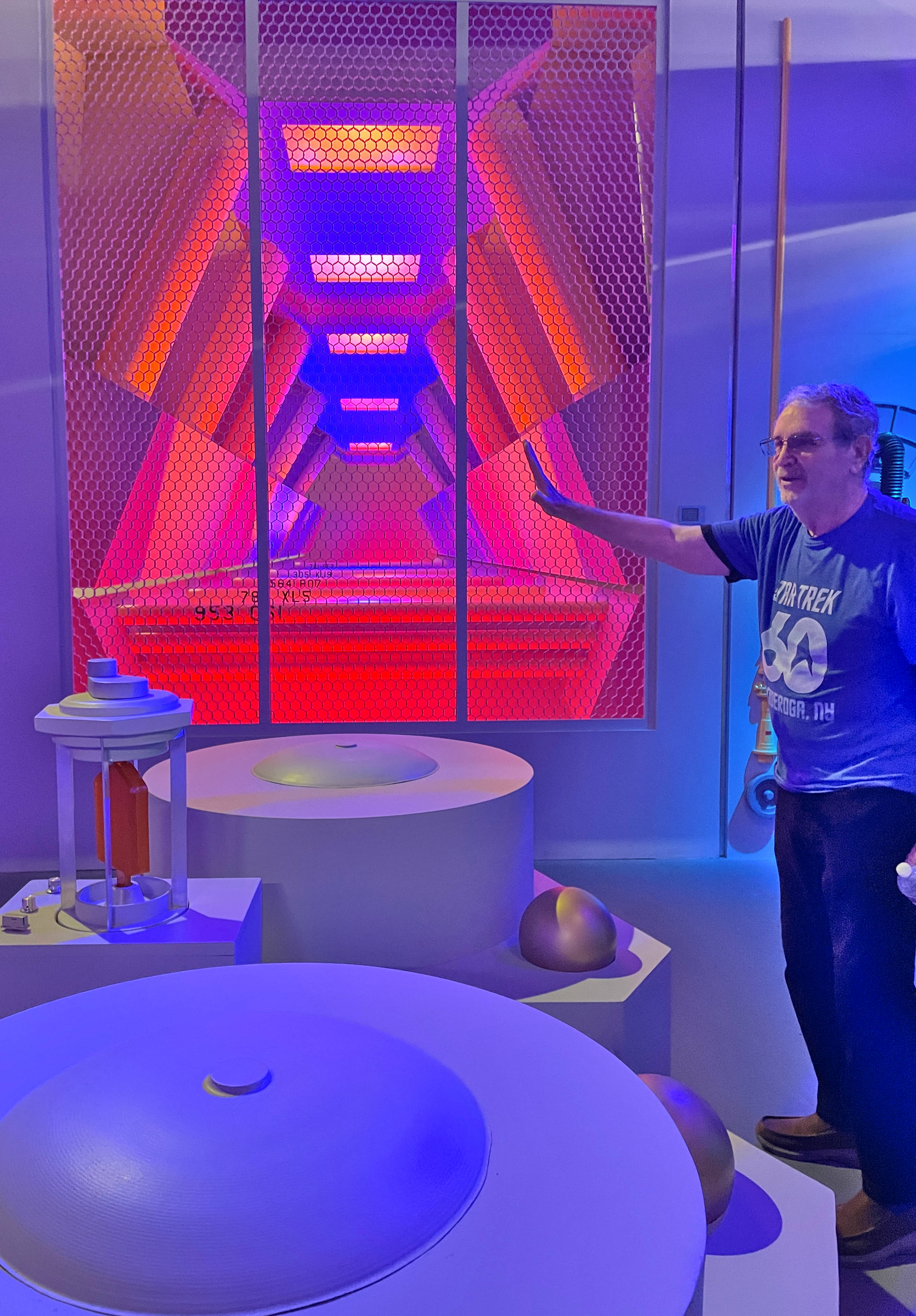
I was invited to speak again at the Star Trek Original Series Set Tour in Ticonderoga, NY, this September. Michael and Denise Okuda were there, with other celebrity guests including George Takei, Jonathan Frakes, Brent Spiner, David Gerrold, Robin Curtis, and Bjo Trimble. Mike and Denise are Star Trek design royalty themselves, and therefore uniquely qualified to talk about Matt Jefferies.
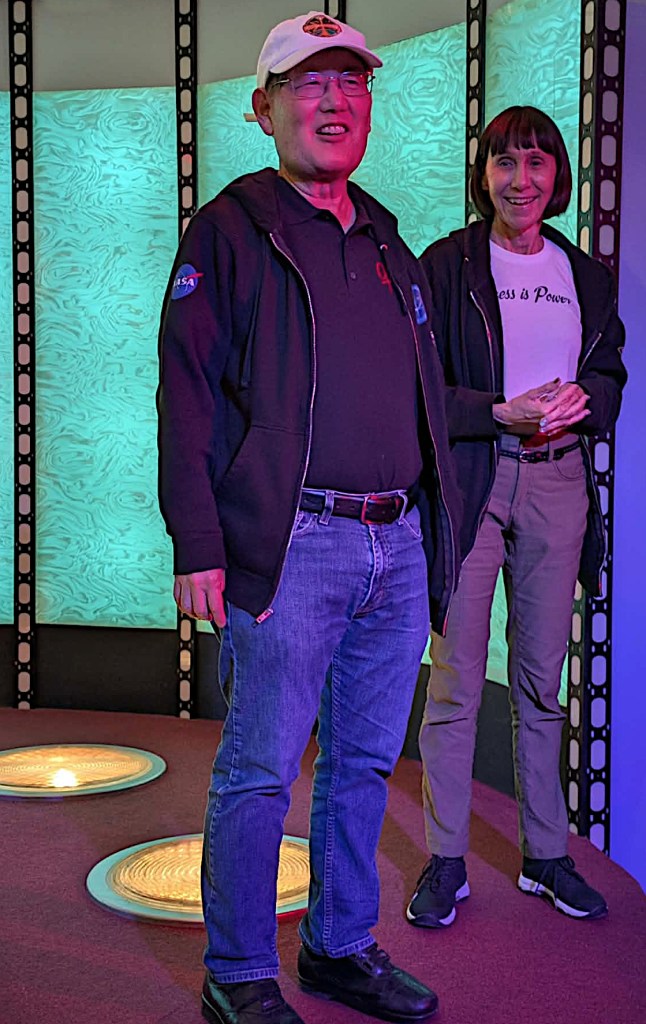
Photo by Bill Kobylak Here is an edited transcript of our conversation.
Do we all agree that Matt created the most beautiful ship in all of science fiction?
Denise: Yes, in our opinion.
Michael: There is no doubt. And it is not just that it is a beautiful design. Matt Jefferies had an impossible task. He needed to show a spaceship that was so far advanced over anything that was current…yet he had no idea how it was powered or how it would operate. He had to come up with something that was distinctive from everything that had come before and yet it had to have an air of believability. Because of his artistic design sense and his use of aircraft logic, that ship is absolutely distinctive.
Put another way, one of the things that artists fear the most is the blank page, and no artist in film or television has ever faced a page as blank as Matt Jefferies did when Gene Roddenberry said: I don’t care how you design it, just make it look like it has power and I don’t want to see rocket engines or fins or anything like that.
Matt came up with a solution that not only worked well then but works well today.
Tell me about his design philosophy.
Michael: A lot of what we think of as futuristic design, especially back in that period, was either very curvy or was very busy, with lots of stuff. And both of those are relatively expensive: curved structures and curved shapes are inherently more expensive to fabricate than straight lines, and lots of intricate controls and meters and dials and gauges are expensive, not just to buy but to wire up and rig.
That is something Matt could not afford, on the budget and the schedule. So Matt thought outside of the box: he decided that space flight is so advanced that it becomes simple. So the hallmark of what he did in the original Star Trek is he had immensely simple designs. It looked like it had great thought behind it and great functionality. It wasn’t interesting shapes for the sake of looking cool; instead, you had the sense that it was there for a reason. That helped you believe in the ship and therefore in the show.
Denise: Michael and I are attracted to simplicity of design, and that is Matt Jefferies. They could not afford to use the latest and greatest toggle switches or whatever, they had to think of something they could do within the time and budget. The result is that 60 years later, it is not dated. It is a unique look but it is not dated.
Michael: If you look at the hallmark of high technology and space flight at the time, that was Mission Control in Houston. Look at those panels: there were push buttons and toggle switches, and rotary handset telephones to communicate. Obviously this was well designed — it literally got us to the Moon. But if they had used that latest-and-greatest technology on the Enterprise, it would be long obsolete (by now). Instead, Matt took a rather strange style, these screens with blinky icons and the jelly beans (buttons), and he said “That’s the future.” He was consistent with it, he did it with aircraft logic, and it still holds up today.
So the design was attractive but also practical?
Michael: Yes. For example, when we talked to Matt about the Enterprise design, he wanted the hull to be smooth. He didn’t want stuff sticking out. His argument was that space is a dangerous environment, so design the ship so that everything could be performed from the inside. That made the exterior of the ship look simpler and cleaner, and whenever anything goes wrong, we do [repairs] from inside the ship.
That was visionary on his part, but it was also practical, as they wanted to avoid space-suit scenes.
Doug Drexler told me he had the same thought about repairs with his NX-01 design for Enterprise.
Michael: Right, because he wanted to echo what Matt had done.
Doug probably also touched on this, but one of the criticisms of the Enterprise design is that if those engines were rockets and you were to start them up, the ship would tumble. There are those who say that Matt should have thought this through better. I entirely disagree. To me, that means the Enterprise operates on principles of physics that have not yet been discovered, and that speaks to that ship being so advanced.
As proud as I am to have worked on the Enterprise D and other Enterprises, most of those have really strong pylons, so I can see they’re paying homage to the design heritage but I think they miss something.
And there is a timeless quality to the TOS look.
Michael: Yes. Another example is the opening of Star Trek II, The Wrath of Khan: they had that wire-frame video on the bridge with the Enterprise. At the time it was very cool, it was state of the art; they used an Evans & Sutherland vector computer, which was bleeding-edge technology at the time. But now it looks quaint. I still love the movie, and I admire them for being able to pull that off because I loved it at the time, but it doesn’t hold up as well as what Matt did with much smaller resources.

We don’t know much about Matt. Tell me about him as a person.
Michael: He was immensely talented and a little befuddled by the adulation he received. He was proud of his work, but…
Denise: He was bemused that people paid such close attention to the designs and were so curious about them. He was humble but I also think he looked at it as just a project he worked on. He was proud of it but it was a job and then he moved on to Little House on the Prairie. He wasn’t flippant about it, but he was bemused.
Michael: Matt was also a little intimidated by fans. Fans would come up and say “What does that little square do? What about that circle? Is that the tractor beam?” He instinctively did things that looked credible and looked like it belonged there, but if you ask about the specifics or how it operates — his job was not to figure that out. Had he taken the time to figure that out he absolutely could have, but if he had taken that time he would have had to ignore the 157 other things the art director had to do that morning.

But you two are Star Trek fans yourself, so you do understand why we fans want to talk to you?
Michael: I am still bemused because we are not Matt Jefferies. Matt was singular, he was a visionary. We did our best to follow in that tradition.
Denise: People know that we are huge fans of Star Trek, especially the original series. We are so much like [all the other fans]. Fans are friends you have not met, and it is always very flattering when people want to hear what we have to say.
We tend to associate Matt with the Enterprise, but he was primarily a set designer.
Michael: That is absolutely correct. Matt was hired on The Cage as a set designer. Matt’s initial assignment was to design the bridge and the ship.
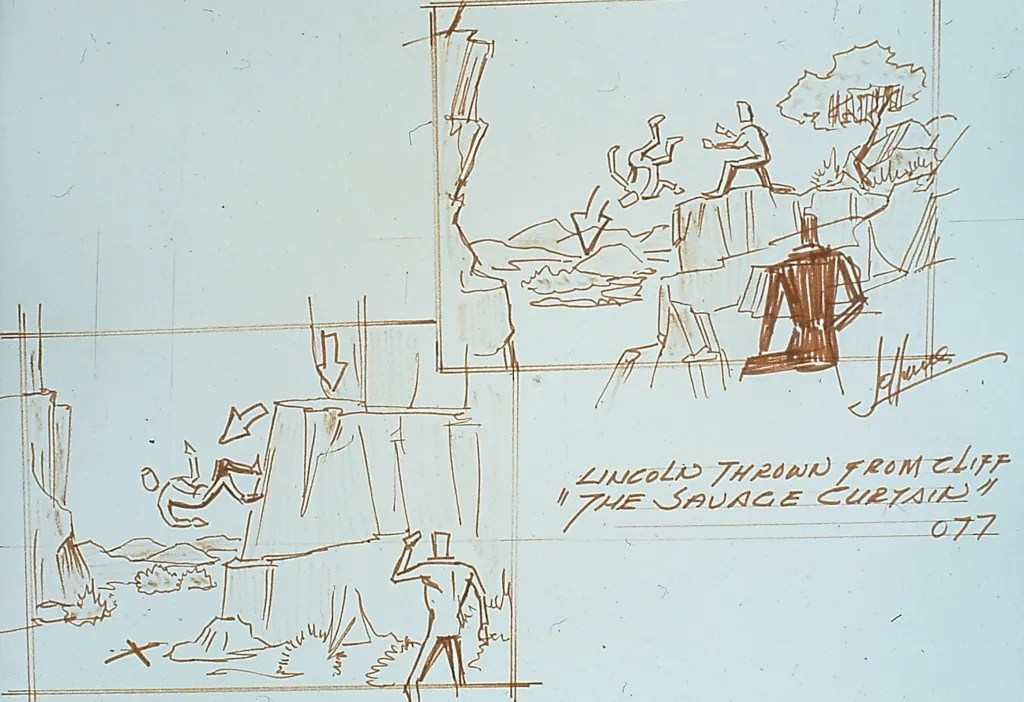
In The Savage Curtain, for example, Lincoln was originally thrown down a cliff and Matt had to design that.
Michael: Matt also filled the job of illustrator on the show. That job is not to make pretty pictures but to visualize how you are going to shoot something. Is there enough space to throw the guy? Can we reuse set pieces to do that? They are principally about problem solving, not art for art’s sake.
Has Star Trek been loyal to Matt Jefferies’ design ideas?
Michael: The job of each Star Trek project is to give itself its own identity, so by definition you are going to do something different than what Matt did. The challenge is to do that in a way that pays respect to what Matt did and not violate it egregiously.
I never asked Matt what he thought of what we did on The Next Generation. I would like to think he respected what we did.
How does Matt’s vision inform your own work?
Denise: It has to be at the forefront of our brains. We were raised on Star Trek, and we admired Matt Jefferies. Again, simplicity of design. It is with us at all times.
Michael: What she said.
Are there any other Matt stories you want to share?
Michael: Matt told us one of his favourite things to do was to hang out at the hangar at Santa Paula Airport. In the hangar was a loft, and when the original series wrapped he grabbed the two mattresses that were in Kirk and Spock’s quarters and for years when he and Mary Ann stayed there overnight they would sleep on those beds.
Denise and Michael had packed schedules at Trekonderoga and lots of people wanted to talk to them. I very much appreciate that they found time to speak with me, before they themselves headed to an airport.
Postscript
One of the few times we can see Matt Jefferies talk about his work on Star Trek is in this video of his conversation with Doug Drexler and Michael and Denise. “I wanted to record his voice,” Michael told me. “I knew Doug would bring that fabulous reference folder and I wanted to see what he was pointing at. That’s why I shot the video.”
-
My dinner with David Gerrold
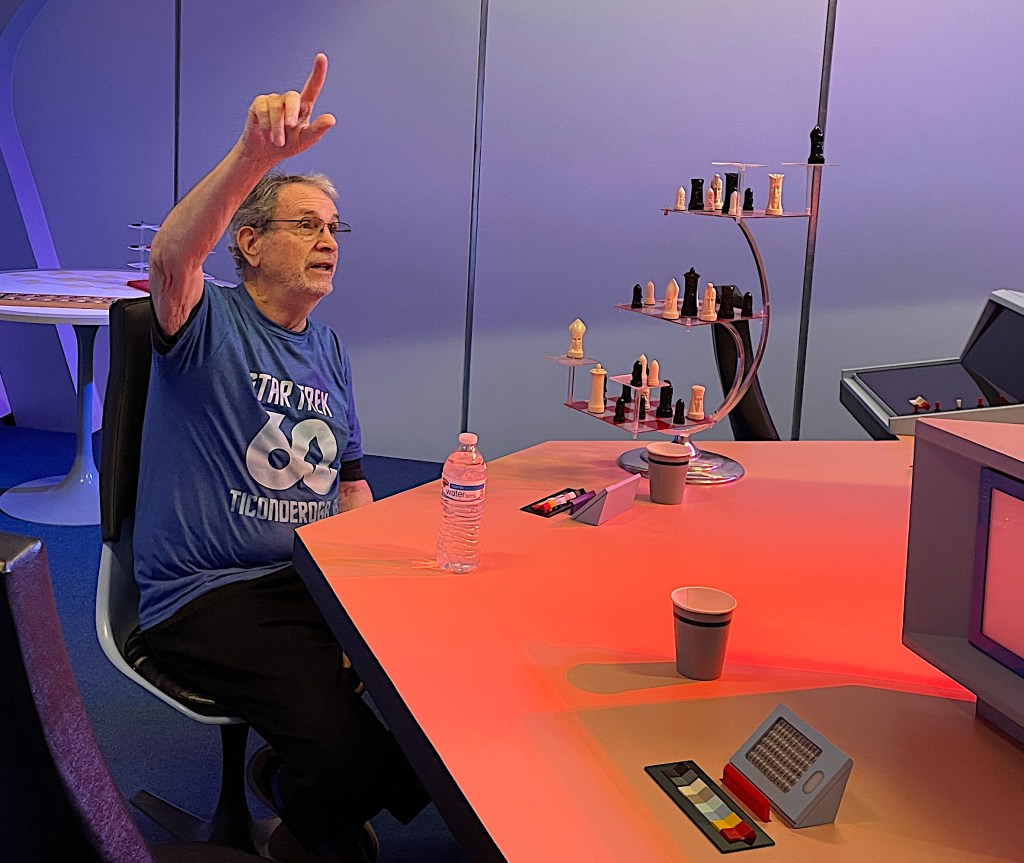
I am very fortunate in my friends. A good example is an email I received this past June from sci-fi novelist and Star Trek fan Robert J. Sawyer. Rob and his wife Carolyn were planning a dinner with David Gerrold, and he asked me to join them. “Let me know if that works for you,” Rob wrote.
It did, indeed, work for me. The dinner setting was the big 60th anniversary celebration at the Star Trek Original Series Set Tour in Ticonderoga, NY. Rob and I had been invited to give talks, and we were in great company: the celebrity guest list included William Shatner, BarBara Luna, Louise Sorel, Nancy Kovack, France Nuyen, Phil Morris, Clint Howard, and Pamelyn Ferdin. And David Gerrold, Star Trek royalty and Rob’s longtime friend. (See also my article on their book Boarding the Enterprise.)
I spent the week before Ticonderoga rereading David’s The World of Star Trek, published in 1973. It’s a book I loved as a teen but hadn’t read in years. I am pleased to say it holds up. It’s an important early non-fiction work; I also wrote an article on the book itself.
But back to dinner. A few hours before we were to gather, I asked Rob if it would be okay to request an interview with David during the meal. I wanted to discuss The World of Star Trek but I didn’t know if that was proper dinner behaviour. Ask him, Rob said, and so I did. And I asked if I could record the conversation.
David talked to me between entrée and cappuccino about one of the foundational works of Star Trek scholarship. Here is an edited transcript.
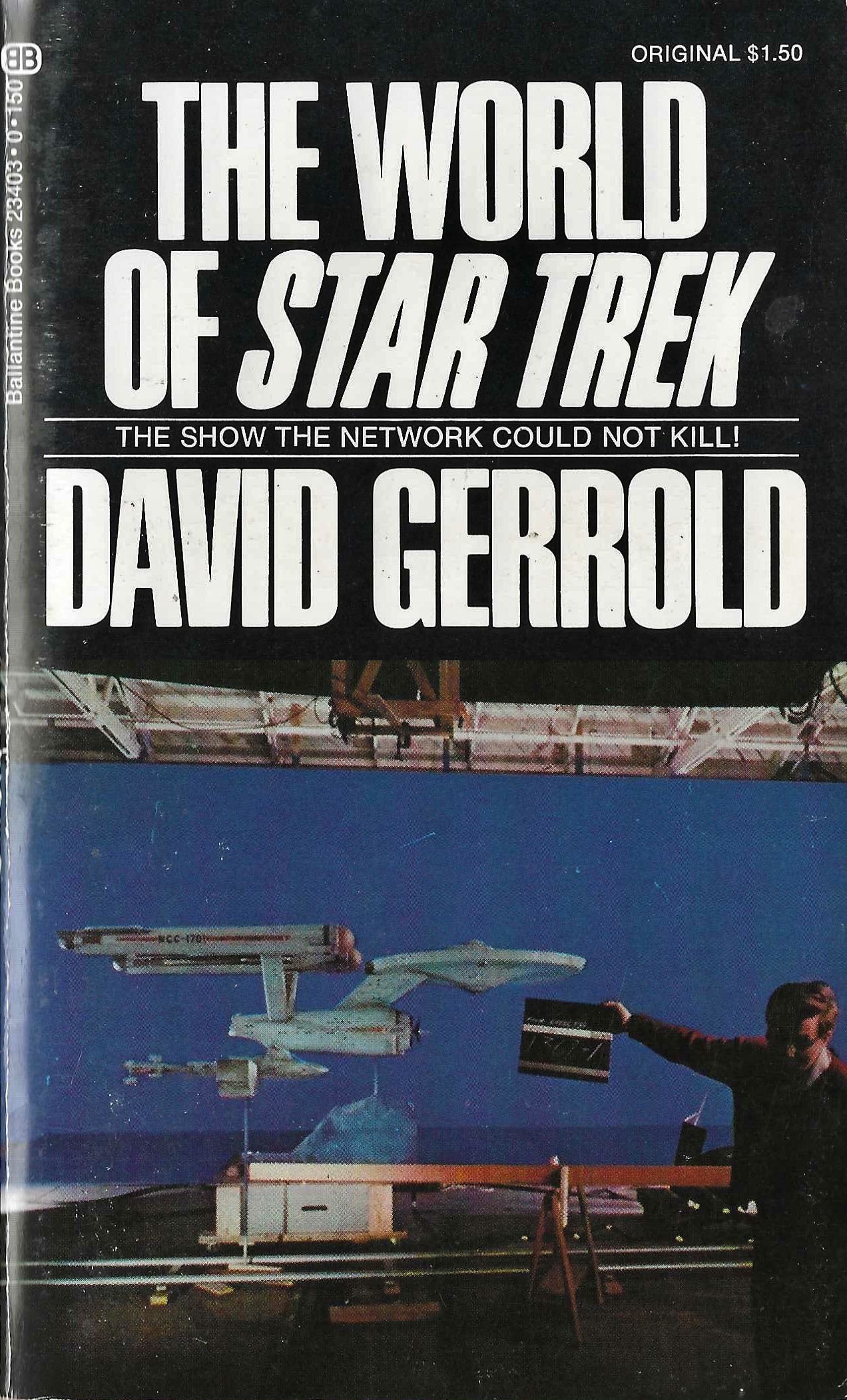
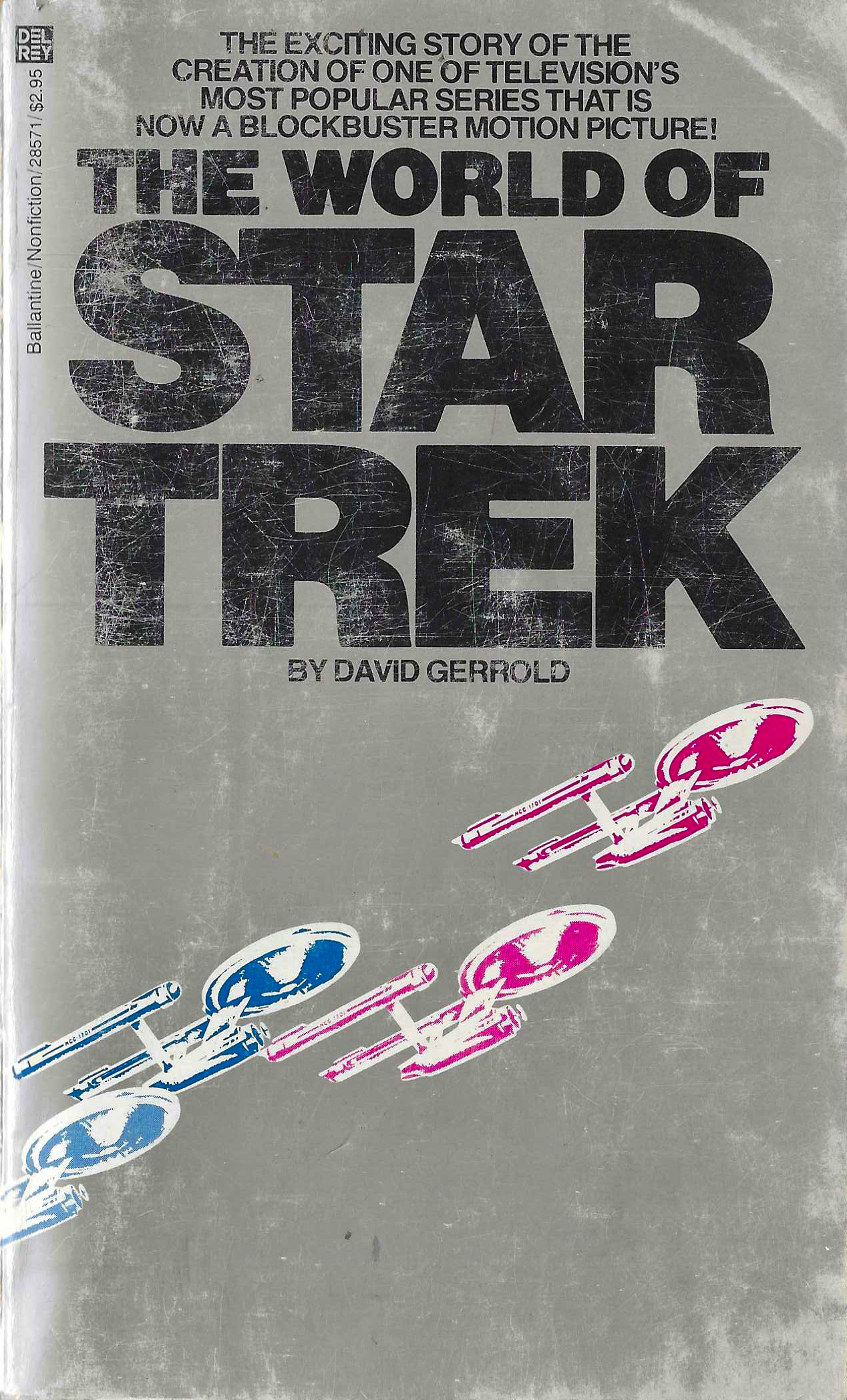
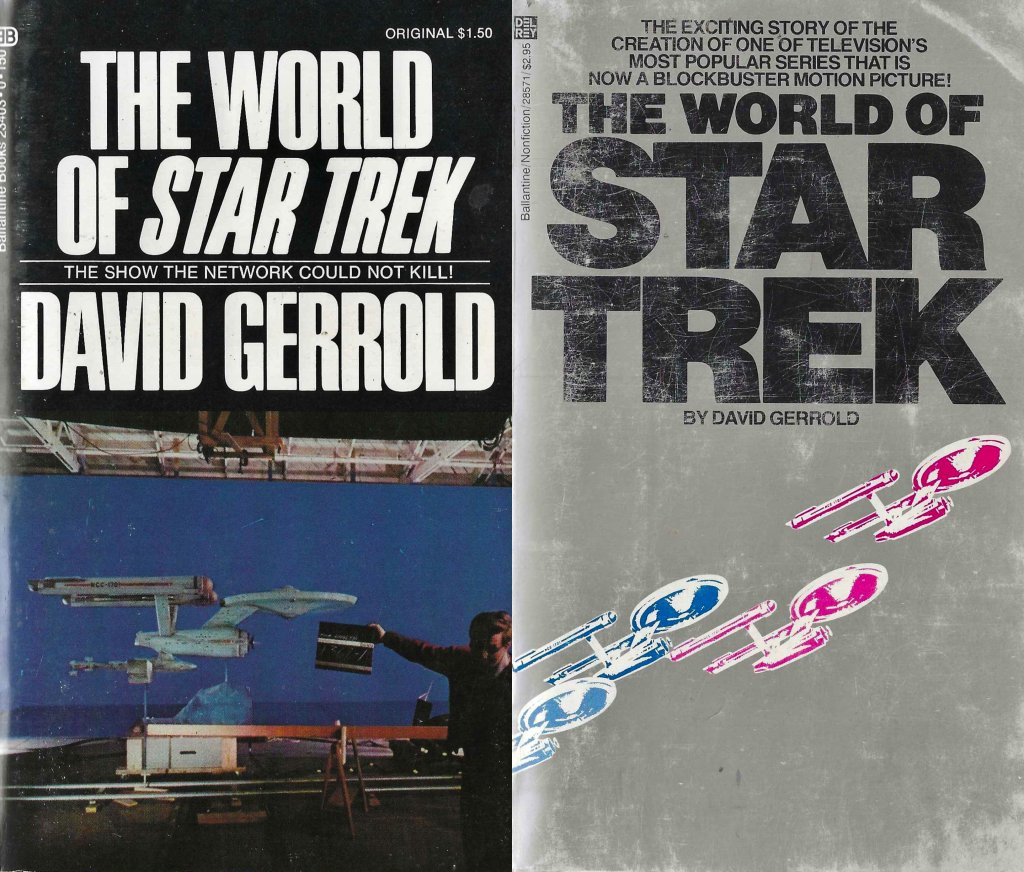
The first printing of the US edition (left) and the Canadian tenth.
[The book] was enthusiastic. I think that was part of its success. But it wasn’t blindly enthusiastic. There was a chapter at the end where I said here’s how it could be better, here’s what they could have done and should have done.
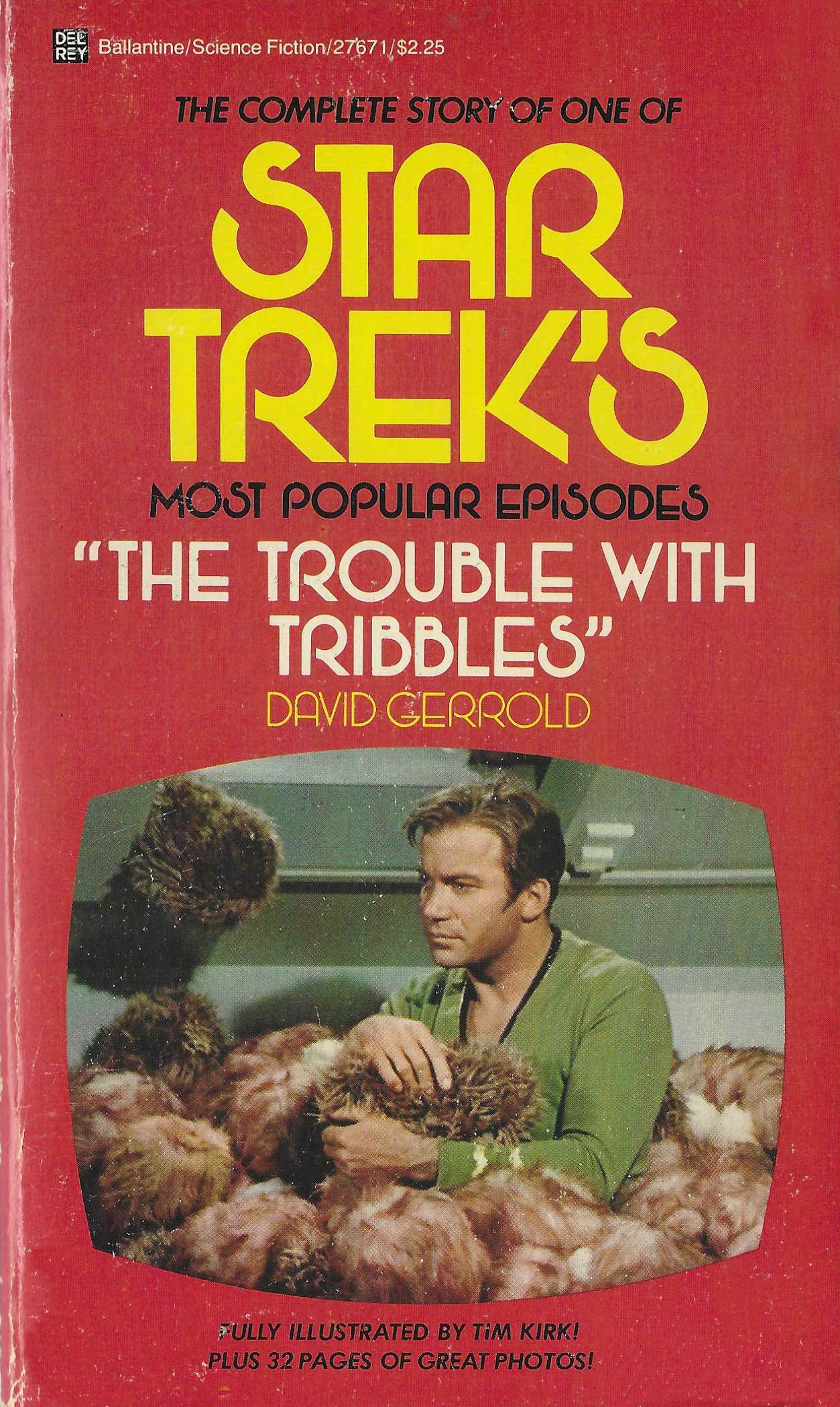
[I had pitched] a book about The Trouble with Tribbles but halfway through I realized there was too much material. And I called [the publisher] and said, “Let’s break it into two books” and so one book was about The Trouble with Tribbles and the other was The World of Star Trek. And they both sold very, very well.
I bought a house. My first house.
My biggest regret was we didn’t do the pictures in color and charge $1.75 for the books. We only charged $1.50. The World of Star Trek outsold The Trouble with Tribbles back then; now, The Trouble with Tribbles outsells The World of Star Trek.
[The publisher] had faith not only in me, but she had faith in Star Trek, because they had done so well with the Gene Roddenberry book (The Making of Star Trek). And the Gene Roddenberry book was really: here’s the bible, and here’s the publicity for it…all Stephen Whitfield did was compile all of the stuff, maybe a couple interviews, but nothing more. And me, I interviewed every actor I could get to, every person I could get to. And I heard some of their stories for the first time, like Nichelle with Martin Luther King and so on.
I felt privileged to be able to capture [all that]. I knew that it would sell, but I didn’t know it was going to sell that well. I thought, I love this stuff, behind the scenes. Nobody else had done a behind-the-scenes book. And so, The World of Star Trek peeks behind the scenes, how it was made. And the fans grabbed onto it not just because it was about Star Trek, but it gave them insight into Star Trek.
[When I wrote the book,] I had not yet encountered many of the assholes that were in television. There are people who are in television for the fame, and people who are there for the money, and people who are there because their brother-in-law dragged them in; there are people who are in television for the wrong reasons. Now, I grew up in the theater arts environment, and yeah, there are assholes in theater, but what I learned is the only people who really succeed in theater are people who love theater. Television doesn’t work that way because there’s too much money floating around. And…money is addictive. It is like heroin.
But if you can be on a show that you love, and you love going in, and you love solving the problems… You know, Bob Justman was that way. Dorothy Fontana got it. Gene L. Coon got it. Most of the actors understood that because…actors do connect with the audience. And with Star Trek, once they discovered that the fans were in love with them, they suddenly blossomed. They were stars, they weren’t just actors anymore.
If I had to pick the nicest person in the cast, De Kelley would be way up there. Leonard, when he wasn’t being Spock, he was terrific. Bill had to do like 14-hour days, but when he had time he was playful, he was generous. Nichelle was the warmest.
Once you figured out the writing for the show, you wanted to give De the punchline. He could deliver it.
Writing has paid David Gerrold’s mortgage and grocery bills, and congratulations to him for making that work. And income was certainly one motivation for writing The World of Star Trek. But David also loves the show, and that love is in his book and was obvious in his dinner conversation: “With The World of Star Trek, I said it in the book but I’ll say it again: Star Trek was a dream. It is a dream that the way things are is not the way they have to be. It is a vision of the future, that we’re going to learn how to be a mature species. It is a dream.”
-
Revisiting The World of Star Trek
Robert J. Sawyer recently invited me to join him and Star Trek luminary David Gerrold for dinner. I interviewed David after the dishes had been cleared, and that story is told here.
David is every bit as interesting and charming as you would wish. Knowing I would soon have the chance to speak with him, I reread two of his books: The Martian Child (which made me cry, darn you, David) and The World of Star Trek, which I had not read since my teen years. The piece linked above is about the writing of that book. Here, I will share two excerpts in the hope that, to continue the dinner theme, they serve as an amuse-bouche that will prompt you to pull the book off your shelf or go buy a copy.
The World of Star Trek is David’s exploration both of what made the show so popular and of what the producers could have done better, and is told from the standpoint of a writer. He talks a lot about the successes, failures, and hurdles of the creative process that built Star Trek, including this early framing of the genre’s challenge:
Science fiction is not a western with ray guns and spaceships. It is a genre so demanding that few of its practitioners are more than moderately competent at it. The responsibility to be logical and scientifically accurate, while at the same time telling a good dramatic story, will continually defeat any writer who approaches the field with less than total respect for its requirements.
One of the book’s most interesting analyses is of the transporter. Fans like it because it’s cool, and it kept the plot moving for writers and directors. But David explains the trap it created.
[The transporter] was one of Star Trek’s best ideas—a teleportation device so that the Captain and crew could “beam down” to a planet whenever they chose. Thus, the special-effects crew was relieved of the responsibility of having to show either the starship or its shuttlecraft landing on a new planet each week. A golden flicker mixed with a dissolve and an over-dubbed reverberated whine is not only cheaper—it’s more versatile and impressive.
Unfortunately the use of the transporter set up conditions of its own that were not foreseen in the initial postulation.
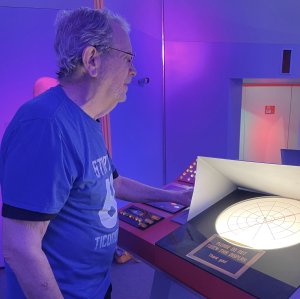
David at the Star Trek Set Tour And that was the miscalculation. If the transporter had been designed for the express purpose (pun intended) of getting our heroes into the story faster, then it also allowed for them to get out of it just as quickly.
Any time Captain Kirk got himself into real trouble, all he needed to do was call the Enterprise and holler “Scotty! Save my ass!” and Scotty would beam him up so fast the air would crackle. Knowing that, then, there would certainly be no suspense whenever Captain Kirk was captured by the giant Yang-Yangs or the Creeping Blorch.
Therefore, one of three things had to happen to keep Kirk in a story where he was personally menaced:
He would run into aliens of such superior ability that they could nullify his transporter beam. Thus he got captured.
He could run into aliens of such inferior ability that they would knock him over the head and take his communicator away from him without knowing what it was. Again, he got captured.
Or—contact between the Captain and the Enterprise would be cut off by some arbitrary force created by the writer for this specific purpose, thus trapping Kirk in the story until contact could be restored—usually not until just before the last commercial.
This constraint was often solved in a way that served the story. David cites The Squire of Gothos, Tomorrow is Yesterday, and Errand of Mercy as, respectively, examples of when this worked. But as the series progressed, we got The Apple, Bread and Circuses, A Private Little War, The Omega Glory, A Piece of the Action, and Spectre of the Gun — and “the cumulative effect is the focusing of attention on the mechanism used to prevent Kirk from being rescued. We begin to realize that Plato’s Stepchildren is the same story as The Gamesters of Triskelion; the only difference is in the details.”
Pick up the book for more. The World of Star Trek is a fascinating look at the craft of writing this show we love, and it delivers ’70s interviews with stars and production staff, details of early fan activities, and, in David’s words, an account of “some of that magic so that years from now some yet unborn Trekkie may open it up and be able to recapture at least a hint of Star Trek’s magic seasons.”
-
Deep cuts are the latest collectible trend

We’re seeing an increase in what I call deep-cut collectibles: figures based on secondary and even obscure characters, ornaments depicting oddball 1970s models, and screen-accurate recreations of the bridge, among others.
And I am definitely here for all this — even though I may no longer be the ideal customer. Forty years into this journey, I have slowed and focused my collecting, and I now concentrate on vintage 1960s and 1970s items. Having said that, I really want that sweet Nacelle Toys bridge model.
And I applaud these companies for releasing collectibles that are essentially love letters to us.
Deep cuts are not new
Deep-cut and obscure collectibles have always existed in our fandom. Over the last few decades, we had the Mego Cheron figure, cards signed by seen-once guest stars, the Spock decanter from the Grenadier Spirits Company, the Eaglemoss model of the Jefferies ring-ship design, and the Playmates Dr. McCoy’s Medical Kit, featuring the “Anabolic Protoplaser with light Up Laser Tip!”
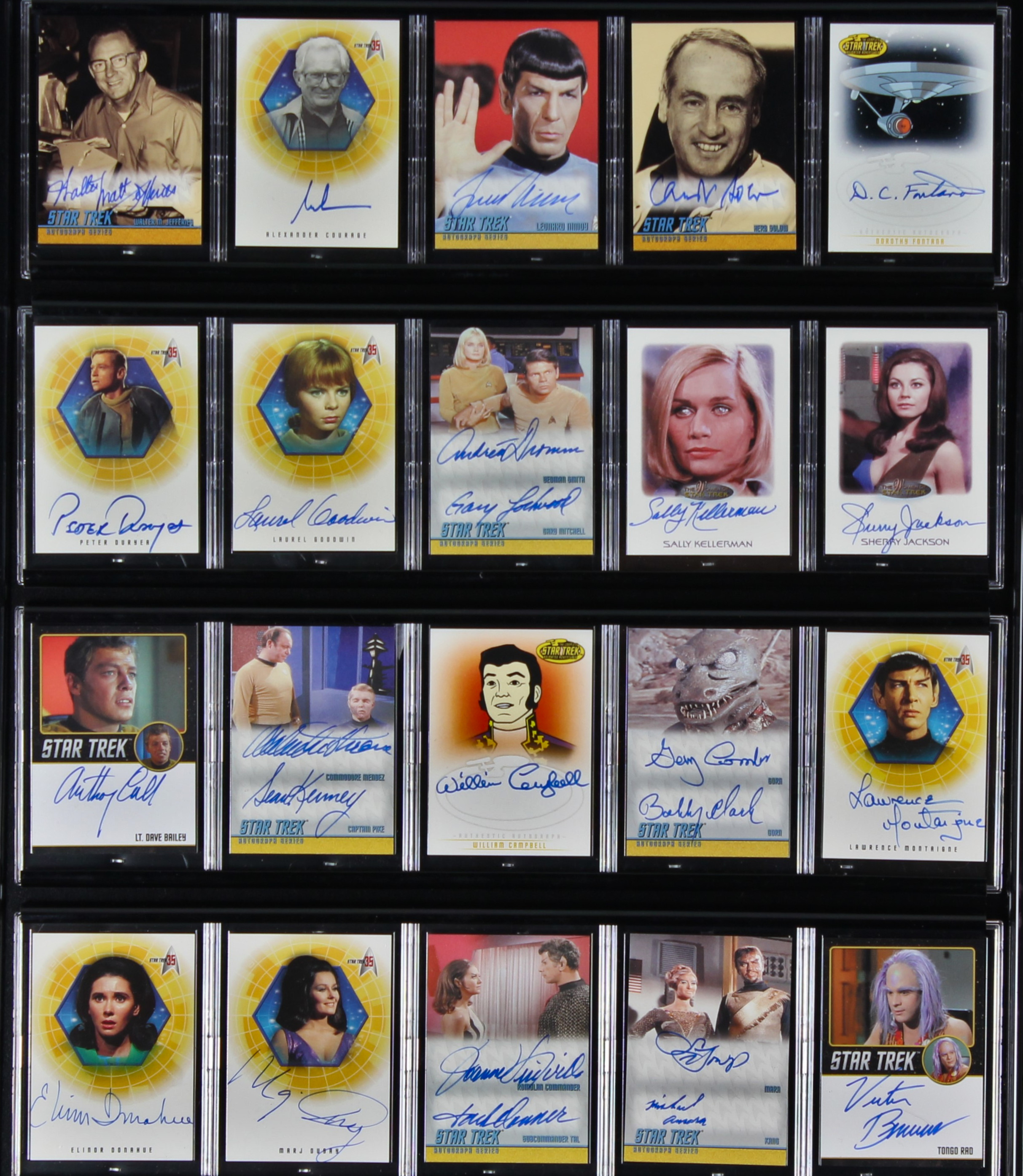
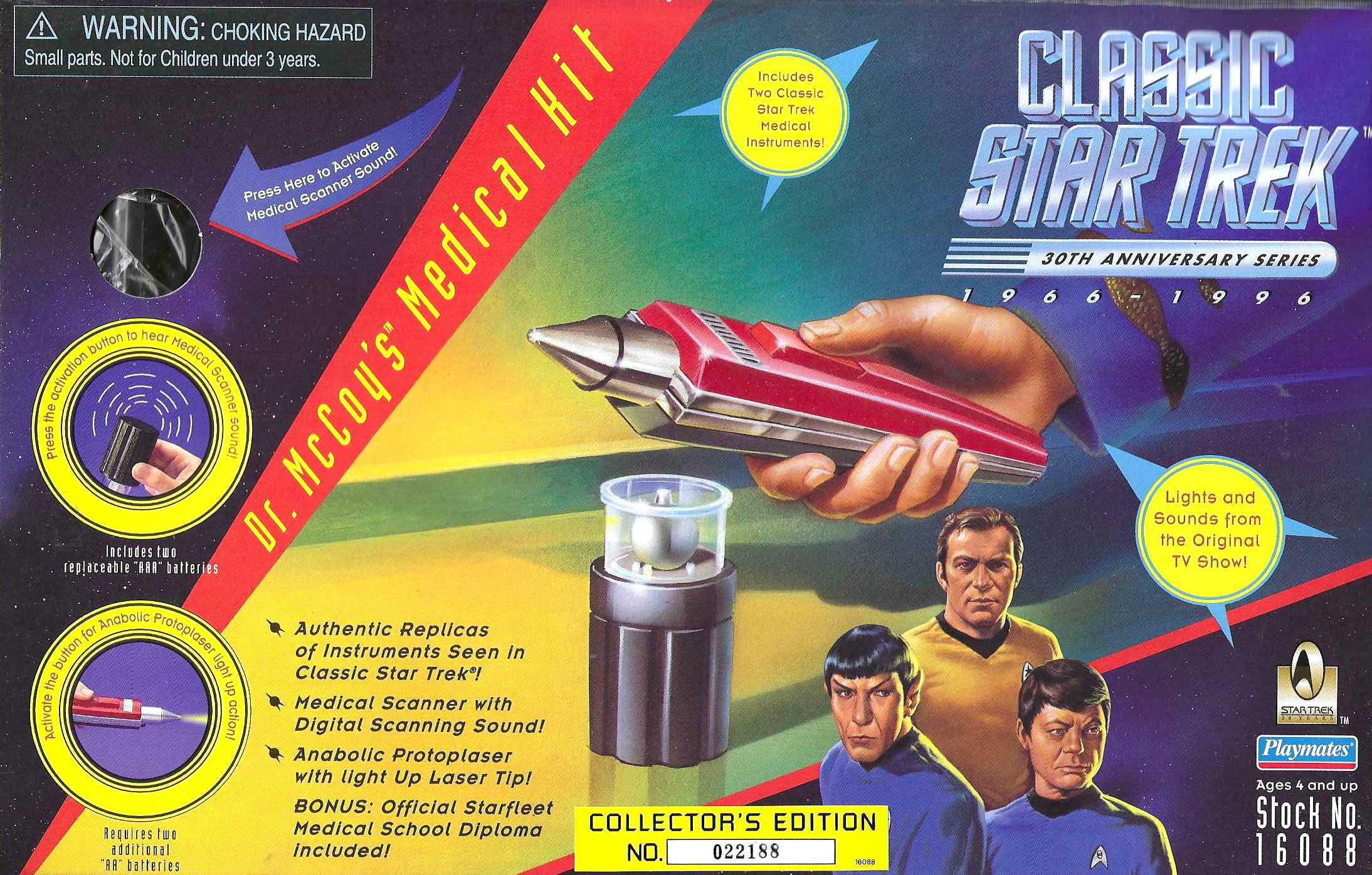
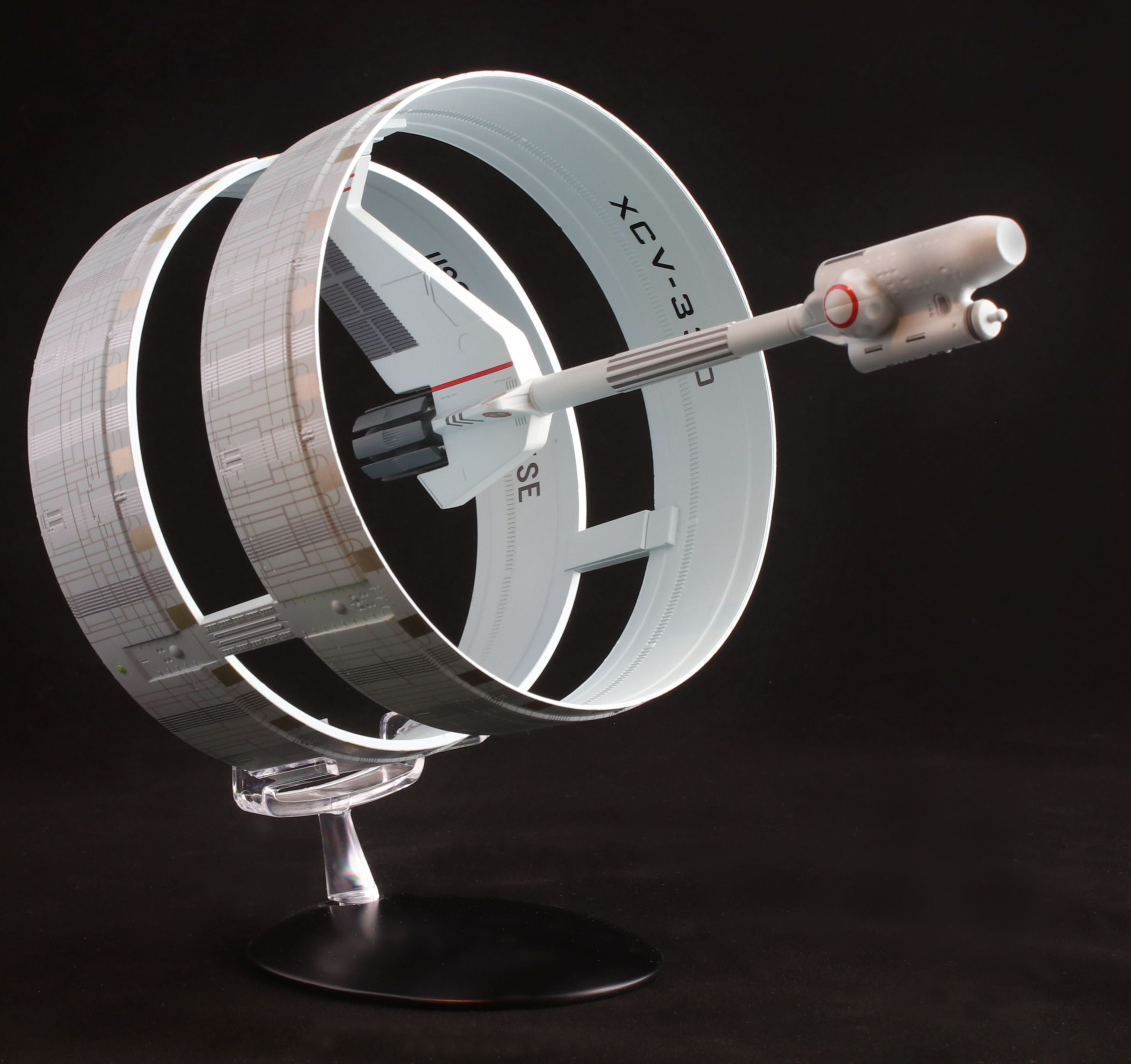

And that list is just from looking around my Star Trek room. There are others.
Celebrating the new deep cuts
So, deep-cut collectibles are not new but I am glad to see the recent uptick in this category.
This TrekNews article rounds up some of the latest obscure figures, including Captain Rachel Garrett from Yesterday’s Enterprise, Tuvix from the actually good Voyager episode of the same name, Peter Preston from Star Trek II, In a Mirror Darkly’s Captain Archer, and others.
And then there is my favourite recent addition: Hallmark’s tribute to the weirdest of all AMT products, the Spock shooting the three-headed snake model.
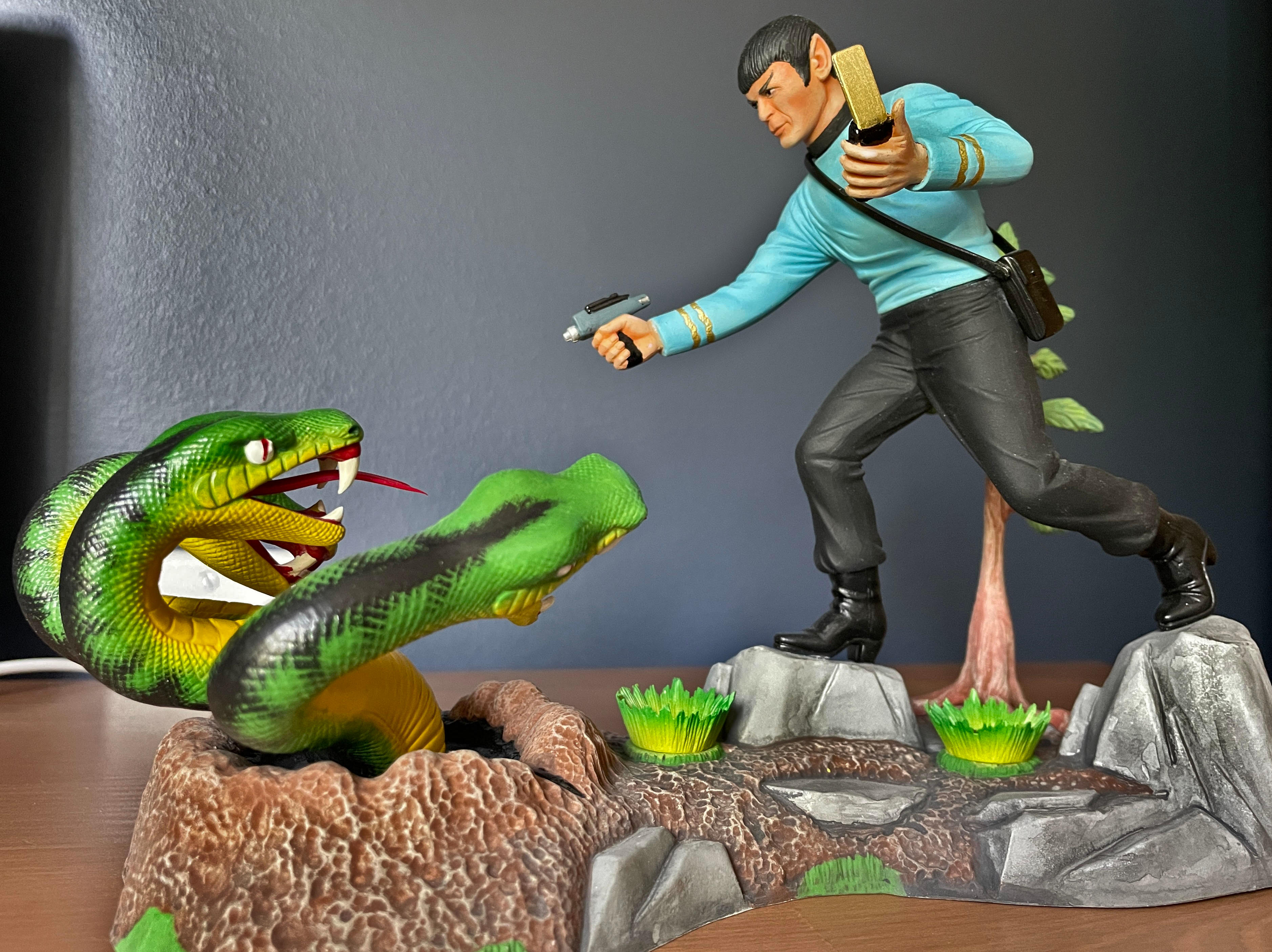

The AMT model and the new Hallmark ornament
I love that model so much that I paid a professional to assemble and paint one for me. (He also did my AMT Enterprise.) I wonder if today’s Hallmark customers will know where this little gem came from.
The 60th anniversary of Star Trek is surely the catalyst for much of this merch activity, but I think licensees are also tapping into a nostalgia for simpler and better times. Spock shooting that snake is not true to Star Trek’s ethos, but it does evoke a time when building models or playing landing party with action figures helped us celebrate these stories.
-
Space challenged? DIY some more display room
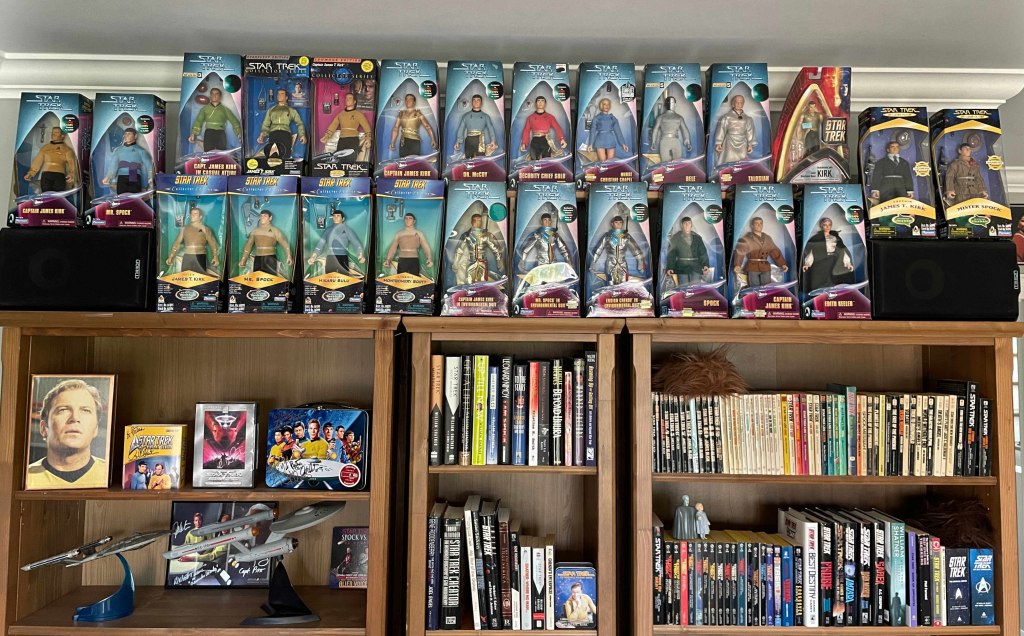
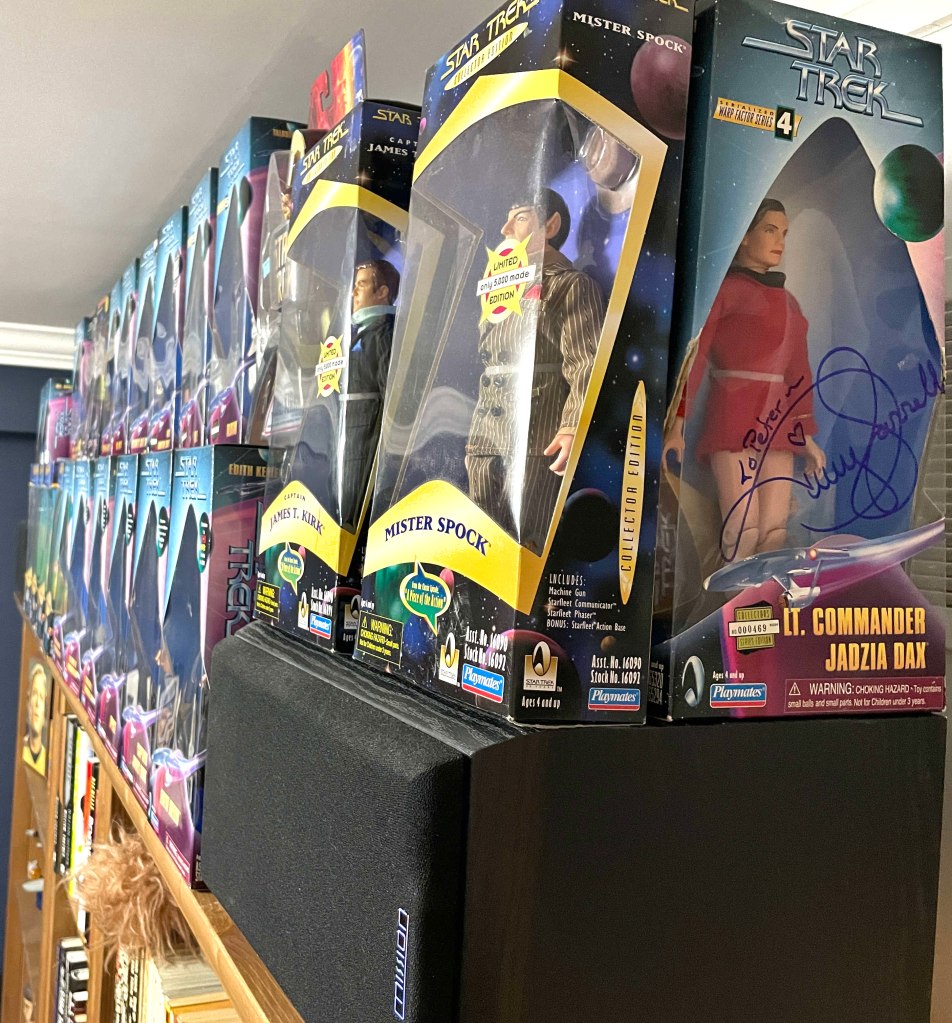
I have a long-standing fondness for the nine-inch TOS Playmates figures. I own 24 of them but, since moving to a smaller Star Trek room last year, I could only display 14. They ran along one row on top of my bookshelves, with the rest piled out of sight behind. Here is the before shot.
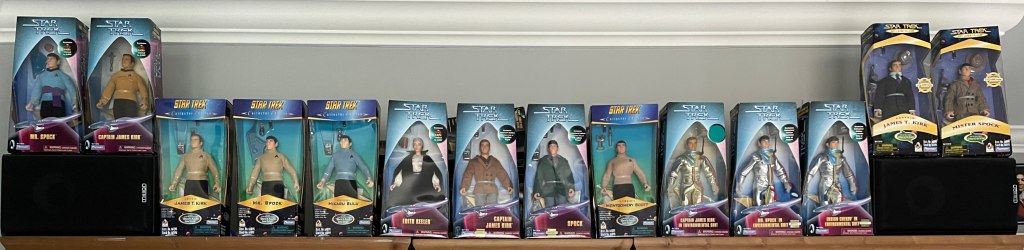
One day, I realized that my high ceiling gave me a fair bit of airspace so, like big cities around the world, I maximized my available real estate by building up.
I built a shelf on legs that sits behind the front row of figures. That may not seem like a big deal: “So…you discovered shelving?” No, but I was inventive in finding more space for a shelf. And it was cheap.
I bought a six foot fence board for $10.21 and an eight foot length of 2×2 for $3.88. I trimmed about six inches off the board, to fit the shelf between my stereo speakers. I chopped the 2×2 into 11-inch legs because the boxes are 12 inches tall, so this would raise the second row to a good viewing height. Wood glue I already owned did the rest.
Total cost, after tax: $15.92.
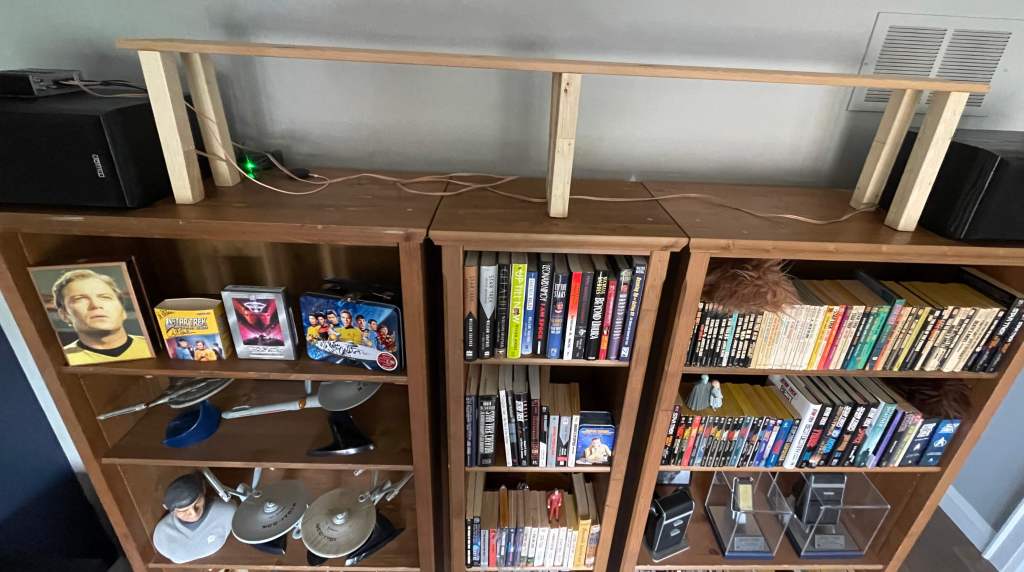
The new display shows off a large number of figures but still looks neat and organized.
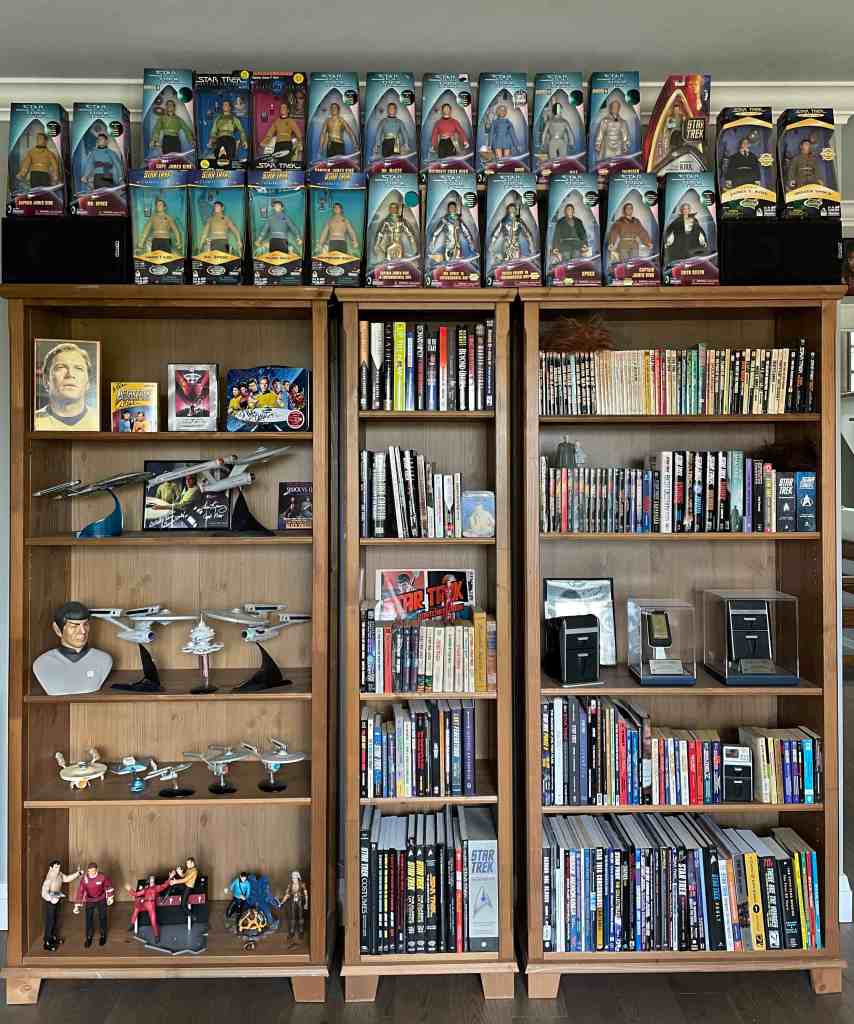
(Did you spot the one Art Asylum figure? It’s over on the right, top row. That Kirk is a placeholder; I’ll swap it out once I pick up one of the 12 TOS nine-inch figures I do not own. And then what will I do when I buy another after that? No idea.)
Lots of collectors are challenged for space, and I am a big believer in displaying as much of your stuff as possible. So, look up by the ceiling and over doorways. Buy a cabinet that suits your items. Consider putting some items behind others — but don’t overdo that: it is easy to slide into a cluttered look.
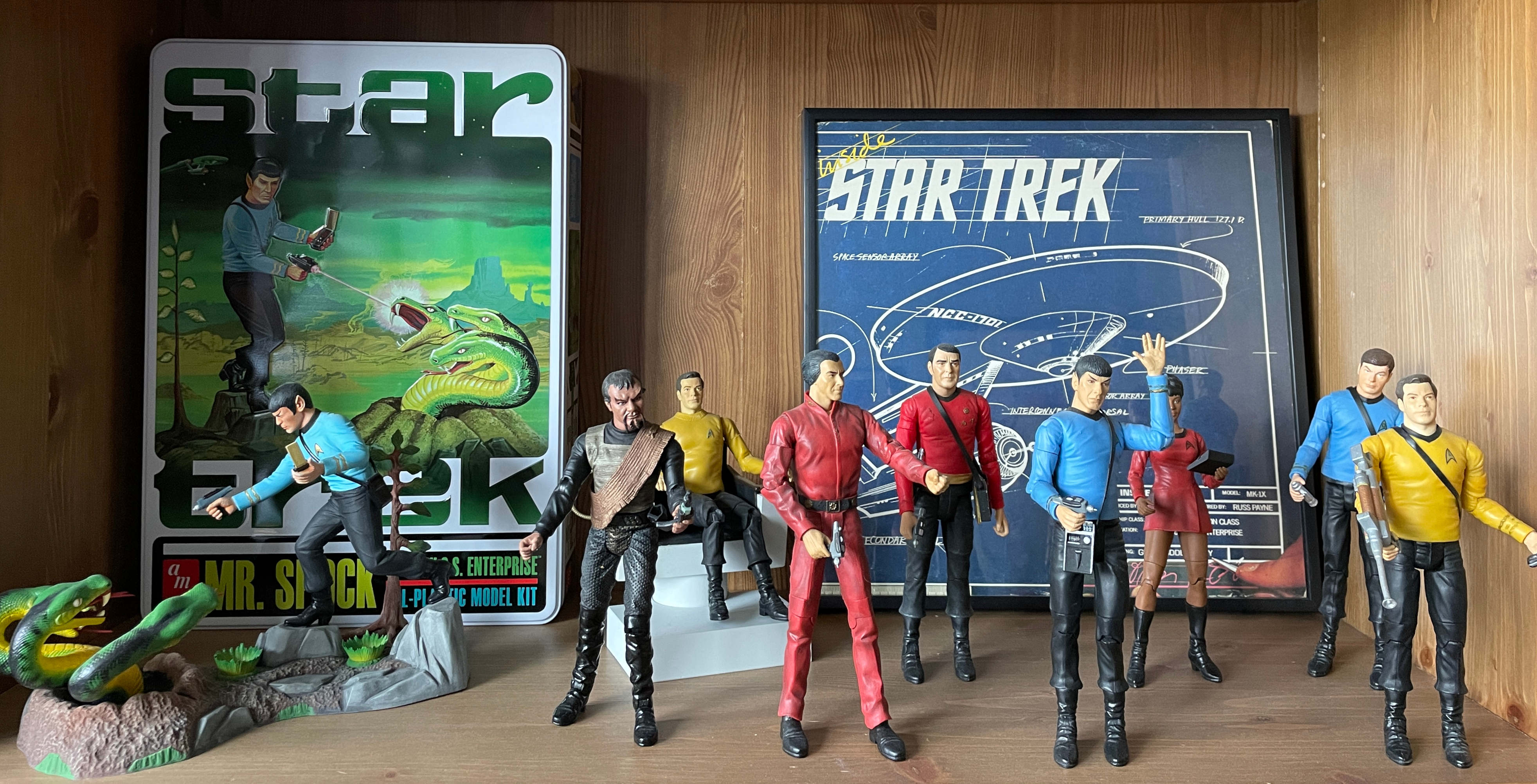
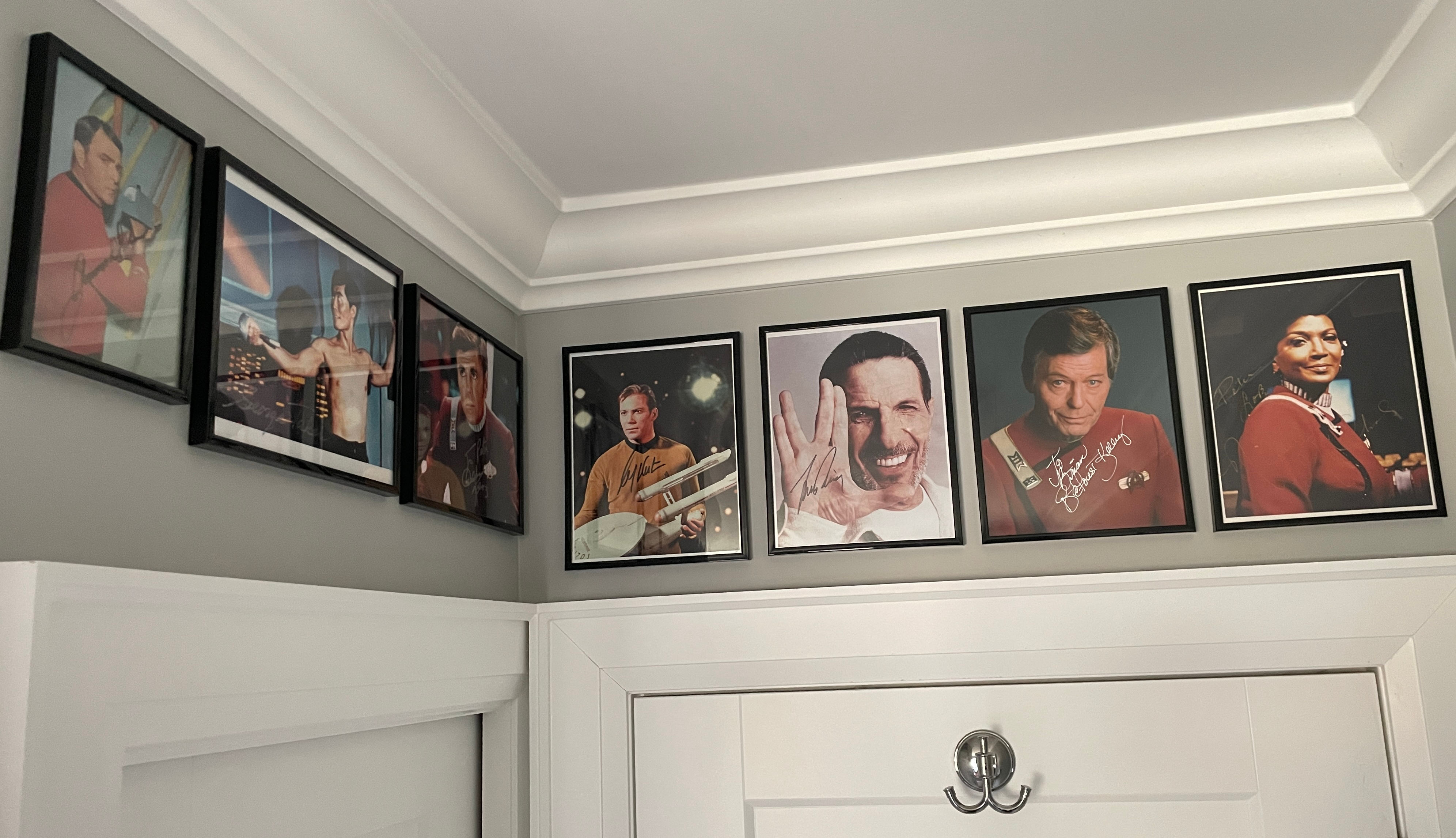
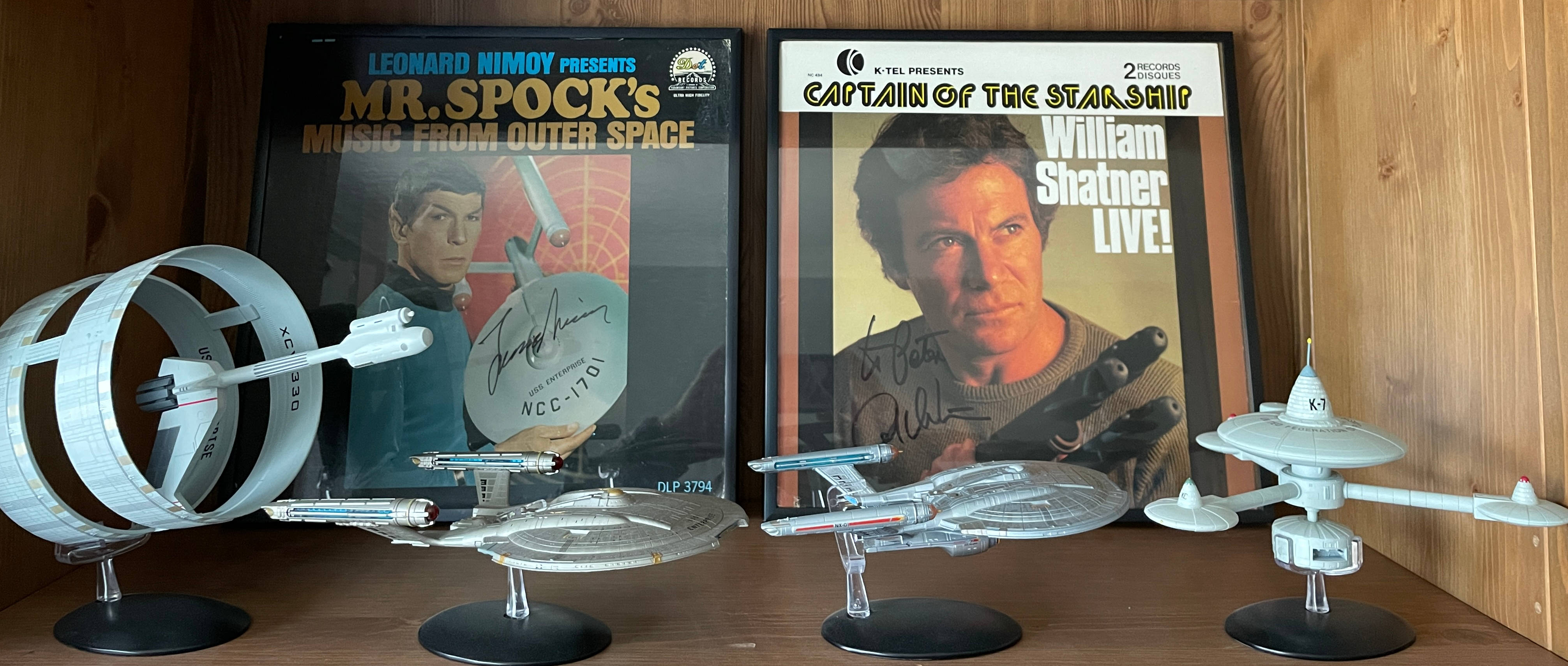
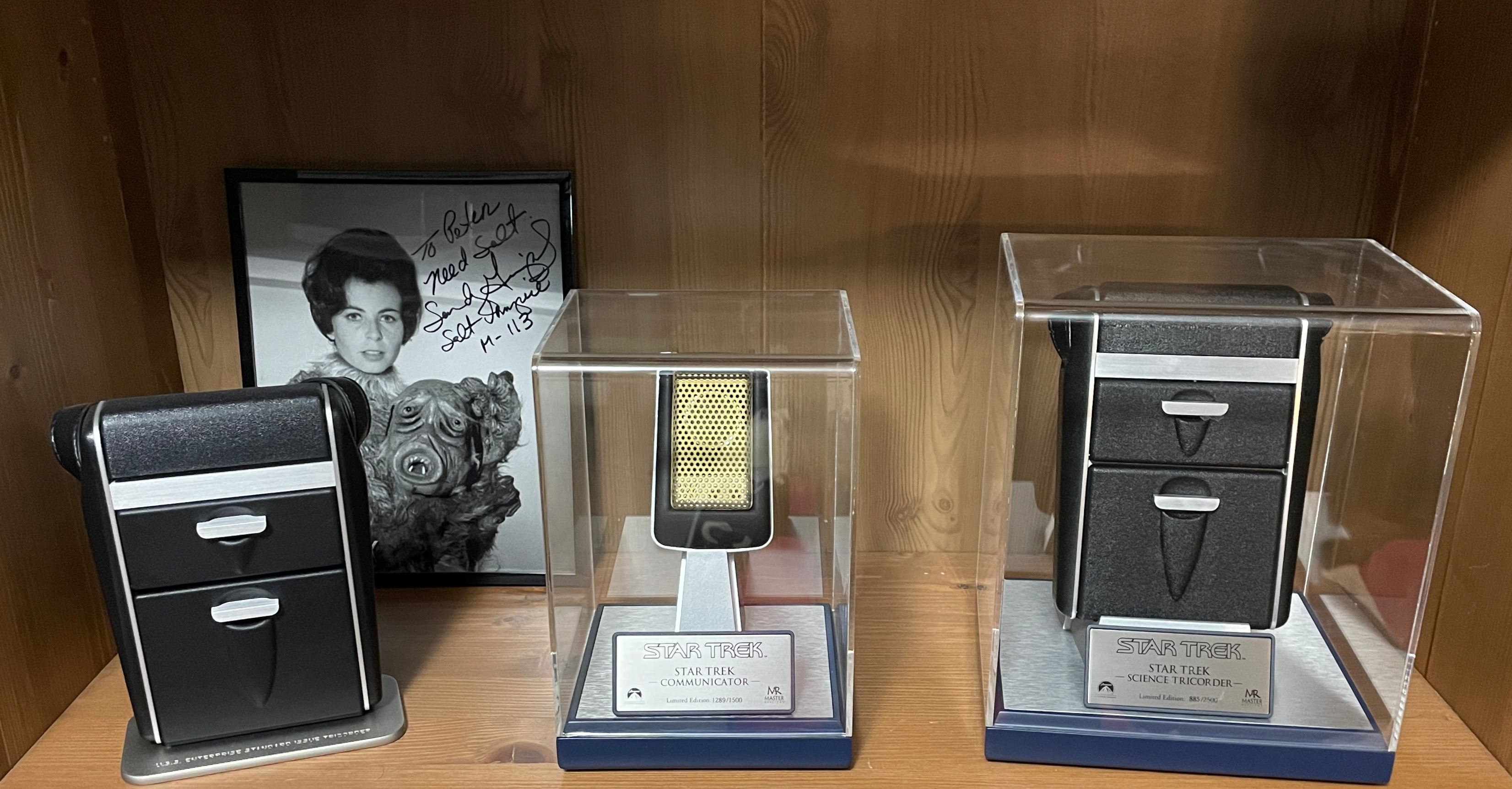
I even perched my signed Trials and Tribble-ations Dax figure on top of the speaker around one corner. Again, maximizing space. Now if only I could come up with such an easy solution for the bridge set I want but have no room for.
That’s a problem for another day. This morning, when I walked into my Star Trek room to review this post, my eyes went first to my new display. It made me happy.
-
This 1978 Nimoy newsletter was the Internet of the ’70s
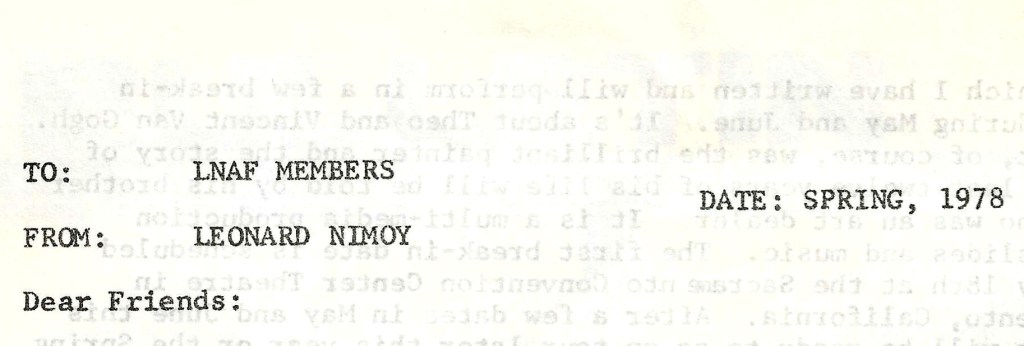
Leonard Nimoy needed to tell fans about his new movie, new play, new book of poetry, new cassette, and that, yes, he would be in the upcoming Star Trek: The Motion Picture.
Today, this would be done on Bluesky, Facebook, and Stephen Colbert’s The Late Show, but 50 years ago those updates came to fans in a stapled and folded newsletter from the Leonard Nimoy Association of Fans for $4 (US) per year.
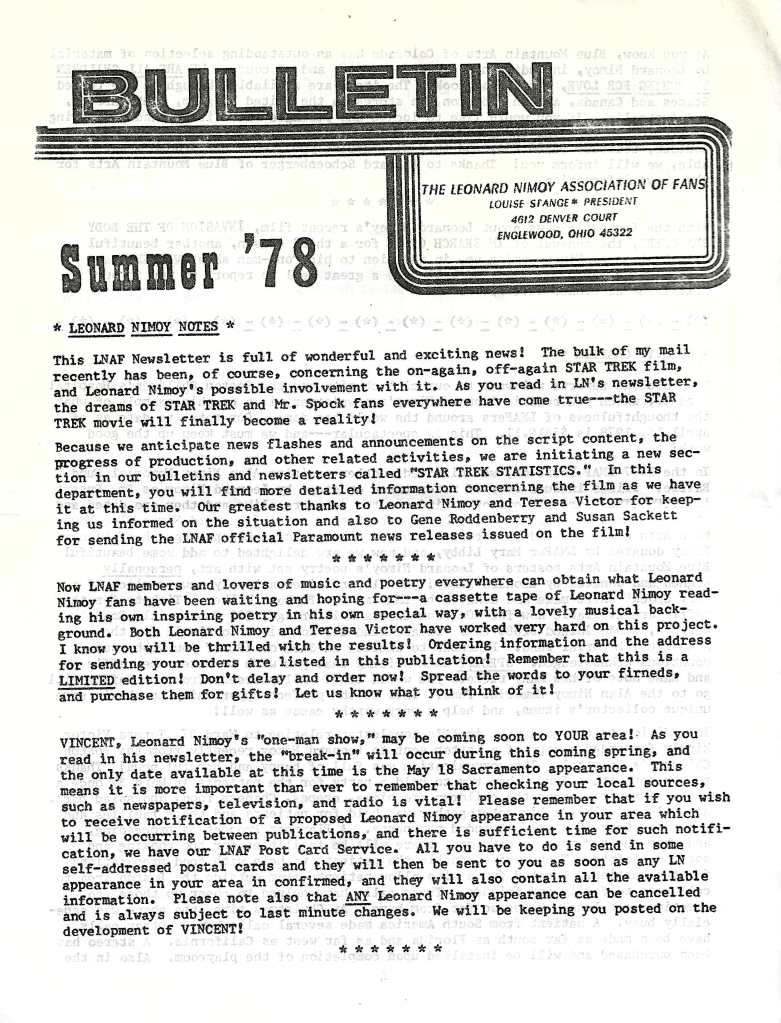
The Spring 1978 newsletter was produced by LNAF president Louise Stange, and included a letter from Nimoy to his fans. Here is a scan, followed by the highlights.
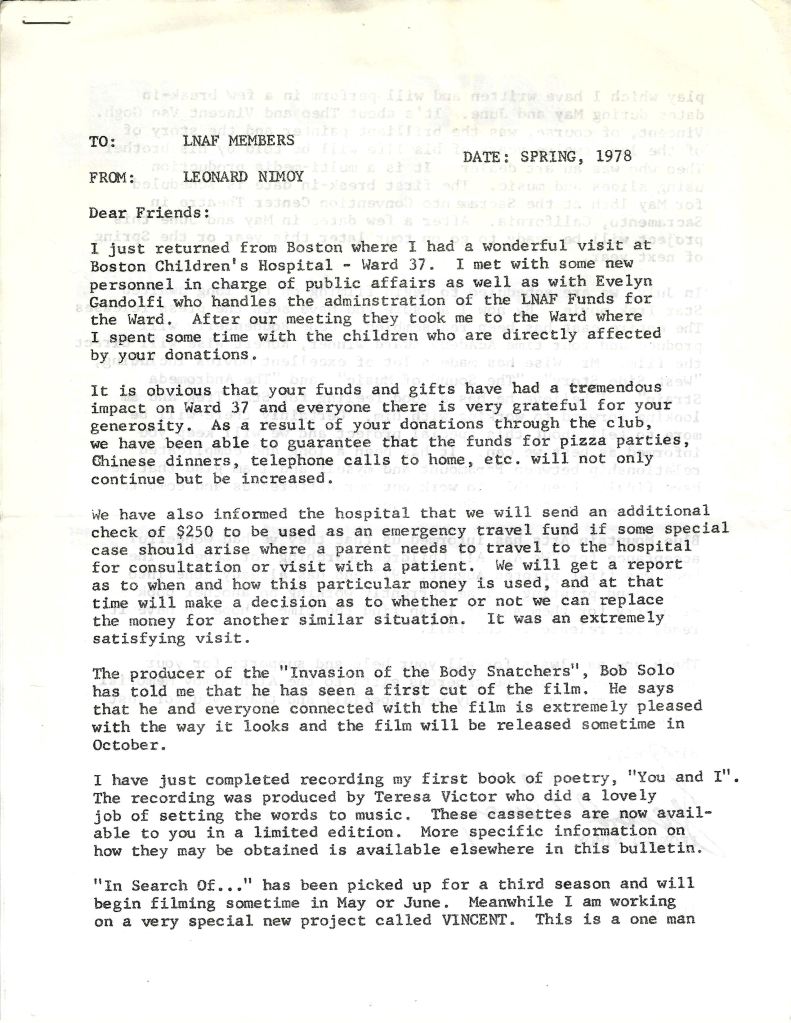
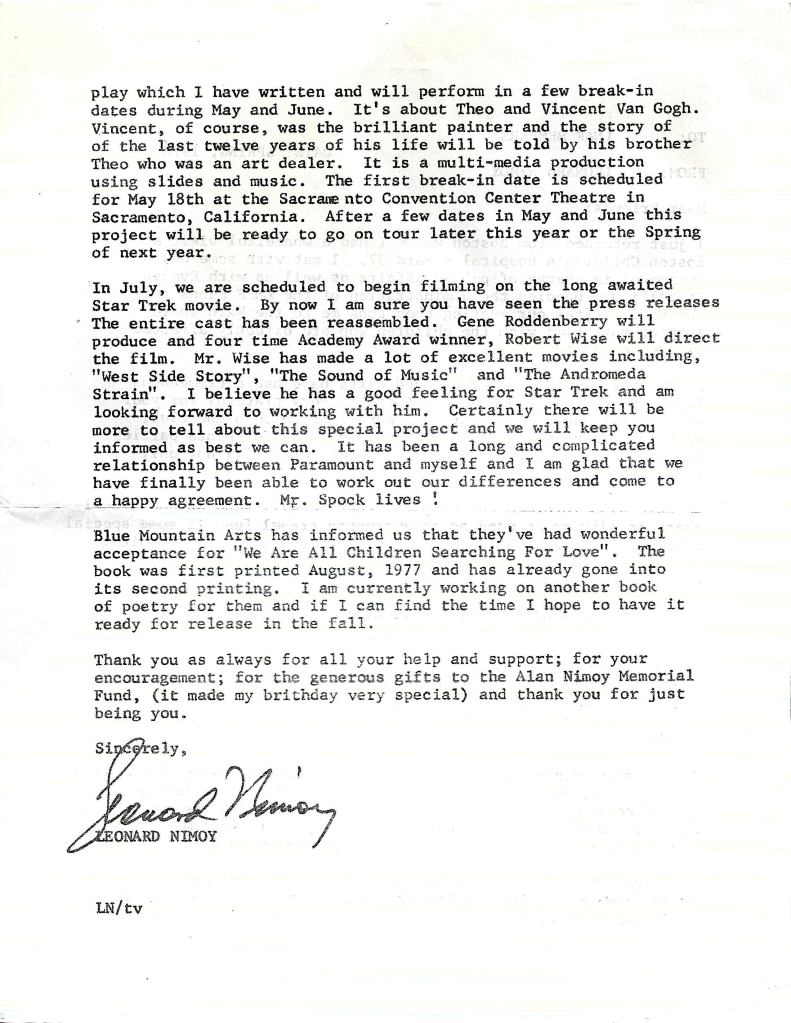
Collecting money for charity. Nimoy wanted his fan club to have a charitable component. The designated recipient had been UNICEF but this changed in 1975, following the 1973 death of Nimoy’s teenaged nephew from cystic fibrosis. Donations were then split between the Alan Nimoy Memorial Fund and the Cystic Fibrosis Foundation. This letter also details Nimoy’s fundraising for the Boston Children’s Hospital.
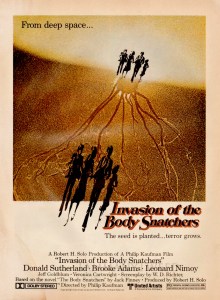
Highlighting Invasion. The best movie featuring a Star Trek star prior to The Motion Picture in 1979 was the remake of Invasion of the Body Snatchers. Nimoy tells readers that the producer, Rob Solo, is pleased with an early cut of the film.
I don’t own the You and I cassette, but now I want to. Promotion was a main function of the fan clubs, and Nimoy wanted it known people could drop some money on his new cassette of poetry reading. That pitch probably worked then and it just worked now. I hit up eBay looking for one. No luck yet.
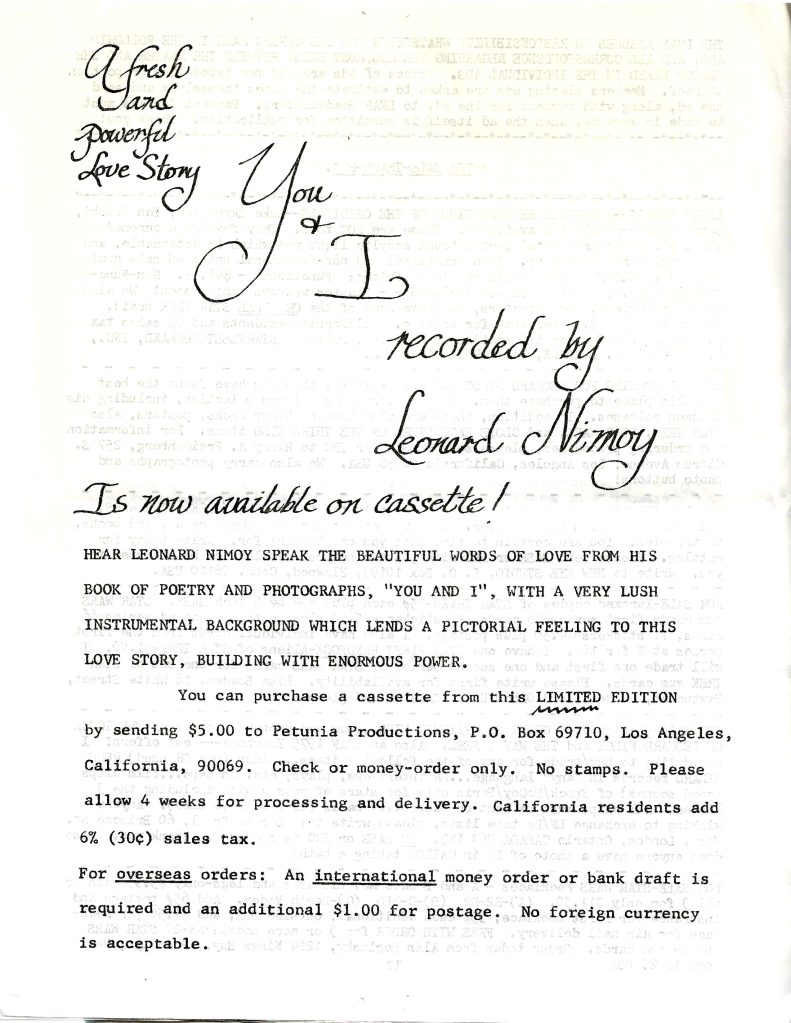
Burying the lede. The big news for fans in the spring of 1978 was that Nimoy had settled his dispute with Paramount and would indeed play Spock again — but that was stuck on the second page, following the important announcement that readers could see a preview of his play Vincent at the Sacramento Convention Center Theatre.
Also, early eBay
These newsletters were also a vehicle for collectibles. There are a couple of pages of people looking to buy or sell. I love Ellie Ockert’s complete lack of negotiating skills when she exclaimed “WANTED DESPERATELY – NAME YOUR PRICE.”
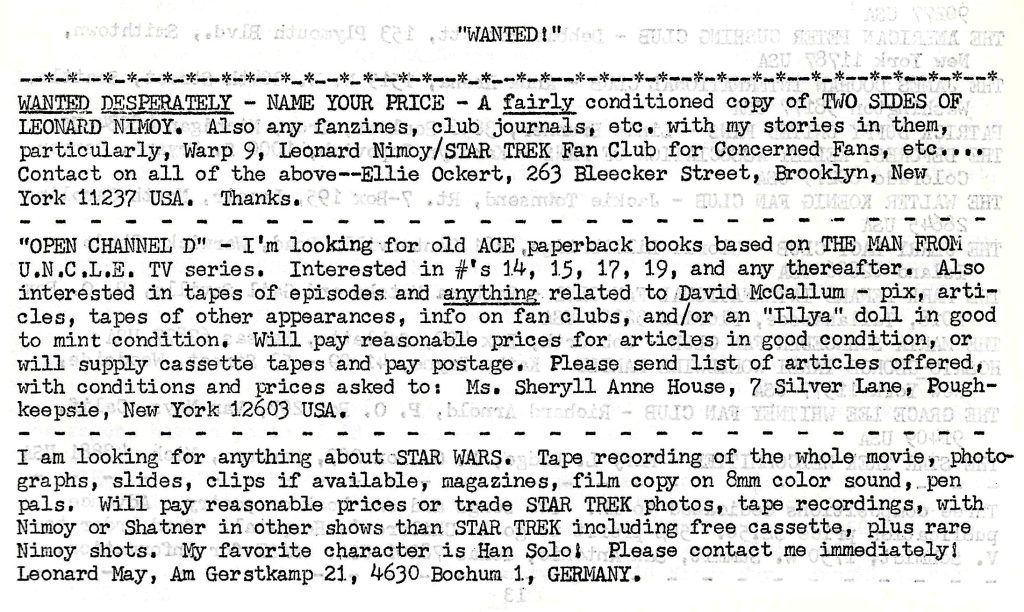
I own a bunch of paper from the LNAF but, like this newsletter until just recently, I have barely glanced through the pile. I will try to share more of this 1970s fandom in the future.
-
Goodbye, John Wheeler
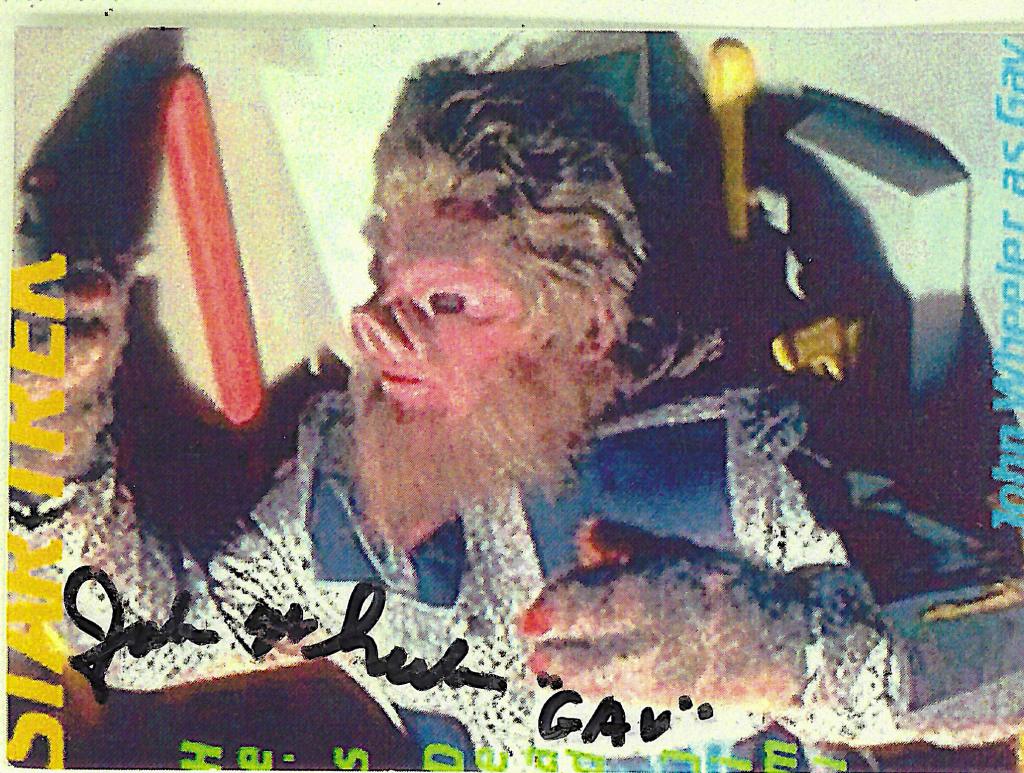
John Wheeler, the actor who helped create the Tellarites, died on February 6, 2026. His passing was made public a few weeks later.
Before his death, all I knew about Wheeler, beyond his appearance as Gav in Journey to Babel, was that he had a sense of humour about himself. Every autograph of his I have seen includes a little joke, often self-deprecating. You can see this in the signed piece of paper I own.
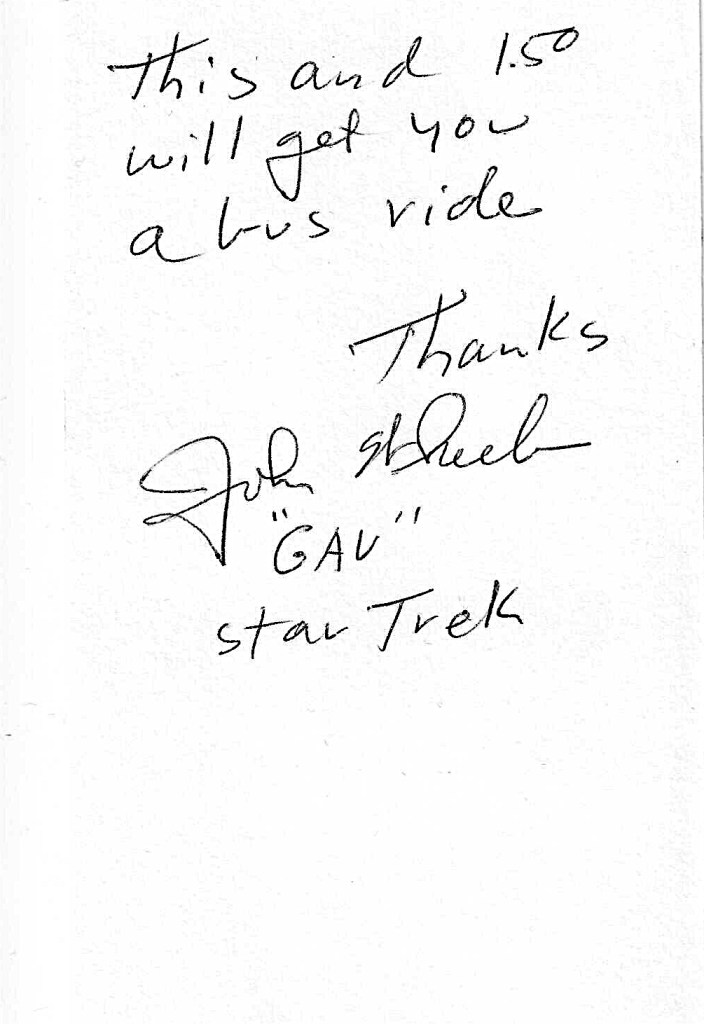
This and 1.50 will get you a bus ride.
Thanks John Wheeler “GAV” Star Trek
I am not sure where or when he signed this, but it was far enough in the past that a bus ride cost only $1.50.
I own a lot of Star Trek autographs, and almost all of them were obtained in person. That matters because the scrawled name is nice but the real value is the minute or two I get when I reach the front of the autograph line. (That was my experience with Nichelle Nichols, Leonard Nimoy, and many others.)
The two Wheeler autographs I own are an exception; I bought them from a dealer, for two reasons: first, it was unlikely the actor would travel up to Canada for a convention, and second, I liked his joke. It was the 3×5 card that drew my interest; the signed photo card came with it.
I have tried to learn about Wheeler since his death, but sadly all my Star Trek reference works are mute. Bjo Trimble’s Star Trek Concordance mentions only Gav, not Wheeler, and Wheeler does not appear in The Fifty-Year Mission or Altman and Gross’ earlier works, or The Star Trek Compendium, The Star Trek Interview Book, The Star Trek Encyclopedia, Star Trek The Complete Unauthorized History, or These are the Voyages.
That is not really surprising. His was a small (albeit important) role in only one episode, and if anyone had asked Wheeler he would probably not have remembered much about the two days he was on set in 1967. It was common for the guest actors, approached by fans decades later, to recall little.
I have since learned from online sources like IMDb and Memory Alpha that he had an extensive list of credits as a character actor, but about his time on the Enterprise I still know nothing.
Thank you, John. You were a working actor and Star Trek was just another job, and not necessarily even among the most interesting or challenging, outside of donning the Tellarite mask. But it meant a lot to us. You helped create a species that continues in our history today.
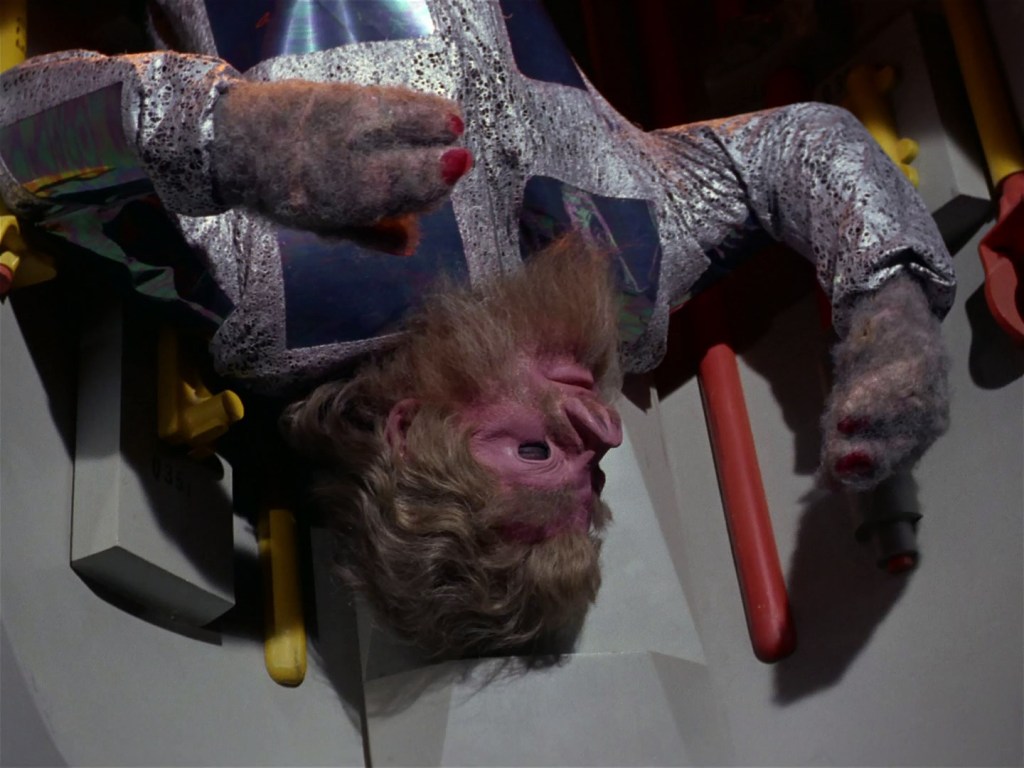
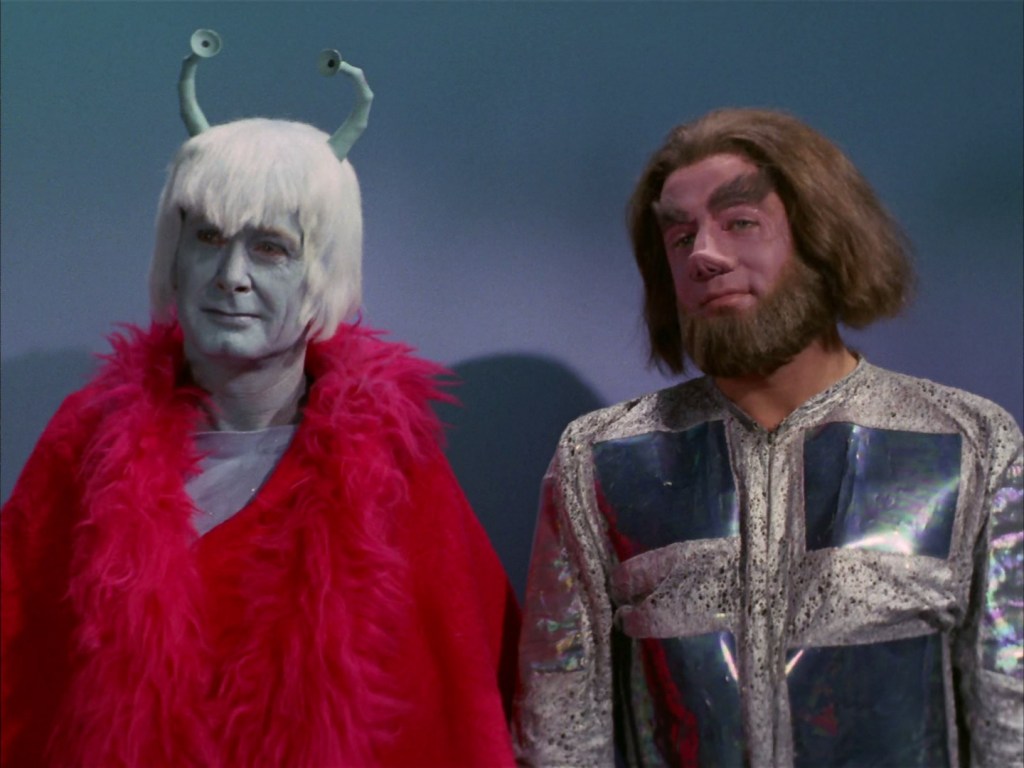
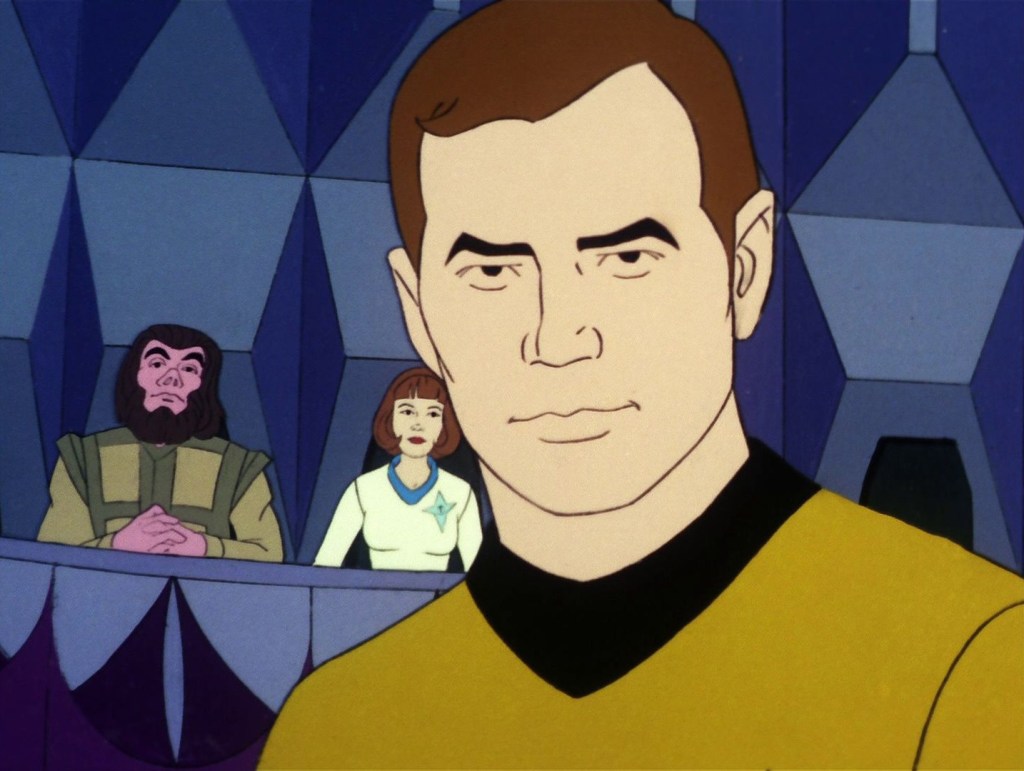

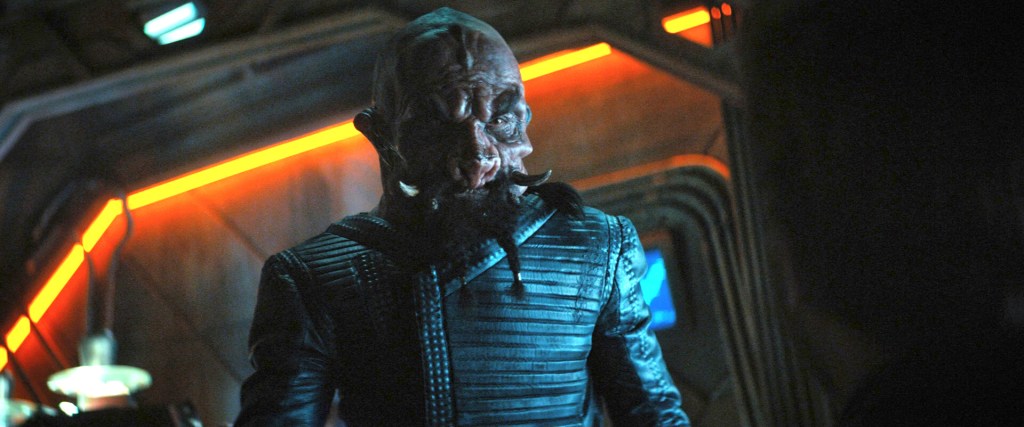
Left to right: TOS Journey to Babel. TOS Whom Gods Destroy. TAS The Time Trap. ENT Bounty. DIS Short Treks The Escape Artist. LD Moist Vessel
-
Space: the final impediment
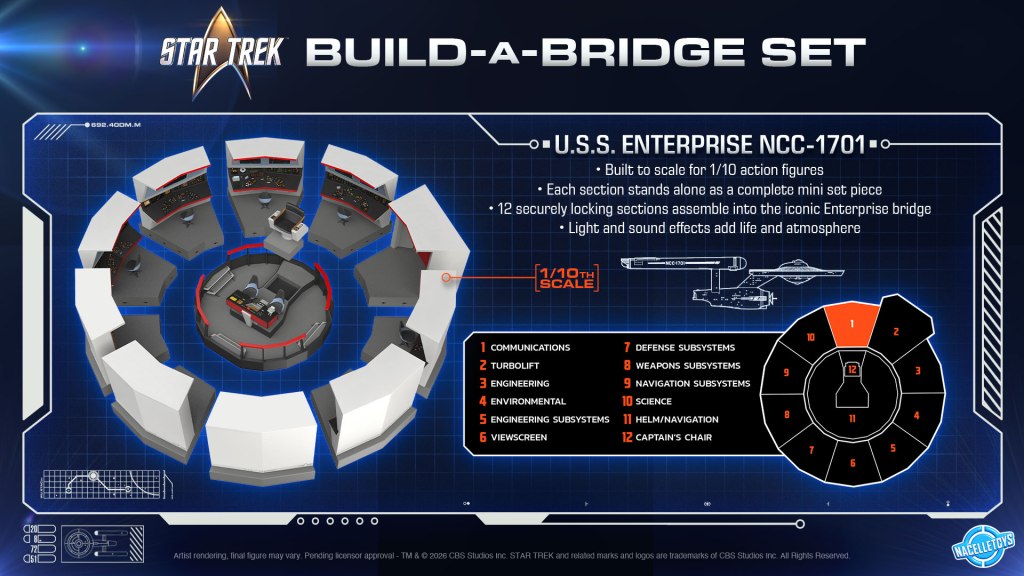
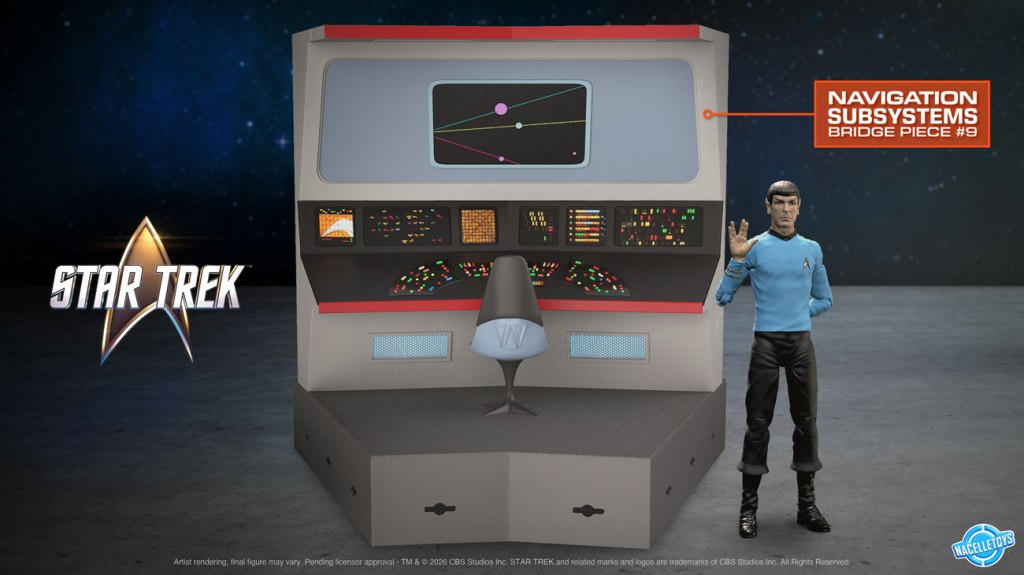
Nacelle Toys just announced it’s making a 12-piece, 1/10-scale original-series Enterprise bridge model. The modules will be sold one per month, launching later this year to coincide with the 60th anniversary of our show.
Pricing has not been announced but it’s a fair guess the set will not be cheap. But that’s not really the problem; I love that bridge and I will find the money. No, the hurdle is space. The fully assembled piece will be 40 inches in diameter. That’s one full metre of TOS excellence.
Where will I put the thing?

I learned about this wonderful new collectible in a TrekCore article, which is where I also grabbed the bridge images; oddly, there does not seem to be anything on the Nacelle site about this. Thanks as always, TrekCore.
I am fortunate to have a sizable room for my Star Trek collection (even after recently moving to a smaller space) but the only way to accommodate the bridge is to remove something large, like a couple of bookcases or the cabinet holding my Polar Lights Enterprise or the cabinet that displays my Mego collection — and those are not options.
The only other candidate is my smallish corner desk, but that’s where I work. If I can’t work, I can’t afford the bridge.
I’ve heard from many collectors who are also space challenged. One woman I know has her stuff in boxes, and she has some excellent stuff that I don’t own. (Hey, Lisa.) So I am not alone.
And there is one more challenge: getting the pieces. I sent inquiries to a couple of local hobby/model stores and it seems Nacelle sells direct only, not through dealers. And here in Canada, getting 12 packages delivered from the US could kick-off border problems and fees.
Nacelle has handed me a real puzzle, but I love that bridge set so I need to figure out something. As Spock is reported to have said, there are always possibilities.
-
Dayton Ward and I created a Trek non-fiction reading list
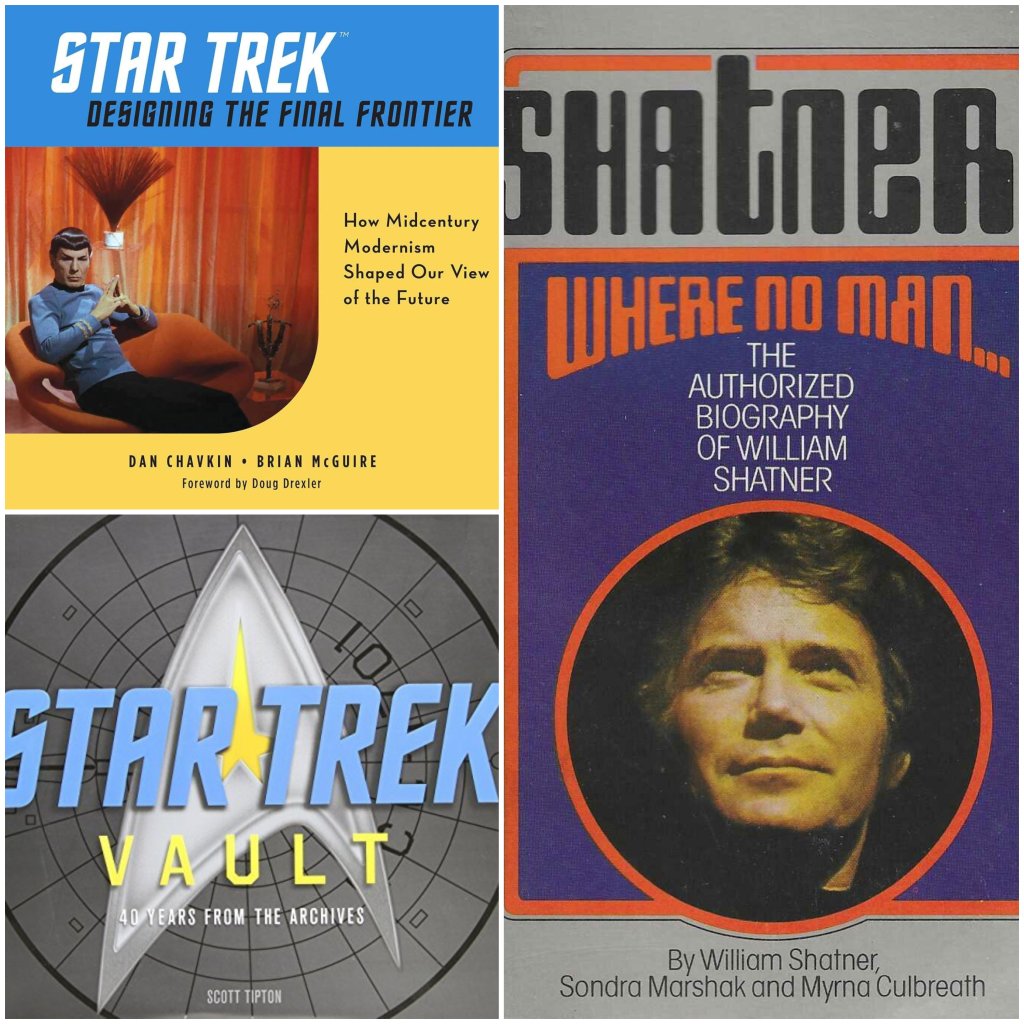
I like that headline but it’s not actually true. Prolific author and well-known Star Trek fan Dayton Ward posted a list of non-fiction Trek books he wants to read or revisit, and I added my picks in an exchange on Bluesky. So, I did not collaborate with him and we’ve never even met (although I think we would get along famously), but his article plus my suggestions add up to a good to-read resource.
First, check out Dayton’s post. It’s always a pleasure to read content from knowledgeable Star Trek fans, and his suggestions are solid. And he was wise to set the following parameters, because otherwise a reading list can just become every book that says Star Trek on the cover:
While some titles will include info on the 1970s animated series and/or the follow-on movies featuring the original series cast, my primary focus will be the original show. Certain books offering an overview of the entire franchise – or at least “the entire franchise” as it was when a particular book was written – may be added to the list at some point as stretch goals if I hit the main targets, but even then I’ll likely stick to the parameters I’ve set up. This also isn’t meant to be an inclusive list…
To his selections I added the following. Some are titles Dayton considered but left off, for the reasons stated above. At least one — the DeForest Kelley biography — was new to him. (You can read his replies to my suggestions at the Bluesky link above.)
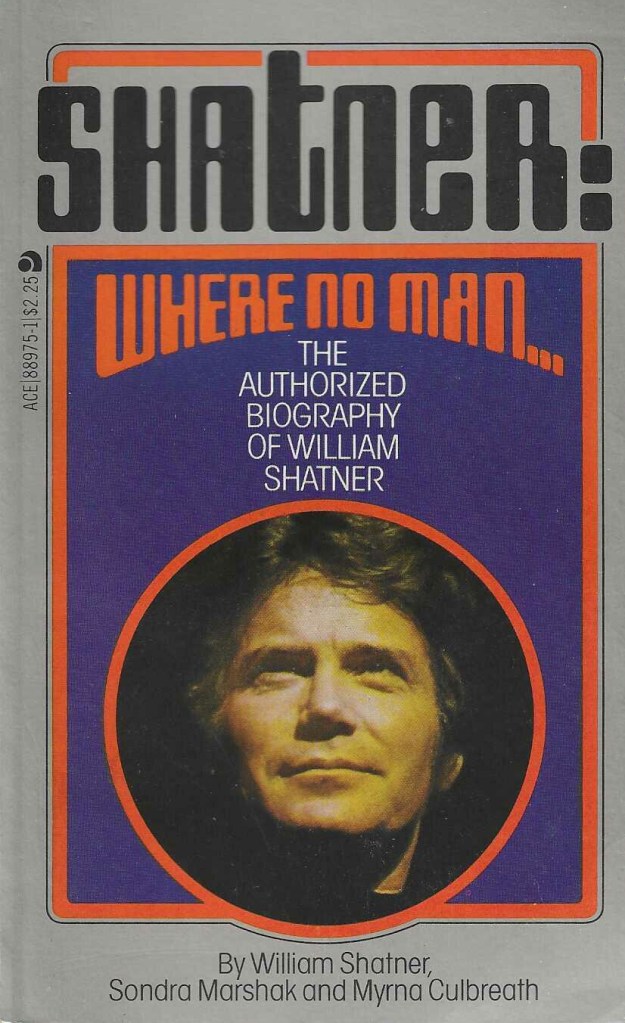
Where No Man…William Shatner, Sondra Marshak, Myrna Culbreath
I cannot say I love Marshak’s and Culbreath’s writing style, but this is the first book about Shatner and I am a completist, so this has to be on my list. Also, it comes from a time when Shatner’s public persona was a little less polished. See also this post for more on that era.
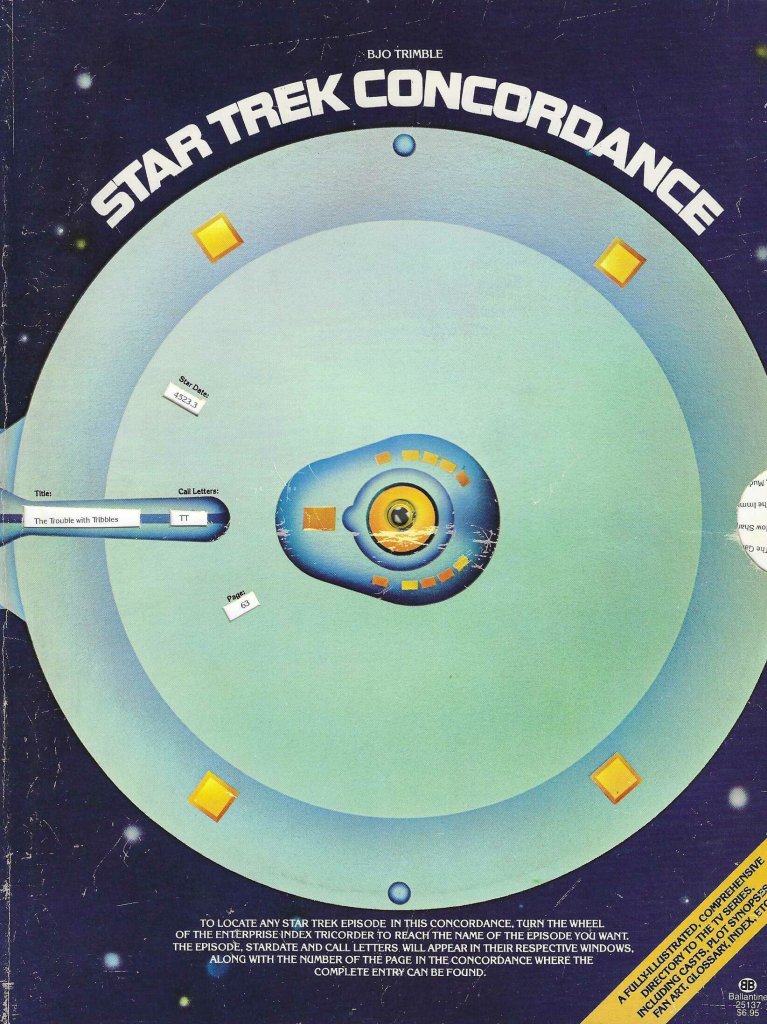
Star Trek Concordance. Bjo Trimble
This episode guide and lexicon was groundbreaking and invaluable when Ballantine published it in 1976, plus it had a spinny “Enterprise Index Tricorder” built into the cover. I also love the two fan versions put out in 1969 and 1973.
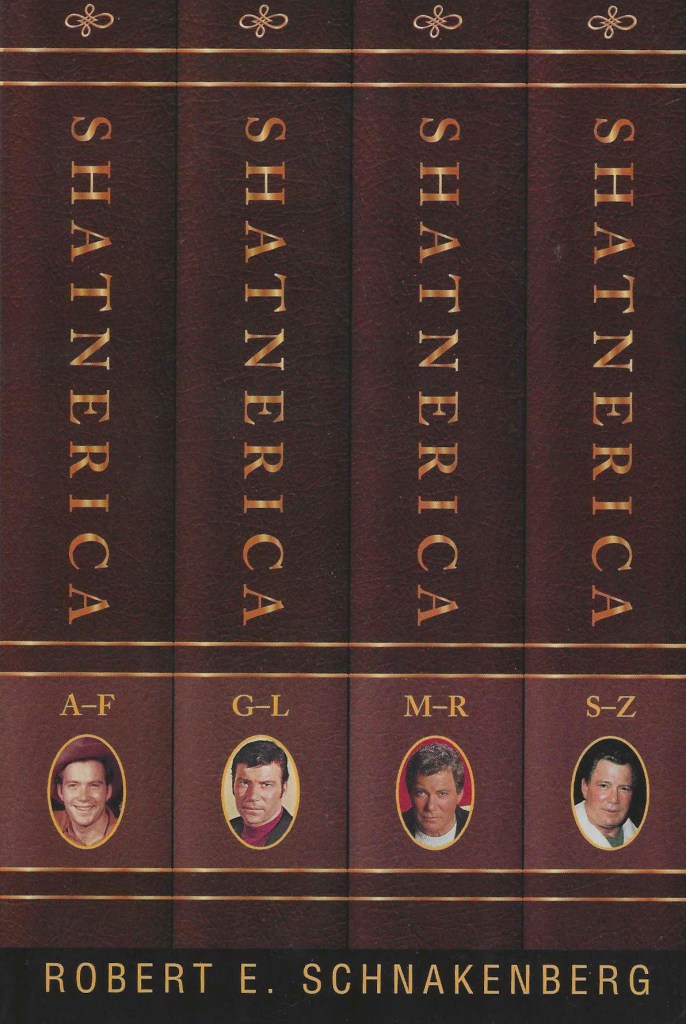
The Encyclopedia Shatnerica. Robert E. Schnakenberg
Does anyone else own this book? I have seen exactly one other copy out in the world — but in writing this post I discovered the author produced a revised version in 2008. So I have now ordered it. Thanks, Dayton.
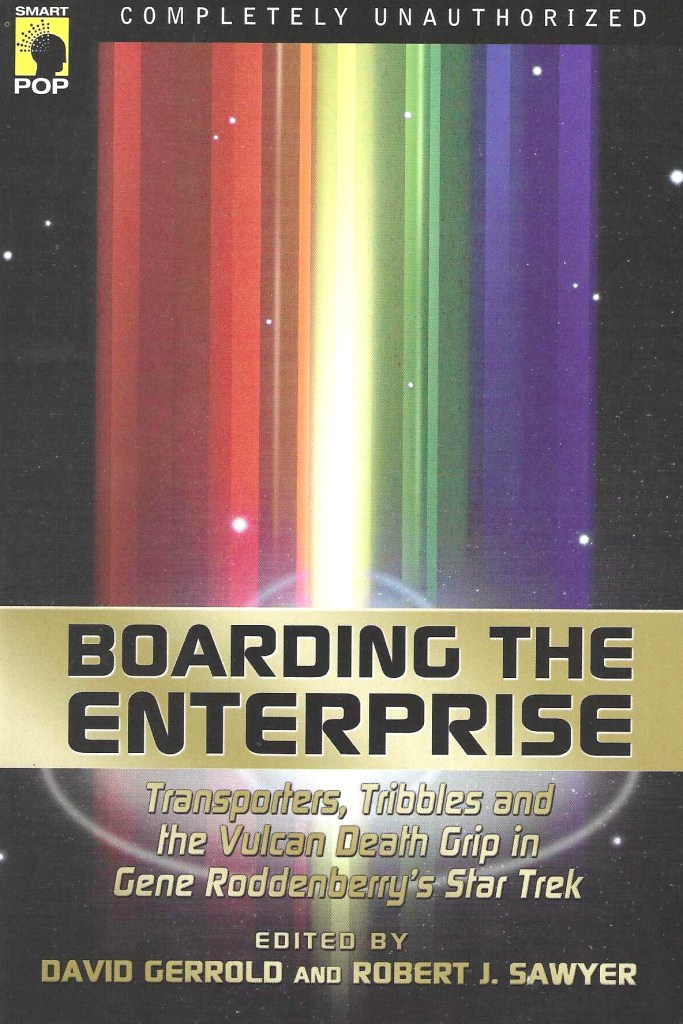
Boarding the Enterprise. David Gerrold, Robert J. Sawyer
This is an intelligent and challenging collection of essays examining philosophical, scientific, and cultural questions, edited by two prominent thinkers in our fandom. It is not a light beach read, but it is the best analysis I’ve read of this cultural phenomenon. My article on the book is here.

A Harvest of Memories. Kristine M. Smith
Deforest Kelley is the least known of Star Trek’s major players, because he was a more private person than some and because he never wrote his own book, so perhaps the best way to get a little closer to the actor is through a woman who called him a friend for years.
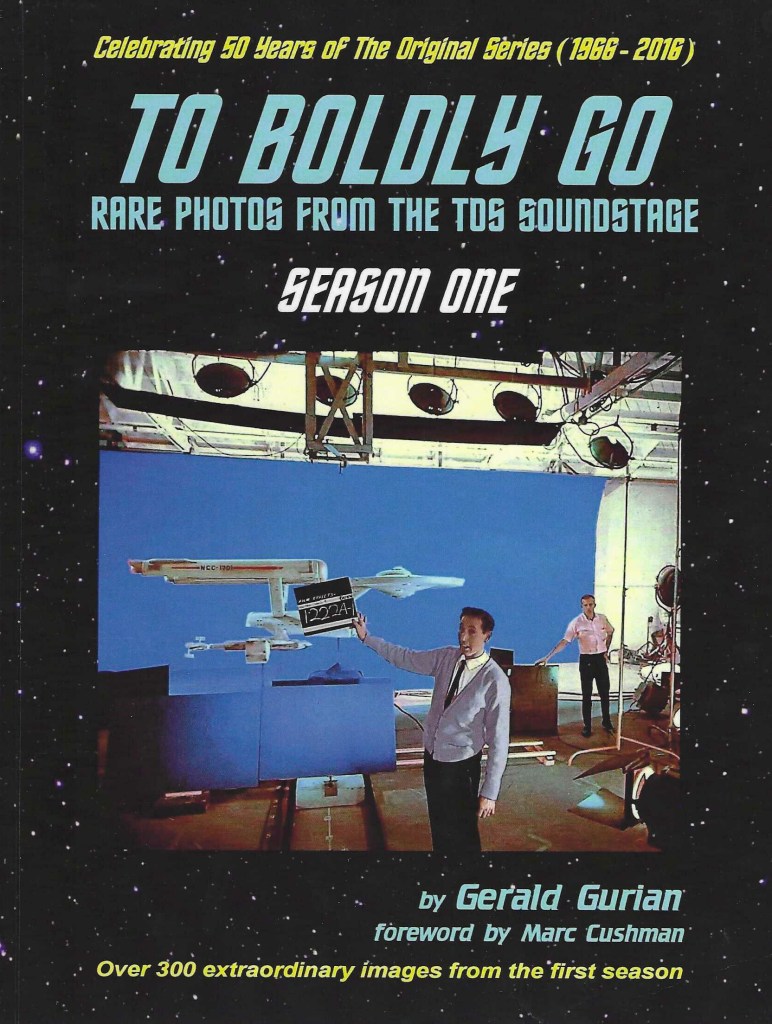
To Boldly Go: Season One, Two, and Three. Gerald Gurian
Dayton chose Star Trek: Lost Scenes for his rare-pics fix, and it is an excellent book, but I encouraged him to add this three-volume work to his list. Gerald has a remarkable collection and we are lucky he shared it.
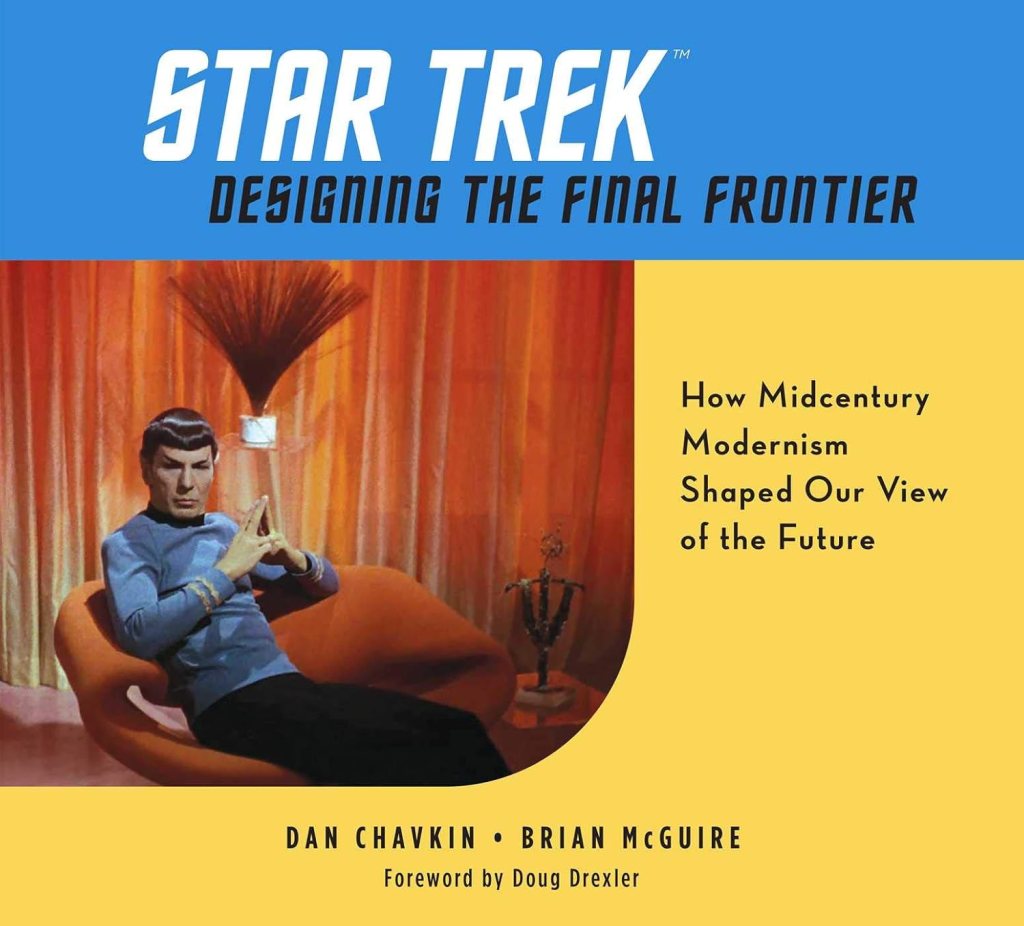
Designing the Final Frontier. Dan Chavkin, Brian McGuire
Star Trek is as defined by its look as by its acting and writing, and this examination through the lens of midcentury modernism is fascinating. Plus, the research is impeccable and the images are excellent.
Star Trek Vault. Scott Tipton
This did not make Dayton’s cut because it is “more of a franchise book than a TOS book” and that is valid, but don’t let that stop you. This is another thoroughly researched work, and it is unique because it includes 14 reproductions of cool collectibles. If you ever feel the need to own some vintage merch, the Vault delivers.
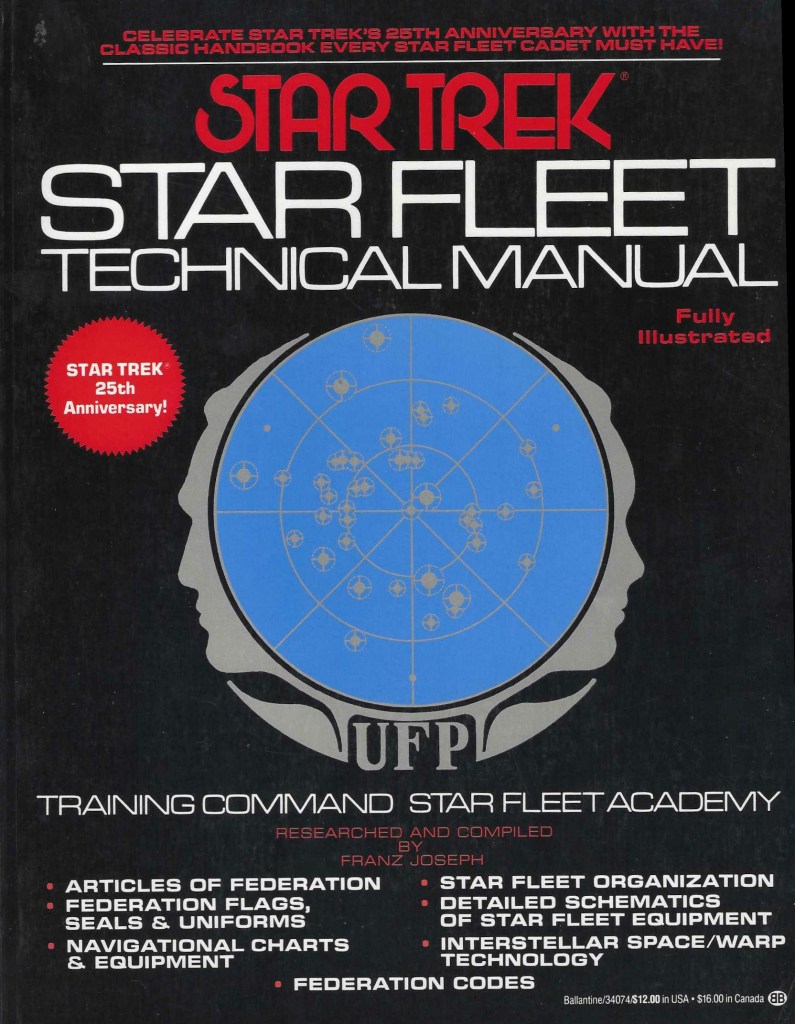
Star Trek Star Fleet Technical Manual. Franz Joseph
On this point I must simply disagree with Dayton. Again, his reasoning is sound, given his rules: the manual is “‘inside the box’ and I was making a conscious choice to exclude those.” But, for me, any guideline that eliminates this foundational resource must bend to add it.
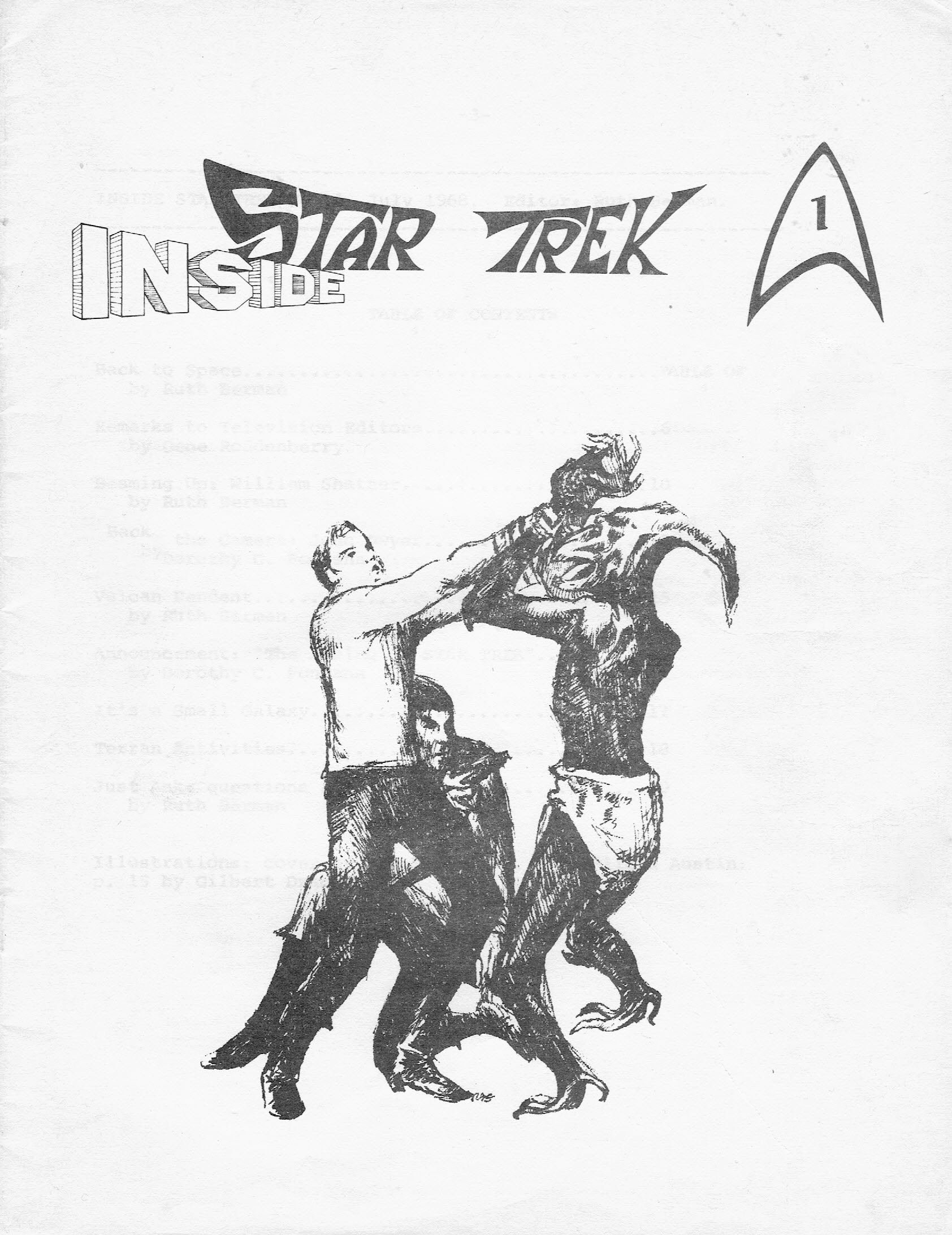
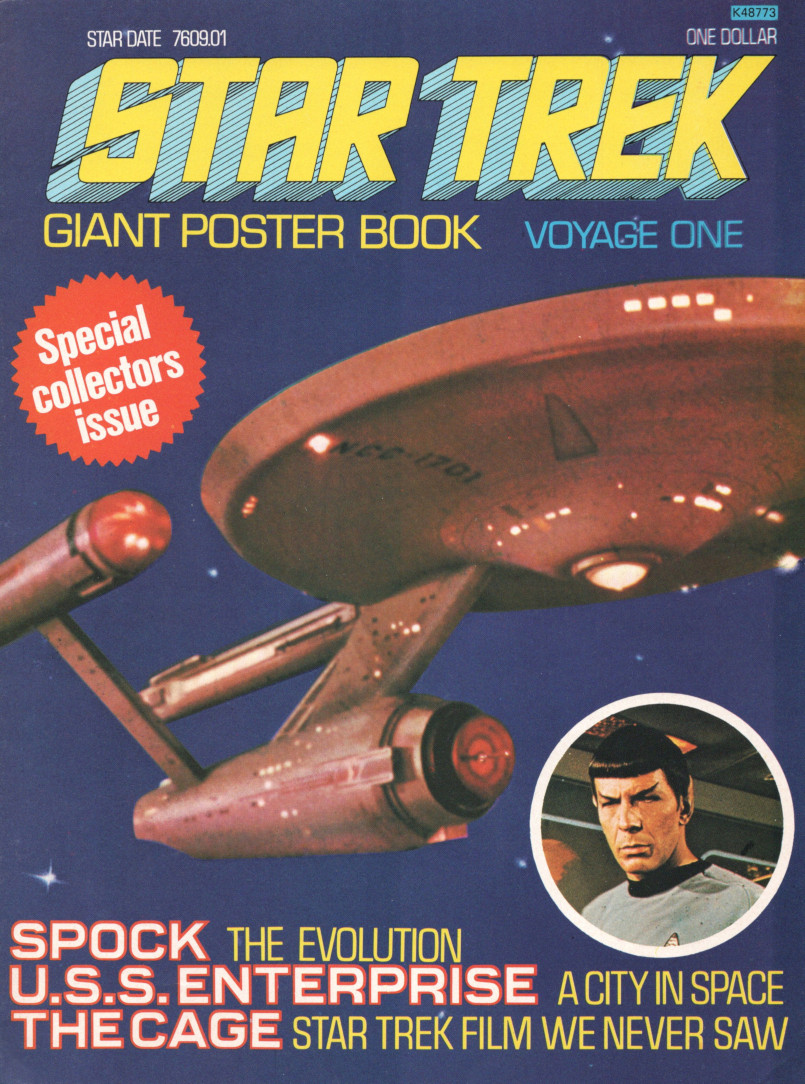
Those are my nine book suggestions, but I also pushed for the inclusion of the Inside Star Trek newsletters (and here is my ongoing review of those), the Star Trek Giant Poster Books (my series on those) and the Spockanalia fanzine (which I own but have not yet covered).
Thank you, Dayton, for the list and the inspiration to add to it. I am often skeptical of Star Trek lists, as they are written either by people with little knowledge or designed simply to generate clicks (or both), but I really liked what you did here and I recognize the expertise and the years of fandom underpinning it.A Harvest of Memories, Bjo Trimble, Boarding the Enterprise, Brian McGuire, Dan Chavkin, David Gerrold, Dayton Ward, DeForest Kelley, Designing the Final Frontier, Franz Joseph, Gerald Gurian, Inside Star Trek newsletter, Kristine M. Smith, Myrna Culbreath, Robert E. Schnakenberg, Robert J. Sawyer, Scott Tipton, Sondra Marshak, Star Fleet Technical Manual, Star Trek, Star Trek Giant Poster Book, Star Trek Vault, The Encyclopedia Shatnerica, To Boldly Go, Where No Man, William Shatner -
Giant Poster Book four: super aliens, a sort-of review of Babel, plus tribble trivia
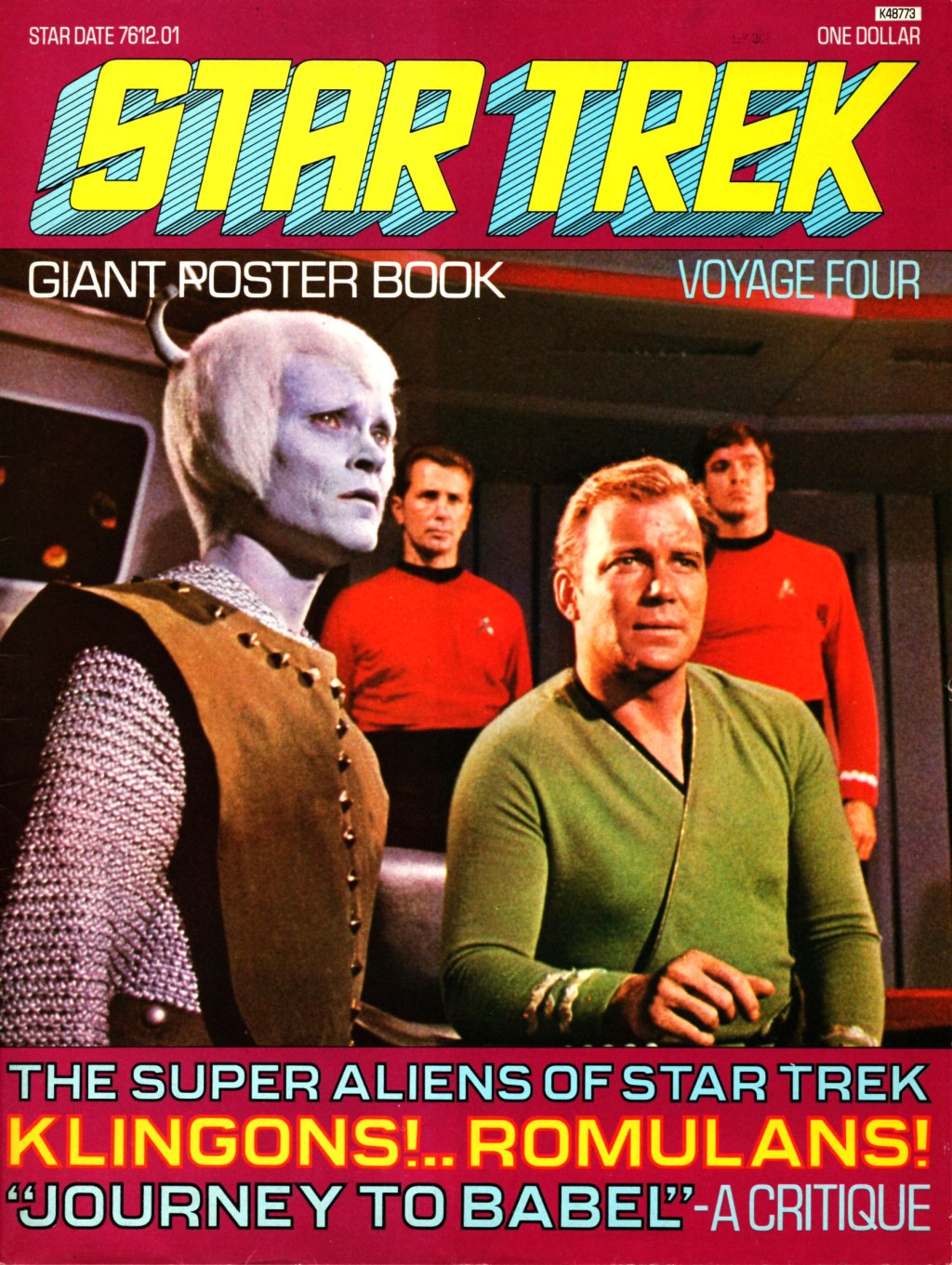
The Star Trek Giant Poster Books were the first professionally published Trek magazines. Seventeen issues were produced between September 1976 and April 1978, plus a 1979 “Collectors Issue” devoted to The Motion Picture. Each delivered six pages of content plus the cover and back cover and folded out into a large poster.
I own the complete set and will cover each issue. The story of the magazine’s genesis is told here.
Here are highlights from issue four, published in December 1976, plus a scan of the magazine.
The first three issues of the Star Trek Giant Poster Book are excellent. The fourth is a bit of a miss. It happens. Even the excellent first season of TOS gave us The Alternative Factor.
Issue four opens with a clever editorial from Ron Barlow. Fans had worked to delay the cancellation of the series, so he tried to get some of that same energy behind the pages of the magazine. He urged readers to pester newsstands and book stores to stock it, encourage fanzines to write about it, and — of course — asked them to dig out $10 for a subscription. Eighteen issues were published, so the appeal was a success of sorts.
What follows in this issue, though, may not have pushed many sawbucks into envelopes. We get a review of Journey to Babel that somehow ignores the emotion, excitement, and tension of the story, telling readers:
A diplomatic mission as important as Babel poses a significant threat to Kirk’s hold on his very private, very special community since it is his success at such important matters that will determine his future, not only as a starship captain, but with Star Fleet in general.
What? We also get: “Although Kirk is a good officer and concerned with the well being of the Federation, his first priority (this is, of course, assuming that he is human), is that of a personal nature…” Assuming he is human?
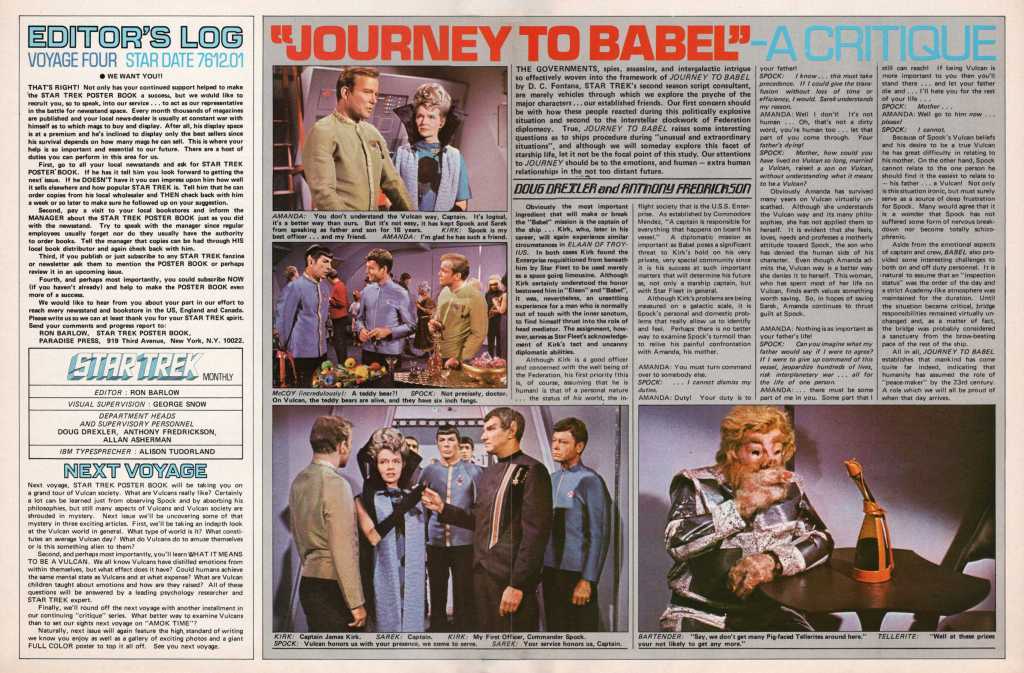
Allan Asherman’s rundown of The Super Aliens of Star Trek is really just a list of powerful beings and a reminder of in which episode each appeared. But this is actually more useful than it might appear today. In 1976, Bjo Trimble’s Star Trek Concordance was only just becoming widely available and Asherman’s own The Star Trek Compendium was still five years away. So lists were reference resources, and probably welcomed.
The final two articles are basically fan fiction about the history of the Klingons and Romulans. Again, some perspective helps here: the total number of Star Trek tales then was tiny compared to the ranks of episodes, novels, short stories, and comics we have today, so fans may have enjoyed these pieces.
The best bits of this issue are the last two pages. The ad for the magazine itself is humorous, pushing the publication as a treatment for Star Trek Fever. And the answers to the trivia questions from issue three are interesting, especially the statement that 1,000 tribbles were sewn for The Trouble with Tribbles, in four variations. I have no idea if that is correct.
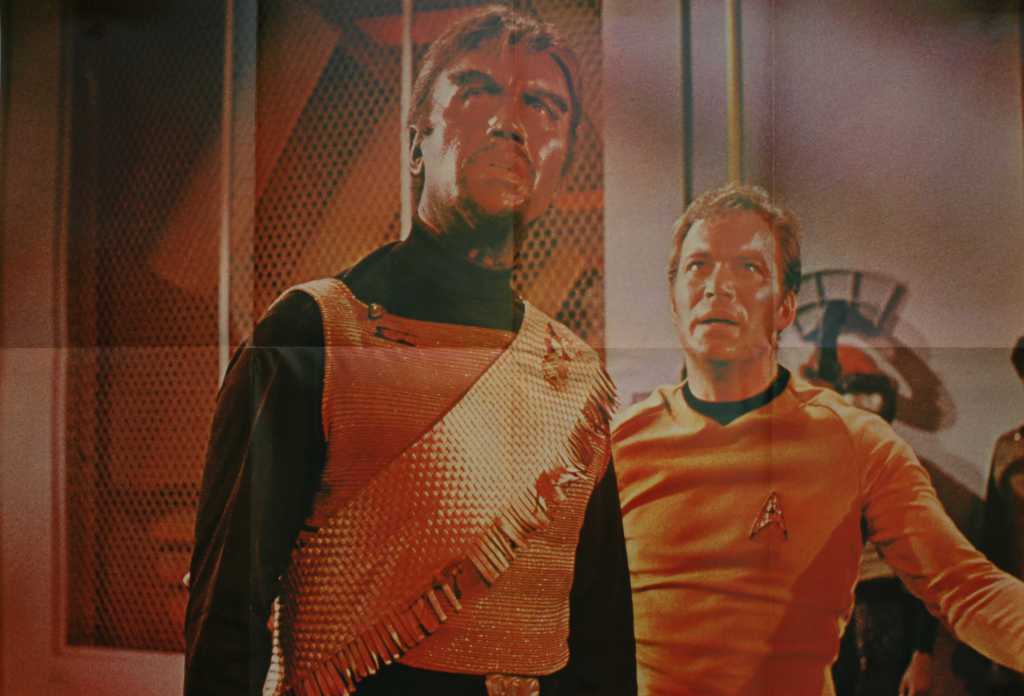
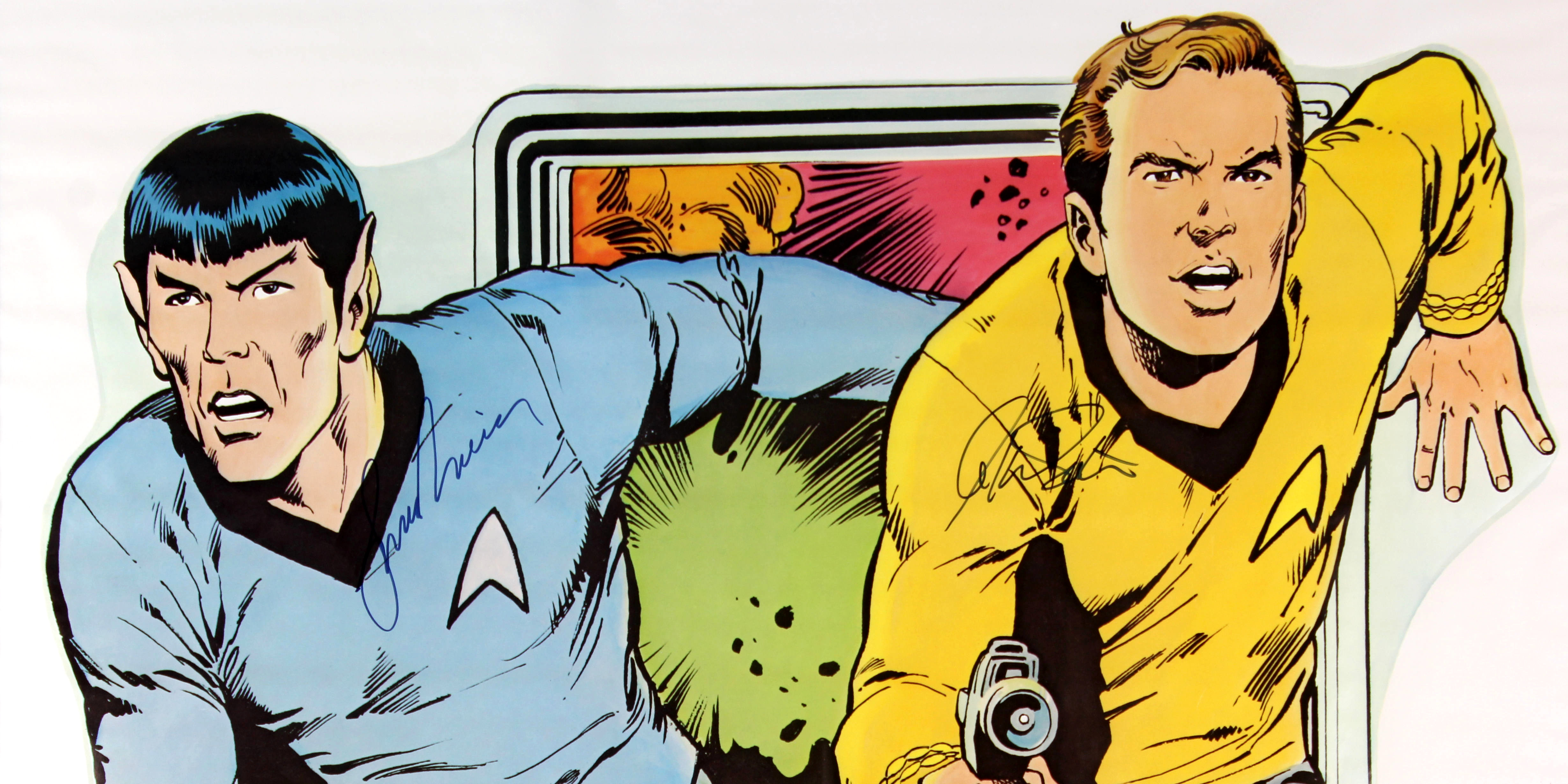
And the poster is excellent.
Let’s hope the next outing is better. I am about to read issue five for the first time in many years.
Collecting Trek
A TOS collection 40 years in the making

