-
David Gerrold is a good guy — and he needs help
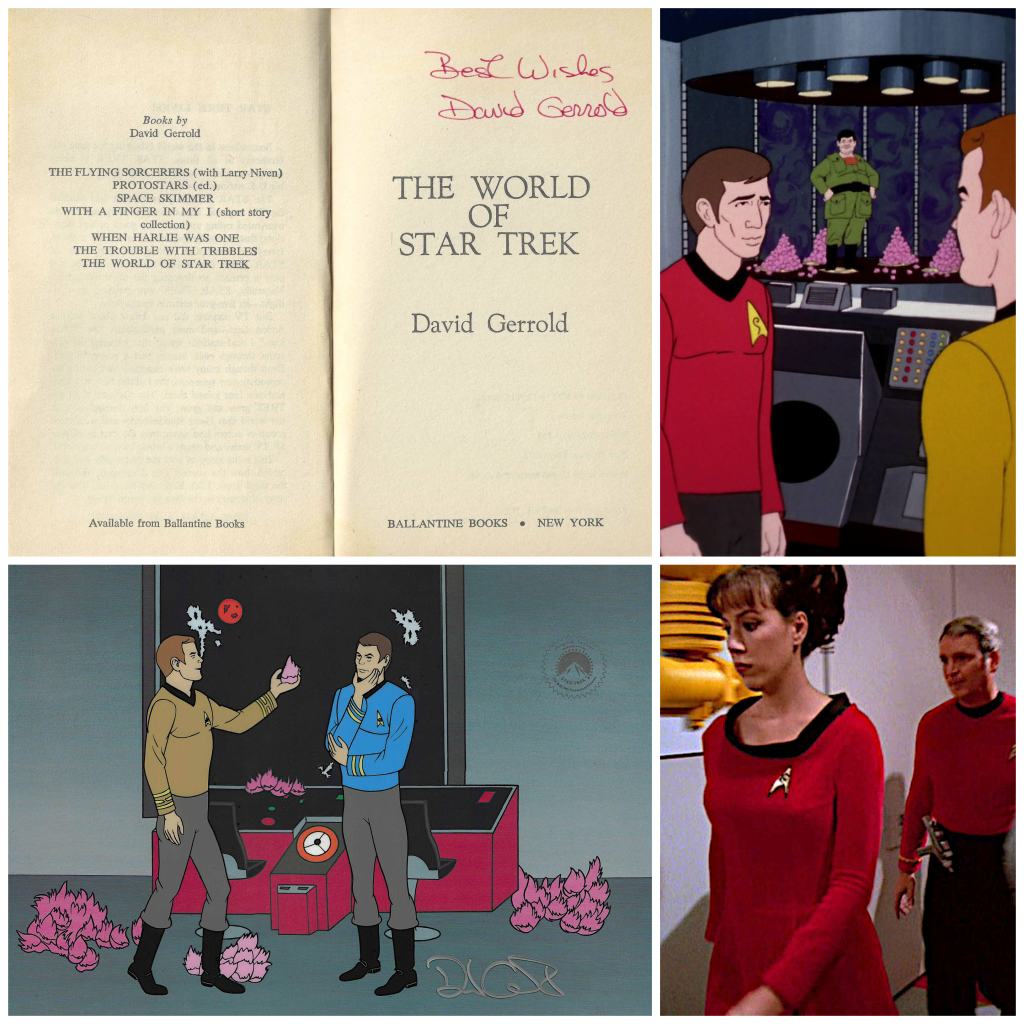
David Gerrold is ill. The author of The Trouble with Tribbles, uncredited polisher of many scripts, writer of the animated episodes More Tribbles, More Troubles and BEM, story editor early in the production of The Next Generation, and prolific fiction writer outside of Star Trek reluctantly launched a GoFundMe to help with medical bills.
I am sad to say I have never met David, but from all I have heard he is a great guy. For example, he is a regular tour guide and presenter at the Star Trek Original Series Set Tours in Ticonderoga, and my friend Robert J. Sawyer (his site, my site) likes him a lot. I asked Rob to tell me just a little about David.
David Gerrold and I have been friends for thirty years — a fact that astonishes me. Not, I hasten to add, because it’s hard to be David’s friend. It isn’t; he’s a warm, wise, caring man. But because, way back in 1972, the very first adult science-fiction novel I ever read was David’s own first novel, Space Skimmer. The notion that someday I’d meet this man, let alone visit him in his home, or travel with him to Turkey, or co-edit with him the essay collection Boarding the Enterprise, or write the introduction to the latest edition of his masterpiece The Man Who Folded Himself, would have been inconceivable to twelve-year-old me.
But it’s a friendship I cherish. David has made the world a better place through his heartfelt and moving writing, through his nurturing of other writers, through his fundraising for AIDS Project Los Angeles, through his advocacy, and through his devotion to his wonderful son Sean. If anyone deserves to live long and prosper, it’s David.
So he’s a good guy and a Star Trek luminary. Send him some money, if you are able.
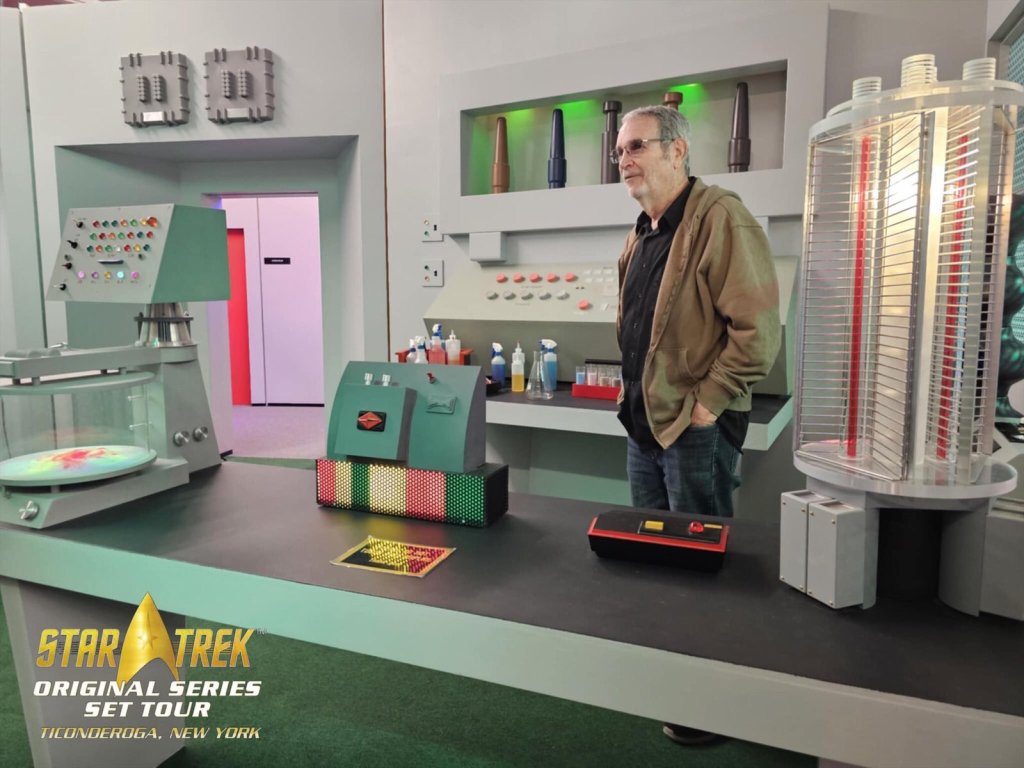
Photo credit: Star Trek Original Series Set Tour I have not met David, as I said, but I have a few collecting stories to share.
A bookstore find
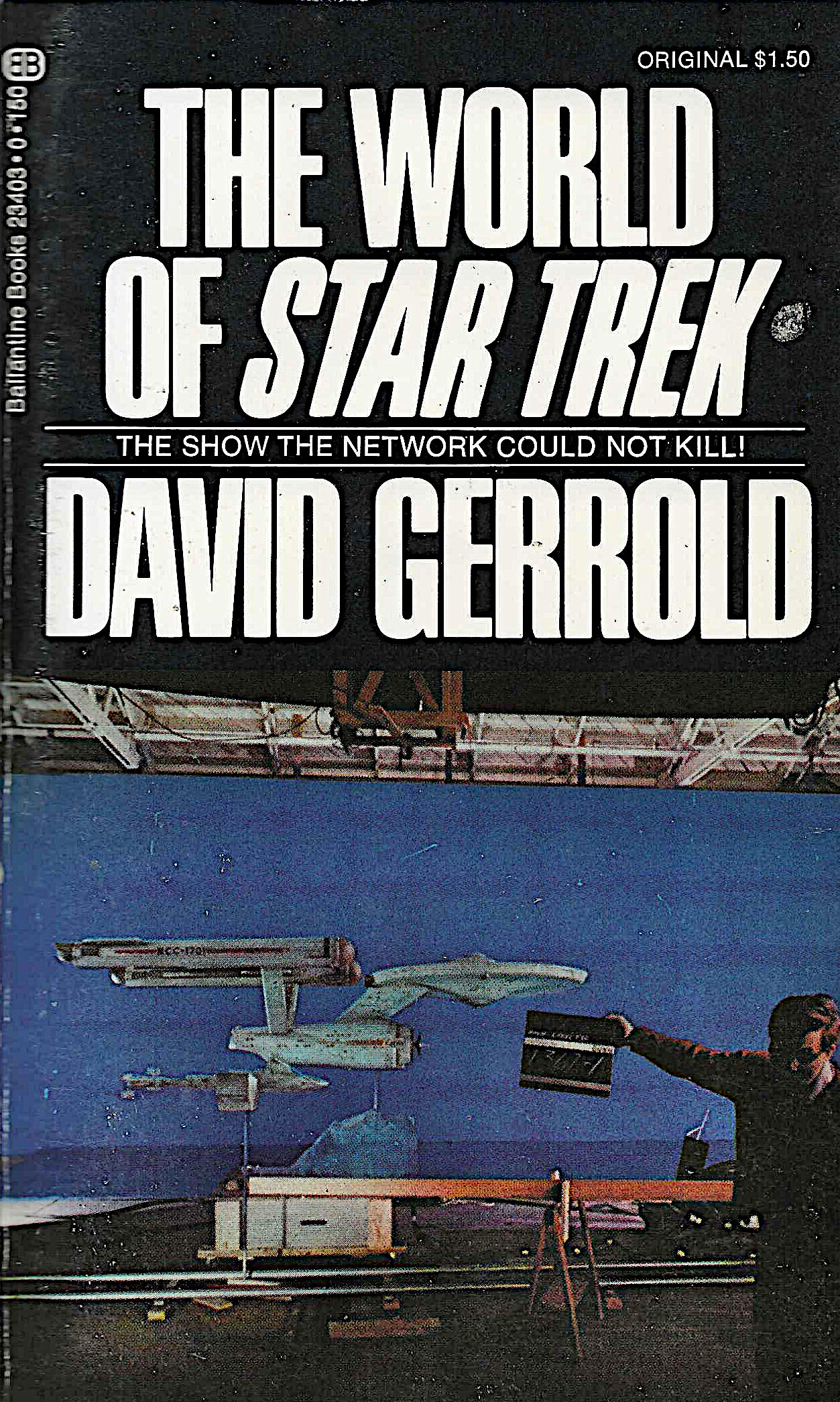
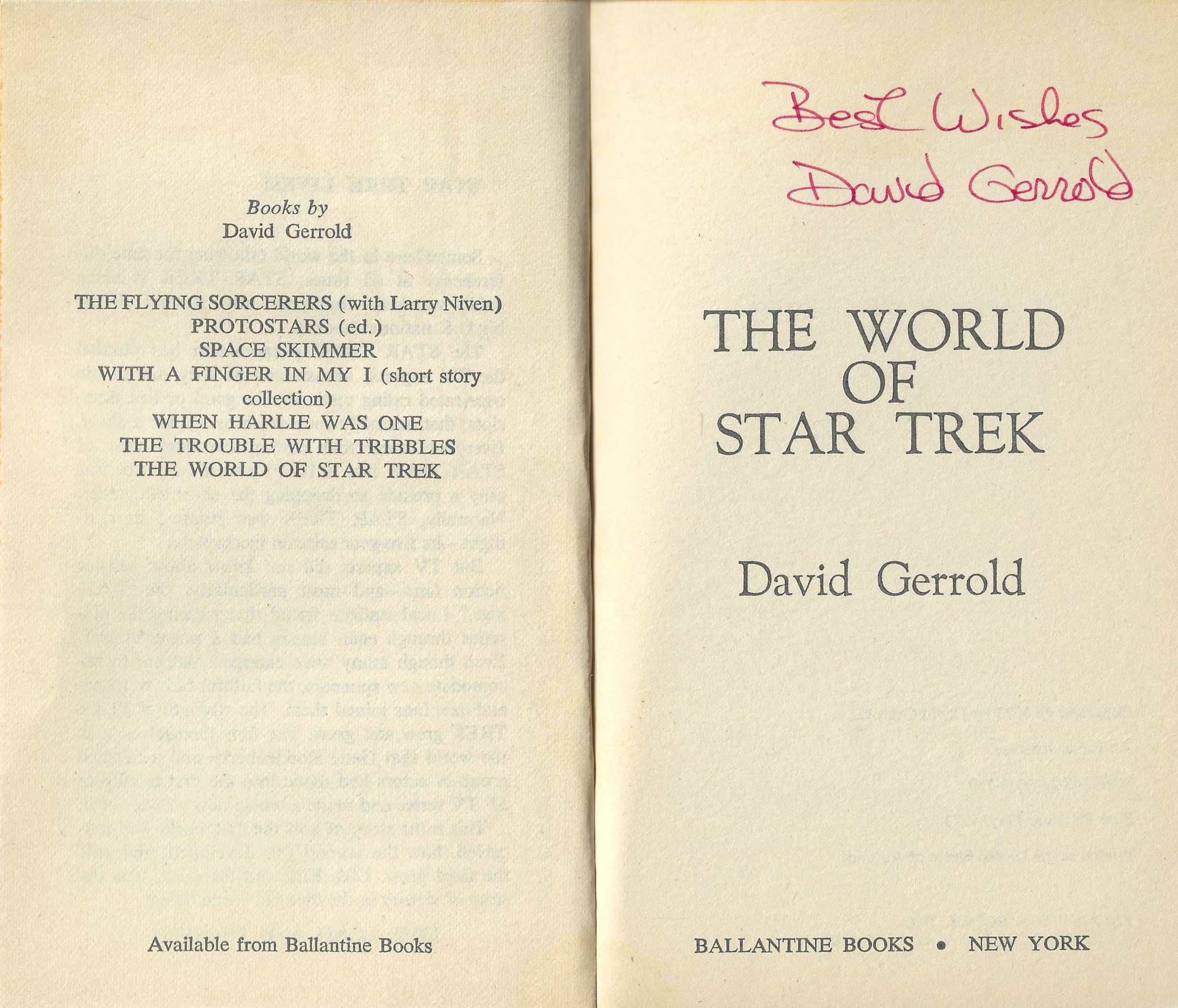
I own about 150 TOS autographs, and my first was David’s. He had signed a first edition of his book The World of Star Trek and it ended up on the shelf in Toronto’s Bakka book store. It was published in 1973; I bought it about six years later. It was amazing to me that a person so important to Star Trek had held the same book I now owned, and it started my collecting journey.
An eBay find
My second David autograph is on a seri-cel. (What’s a seri-cel?) I spotted it on eBay in 2013. It’s a great scene from his More Tribbles, More Troubles episode, but I did not know if the signature was real. So I emailed him through his site, and he got back to me quickly: “Yes, I did sign those. Thanks for checking.”
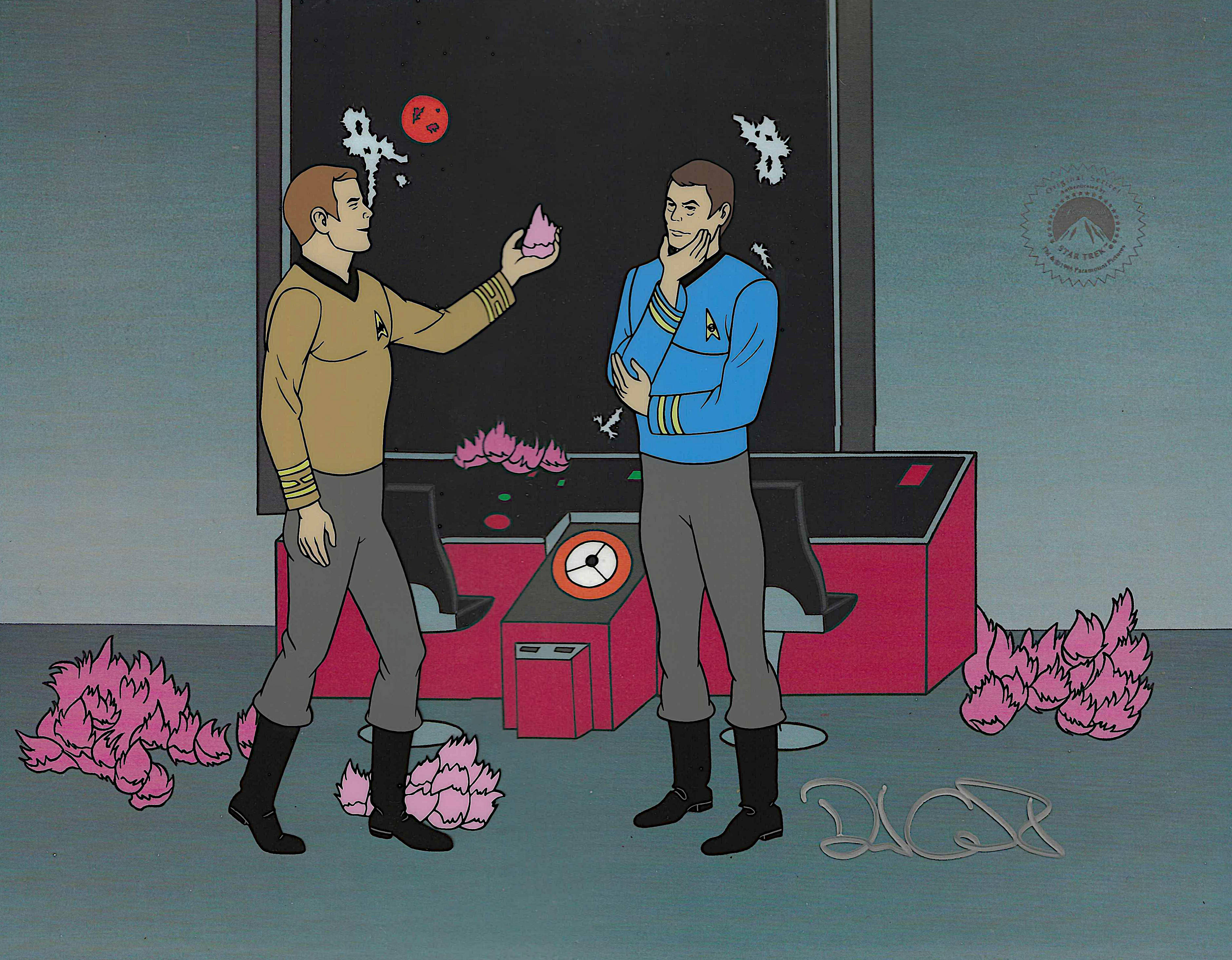
That brings up a good collecting tip: if a person related to a collectible is still with us, reach out with any questions about authenticity. They are often happy to be asked. That has also worked for me with Noel Sturgeon, Susan Sackett, Howard Weinstein, and others.
A surprise find
I also have David’s autograph on The Concordance Color Book but I did not know it was there. The signatures of DC Fontana and Gene Roddenberry were also big surprises.
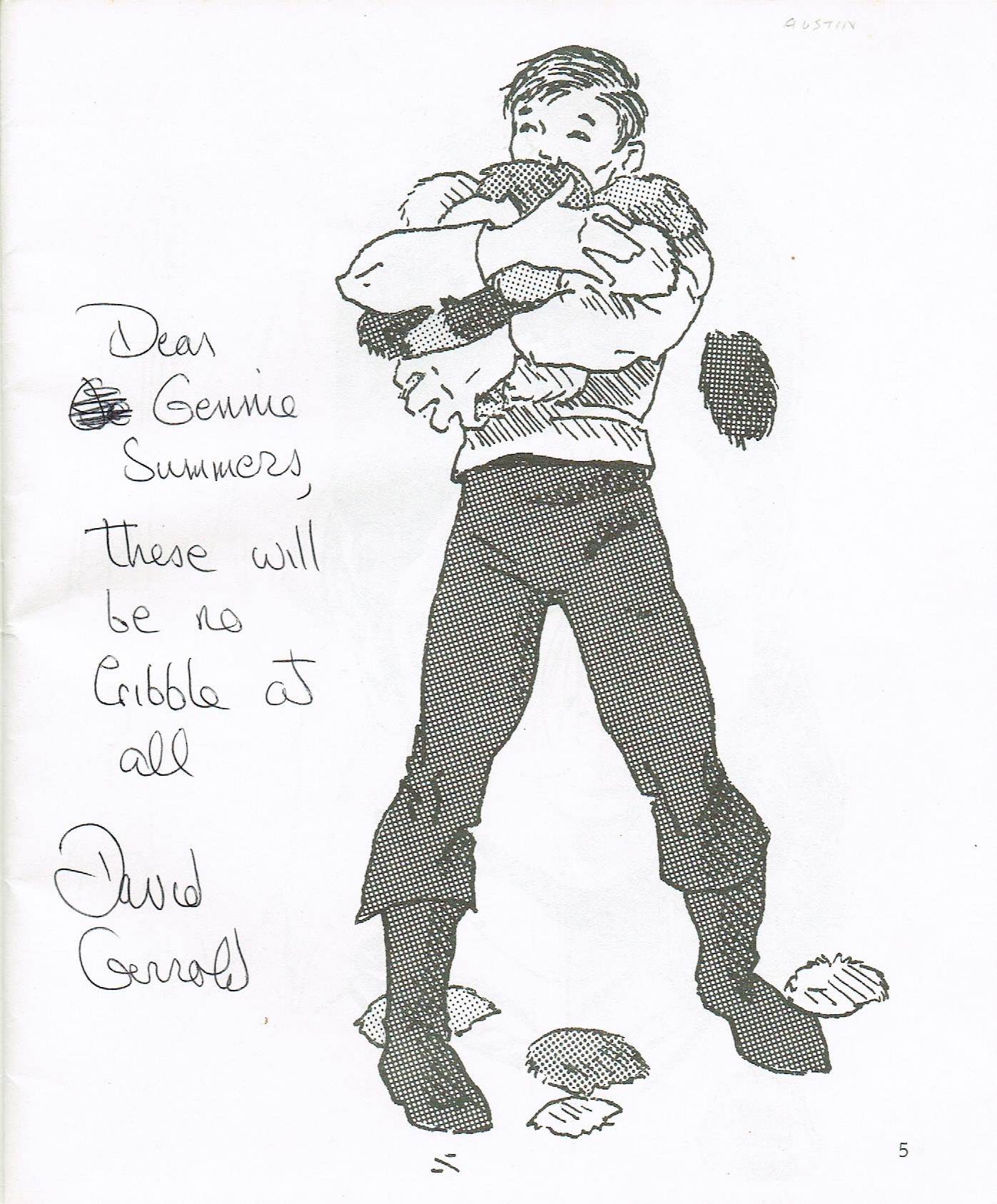
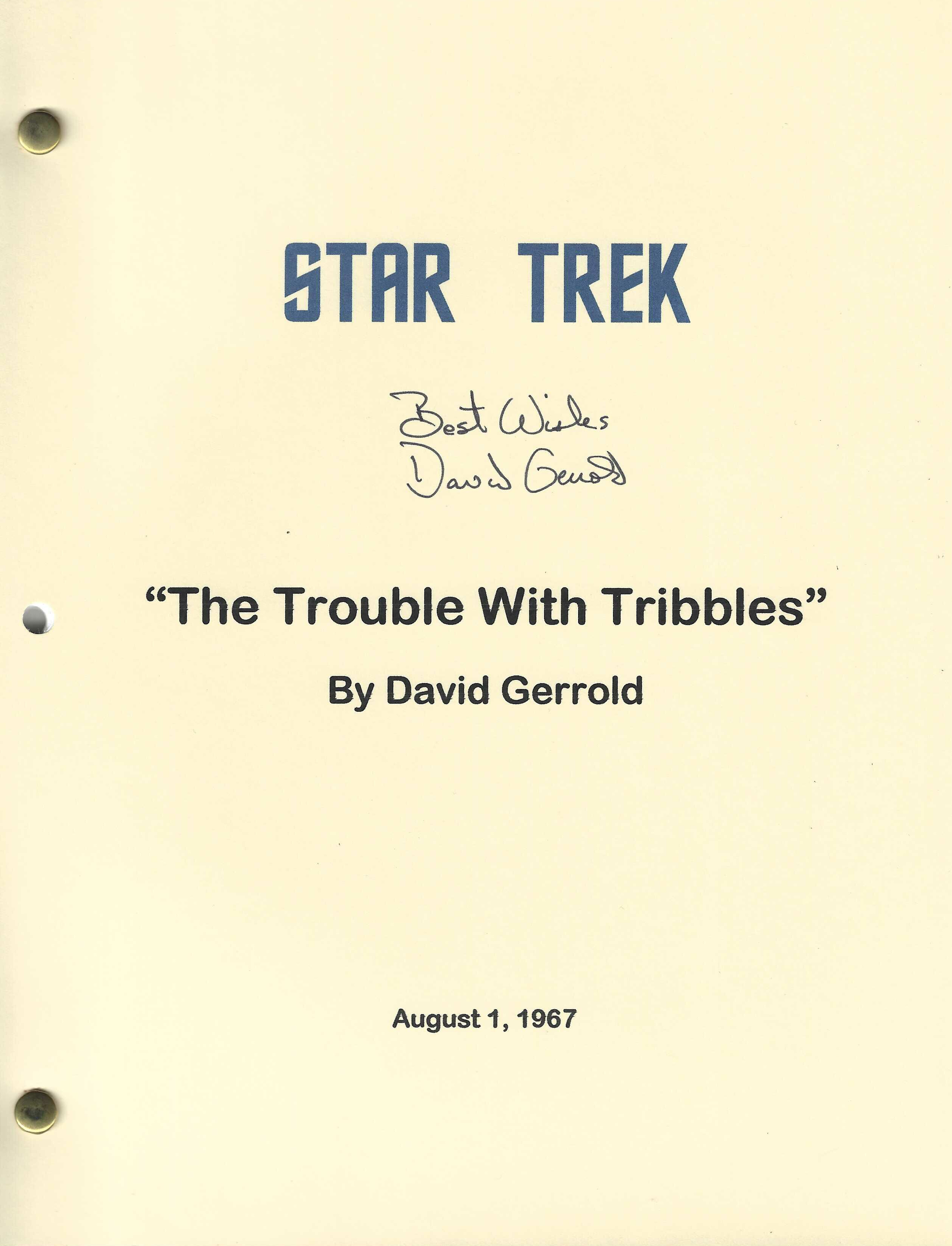
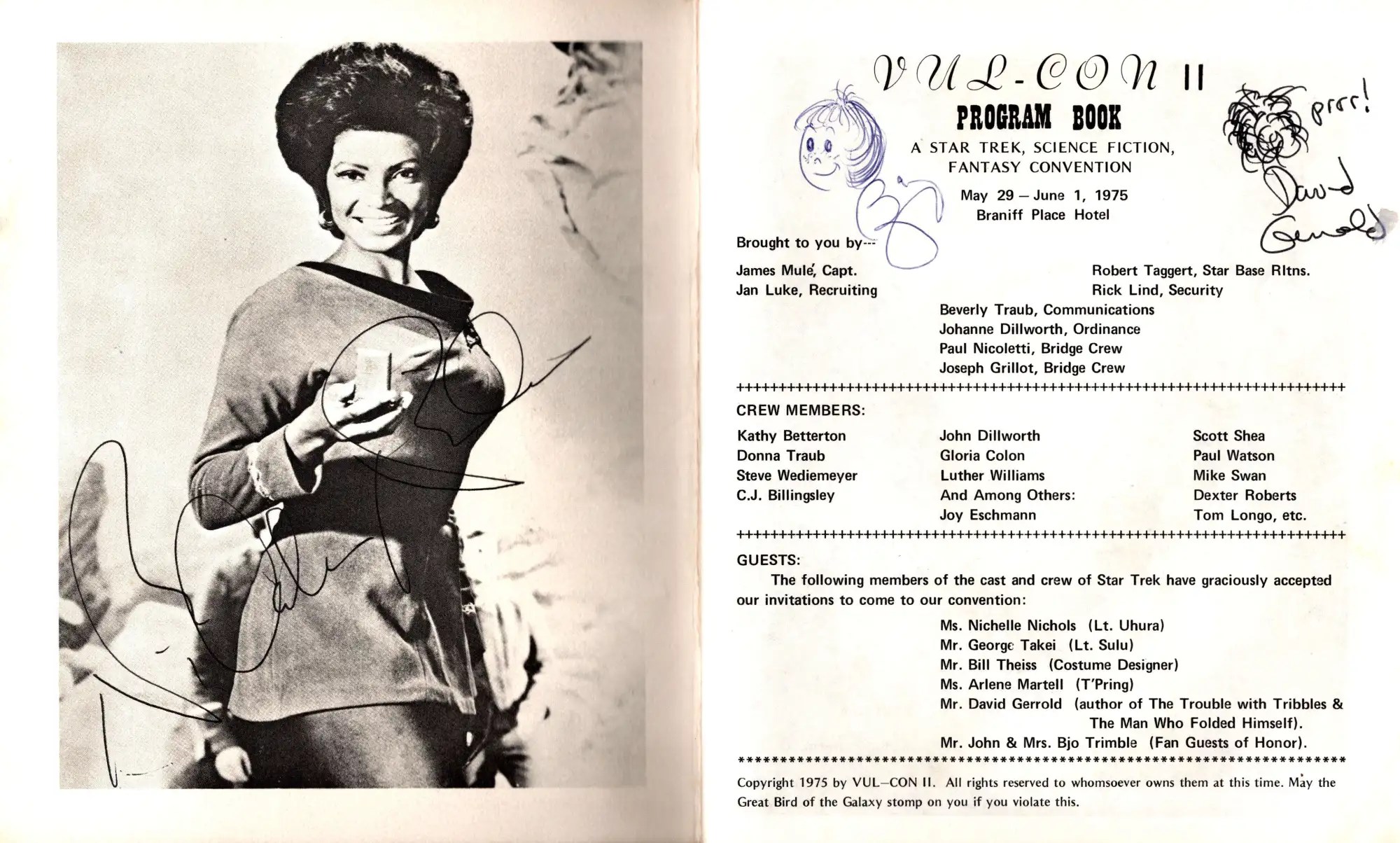
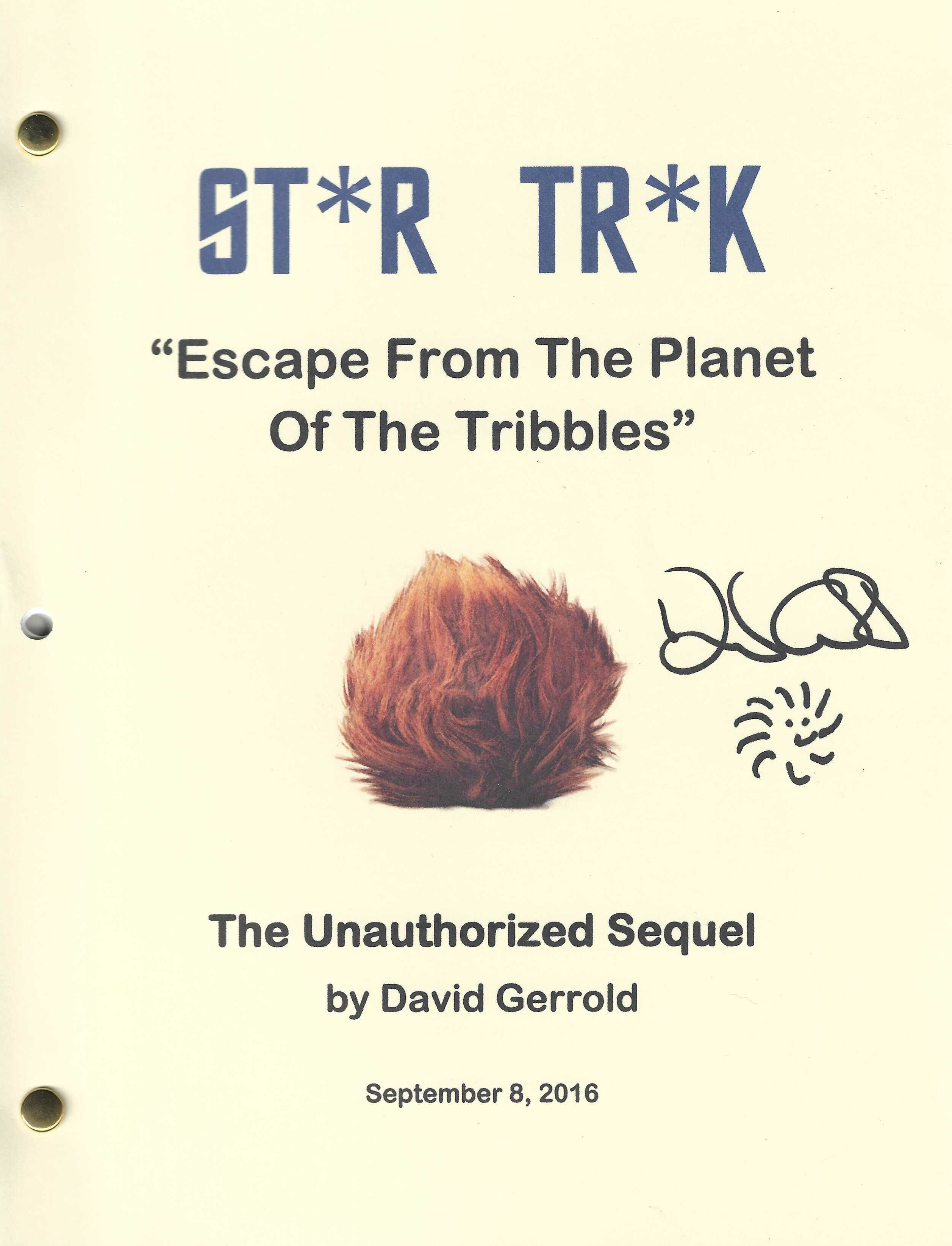
And I have three more: a Tribbles script, purchased from his site; a convention program; and an Escape From The Planet Of The Tribbles script, bought at the Star Trek Tours last year.
I shared some collecting stories, because that’s what this site is about, but my goal here is to encourage people to send David some help, if they are able. We don’t often have the chance to give tangible thanks to the people who helped build this world for us.
I will give David the last words here. This is from his GoFundMe, where he has posted some fiction to thank people for visiting the page, whether they donate or not:
…there are people in much more serious circumstances. If you can afford to donate, donate to them first. If you want to help me finish the book, and if you can afford it, then I thank you in advance. And if you can’t, then just download the files as a thank you for reading this far.
-
Harlan Ellison really hated The Motion Picture
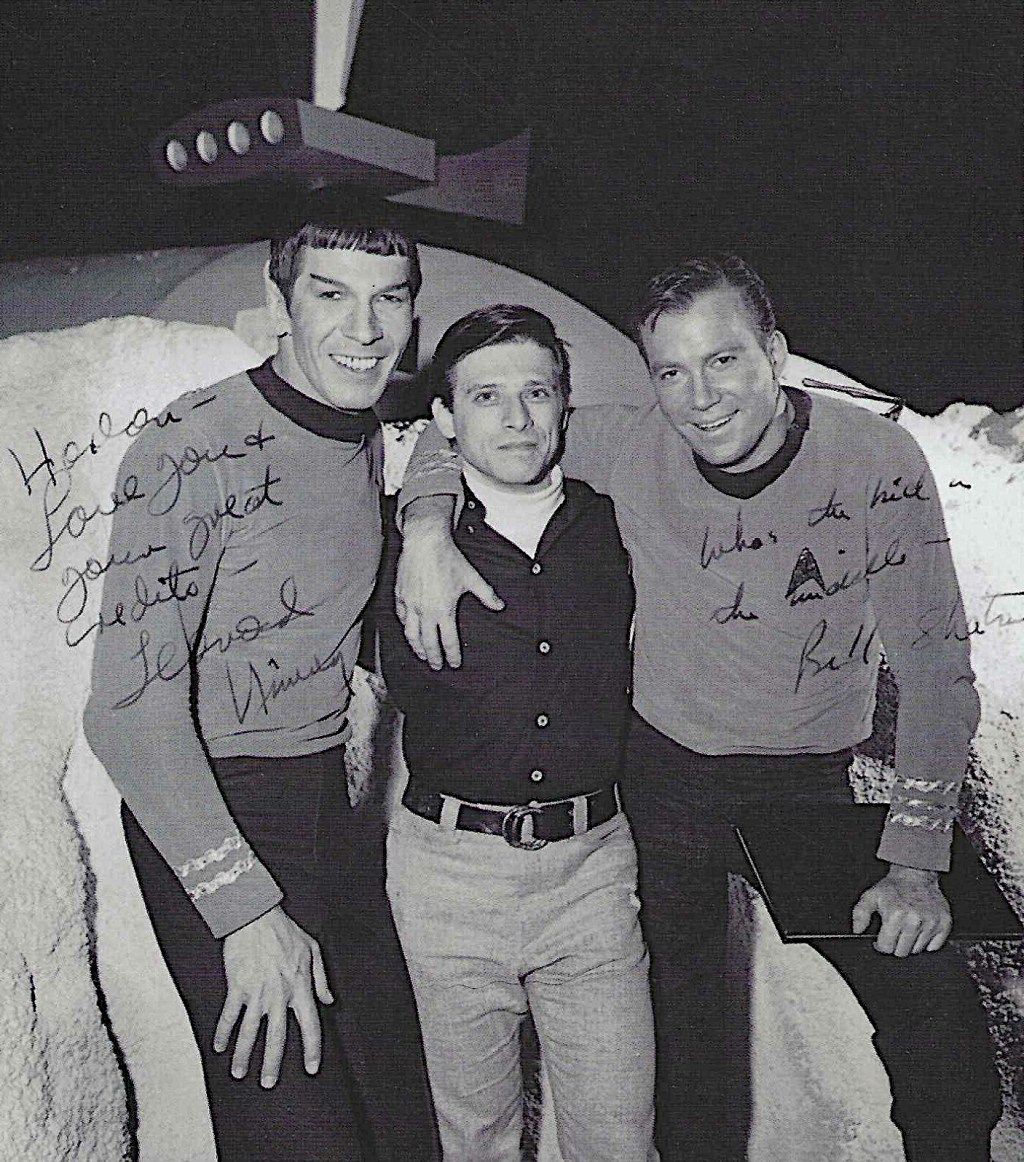
Lots of critics dumped on The Motion Picture back in the day. Gene Siskel, for example, speaking in 1982 and therefore enjoying the opportunity of three years to mellow his opinion, still called the movie a “worthless bore.”
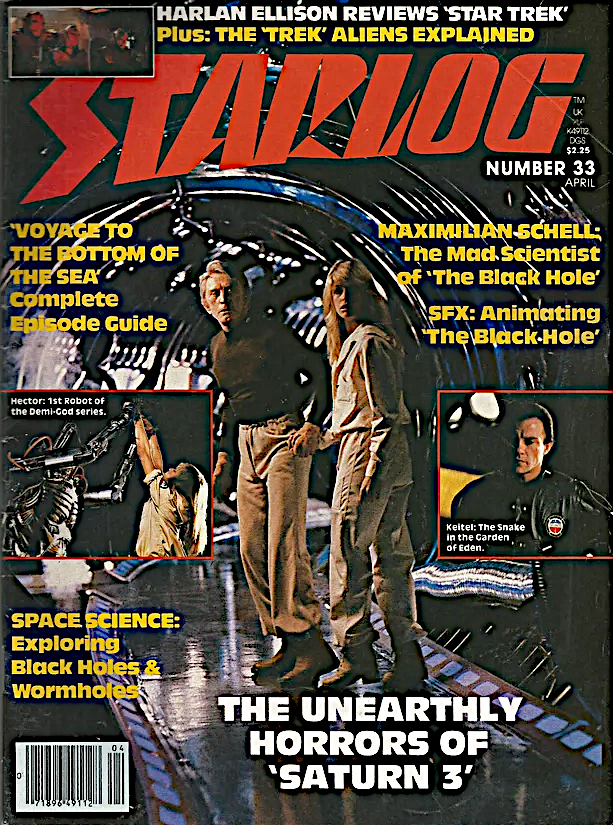
Harlan Ellison was equally scathing, but his take in Starlog issue 33 from April 1980 was even more brutal as he was a Star Trek luminary. This call was coming from inside the house.

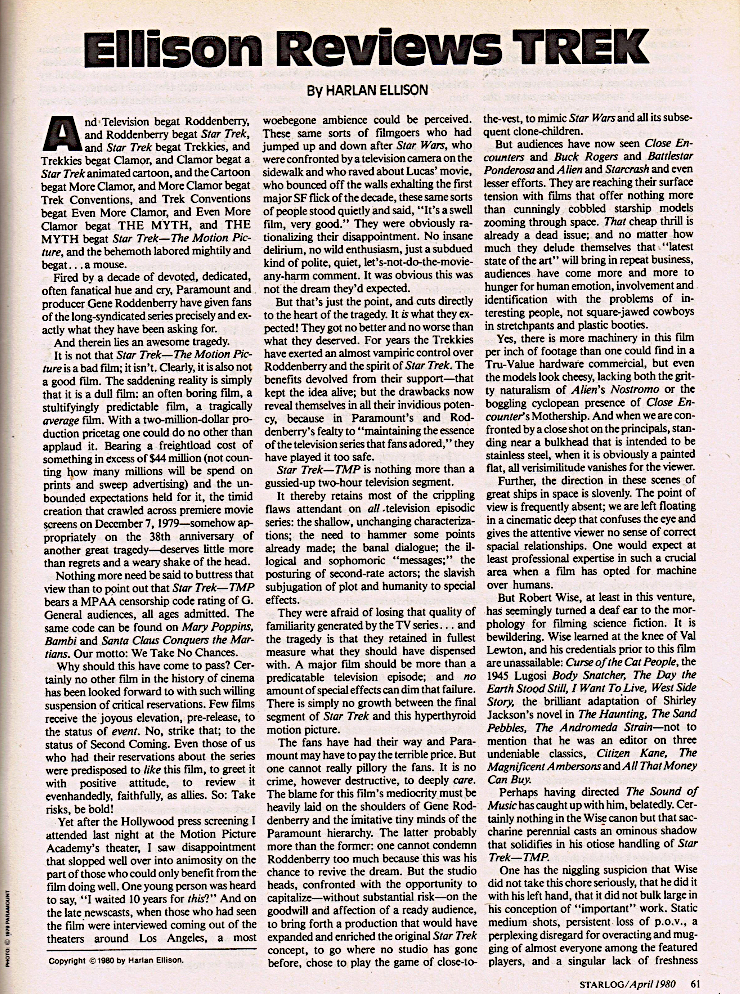
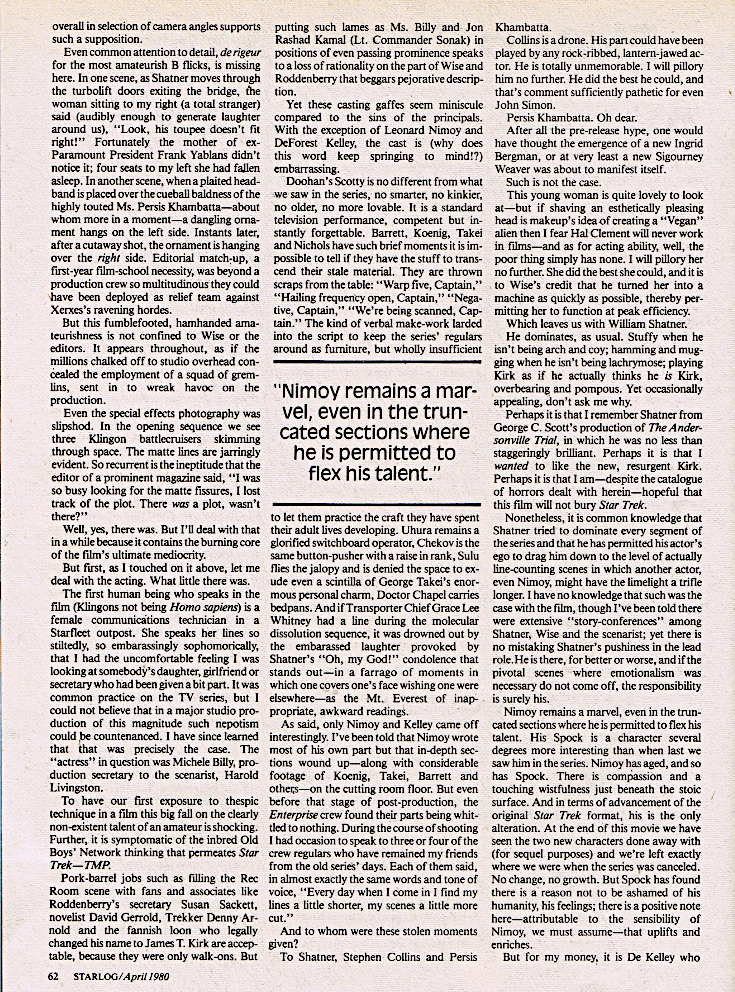

The Motion Picture, Ellison wrote, is a “dull film: an often boring film, a stultifyingly predictable film, a tragically average film.” The movie suffered from “shallow, unchanging characterization; the need to hammer some points already made; the banal dialogue; the illogical and sophomoric “messages;” the posturing of second-rate actors; the slavish subjugation of plot and humanity to special effects.”
Similar opinions were fairly widespread then and are still held by many today. What’s interesting, though, is who Ellison blamed: the fault was partly in the stars (those second-rate actors) but it was mostly the fans who pulled down the enterprise, by forcing Gene Roddenberry to serve a bland pablum rather than an exciting new dish.
[Fans] got no better and no worse than what they deserved. For years the Trekkies have exerted an almost vampiric control over Roddenberry and the spirit of Star Trek. The benefits devolved from their support—that kept the idea alive; but the drawbacks now reveal themselves in all their invidious potency, because in Paramount’s and Roddenberry’s fealty to “maintaining the essence of the television series the fans adored,” they have played it too safe.
His reference to the spirit of Star Trek is ironic, as in my opinion he never understood exactly that. His review continued the long Ellison tradition of ignoring the essence of the show in favour of a story he thought should be told. You can see this clearly in his version of The City on the Edge of Forever. I have detailed my problems with Ellison’s script, so I will only say here that the tale and his decades-long devotion to it prove he misunderstood what made Star Trek Star Trek.
Also, in dismissing the fans of the 1960s and 1970s, he looked away from the most amazing accomplishment in all of fandom: the resurrection and huge success of a franchise about to celebrate its 60th anniversary. To steal a line from Firefly, “We’ve done the impossible, and that makes us mighty.”

It’s not that Ellison was entirely wrong: the movie is on the slow side, and when he said a “major film should be more than a predictable television episode” he drew a comparison to The Changeling. But he often seems to stretch to find negativity. For example, he said the “models look cheesy.” That is ridiculous; the Enterprise and the three Klingon ships are gorgeous. He also wrote that “There is simply no growth between the final segment of Star Trek and this hyperthyroid motion picture.” No growth in a starship commander unhappy with promotion beyond command, in a half-Vulcan working to purge his human side, in a best friend who has left Starfleet for a simpler medical career, and in a crew that has matured to new responsibilities and new adventures.
Clyde Gilmour, writing in The Toronto Star, gave the outing a mixed and fairer review: “The movie is not as much fun as Star Wars, not as majestic as Close Encounters, not as scary as Alien. But it’s just as handsome and just as lavishly produced as any of them and is compulsively watchable all the way, though it drags at times. On the whole, however, it is curiously unexciting.”

Ellison wrote in his piece: “There is no meanness in me.” I would like to think that is true, but he does not make it easy. Some of this seems mean, and feels like the intent was to be so. But I have also written about the differing opinions on the man and suggested that Ellison’s challenging persona was part of a public schtick built partly on throwing punches. The headline on his review of Star Wars was Luke Skywalker is a Nerd and Darth Vader Sucks Runny Eggs.
Ellison courted controversy and I wish to this day that I had known the man but, absent personal experience, all I have is what he put out into the world. And this review does not make me like him more.
Postscript
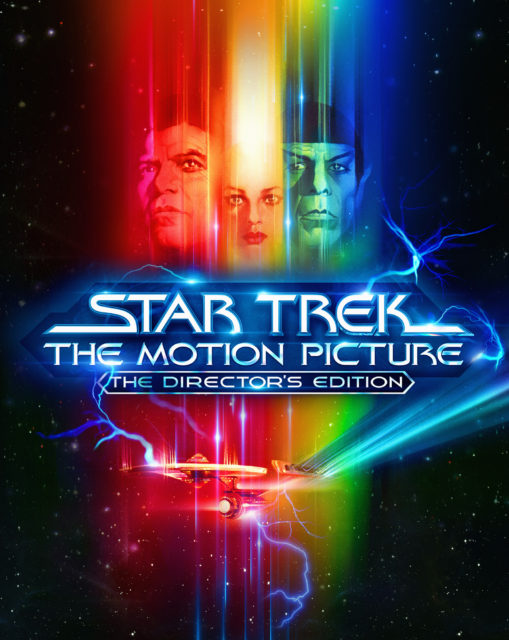
The film has risen in the estimation of many, due in large part to the 2022 release of the excellent The Director’s Edition. That version of the film is far closer to what director Robert Wise would have done with a few more months to shoot and edit. If you have not seen The Director’s Edition, you have not really seen The Motion Picture.
-
Read NBC’s promo booklet for its new show
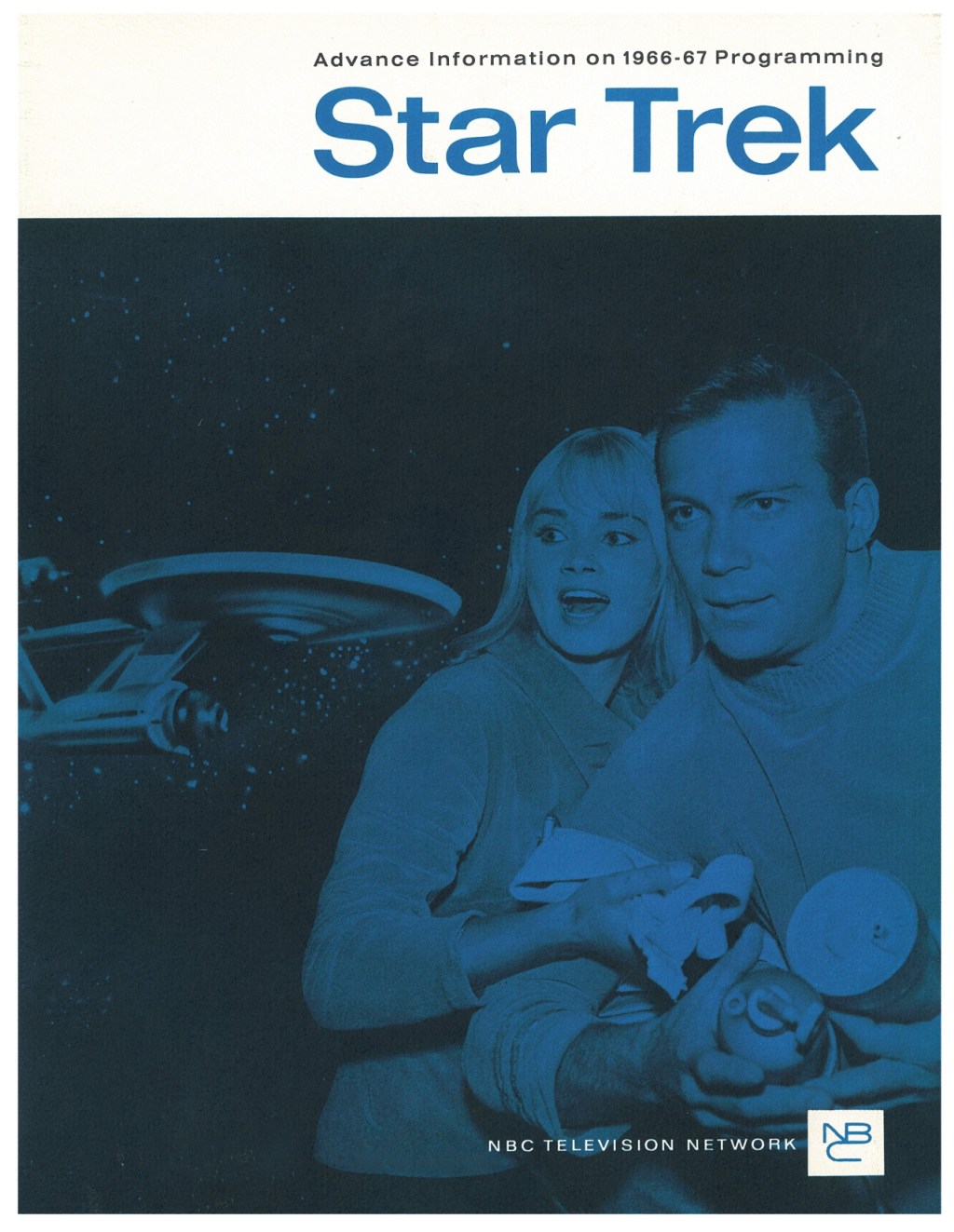
NBC used a few vehicles to promote Star Trek. It produced some commercials, included the show in its NBC Week kickoff for the 1996 TV season, and distributed an “Advance Information” booklet to boost awareness among advertisers and broadcast affiliates. That featured the second pilot, Where No Man Has Gone Before, and is an interesting look at the business of mid-sixties television.
A few photos stand out. The first is the cover shot, partly because it features Andrea Dromm’s character Yeoman Smith, who we would never see again and who didn’t have much to do in the episode. The thinking behind the cover photo probably began and ended with “Dromm is an attractive woman.” The write-up she received suggests her role was intended to be recurring. She was instead replaced by Grace Lee Whitney’s Janice Rand in The Corbomite Maneuver, the next episode produced.
The photo is also notable because Smith seems to be holding a dish cloth while our Captain clutches some…maybe kitchen canisters. I am not sure.
A lot of the publicity photos, especially the early ones, followed the creative approach of “grab whatever is handy,” like the flashlight photos of Spock, Rand and Kirk.


The second standouts are the infamous Spock airbrush pictures. NBC execs were apparently worried about the Vulcan’s “satanic” appearance, so they rounded the pointed ears and curved eyebrows. That was obviously the wrong move; Spock quickly became the most popular character and his distinctive look was a big contributor. But it’s an odd decision specifically because Where No Man… had already been filmed, so viewers would see Spock in all his alien glory whatever NBC did on these pages.
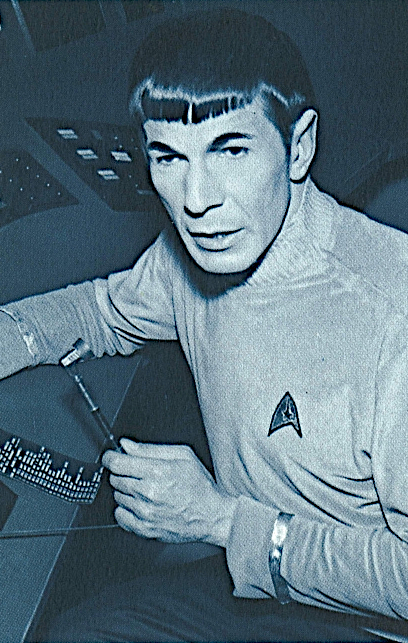

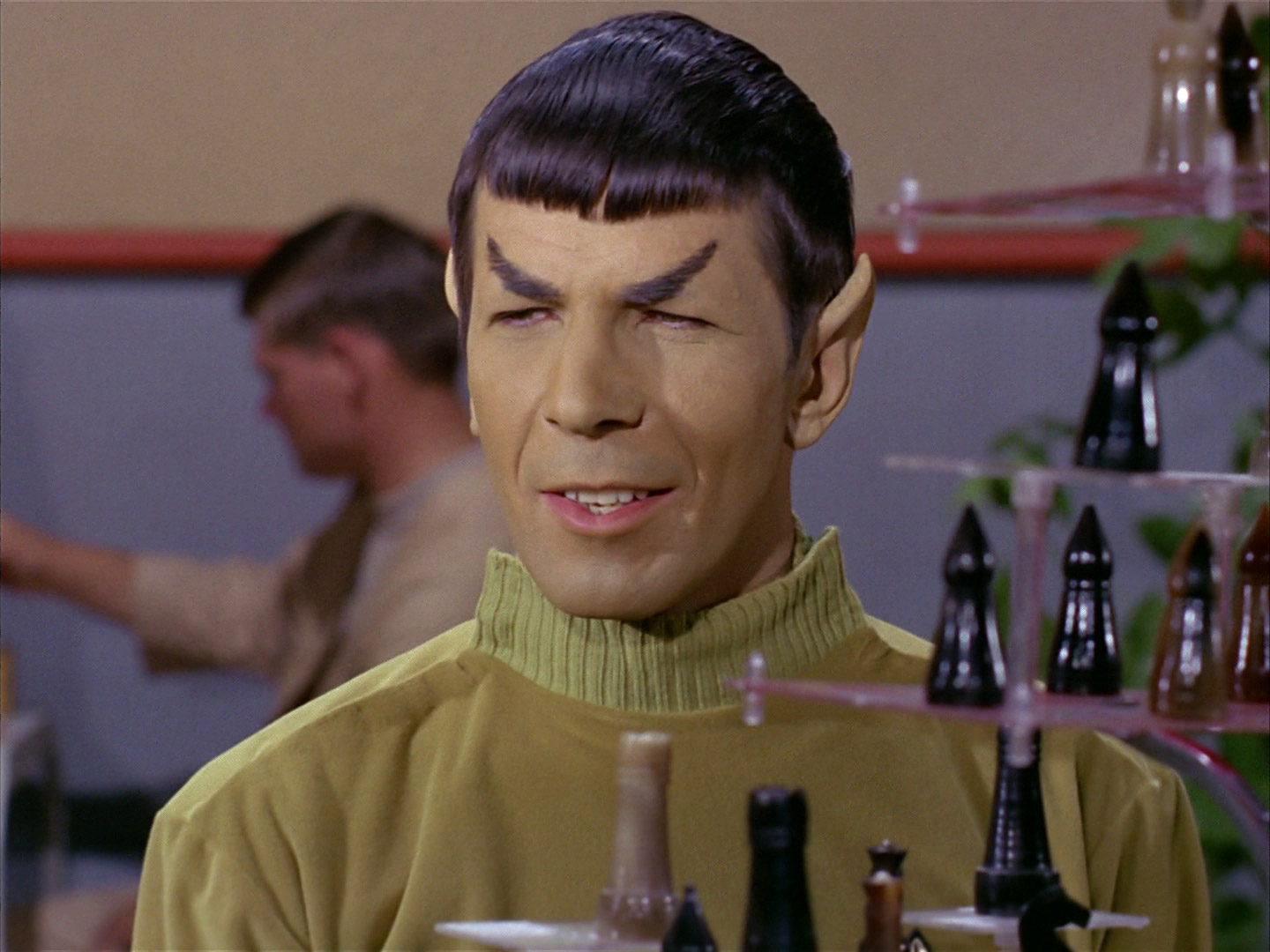
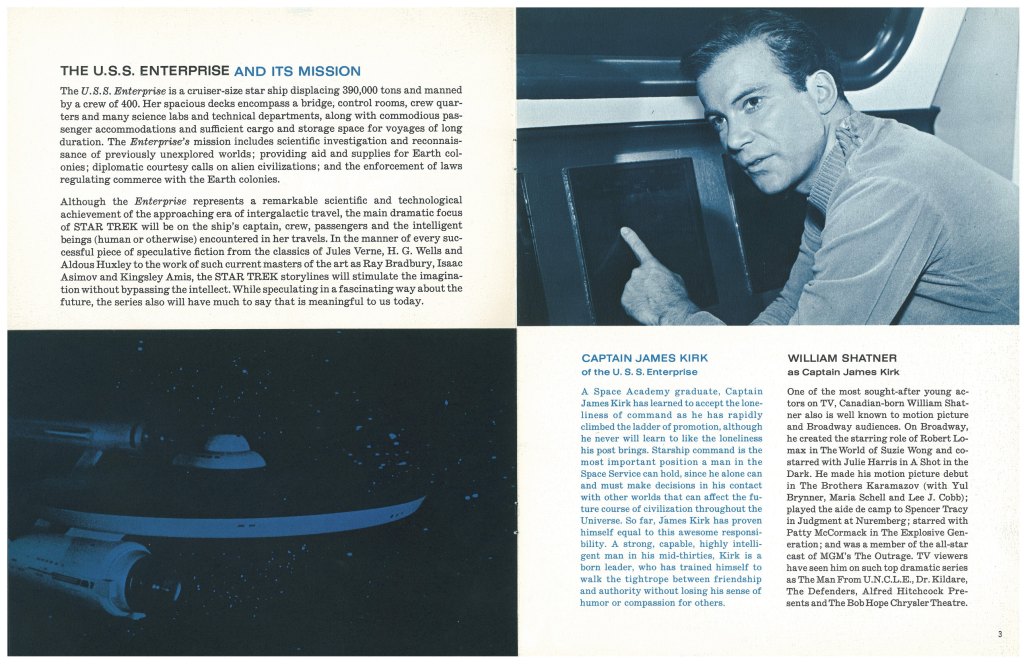
But my favourite bit of this booklet is that Sulu, as the ship’s astrophysicist, gets to decide if the captain is allowed to head planetside: “Frequently, it is [Sulu’s] assessment of the conditions on unexplored planets that finally determines when and how they will be explored, or if they can be explored at all.”
Imagine this scene: Kirk rises from the captain’s chair and snaps out commands ordering a landing party to the transporter room—but then the turbolift whooshes open and Sulu strides in saying “Belay that order, Captain! My astrophysical assessment says no to visiting this planet.”
George Takei would have enjoyed playing that.
It is also funny to see that one of Captain Kirk’s main responsibilities as the commander of this awesome vessel of exploration is the “enforcement of laws regulating commerce with Earth colonies.” This brings to mind Gene Roddenberry’s first draft of the opening narration, in which Kirk would have said “the giant starship visits Earth colonies, regulates commerce, and explores strange new worlds and civilizations.”
A five-year mission to ensure that credits keep flowing to shareholders would have been far less interesting to viewers although, to be fair, commerce is essentially the driving force behind The Devil in the Dark. Kirk needs to stop the killings but those humans are only in danger at all because “Janus Six could supply the mineral needs of a thousand planets.”
Other fun bits from the NBC promo:
– The Enterprise serves instant coffee.
– Sexism was popular back then: Dromm’s Yeoman Smith is a “welcome change of scenery.” See also Herb Solow calling Nichelle Nichols a “shapely broad” in the January 1967 issue of Ebony.
– NBC’s promotion department repeated the untrue story that Gene Roddenberry was the “head writer” for Have Gun—Will Travel. There was no such position on that show, and I believe it was Roddenberry who liked to spread that exaggeration.
– Nimoy did not appear in the movie Seconds. It seems he shot a scene but it was cut from the movie.
It is interesting to wonder what would have happened had the network put more support behind this interstellar vehicle. This promotional piece was a good start.

-
Enjoy some bitter dregs
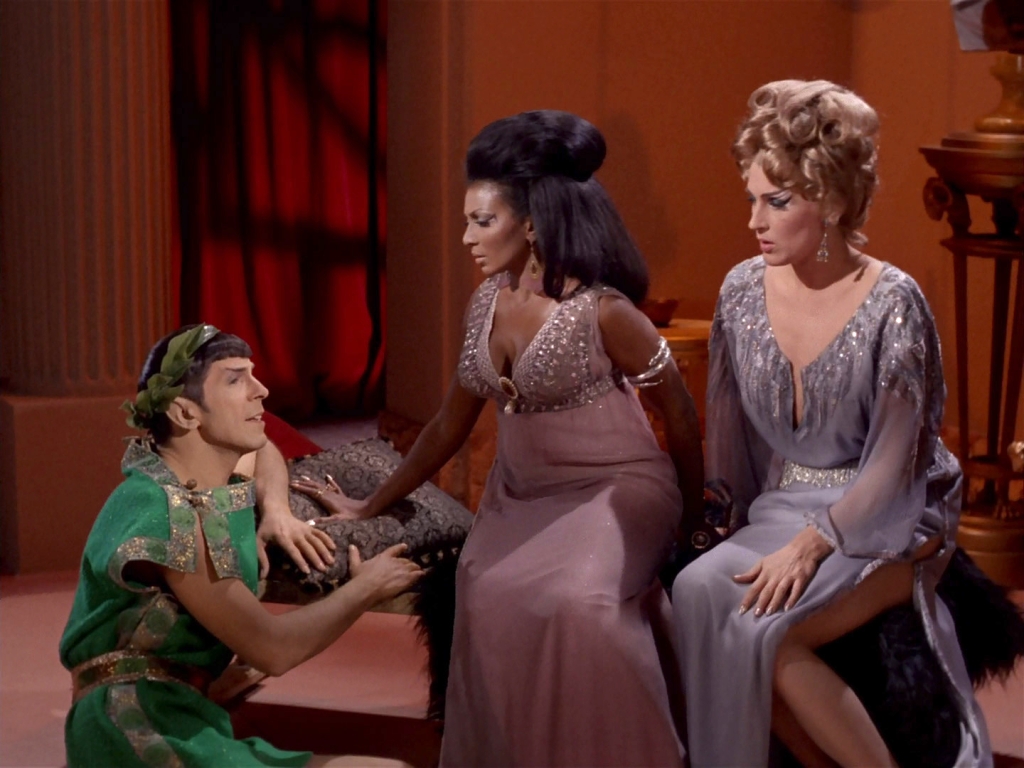
I was thrilled to be invited to speak at this year’s Trekonderoga convention at the Star Trek Original Series Set Tour in Ticonderoga, NY.
I am doing two presentations: Come talk Star Trek collectibles, which is a series of stories behind my best items, and Collecting advice: how to start, what to buy, and how to display it.
Powering my preparation for these talks is vintage music from Leonard Nimoy and William Shatner, and I thought I would share some of that sonic goodness. So here is Nimoy’s Maiden Wine, from his album The Touch of Leonard Nimoy. That album was released just after Star Trek was cancelled.
The performance on the LP is livelier than the screened version and is among the best of Nimoy’s musical outings, but it does present a bleak, albeit often accurate, message about male/female relationships.
-
This lunchbox is a tribute to Star Trek’s 50th
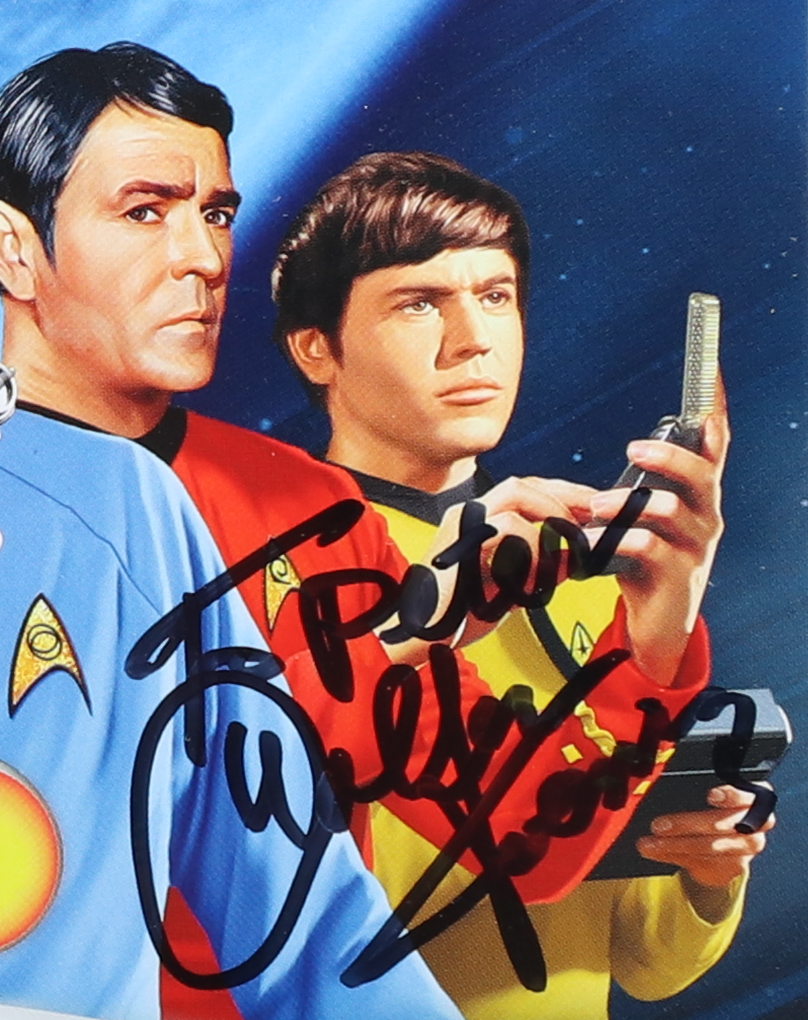
This post is long overdue. Back in 2019, I wrote about my 50th anniversary Fan Expo Star Trek lunchbox. It was produced in 2016 and, at that time, four main cast members were still alive: William Shatner, George Takei, Nichelle Nichols and Walter Koenig. Three of them were guests at that year’s Fan Expo convention in Toronto, and I had each sign for me.
Missing was Walter Koenig. I liked the idea of commemorating the anniversary by gathering their signatures on one item, so I waited on Walter’s return to Toronto.
He has not graced our city since then, but a good friend named Jason travelled to Vegas for the big Trek convention in 2021 and he carried my collectible with him and got it signed. Thank you, Jason, and I am sorry it took so long for me to update this story.

The 2016 version, with no Walter 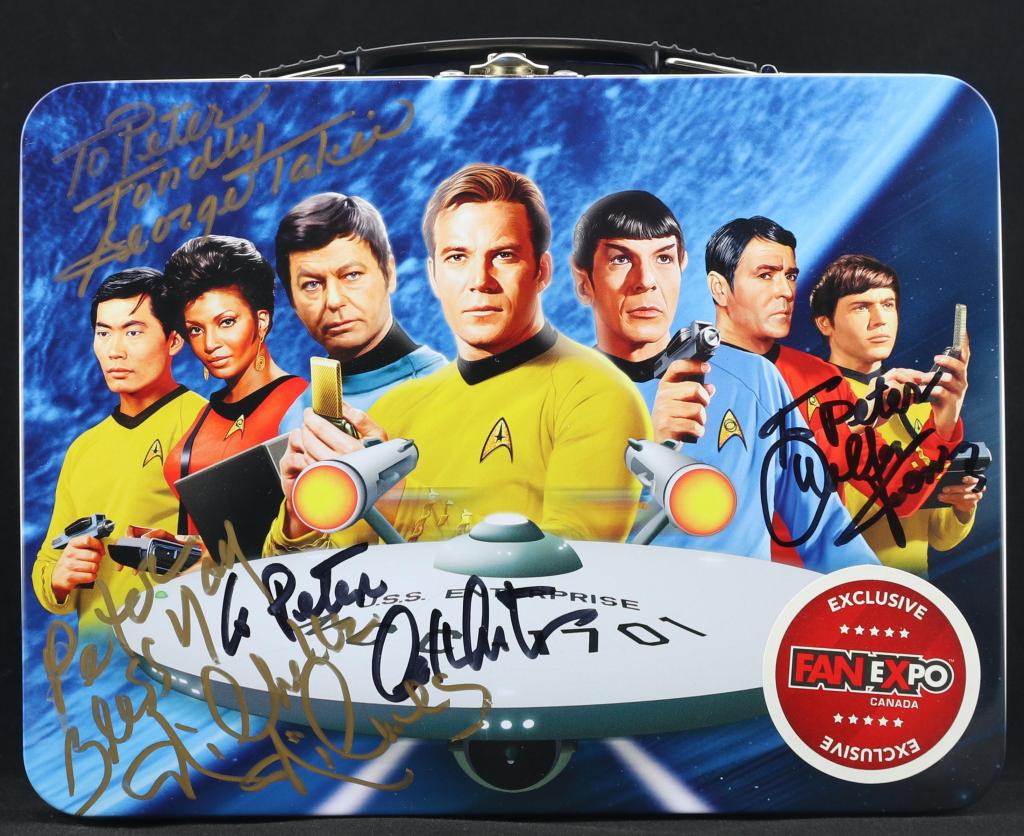
That little metal box took on a melancholy air when Nichelle Nichols died in July of 2022, and it will get sadder as each member of that group leaves us in the future.
But I like that it commemorates the 50th, and it is a treasured addition to my collection.
-
’70s fandom was okay with cartoon nudity
I am always fascinated by 1970s fandom. Star Trek would have been forgotten after 1969 if dedicated fans had not kept it alive and, simply through the force of not giving up, finally persuaded Paramount to mount a new show and then The Motion Picture.
I am also interested because the fan experience itself was different back then. I wrote about the far more personal celebrity encounters at early conventions over on my Toronto Star Trek ’76 site, and today’s post is about a smaller, quirkier difference.
1970s cons were apparently okay with cartoon nudity, at gatherings we would now classify as family events.
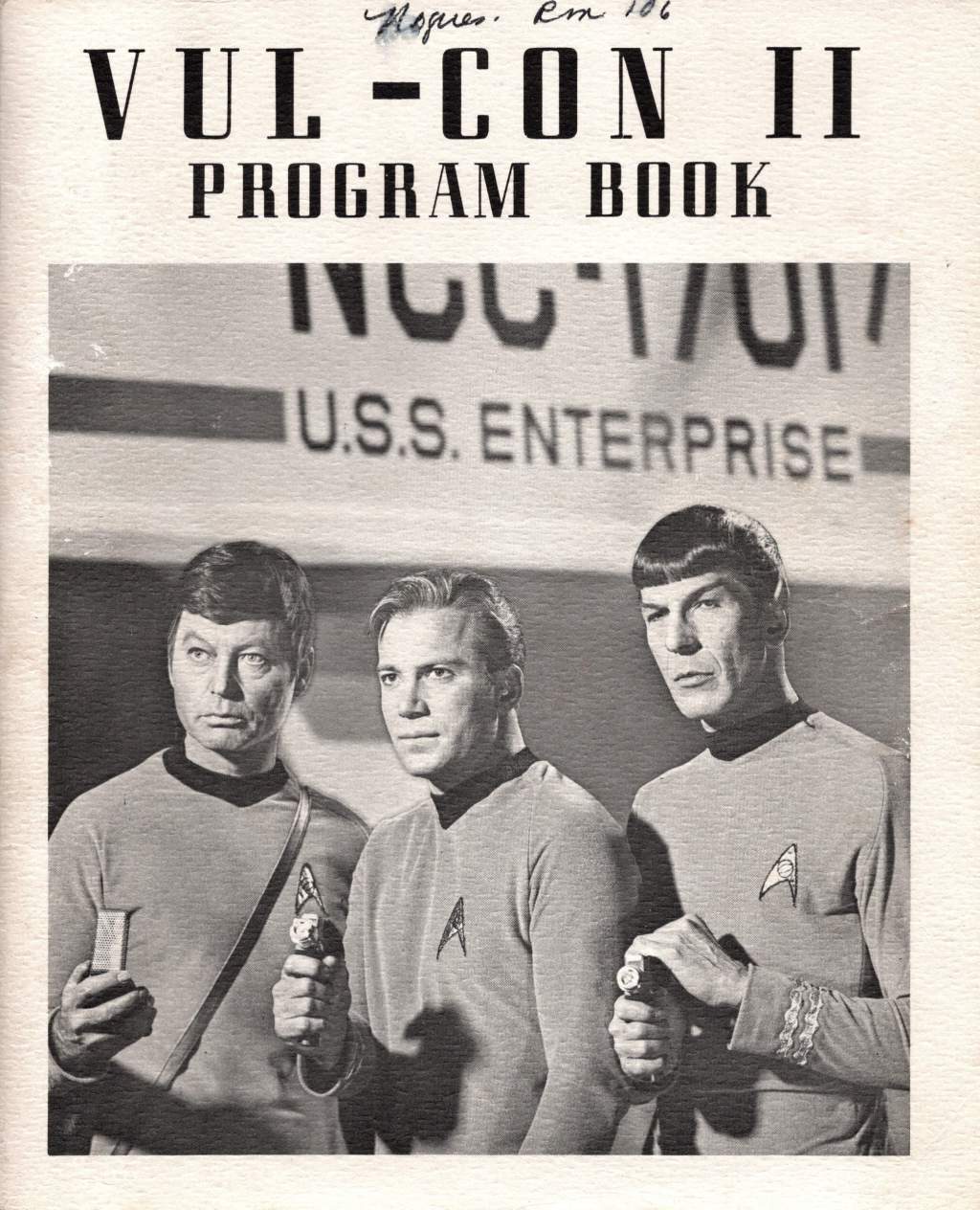
I own the program book for the Vul-Con II convention, held in New Orleans in the spring of 1975. I bought this many years ago because it is signed by Nichelle Nichols, Bjo Trimble and David Gerrold.

The program offered attendees a centrefold of Spock looking at a centrefold. I am here to share Star Trek collectible history, not pass judgement, and this nudity is certainly of a very gentle nature, but it is notable for what it says about how 1970s mores contrast to current norms. Many convention-goers would complain about this today.

Others would be more offended by the illogic of Spock looking at a naked woman who is not his, and by that Vulcan woman even posing for the photo, than they are by the nudity itself. And that’s another reason to love this fan community.
Postscript
I believe the Vulcan centrefold was drawn by artist Danny Frolich.

-
Goodbye, beloved Star Trek room
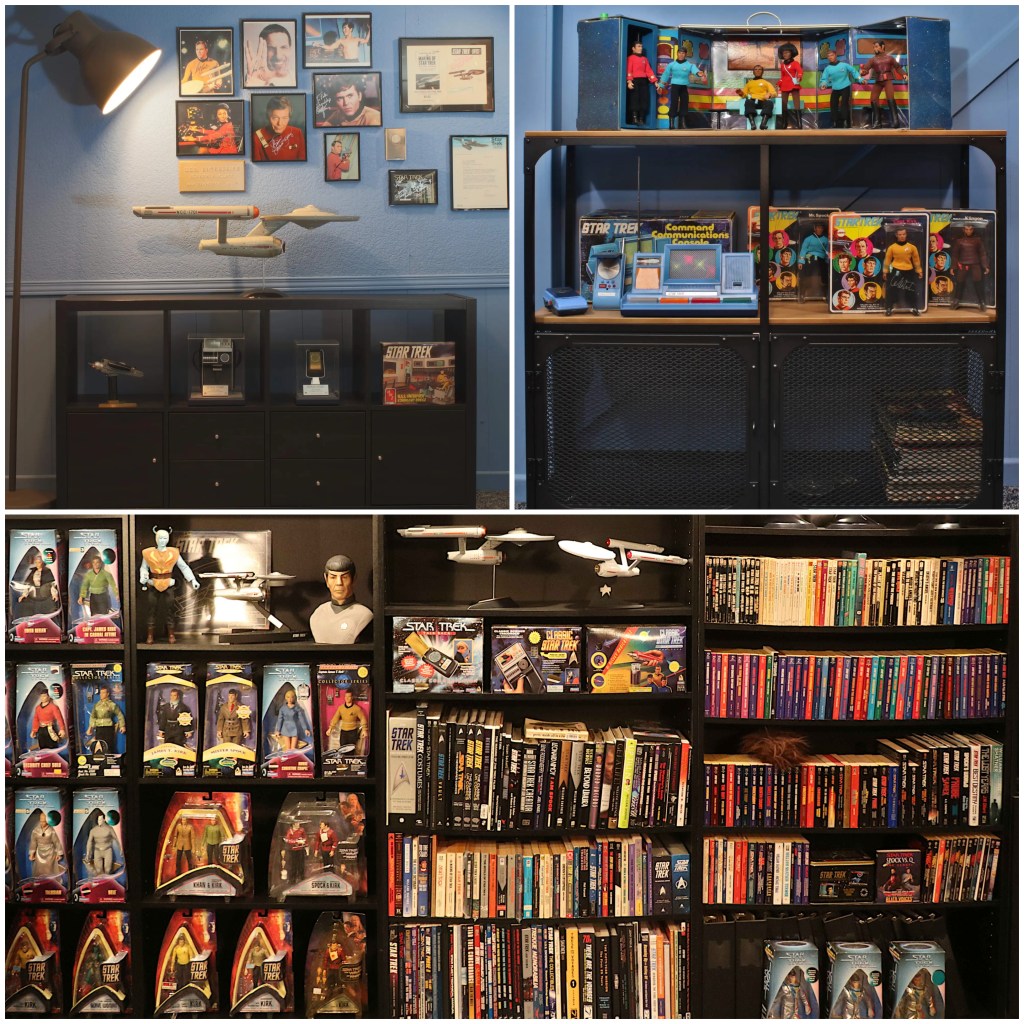
My family and I are moving soon, and our new house is great but the room I am transporting my collection to is significantly smaller than what I have now. So this post is a tribute to my current space, because it has been very good to me.
I have said before that you should display your collectibles if you can (I made a big deal of that here), and so I’ve worried that if I move one day I would not have the same amount of space. This was on my mind when I was interviewed about collecting and was asked “How has your passion for Star Trek influenced other areas of your life?” I answered “If I move someday, my new home has to have a large Star Trek room. I have one now and the walls and shelves are full.”
I am looking at those full walls and shelves as I type this. My current room, which doubles as my home office, is about 37 square meters (or 400 square feet). The new space is about half that.
And the new room has a large window, which makes this worse. You know you’re a true collector when a big bright window — normally a good thing — annoys you because it reduces the wall space available to hang 8x10s and posters.
I know I am fortunate to have a Star Trek room in the new house; there are many collectors who have all their stuff in boxes because they have nowhere to display it. But still, this is tough.
My current space
Here is a recent panorama photo. My room is 360-degrees of Star Trek. Click the photo to see a larger view, or download a higher-res version.

I also took some videos. I have seen other collectors make impressive video tours of their space. My film skills are not as strong.
Tough calls
The smaller space means I have to downsize. I need to make some cuts to what I own and also economize on how all this is displayed.
One casualty will be my big box of TOS calendars. I have almost every wall calendar from 1976 until a few years ago, and I even acquired a number from the other series. They are all in a big Rubbermaid box in storage and I never look at them, so they have to go. I will also get rid of a bunch of unopened model kits. I am not a modeller.

And I am considering letting go of most of my Trek novels. I will keep the older ones, like Spock Must Die! and Spock, Messiah! and the terrible Mission to Horatius, but I own more than 120 novels in paper, and all those old Pocket Books take up a lot of room. Plus, I have been buying them over the last few years as e-books.
I will keep every non-fiction Star Trek book I own. I love all those.
The bigger change will be the amount of display space I have. I own 60 or 70 signed photos, posters, albums, etc., and a lot of those are on my walls right now. I won’t have the space in the new room.
I may scan all that stuff and load the pics onto a digital photo frame. It won’t be the same, but I could at least still see the items regularly.
Earlier in this whole move process, we actually bought a different house. That deal fell through, but for a while I was trying to figure out if I could move my Star Trek life into an 8 x 20 foot shipping container, kitted out as a living space and dropped into the small backyard. That would have been even tighter.
Display your collectibles if you can. That can be one shelf or two bookcases or a full-room tribute but you will enjoy them more if you can look at them every day. Walking into my Star Trek room and seeing my Polar Lights Enterprise or my Mego display or my signed wallpaper poster or my Toronto Star Trek ’76 poster or my Ebony cover or my surprise Roddenberry autograph or my AMT Enterprise or my Heineken ad makes me happy.
Collectibles should not be in a storage box.
-
Look to 1950s sci-fi to appreciate the genius of Gene Roddenberry
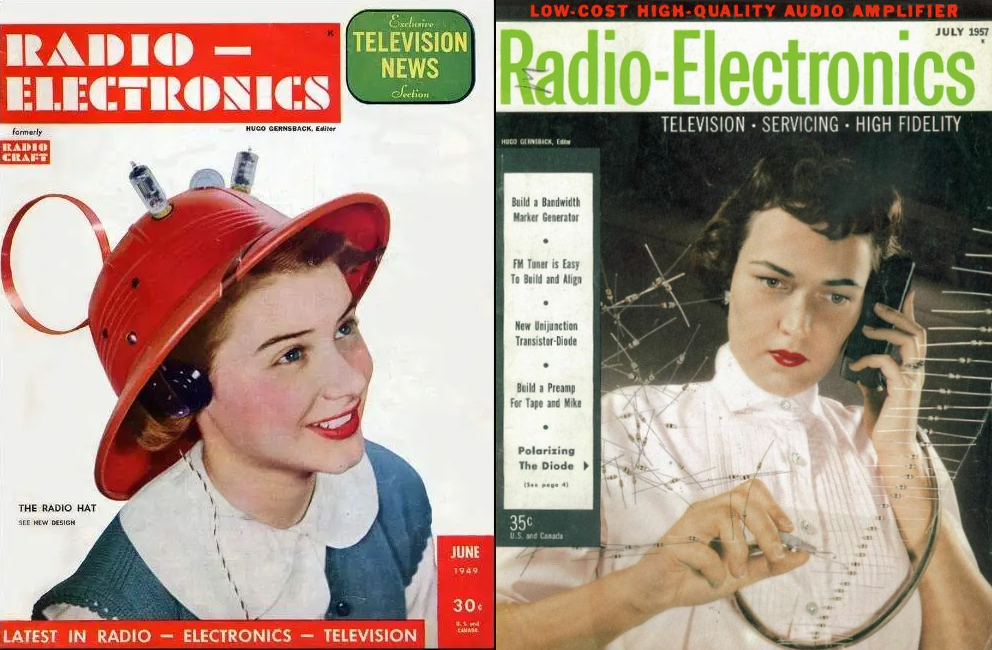
Perhaps the best science-fiction radio series ever produced was X Minus One. NBC broadcast 126 episodes from 1955 to 1958, with stories from preeminent writers of the period including Ray Bradbury, Robert Silverberg, Philip K. Dick, Robert A. Heinlein, Robert Bloch, Frederik Pohl and Fritz Leiber.
And Clifford D. Simak. Simak’s novels and short stories landed him a Nebula Award and three Hugo Awards, plus two Retrospective Hugo Awards.

The Big Front Yard won a Hugo in 1959 Six of his stories were adapted for X Minus One, including Courtesy. That radio play told “the story of the second expedition to the planet of Landro” in which 180 men attempted to colonize a “god-forsaken sphere” already inhabited by an indigenous population.
In Simak’s tale, the planet’s “aborigines” are described as “strange, ugly little people” and “cave rats” and, when it is suggested they may hold an important answer to a peril faced by the humans, one crewmember promises the commander he will “get a few of them and beat it out of them.” And it gets worse from there.
Gene Roddenberry was a fan of early pulp sci-fi, and the stories written in the 1930s, ’40s and ’50s taught him about the genre but, when he committed his view of the future to paper in the 1964 Star Trek is… pitch and wrote The Cage pilot episode, his heroes would act very differently from Simak’s. Roddenberry wanted humans to explore strange new worlds and seek out new civilizations, not beat members of those civilizations to death.
Click the YouTube link below to listen to Courtesy, recorded in 1955, and contrast it to the spirit of The Cage, filmed only nine years later.
Simak’s story offers up a weak, mystical note of redemption at the end that does little to erase the ugliness of what came before. But I called X Minus One the greatest of the sci-fi radio series because the show often delivered great tales.
Cold Equations, broadcast just after Courtesy, is one of those. The hard sci-fi story absolutely sticks the landing, and adventures like these also inspired Roddenberry.
-
Not a modeller? Pay a pro. You’ll love the result
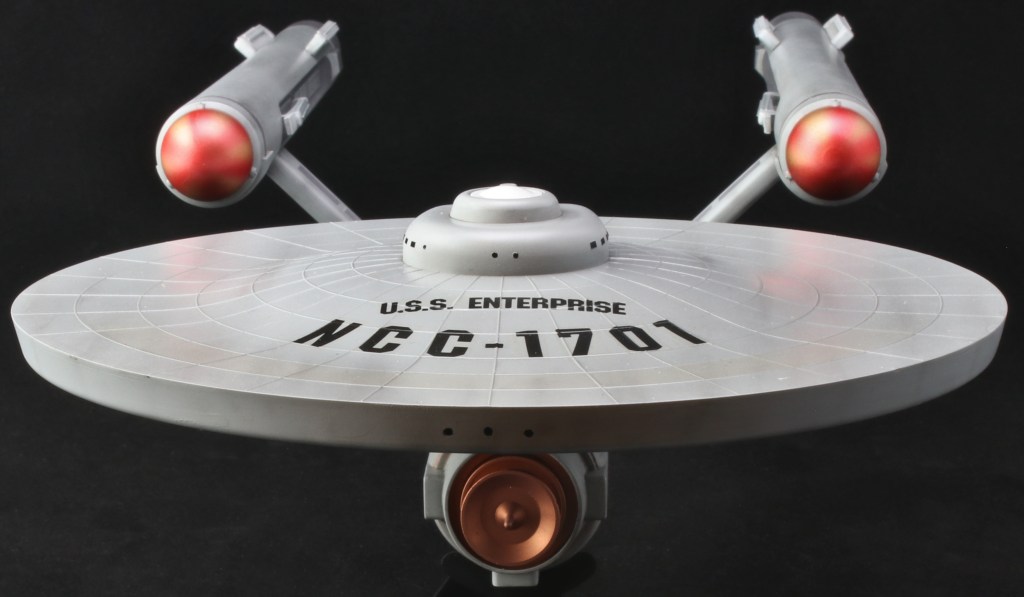
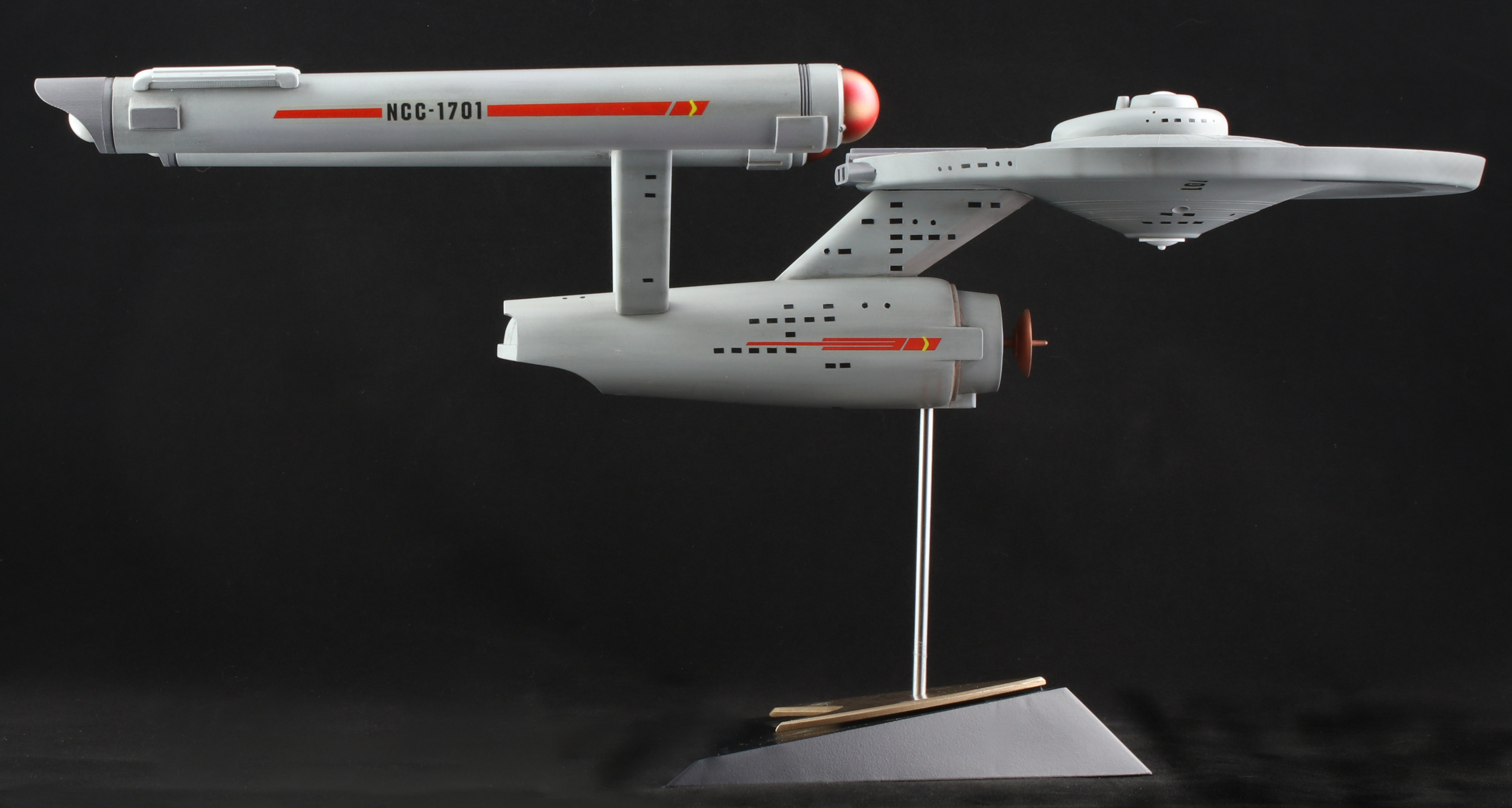
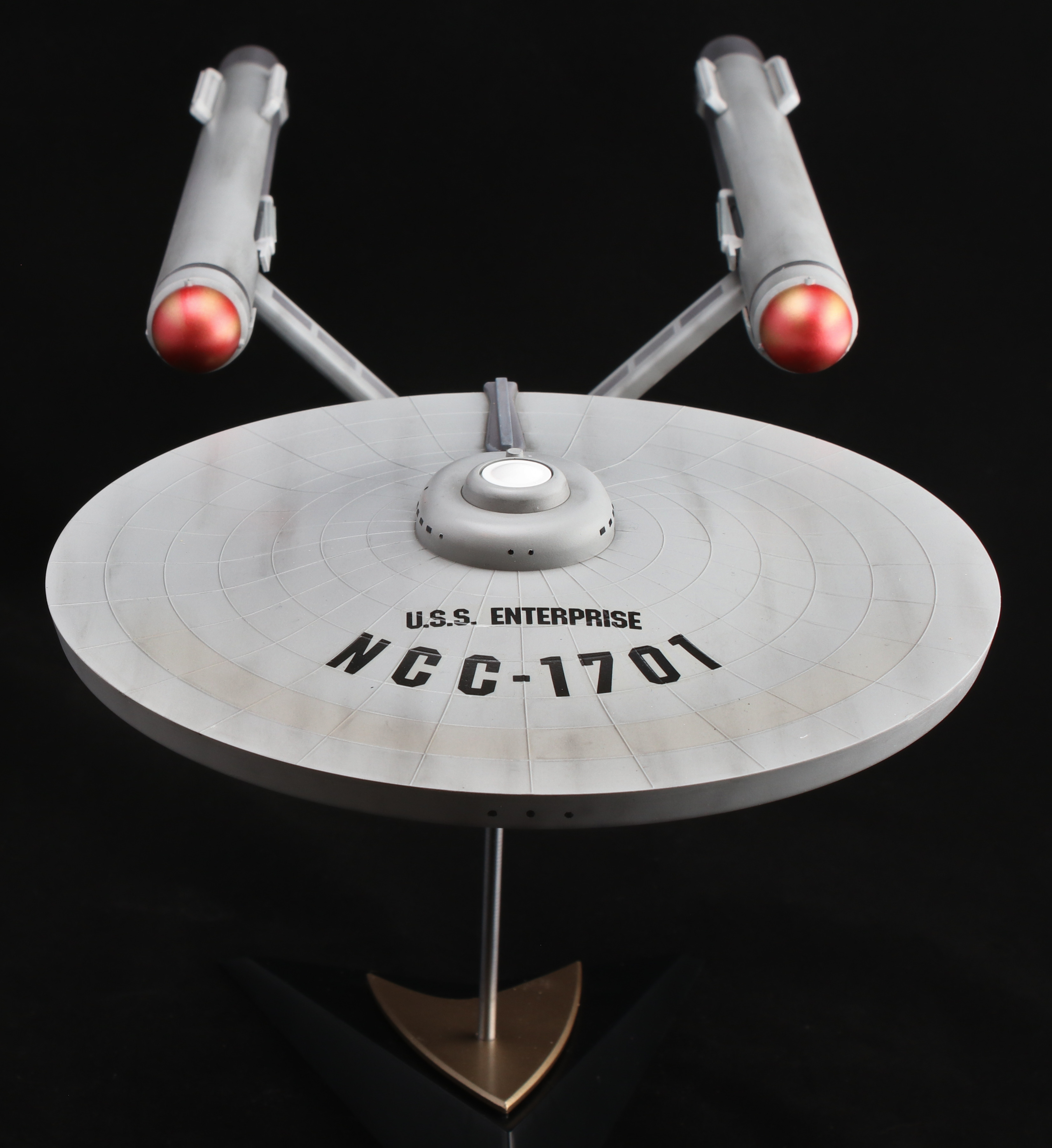
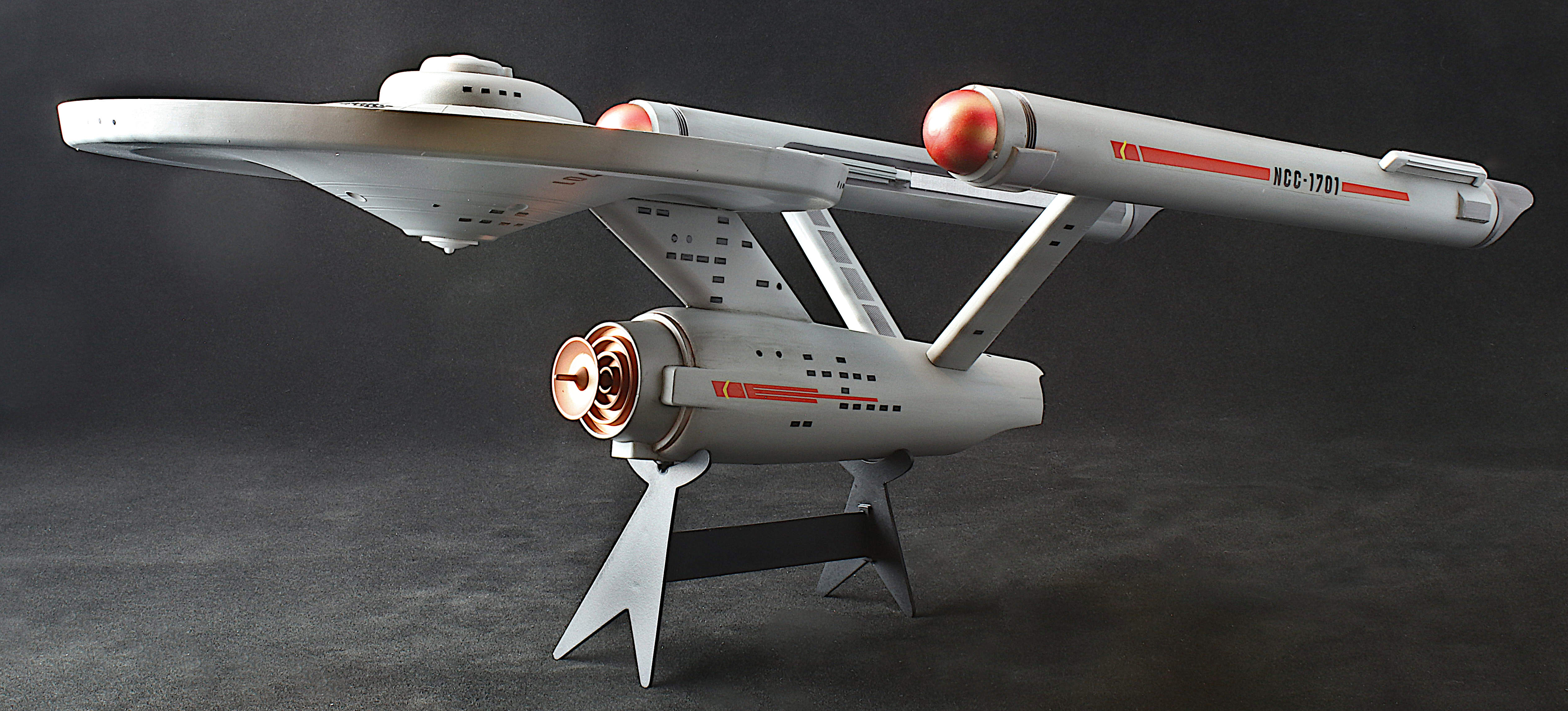
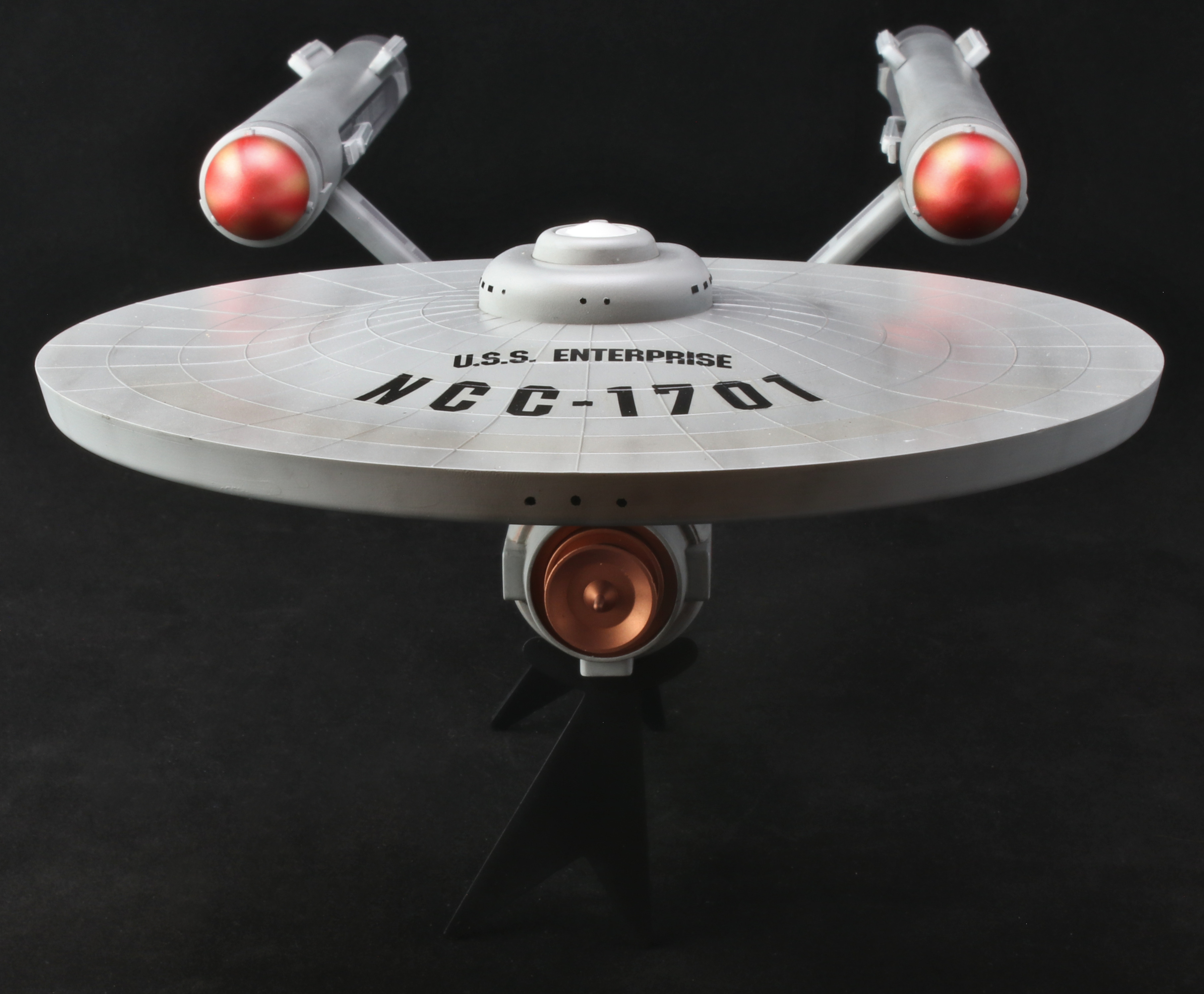
I recently commissioned a build of the AMT Enterprise kit from an experienced modeler — and I am thrilled with my new acquisition. It’s vintage and cool and executed with a lot of skill. It’s exactly what I wanted.
And it’s been a long time coming. Like most fans of around my age, I tried to build an AMT kit back in the day, but in addition to the poorly joined pieces and the glue everywhere, I had no idea how to paint the thing. I gave up.
Decades later, I found James Small at Small Art Works in Nova Scotia. He is an experienced professional who has also worked on movie models (for Battlefield Earth) and has been the go-to builder for Round 2, the company that manufactures models under the AMT and Polar Lights brands, among others. He’s constructed more than 100 kits for the company, including all the Star Trek, Star Wars, and Space: 1999 models since about 2009. His builds are used for the vendor’s product shots and his name is on the boxes. So, you know he’s good.


The age of assessment
This commission came about now because I am in what I call the assessment phase of my hobby. Collectors spend years acquiring, because there’s a lot of cool stuff we don’t yet own. Eventually, though, we step back, appreciate what we already possess, and begin to contemplate the gaps, the rare or expensive items that are not yet on our shelves.
An AMT Enterprise was one such gap, although the kit itself is neither rare nor expensive; the recent reissue of it can be yours for about C$60. What is rare, for me, is the skill required to create a really nice build.
If you don’t know the difference between Revell Contacta Clear and Tamiya Liquid Cement — and I do not — hire a pro like Jim. The results are great.
Which kit, and how accurate?
I had to decide which AMT Enterprise to build, and to understand that question we need a little history.
AMT made 10 different versions of the Enterprise over the decades since 1966, and that does not include special editions like the cutaway ship. Memory Alpha has a good summary chart of these products.
My goal was to finally own the model I couldn’t have as a kid, so I wanted a really old kit, right? No. They’re quite expensive but the real problem is that the nacelles eventually droop, as the point where the pylons connect to the secondary hull was too weak in the original kits.
The other issue is that older kits are less accurate, but that didn’t bother me. I own the Polar Lights 32-inch model so I have a ship that’s true to the TV show. My goal here was nostalgia.
That goal also ruled out the newest reissue from Round 2. The newer versions are closer to the real model, but that means they are less old-timey.
The option I chose was already on my shelf: an AMT kit dated 1983 on the box, although I think it was originally released in 1975. It wouldn’t suffer nacelle droop and was from around the time I tried to build one myself.

I mailed my kit off to Jim, and then the questions started, because there are a lot of ways to build these kits. For example, AMT added raised grid lines to the saucer on many of its versions, including mine. Some modellers painstakingly sanded these down. What did I want Jim to do? I opted to keep the lines, as teenage me would have done.
Did I want it painted white or light grey? Light grey. Did I want the front of the nacelles painted red, dark red, copper, or gold? Red with gold highlights. What about the flimsy stand that came with the model? Give me the flimsy stand for when I am feeling authentic but also make me a new one so my ship won’t fall over. (You see both in the photos below.)
And then there were the windows, a significant decision:
Do you prefer the window arrangement/decoration as shown on this model done “old school” (and as etched into the plastic) as the kit was originally?

Or a more “authentic” look, like this?
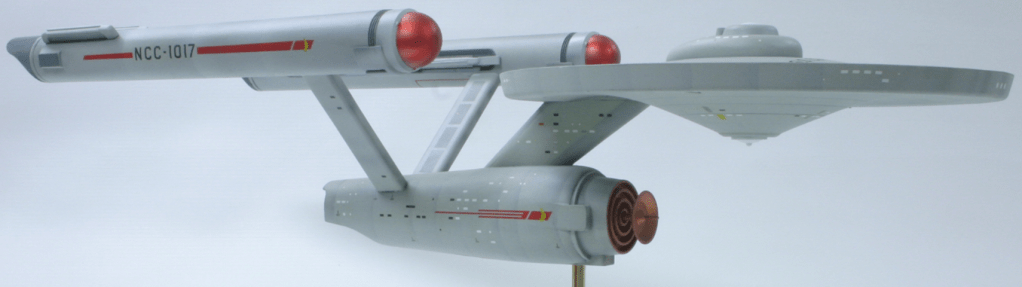
I agonized over this call, but I went with the old-school look, again to honour the idea that this was a model I might have built as a teen.
I love my AMT Enterprise, and I very much appreciate that Jim asked me all those questions and that there are still people out there with the knowledge and skill to build these things well. Pay a pro to build a model, if you can. The result will be gorgeous and you’ll be supporting a hobby and skillset that are, sadly, disappearing.
Here are photos of the model Jim built for me.

Jim and I also discussed the state of modelling today, and it’s an interesting — if melancholy — read.
-
The state of modelling, then and now
Modeling has changed dramatically over the last few decades. Once every young sci-fan, and indeed every horror, airplane or car aficionado, glued and painted plastic model kits, or tried to. Today, far fewer people assemble these shaped sheets of plastic into fantastic spaceships or cool hotrods.

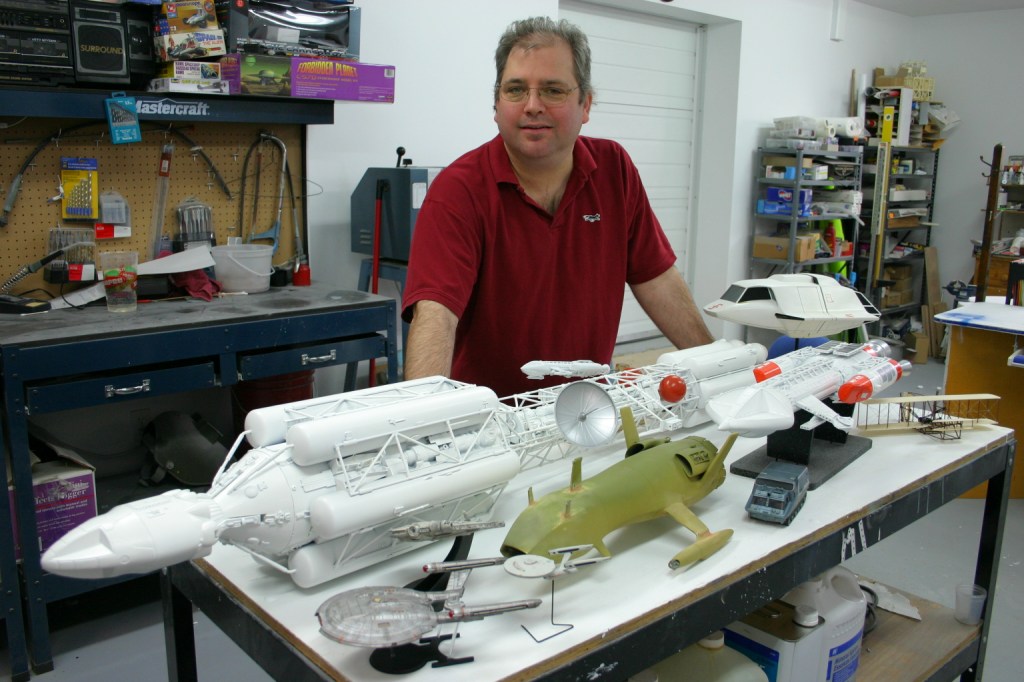
James Small Professional modeler James Small, who recently built my AMT Enterprise model, supplied this grim assessment: “Unfortunately, it’s a dying hobby. Enjoy it while you can.”
Modelling was once big business
AMT launched its Enterprise model kit in 1966, and it was a huge success as soon as it hit store shelves. Star Trek Associate Producer Bob Justman told Gene Roddenberry in a memo dated October 19, 1967, that:
I have it on reliable information that the “STAR TREK” Model Kit will sell more than a million copies within its first year of production… All I know is that the machine which turns out the plastic parts for the kit goes continually 24 hours a day, 7 days a week and AMT is rushing another machine into production, so that they can keep up with the demand.
(I wrote about the Enterprise and other AMT models in an article that mostly covers how much it cost to build the Galileo shuttlecraft.)
Sadly, Jim told me the heyday of modelling is well in the past.
When I was a kid, almost everyone made model kits at some point, and that simply doesn’t exist anymore. The audience for model kits today is pretty much adults my age, which is why they cost so much now. We used to buy model kits at the five-and-dime store; a Matchbox airplane kit was $1.25 and now those types of kits are $50.
Jim got into modeling through airplanes.
It started with airplanes. I think the first one was a Matchbox kit of a Boeing P-12E. I did a horrible job, it was a difficult kit for a kid to build, but it was still interesting.
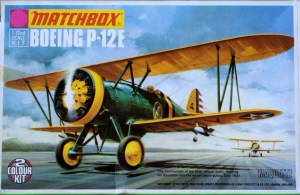
Photo from scalemates But it was Space: 1999, a show I’ve never liked although the ships are cool, that really cemented his interest and later led to work with Round 2, the preeminent model manufacturer today.
I loved Space: 1999 and…I first learned about making models for movies and TV from reading the book The Making of Space: 1999. I opened it to photos of Brian Johnson and Nick Alder holding that 44-inch Eagle model and it was sort of like a kid discovering a magician’s trick. Then Star Wars came along and I gobbled that up, and it just continued from there.
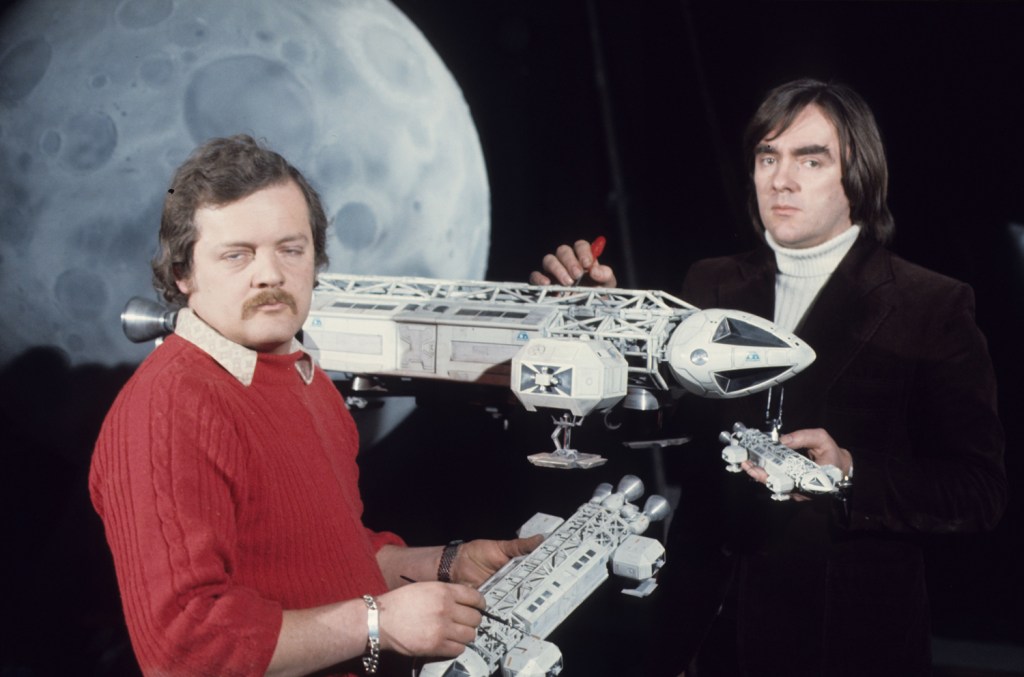
Nick Alder and Brian Johnson. Photo from The Prop Gallery I had the old MPC Eagle kit from around 1975 but I was never satisfied with it, because it was not terribly accurate. It didn’t match what I saw on screen; it was simplified and the proportions were off, and I always wanted a better model. Then Round 2 hired me in 2008 or so to do some build-ups for them, and I’ve been working with them ever since. Around 2013, I became friends with Jamie Hood, one of the product developers there…and I kept bugging him to do the Eagle from Space: 1999. Then they got the license and they released the old kit and it started flying off the shelves. He couldn’t believe it. They released the other kits too, like the Moonbase Alpha, and I said you have to do a much better model of the Eagle.
I knew a guy named Chris Trice who had access to the original 44-inch Eagle miniatures and he had measured them and built replicas that were superbly accurate, and a guy named Daniel Prud’homme had done some blueprints of the Eagle based on Chris’ measurements. So I said to Jamie “Here’s how you get the Eagle done. All of the design work is already done.”
He took my advice and they built it and it is one of the best-selling kits they ever had.
But even with sales successes like that, modeling is not what it used to be.
The technology has advanced to the point that kits are much better and in fact cheaper to produce and at better quality, but because they’re not selling in the numbers they used to — they used to sell in the hundreds of thousands and even millions, and now they’re selling in the low thousands — the cost per unit is way up.
Kits got better, but fewer people are buying them now.
It’s sad to think that models and the skills of modellers may disappear soon. If you can, buy a kit and build a model, or hire a pro like Jim to do it for you. Either way, the ship you put on your shelf will bring you joy.
Collecting Trek
A TOS collection 40 years in the making


