-
An old Scottish ballad inspired the iconic song in Charlie X
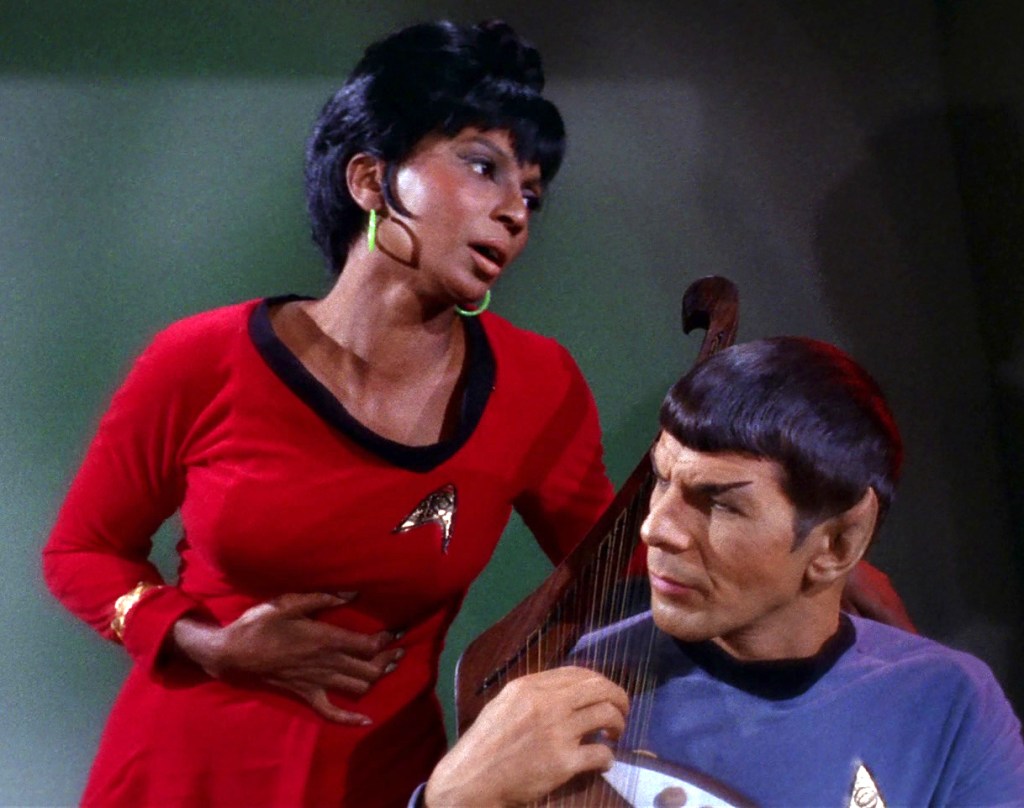
Time spent reading a Star Trek script often rewards you with a real gem. For example, I had forgotten that Uhura’s teasing song about Spock and then Charlie in Charlie X was based on an old Scottish folk song. But it’s right there in the script.
The final draft script, dated July 5, 1966, includes this note in the recreation-room scene:
Spock “clearly wanting to offer amends, he thinks…strikes a chord…in Uhura’s key…a song she knows… (the tune is: “CHARLIE IS MY DARLING”) (Public Domain) (Lyrics by Gene Roddenberry).”
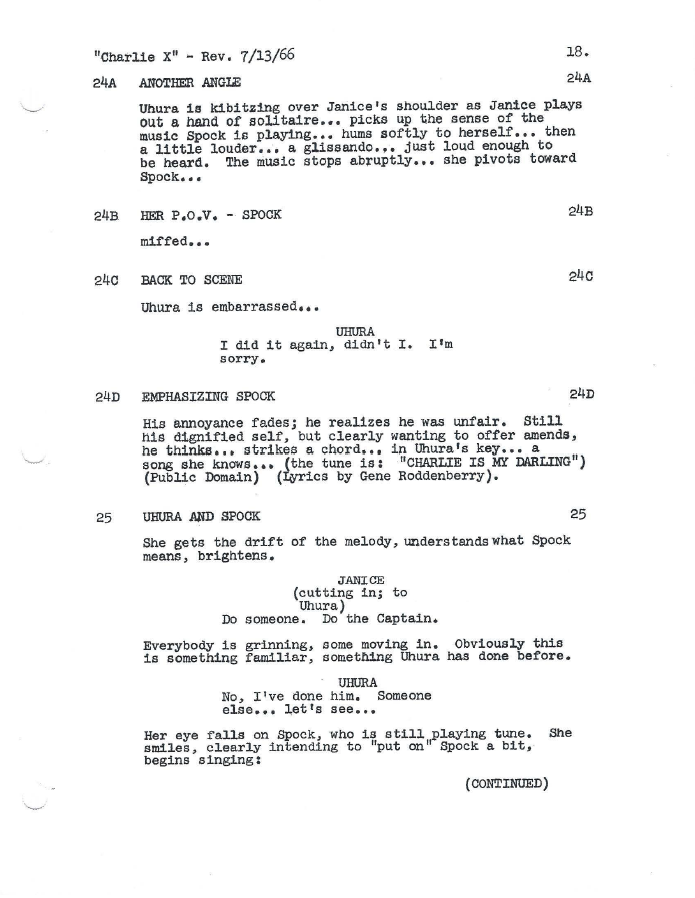


Click for larger imagesCharlie is my Darling is an old Scottish folk song, or really a few related songs, which tells of the arrival of the pretender Charles Edward Stuart to the Scottish highlands in the mid 1700s. Here is what Wikipedia says about the song:
All known versions of the song refer to the figure of Bonnie Prince Charlie of Scotland (Charles Edward Stuart).
The earlier versions focus on Charles as a patriotic hero of Scotland during the Jacobite revolts of the 18th century, and it describes the arrival of Charles, referred to as “the Young Chevalier,” to the Highlands… A later version of the song by Robert Burns contains lyrics that mean to poke fun at Charles’ womanizing reputation. Burns’ version of the lyrics are, in comparison to the earlier ones, considered to be fairly risqué for the times, with a narrative that alludes to the amorous adventures of Charles with the Scottish women of the towns he visits during his battles.
You can read Robert Burns’ words here.
And here are some renditions of Charlie is my Darling: a well-known version by Eddi Reader, a traditional version by Ewan MacColl, and a fun version by Rita and the Runaways
And here is the Star Trek take on the tune.
I think it is fair to characterise Uhura’s version as “loosely based” on the original, but you can certainly hear the influence of the bonnie old Scottish song. And Gene Roddenberry’s interpretation of it gave us one of the best moments of the original series.
Postscript
The bare bones of the idea that became Charlie X appeared in Gene Roddenberry’s 1964 Star Trek is… pitch. The story was called The Day Charlie Became God. His idea: “The accidental occurrence of infinite power to do all things in the hands of a very finite man.”

Then, according to the fine folks at Fact Trek, Roddenberry worked up two outlines called Charlie Is God in April and August of 1964 and further revised the idea in April 1966. Dorothy Fontana took over the project and created two treatments and two draft teleplays. Fontana was credited for the teleplay and Roddenberry for the story.

-
Enjoy vintage 1960s commercials
I love vintage Star Trek commercials. I recently digitized a VHS tape of old Trek content owned by fan David Penn. I’ve written about the blooper reels and a Star Trek V phone game from that tape. Today’s post offers up four commercials from 1966 — and an odd story about NBC’s promotional tactics.
The first two commercials are previews, telling viewers about this great new NBC show. The network promised Star Trek would be “The first adult space adventure” — a clear contrast to Lost in Space, which hit the airwaves one year earlier.
These are the promo spots people endured almost 60 years ago, as they waited to get back to Bonanza, The Virginian, and Walt Disney’s Wonderful World of Color.
Coming to Fridays this fall
Galaxy premiere, September 15, 1966
Wait, September 15? Yes, sort of. Scroll down for an explanation.
“Trackless journey” season promo
Next Voyage: Where No Man Has Gone Before
A story of two premiere dates
The second video above promised Star Trek would premiere on September 15, but we all know the first Trek episode aired in America on September 8, 1966, right? (And two days earlier in Canada.) Yes, that’s correct. But so is the September 15 date, sort of.
NBC held what it called NBC Week beginning on Saturday, September 10. That’s when its new shows first aired, and an ad in TV Guide promoted Star Trek‘s “Galaxy Premiere!” on September 15.
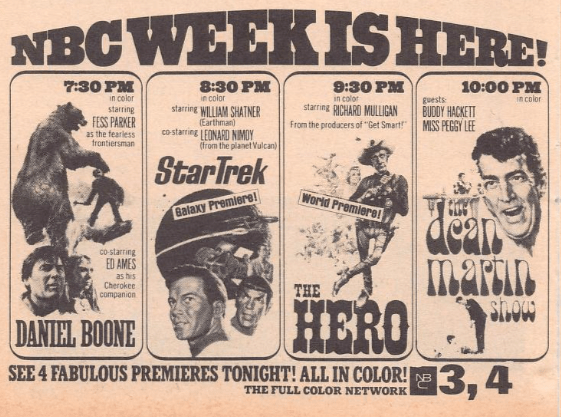
Also, an article in the Boston Herald promised that “Star Trek, an hour-long drama…will debut Thursday, Sept. 15, at 8:30 p.m.”
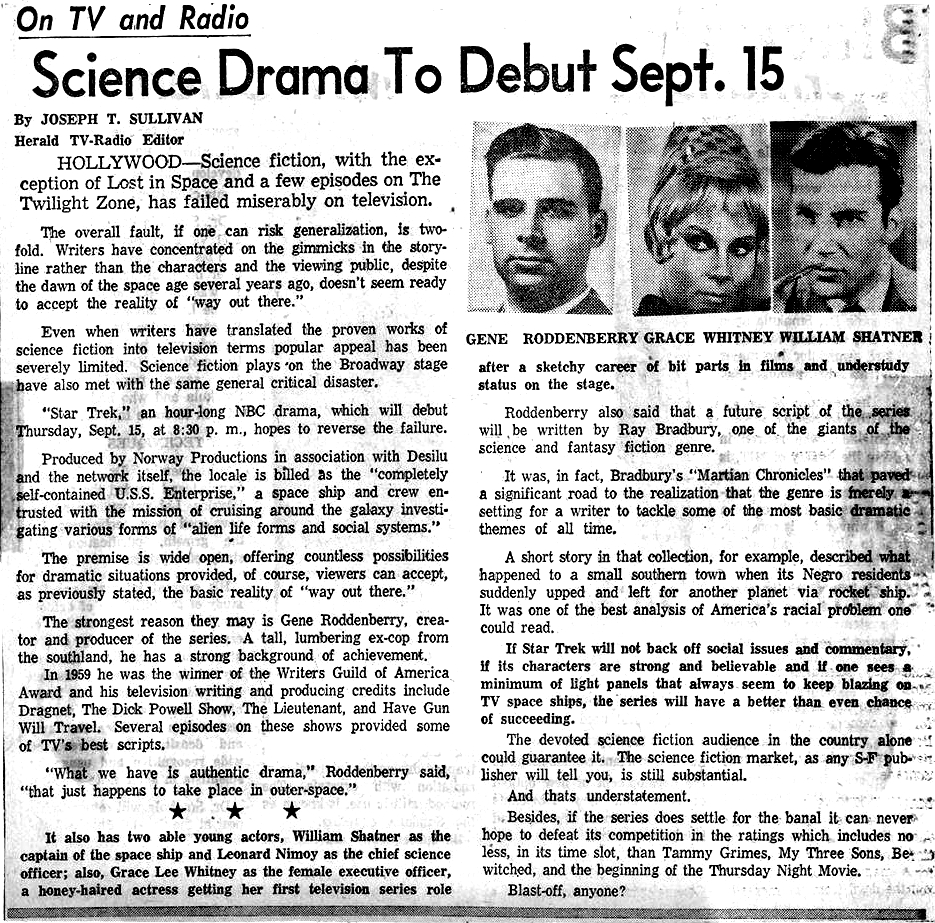
Article from the site WendyLovesJesus
So what gives? The Man Trap was on screens one week earlier, and it was Trek’s second episode, Charlie X, that aired September 15. And here is the proof, from the Northern California edition of TV Guide. (Click on pics for bigger versions.)
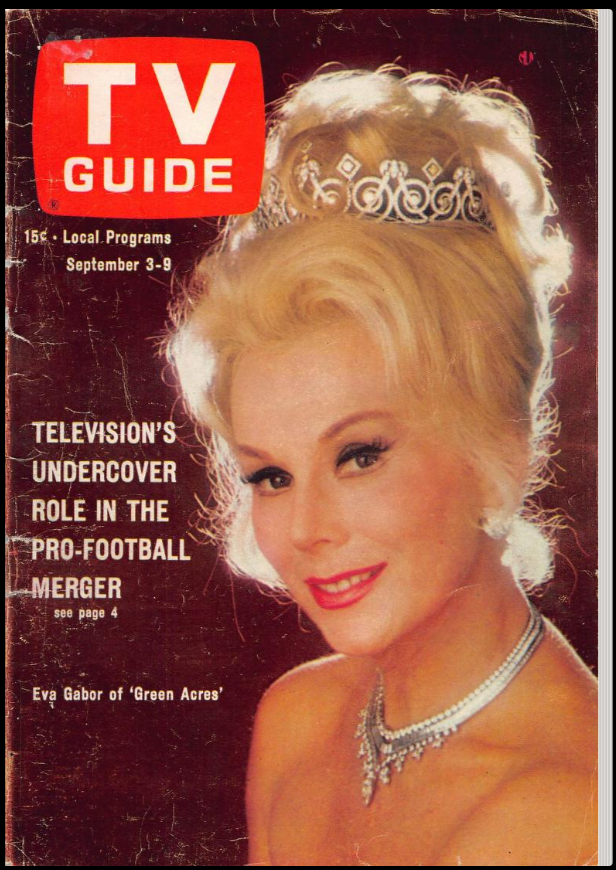

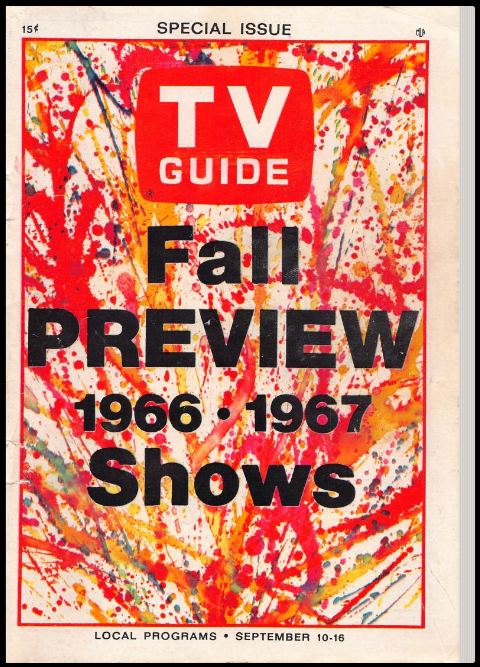

It seems NBC called the broadcast of Charlie X the show’s premiere, even though it simply wasn’t. The page above from September 8 uses the term “Advance Premiere” for The Tammy Grimes Show and That Girl, and I guess Star Trek was in the same category.
But in addition to “advance premiere” being an oxymoron, this seems an odd way to build buzz for a new show. NBC bought promo space to convince viewers to watch Star Trek on September 15, and those people who listened to the network’s own statements would have missed the first episode. I bet many did.
At least the network paid for some nice artwork.

-
Janos Prohaska chased Woody Allen in Take the Money and Run

Janos Prohaska was a talented costume designer and stuntman who played a number of iconic characters in the original series, but his untimely death in a plane crash in 1974 meant he never got to meet fans and sign photos at the conventions that were just then starting. So his autograph is exceedingly rare.
Prohaska was born in Hungary in 1919 and made a living in Hollywood by creating and performing in a series of alien and animal costumes. He was featured in Star Trek in The Cage, The Devil in the Dark, A Private Little War, and The Savage Curtain.
I recently interviewed Star Trek collector Gerald Gurian for an article on his excellent book Autographs of the Final Frontier. Gurian shared with me a real rarity: Prohaska’s signature on a contract for the 1968 Woody Allen comedy Take the Money and Run. Prohaska is on-screen for only a few seconds, for which he received the day rate of $350 plus first-class airfare between San Francisco and LA.

Here is the scene from the movie:
Prohaska’s first scheduled day on set, June 26, 1968, was a few months before he filmed his last Star Trek appearance, as Yarnek in The Savage Curtain, in December of that year.
Gurian also shared these images with me: a scan of a 4 x 5-inch transparency from The Cage that was once part of Matt Jefferies’ Desilu photo collection and a behind-the-scenes image of clapper loader Bill McGovern with Prohaska as the Mugato.
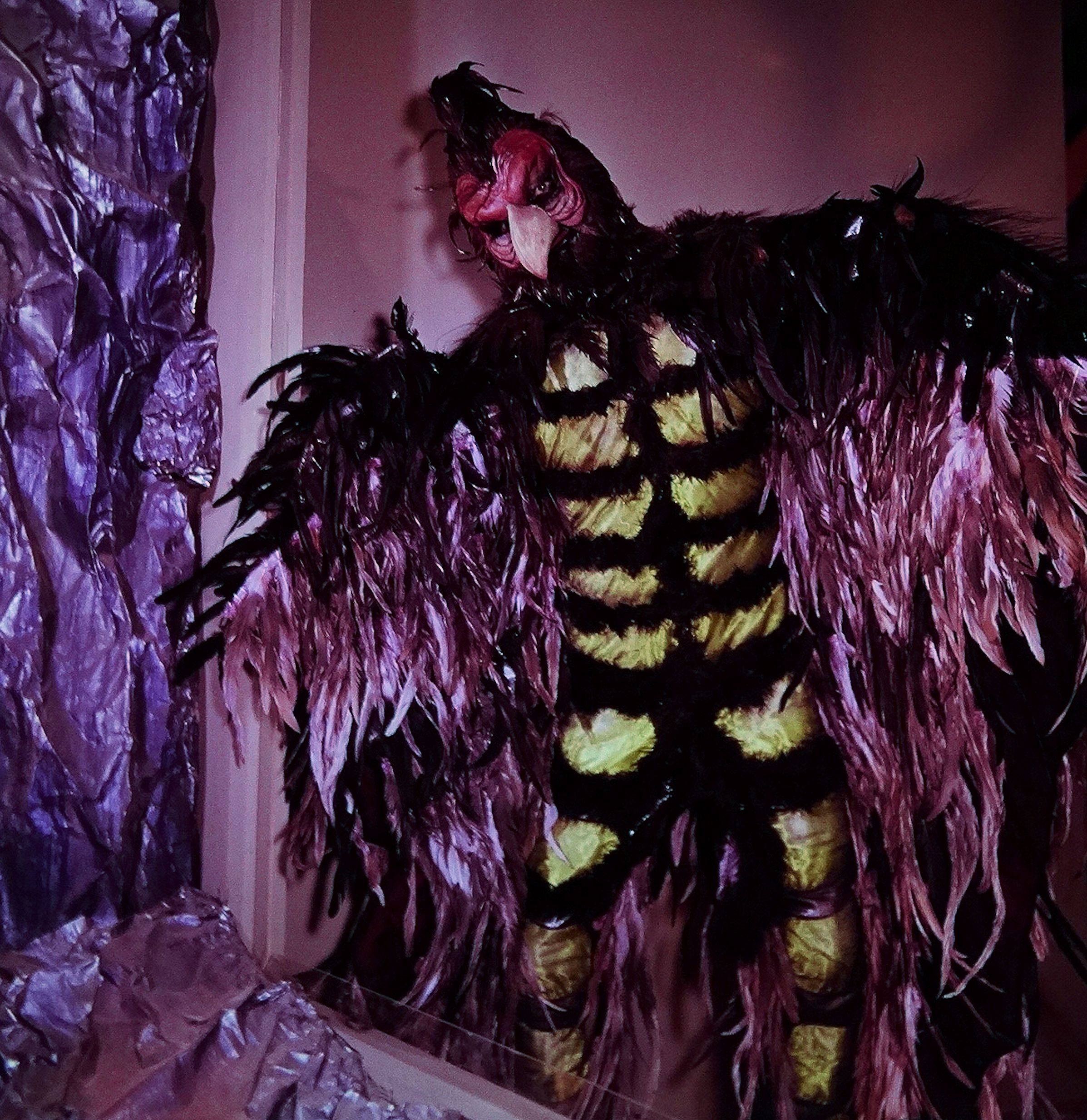

These images are posted here with Gurian’s permission. Thank you, Gerald.
Postscript
Prohaska was once well known for playing the Cookie Bear from 1969 to 1971 on The Andy Williams Show, although his Hungarian accent meant his lines were spoken by someone else.
Here is a brief interview with Janos Prohaska:
-
Read the Nazi-themed script that almost got made

I recently watched the season two episode Patterns of Force with my good friends Rob Sawyer and Carolyn Clink. We had not seen it in a while and, as we do, we had an interesting discussion about its message and its place in the Trek canon.
I marvelled again that the idea of the Enterprise visiting an actual Nazi planet was ever greenlit, and especially in the way Star Trek handled it. While the Second World War was a common topic for TV and cinema in the 1960s, sitcoms like Hogan’s Heroes and movies like The Dirty Dozen and The Great Escape focused solely on the combat, soldiers fighting soldiers. They ignored the death camps. Star Trek chose instead to address the Holocaust head on, presenting a story about the planet Ekos’ genocidal “final solution” to eliminate the people of neighbouring planet Zeon.
But even more surprising than the production of a Holocaust-themed episode is that Patterns of Force was actually the second such story Star Trek commissioned. The first, titled Tomorrow the Universe and written by Paul Schneider, progressed all the way to a revised second draft script in June of 1967. That same month, TOS producer John Meredyth Lucas submitted his story outline for Patterns of Force, and it was chosen over Schneider’s work. And while the two stories had some differences, they marched over much of the same ground.
Read the rejected script
I have a PDF of Schneider’s first draft script, and you can get your own copy at the download link.
The story opens with the Enterprise visiting the planet Spurlos to retrieve a Federation cultural-exchange team. The inhabitants call themselves “Rikes” and I do not know if that was a deliberate rendering or a misspelling of Reich.
The crew beams down and finds Federation data tapes belonging to team leader Dr. Alana Steele, a prominent astro-sociologist. Spock discovers the tapes cover “ten Earth years: nineteen thirty three to forty three…one of Dr. Steele’s special fields of scholarship.” We learn those dates are no coincidence, as the Nazi connections then really start to kick in.
The temple-like roof of the monument is adorned with a large photograph…DeSalle shakes his head uncertainly, as he gazes at the strangely recognizable face — the visor of the high-peaked cap shading the pinched features, the balefully glaring eyes, the precise little moustache, under the sharp nose.
DESALLE(trying to recall)
Familiar face – but I can’t place it…
KIRK
(frowning deeply)
Think of your Earth history, Mr. DeSalle. A figure from its darkest chapter…
CROWD VOICES (o.s.)
(in deafening unison)
Sieg – heil! Sieg – heil! Sieg – heil!
…
KRIEG’S VOICE
Security units are ordered to bring all prisoners and remaining classes of persons to the Nazi Party Rally! Any refusing to attend will be liquidated!
As in Patterns of Force, the Holocaust is front and centre here. Soldiers wearing SS uniforms goose step into the square with a group of prisoners called “Undermen” — the English translation of the Nazi term “Untermensch.”
Kirk and the landing party are soon chatting with Hitler himself, or at least a wannabe Spurlos version. These local fascists believe Earth’s Hitler won the war and the Nazis formed a world government that became the blueprint for the Federation and Starfleet.
“Hitler” summons Dr. Steele and we learn she is using Spurlos as a large social experiment; she has introduced Nazism to examine “the deepest causes of aggressive behavior in human society.” The planet is her test lab, and she will trigger the death of countless people so she can observe how fascism plays out in her new home.
The same basic idea is used in Patterns of Force: cultural observer Professor John Gill introduced Nazism to Ekos because he admired the efficiency of fascist Germany.
I won’t relate how Tomorrow the Universe ends; read the script if you’re curious. I will say it falters in acts three and four, with Spock pulling a deus out of the machina and — as in Patterns of Force — the misguided Federation representative broadcasting a public admission of wrongdoing.
Ultimately, Tomorrow the Universe is an okay script but Patterns of Force is better. Schneider’s take is a little too on the nose, with a leader who looks and acts like Hitler and even goes by that name. It is like a dour take on A Piece of the Action, in that it depicts an imitative culture but one that is horrifying where A Piece of the Action is funny. Lucas’ story leaned into Nazism as an allegory about evil, while Schneider settled for dressing up a cardboard bad guy in a Nazi uniform.
Both stories also suffer from the unrealistic idea that one person saying at the end “I was wrong and Nazism is bad” would turn around an entire society that had devoted its resources and ideology to victimising its neighbours.
No credit where it’s due
But you have to give Schneider props for coming up with many of the basic story beats first — although he received no actual credit on Patterns of Force. That is despite the many similarities: that Nazism being attractive was not a one-off occurrence, an attack in space as the Enterprise approaches, and of course a Federation representative bringing 1930s fascism to a distant planet.
Paul Schneider himself was surprised and hurt by how this all played out. And angry, I’m sure.
Picture this: he is sitting at home in early February of 1968 and he sees a “Next week on Star Trek” promo for a Nazi-themed episode, and he figures this must be his script. In a letter to Roddenberry, he wrote: “I assumed this to be the production on my third teleplay for ‘Star Trek’ — finished in early 1967. Not an unnatural assumption, I think — since my ‘Tomorrow the Universe’ concerned precisely the same situation.”
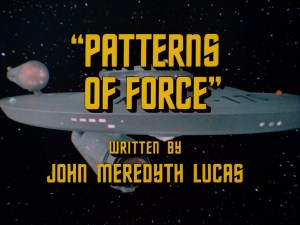
He then watched the premiere of Patterns of Force on February 16, 1968. His letter is dated the next day. He continues to Roddenberry:
Yesterday I viewed the segment — now titled ‘Patterns of Force’ — and was flabbergasted to see the credit listed as ‘written by John Meredyth Lucas.’ …Not a clue can I find to the process of reasoning which excluded me from all credit participation — even down to story. I’ve gone over my own original story and two script versions; by no stretch would I deny that changes were made; nor, by the same stretch, could I deny that much remains essentially the same.”

He adds “Of course, the issue must now go to the Guild for arbitration.” Absolutely it must.
Roddenberry sent a reply, dated February 20, 1968, pointing out that he is now acting as Executive Producer only and “confining myself to policy decisions and staying away from the details of day-to-day line production.” He added “One thing I think both of us know for sure is that neither Gene Coon nor John Meredyth Lucas is in the habit of stealing from their fellows.”
I do not think Schneider knew that at all. He had reworked his script over the first half of 1967, with the revised second draft dated June 1. Lucas’ first story outline was dated June 7.
Eight days after his reply to Schneider, Gene Roddenberry sent Gary Ellingsworth at the Writers Guild of America West a copy of Schneider’s first draft script and Lucas’ final draft, and told Ellingsworth:
I double checked with both John Lucas and Gene Coon (who was producing the show at that time) and they assure me that John never read Paul Schneider’s story or script, and in fact John Lucas was only lately aware that Schneider had written a Nazi script.
On the other hand we are all anxious to be fair to Paul Schneider if we have somewhere along the line violated any rules, regulations, or ethical practices. Gene Coon informed me that having paid Paul Schneider full price for the script, he presumed we owned the “Nazi idea” but felt that since he was not using Schneider’s story he had no obligation to clear Lucas’ assignment elsewhere.
I do not have a copy of the Guild’s response, but it sided with Roddenberry — and Schneider then decided to apologise to Roddenberry for his complaint. He wrote on May 23, 1968:
I’ve been told about the Guild-arbitration on judgement that the ‘Patterns of Force’ script for ‘Star Trek’ was strictly by John Meredyth Lucas.
Obviously I was wrong — and I mis-read the situation — and I owe apologies to you and Mr. Lucas.
I think business considerations and not contrition prompted the note. Schneider penned the season one episodes Balance of Terror and The Squire of Gothos, and had been paid for his work on Tomorrow the Universe. Perhaps it was best to swallow the slight here in the hope of future commissions. And, indeed, he contributed The Terratin Incident to the animated series a few years later.
However, the timing of the drafts and the plot similarities make me think it likely Lucas had in fact read Schneider’s script.
In either case, the producers and the network were brave to directly address the Holocaust so soon after the war, in either script. Both takes on the Nazis raise uncomfortable issues and that was, of course, the goal.
-
William Shatner reflects on being Kirk, in 1976 and 2004
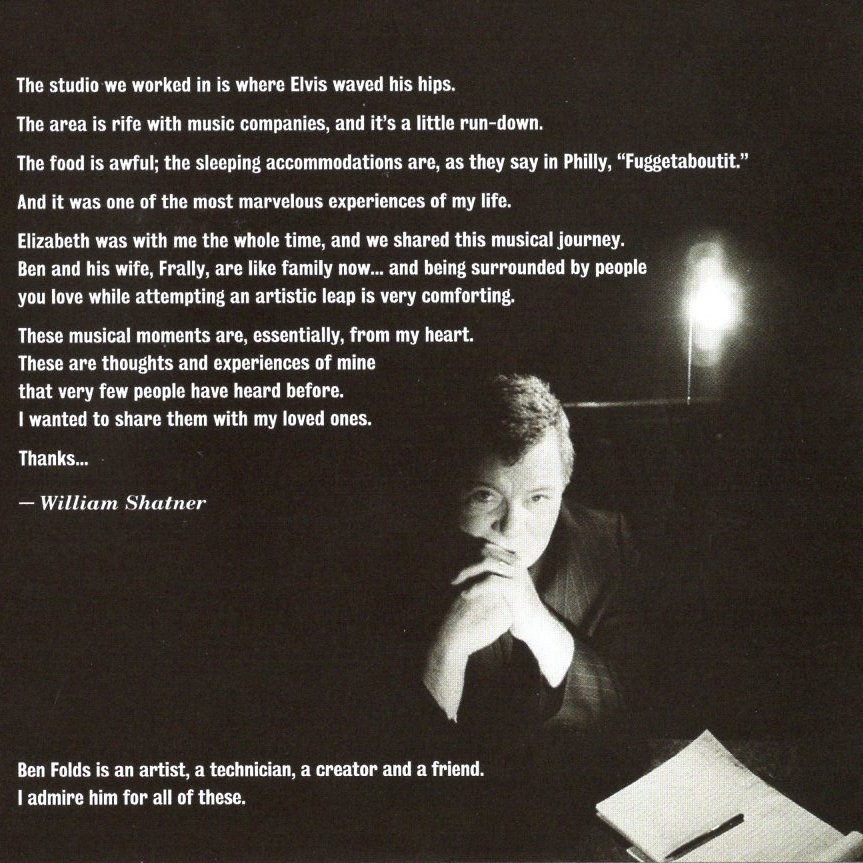
One of William Shatner’s most intriguing aspects is his introspection. He is genuinely interested in how humans work and how he works.
He has examined human nature in many interviews and autobiographical books, but two pieces of audio separated by almost three decades also provide compelling musings about the actor and the individual.

The first comes from Inside Star Trek, a fascinating album of interviews and character sketches Gene Roddenberry recorded in 1976. The opening track is a chat with Shatner, and here is their first exchange.
Roddenberry: There are some questions I have been wanting to ask you for 10 years. One of them is, how much of Bill Shatner is Captain Kirk?
Shatner: Well, Gene, the act of putting on a…television series is such a backbreaking, all-encompassing task, the hours we put in are so enormous, that to be able to make up a character and sustain that for the years that we did it would be impossible I think for anyone, but certainly impossible for me, so what essentially comes out is William Shatner himself, as himself, saying the lines that were written for me to say… I think that the people you see on television, playing leads in television series, that’s what they’re like. When people ask ‘What is so-and-so really like?’…what you’re seeing is what you’re getting.”
Roddenberry: How did Captain Kirk, the character, the strong, the usually wise commander of the vessel, how much of that influenced you and your personality?
Shatner: I don’t think I carried home any of the characteristics of Captain Kirk, other than as I’ve just said those characteristics that were me. But the wisdom, and the sagacity, and the courage that Captain Kirk evidenced in the play of the week was written as fiction, and I often wished that I could be able to do that in my own personal life, but fallible me is…fallible me.
“I often wished that I could be able to do that in my own personal life.” Shatner revisited that conclusion on 2004’s Has Been, easily his greatest album. And if you think I’m grading on a curve anchored on one end by Mr. Tambourine Man and on the other by Lucy in the Sky with Diamonds, you haven’t listened to Has Been. It’s truly excellent.
The second piece of audio is the last track on the album, called Real and performed with Brad Paisley and written by him for Shatner. The song neatly sums up Shatner’s feelings about himself.
And while there’s a part of me
In that guy you’ve seen
Up there on the screen
I am so much more
And I wish I knew the things you think I do
I would change this world for sure
But I eat and sleep and breathe and bleed and feel
Sorry to disappoint you
But I’m real
I’d love to help the world and all its problems
But I’m an entertainer, and that’s all
So the next time there’s an asteroid or a natural disaster
I’m flattered that you thought of me
But I’m not the one to call
Leonard Nimoy obviously spent a lot of time thinking about this same issue; he wrote two books — I am Not Spock and I Am Spock — to work out where he and the character stood. In an interview recorded in 1976, the same year as Shatner’s discussion with Roddenberry, Nimoy said about his first book:
The title is really a simple statement of fact, I am not Spock. In the sense that I am the actor who played the role, of course I am Spock, but in the sense of true identity, I am not. I am someone else.
Shatner would agree, and it’s so interesting that two men with such different approaches to the craft would also be caught up in the meaning of character.
The persona we see on screen is Bill Shatner, because it was simply too much work to do otherwise on a weekly series, but Shatner is not Kirk. Fallible me is…fallible me, he said. Not a hero.
But he is certainly a thoughtful artist who spent decades pondering some big questions, and still does.
-
Giant Poster Book two: insights into those amazing special effects
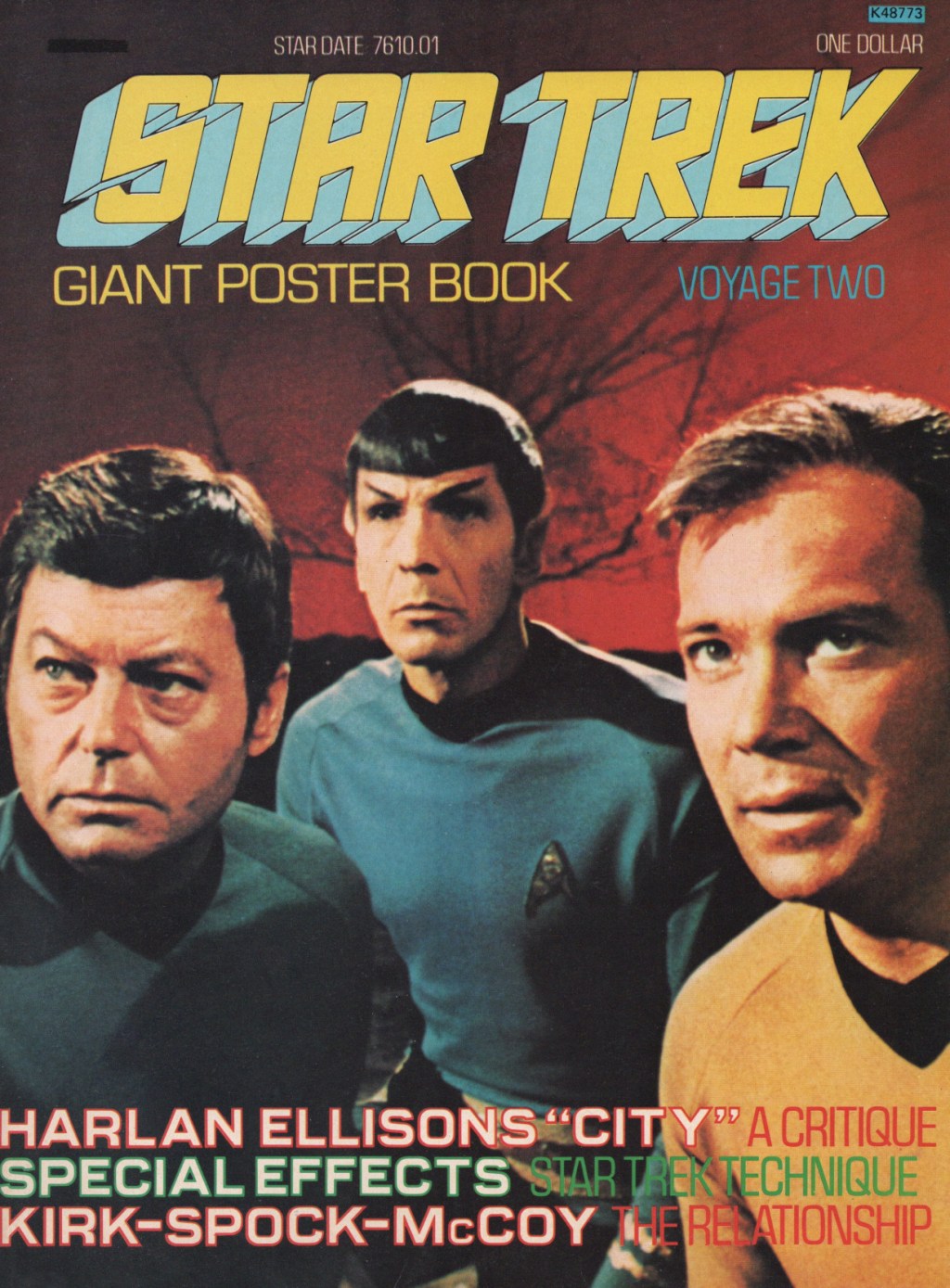
The Star Trek Giant Poster Books were the first professionally published Trek magazines. Seventeen issues were produced between September 1976 and April 1978, plus a 1979 “Collectors Issue” devoted to The Motion Picture. Each delivered six pages of content plus the cover and back cover and folded out into a large poster.
I own the complete set and will cover each issue. The story of the magazine’s genesis is told here.
Here are highlights from issue two, published in October 1976, plus a scan of the magazine.
A personal note: Allan Asherman died in September of 2023. Asherman was a foundational member of Star Trek fandom, a collector of renown, an author, and one of the original team on the Star Trek Giant Poster Books. I had tried for months to get in touch; he had mostly withdrawn from fandom and I hoped we could again hear his voice. I am sad I did not get to speak with him.
How did they do that?
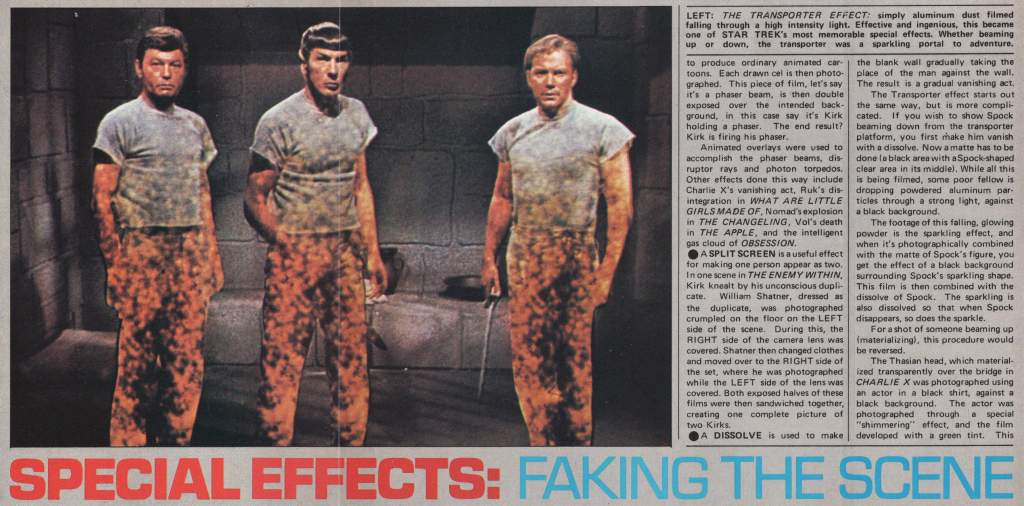
Issue 2 offers an in-depth and fascinating article on how the original series special effects were created. Asherman tells us how Charlie was made to fade away, how Kirk could kneel beside his duplicate, and that Spock beaming down to a planet began with a dissolve, deployed a matte, added in a sparkle of powdered aluminum, and that the effect was completed by combining these elements.
Asherman ends the piece with “The special photographic effects of Star Trek were usually beautifully done,” and it is fun to know how they were accomplished.
The story behind The City on the Edge of Forever
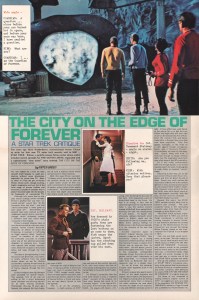
This issue features the first Star Trek Critique, a series of in-depth episode essays. The series began, just as the Fotonovels would do a year later, with Harlan Ellison’s classic episode.
Except that the screened episode was not really Ellison’s story. Author Mitch Green tells readers about the significant changes made to the script, and that “It’s Ellison’s contention that the final aired version is only a ‘watered down’ remnant of the original, the love story having lost much of its intended impact.”
That take is familiar today to serious fans but was likely news to many in 1976. The best way to experience the original story today is in the excellent IDW graphic novel of Ellison’s teleplay.
Exploring the triumvirate
The third article in this issue is a bit of a disappointment. Ostensibly an examination of the most important interpersonal relationship in TOS, most of the article is simply a recap of scenes in which the Kirk-Spock-McCoy friendship is explored, with little analysis of those moments. To be fair, this was written before streaming and Blu-rays, so simply revisiting pivotal scenes may have made an interesting read.
The best bit of the article is the conclusion:
Years after Star Trek’s original airings we are still concerned enough about the relationship for me to write this article, and for you to read it. Why? Because there’s a little of Kirk, Spock and McCoy in every one of us. Which makes them as real as we are!
The poster
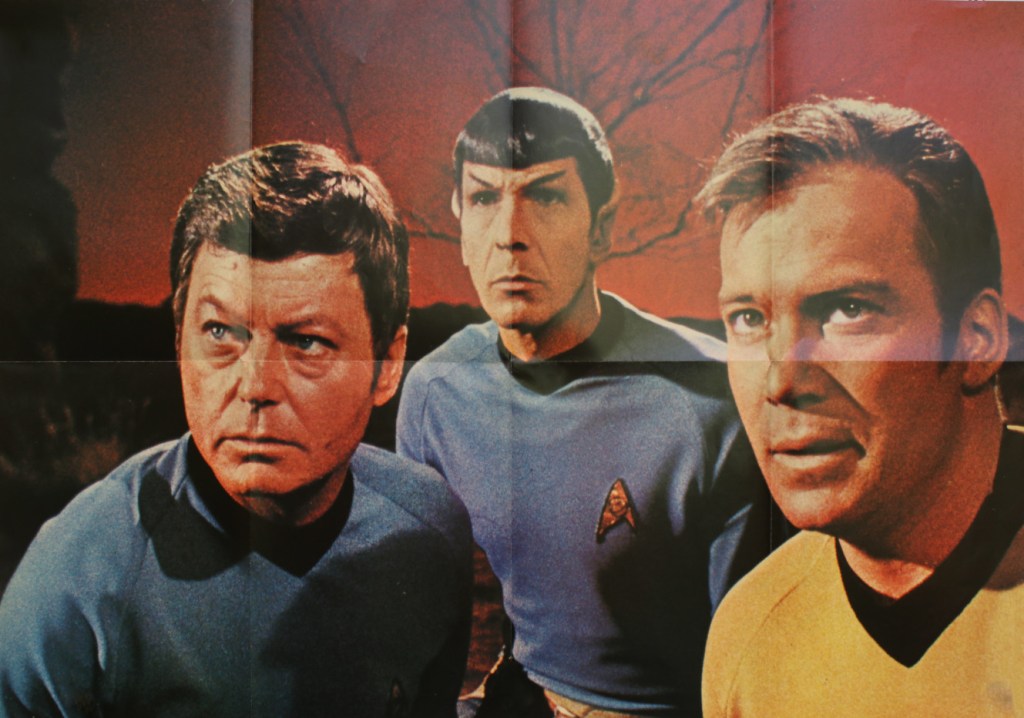
The trio confronts The Spectre of the Gun.
Read the other articles in this series.
-
Has the three-foot shooting model been found?
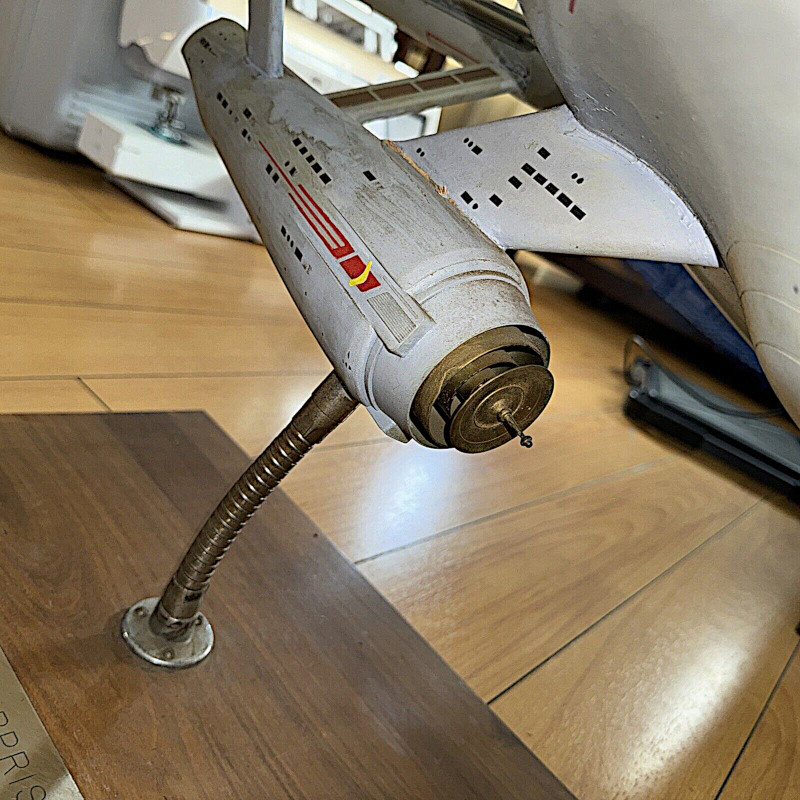
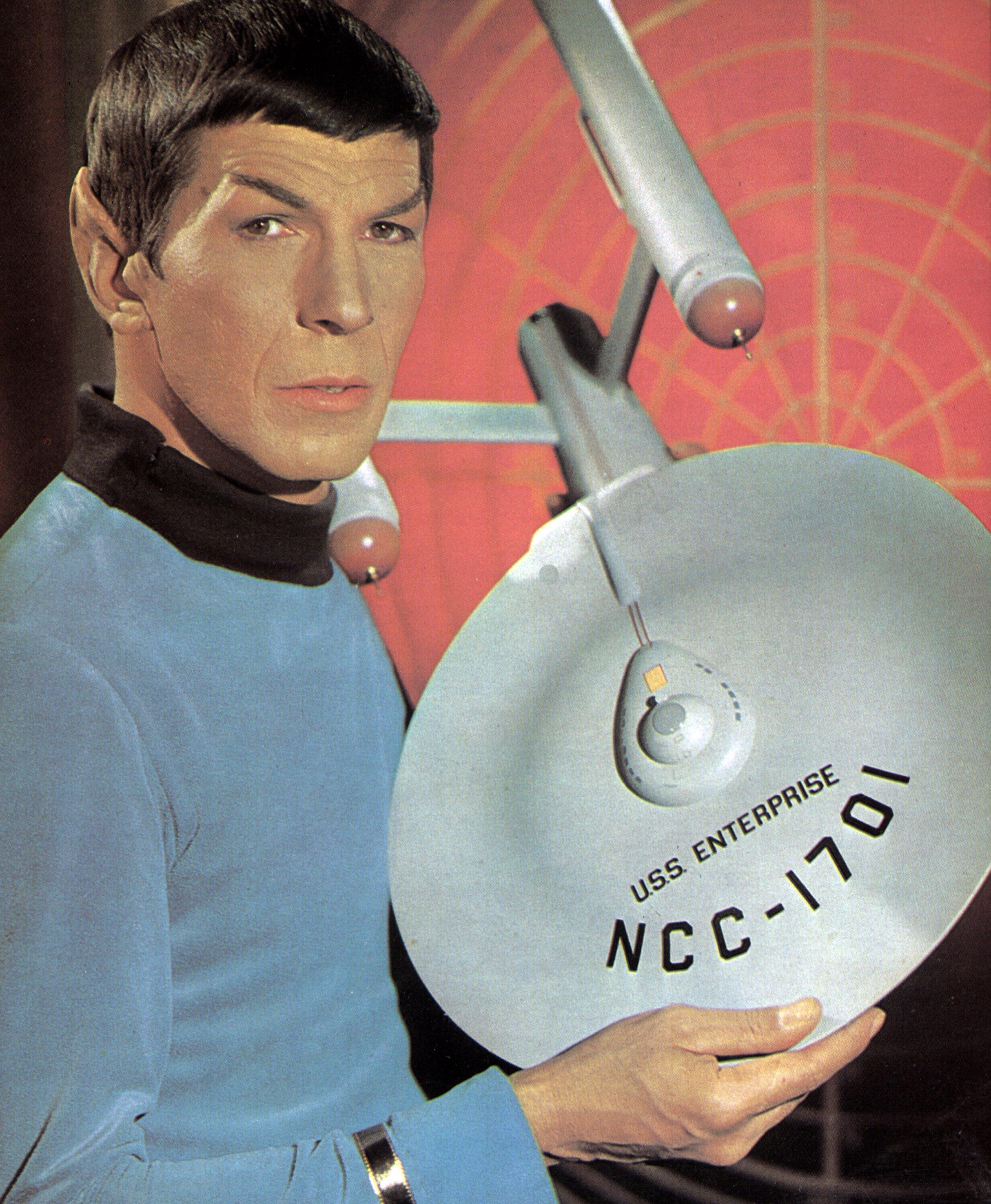
The three foot model of the Enterprise — the original shooting model, seen in The Cage and in stock footage in other episodes — has reportedly been found. And it looks like the real thing.
The ship popped up in an eBay listing and the auction was taken down shortly after. The opening price was set at $1,000 and two bids were placed, for $1,500 and $2,500, but they were both cancelled by the seller.

At time of writing, it is unclear why the auction was cancelled but I suspect someone told the new owner that there is big money to be had. Really big. At the recent auction of Greg Jein’s collection, the Galileo model sold for $225,000 and the X-Wing model for more than $3 million. The original Enterprise would come in somewhere in the upper end of that range.
Here is every photo from the short-lived eBay appearance. Click on the photos for larger versions.
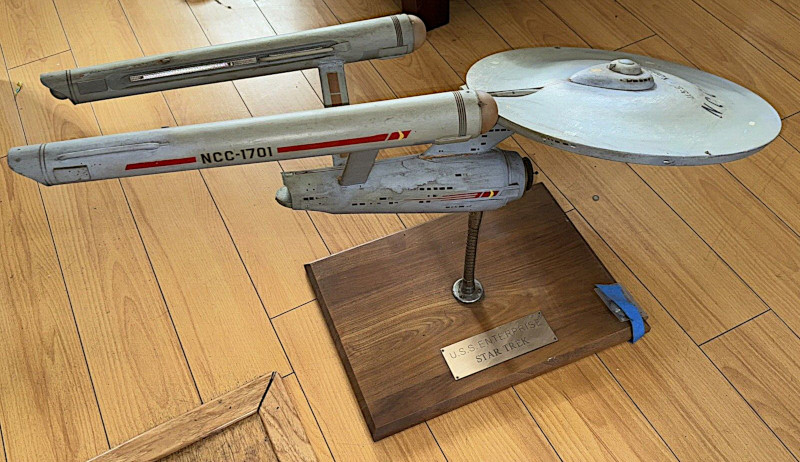
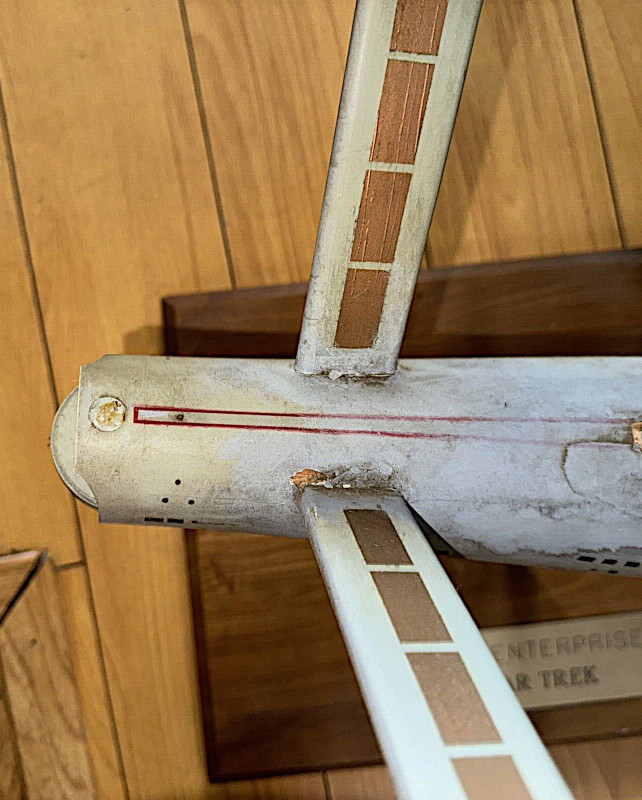
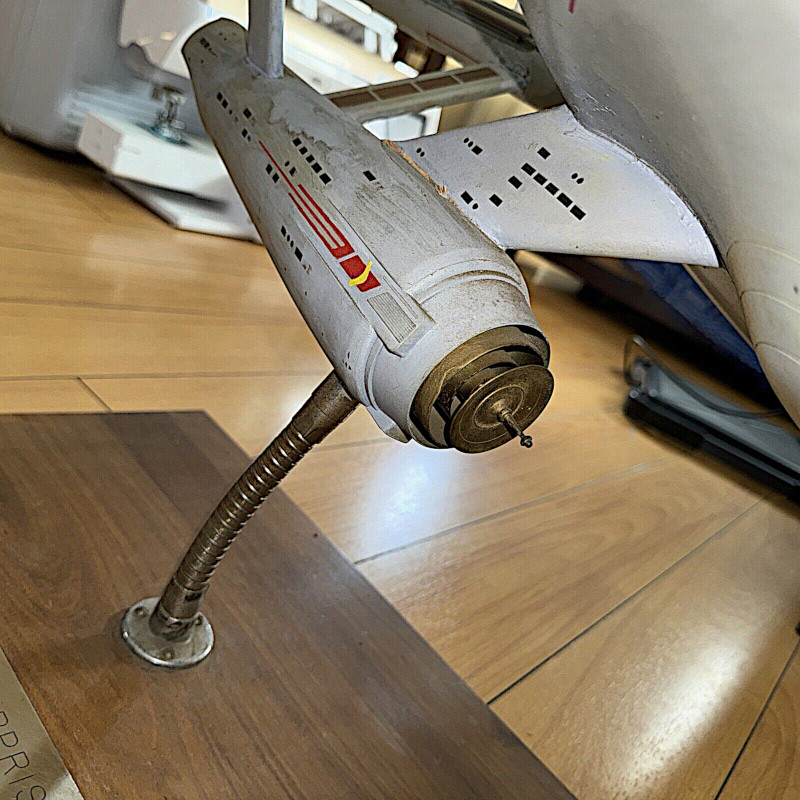
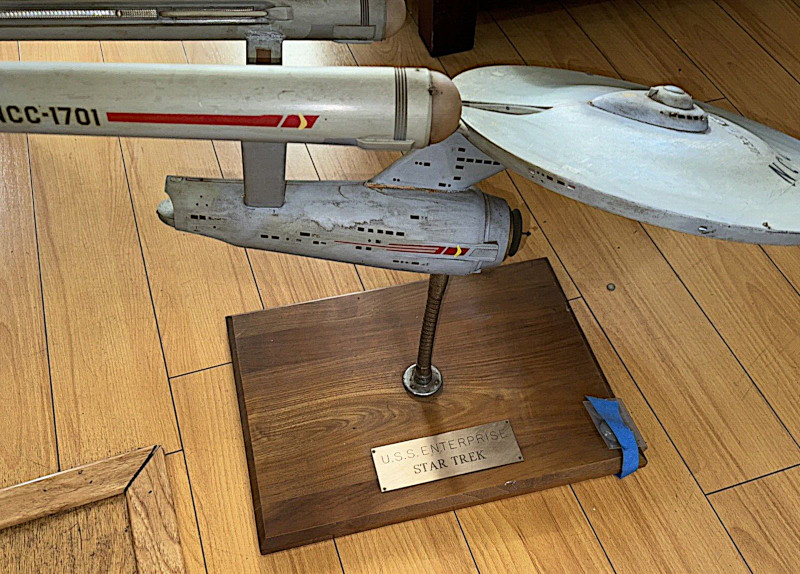
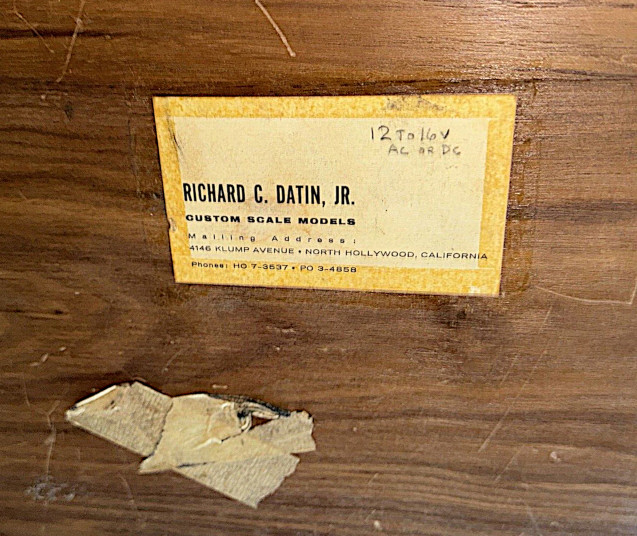
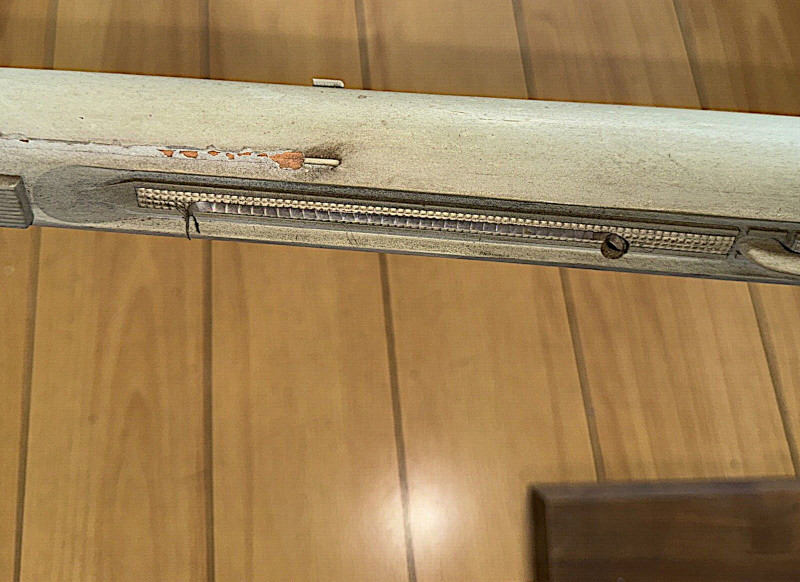
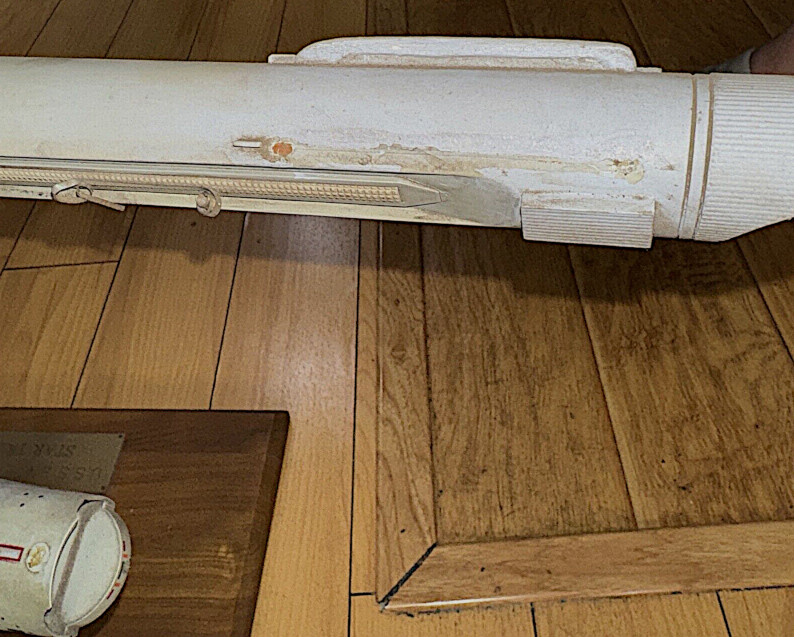
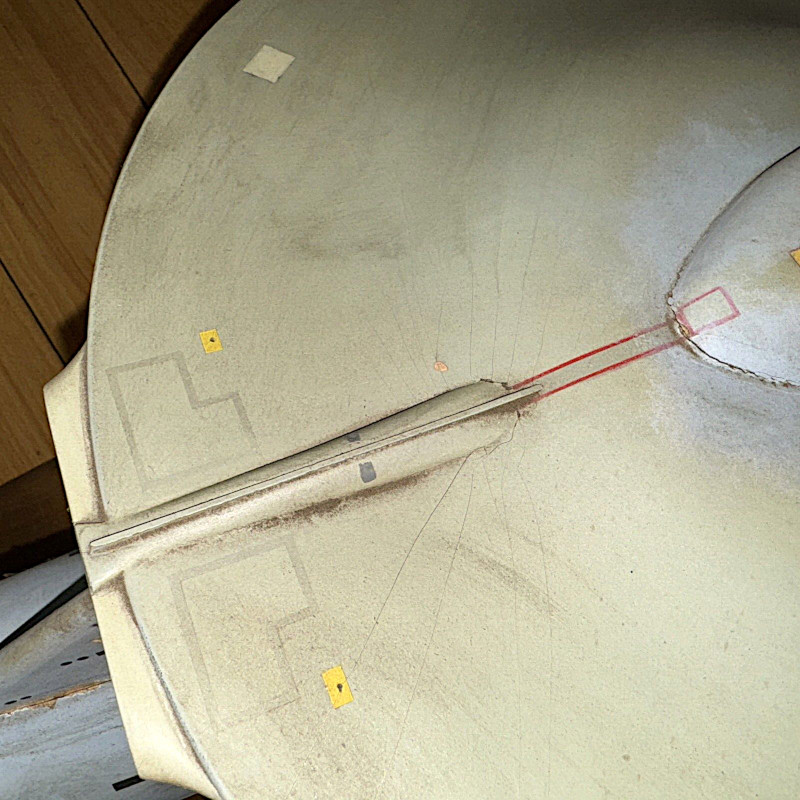
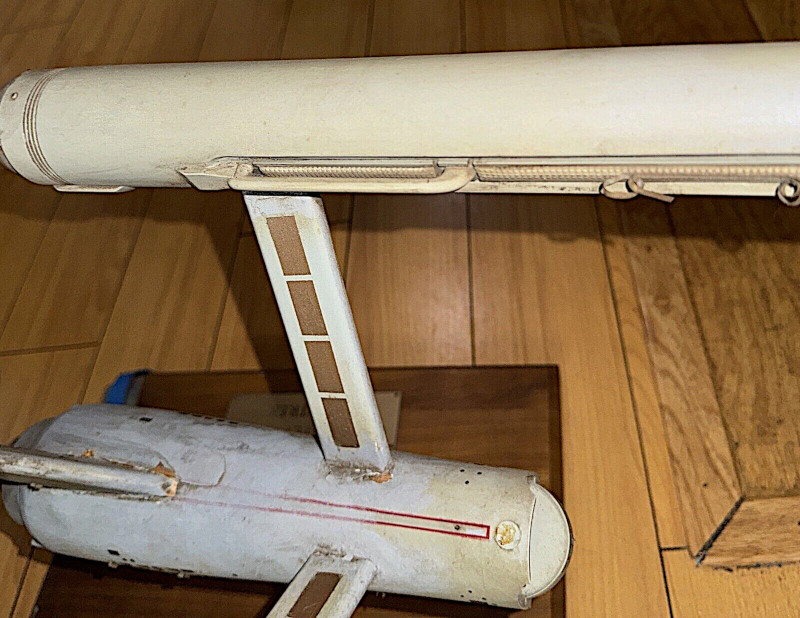
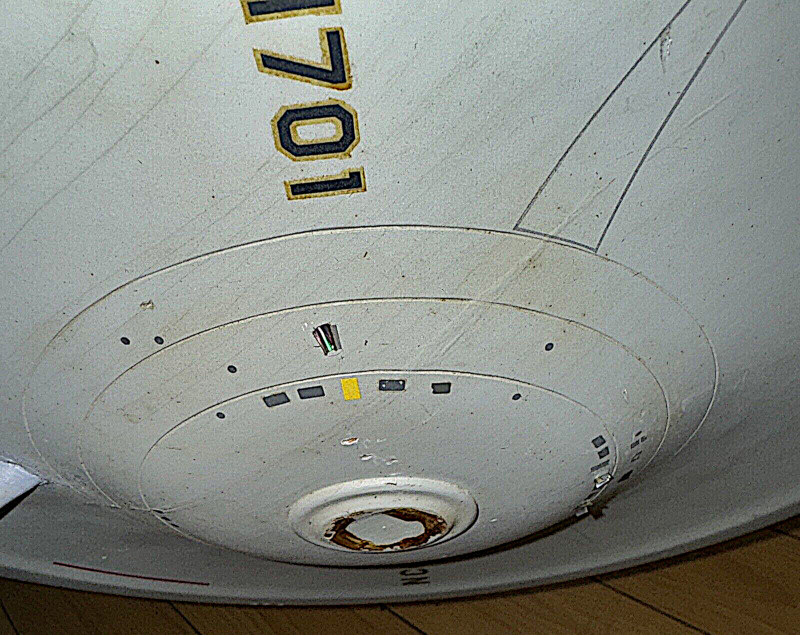
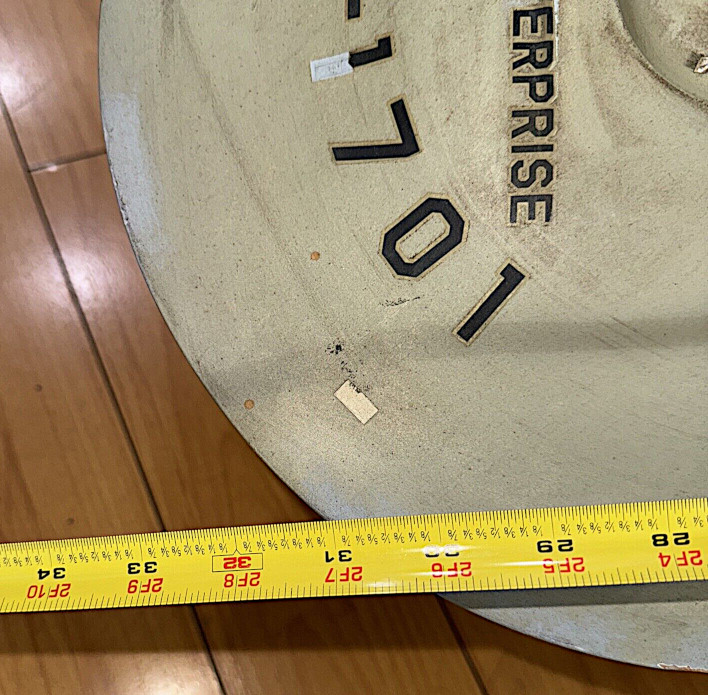
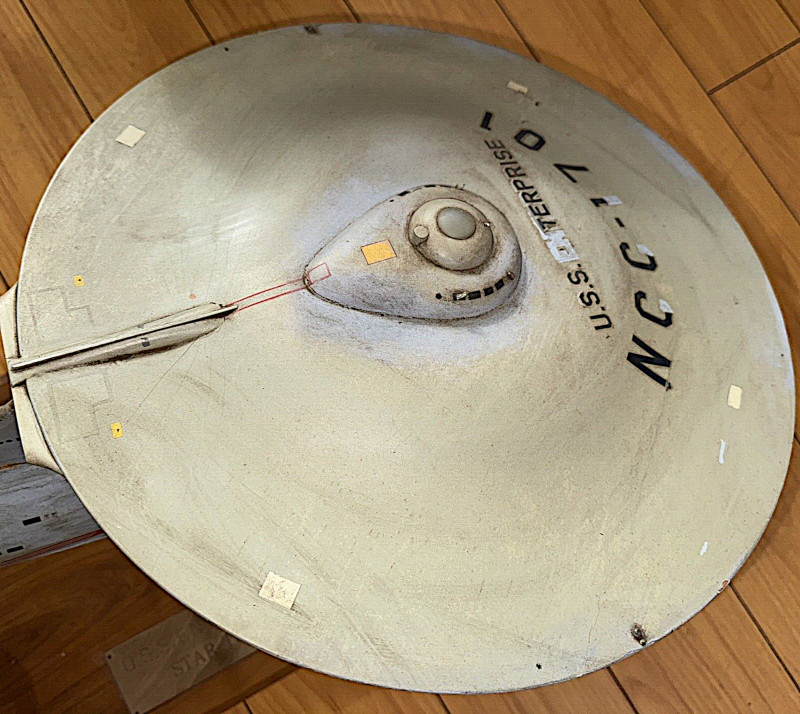

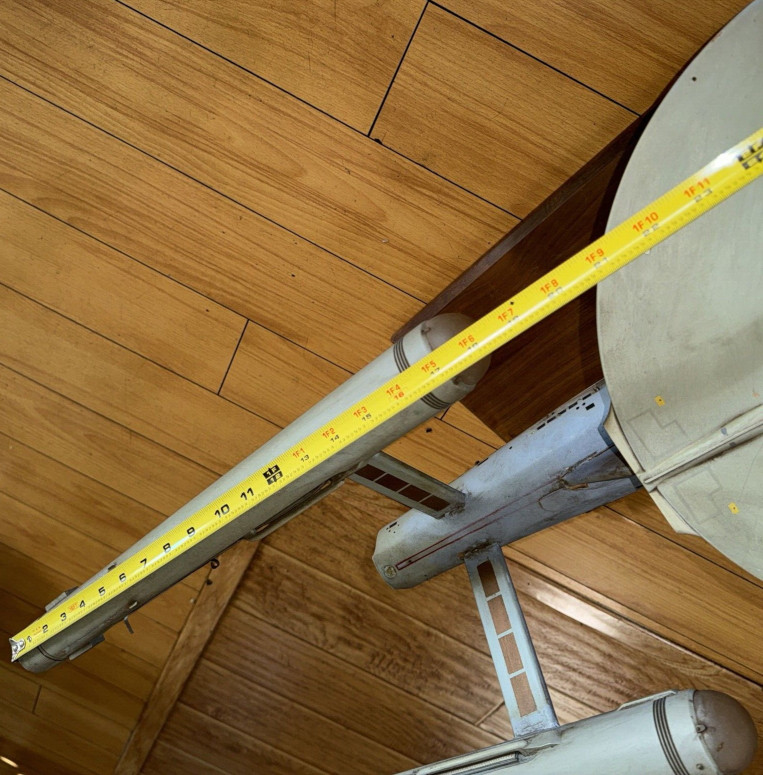

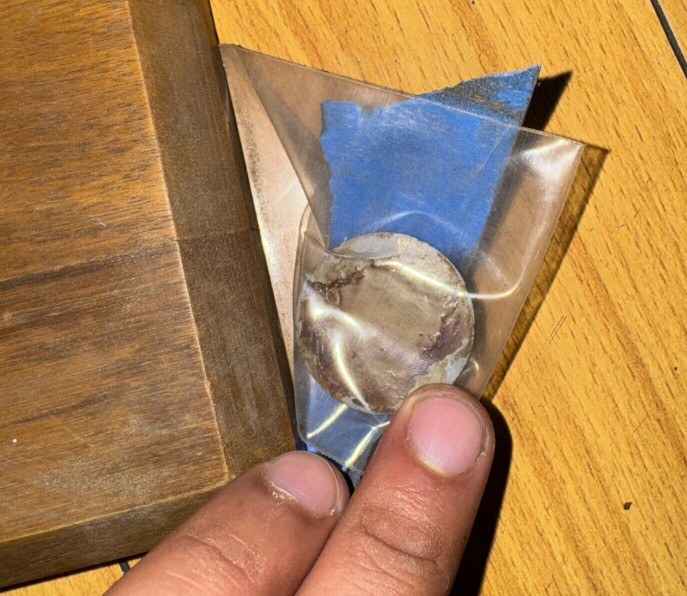
The model looks like the real thing and, while no one yet knows for sure, the consensus of the knowledgeable folks at the Replica Prop Forum is that this is legit.
The rumour on the Internet is that the Enterprise was found in an abandoned storage locker, but that is not actually stated in the auction, which said only:
Item description from the seller
This ship is a custom made spaceship by Richard Datin jr
Made by wood and hand painted
It’s a 1 in 1 very rare and very old
It will have its aging like wooden cracks and sticker pealing off
Very nice for a collection
32 inches long
A fuller story will come out soon, but for now it seems that the greatest missing piece of Star Trek history has been found.
-
Did you play the Star Trek V phone game in 1989?
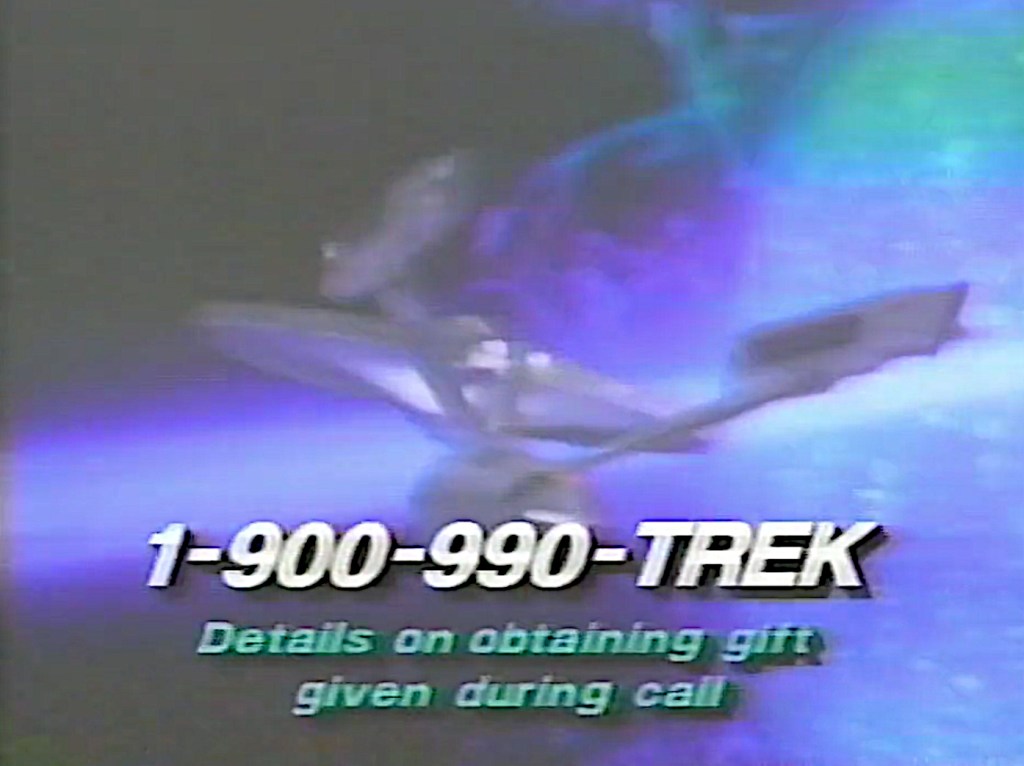
Star Trek fan David Penn recently shared with me a VHS tape crammed with vintage Trek videos. One of the gems is a commercial for a 1989 phone game based on Star Trek V: The Final Frontier. I consider it a gem because I had never heard of the game.
Here is the commercial:
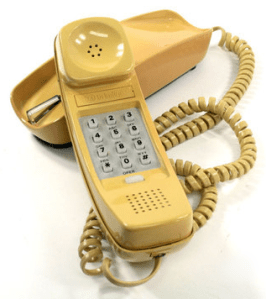
Photo from WorthPoint.com And just to be clear: if you’re picturing gamers pulling out smartphones for this, nope. It would have been old-timey landline phones almost exclusively.
There is no information on this game online and certainly no recording of the audio. Until I posted the video above, even the commercial did not exist on YouTube. Which means fandom has forgotten about this little Trek past time.
Players were presented with “six interactive Star Trek adventures” and, being a phone game, the interaction was of the “Press three to raise shields” variety. At $2.50 per call, the phone bill could deliver a nasty surprise at the end of the month.
Luckily, Penn played the game and shared some memories.
A narrator (not a recognizable actor) would quickly introduce a scenario. As the story progressed, you were given a choice and made your decision by pressing a button on the phone. If you scored high enough, you would be mailed a prize. I got a USS Enterprise NCC-1701-A ensign patch, which was about the size of a US half-dollar. Obviously, I wasn’t good enough at the game to be command material.
I can’t remember if there was more than one dilemma per game. I’m afraid I don’t remember anything really specific about the scenarios, other than one I played involved an encounter in space and the option of firing phasers or photon torpedoes. I do remember being delighted that they used actual TOS sound effects in the story and game play.
I don’t think I could have played it more than eight times total. I wouldn’t have had more than $20 to throw away at the time.
@joebailey64 on
TwitterX told me he was also a winner: “I was sent a small delta pin that was about a centimetre in height.”I am glad I could post the commercial and a little information on the game, but I really wish I could have located more details. I like to think that someone out there has audio recordings or scripts of the scenarios.
And remember kids: check with your parents before calling.
I also published a post about the seasons one, two, and three bloopers that were on Penn’s tape. More videos are coming.
Postscript
MeTV.com posted an article about other 1-900 game lines (and some that peddled gossip and teen heartthrob dreams). It seems Hulk Hogan was plying a similar game back in the ’80s. From the article:
Hulk Hogan gave his Hulkamaniacs a little interactivity with his hotline. The WWF superstar had a game built into his 1-900 number that allowed you to “wrestle” opponents like the Mountie by pressing buttons on your phone to perform moves.
-
Check out the definitive reference work on Trek signatures
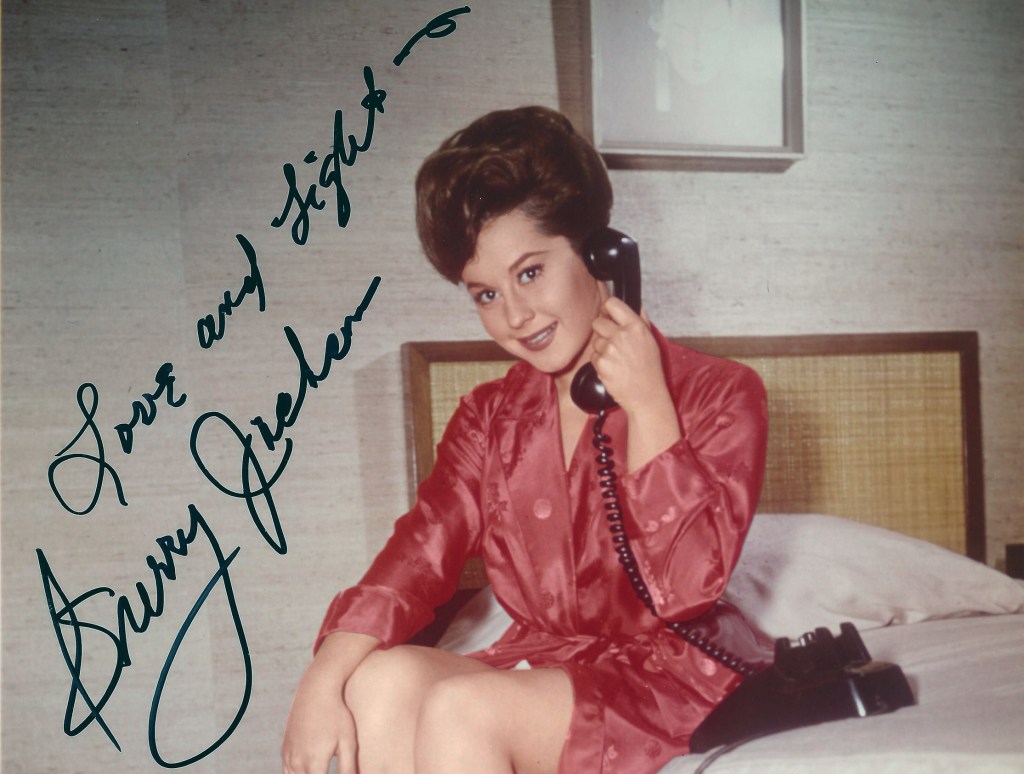
I own a lot of Star Trek autographs. More than 150, some quite rare. And I am in awe of the collection assembled by lifelong Trek fan Gerald Gurian. He has hundreds of signatures, and he decided to share them with fandom by publishing the 468-page masterwork Autographs of the Final Frontier.
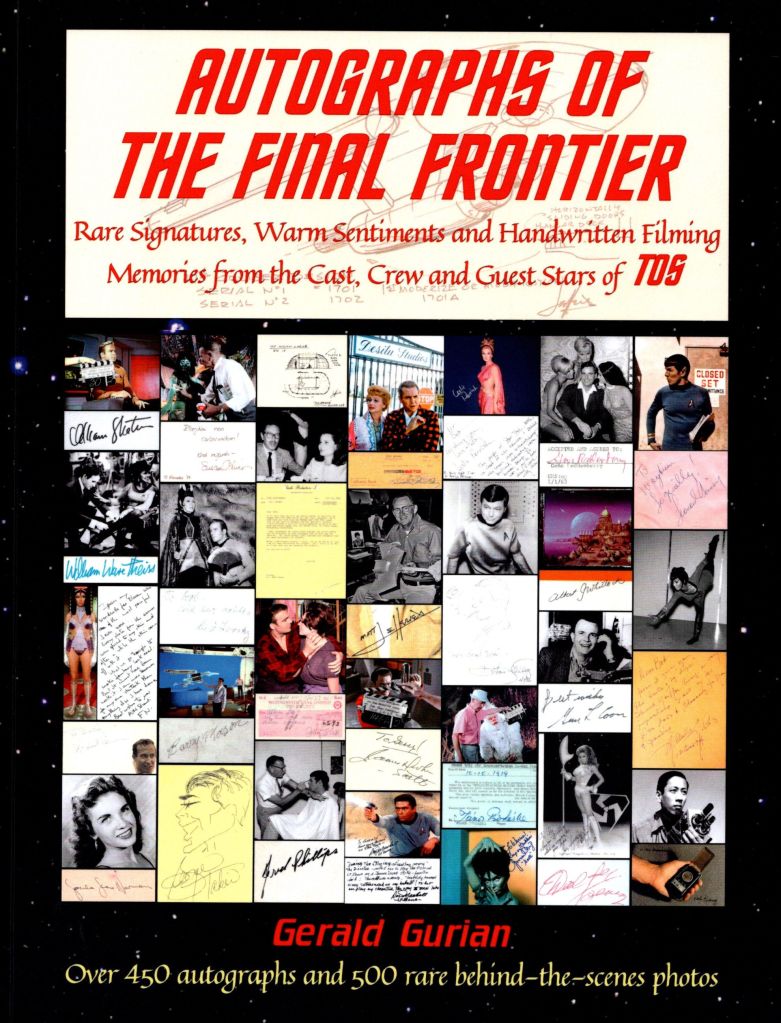
The book presents more than 450 autographs, but what’s really impressive is the breadth of the coverage. No one picking up a book like this would be surprised to see examples from William Shatner, George Takei or Gene Roddenberry, or even William Campbell, DC Fontana, or Ralph Senensky, but Gurian goes well beyond that. He has Max Kleven, a gladiator in Bread and Circuses; Arthur Batanides, D’Amato from That Which Survives; propmaster Irving Feinberg; Linwood G. Dunn, special effects photographer; matte painter Albert Whitlock; and hundreds of others.
The autograph book is actually Gurian’s fourth. His first published works are the three-volume To Boldly Go set, which presents rare production photos.

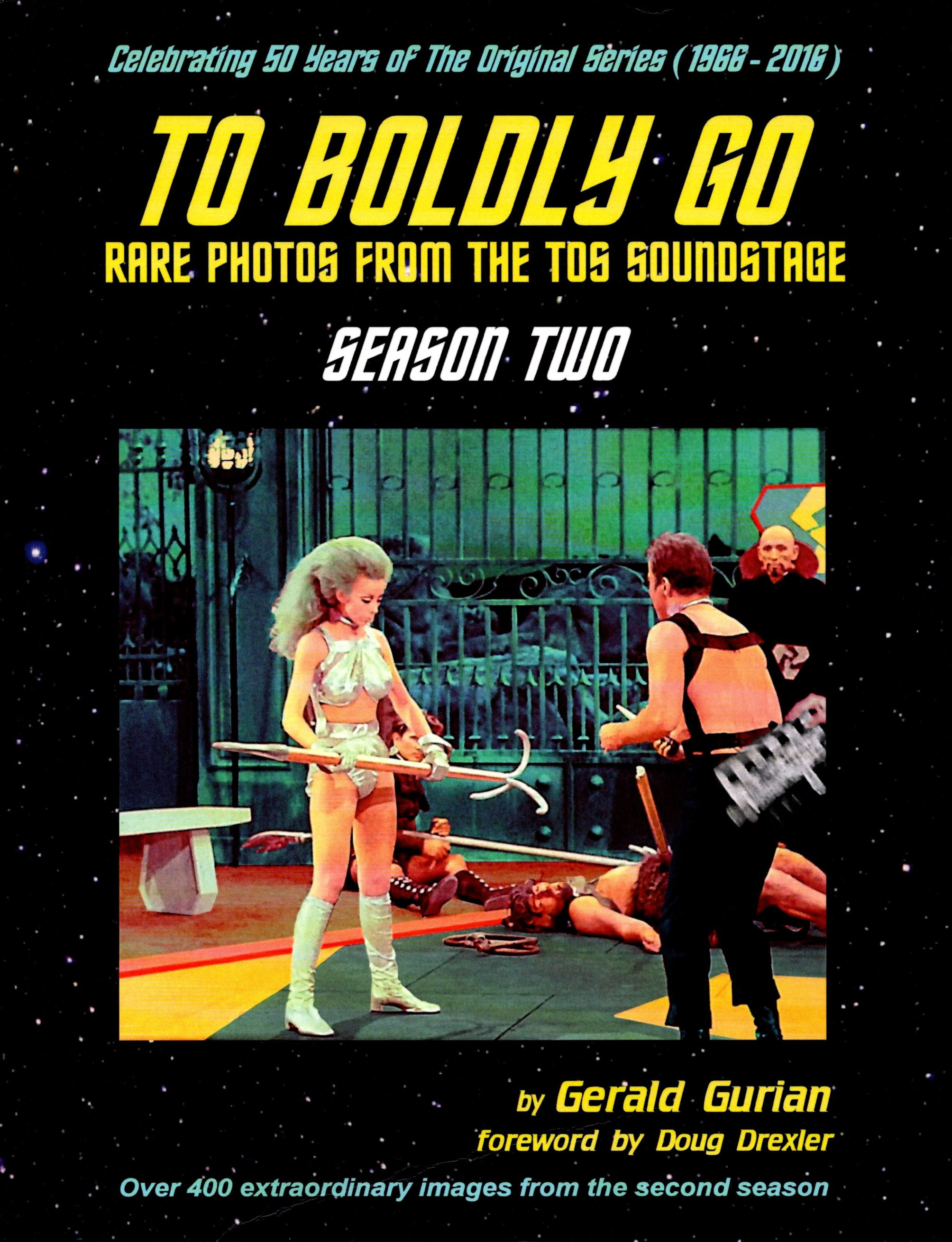

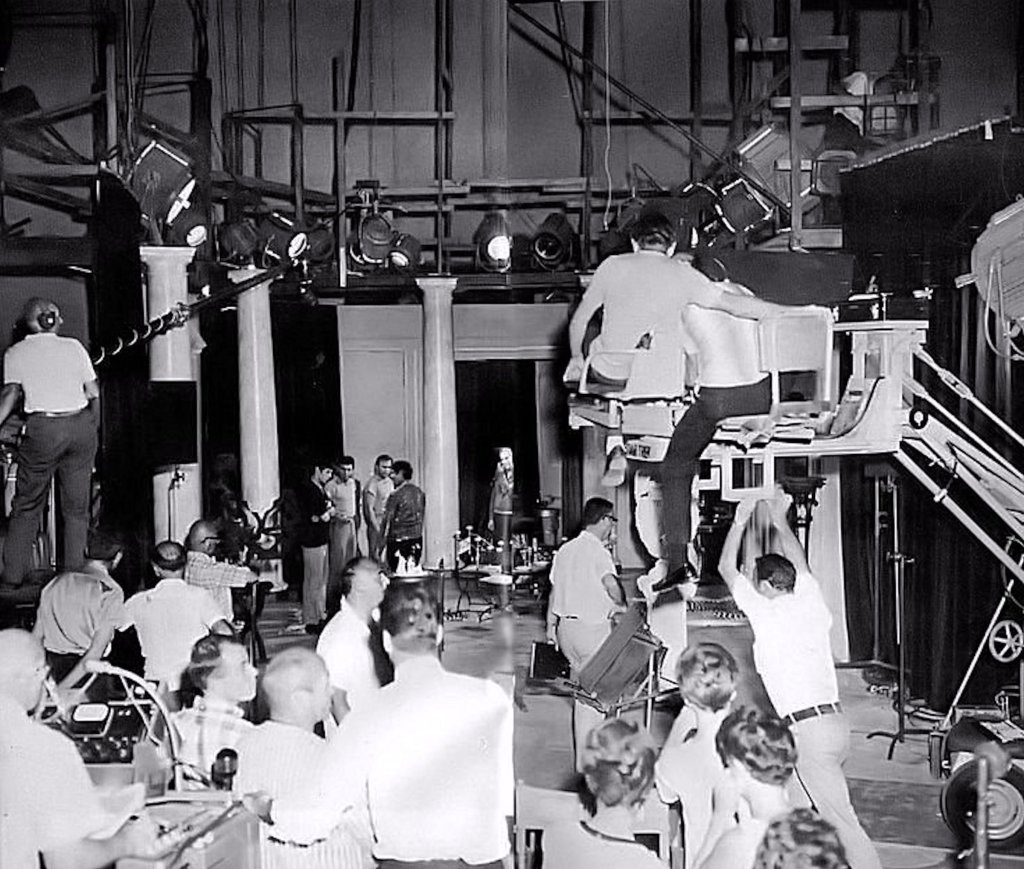
The autograph and production photos in this article were supplied by Gerald Gurian and used with his permission. “I never thought I would author a book on Star Trek,” Gurian told me. “I posted some rare photos on my site (Star Trek prop, costume and auction authority) and that attracted the attention of Marc Cushman and his publishing team and they contacted me to ask if they could use some photos for his book series, These Are The Voyages.” Gurian was happy to have Cushman use his images but they were reproduced in black-and-white and mostly in a fairly small size, and “I thought it was a shame no one could see the colour versions.
“That led me to create the original three books, and then I thought it’s a shame I have not used the autograph material, and so that led to this book.”
About a dozen autographs in the fourth book come from other people but Gurian owns the rest. And he also included 500 of those rare behind-the-scenes photos.
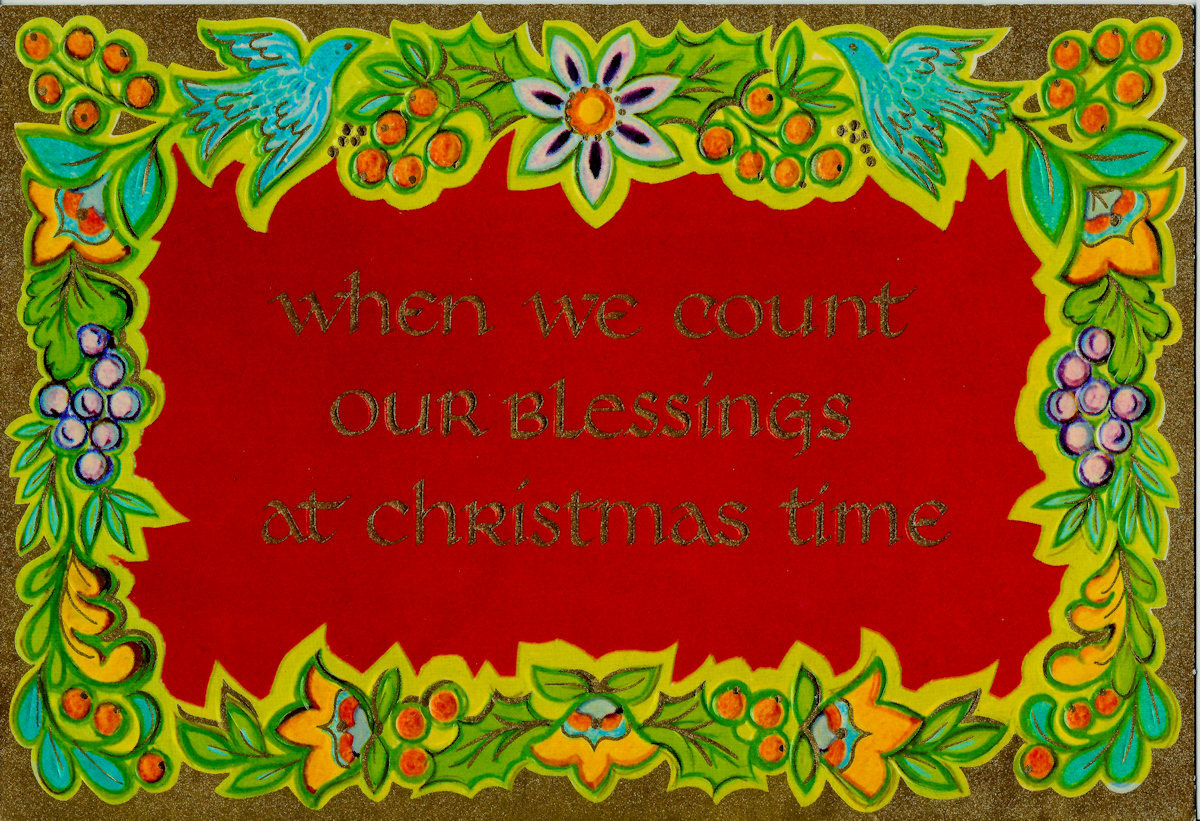
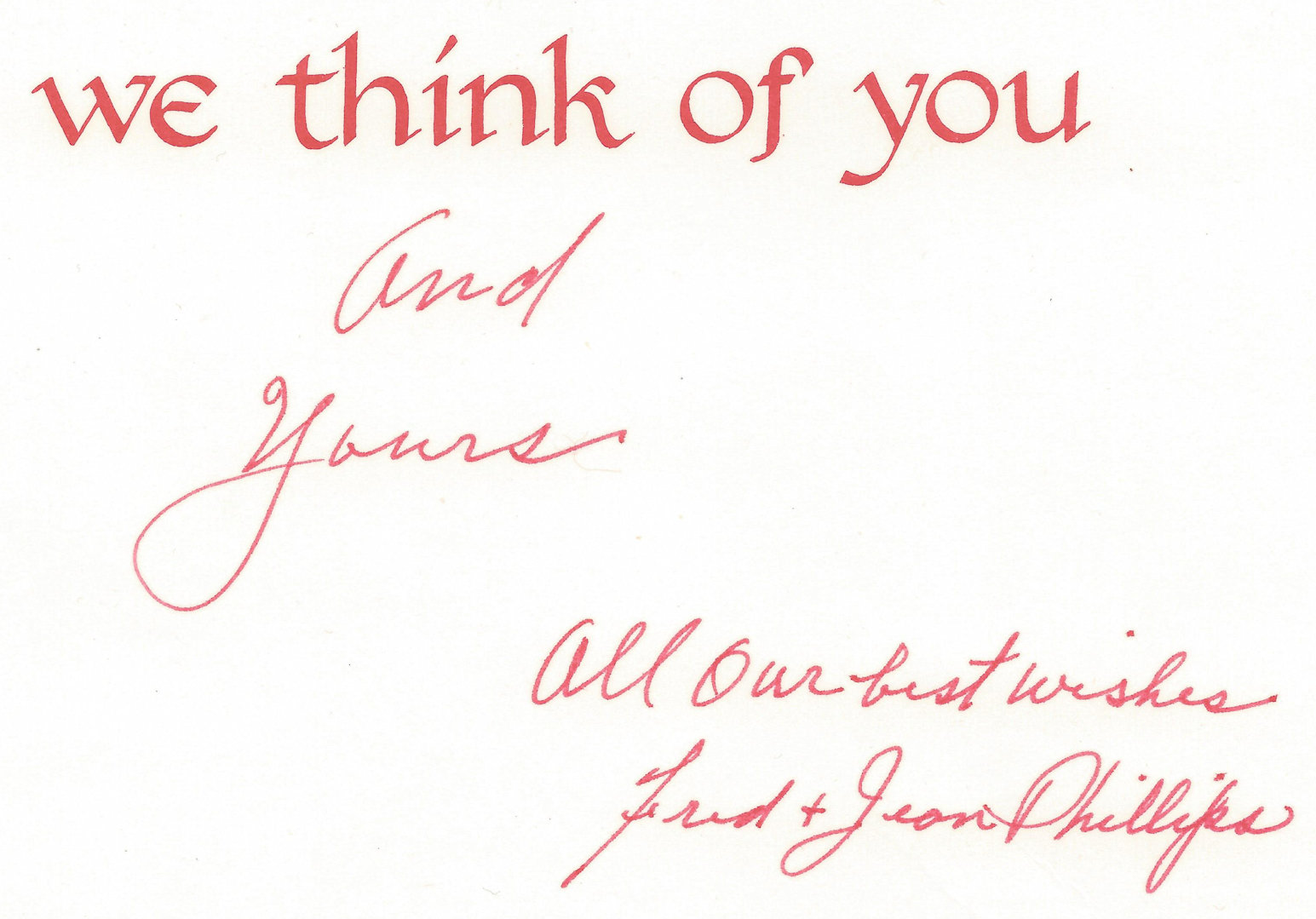
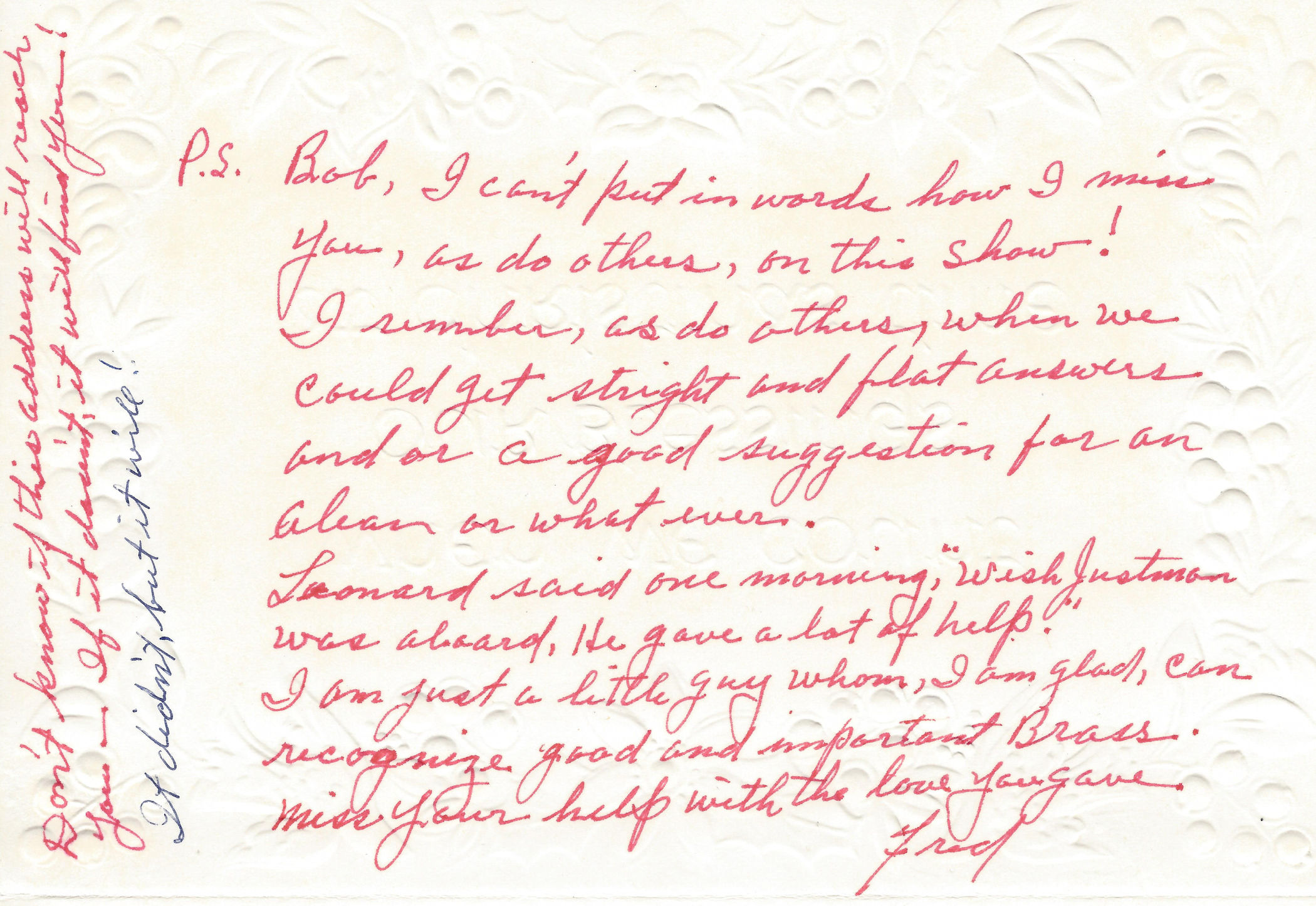
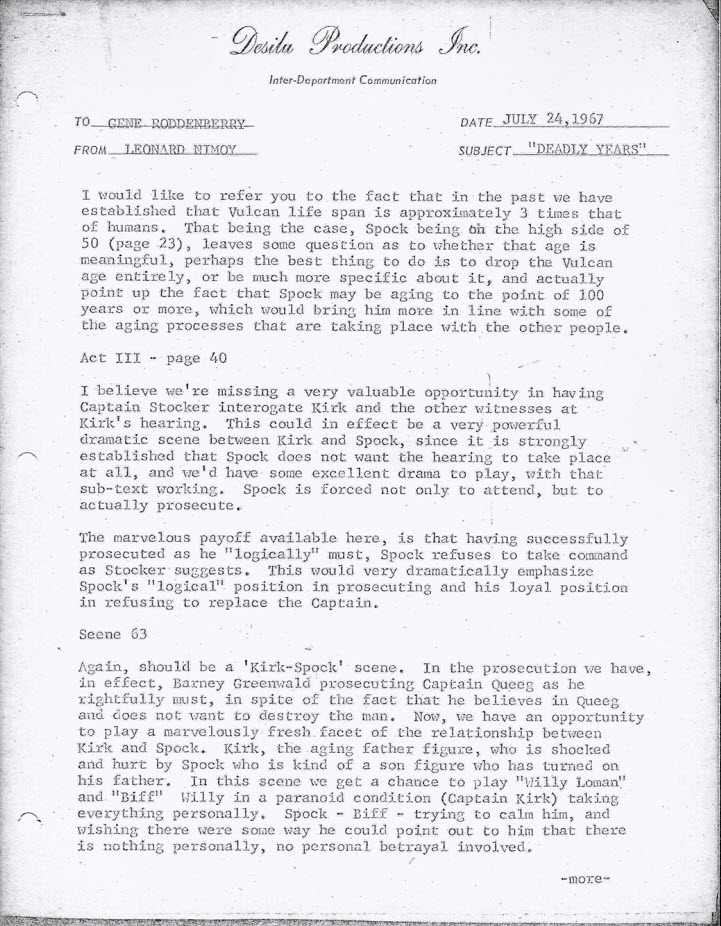
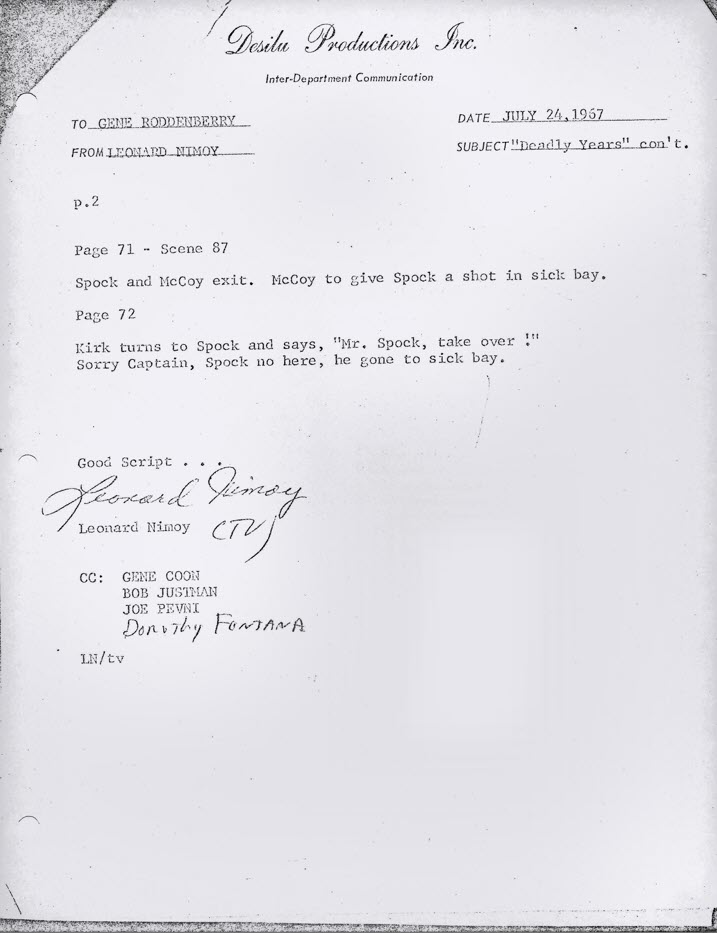
I think of the book as a tribute to the cast and production crew and all of the guest and supporting actors of TOS. It’s a series that I literally grew up with and [it has given] me so much inspiration and enjoyment over the years. So the book not only provides some biographical information on all those key folks but also provides fans with a little greater insight into their personal sides, through some of their behind-the-scenes writings and interactions, like a Fred Phillips Christmas card to Bob Justman or the Nimoy Deadly Years memo.
And, from a fan perspective, I think it’s cool to see many of those handwritten accounts from the guest stars that elaborate on some of their TOS filming experiences, and, in general, the book is a good reference. Plus, the inclusion of quite a large number of rare, behind-the-scenes photographs from the filming of the episodes hopefully makes the volume even more enjoyable for fans.
What is it about autographs?
I asked Gurian why fans collect autographs. He says it’s all about a personal connection to the celebrity.
Even a simple signature allows a fan to feel a more intimate bond of association with a much admired actor or athlete or historical figure than, say, owning a mass-market trading card or photograph or figurine, since the signature was actually created directly by the person. And if it was obtained in-person, then there are all of those additional memories of personally interacting with the individual and obtaining the autograph. For more sophisticated items such as handwritten letters or other correspondence and documents, there is of course further valuable historical insights that could be derived.
Gurian is right. James Doohan was a guest at one of the first conventions I attended, and I decided not to get his autograph. I didn’t want to hand over the few dollars I had for a scrawled signature. Then, watching the fans, I realized they weren’t paying for the actual signature; they were getting a few minutes to chat, and the signed photo was a reminder of that time. I bought a 5×7 from Doohan (because it was $2 cheaper than an 8×10) and I have always been glad I did. See also my chat with Nichelle Nichols over her Ebony magazine cover.
The book was published in 2018 and at that time Gurian already owned perhaps the most extensive collection of Star Trek autographs. But a lot is not always enough. “I have acquired some additional ones since publishing the book,” he told me. Because collectors collect. We can’t help it.
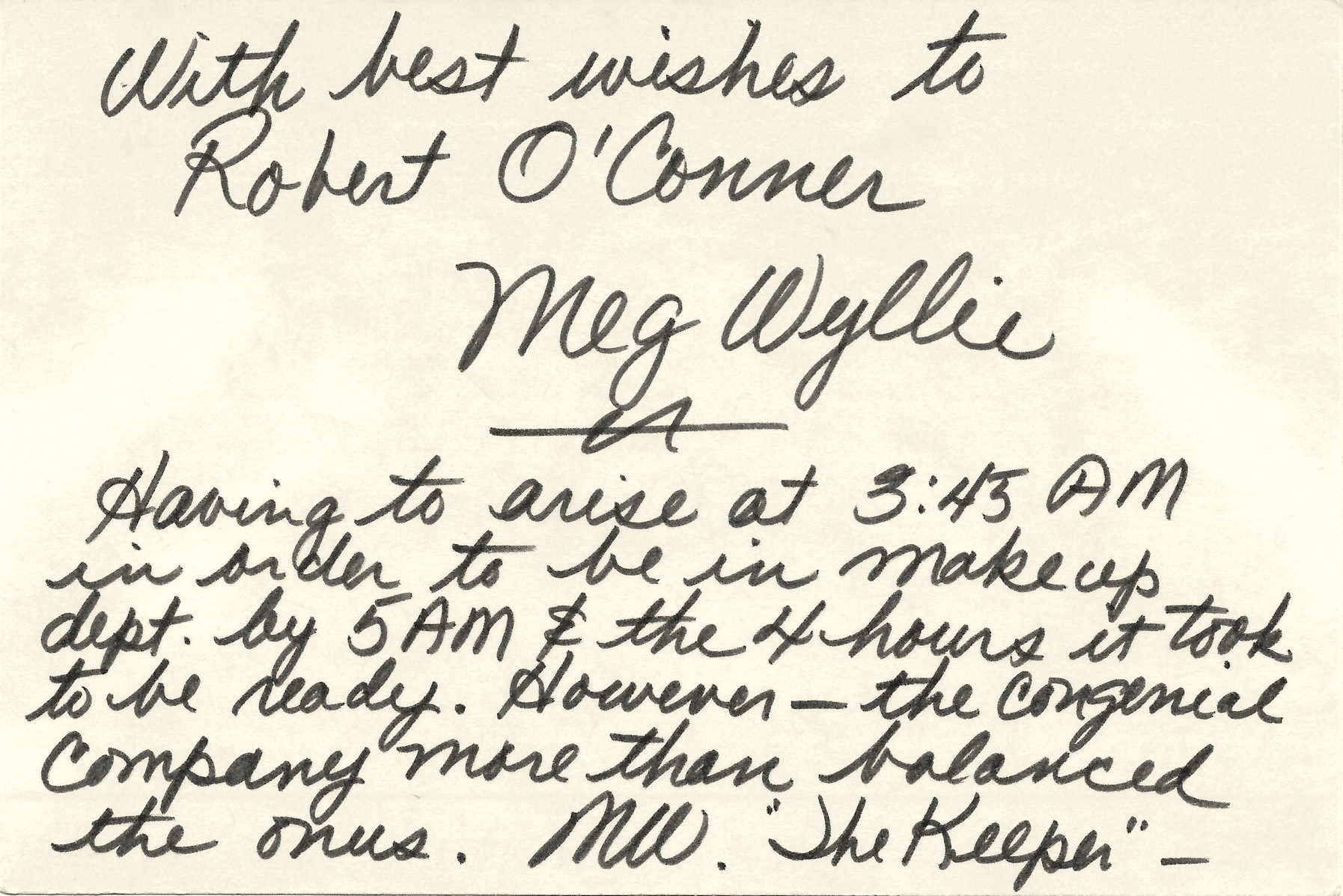
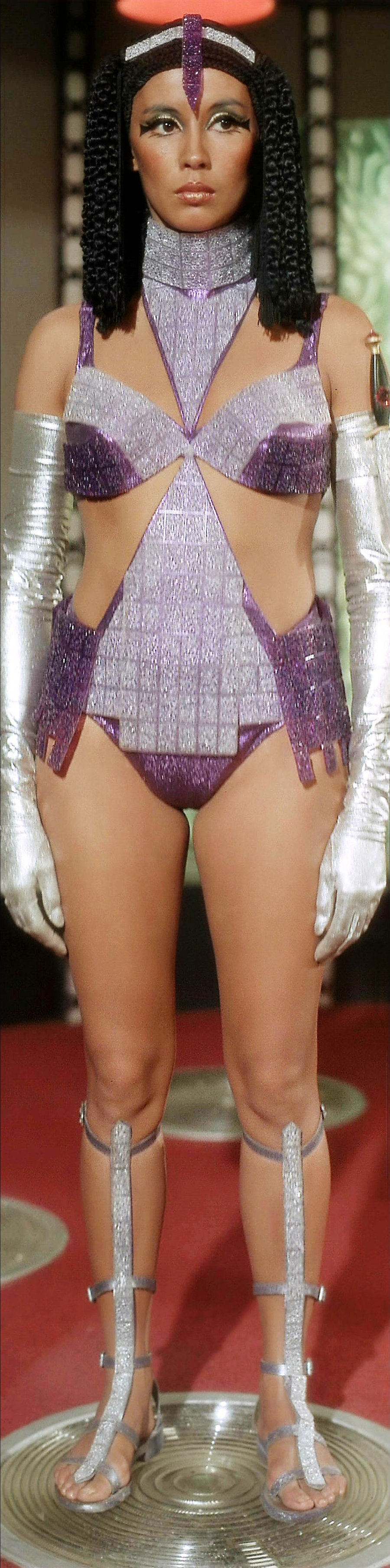
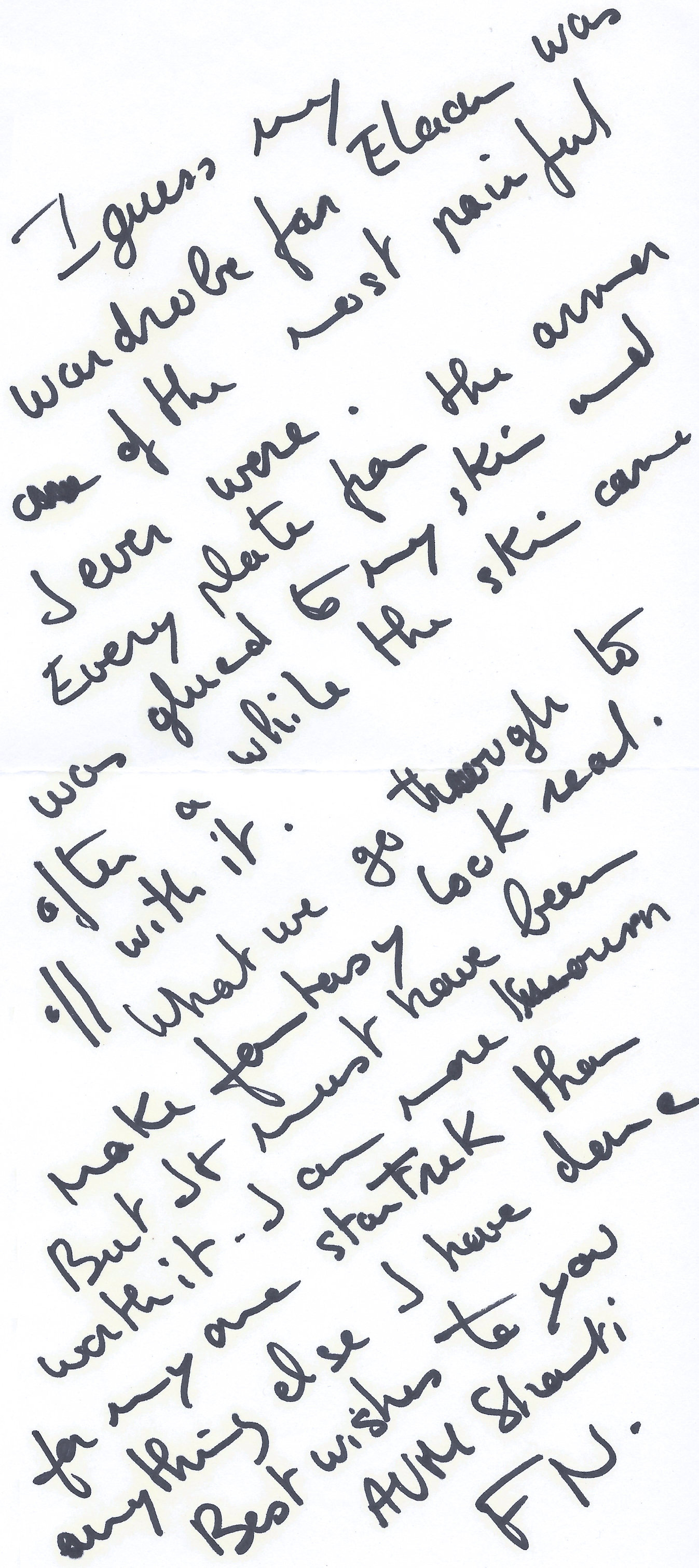
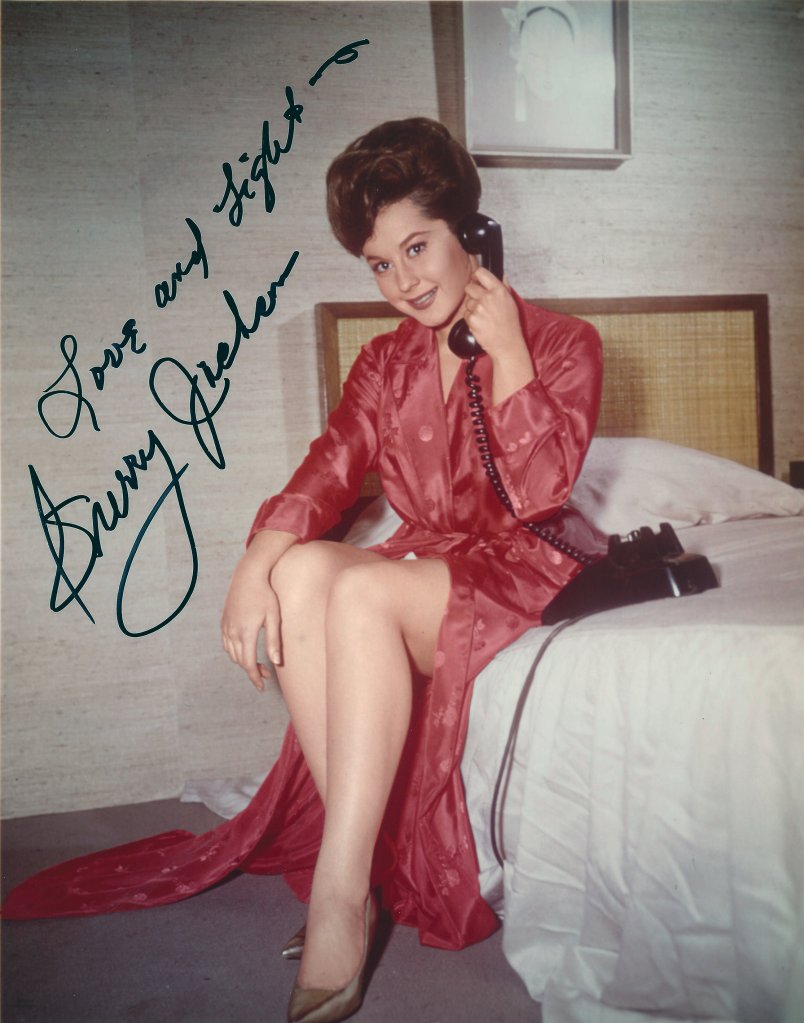
Autographs of the Final Frontier and the three To Boldly Go photo collections are available from Amazon and elsewhere.
-
Ponder the mystery of the F-104s sculpture
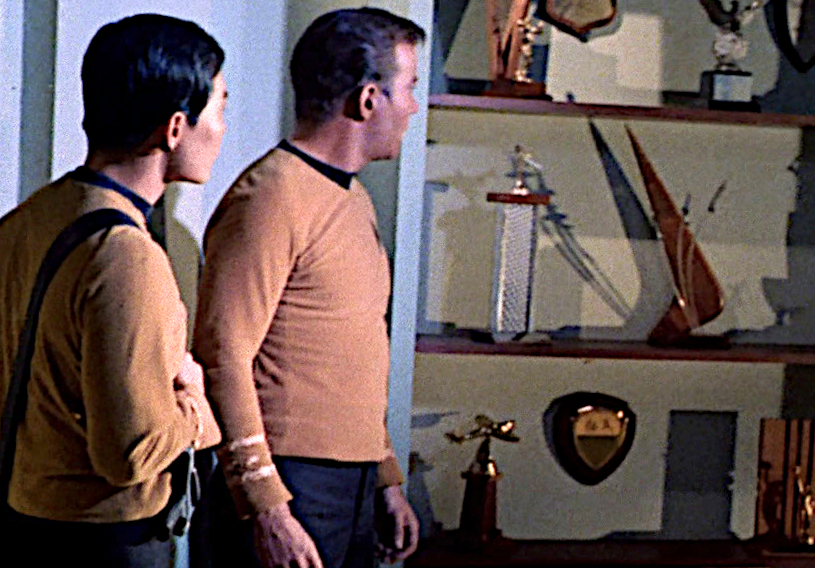
Much of the action in the episode Tomorrow is Yesterday is set in a US Air Force base in 1969. As the episode was filmed in the US in 1966, it presented relatively few challenges for Art Director Matt Jefferies. But he still had some work to do, including designing and crafting (or commissioning) a small sculpture of three Lockheed F-104 fighter jets. Here is Jefferies’ design sketch.

You can glimpse the sculpture a couple of times. At 23 minutes into the episode, a guard strolls past a cabinet in a hallway, and a half minute later Kirk and Sulu walk through the same area. The sculpture sits among a number of trophies near the middle.


The odd thing about this is the piece is on screen for only a few seconds. For a series that was always strained for both dollars and time, why expend resources on such a small detail? It is not like an early draft of the script had Captain Kirk pick up the sculpture and say “Ah, here is the answer to our time-travel dilemma.”
It seems to me that this is an example of what made Star Trek great at the time and explains its ongoing popularity: the people who made it all valued quality. Desilu paid de Forest Research to vet every script. Leonard Nimoy cared about the verisimilitude of his character. Roddenberry pursued heavy hitters to write for the series. And Jefferies put effort into even small elements that our characters would just stroll past.
About that boomerang
The on-screen sculpture looks a lot like Jefferies’ design, except that the back piece became more elaborate between drafting table and set. It took on the boomerang shape that we often see in other episodes, as in this screencap from Court Martial. Again, this attention to detail adds a richness to the universe that was rarely, if ever, seen in other TV programs of the time.

Collecting Trek
A TOS collection 40 years in the making

