Robert J. Sawyer recently invited me to join him and Star Trek luminary David Gerrold for dinner. I interviewed David after the dishes had been cleared, and that story is told here.
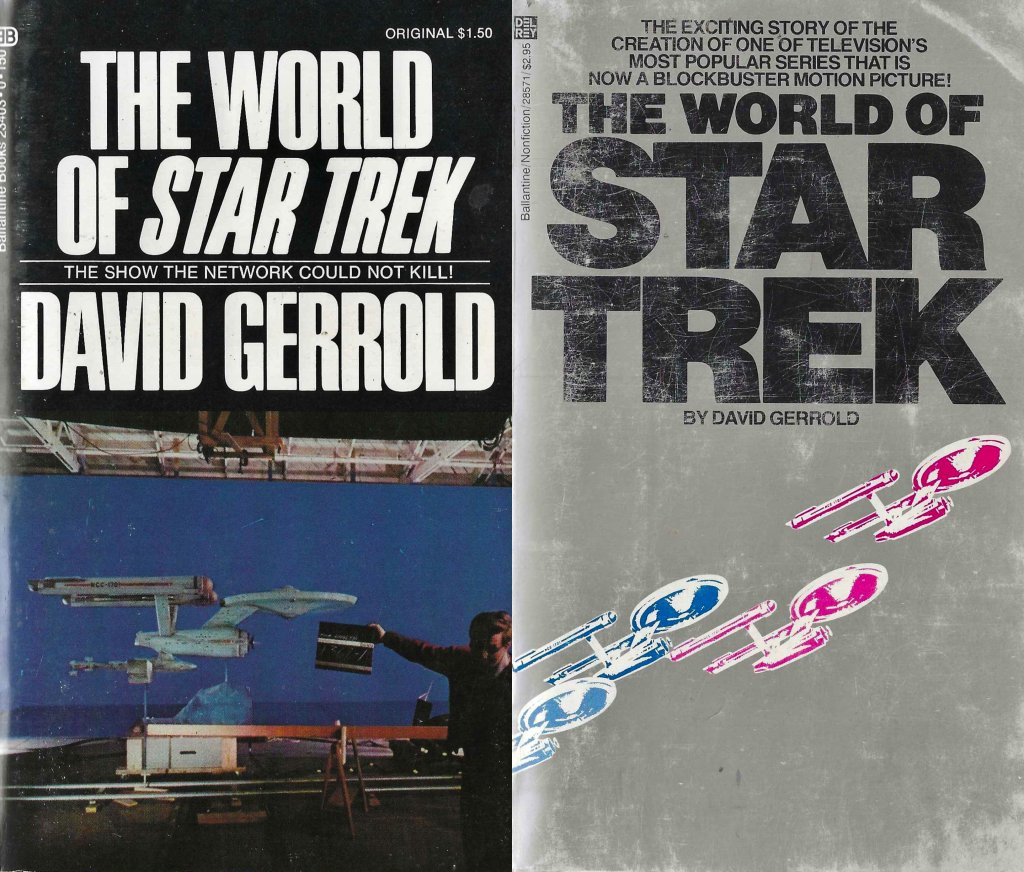
David is every bit as interesting and charming as you would wish. Knowing I would soon have the chance to speak with him, I reread two of his books: The Martian Child (which made me cry, darn you, David) and The World of Star Trek, which I had not read since my teen years. The piece linked above is about the writing of that book. Here, I will share two excerpts in the hope that, to continue the dinner theme, they serve as an amuse-bouche that will prompt you to pull the book off your shelf or go buy a copy.
The World of Star Trek is David’s exploration both of what made the show so popular and of what the producers could have done better, and is told from the standpoint of a writer. He talks a lot about the successes, failures, and hurdles of the creative process that built Star Trek, including this early framing of the genre’s challenge:
Science fiction is not a western with ray guns and spaceships. It is a genre so demanding that few of its practitioners are more than moderately competent at it. The responsibility to be logical and scientifically accurate, while at the same time telling a good dramatic story, will continually defeat any writer who approaches the field with less than total respect for its requirements.
One of the book’s most interesting analyses is of the transporter. Fans like it because it’s cool, and it kept the plot moving for writers and directors. But David explains the trap it created.
[The transporter] was one of Star Trek’s best ideas—a teleportation device so that the Captain and crew could “beam down” to a planet whenever they chose. Thus, the special-effects crew was relieved of the responsibility of having to show either the starship or its shuttlecraft landing on a new planet each week. A golden flicker mixed with a dissolve and an over-dubbed reverberated whine is not only cheaper—it’s more versatile and impressive.
Unfortunately the use of the transporter set up conditions of its own that were not foreseen in the initial postulation.
And that was the miscalculation. If the transporter had been designed for the express purpose (pun intended) of getting our heroes into the story faster, then it also allowed for them to get out of it just as quickly.
Any time Captain Kirk got himself into real trouble, all he needed to do was call the Enterprise and holler “Scotty! Save my ass!” and Scotty would beam him up so fast the air would crackle. Knowing that, then, there would certainly be no suspense whenever Captain Kirk was captured by the giant Yang-Yangs or the Creeping Blorch.
Therefore, one of three things had to happen to keep Kirk in a story where he was personally menaced:
He would run into aliens of such superior ability that they could nullify his transporter beam. Thus he got captured.
He could run into aliens of such inferior ability that they would knock him over the head and take his communicator away from him without knowing what it was. Again, he got captured.
Or—contact between the Captain and the Enterprise would be cut off by some arbitrary force created by the writer for this specific purpose, thus trapping Kirk in the story until contact could be restored—usually not until just before the last commercial.
This constraint was often solved in a way that served the story. David cites The Squire of Gothos, Tomorrow is Yesterday, and Errand of Mercy as, respectively, examples of when this worked. But as the series progressed, we got The Apple, Bread and Circuses, A Private Little War, The Omega Glory, A Piece of the Action, and Spectre of the Gun — and “the cumulative effect is the focusing of attention on the mechanism used to prevent Kirk from being rescued. We begin to realize that Plato’s Stepchildren is the same story as The Gamesters of Triskelion; the only difference is in the details.”
Pick up the book for more. The World of Star Trek is a fascinating look at the craft of writing this show we love, and it delivers ’70s interviews with stars and production staff, details of early fan activities, and, in David’s words, an account of “some of that magic so that years from now some yet unborn Trekkie may open it up and be able to recapture at least a hint of Star Trek’s magic seasons.”

