Modeling has changed dramatically over the last few decades. Once every young sci-fan, and indeed every horror, airplane or car aficionado, glued and painted plastic model kits, or tried to. Today, far fewer people assemble these shaped sheets of plastic into fantastic spaceships or cool hotrods.
AMT launched its Enterprise model kit in 1966, and it was a huge success as soon as it hit store shelves. Star Trek Associate Producer Bob Justman told Gene Roddenberry in a memo dated October 19, 1967, that:
I have it on reliable information that the “STAR TREK” Model Kit will sell more than a million copies within its first year of production… All I know is that the machine which turns out the plastic parts for the kit goes continually 24 hours a day, 7 days a week and AMT is rushing another machine into production, so that they can keep up with the demand.
(I wrote about the Enterprise and other AMT models in an article that mostly covers how much it cost to build the Galileo shuttlecraft.)
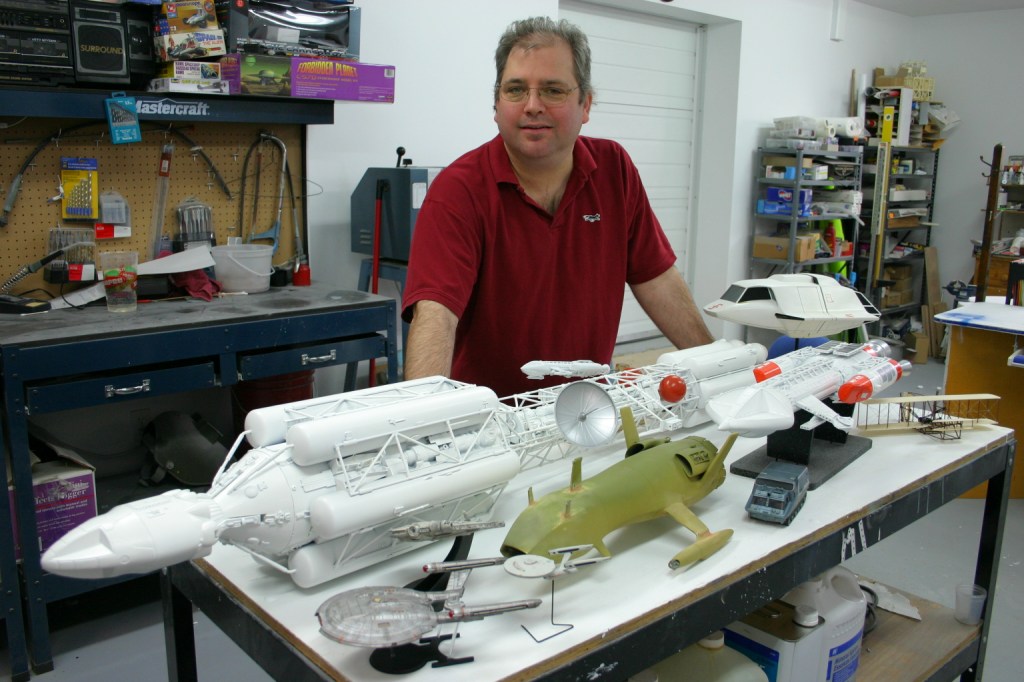
Sadly, Jim told me the heyday of modelling is well in the past.
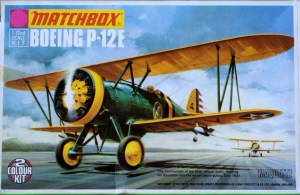
When I was a kid, almost everyone made model kits at some point, and that simply doesn’t exist anymore. The audience for model kits today is pretty much adults my age, which is why they cost so much now. We used to buy model kits at the five-and-dime store; a Matchbox airplane kit was $1.25 and now those types of kits are $50.
Jim got into modeling through airplanes.
It started with airplanes. I think the first one was a Matchbox kit of a Boeing P-12E. I did a horrible job, it was a difficult kit for a kid to build, but it was still interesting.
But it was Space: 1999, a show I’ve never liked although the ships are cool, that really cemented his interest and later led to work with Round 2, the preeminent model manufacturer today.
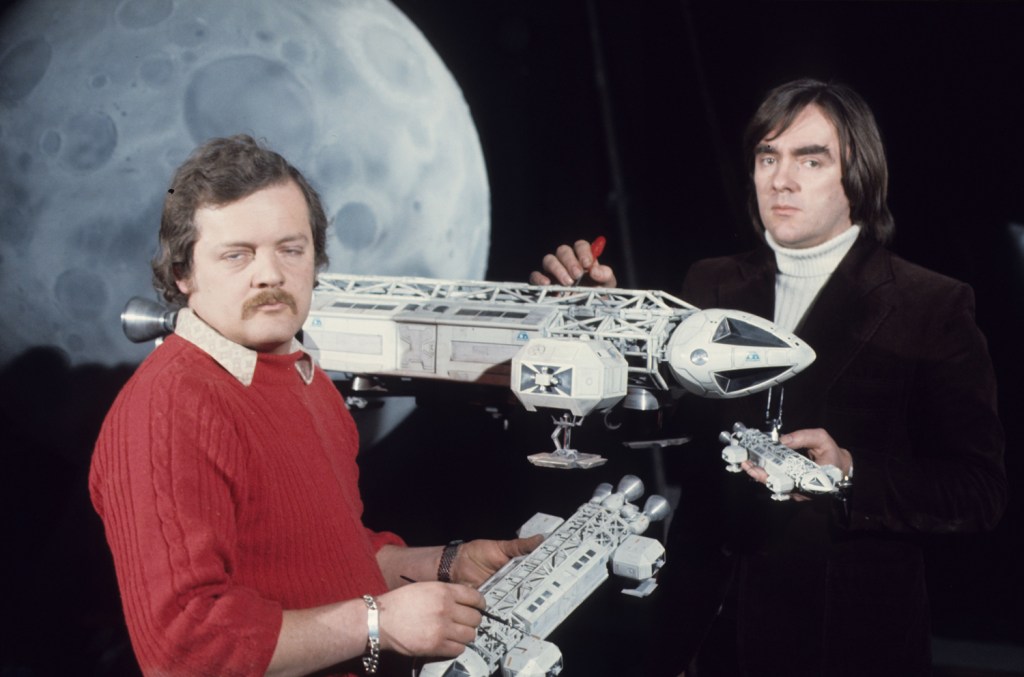
I loved Space: 1999 and…I first learned about making models for movies and TV from reading the book The Making of Space: 1999. I opened it to photos of Brian Johnson and Nick Alder holding that 44-inch Eagle model and it was sort of like a kid discovering a magician’s trick. Then Star Wars came along and I gobbled that up, and it just continued from there.
I had the old MPC Eagle kit from around 1975 but I was never satisfied with it, because it was not terribly accurate. It didn’t match what I saw on screen; it was simplified and the proportions were off, and I always wanted a better model. Then Round 2 hired me in 2008 or so to do some build-ups for them, and I’ve been working with them ever since. Around 2013, I became friends with Jamie Hood, one of the product developers there…and I kept bugging him to do the Eagle from Space: 1999. Then they got the license and they released the old kit and it started flying off the shelves. He couldn’t believe it. They released the other kits too, like the Moonbase Alpha, and I said you have to do a much better model of the Eagle.
I knew a guy named Chris Trice who had access to the original 44-inch Eagle miniatures and he had measured them and built replicas that were superbly accurate, and a guy named Daniel Prud’homme had done some blueprints of the Eagle based on Chris’ measurements. So I said to Jamie “Here’s how you get the Eagle done. All of the design work is already done.”
He took my advice and they built it and it is one of the best-selling kits they ever had.
But even with sales successes like that, modeling is not what it used to be.
The technology has advanced to the point that kits are much better and in fact cheaper to produce and at better quality, but because they’re not selling in the numbers they used to — they used to sell in the hundreds of thousands and even millions, and now they’re selling in the low thousands — the cost per unit is way up.
Kits got better, but fewer people are buying them now.
It’s sad to think that models and the skills of modellers may disappear soon. If you can, buy a kit and build a model, or hire a pro like Jim to do it for you. Either way, the ship you put on your shelf will bring you joy.
2 responses to “The state of modelling, then and now”
The funny thing is you can still get cheap and abundant models… in Japan.
My favorite scene—we were at a department store (Yodobashi Camera in Osaka) and there was this little pregnant Japanese woman schooling her husband on plamo (Plastic Models).
(in Japanese) “No, *these* are from Gundam. *Those* are from Zeta Gundam.”

 Collecting Trek
2 responses to “The state of modelling, then and now”
The funny thing is you can still get cheap and abundant models… in Japan.
My favorite scene—we were at a department store (Yodobashi Camera in Osaka) and there was this little pregnant Japanese woman schooling her husband on plamo (Plastic Models).
(in Japanese) “No, *these* are from Gundam. *Those* are from Zeta Gundam.”
LikeLike
That is a great story. And I did not know that about Japan.
LikeLike