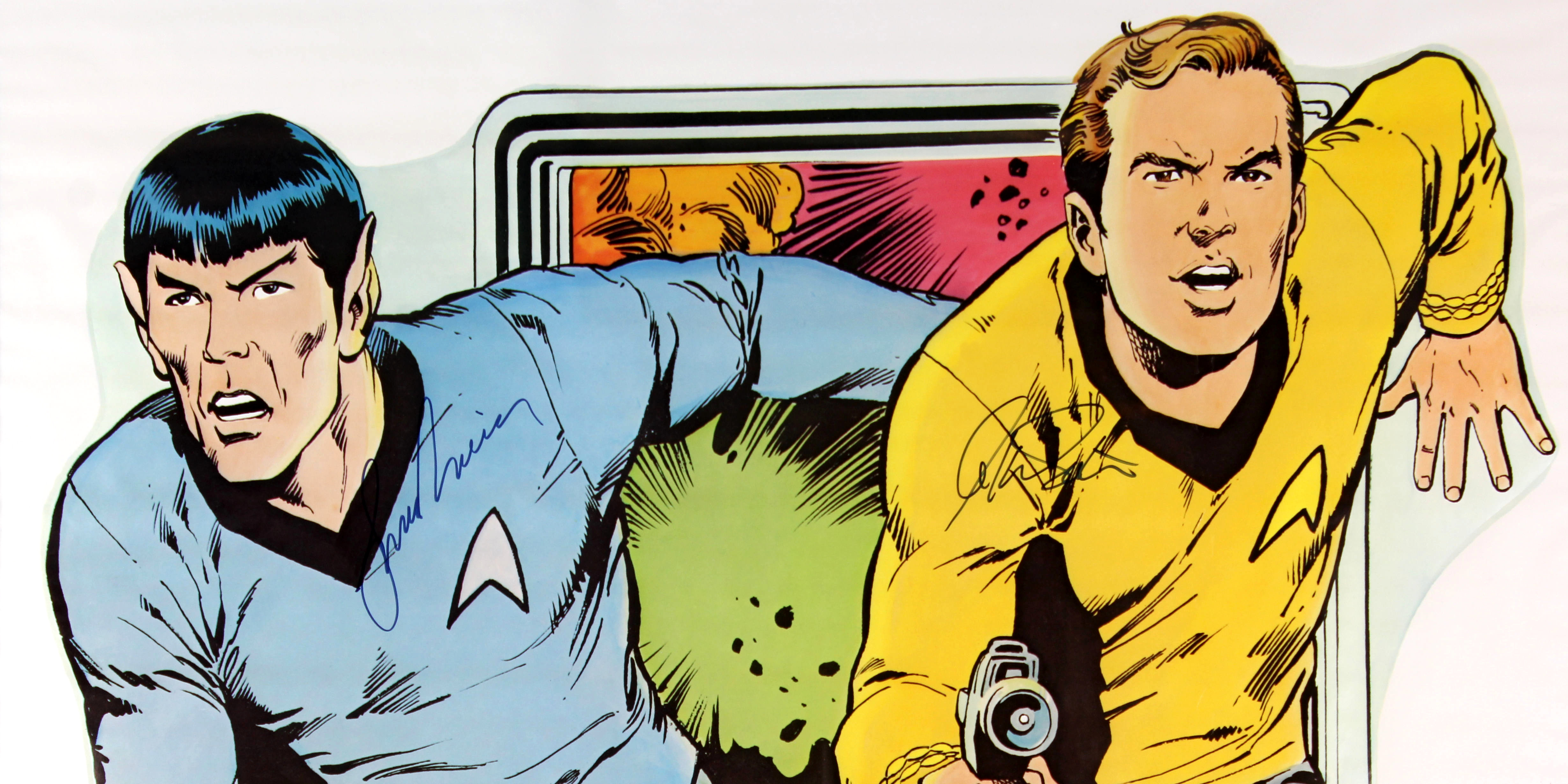

I recently watched the season two episode Patterns of Force with my good friends Rob Sawyer and Carolyn Clink. We had not seen it in a while and, as we do, we had an interesting discussion about its message and its place in the Trek canon.
I marvelled again that the idea of the Enterprise visiting an actual Nazi planet was ever greenlit, and especially in the way Star Trek handled it. While the Second World War was a common topic for TV and cinema in the 1960s, sitcoms like Hogan’s Heroes and movies like The Dirty Dozen and The Great Escape focused solely on the combat, soldiers fighting soldiers. They ignored the death camps. Star Trek chose instead to address the Holocaust head on, presenting a story about the planet Ekos’ genocidal “final solution” to eliminate the people of neighbouring planet Zeon.
But even more surprising than the production of a Holocaust-themed episode is that Patterns of Force was actually the second such story Star Trek commissioned. The first, titled Tomorrow the Universe and written by Paul Schneider, progressed all the way to a revised second draft script in June of 1967. That same month, TOS producer John Meredyth Lucas submitted his story outline for Patterns of Force, and it was chosen over Schneider’s work. And while the two stories had some differences, they marched over much of the same ground.
Read the rejected script
I have a PDF of Schneider’s first draft script, and you can get your own copy at the download link.
The story opens with the Enterprise visiting the planet Spurlos to retrieve a Federation cultural-exchange team. The inhabitants call themselves “Rikes” and I do not know if that was a deliberate rendering or a misspelling of Reich.
The crew beams down and finds Federation data tapes belonging to team leader Dr. Alana Steele, a prominent astro-sociologist. Spock discovers the tapes cover “ten Earth years: nineteen thirty three to forty three…one of Dr. Steele’s special fields of scholarship.” We learn those dates are no coincidence, as the Nazi connections then really start to kick in.
The temple-like roof of the monument is adorned with a large photograph…DeSalle shakes his head uncertainly, as he gazes at the strangely recognizable face — the visor of the high-peaked cap shading the pinched features, the balefully glaring eyes, the precise little moustache, under the sharp nose.
DESALLE(trying to recall)
Familiar face – but I can’t place it…
KIRK
(frowning deeply)
Think of your Earth history, Mr. DeSalle. A figure from its darkest chapter…
CROWD VOICES (o.s.)
(in deafening unison)
Sieg – heil! Sieg – heil! Sieg – heil!
…
KRIEG’S VOICE
Security units are ordered to bring all prisoners and remaining classes of persons to the Nazi Party Rally! Any refusing to attend will be liquidated!
As in Patterns of Force, the Holocaust is front and centre here. Soldiers wearing SS uniforms goose step into the square with a group of prisoners called “Undermen” — the English translation of the Nazi term “Untermensch.”
Kirk and the landing party are soon chatting with Hitler himself, or at least a wannabe Spurlos version. These local fascists believe Earth’s Hitler won the war and the Nazis formed a world government that became the blueprint for the Federation and Starfleet.
“Hitler” summons Dr. Steele and we learn she is using Spurlos as a large social experiment; she has introduced Nazism to examine “the deepest causes of aggressive behavior in human society.” The planet is her test lab, and she will trigger the death of countless people so she can observe how fascism plays out in her new home.
The same basic idea is used in Patterns of Force: cultural observer Professor John Gill introduced Nazism to Ekos because he admired the efficiency of fascist Germany.
I won’t relate how Tomorrow the Universe ends; read the script if you’re curious. I will say it falters in acts three and four, with Spock pulling a deus out of the machina and — as in Patterns of Force — the misguided Federation representative broadcasting a public admission of wrongdoing.
Ultimately, Tomorrow the Universe is an okay script but Patterns of Force is better. Schneider’s take is a little too on the nose, with a leader who looks and acts like Hitler and even goes by that name. It is like a dour take on A Piece of the Action, in that it depicts an imitative culture but one that is horrifying where A Piece of the Action is funny. Lucas’ story leaned into Nazism as an allegory about evil, while Schneider settled for dressing up a cardboard bad guy in a Nazi uniform.
Both stories also suffer from the unrealistic idea that one person saying at the end “I was wrong and Nazism is bad” would turn around an entire society that had devoted its resources and ideology to victimising its neighbours.
No credit where it’s due
But you have to give Schneider props for coming up with many of the basic story beats first — although he received no actual credit on Patterns of Force. That is despite the many similarities: that Nazism being attractive was not a one-off occurrence, an attack in space as the Enterprise approaches, and of course a Federation representative bringing 1930s fascism to a distant planet.
Paul Schneider himself was surprised and hurt by how this all played out. And angry, I’m sure.
Picture this: he is sitting at home in early February of 1968 and he sees a “Next week on Star Trek” promo for a Nazi-themed episode, and he figures this must be his script. In a letter to Roddenberry, he wrote: “I assumed this to be the production on my third teleplay for ‘Star Trek’ — finished in early 1967. Not an unnatural assumption, I think — since my ‘Tomorrow the Universe’ concerned precisely the same situation.”
He then watched the premiere of Patterns of Force on February 16, 1968. His letter is dated the next day. He continues to Roddenberry:
Yesterday I viewed the segment — now titled ‘Patterns of Force’ — and was flabbergasted to see the credit listed as ‘written by John Meredyth Lucas.’ …Not a clue can I find to the process of reasoning which excluded me from all credit participation — even down to story. I’ve gone over my own original story and two script versions; by no stretch would I deny that changes were made; nor, by the same stretch, could I deny that much remains essentially the same.”

He adds “Of course, the issue must now go to the Guild for arbitration.” Absolutely it must.
Roddenberry sent a reply, dated February 20, 1968, pointing out that he is now acting as Executive Producer only and “confining myself to policy decisions and staying away from the details of day-to-day line production.” He added “One thing I think both of us know for sure is that neither Gene Coon nor John Meredyth Lucas is in the habit of stealing from their fellows.”
I do not think Schneider knew that at all. He had reworked his script over the first half of 1967, with the revised second draft dated June 1. Lucas’ first story outline was dated June 7.
Eight days after his reply to Schneider, Gene Roddenberry sent Gary Ellingsworth at the Writers Guild of America West a copy of Schneider’s first draft script and Lucas’ final draft, and told Ellingsworth:
I double checked with both John Lucas and Gene Coon (who was producing the show at that time) and they assure me that John never read Paul Schneider’s story or script, and in fact John Lucas was only lately aware that Schneider had written a Nazi script.
On the other hand we are all anxious to be fair to Paul Schneider if we have somewhere along the line violated any rules, regulations, or ethical practices. Gene Coon informed me that having paid Paul Schneider full price for the script, he presumed we owned the “Nazi idea” but felt that since he was not using Schneider’s story he had no obligation to clear Lucas’ assignment elsewhere.
I do not have a copy of the Guild’s response, but it sided with Roddenberry — and Schneider then decided to apologise to Roddenberry for his complaint. He wrote on May 23, 1968:
I’ve been told about the Guild-arbitration on judgement that the ‘Patterns of Force’ script for ‘Star Trek’ was strictly by John Meredyth Lucas.
Obviously I was wrong — and I mis-read the situation — and I owe apologies to you and Mr. Lucas.
I think business considerations and not contrition prompted the note. Schneider penned the season one episodes Balance of Terror and The Squire of Gothos, and had been paid for his work on Tomorrow the Universe. Perhaps it was best to swallow the slight here in the hope of future commissions. And, indeed, he contributed The Terratin Incident to the animated series a few years later.
However, the timing of the drafts and the plot similarities make me think it likely Lucas had in fact read Schneider’s script.
In either case, the producers and the network were brave to directly address the Holocaust so soon after the war, in either script. Both takes on the Nazis raise uncomfortable issues and that was, of course, the goal.


3 responses to “Read the Nazi-themed script that almost got made”
A fascinating account. Thanks for putting this together!
It is entirely possibly that JM Lucas hadn’t read the Schneider script – but he was being guided by someone who HAD read the Schneider script: Gene Coon.
It reminds me of the situation with THE EMPIRE STRIKES BACK. On that film, script credit was given to Leigh Brackett and Lawrence Kasdan, but in fact the screenplay was written ONLY by Kasdan, who swears that he never read Brackett’s original draft. That sounds most unlikely, but sitting in between Brackett and Kasdan was George Lucas, who clearly was directing both writers, and hence some of the distinctive features of Brackett’s script turn up in Kasdan’s script. (I did a podcast episode about this last year: https://101sf.blogspot.com/2023/06/the-secrets-george-lucas-kept-from.html)
LikeLike
Hello Phil. Thanks for the comment. Your theory is certainly possible, and I am intrigued by the Lucas comparison.
I have just downloaded that episode of your podcast, plus the ones on CE3K, the Trek bibles, and TinTin. I have added them to my (long) listening queue and I look forward to hearing what you two have to say.
LikeLike
Thanks for giving us a listen. I hope you enjoy them!
LikeLike