Lots of critics dumped on The Motion Picture back in the day. Gene Siskel, for example, speaking in 1982 and therefore enjoying the opportunity of three years to mellow his opinion, still called the movie a “worthless bore.”
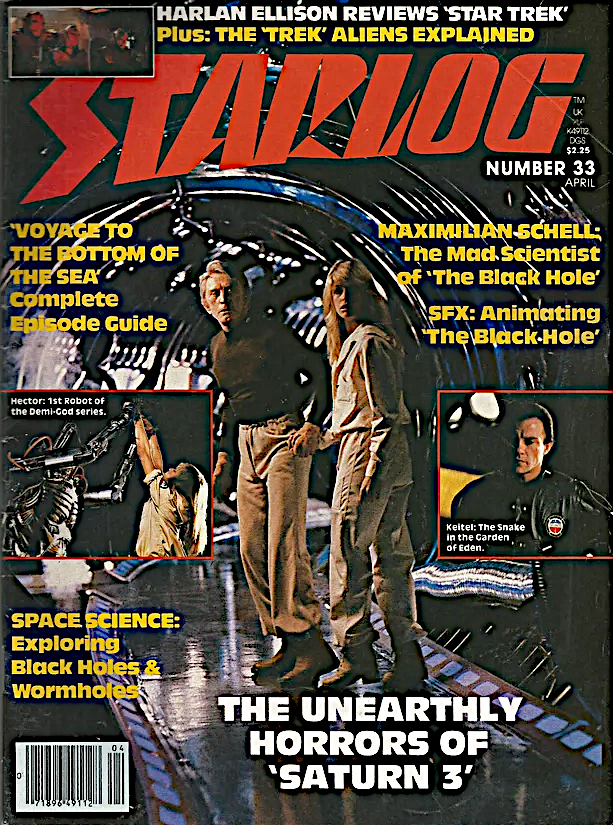
Harlan Ellison was equally scathing, but his take in Starlog issue 33 from April 1980 was even more brutal as he was a Star Trek luminary. This call was coming from inside the house.

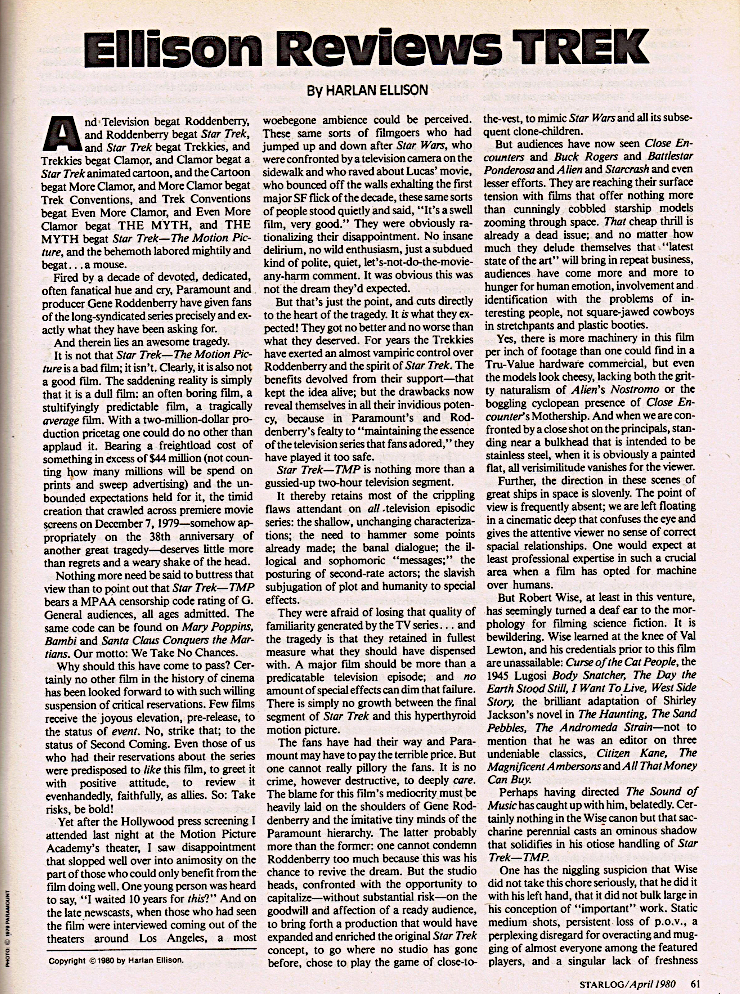
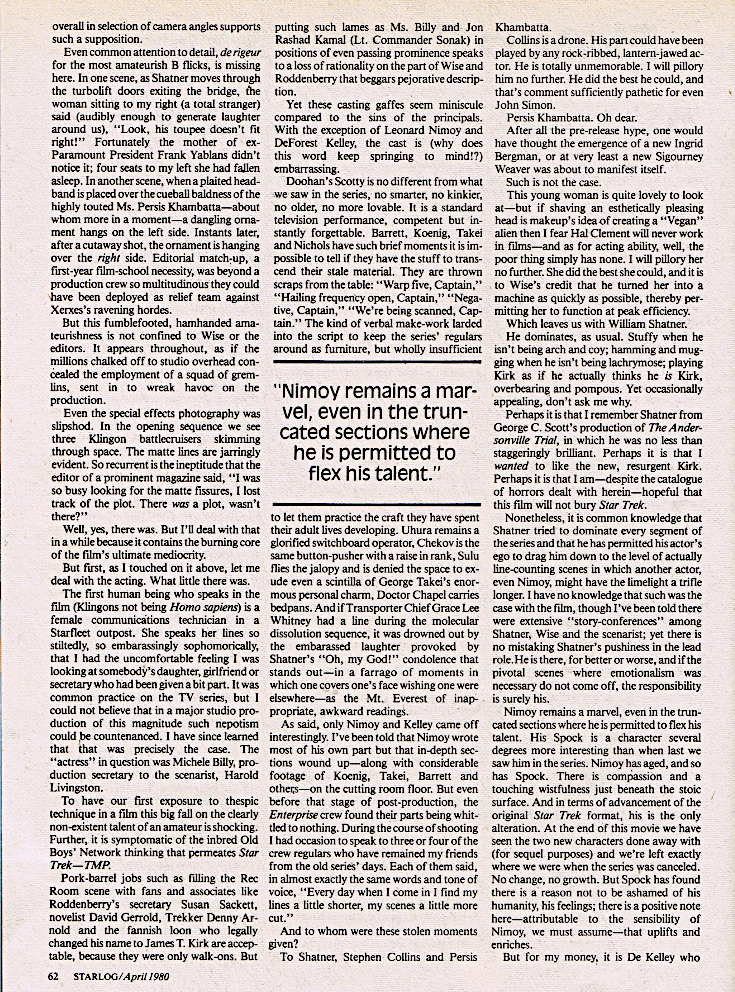

The Motion Picture, Ellison wrote, is a “dull film: an often boring film, a stultifyingly predictable film, a tragically average film.” The movie suffered from “shallow, unchanging characterization; the need to hammer some points already made; the banal dialogue; the illogical and sophomoric “messages;” the posturing of second-rate actors; the slavish subjugation of plot and humanity to special effects.”
Similar opinions were fairly widespread then and are still held by many today. What’s interesting, though, is who Ellison blamed: the fault was partly in the stars (those second-rate actors) but it was mostly the fans who pulled down the enterprise, by forcing Gene Roddenberry to serve a bland pablum rather than an exciting new dish.
[Fans] got no better and no worse than what they deserved. For years the Trekkies have exerted an almost vampiric control over Roddenberry and the spirit of Star Trek. The benefits devolved from their support—that kept the idea alive; but the drawbacks now reveal themselves in all their invidious potency, because in Paramount’s and Roddenberry’s fealty to “maintaining the essence of the television series the fans adored,” they have played it too safe.
His reference to the spirit of Star Trek is ironic, as in my opinion he never understood exactly that. His review continued the long Ellison tradition of ignoring the essence of the show in favour of a story he thought should be told. You can see this clearly in his version of The City on the Edge of Forever. I have detailed my problems with Ellison’s script, so I will only say here that the tale and his decades-long devotion to it prove he misunderstood what made Star Trek Star Trek.
Also, in dismissing the fans of the 1960s and 1970s, he looked away from the most amazing accomplishment in all of fandom: the resurrection and huge success of a franchise about to celebrate its 60th anniversary. To steal a line from Firefly, “We’ve done the impossible, and that makes us mighty.”

It’s not that Ellison was entirely wrong: the movie is on the slow side, and when he said a “major film should be more than a predictable television episode” he drew a comparison to The Changeling. But he often seems to stretch to find negativity. For example, he said the “models look cheesy.” That is ridiculous; the Enterprise and the three Klingon ships are gorgeous. He also wrote that “There is simply no growth between the final segment of Star Trek and this hyperthyroid motion picture.” No growth in a starship commander unhappy with promotion beyond command, in a half-Vulcan working to purge his human side, in a best friend who has left Starfleet for a simpler medical career, and in a crew that has matured to new responsibilities and new adventures.
Clyde Gilmour, writing in The Toronto Star, gave the outing a mixed and fairer review: “The movie is not as much fun as Star Wars, not as majestic as Close Encounters, not as scary as Alien. But it’s just as handsome and just as lavishly produced as any of them and is compulsively watchable all the way, though it drags at times. On the whole, however, it is curiously unexciting.”

Ellison wrote in his piece: “There is no meanness in me.” I would like to think that is true, but he does not make it easy. Some of this seems mean, and feels like the intent was to be so. But I have also written about the differing opinions on the man and suggested that Ellison’s challenging persona was part of a public schtick built partly on throwing punches. The headline on his review of Star Wars was Luke Skywalker is a Nerd and Darth Vader Sucks Runny Eggs.
Ellison courted controversy and I wish to this day that I had known the man but, absent personal experience, all I have is what he put out into the world. And this review does not make me like him more.
Postscript
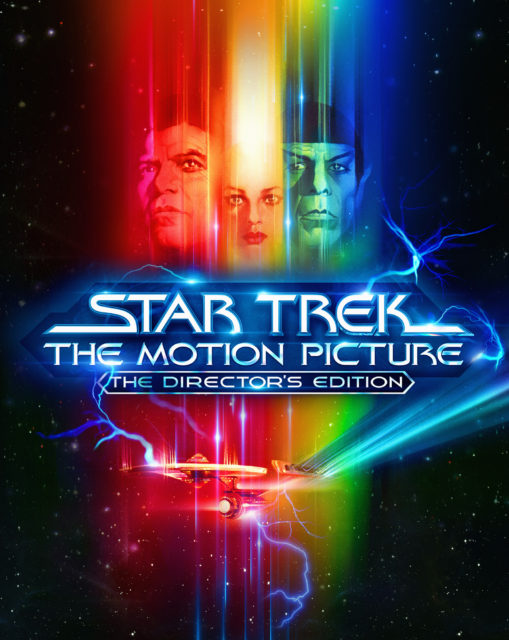
The film has risen in the estimation of many, due in large part to the 2022 release of the excellent The Director’s Edition. That version of the film is far closer to what director Robert Wise would have done with a few more months to shoot and edit. If you have not seen The Director’s Edition, you have not really seen The Motion Picture.
 Collecting Trek