
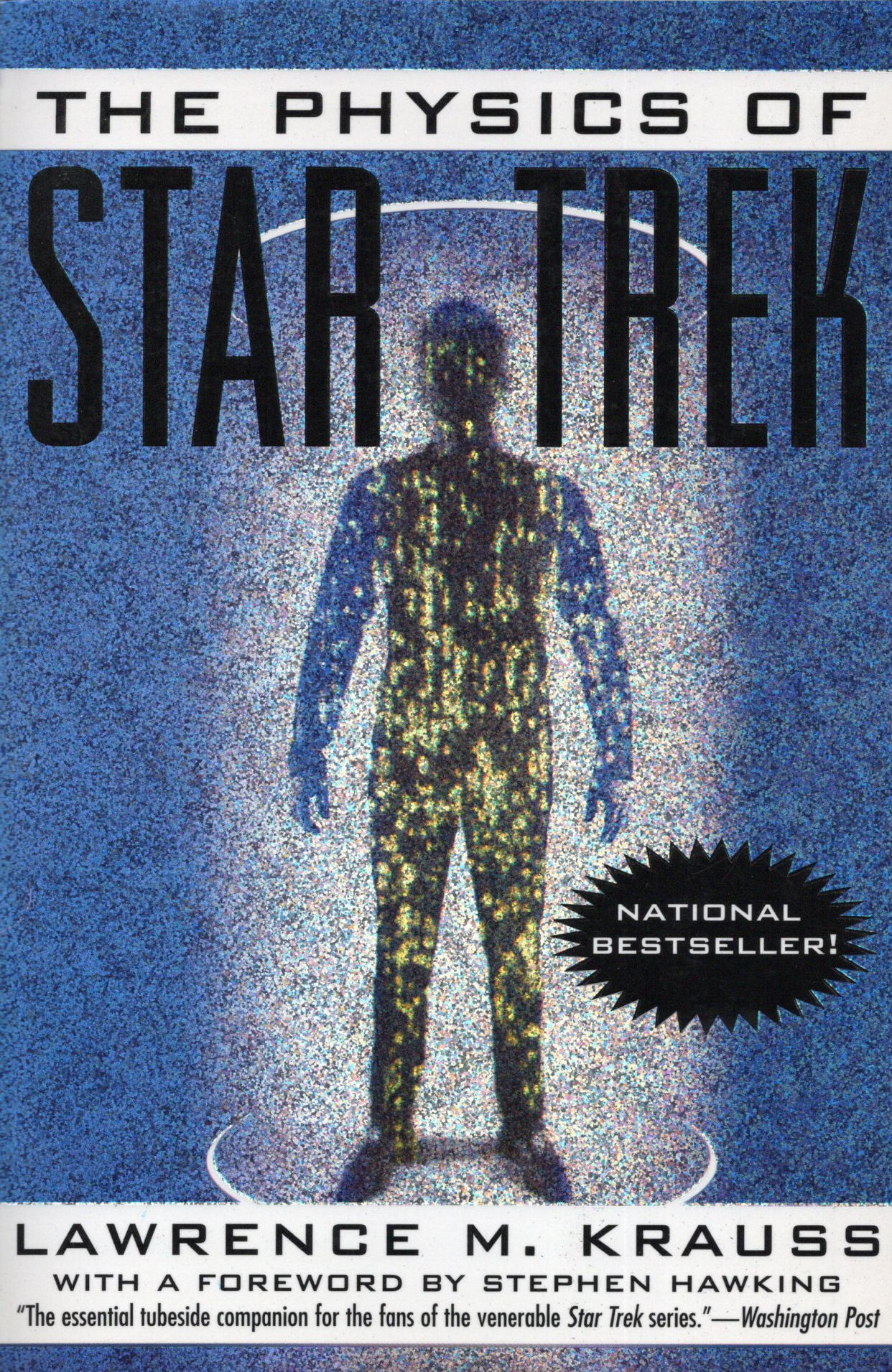
I own about 160 Star Trek books but I must admit I have not read them all. One in that category is The Physics of Star Trek by professor Lawrence M. Krauss. I pulled it out of a storage box recently and spotted Stephen Hawking’s name on the cover. The famous physicist wrote the foreword — and that was worth checking out.
Before we get to what Hawking wrote, I should say that I kept reading after his bit and was drawn into the book. Krauss knows his Trek: the book opens with an imagined scene aboard the USS Defiant just before the interphase begins in The Tholian Web. I was impressed, and the book is very approachable and full of Trek content.

Back to Hawking. The foreword is brief but he does make an interesting statement about warp drive.
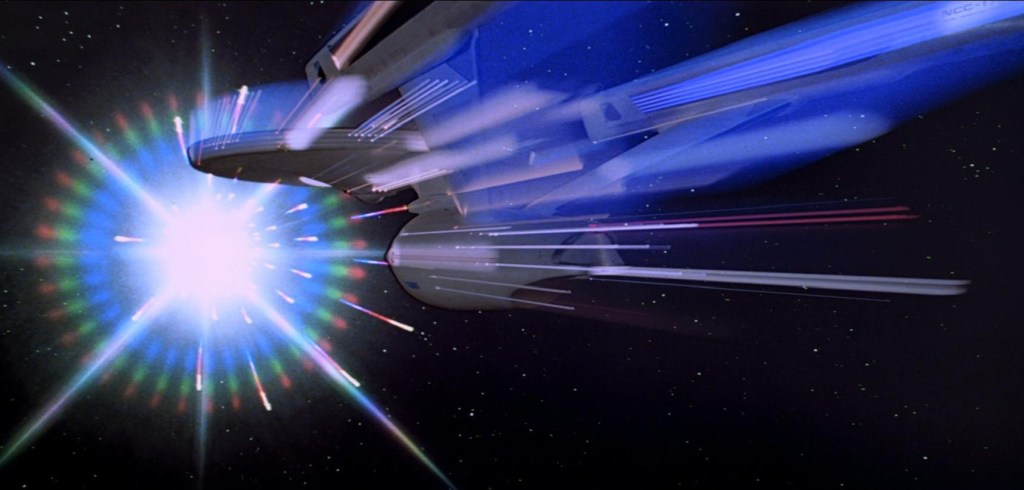
One thing that Star Trek and other science fiction have focused attention on is travel faster than light. Indeed, it is absolutely essential to Star Trek’s story line. If the Enterprise were restricted to flying just under the speed of light, it might seem to the crew that the round trip to the center of the galaxy took only a few years, but 80,000 years would have elapsed on Earth before the spaceship’s return. So much for going back to see your family!
Fortunately, Einstein’s general theory of relativity allows the possibility for a way around this difficulty: one might be able to warp spacetime and create a shortcut between the places one wanted to visit. Although there are problems of negative energy, it seems that such warping might be within our capabilities in the future. There has not been much scientific research along these lines, however, partly, I think, because it sounds too much like science fiction… The physics that underlies Star Trek is surely worth investigating. To confine our attention to terrestrial matters would be to limit the human spirit.
My Starfleet-wannabe heart beat a little faster as I read that because, as Hawking said, faster-than-light propulsion is required for the adventures we see on screen — and for the adventures we all dream of living. We don’t want to set course and arrive in a couple of years. We want to set course, play a little 3D chess, lunch on a chicken sandwich and coffee, spend the evening at a Christmas party in the science lab, and wake up just before we drop out of warp near a strange new world.
It’s nice to think that only some scientific effort stands between us and the Phoenix, but Hawking also wrote that public priorities often get in the way: “Imagine the outcry about the waste of taxpayers’ money if it were known the National Science Foundation were supporting research on time travel.”
Sci-fi author and professor Adam Roberts also sees this problem, and he blames futuristic TV and movies for making real space travel seem dull. Roberts wrote in the book Boarding the Enterprise that:
It is the very success and popularity of science fiction itself that finished off the Space Race… SF is too good at what it does. Why should people bother with real space flight when fictional space flight is so much better in every way — more exciting, more engaging, more satisfying (and with a better view)? The idea of traveling to the stars is something that touches the souls of most human beings, but why should they invest emotionally and intellectually — and therefore financially — in actual space technology when they can get so much more from fictionalized space flight?
It’s a valid point but I hope Hawking’s opinion that it is worth investigating these possibilities eventually takes hold, and that “some kind of star trek” will inspire scientists. We’ll know in about four decades.

 Collecting Trek